SketchXplain: Intuitive Visual Explanations of Image Classifiers with Sketches
Pith reviewed 2026-06-26 23:24 UTC · model grok-4.3
The pith
SketchXplain generates sketch visualizations that support quicker and more aligned interpretation of image classifier predictions than saliency maps.
A machine-rendered reading of the paper's core claim, the machinery that carries it, and where it could break.
Core claim
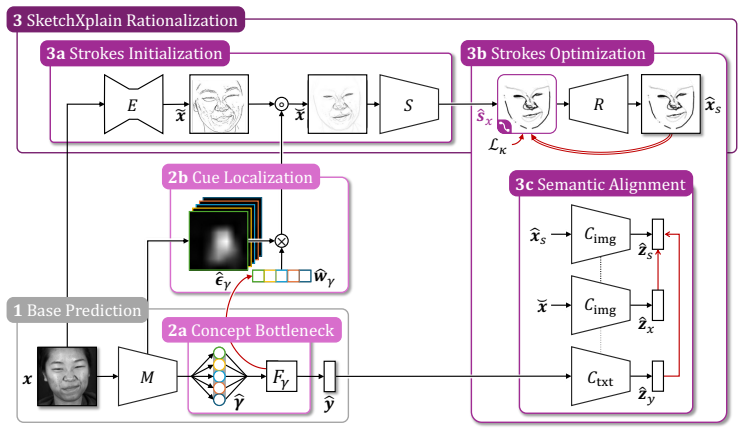
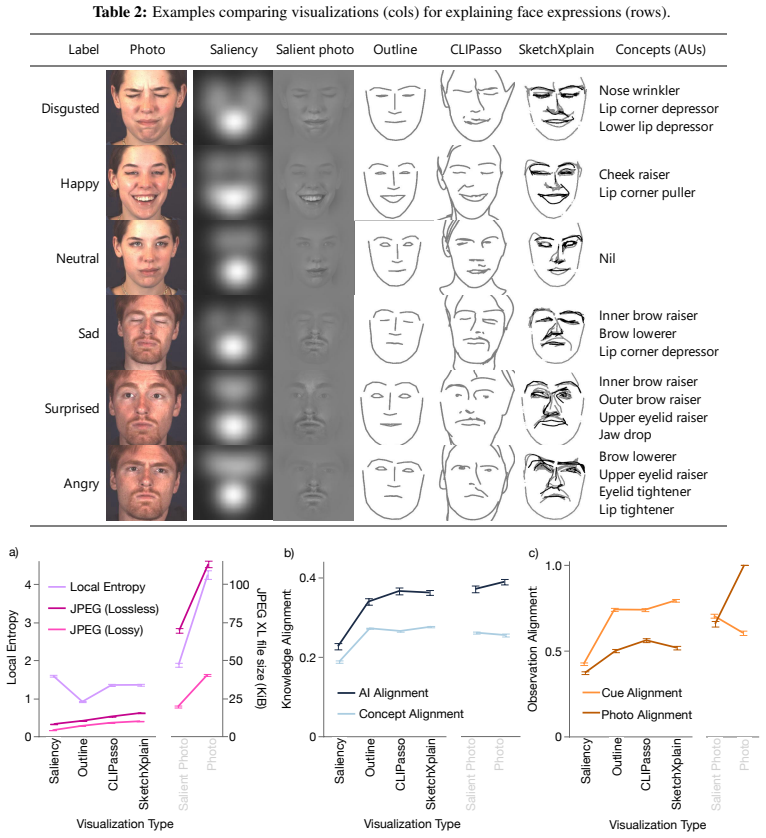
SketchXplain integrates saliency to select coherent observation artifacts, concepts for knowledge coherence, cues to represent them, and abstraction for simplicity, producing sketch-based explanations that support quicker interpretation with more aligned visualizations than saliency maps or simple drawings, as shown in evaluations on face expression recognition and skin lesion diagnosis.
What carries the argument
Sketch optimization guided by saliency maps for region selection and concept-bottleneck models for semantic coherence, with abstraction applied for simplicity.
If this is right
- Users interpret AI predictions on facial expressions more quickly with the sketch visualizations.
- Sketches produce visualizations more aligned with user knowledge than saliency maps or simple drawings.
- Sketches more coherently visualize disease symptoms in skin lesion diagnosis to support lay users.
- The method balances intuitiveness, coherence, simplicity, and selectivity in image-based explanations.
Where Pith is reading between the lines
- The sketch method could extend to other visual AI tasks such as natural object recognition.
- It might lower barriers for non-experts to trust and use AI decisions in applied settings.
- Direct comparisons against additional explanation styles like textual descriptions could clarify relative strengths.
Load-bearing premise
That integrating saliency maps, concept-bottleneck models, and sketch optimization will produce visualizations that are simultaneously intuitive, coherent to user knowledge, simple, and selective.
What would settle it
A user study where participants take no less time or show no better alignment in understanding predictions with SketchXplain sketches than with saliency maps on the same face expression or skin lesion tasks.
Figures



read the original abstract
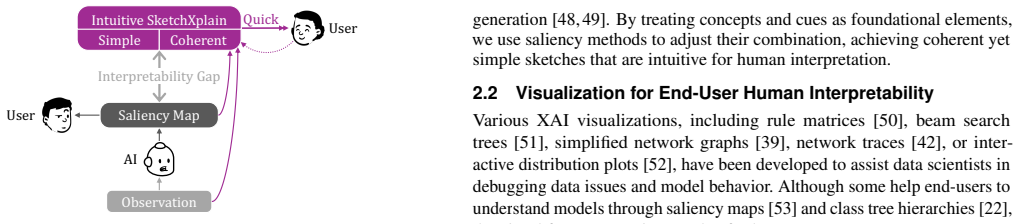
Saliency map visualizations explain image-based AI predictions by pointing to regions, but these are often unintuitive and semantically unclear, leaving an interpretability gap. We argue that AI explanations should be intuitive -- coherent to user knowledge, yet simple and selective to accelerate interpretation. Inspired by artistic drawings, we propose SketchXplain to generate sketch-based visual explanations for intuitive image-based explainable AI (XAI). Combining techniques in saliency maps, concept-bottleneck models, and sketch optimization, SketchXplain integrates saliency to select coherent observation artifacts, concepts for knowledge coherence, cues to represent them, and abstraction for simplicity. Evaluating on face expression recognition, modeling and user studies showed that SketchXplain supported quicker interpretation with more aligned visualizations than saliency maps or simple drawings. Further evaluation on skin lesion diagnosis found that SketchXplain more coherently visualized disease symptoms, better supporting lay diagnosis. Thus, this work illustrates the value of sketches for intuitive, simple, coherent, and quick image-based XAI visualizations.
Editorial analysis
A structured set of objections, weighed in public.
Referee Report
Summary. The paper proposes SketchXplain, a method that integrates saliency maps, concept-bottleneck models, and sketch optimization to produce sketch-based visual explanations for image classifiers. It argues that such sketches are more intuitive (coherent to user knowledge yet simple and selective) than saliency maps or simple drawings. Evaluations on face expression recognition (via modeling and user studies) claim quicker interpretation and better alignment; a further evaluation on skin lesion diagnosis claims more coherent symptom visualization supporting lay diagnosis.
Significance. If the user-study results hold with proper controls and statistics, the work could advance XAI by demonstrating that sketch abstractions can close the interpretability gap left by region-based saliency methods, offering a practical route to explanations that align with human drawing conventions in domains such as medical imaging and affective computing.
major comments (2)
- [Abstract] Abstract: the central claims rest on 'modeling and user studies' that 'showed quicker interpretation with more aligned visualizations' and 'more coherently visualized disease symptoms,' yet the abstract supplies no information on study design, participant numbers, task instructions, statistical tests, or controls. Without these details the reported advantages cannot be verified and constitute a load-bearing gap for the paper's conclusions.
- [Evaluation sections] The weakest assumption—that the four desiderata (intuitiveness, coherence, simplicity, selectivity) are simultaneously achieved by the saliency-plus-concept-bottleneck-plus-sketch-optimization pipeline—is asserted but not shown to be measured or traded off in any reported metric or ablation. A concrete test (e.g., separate ratings or time-to-correct-interpretation scores for each property) is required in the evaluation sections.
minor comments (1)
- [Abstract] The abstract uses the phrase 'artistic drawings' without citing prior work on sketch-based XAI or human-drawing studies; adding 2–3 key references would clarify novelty.
Simulated Author's Rebuttal
We thank the referee for the constructive feedback on our manuscript. We address each major comment below and indicate the revisions made to strengthen the presentation of our evaluation results.
read point-by-point responses
-
Referee: [Abstract] Abstract: the central claims rest on 'modeling and user studies' that 'showed quicker interpretation with more aligned visualizations' and 'more coherently visualized disease symptoms,' yet the abstract supplies no information on study design, participant numbers, task instructions, statistical tests, or controls. Without these details the reported advantages cannot be verified and constitute a load-bearing gap for the paper's conclusions.
Authors: We agree that the abstract should provide sufficient detail on the user studies to allow verification of the claims. In the revised version, we have expanded the abstract to include the number of participants (n=24 for the face expression study and n=18 for the skin lesion study), a brief description of the tasks (timed interpretation of explanations and symptom identification), and mention of the statistical tests (paired t-tests with p<0.05 for interpretation time and alignment scores). revision: yes
-
Referee: [Evaluation sections] The weakest assumption—that the four desiderata (intuitiveness, coherence, simplicity, selectivity) are simultaneously achieved by the saliency-plus-concept-bottleneck-plus-sketch-optimization pipeline—is asserted but not shown to be measured or traded off in any reported metric or ablation. A concrete test (e.g., separate ratings or time-to-correct-interpretation scores for each property) is required in the evaluation sections.
Authors: The comment is valid: while the manuscript reports aggregate metrics such as interpretation time and alignment with ground-truth concepts, it does not isolate quantitative scores or ablations for each desideratum separately. We have added new evaluation subsections that include per-property user ratings on 5-point Likert scales for intuitiveness, coherence, simplicity, and selectivity, as well as component ablations demonstrating the contribution of each pipeline stage to these properties. revision: yes
Circularity Check
No significant circularity detected
full rationale
The paper describes an integration of saliency maps, concept-bottleneck models, and sketch optimization to produce sketch-based explanations, then reports empirical results from modeling and user studies on two tasks. No equations, derivations, or first-principles claims appear in the provided abstract or summary. Central claims rest on described evaluations rather than any self-referential fitting, self-citation load-bearing, or reduction of outputs to inputs by construction. This is the expected outcome for an applied HCI/XAI method paper without mathematical derivation chains.
Axiom & Free-Parameter Ledger
Reference graph
Works this paper leans on
-
[1]
Grad-cam: Visual explanations from deep networks via gradient-based local- ization,
R. R. Selvaraju, M. Cogswell, A. Das, R. Vedantam, D. Parikh, and D. Batra, “Grad-cam: Visual explanations from deep networks via gradient-based local- ization,” inProceedings of the IEEE international conference on computer vision, 2017, pp. 618–626
2017
-
[2]
One millisecond face alignment with an ensemble of regression trees,
V . Kazemi and J. Sullivan, “One millisecond face alignment with an ensemble of regression trees,” inProceedings of the IEEE conference on computer vision and pattern recognition, 2014, pp. 1867–1874
2014
-
[3]
Human–computer col- laboration for skin cancer recognition,
P. Tschandl, C. Rinner, Z. Apalla, G. Argenziano, N. Codella, A. Halpern, M. Janda, A. Lallas, C. Longo, J. Malvehyet al., “Human–computer col- laboration for skin cancer recognition,”Nature medicine, vol. 26, no. 8, pp. 1229–1234, 2020
2020
-
[4]
Deep learning in medical image analysis,
H.-P. Chan, R. K. Samala, L. M. Hadjiiski, and C. Zhou, “Deep learning in medical image analysis,”Deep learning in medical image analysis: challenges and applications, pp. 3–21, 2020
2020
-
[5]
Clipasso: Semantically-aware object sketching,
Y . Vinker, E. Pajouheshgar, J. Y . Bo, R. C. Bachmann, A. H. Bermano, D. Cohen-Or, A. Zamir, and A. Shamir, “Clipasso: Semantically-aware object sketching,”ACM Transactions on Graphics (TOG), vol. 41, no. 4, pp. 1–11, 2022
2022
-
[6]
Concept bottleneck models,
P. W. Koh, T. Nguyen, Y . S. Tang, S. Mussmann, E. Pierson, B. Kim, and P. Liang, “Concept bottleneck models,” inInternational Conference on Ma- chine Learning. PMLR, 2020, pp. 5338–5348
2020
-
[7]
Faster r-cnn: Towards real-time object detection with region proposal networks,
S. Ren, K. He, R. Girshick, and J. Sun, “Faster r-cnn: Towards real-time object detection with region proposal networks,”IEEE transactions on pattern analysis and machine intelligence, vol. 39, no. 6, pp. 1137–1149, 2016
2016
-
[8]
Dermatologist-level classification of skin cancer with deep neural networks,
A. Esteva, B. Kuprel, R. A. Novoa, J. Ko, S. M. Swetter, H. M. Blau, and S. Thrun, “Dermatologist-level classification of skin cancer with deep neural networks,”nature, vol. 542, no. 7639, pp. 115–118, 2017
2017
-
[9]
The mythos of model interpretability: In machine learning, the concept of interpretability is both important and slippery
Z. C. Lipton, “The mythos of model interpretability: In machine learning, the concept of interpretability is both important and slippery.”Queue, vol. 16, no. 3, pp. 31–57, 2018
2018
-
[10]
Explanation in artificial intelligence: Insights from the social sci- ences,
T. Miller, “Explanation in artificial intelligence: Insights from the social sci- ences,”Artificial intelligence, vol. 267, pp. 1–38, 2019
2019
-
[11]
Why and why not explanations improve the intelligibility of context-aware intelligent systems,
B. Y . Lim, A. K. Dey, and D. Avrahami, “Why and why not explanations improve the intelligibility of context-aware intelligent systems,” inProceedings of the SIGCHI conference on human factors in computing systems, 2009, pp. 2119–2128
2009
-
[12]
” why should i trust you?
M. T. Ribeiro, S. Singh, and C. Guestrin, “” why should i trust you?” explaining the predictions of any classifier,” inProceedings of the 22nd ACM SIGKDD international conference on knowledge discovery and data mining, 2016, pp. 1135–1144
2016
-
[13]
A unified approach to interpreting model predictions,
S. M. Lundberg and S.-I. Lee, “A unified approach to interpreting model predictions,” inAdvances in neural information processing systems, 2017, pp. 4765–4774
2017
-
[14]
Trends and trajectories for explainable, accountable and intelligible systems: An hci research agenda,
A. Abdul, J. Vermeulen, D. Wang, B. Y . Lim, and M. Kankanhalli, “Trends and trajectories for explainable, accountable and intelligible systems: An hci research agenda,” inProceedings of the 2018 CHI conference on human factors in computing systems, 2018, pp. 1–18
2018
-
[15]
Feature visualization,
C. Olah, A. Mordvintsev, and L. Schubert, “Feature visualization,”Distill, vol. 2, no. 11, p. e7, 2017
2017
-
[16]
Learning deep features for discriminative localization,
B. Zhou, A. Khosla, A. Lapedriza, A. Oliva, and A. Torralba, “Learning deep features for discriminative localization,” inProceedings of the IEEE conference on computer vision and pattern recognition, 2016, pp. 2921–2929
2016
-
[17]
Ablation-cam: Visual explanations for deep convolu- tional network via gradient-free localization,
H. G. Ramaswamyet al., “Ablation-cam: Visual explanations for deep convolu- tional network via gradient-free localization,” inThe IEEE Winter Conference on Applications of Computer Vision, 2020, pp. 983–991
2020
-
[18]
On pixel-wise explanations for non-linear classifier decisions by layer-wise relevance propagation,
S. Bach, A. Binder, G. Montavon, F. Klauschen, K.-R. M¨uller, and W. Samek, “On pixel-wise explanations for non-linear classifier decisions by layer-wise relevance propagation,”PloS one, vol. 10, no. 7, p. e0130140, 2015
2015
-
[19]
Interpretable explanations of black boxes by meaningful perturbation,
R. C. Fong and A. Vedaldi, “Interpretable explanations of black boxes by meaningful perturbation,” inProceedings of the IEEE International Conference on Computer Vision, 2017, pp. 3429–3437
2017
-
[20]
Ex- plaining nonlinear classification decisions with deep taylor decomposition,
G. Montavon, S. Lapuschkin, A. Binder, W. Samek, and K.-R. M¨uller, “Ex- plaining nonlinear classification decisions with deep taylor decomposition,” Pattern Recognition, vol. 65, pp. 211–222, 2017
2017
-
[21]
The intuitive appeal of explainable machines,
A. D. Selbst and S. Barocas, “The intuitive appeal of explainable machines,” Fordham L. Rev., vol. 87, p. 1085, 2018
2018
-
[22]
Abstraction alignment: Comparing model-learned and human-encoded conceptual relationships,
A. Boggust, H. Bang, H. Strobelt, and A. Satyanarayan, “Abstraction alignment: Comparing model-learned and human-encoded conceptual relationships,” in Proceedings of the 2025 CHI Conference on Human Factors in Computing Systems, 2025, pp. 1–20
2025
-
[23]
Sensible ai: Re-imagining interpretability and explainability using sensemaking theory,
H. Kaur, E. Adar, E. Gilbert, and C. Lampe, “Sensible ai: Re-imagining interpretability and explainability using sensemaking theory,” inProceedings of the 2022 ACM Conference on Fairness, Accountability, and Transparency, 2022, pp. 702–714
2022
-
[24]
Towards relatable explainable ai with the perceptual process,
W. Zhang and B. Y . Lim, “Towards relatable explainable ai with the perceptual process,” inCHI Conference on Human Factors in Computing Systems, 2022, pp. 1–24
2022
-
[25]
Eval- uating saliency map explanations for convolutional neural networks: a user study,
A. Alqaraawi, M. Schuessler, P. Weiß, E. Costanza, and N. Berthouze, “Eval- uating saliency map explanations for convolutional neural networks: a user study,” inProceedings of the 25th international conference on intelligent user interfaces, 2020, pp. 275–285
2020
-
[26]
Amplifying the mind’s eye: sketching and visual cognition,
J. Fish and S. Scrivener, “Amplifying the mind’s eye: sketching and visual cognition,”Leonardo, vol. 23, no. 1, pp. 117–126, 1990
1990
-
[27]
Why do line drawings work? a realism hypothesis,
A. Hertzmann, “Why do line drawings work? a realism hypothesis,”Perception, vol. 49, no. 4, pp. 439–451, 2020
2020
-
[28]
Simple line drawings suffice for functional mri decoding of natural scene categories,
D. B. Walther, B. Chai, E. Caddigan, D. M. Beck, and L. Fei-Fei, “Simple line drawings suffice for functional mri decoding of natural scene categories,” Proceedings of the National Academy of Sciences, vol. 108, no. 23, pp. 9661– 9666, 2011
2011
-
[29]
Embedding intentions in drawings: How archi- tects craft and curate drawings to achieve their goals,
D. Retelny and P. Hinds, “Embedding intentions in drawings: How archi- tects craft and curate drawings to achieve their goals,” inProceedings of the 19th ACM Conference on Computer-Supported Cooperative Work & Social Computing, 2016, pp. 1310–1322
2016
-
[30]
In- terpretability beyond feature attribution: Quantitative testing with concept activation vectors (tcav),
B. Kim, M. Wattenberg, J. Gilmer, C. Cai, J. Wexler, F. Viegaset al., “In- terpretability beyond feature attribution: Quantitative testing with concept activation vectors (tcav),” inInternational conference on machine learning. PMLR, 2018, pp. 2668–2677
2018
-
[31]
Cogam: measur- ing and moderating cognitive load in machine learning model explanations,
A. Abdul, C. V on Der Weth, M. Kankanhalli, and B. Y . Lim, “Cogam: measur- ing and moderating cognitive load in machine learning model explanations,” inProceedings of the 2020 CHI conference on human factors in computing systems, 2020, pp. 1–14
2020
-
[32]
Less or more: Towards glanceable explanations for llm recommendations using ultra-small devices,
X. Wang, M. Yu, H. Nguyen, M. Iuzzolino, T. Wang, P. Tang, N. Lynova, C. Tran, T. Zhang, N. Sendhilnathanet al., “Less or more: Towards glanceable explanations for llm recommendations using ultra-small devices,” inProceed- ings of the 30th International Conference on Intelligent User Interfaces, 2025, pp. 938–951
2025
-
[33]
Explanatory coherence,
P. Thagard, “Explanatory coherence,”Behavioral and brain sciences, vol. 12, no. 3, pp. 435–467, 1989
1989
-
[34]
From anecdotal evidence to quantitative evaluation methods: A systematic review on evaluating explainable ai,
M. Nauta, J. Trienes, S. Pathak, E. Nguyen, M. Peters, Y . Schmitt, J. Schl¨otterer, M. Van Keulen, and C. Seifert, “From anecdotal evidence to quantitative evaluation methods: A systematic review on evaluating explainable ai,”ACM Computing Surveys, vol. 55, no. 13s, pp. 1–42, 2023
2023
-
[35]
Accuracy-time tradeoffs in ai-assisted decision making under time pressure,
S. Swaroop, Z. Bu c ¸inca, K. Z. Gajos, and F. Doshi-Velez, “Accuracy-time tradeoffs in ai-assisted decision making under time pressure,” inProceedings of the 29th International Conference on Intelligent User Interfaces, 2024, pp. 138–154
2024
-
[36]
Rationalization: A neural machine translation approach to generating natural language explanations,
U. Ehsan, B. Harrison, L. Chan, and M. O. Riedl, “Rationalization: A neural machine translation approach to generating natural language explanations,” in Proceedings of the 2018 AAAI/ACM Conference on AI, Ethics, and Society, 2018, pp. 81–87
2018
-
[37]
Faithful explanations of black-box nlp models using llm-generated counterfac- tuals,
Y . O. Gat, N. Calderon, A. Feder, A. Chapanin, A. Sharma, and R. Reichart, “Faithful explanations of black-box nlp models using llm-generated counterfac- tuals,” inThe Twelfth International Conference on Learning Representations, 2024
2024
-
[38]
Network dissection: Quantifying interpretability of deep visual representations,
D. Bau, B. Zhou, A. Khosla, A. Oliva, and A. Torralba, “Network dissection: Quantifying interpretability of deep visual representations,” inProceedings of the IEEE conference on computer vision and pattern recognition, 2017, pp. 6541–6549
2017
-
[39]
Summit: Scaling deep learning interpretability by visualizing activation and attribution sum- marizations,
F. Hohman, H. Park, C. Robinson, and D. H. Polo Chau, “Summit: Scaling deep learning interpretability by visualizing activation and attribution sum- marizations,”IEEE Transactions on Visualization and Computer Graphics, vol. 26, no. 1, p. 1096–1106, Jan. 2020
2020
-
[40]
Towards better analysis of deep convolutional neural networks,
M. Liu, J. Shi, Z. Li, C. Li, J. Zhu, and S. Liu, “Towards better analysis of deep convolutional neural networks,”IEEE Transactions on Visualization and Computer Graphics, vol. 23, no. 1, pp. 91–100, 2017
2017
-
[41]
Activis: Visual explo- ration of industry-scale deep neural network models,
M. Kahng, P. Y . Andrews, A. Kalro, and D. H. Chau, “Activis: Visual explo- ration of industry-scale deep neural network models,”IEEE Transactions on Visualization and Computer Graphics, vol. 24, no. 1, pp. 88–97, 2018
2018
-
[42]
Cnn explainer: Learning convolutional neural networks with interactive visualization,
Z. J. Wang, R. Turko, O. Shaikh, H. Park, N. Das, F. Hohman, M. Kahng, and D. H. Polo Chau, “Cnn explainer: Learning convolutional neural networks with interactive visualization,”IEEE Transactions on Visualization and Computer Graphics, vol. 27, no. 2, pp. 1396–1406, 2021
2021
-
[43]
Visual genealogy of deep neural networks,
Q. Wang, J. Yuan, S. Chen, H. Su, H. Qu, and S. Liu, “Visual genealogy of deep neural networks,”IEEE Transactions on Visualization and Computer Graphics, vol. 26, no. 11, pp. 3340–3352, 2020
2020
-
[44]
A workflow for visual diagnostics of binary classifiers using instance-level expla- nations,
J. Krause, A. Dasgupta, J. Swartz, Y . Aphinyanaphongs, and E. Bertini, “A workflow for visual diagnostics of binary classifiers using instance-level expla- nations,” in2017 IEEE Conference on Visual Analytics Science and Technology (VAST), 2017, pp. 162–172
2017
-
[45]
Human-in-the-loop extraction of interpretable concepts in deep learning models,
Z. Zhao, P. Xu, C. Scheidegger, and L. Ren, “Human-in-the-loop extraction of interpretable concepts in deep learning models,”IEEE Transactions on Visualization and Computer Graphics, vol. 28, no. 1, pp. 780–790, 2022
2022
-
[46]
Human-centered tools for coping with imperfect algorithms during medical decision-making,
C. J. Cai, E. Reif, N. Hegde, J. Hipp, B. Kim, D. Smilkov, M. Wattenberg, F. Viegas, G. S. Corrado, M. C. Stumpeet al., “Human-centered tools for coping with imperfect algorithms during medical decision-making,” inPro- ceedings of the 2019 chi conference on human factors in computing systems, 2019, pp. 1–14
2019
-
[47]
Visualizing and understanding convolutional networks,
M. D. Zeiler and R. Fergus, “Visualizing and understanding convolutional networks,” inEuropean conference on computer vision. Springer, 2014, pp. 818–833
2014
-
[48]
Sketchxai: A first look at explainability for human sketches,
Z. Qu, Y . Gryaditskaya, K. Li, K. Pang, T. Xiang, and Y .-Z. Song, “Sketchxai: A first look at explainability for human sketches,” inProceedings of the IEEE/CVF Conference on Computer Vision and Pattern Recognition, 2023, pp. 23 327–23 337
2023
-
[49]
What sketch explainability really means for downstream tasks?
H. Bandyopadhyay, P. N. Chowdhury, A. K. Bhunia, A. Sain, T. Xiang, and Y .-Z. Song, “What sketch explainability really means for downstream tasks?” inProceedings of the IEEE/CVF Conference on Computer Vision and Pattern Recognition, 2024, pp. 10 997–11 008
2024
-
[50]
Rulematrix: Visualizing and understanding classifiers with rules,
Y . Ming, H. Qu, and E. Bertini, “Rulematrix: Visualizing and understanding classifiers with rules,”IEEE Transactions on Visualization and Computer Graphics, vol. 25, no. 1, pp. 342–352, 2019
2019
-
[51]
Seq2seq-vis: A visual debugging tool for sequence-to-sequence models,
H. Strobelt, S. Gehrmann, M. Behrisch, A. Perer, H. Pfister, and A. M. Rush, “Seq2seq-vis: A visual debugging tool for sequence-to-sequence models,”IEEE Transactions on Visualization and Computer Graphics, vol. 25, no. 1, pp. 353– 363, 2019
2019
-
[52]
Gan lab: Understanding complex deep generative models using interactive visual experimentation,
M. Kahng, N. Thorat, D. H. Chau, F. B. Vi ´egas, and M. Wattenberg, “Gan lab: Understanding complex deep generative models using interactive visual experimentation,”IEEE Transactions on Visualization and Computer Graphics, vol. 25, no. 1, pp. 310–320, 2019
2019
-
[53]
Shared interest: Measuring human-ai alignment to identify recurring patterns in model behavior,
A. Boggust, B. Hoover, A. Satyanarayan, and H. Strobelt, “Shared interest: Measuring human-ai alignment to identify recurring patterns in model behavior,” inProceedings of the 2022 CHI Conference on Human Factors in Computing Systems, 2022, pp. 1–17
2022
-
[54]
Does the whole exceed its parts? the effect of ai explanations on complementary team performance,
G. Bansal, T. Wu, J. Zhou, R. Fok, B. Nushi, E. Kamar, M. T. Ribeiro, and D. Weld, “Does the whole exceed its parts? the effect of ai explanations on complementary team performance,” inProceedings of the 2021 CHI conference on human factors in computing systems, 2021, pp. 1–16
2021
-
[55]
The who in xai: how ai background shapes perceptions of ai explanations,
U. Ehsan, S. Passi, Q. V . Liao, L. Chan, I.-H. Lee, M. Muller, and M. O. Riedl, “The who in xai: how ai background shapes perceptions of ai explanations,” inProceedings of the 2024 CHI Conference on Human Factors in Computing Systems, 2024, pp. 1–32
2024
-
[56]
Interpreting interpretability: understanding data scientists’ use of interpretabil- ity tools for machine learning,
H. Kaur, H. Nori, S. Jenkins, R. Caruana, H. Wallach, and J. Wortman Vaughan, “Interpreting interpretability: understanding data scientists’ use of interpretabil- ity tools for machine learning,” inProceedings of the 2020 CHI conference on human factors in computing systems, 2020, pp. 1–14
2020
-
[57]
To trust or to think: cognitive forcing functions can reduce overreliance on ai in ai-assisted decision-making,
Z. Buc ¸inca, M. B. Malaya, and K. Z. Gajos, “To trust or to think: cognitive forcing functions can reduce overreliance on ai in ai-assisted decision-making,” Proceedings of the ACM on Human-computer Interaction, vol. 5, no. CSCW1, pp. 1–21, 2021
2021
-
[58]
Are explanations helpful? a comparative study of the effects of explanations in ai-assisted decision-making,
X. Wang and M. Yin, “Are explanations helpful? a comparative study of the effects of explanations in ai-assisted decision-making,” inProceedings of the 26th International Conference on Intelligent User Interfaces, 2021, pp. 318–328
2021
-
[59]
Designing theory-driven user- centric explainable ai,
D. Wang, Q. Yang, A. Abdul, and B. Y . Lim, “Designing theory-driven user- centric explainable ai,” inProceedings of the 2019 CHI conference on human factors in computing systems, 2019, pp. 1–15
2019
-
[60]
Human-centered explainable ai (xai): From algorithms to user experiences,
Q. V . Liao and K. R. Varshney, “Human-centered explainable ai (xai): From algorithms to user experiences,”arXiv preprint arXiv:2110.10790, 2021
arXiv 2021
-
[61]
Incremental xai: Memorable understanding of ai with incremental explanations,
J. Y . Bo, P. Hao, and B. Y . Lim, “Incremental xai: Memorable understanding of ai with incremental explanations,” inProceedings of the 2024 CHI Conference on Human Factors in Computing Systems, 2024, pp. 1–17
2024
-
[62]
Iris: Interpretable rubric- informed segmentation for action quality assessment,
H. Matsuyama, N. Kawaguchi, and B. Y . Lim, “Iris: Interpretable rubric- informed segmentation for action quality assessment,” inProceedings of the 28th International Conference on Intelligent User Interfaces, 2023, pp. 368– 378
2023
-
[63]
Diagrammatization: Rational- izing with diagrammatic ai explanations for abductive-deductive reasoning on hypotheses,
B. Y . Lim, J. P. Cahaly, C. Y . Sng, and A. Chew, “Diagrammatization: Rational- izing with diagrammatic ai explanations for abductive-deductive reasoning on hypotheses,” inProceedings of the 2025 CHI Conference on Human Factors in Computing Systems, 2025, pp. 1–25
2025
-
[64]
Con- trastive explanations that anticipate human misconceptions can improve human decision-making skills,
Z. Buc ¸inca, S. Swaroop, A. E. Paluch, F. Doshi-Velez, and K. Z. Gajos, “Con- trastive explanations that anticipate human misconceptions can improve human decision-making skills,” inProceedings of the 2025 CHI Conference on Human Factors in Computing Systems, 2025, pp. 1–25
2025
-
[65]
Design of an intelligible mobile context-aware application,
B. Y . Lim and A. K. Dey, “Design of an intelligible mobile context-aware application,” inProceedings of the 13th international conference on human computer interaction with mobile devices and services, 2011, pp. 157–166
2011
-
[66]
Evaluating intelligibility usage and usefulness in a context-aware application,
——, “Evaluating intelligibility usage and usefulness in a context-aware application,” inInternational Conference on Human-Computer Interaction. Springer, 2013, pp. 92–101
2013
-
[67]
Progressive disclosure: empirically motivated approaches to designing effective transparency,
A. Springer and S. Whittaker, “Progressive disclosure: empirically motivated approaches to designing effective transparency,” inProceedings of the 24th international conference on intelligent user interfaces, 2019, pp. 107–120
2019
-
[68]
Selective explanations: Leveraging human input to align explainable ai,
V . Lai, Y . Zhang, C. Chen, Q. V . Liao, and C. Tan, “Selective explanations: Leveraging human input to align explainable ai,”Proceedings of the ACM on Human-Computer Interaction, vol. 7, no. CSCW2, pp. 1–35, 2023
2023
-
[69]
Assessing demand for intelligibility in context- aware applications,
B. Y . Lim and A. K. Dey, “Assessing demand for intelligibility in context- aware applications,” inProceedings of the 11th international conference on Ubiquitous computing, 2009, pp. 195–204
2009
-
[70]
Questioning the ai: informing design practices for explainable ai user experiences,
Q. V . Liao, D. Gruen, and S. Miller, “Questioning the ai: informing design practices for explainable ai user experiences,” inProceedings of the 2020 CHI conference on human factors in computing systems, 2020, pp. 1–15
2020
-
[71]
Thinking, fast and slow,
D. Kahneman, “Thinking, fast and slow,”Farrar, Straus and Giroux, 2011
2011
-
[72]
Male,Illustration: a theoretical and contextual perspective
A. Male,Illustration: a theoretical and contextual perspective. Bloomsbury publishing, 2017
2017
-
[73]
Exploratory studies in the effectiveness of visual illustrations,
F. M. Dwyer, “Exploratory studies in the effectiveness of visual illustrations,” AV Communication Review, pp. 235–249, 1970
1970
-
[74]
Students’ comprehension of science concepts depicted in textbook illustrations,
M. Cook, “Students’ comprehension of science concepts depicted in textbook illustrations,”The Electronic Journal for Research in Science & Mathematics Education, 2008
2008
-
[75]
Design principles for visual commu- nication,
M. Agrawala, W. Li, and F. Berthouzoz, “Design principles for visual commu- nication,”Communications of the ACM, vol. 54, no. 4, pp. 60–69, 2011
2011
-
[76]
Gooch and A
B. Gooch and A. Gooch,Non-photorealistic rendering. AK Peters/CRC Press, 2001
2001
-
[77]
Introduction to 3d non-photorealistic rendering: Silhouettes and outlines,
A. Hertzmann, “Introduction to 3d non-photorealistic rendering: Silhouettes and outlines,”Non-Photorealistic Rendering. SIGGRAPH, vol. 99, no. 1, 1999
1999
-
[78]
Vignette: interactive texture design and manipulation with freeform gestures for pen-and-ink illustration,
R. H. Kazi, T. Igarashi, S. Zhao, and R. Davis, “Vignette: interactive texture design and manipulation with freeform gestures for pen-and-ink illustration,” inProceedings of the SIGCHI Conference on Human Factors in Computing Systems, 2012, pp. 1727–1736
2012
-
[79]
State of the
J. E. Kyprianidis, J. Collomosse, T. Wang, and T. Isenberg, “State of the” art”: A taxonomy of artistic stylization techniques for images and video,” IEEE transactions on visualization and computer graphics, vol. 19, no. 5, pp. 866–885, 2012
2012
-
[80]
The genesis of errors in drawing,
R. Chamberlain and J. Wagemans, “The genesis of errors in drawing,”Neuro- science & Biobehavioral Reviews, vol. 65, pp. 195–207, 2016
2016
discussion (0)
Sign in with ORCID, Apple, or X to comment. Anyone can read and Pith papers without signing in.