REVIEW 3 major objections 4 minor 1 cited by
Cosmic Outliers: Low-Spin Halos Explain the Abundance, Compactness, and Redshift Evolution of the Little Red Dots
T0 review · 3 major / 4 minor · reviewed 2026-08-07 · deepseek-v4-flash
Pith's one-line read The Little Red Dots can be explained as galaxies that formed in the lowest ~1% of dark-matter halo spins, one threshold reproducing their abundance, compactness, and redshift distribution.
desk verdict The qualitative low-spin idea is worth a referee's time, but the central ~1% claim fails once the paper restores its own 1.68 half-light factor. read the letter →
The pith
A machine-rendered reading of the paper's core claim, the machinery that carries it, and where it could break.
The reading
What carries the argument
The load-bearing object is the dimensionless halo spin parameter $\lambda=J_h|E|^{1/2}/(G M_h^{5/2})$, assumed to follow a lognormal distribution with median $\bar{\lambda}=0.05$ and logarithmic dispersion $\sigma_{\ln\lambda}=0.5$. The connecting identity is the exponential-disk scale-length relation $R_d=(1/\sqrt{2})(j_d/m_d)\,\lambda\,r_{200}$, evaluated at $j_d/m_d=1$ and with $R_{\rm eff}\approx R_d$, which turns halo spin into galaxy size. Inverting it yields the critical spin $\lambda_{\rm LRD}(z)=\sqrt{2}\,R_{\rm eff}/r_{200}(M_h,z)$, and the cumulative probability of the lognormal below this threshold gives the compact-galaxy fraction $f_{\rm LRD}(z)$. A second mechanism sets observability: the mean surface brightness $\mu(z)=m_{\rm UV}(z)+2.5\log_{10}(2\pi R_{\rm eff}^2)$ is compared with a JWST/NIRCam detection limit of $\mu_{\rm lim}\approx25.2\ \mathrm{mag\,arcsec^{-2}}$, with a logistic correction factor $C(z)$ capturing the gradual loss of detectability at $z\gtrsim8$. The intersection of the rising compact fraction and the falling surface brightness defines the ``LRDs Era'' at $4\lesssim z\lesssim8$.
What would settle it
Measure the resolved gas kinematics of a sample of LRDs at $z\approx5$: the model predicts compact, rotationally supported disks with sizes set by $\lambda_{\rm LRD}$, so finding LRDs that are large ($R_{\rm eff}>300$ pc), diffuse, or dispersion-dominated would falsify the size--spin mapping. A second decisive test is a deep search for compact galaxies at $z\approx9\!-\!10$: the model predicts they should fall below $\mu_{\rm lim}\approx25.2$ mag arcsec$^{-2}$; detecting abundant compact LRDs above that limit would falsify the surface-brightness suppression.
Extended reading notes
Core claim
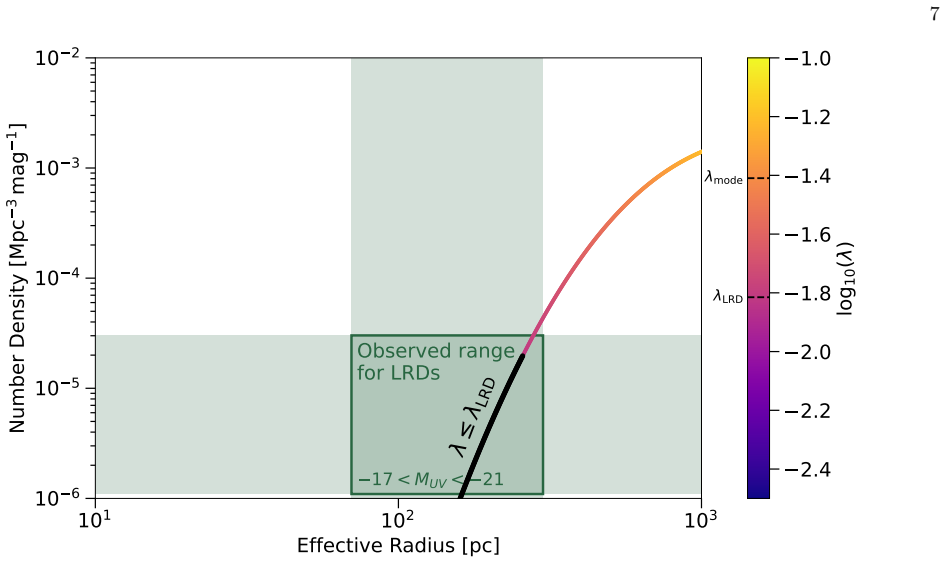
Starting from the disk size--spin relation $R_{\rm eff}\approx (1/\sqrt{2})\,\lambda\,r_{200}(M_h,z)$ and assuming baryons retain their specific angular momentum ($j_d/m_d=1$), the paper inverts the usual logic: rather than predicting a size from a spin, it asks what spin is needed to fit inside 300 pc at $z\approx5$. The answer, $\lambda_{\rm LRD}\approx0.0153$ for a $10^{11}\,M_\odot$ halo, lies in the lowest $\sim0.9\%$ of the lognormal spin distribution (median $0.05$, logarithmic dispersion $0.5$). Because the cumulative fraction below this spin matches the observed LRD-to-galaxy abundance ratio ($\phi_{\rm LRD}/\phi_{\rm LBG}\approx0.009$), the same threshold explains abundance and compactness simultaneously. The redshift evolution follows from two opposing trends: at fixed halo mass the virial radius shrinks as $(1+z)^{-1}$, so the spin required for a fixed size rises as $(1+z)$ and compact galaxies become intrinsically more common at high redshift; meanwhile cosmological surface brightness dimming pushes them below JWST's detection limit by $z\gtrsim8$. Their combination produces a peak in detectable LRD number density near $z\sim5$ and a decline by an order of magnitude from $z=5$ to $z=3$, in agreement with the JWST and ground-based counts compared in the paper.
Load-bearing premise
The load-bearing premise is that baryons preserve their specific angular momentum during collapse ($j_d/m_d=1$), so the low-redshift-calibrated disk size--spin relation applies unchanged to compact high-redshift galaxies; if early disks lose, redistribute, or gain angular momentum, low-spin halos need not produce the observed sizes and the abundance--size link breaks.
Editorial extensions
If this is right
- The abundance of LRDs stops being a separate puzzle: they are the roughly 1% of galaxies whose halos have the lowest spins, not a fundamentally different kind of object.
- At $z<4$, LRDs should exist but become increasingly rare, so surveys need size-sensitive imaging (not just ground-based point-source detections) to confirm the predicted decline.
- At $z>8$, LRDs should be intrinsically common but hidden by surface brightness dimming, so deeper or longer-wavelength observations should reveal a populous faint compact population.
- The same low-spin origin predicts excess small-scale clustering and extreme central densities, both of which are already reported for LRDs and become supporting evidence rather than separate anomalies.
- The model is insensitive to the AGN-versus-stars debate: it works whether the red light comes from an overmassive black hole or from ultra-dense stellar cores.
Reading between the lines
- Extending beyond the paper: if the model is right, the 'LRDs Era' is a selection window rather than a physical epoch, so a survey with higher surface-brightness sensitivity at $z>8$ should reveal a continuous population of compact galaxies extending beyond the current JWST limit.
- Extending beyond the paper: the $j_d/m_d=1$ assumption implies that LRD disks should be rotationally supported with high circular velocities, so measuring resolved kinematics of a handful of $z\sim5$ LRDs would either confirm or break the spin-to-size mapping.
- Extending beyond the paper: the same framework may apply to other rare compact populations, such as extremely red objects or compact quiescent galaxies, predicting that they too occupy the low-spin tail and cluster on small scales.
- Extending beyond the paper: a testable corollary the paper does not spell out is that the size distribution of LRDs at fixed luminosity should be set by the spin cumulative distribution alone, so the fraction of galaxies with $R_{\rm eff}<300$ pc should follow a universal function of $\lambda/r_{200}$.
Editorial analysis
A structured set of objections, weighed in public.
Referee Report
Summary. The paper proposes that the Little Red Dots (LRDs) at z~5 are galaxies forming in the lowest ~1% of the dark matter halo spin distribution. Using the Mo et al. (1998) disk-size relation and a lognormal spin distribution, the authors calibrate the spin threshold at z=5 from the observed abundance ratio of LRDs to Lyman-break galaxies, then show that this threshold yields an effective radius of ~260 pc, within the observed range of 80-300 pc. They further model the redshift evolution of LRD detections through the combination of an evolving compact fraction and cosmological surface brightness dimming, introducing an empirical logistic visibility correction, and compare the predicted relative number density to observations over 2<z<8, reporting good agreement. The paper concludes that LRDs are not a distinct population but the low-spin tail of the continuous halo distribution.
Significance. If the quantitative results held, the framework would provide a single, physically motivated explanation for the abundance, compactness, and redshift distribution of LRDs, with testable implications for clustering and core densities. The paper is transparent about its assumptions, uses observed abundances for calibration, and makes a falsifiable redshift trend. However, the central numerical agreement is compromised by a known factor-of-1.68 error in the size relation, and the redshift comparison is weakened by an empirical correction and normalization at a single redshift. The compactness check is a consistency check rather than an independent prediction. These issues affect the load-bearing quantitative claims, so the paper requires revision before the conclusions can be accepted as stated.
major comments (3)
- [Sec. 2.1, Eq. (3)] The paper sets R_eff = (1/sqrt(2)) λ r200, despite acknowledging in the text that for an exponential disk the half-light radius is a factor of ~1.68 larger than the scale length R_d in Eq. (2). Restoring this standard conversion changes the abundance-calibrated z=5 result: for M_halo=10^11 M_sun (r200≈24 kpc) and λ_LRD=0.0153, one obtains R_eff≈440 pc, not 260 pc, placing the typical LRD above the observed 300 pc upper limit. Conversely, the spin threshold required to reach R_eff=300 pc becomes λ≈0.0105, for which the lognormal PDF with median 0.05 and σ_lnλ=0.5 gives P(λ<0.0105)≈0.08-0.1%, an order of magnitude below the observed fraction f≈0.9%. This is an internal inconsistency in the paper's own equations, not a matter of external priors, and it directly undermines the simultaneous abundance-compactness claim.
- [Sec. 3.3.4, Fig. 5] The claimed excellent agreement with the observed redshift evolution is weakened by three choices. First, all number densities are normalized to the observed value at z=5.5, which removes the absolute abundance and tests only the shape of the decline. Second, the logistic correction C(z) in Eq. (20) is explicitly empirical, with parameters α and µmid chosen to reproduce the observed turnover at z≳6, so the high-redshift suppression is not a parameter-free prediction. Third, a single halo mass M_halo=10^11 M_sun is used at all redshifts, whereas abundance matching at a fixed M_UV=-19 would generally imply an evolving halo mass with redshift. The comparison therefore provides only partial support for the proposed redshift mechanism.
- [Sec. 2.2 and Sec. 3.2] The model's quantitative predictions rest on the assumed universality of the lognormal spin distribution with median 0.05 and dispersion σ_lnλ=0.5, and on the assumption that jd/md=1 for high-redshift disks. Because the low-spin tail (below λ≈0.01) is precisely the region least constrained by simulations, the inferred value of λ_LRD and the predicted redshift decline are sensitive to the tail shape and to the angular momentum retention fraction. The paper notes these assumptions but provides no sensitivity analysis; without such an analysis, the central claim that the lowest ~1% of spins simultaneously fits abundance and compactness is not robustly established. The compactness result should also be described as a consistency check, since λ_LRD at z=5 is calibrated from the observed abundance, not predicted independently.
minor comments (4)
- [Sec. 3.3, paragraph 1] There is a typographical error: "Kocevski et al. 2025).: the 'Little Red Dots Era'" contains an extra period and colon; it should read "Kocevski et al. 2025): the 'Little Red Dots Era'."
- [Sec. 2.3, Eq. (10)] The surface brightness formula assumes a Gaussian profile and uses a specific normalization (2π R_eff^2), but the conversion from effective radius to the relevant scale for mean surface brightness is not derived; a brief justification or reference would improve clarity.
- [Sec. 4, last paragraph] The statement that "a range of empirical evidence supports our low-spin model" is presented without quantitative comparison for the clustering signal or the velocity dispersion relation; these are better framed as qualitative supporting arguments or predictions for future tests.
- [Fig. 3 caption] The caption says "observational ranges encompass the full brightness range of LRDs," but the shaded regions are defined by the number density range and the effective radius range; consider clarifying how the −17 < M_UV < −21 range is incorporated into the comparison.
Circularity Check
The high-redshift turnover in the redshift-evolution test is partly fitted via an empirical visibility correction, while the abundance–compactness link is a consistency check rather than a circular fit.
-
fitted input called prediction
[Sec. 3.3.2, Eq. (20); Sec. 3.3.4, Fig. 5]
"Importantly, this correction factor is partially empirical. While surface brightness dimming is a dominant effect, other observational limitations also contribute to the reduced detectability of LRDs at high redshifts. For example, filter coverage limitations can result in a lack of sufficient photometric bands to apply reliable color selections. This may cause high-z LRDs to be missed or excluded from catalogs during selection procedures. Our correction factor captures the combined impact of these effects and allows us to reproduce the observed turnover in LRD number density at z ≳ 6."
The logistic correction C(z) in Eq. (20) has parameters α and µmid chosen so that the model reproduces the observed turnover at z≳6. Figure 5 then includes C(z) in the theoretical curve, so the claimed 'excellent agreement' with the high-redshift decline is enforced by the fit rather than independently predicted. The low-redshift decline from f_LRD is genuinely derived, but the high-redshift validation is circular because the same data used to calibrate C(z) are later presented as confirmation of the model.
full rationale
The core abundance–compactness chain is not circular: λ_LRD is calibrated from the observed fractional abundance (Eqs. 14–16), and the resulting Reff ≈ 260 pc (Eq. 3) is an independent consequence of the spin PDF and the Mo et al. disk-size relation, not an input to the calibration. It is a consistency check, as the paper itself notes when it emphasizes the monotonic spin–size–abundance correspondence, but it is not a construction that forces the size output from the abundance input. The low-redshift decline is also derived from the lognormal spin PDF and the (1+z) virial-radius scaling. The only substantive circularity is the empirical visibility correction C(z), whose parameters are chosen to reproduce the observed z≳6 turnover and then included in the model curve compared to the same data in Fig. 5. The paper discloses this as 'partially empirical,' so the circularity is partial and localized to the high-redshift validation rather than to the central abundance/compactness claim.
Assumptions & free parameters
free parameters (5)
- Spin threshold at z=5, lambda_LRD =
0.0153
- Logistic correction midpoint, mu_mid =
24.8 mag/arcsec2
- Alpha (logistic steepness) =
not specified
- Effective radius threshold =
300 pc
- Halo mass, M_halo =
10^11 M_sun
assumptions (6)
- domain assumption The halo spin parameter follows a redshift- and mass-independent lognormal distribution with median 0.05 and dispersion 0.5 (Eq 7).
- domain assumption Disk scale length follows the Mo et al. (1998) relation Rd = (1/sqrt2)(jd/md) lambda r200 with jd/md=1 (Eq 2).
- domain assumption Rd approximately equals Reff (Eq 3).
- domain assumption Abundance matching maps M_UV=-19 to M_halo=10^11 M_sun at z=5.
- domain assumption The observed LRD number densities from Kocevski et al., Ma et al., and Zhuang et al. are complete and comparable across redshift.
- domain assumption JWST detectability is governed by a mean surface brightness limit of 25.2 mag/arcsec2.
Cite this review
Pith. "Pith review of Cosmic Outliers: Low-Spin Halos Explain the Abundance, Compactness, and Redshift Evolution of the Little Red Dots." pith.science (2026). https://pith.science/paper/K7JNWUVY
@misc{pith2026250603244,
  author       = {Pith},
  title        = {Pith review of: Cosmic Outliers: Low-Spin Halos Explain the Abundance, Compactness, and Redshift Evolution of the Little Red Dots},
  year         = {2026},
  howpublished = {\url{https://pith.science/paper/K7JNWUVY}},
  note         = {Machine review of arXiv:2506.03244}
}
abstract
The Little Red Dots (LRDs) are high-redshift galaxies uncovered by JWST, characterized by small effective radii ($R_{\rm eff} \sim 80-300$ pc), number densities that are intermediate between those of typical galaxies and quasars, and a redshift distribution peaked at $z \sim 5$. We present a theoretical model in which the LRDs descend from dark matter halos in the extreme low-spin tail of the angular momentum distribution. Within this framework, we explain their three key observational signatures: (i) abundance, (ii) compactness, and (iii) redshift distribution. Our model focuses on observed, not modeled, properties; it is thus independent of whether they are powered primarily by a black hole or stars. We find that the assumption that the prototypical LRD at $z\sim5$ originates from halos in the lowest $\sim 1\%$ of the spin distribution is sufficient to reproduce both their observed number densities and physical sizes. The redshift evolution of their observability is driven by the interplay between the evolving compact disk fraction and cosmological surface brightness dimming. This effect leads to a well-defined "LRDs Era" at $4<z<8$, during which the LRDs are common and detectable; at $z<4$, they are bright but rare, while at $z>8$, they are common but faint. Finally, we test the predicted redshift trend against observational data, finding excellent agreement. Additional observational support comes from their excess small-scale clustering and spectral signatures of extreme core densities, both of which are expected outcomes of galaxy formation in low-spin halos. These findings suggest that the LRDs are not a fundamentally distinct population but the natural manifestation of galaxies forming in the rarest, lowest angular momentum environments.
Figures


Figures from the paper (2 more)


Forward citations
Cited by 1 Pith paper
-
Reduced Incidence of Little Red Dots at z < 3 from Number Density and Halo Mass Evolution
LRDs transition from underdense low-halo-mass environments at z>4 to typical galaxy conditions by z~3.5, with halo growth leading to larger sizes and SED changes that explain their disappearance at lower redshifts.
Reference graph
Works this paper leans on
-
[1]
Akins, H. B., Casey, C. M., Lambrides, E., et al. 2024, arXiv e-prints, arXiv:2406.10341, doi: 10.48550/arXiv.2406.10341
-
[2]
Ananna, T. T., Bogd´ an,´A., Kov´ acs, O. E., Natarajan, P., & Hickox, R. C. 2024, ApJL, 969, L18, doi: 10.3847/2041-8213/ad5669
-
[3]
2008, ApJ, 682, 1195, doi: 10.1086/589278
Ardi, E., Baumgardt, H., & Mineshige, S. 2008, ApJ, 682, 1195, doi: 10.1086/589278
doi:10.1086/589278 2008
-
[4]
Baggen, J. F. W., van Dokkum, P., Labb´ e, I., et al. 2023, ApJL, 955, L12, doi: 10.3847/2041-8213/acf5ef
-
[5]
Baggen, J. F. W., van Dokkum, P., Brammer, G., et al. 2024, ApJL, 977, L13, doi: 10.3847/2041-8213/ad90b8
-
[6]
2001, PhR, 349, 125, doi: 10.1016/S0370-1573(01)00019-9
Barkana, R., & Loeb, A. 2001, PhR, 349, 125, doi: 10.1016/S0370-1573(01)00019-9
-
[7]
Behroozi, P. S., Wechsler, R. H., & Conroy, C. 2013, ApJ, 770, 57, doi: 10.1088/0004-637X/770/1/57
-
[8]
2022, MNRAS, 512, 3703, doi: 10.1093/mnras/stac648
Bird, S., Ni, Y., Di Matteo, T., et al. 2022, MNRAS, 512, 3703, doi: 10.1093/mnras/stac648
Show all 58 references
-
[9]
J., Oesch, P
Bouwens, R. J., Oesch, P. A., Stefanon, M., et al. 2021, AJ, 162, 47, doi: 10.3847/1538-3881/abf83e
2021 doi
-
[10]
2024, Nature, 633, 318, doi: 10.1038/s41586-024-07860-9
Carniani, S., Hainline, K., D’Eugenio, F., et al. 2024, Nature, 633, 318, doi: 10.1038/s41586-024-07860-9
2024 doi
-
[11]
1996, MNRAS, 281, 716, doi: 10.1093/mnras/281.2.716
Cole, S., & Lacey, C. 1996, MNRAS, 281, 716, doi: 10.1093/mnras/281.2.716
1996 doi
-
[12]
Durodola, E., Pacucci, F., & Hickox, R. C. 2025, ApJ, 985, 169, doi: 10.3847/1538-4357/adced2
2025 doi
-
[13]
2007, ApJ, 654, 27, doi: 10.1086/509314 11
Courteau, S. 2007, ApJ, 654, 27, doi: 10.1086/509314 11
2007 doi
- [14]
-
[15]
G., & Struck, C
Elmegreen, B. G., & Struck, C. 2013, ApJL, 775, L35, doi: 10.1088/2041-8205/775/2/L35
2013 doi
-
[16]
L., Bagley, M
Finkelstein, S. L., Bagley, M. B., Arrabal Haro, P., et al. 2025, ApJL, 983, L4, doi: 10.3847/2041-8213/adbbd3
2025 doi
-
[17]
S., Wang, L., Tanikawa, A., Hirai, Y., & Saitoh, T
Fujii, M. S., Wang, L., Tanikawa, A., Hirai, Y., & Saitoh, T. R. 2024, Science, 384, 1488, doi: 10.1126/science.adi4211
2024 doi
-
[18]
J., Zitrin, A., Plat, A., et al
Furtak, L. J., Zitrin, A., Plat, A., et al. 2023, ApJ, 952, 142, doi: 10.3847/1538-4357/acdc9d
2023 doi
-
[19]
E., Labbe, I., Goulding, A
Greene, J. E., Labbe, I., Goulding, A. D., et al. 2024, ApJ, 964, 39, doi: 10.3847/1538-4357/ad1e5f
2024 doi
-
[20]
A., Pacucci, F., & Kocevski, D
Guia, C. A., Pacucci, F., & Kocevski, D. D. 2024, Research Notes of the American Astronomical Society, 8, 207, doi: 10.3847/2515-5172/ad7262
2024 doi
-
[21]
2023, ApJ, 959, 39, doi: 10.3847/1538-4357/ad029e
Harikane, Y., Zhang, Y., Nakajima, K., et al. 2023, ApJ, 959, 39, doi: 10.3847/1538-4357/ad029e
2023 doi
-
[22]
1958, Physics and Philosophy: The Revolution in Modern Science (New York: Harper & Row)
Heisenberg, W. 1958, Physics and Philosophy: The Revolution in Modern Science (New York: Harper & Row)
1958
-
[23]
F., Murray, N., Quataert, E., & Thompson, T
Hopkins, P. F., Murray, N., Quataert, E., & Thompson, T. A. 2010, MNRAS, 401, L19, doi: 10.1111/j.1745-3933.2009.00777.x
2010
-
[24]
2024, ApJL, 973, L49, doi: 10.3847/2041-8213/ad74e2
Inayoshi, K., & Ichikawa, K. 2024, ApJL, 973, L49, doi: 10.3847/2041-8213/ad74e2
2024 doi
-
[25]
2025, ApJL, 980, L27, doi: 10.3847/2041-8213/adaebd
Inayoshi, K., & Maiolino, R. 2025, ApJL, 980, L27, doi: 10.3847/2041-8213/adaebd
2025 doi
-
[26]
D., Onoue, M., Inayoshi, K., et al
Kocevski, D. D., Onoue, M., Inayoshi, K., et al. 2023, ApJL, 954, L4, doi: 10.3847/2041-8213/ace5a0
2023 doi
-
[27]
D., Finkelstein, S
Kocevski, D. D., Finkelstein, S. L., Barro, G., et al. 2025, ApJ, 986, 126, doi: 10.3847/1538-4357/adbc7d
2025 doi
-
[28]
2023, ApJL, 957, L7, doi: 10.3847/2041-8213/ad037a
Kokorev, V., Fujimoto, S., Labbe, I., et al. 2023, ApJL, 957, L7, doi: 10.3847/2041-8213/ad037a
2023 doi
-
[29]
I., Greene, J
Kokorev, V., Caputi, K. I., Greene, J. E., et al. 2024, ApJ, 968, 38, doi: 10.3847/1538-4357/ad4265 Labb´ e, I., van Dokkum, P., Nelson, E., et al. 2023, Nature, 616, 266, doi: 10.1038/s41586-023-05786-2
2024 doi
-
[30]
LaChance, P., Croft, R. A. C., Di Matteo, T., et al. 2025, arXiv e-prints, arXiv:2505.20439, doi: 10.48550/arXiv.2505.20439
2025 doi
- [31]
-
[32]
2024, Research Notes of the American Astronomical Society, 8, 182, doi: 10.3847/2515-5172/ad614c
Loeb, A. 2024, Research Notes of the American Astronomical Society, 8, 182, doi: 10.3847/2515-5172/ad614c
2024 doi
- [33]
-
[34]
2024, ApJL, 976, L24, doi: 10.3847/2041-8213/ad90e1
Madau, P., & Haardt, F. 2024, ApJL, 976, L24, doi: 10.3847/2041-8213/ad90e1
2024 doi
-
[35]
2024, A&A, 691, A145, doi: 10.1051/0004-6361/202347640
Maiolino, R., Scholtz, J., Curtis-Lake, E., et al. 2024, A&A, 691, A145, doi: 10.1051/0004-6361/202347640
2024 doi
-
[36]
2025, MNRAS, 538, 1921, doi: 10.1093/mnras/staf359
Maiolino, R., Risaliti, G., Signorini, M., et al. 2025, MNRAS, 538, 1921, doi: 10.1093/mnras/staf359
2025 doi
-
[37]
P., Brammer, G., et al
Matthee, J., Naidu, R. P., Brammer, G., et al. 2024, ApJ, 963, 129, doi: 10.3847/1538-4357/ad2345
2024 doi
-
[38]
J., Mao, S., & White, S
Mo, H. J., Mao, S., & White, S. D. M. 1998, MNRAS, 295, 319, doi: 10.1046/j.1365-8711.1998.01227.x
1998
-
[39]
P., Naab, T., & White, S
Moster, B. P., Naab, T., & White, S. D. M. 2013, MNRAS, 428, 3121, doi: 10.1093/mnras/sts261
2013 doi
-
[40]
F., Frenk, C
Navarro, J. F., Frenk, C. S., & White, S. D. M. 1996, ApJ, 462, 563, doi: 10.1086/177173
1996 doi
-
[41]
2022, MNRAS, 513, 670, doi: 10.1093/mnras/stac351
Ni, Y., Di Matteo, T., Bird, S., et al. 2022, MNRAS, 513, 670, doi: 10.1093/mnras/stac351
2022 doi
-
[42]
2020, ApJ, 904, 89, doi: 10.3847/1538-4357/abbe11
Niida, M., Nagao, T., Ikeda, H., et al. 2020, ApJ, 904, 89, doi: 10.3847/1538-4357/abbe11
2020 doi
-
[43]
2024, ApJ, 964, 154, doi: 10.3847/1538-4357/ad3044
Pacucci, F., & Loeb, A. 2024, ApJ, 964, 154, doi: 10.3847/1538-4357/ad3044
2024 doi
-
[44]
2024, ApJ, 976, 96, doi: 10.3847/1538-4357/ad84f7
Pacucci, F., & Narayan, R. 2024, ApJ, 976, 96, doi: 10.3847/1538-4357/ad84f7
2024 doi
-
[45]
2023, ApJL, 957, L3, doi: 10.3847/2041-8213/ad0158 Planck Collaboration, Aghanim, N., Akrami, Y., et al
Pacucci, F., Nguyen, B., Carniani, S., Maiolino, R., & Fan, X. 2023, ApJL, 957, L3, doi: 10.3847/2041-8213/ad0158 Planck Collaboration, Aghanim, N., Akrami, Y., et al. 2020, A&A, 641, A6, doi: 10.1051/0004-6361/201833910
2023 doi
-
[46]
J., Kelly, D
Rieke, M. J., Kelly, D. M., Misselt, K., et al. 2023, PASP, 135, 028001, doi: 10.1088/1538-3873/acac53
2023 doi
-
[47]
B., Agertz, O., & Renaud, F
Romeo, A. B., Agertz, O., & Renaud, F. 2020, MNRAS, 499, 5656, doi: 10.1093/mnras/staa3245
2020 doi
-
[48]
B., Agertz, O., & Renaud, F
Romeo, A. B., Agertz, O., & Renaud, F. 2023, MNRAS, 518, 1002, doi: 10.1093/mnras/stac3074
2023 doi
- [49]
-
[50]
1995, MNRAS, 272, 570, doi: 10.1093/mnras/272.3.570
Steinmetz, M., & Bartelmann, M. 1995, MNRAS, 272, 570, doi: 10.1093/mnras/272.3.570
1995 doi
-
[51]
M., et al
Tacchella, S., Dekel, A., Carollo, C. M., et al. 2016, MNRAS, 457, 2790, doi: 10.1093/mnras/stw131
2016 doi
- [52]
- [53]
-
[54]
C., Askar, A., Kamlah, A
Vergara, M. C., Askar, A., Kamlah, A. W. H., et al. 2025, arXiv e-prints, arXiv:2505.07491, doi: 10.48550/arXiv.2505.07491
2025 doi
-
[55]
S., Quinn, P
Warren, M. S., Quinn, P. J., Salmon, J. K., & Zurek, W. H. 1992, ApJ, 399, 405, doi: 10.1086/171937 12
1992 doi
-
[56]
T., et al
Yue, M., Eilers, A.-C., Ananna, T. T., et al. 2024, ApJL, 974, L26, doi: 10.3847/2041-8213/ad7eba
2024 doi
- [57]
-
[58]
2015, MNRAS, 450, 2327, doi: 10.1093/mnras/stv740
Zolotov, A., Dekel, A., Mandelker, N., et al. 2015, MNRAS, 450, 2327, doi: 10.1093/mnras/stv740
2015 doi
Reviewed August 7, 2026 · model on record in the stance chip above.
Discussion (0). Sign in to comment.