Breakdown of Thermalization from Real-Time Dynamics in the Two-Dimensional Hubbard Model
Pith reviewed 2026-06-28 03:52 UTC · model grok-4.3
The pith
Beyond a critical interaction strength, the two-dimensional Hubbard model fails to reach thermal equilibrium after an interaction quench.
A machine-rendered reading of the paper's core claim, the machinery that carries it, and where it could break.
Core claim
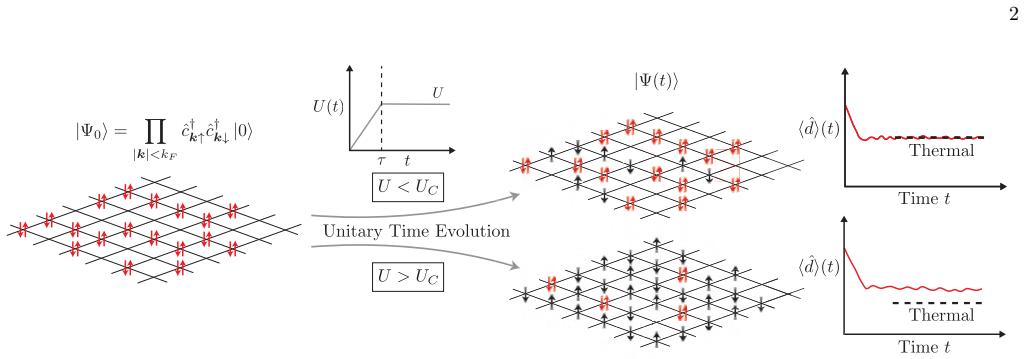
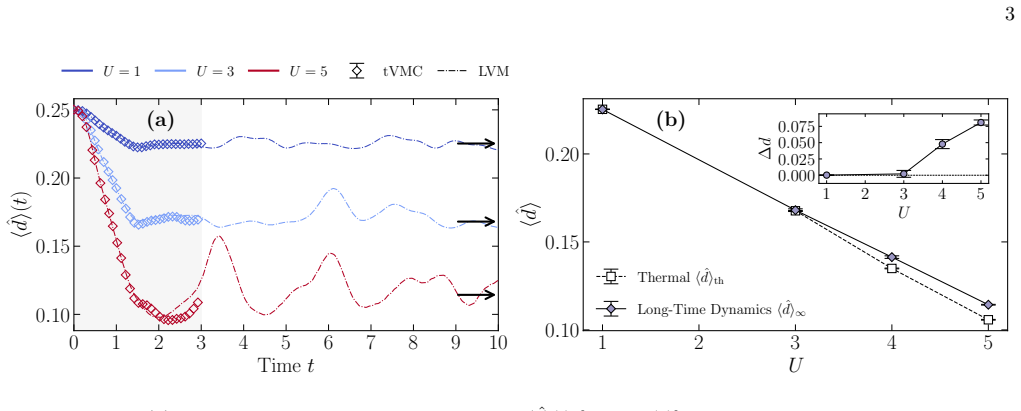
In the half-filled two-dimensional Hubbard model, a quench in the interaction U produces two regimes: below a critical U_C the long-time double occupancy agrees with the thermal ensemble value, consistent with ergodic relaxation; above U_C the dynamics deviate from the thermal prediction and exhibit clear signatures of thermalization breaking.
What carries the argument
Time-dependent variational Monte Carlo combined with transformer-based Neural-Network Quantum States, which evolves the many-body wave function and extracts the long-time double occupancy without bias toward thermal or non-thermal states.
If this is right
- Below the critical interaction the system relaxes to the thermal value of double occupancy.
- Above the critical interaction the long-time double occupancy deviates from the thermal ensemble.
- Numerical methods of this type can now access nonequilibrium regimes in correlated fermions that were previously unreachable.
- The observed breakdown supplies a concrete diagnostic for thermalization failure in two-dimensional fermionic models.
Where Pith is reading between the lines
- The critical interaction may mark the onset of a non-ergodic regime whose microscopic origin could be explored by varying lattice geometry or doping.
- Quantum simulators could be tuned across the reported threshold to test whether the same deviation appears in measurable observables such as momentum distribution.
- The result raises the question of whether similar thermalization breaking occurs after other quench protocols, such as changes in hopping or external fields.
Load-bearing premise
The variational Monte Carlo procedure with neural-network states yields an unbiased long-time limit for double occupancy that does not artificially favor either thermal or non-thermal behavior.
What would settle it
An ultracold-atom experiment measuring double occupancy at long times after an interaction quench in the 2D Hubbard model at half filling, performed both below and above the reported critical U value.
Figures
read the original abstract
Thermalization in strongly correlated fermionic systems remains a central open problem in quantum many-body physics. In this work, we investigate the real-time dynamics and the approach to thermalization in the two-dimensional Hubbard model, a paradigmatic framework for correlated electrons, relevant to high-temperature superconductivity and ultracold quantum simulation. Focusing on the half-filled square lattice, we monitor the time evolution of the double occupancy following a quench in the on-site interaction $U$, and assess whether its long-time value is captured by a canonical thermal ensemble. We employ time-dependent variational Monte Carlo methods combined with transformer-based Neural-Network Quantum States to accurately describe the nonequilibrium dynamics of fermions, especially for the behavior at long times, thereby accessing regimes that were previously inaccessible to numerical simulations. Our results reveal two distinct dynamical behaviors: for weak to intermediate interactions, the long-time double occupancy agrees with the thermal prediction, consistent with ergodic relaxation; beyond a critical interaction $U_{C}$, the dynamics deviate markedly from the thermal expectation, revealing clear signatures of thermalization breaking. These results establish numerical simulation as a powerful tool to probe nonequilibrium quantum phenomena in correlated fermionic matter.
Editorial analysis
A structured set of objections, weighed in public.
Referee Report
Summary. The paper studies real-time quench dynamics in the half-filled 2D Hubbard model on the square lattice using time-dependent variational Monte Carlo combined with transformer-based neural-network quantum states. It monitors the double occupancy and reports that its long-time value matches the prediction of a canonical thermal ensemble for weak-to-intermediate interaction strengths, while deviating markedly beyond a critical U_C, which the authors interpret as a breakdown of thermalization.
Significance. If the numerical evidence is robust, the result would constitute a concrete demonstration of non-ergodic long-time behavior in a paradigmatic fermionic lattice model, obtained from direct time evolution rather than equilibrium assumptions. The internal consistency check (recovery of thermal values in the ergodic regime) is a positive feature of the approach.
major comments (2)
- [Abstract / Methods] The abstract and available description supply no quantitative information on convergence with respect to variational parameters, bond dimension or network depth, finite-size scaling, or comparison against exactly solvable limits (e.g., U=0 or infinite-temperature states). Without these checks the claimed deviation for U>U_C cannot be assessed for systematic bias in the long-time limit.
- [Results] The identification of U_C and the statement that the dynamics 'deviate markedly' require explicit error bars, statistical uncertainties from the Monte Carlo sampling, and a clear criterion (e.g., a threshold on the difference from thermal value) that is independent of the variational ansatz.
minor comments (1)
- [Model and quench protocol] Notation for the quench protocol (initial state, sudden change in U) should be stated explicitly with a figure or equation.
Simulated Author's Rebuttal
We thank the referee for the careful reading, the positive assessment of the work's significance, and the constructive major comments. We address each point below and will revise the manuscript to strengthen the presentation of convergence, uncertainties, and criteria.
read point-by-point responses
-
Referee: [Abstract / Methods] The abstract and available description supply no quantitative information on convergence with respect to variational parameters, bond dimension or network depth, finite-size scaling, or comparison against exactly solvable limits (e.g., U=0 or infinite-temperature states). Without these checks the claimed deviation for U>U_C cannot be assessed for systematic bias in the long-time limit.
Authors: We agree that quantitative convergence information is needed to assess possible systematic bias. In the revised manuscript we will add a dedicated subsection with explicit data on convergence versus network depth and number of variational parameters. We will also include finite-size scaling for lattices up to 8x8 and direct comparisons to the exactly solvable U=0 limit (where long-time double occupancy recovers the thermal value) as well as the infinite-temperature state. These additions will allow readers to evaluate the robustness of the deviation reported for U>U_C. revision: yes
-
Referee: [Results] The identification of U_C and the statement that the dynamics 'deviate markedly' require explicit error bars, statistical uncertainties from the Monte Carlo sampling, and a clear criterion (e.g., a threshold on the difference from thermal value) that is independent of the variational ansatz.
Authors: We accept that error bars and an explicit, ansatz-independent criterion are required. The revised version will display statistical uncertainties from the Monte Carlo sampling on all relevant plots. We will define U_C via a concrete threshold (deviation from the thermal value exceeding three times the Monte Carlo error bar) and demonstrate that this threshold remains stable when the network architecture is varied. The criterion and its robustness will be stated clearly in the text and figures. revision: yes
Circularity Check
No significant circularity; numerical simulation result stands on direct computation
full rationale
The paper reports results from real-time t-VMC evolution with transformer NNQS on the 2D Hubbard model. The central claim (deviation from thermal double occupancy beyond U_C) is obtained by direct numerical time evolution and comparison to canonical ensemble values, not by any algebraic reduction, fitted-parameter renaming, or self-citation chain. The abstract explicitly notes internal consistency: agreement with thermal predictions at weak-to-intermediate U serves as a benchmark that the variational dynamics are unbiased. No equations or steps are presented that define a quantity in terms of itself or import uniqueness from prior self-work. The work is therefore self-contained against external thermal benchmarks and receives the default non-circularity finding.
Axiom & Free-Parameter Ledger
Reference graph
Works this paper leans on
-
[1]
Time-dependent variational principles (TDVP) [66] determine parameter updates such that Ψθ(t) follows the dynamics dictated by Eq
Time-Dependent Variational Monte Carlo The time evolution of a quantum state|Ψ(t)⟩governed by the Hamiltonian ˆHis described by the time-dependent Schr¨ odinger equation d dt |Ψ(t)⟩=−i ˆH|Ψ(t)⟩.(6) In variational approaches, the exact state|Ψ(t)⟩is ap- proximated by a parameterized Ansatz|Ψ θ(t)⟩, whose time dependence is encoded in the variational parame...
-
[2]
The prefactor 7 1/ √ Nin Eq
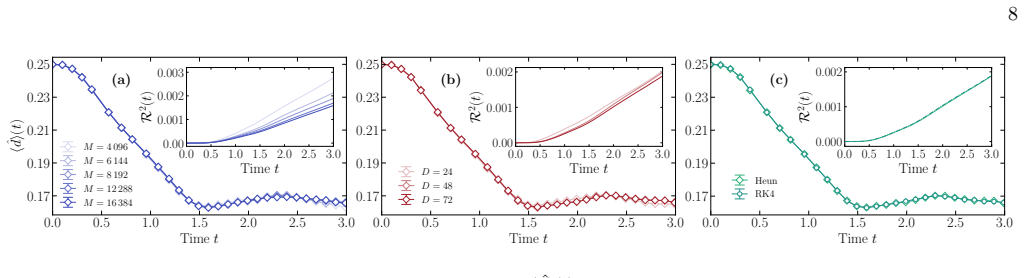
Variational Error The accuracy of the variational dynamics simulated with tVMC can be quantified by the integrated TDVP error [73]: R2(t) = 1√ N Z t 0 √ δs2,(12) where the residualδs 2 corresponds to: δs2 =δt 2[Var( ˆH) + ˙θT Sθ−2Re(F) T ˙θ],(13) with Var( ˆH) =⟨ ˆH2⟩ − ⟨ ˆH⟩2 denoting the variance of the possibly time-dependent Hamiltonian. The prefactor...
-
[3]
The network takes as input a many-electron configurationn= (n ↑,n ↓), where nσ = (n1σ,
Transformer Backflow Wave Function The variational wave function employed in this work is based on a transformer neural-network architec- ture [77], originally introduced for sequence modeling and subsequently adapted to represent many-body wave functions [44, 78, 79]. The network takes as input a many-electron configurationn= (n ↑,n ↓), where nσ = (n1σ, ...
-
[4]
As shown in Fig
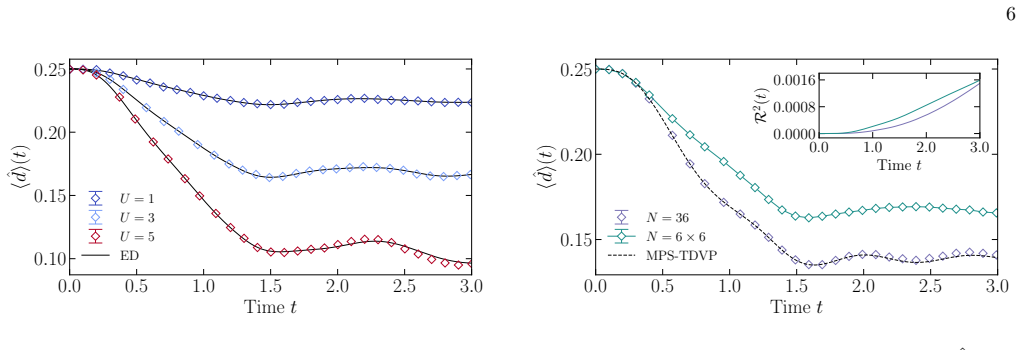
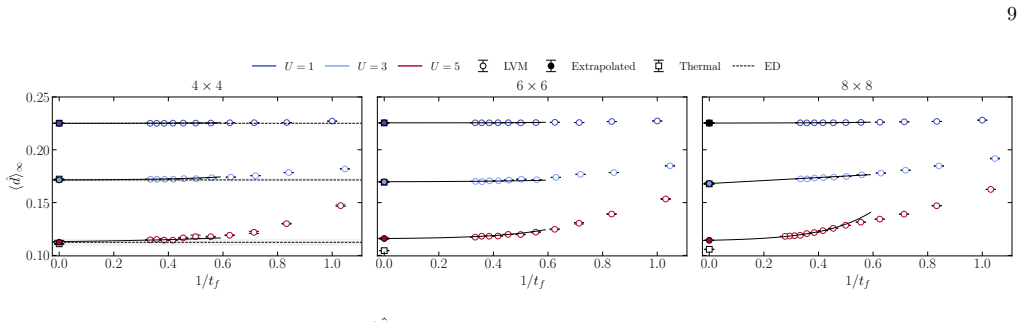
Validation with Other Methods We first assess the accuracy of our simulations by benchmarking against exact diagonalization (ED) results whenever such calculations are feasible, namely for the 4×4 lattice. As shown in Fig. 4, our results agree ex- cellently with ED across several values of the interaction strengthU, supporting the accuracy of our tVMC cal...
-
[5]
Convergence with the Hyperparameters We analyzed the convergence of the tVMC simulations with respect to the key hyperparameters and algorith- mic choices. First of all, we consider the number of Monte Carlo samples and the number of variational pa- rameters in the architecture, the latter being controlled by the transformer hidden dimensionD. As displaye...
-
[6]
Swiss AI initiative
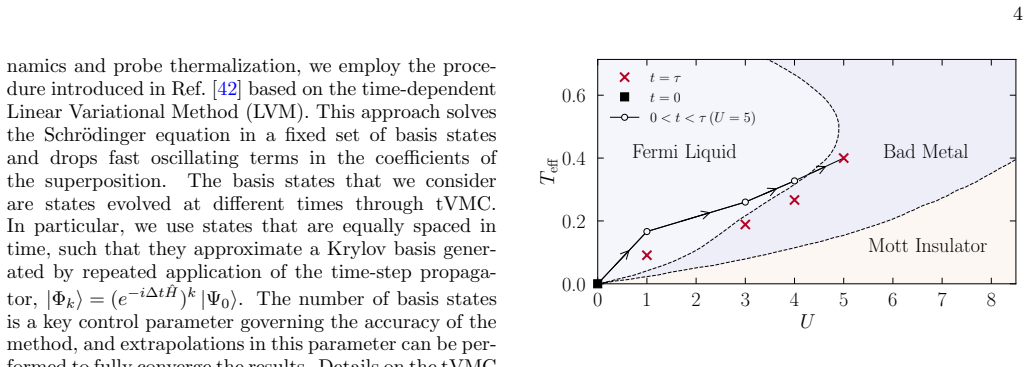
Time-Dependent Linear Variational Method To extract the infinite-time limit of the observable, we resort to the approach introduced in Ref. [42] based on the time-dependent Linear Variational Method (LVM). The LVM provides the equations of motion for the uni- tary time evolution generated by the Schr¨ odinger equa- tion projected onto the subspace spanned...
2025
-
[7]
A. Zong, B. R. Nebgen, S.-C. Lin, J. A. Spies, and M. Zuerch, Emerging ultrafast techniques for studying quantum materials, Nature Reviews Materials8, 224 (2023)
2023
-
[8]
Giannetti, M
C. Giannetti, M. Capone, D. Fausti, M. Fabrizio, F. Parmigiani, and D. Mihailovic, Ultrafast optical spectroscopy of strongly correlated materials and high- temperature superconductors: a non-equilibrium ap- proach, Advances in Physics65, 58 (2016)
2016
-
[9]
de la Torre, D
A. de la Torre, D. M. Kennes, M. Claassen, S. Gerber, J. W. McIver, and M. A. Sentef, Colloquium: Nonther- mal pathways to ultrafast control in quantum materials, Rev. Mod. Phys.93, 041002 (2021)
2021
-
[10]
D. N. Basov, R. D. Averitt, D. van der Marel, M. Dres- sel, and K. Haule, Electrodynamics of correlated elec- tron materials, Rev. Mod. Phys.83, 471 (2011)
2011
-
[11]
C. L. Smallwood, J. P. Hinton, C. Jozwiak, W. Zhang, J. D. Koralek, H. Eisaki, D.-H. Lee, J. Orenstein, and A. Lanzara, Tracking cooper pairs in a cuprate su- perconductor by ultrafast angle-resolved photoemission, Science336, 1137 (2012)
2012
-
[12]
W. Hu, S. Kaiser, D. Nicoletti, C. R. Hunt, I. Gierz, M. C. Hoffmann, M. Le Tacon, T. Loew, B. Keimer, and A. Cavalleri, Optically enhanced coherent transport in yba 2 cu 3 o 6.5 by ultrafast redistribution of interlayer coupling, Nature materials13, 705 (2014)
2014
-
[13]
Amano, D
T. Amano, D. Babich, R. Mandal, J. Guzman-Brambila, A. Volte, E. Trzop, M. Servol, E. Pastor, M. Alashoor, J. Larsson,et al., Propagation of insulator-to-metal transition driven by photoinduced strain waves in a mott material, Nature Physics20, 1778 (2024)
2024
-
[14]
Verma, D
A. Verma, D. Goleˇ z, O. Y. Gorobtsov, K. Kaj, R. Rus- sell, J. Z. Kaaret, E. Lamb, G. Khalsa, H. P. Nair, Y. Sun,et al., Picosecond volume expansion drives a later-time insulator–metal transition in a nano-textured mott insulator, Nature Physics20, 807 (2024)
2024
-
[15]
Schneider, L
U. Schneider, L. Hackerm¨ uller, J. P. Ronzheimer, S. Will, S. Braun, T. Best, I. Bloch, E. Demler, S. Mandt, D. Rasch,et al., Fermionic transport and out-of-equilibrium dynamics in a homogeneous hubbard model with ultracold atoms, Nature Physics8, 213 (2012)
2012
-
[16]
A. J. Daley, I. Bloch, C. Kokail, S. Flannigan, N. Pear- son, M. Troyer, and P. Zoller, Practical quantum advan- tage in quantum simulation, Nature607, 667 (2022)
2022
-
[17]
J¨ ordens, N
R. J¨ ordens, N. Strohmaier, K. G¨ unter, H. Moritz, and T. Esslinger, A mott insulator of fermionic atoms in an optical lattice, Nature455, 204 (2008)
2008
-
[18]
Schneider, L
U. Schneider, L. Hackermuller, S. Will, T. Best, I. Bloch, T. A. Costi, R. Helmes, D. Rasch, and A. Rosch, Metallic and insulating phases of repulsively interacting fermions in a 3d optical lattice, Science322, 1520 (2008)
2008
-
[19]
M. F. Parsons, A. Mazurenko, C. S. Chiu, G. Ji, D. Greif, and M. Greiner, Site-resolved measurement of the spin-correlation function in the fermi-hubbard model, Science353, 1253 (2016)
2016
-
[20]
L. W. Cheuk, M. A. Nichols, K. R. Lawrence, M. Okan, H. Zhang, E. Khatami, N. Trivedi, T. Paiva, M. Rigol, and M. W. Zwierlein, Observation of spatial charge and spin correlations in the 2d fermi-hubbard model, Science 353, 1260 (2016). 11
2016
-
[21]
M. Boll, T. A. Hilker, G. Salomon, A. Omran, J. Ne- spolo, L. Pollet, I. Bloch, and C. Gross, Spin-and density-resolved microscopy of antiferromagnetic cor- relations in fermi-hubbard chains, Science353, 1257 (2016)
2016
-
[22]
M. A. Nichols, L. W. Cheuk, M. Okan, T. R. Hartke, E. Mendez, T. Senthil, E. Khatami, H. Zhang, and M. W. Zwierlein, Spin transport in a mott insulator of ultracold fermions, Science363, 383 (2019)
2019
-
[23]
P. T. Brown, D. Mitra, E. Guardado-Sanchez, R. Nourafkan, A. Reymbaut, C.-D. H´ ebert, S. Berg- eron, A.-M. Tremblay, J. Kokalj, D. A. Huse,et al., Bad metallic transport in a cold atom fermi-hubbard system, Science363, 379 (2019)
2019
-
[24]
Koepsell, J
J. Koepsell, J. Vijayan, P. Sompet, F. Grusdt, T. A. Hilker, E. Demler, G. Salomon, I. Bloch, and C. Gross, Imaging magnetic polarons in the doped fermi–hubbard model, Nature572, 358 (2019)
2019
-
[25]
Hartke, B
T. Hartke, B. Oreg, C. Turnbaugh, N. Jia, and M. Zwierlein, Direct observation of nonlocal fermion pairing in an attractive fermi-hubbard gas, Science381, 82 (2023)
2023
-
[26]
Georges and G
A. Georges and G. Kotliar, Hubbard model in infinite dimensions, Physical Review B45, 6479 (1992)
1992
-
[27]
S. R. White, Density matrix formulation for quan- tum renormalization groups, Phys. Rev. Lett.69, 2863 (1992)
1992
-
[28]
Dagotto, Correlated electrons in high-temperature superconductors, Rev
E. Dagotto, Correlated electrons in high-temperature superconductors, Rev. Mod. Phys.66, 763 (1994)
1994
-
[29]
Innerberger, P
M. Innerberger, P. Worm, P. Prauhart, and A. Kauch, Electron-light interaction in nonequilibrium: exact di- agonalization for time-dependent hubbard hamiltoni- ans, The European Physical Journal Plus135, 922 (2020)
2020
-
[30]
D. Wu, R. Rossi, F. Vicentini, and G. Carleo, From tensor-network quantum states to tensorial recurrent neural networks, Phys. Rev. Res.5, L032001 (2023)
2023
-
[31]
Hubig, A
C. Hubig, A. Bohrdt, M. Knap, F. Grusdt, and J. I. Cirac, Evaluation of time-dependent correlators after a local quench in ipeps: hole motion in the tj model, Sci- Post Physics8, 021 (2020)
2020
- [32]
-
[33]
D. P. Arovas, E. Berg, S. A. Kivelson, and S. Raghu, The hubbard model, Annual review of condensed matter physics13, 239 (2022)
2022
-
[34]
Srednicki, Chaos and quantum thermalization, Phys
M. Srednicki, Chaos and quantum thermalization, Phys. Rev. E50, 888 (1994)
1994
-
[35]
Rigol, V
M. Rigol, V. Dunjko, and M. Olshanii, Thermalization and its mechanism for generic isolated quantum sys- tems, Nature452, 854 (2008)
2008
-
[36]
A. M. Kaufman, M. E. Tai, A. Lukin, M. Rispoli, R. Schittko, P. M. Preiss, and M. Greiner, Quan- tum thermalization through entanglement in an isolated many-body system, Science353, 794 (2016)
2016
-
[37]
Reimann, Typical fast thermalization processes in closed many-body systems, Nature communications7, 10821 (2016)
P. Reimann, Typical fast thermalization processes in closed many-body systems, Nature communications7, 10821 (2016)
2016
-
[38]
D. A. Abanin, E. Altman, I. Bloch, and M. Serbyn, Col- loquium: Many-body localization, thermalization, and entanglement, Rev. Mod. Phys.91, 021001 (2019)
2019
-
[39]
Eckstein, M
M. Eckstein, M. Kollar, and P. Werner, Interaction quench in the hubbard model: Relaxation of the spec- tral function and the optical conductivity, Phys. Rev. B 81, 115131 (2010)
2010
-
[40]
Eckstein, M
M. Eckstein, M. Kollar, and P. Werner, Thermalization after an interaction quench in the hubbard model, Phys. Rev. Lett.103, 056403 (2009)
2009
-
[41]
Eurich, M
N. Eurich, M. Eckstein, and P. Werner, Optimal ramp shapes for the fermionic hubbard model in infinite di- mensions, Phys. Rev. B83, 155122 (2011)
2011
-
[42]
Balzer, F
K. Balzer, F. A. Wolf, I. P. McCulloch, P. Werner, and M. Eckstein, Nonthermal melting of n´ eel order in the hubbard model, Phys. Rev. X5, 031039 (2015)
2015
-
[43]
Tsuji, M
N. Tsuji, M. Eckstein, and P. Werner, Nonthermal antiferromagnetic order and nonequilibrium criticality in the hubbard model, Phys. Rev. Lett.110, 136404 (2013)
2013
-
[44]
Blankenbecler, D
R. Blankenbecler, D. J. Scalapino, and R. L. Sugar, Monte carlo calculations of coupled boson-fermion sys- tems. i, Phys. Rev. D24, 2278 (1981)
1981
-
[45]
Carleo, F
G. Carleo, F. Becca, M. Schiro, and M. Fabrizio, Local- ization and Glassy Dynamics Of Many-Body Quantum Systems, Scientific Reports2, 243 (2012)
2012
-
[46]
Becca and S
F. Becca and S. Sorella,Quantum Monte Carlo Ap- proaches for Correlated Systems(Cambridge University Press, 2017)
2017
-
[47]
Motta, W
M. Motta, W. Kirby, I. Liepuoniute, K. J. Sung, J. Cohn, A. Mezzacapo, K. Klymko, N. Nguyen, N. Yoshioka, and J. E. Rice, Subspace methods for electronic structure simulations on quantum computers, Electronic Structure6, 013001 (2024)
2024
-
[48]
Sinibaldi, D
A. Sinibaldi, D. Hendry, F. Vicentini, and G. Carleo, Time-dependent neural galerkin method for quantum dynamics, Phys. Rev. Lett.136, 120402 (2026)
2026
-
[49]
Carleo and M
G. Carleo and M. Troyer, Solving the quantum many- body problem with artificial neural networks, Science 355, 602 (2017)
2017
-
[50]
L. L. Viteritti, R. Rende, and F. Becca, Transformer variational wave functions for frustrated quantum spin systems, Phys. Rev. Lett.130, 236401 (2023)
2023
-
[51]
K. Ido, T. Ohgoe, and M. Imada, Time-dependent many-variable variational monte carlo method for nonequilibrium strongly correlated electron systems, Physical Review B92, 245106 (2015)
2015
-
[52]
K. Ido, T. Ohgoe, and M. Imada, Correlation-induced superconductivity dynamically stabilized and enhanced by laser irradiation, Science advances3, e1700718 (2017)
2017
-
[53]
Blaß and H
B. Blaß and H. Rieger, Test of quantum thermalization in the two-dimensional transverse-field Ising model, Sci- entific Reports6, 38185 (2016)
2016
-
[54]
Carleo, F
G. Carleo, F. Becca, M. Schir´ o, and M. Fabrizio, Lo- calization and glassy dynamics of many-body quantum systems, Scientific reports2, 243 (2012)
2012
-
[55]
Y. Gu, W. Li, H. Lin, B. Zhan, R. Li, Y. Huang, D. He, Y. Wu, T. Xiang, M. Qin, L. Wang, and D. Lv, Solving the hubbard model with neural quantum states (2025), arXiv:2507.02644
arXiv 2025
-
[56]
L. L. Viteritti, R. Rende, C. Roth, A. Sengupta, G. Car- leo, and A. Georges, Beyond variational bias: Resolv- ing intertwined orders in the hubbard model (2026), arXiv:2604.21978
Pith/arXiv arXiv 2026
-
[57]
Z. Wang, F. F. Assaad, and F. Parisen Toldin, Finite- size effects in canonical and grand-canonical quantum 12 monte carlo simulations for fermions, Phys. Rev. E96, 042131 (2017)
2017
-
[58]
M. Lu, Y.-F. Song, Y. Deng, and Y.-Y. He, Quantum monte carlo study of the metal-insulator crossover in the square-lattice hubbard model (2026), arXiv:2602.22705
Pith/arXiv arXiv 2026
-
[59]
A. D. King, A. Nocera, M. M. Rams, J. Dziarmaga, R. Wiersema, W. Bernoudy, J. Raymond, N. Kaushal, N. Heinsdorf, R. Harris, K. Boothby, F. Altomare, M. Asad, A. J. Berkley, M. Boschnak, K. Chern, H. Christiani, S. Cibere, J. Connor, M. H. Dehn, R. Deshpande, S. Ejtemaee, P. Farre, K. Hamer, E. Hoskinson, S. Huang, M. W. Johnson, S. Kortas, E. Ladizinsky, ...
2025
-
[60]
L. Mauron and G. Carleo, Challenging the quantum ad- vantage frontier with large-scale classical simulations of annealing dynamics (2025), arXiv:2503.08247
arXiv 2025
-
[61]
Mauron, Z
L. Mauron, Z. Denis, J. Nys, and G. Carleo, Predicting topological entanglement entropy in a rydberg analogue simulator, Nature physics21, 1332 (2025)
2025
-
[62]
Tindall, A
J. Tindall, A. F. Mello, M. Fishman, E. M. Stouden- mire, and D. Sels, Dynamics of disordered quantum sys- tems with two- and three-dimensional tensor networks, Science392, 868–872 (2026)
2026
-
[63]
S. R. White, D. J. Scalapino, R. L. Sugar, E. Y. Loh, J. E. Gubernatis, and R. T. Scalettar, Numerical study of the two-dimensional hubbard model, Phys. Rev. B 40, 506 (1989)
1989
-
[64]
J. P. F. LeBlanc, A. E. Antipov, F. Becca, I. W. Bu- lik, G. K.-L. Chan, C.-M. Chung, Y. Deng, M. Fer- rero, T. M. Henderson, C. A. Jim´ enez-Hoyos, E. Kozik, X.-W. Liu, A. J. Millis, N. V. Prokof’ev, M. Qin, G. E. Scuseria, H. Shi, B. V. Svistunov, L. F. Tocchio, I. S. Tupitsyn, S. R. White, S. Zhang, B.-X. Zheng, Z. Zhu, and E. Gull (Simons Collaboratio...
2015
-
[65]
H. Xu, C.-M. Chung, M. Qin, U. Schollw¨ ock, S. R. White, and S. Zhang, Coexistence of superconductiv- ity with partially filled stripes in the hubbard model, Science384, 10.1126/science.adh7691 (2024)
-
[66]
F. ˇSimkovic, R. Rossi, A. Georges, and M. Ferrero, Ori- gin and fate of the pseudogap in the doped hubbard model, Science385, 10.1126/science.ade9194 (2024)
-
[67]
C. Roth, A. Chen, A. Sengupta, and A. Georges, Su- perconductivity in the two-dimensional hubbard model revealed by neural quantum states (2025), 2511.07566
arXiv 2025
-
[68]
Charlebois and M
M. Charlebois and M. Imada, Single-particle spectral function formulated and calculated by variational monte carlo method with application tod-wave superconduct- ing state, Phys. Rev. X10, 041023 (2020)
2020
-
[69]
Yang and A
C. Yang and A. E. Feiguin, Spectral function of the two- dimensional hubbard model: A density matrix renor- malization group plus cluster perturbation theory study, Phys. Rev. B93, 081107(R) (2016)
2016
-
[70]
J. B. Rigo and M. Schmitt, Operator lanczos approach enabling neural quantum states as real-frequency impu- rity solvers (2025), arXiv:2512.08624
arXiv 2025
-
[71]
Q. Li, J. Callaway, and L. Tan, Spectral function in the two-dimensional hubbard model, Phys. Rev. B44, 10256 (1991)
1991
-
[72]
X. Yuan, S. Endo, Q. Zhao, Y. Li, and S. C. Benjamin, Theory of variational quantum simulation, Quantum3, 191 (2019)
2019
-
[73]
The case of complex parameters can be handled by treating each complex parameter as a pair of real-valued parameters
-
[74]
Rende, L
R. Rende, L. L. Viteritti, L. Bardone, F. Becca, and S. Goldt, A simple linear algebra identity to optimize large-scale neural network quantum states, Communi- cations Physics7, 260 (2024)
2024
-
[75]
Chen and M
A. Chen and M. Heyl, Empowering deep neural quantum states through efficient optimization, Nature Physics20, 1476 (2024)
2024
-
[76]
Novak, J
R. Novak, J. Sohl-Dickstein, and S. S. Schoenholz, Fast finite width neural tangent kernel, inProceedings of the 39th International Conference on Machine Learning, Vol. 162, edited by K. Chaudhuri, S. Jegelka, L. Song, C. Szepesvari, G. Niu, and S. Sabato (PMLR, 2022) pp. 17018–17044
2022
-
[77]
Medvidovi´ c and D
M. Medvidovi´ c and D. Sels, Variational quantum dy- namics of two-dimensional rotor models, PRX Quantum 4, 040302 (2023)
2023
-
[78]
Schmitt and M
M. Schmitt and M. Heyl, Quantum Many-Body Dynam- ics in Two Dimensions with Artificial Neural Networks, Phys. Rev. Lett.125, 100503 (2020)
2020
-
[79]
J. Vovrosh, S. Juli` a-Farr´ e, W. Krinitsin, M. Kaicher, F. Hayes, E. Gottlob, A. Kshetrimayum, K. Bidzhiev, S. B. J¨ ager, M. Schmitt, J. Tindall, C. Dalyac, T. Mendes-Santos, and A. Dauphin, Simulating dynam- ics of the two-dimensional transverse-field ising model: a comparative study of large-scale classical numerics (2025), arXiv:2511.19340 [quant-ph]
Pith/arXiv arXiv 2025
-
[80]
D. Wu, R. Rossi, F. Vicentini, N. Astrakhant- sev, F. Becca, X. Cao, J. Carrasquilla, F. Ferrari, A. Georges, M. Hibat-Allah,et al., Variational bench- marks for quantum many-body problems, Science386, 296 (2024)
2024
discussion (0)
Sign in with ORCID, Apple, or X to comment. Anyone can read and Pith papers without signing in.