Star Formation at the Periphery of a Molecular Superbubble: The Case of G12.79+0.43
Pith reviewed 2026-06-26 14:00 UTC · model grok-4.3
The pith
G12.79+0.43 lies on the rim of a 50-parsec molecular superbubble whose expansion age is 0.3 million years.
A machine-rendered reading of the paper's core claim, the machinery that carries it, and where it could break.
Core claim
G12.79+0.43 is located along the rim of a larger molecular superbubble (diameter ~50 pc) that also encompasses the well-known W33 region. The inferred expansion age of this superbubble is ~0.3 Myr. While the spatial association between G12.79+0.43 and the superbubble is evident, the current data do not allow us to establish a clear causal connection between the superbubble evolution and the ongoing star formation within G12.79+0.43.
What carries the argument
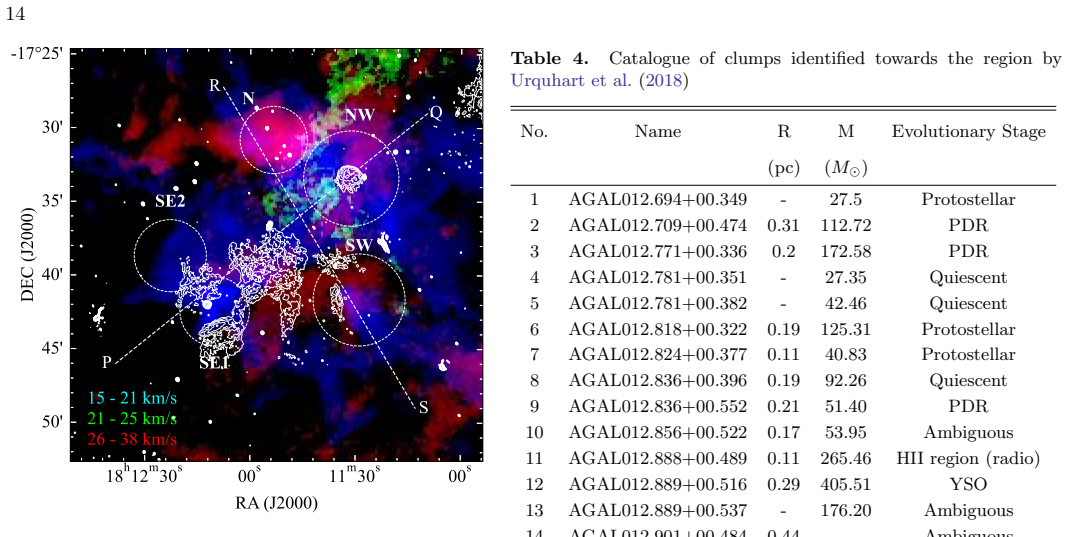
The molecular superbubble identified from CO velocity components across a 2°×2° field, with G12.79+0.43 positioned on its irregular rim.
If this is right
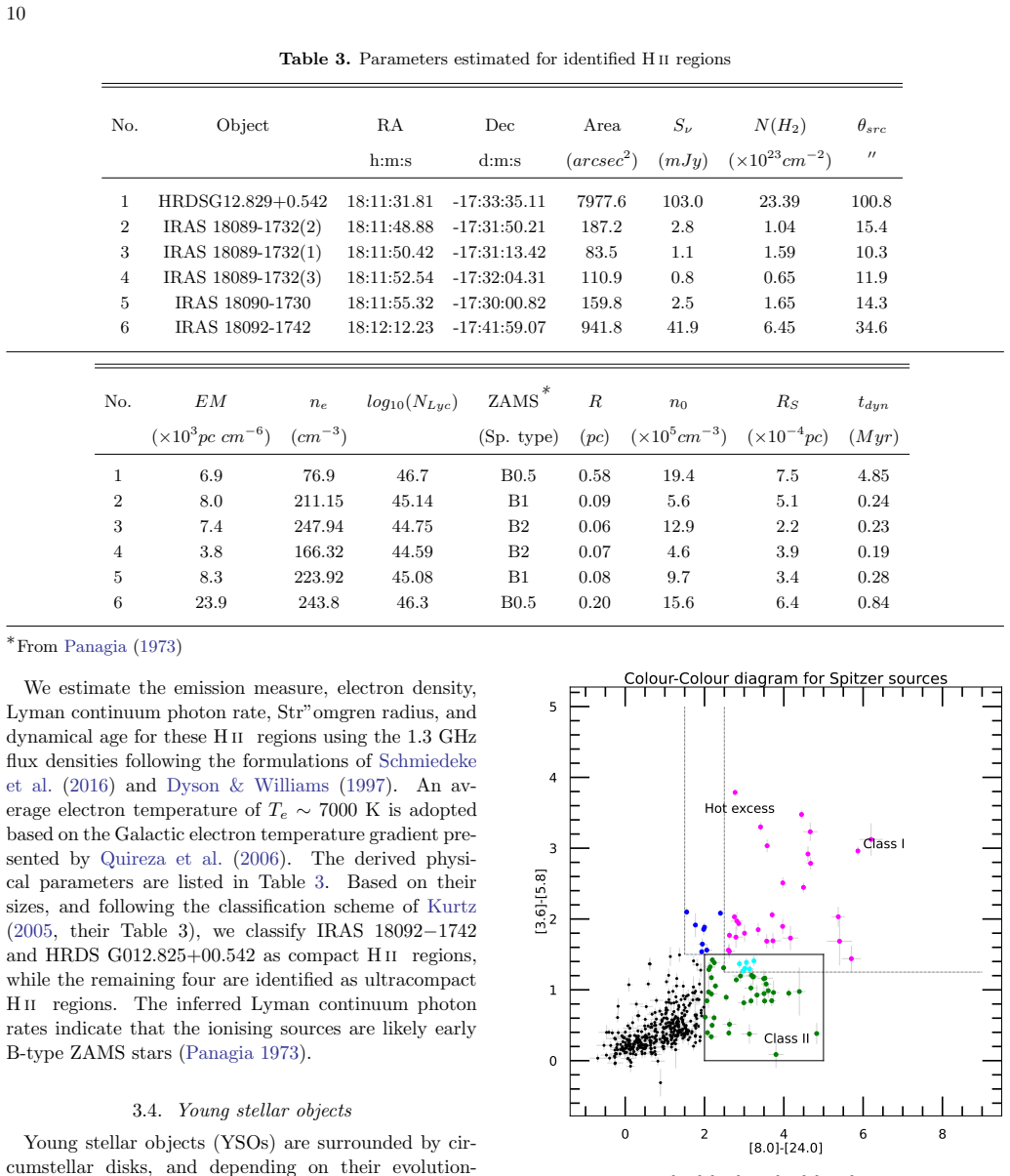
- Active star formation traced by 82 YSO candidates and six HII regions occurs along the superbubble rim.
- The superbubble spans ~50 pc and has been expanding for ~0.3 Myr.
- Low-frequency radio data reveal diffuse emission filling the central region enclosed by the infrared-bright rim.
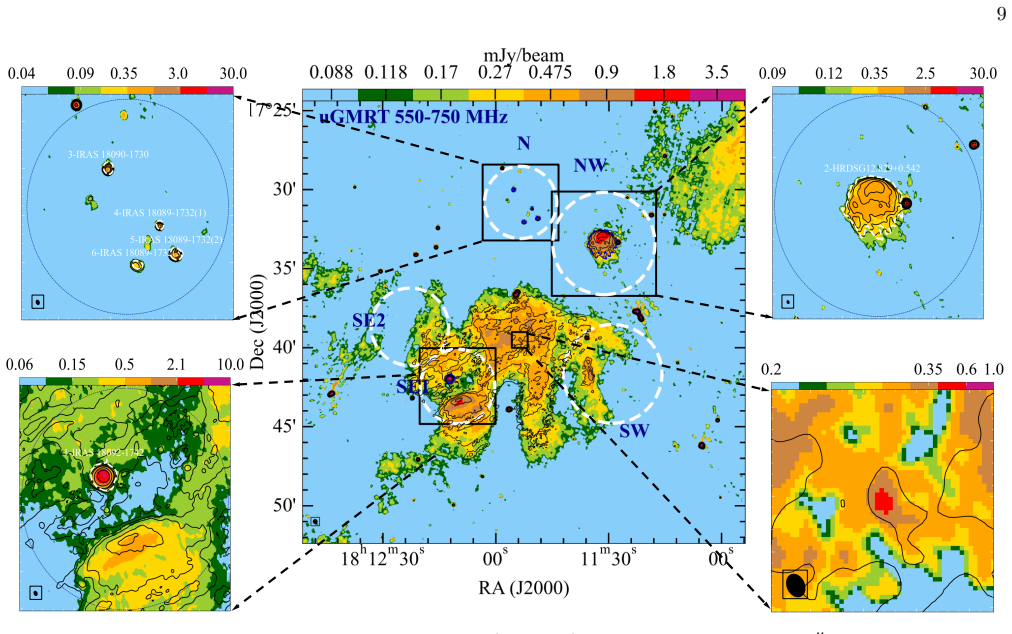
- The cloud complex extends ~18 arcmin on the sky and contains compact radio sources likely powered by early B-type stars.
Where Pith is reading between the lines
- If the rim association holds, similar triggered or enhanced star formation may appear at the edges of other molecular superbubbles.
- Higher-resolution kinematic mapping could test whether the three velocity components truly belong to one expanding shell.
- Comparison with other superbubbles that lack rim star formation would clarify what additional conditions are required for the observed activity.
Load-bearing premise
The three CO velocity components and the arrangement of infrared and radio sources indicate that G12.79+0.43 is physically connected to the superbubble rather than aligned by chance along the line of sight.
What would settle it
Distance or proper-motion measurements showing G12.79+0.43 lies at a significantly different distance from the superbubble and W33 would remove the physical association.
Figures






read the original abstract
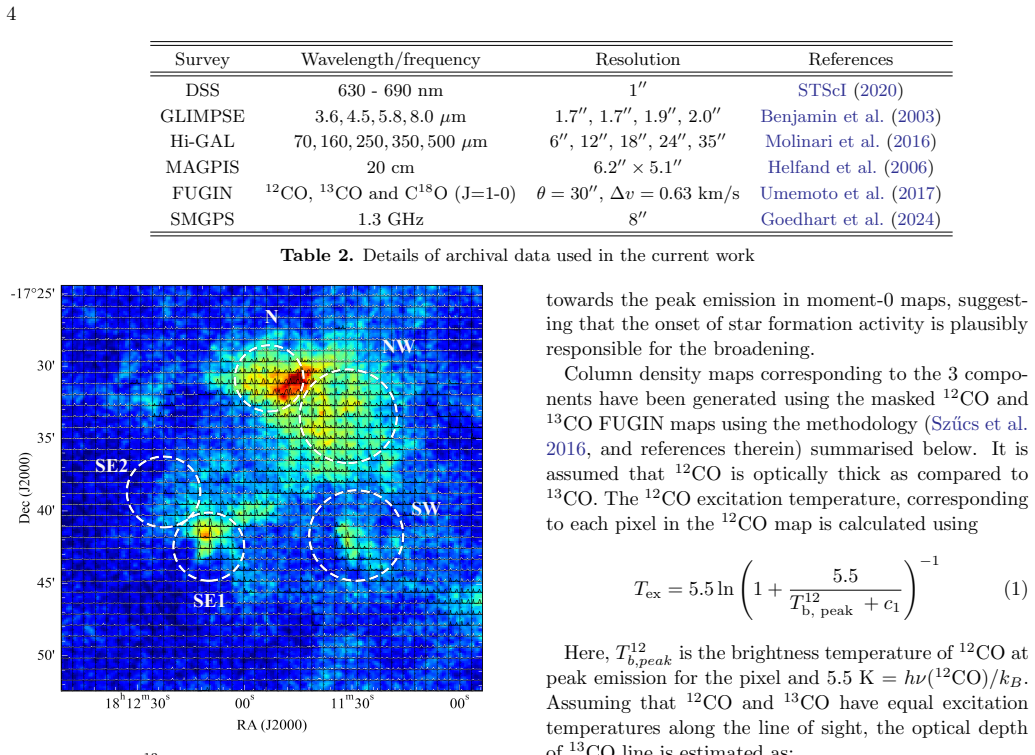
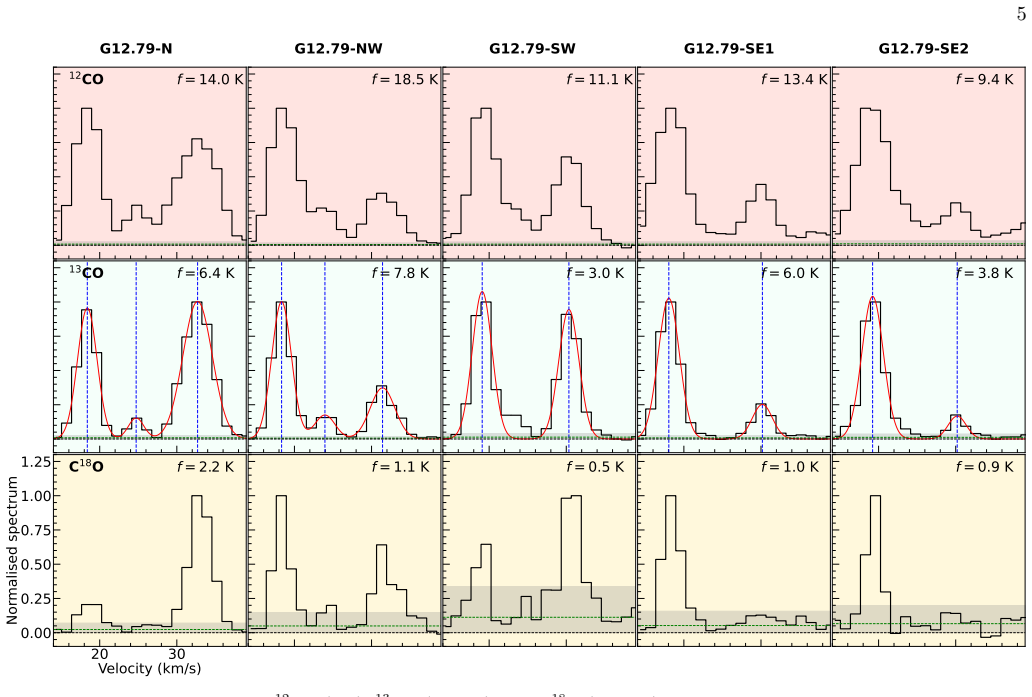
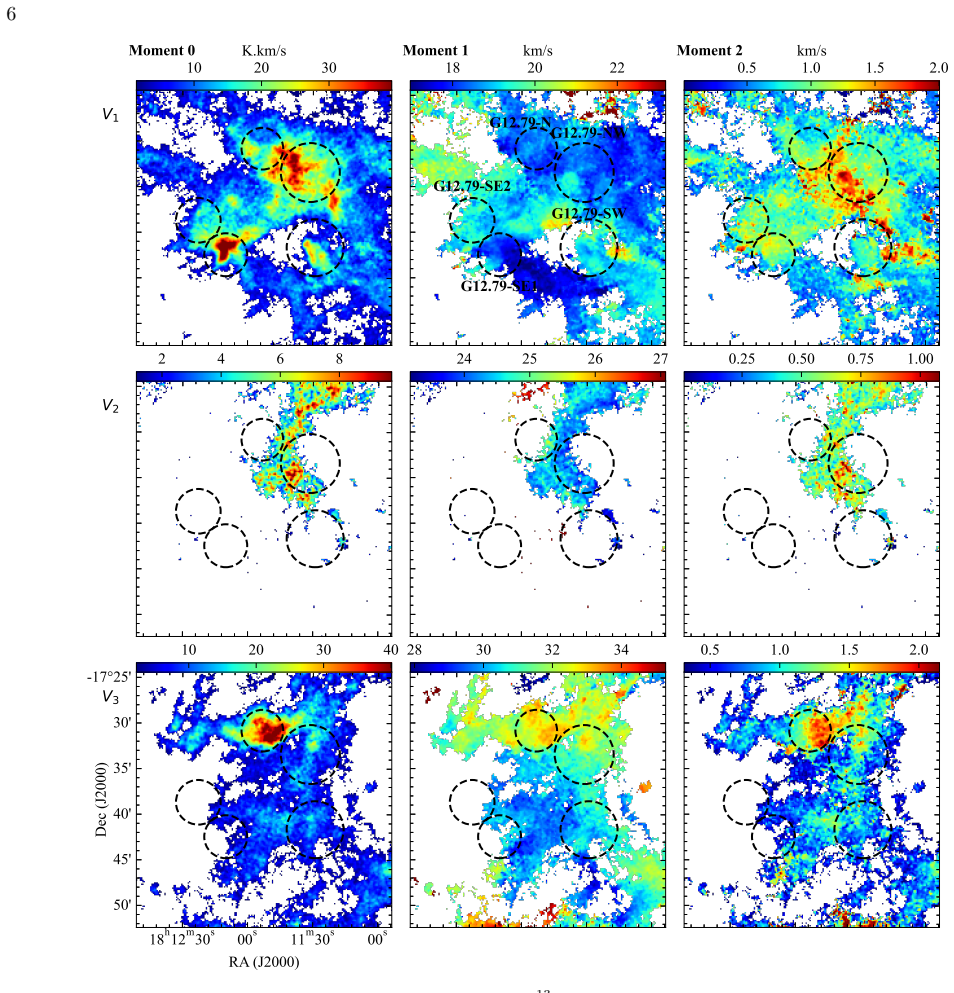
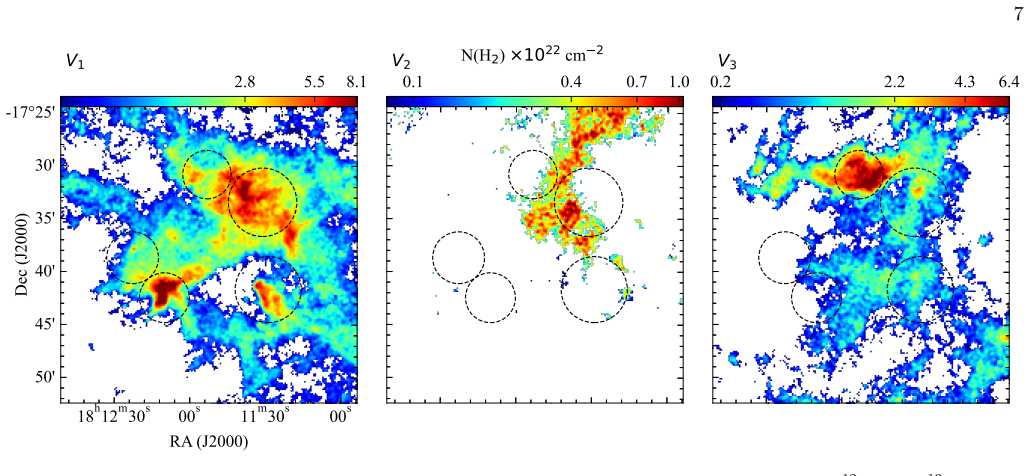
We present a multiwavelength investigation of the molecular cloud complex G12.79+0.43, which extends over $\sim18'$ on the sky. Several infrared- and radio-bright regions are arranged along an irregular rim, surrounding a central region characterised by diffuse 24~$\mu$m emission. CO molecular line observations reveal three prominent velocity components along the line of sight. Low-frequency radio continuum observations at 666 and 1300~MHz show diffuse emission spanning $\sim10.5'$ ($\sim$7.3~pc), predominantly filling the central region enclosed by the infrared-bright structures. We identify 70 compact radio sources and six \hii~regions across the cloud complex, which are likely powered by early B-type ZAMS stars. Using infrared data, we identify a total of 82 YSO candidates, including 28 Class~I sources, distributed across the cloud complex. On larger scales, the kinematics of the molecular gas over a $2^\circ\times2^\circ$ field indicate that G12.79+0.43 is located along the rim of a larger molecular superbubble (diameter $\sim50$~pc) that also encompasses the well-known W33 region. The inferred expansion age of this superbubble is $\sim0.3$~Myr. While the spatial association between G12.79+0.43 and the superbubble is evident, the current data do not allow us to establish a clear causal connection between the superbubble evolution and the ongoing star formation within G12.79+0.43.
Editorial analysis
A structured set of objections, weighed in public.
Referee Report
Summary. The manuscript presents multiwavelength observations (CO lines, radio continuum at 666/1300 MHz, IR photometry) of the ~18' molecular cloud complex G12.79+0.43. It identifies 82 YSO candidates (28 Class I) and 6 HII regions powered by early B-type stars, notes diffuse radio emission filling a central region, and uses 2°×2° CO kinematics to argue that G12.79+0.43 lies along the rim of a larger ~50 pc molecular superbubble also containing W33, with an inferred expansion age of ~0.3 Myr. The authors explicitly state that the data show spatial association but do not establish a causal link between superbubble evolution and the observed star formation.
Significance. If the kinematic association holds, the work supplies a concrete observational example of star formation occurring at the periphery of a Galactic molecular superbubble, adding to the literature on feedback and possible triggering. Strengths include the multi-tracer source census and the authors' explicit caution against inferring causation. No machine-checked proofs or parameter-free derivations are present, as expected for an observational study.
major comments (1)
- [Kinematics / CO velocity components] Kinematics section (2°×2° field analysis): the claim that G12.79+0.43 lies on the rim of the ~50 pc superbubble rests on interpreting the three CO velocity components as indicating physical association rather than line-of-sight projection; this premise directly supports the diameter and ~0.3 Myr age and requires either a quantitative estimate of chance-alignment probability or additional corroborating data (e.g., extinction or proper-motion matches) to be load-bearing.
minor comments (2)
- [Methods / source identification] Methods section: the source extraction, contamination removal, and distance assumptions used to classify the 70 compact radio sources and 82 YSOs should be stated with explicit criteria and any adopted distance value, for reproducibility.
- [Figures / text] Figure captions and text: ensure consistent use of units when converting angular sizes (e.g., 18', 10.5', 2°) to physical scales, and clarify which velocity component is assigned to the superbubble rim.
Simulated Author's Rebuttal
We thank the referee for the constructive review and recommendation for minor revision. We address the single major comment below, noting that the manuscript already cautions against inferring causation from the observed association.
read point-by-point responses
-
Referee: [Kinematics / CO velocity components] Kinematics section (2°×2° field analysis): the claim that G12.79+0.43 lies on the rim of the ~50 pc superbubble rests on interpreting the three CO velocity components as indicating physical association rather than line-of-sight projection; this premise directly supports the diameter and ~0.3 Myr age and requires either a quantitative estimate of chance-alignment probability or additional corroborating data (e.g., extinction or proper-motion matches) to be load-bearing.
Authors: We agree that the superbubble identification relies on interpreting the three CO velocity components, observed across the 2°×2° field, as tracing a coherent expanding structure rather than unrelated projections. The position-velocity diagrams and channel maps show morphological continuity consistent with a shell encompassing both G12.79+0.43 and W33. The ~50 pc diameter and ~0.3 Myr age follow directly from this kinematic picture and standard expansion assumptions. A quantitative chance-alignment probability cannot be calculated without a detailed statistical model of inner-Galaxy CO crowding and velocity fields, which lies outside the scope of this observational paper and would itself be assumption-dependent. Additional corroborating data (proper motions, extinction) are not available in the current multiwavelength dataset. We have therefore added a clarifying sentence in Section 4.2 stating that the association is kinematic and morphological but that line-of-sight projection remains possible; the text continues to emphasize that no causal link to star formation is claimed. This constitutes a partial revision. revision: partial
Circularity Check
No significant circularity
full rationale
The manuscript is a purely observational study relying on multiwavelength survey data (CO lines, infrared, radio continuum) to report spatial and kinematic associations. No equations, fitted parameters, derivations, or model predictions appear in the provided text. The superbubble diameter and expansion age are inferred from standard kinematic scaling of external 2°×2° field data; the paper explicitly states that causality cannot be established. No self-citation chains, self-definitional steps, or fitted inputs renamed as predictions are present. The central claims remain independent of any internal reduction to the paper's own inputs.
Axiom & Free-Parameter Ledger
free parameters (1)
- superbubble expansion age
axioms (2)
- domain assumption Radio continuum sources at 666 and 1300 MHz are HII regions powered by early B-type ZAMS stars
- domain assumption IR color criteria reliably separate Class I YSOs from other sources
Reference graph
Works this paper leans on
-
[1]
, year = 1960, month = jan, volume =
A catalogue of H -emission regions in the southern Milky Way. , year = 1960, month = jan, volume =. doi:10.1093/mnras/121.1.103 , adsurl =
-
[2]
GS 121-05-037: A new Galactic chimney candidate with signs of triggered star formation. , keywords =. doi:10.1051/0004-6361/202243942 , adsurl =
-
[3]
The `Carina Flare' supershell: probing the atomic and molecular ISM in a Galactic chimney. , keywords =. doi:10.1111/j.1365-2966.2008.13152.x , archivePrefix =. 0802.4463 , primaryClass =
-
[4]
Hot dust, ionised gas, and binarity at au scales
The first interferometric survey of massive YSOs in the K-band. Hot dust, ionised gas, and binarity at au scales. , keywords =. doi:10.1051/0004-6361/202141373 , archivePrefix =. 2108.02868 , primaryClass =
-
[5]
Infrared Dust Bubbles: Probing the Detailed Structure and Young Massive Stellar Populations of Galactic H II Regions. , keywords =. doi:10.1086/588005 , archivePrefix =. 0806.0609 , primaryClass =
work page internal anchor Pith review Pith/arXiv arXiv doi:10.1086/588005
-
[6]
The Bubbling Galactic Disk. , keywords =. doi:10.1086/507015 , adsurl =
-
[7]
The CO-to-H _ 2 conversion factor of Galactic giant molecular clouds using CO isotopologues: high-resolution X _ CO maps. , keywords =. doi:10.1093/mnras/stad3648 , archivePrefix =. 2311.13760 , primaryClass =
-
[8]
Trigonometric Parallaxes of Massive Star Forming Regions: G012.88+0.48 and W33
Trigonometric parallaxes of massive star forming regions: G012.88+0.48 and W33. , keywords =. doi:10.1051/0004-6361/201220793 , archivePrefix =. 1304.2041 , primaryClass =
work page internal anchor Pith review Pith/arXiv arXiv doi:10.1051/0004-6361/201220793 2041
-
[9]
, year = 2012, month = jul, volume =
The Milky Way Project First Data Release: a bubblier Galactic disc. , keywords =. doi:10.1111/j.1365-2966.2012.20770.x , archivePrefix =. 1201.6357 , primaryClass =
-
[10]
Molecular Superbubbles in the Starburst Galaxy NGC 253
Molecular Superbubbles in the Starburst Galaxy NGC 253. , keywords =. doi:10.1086/498075 , archivePrefix =. astro-ph/0509430 , primaryClass =
work page internal anchor Pith review Pith/arXiv arXiv doi:10.1086/498075
-
[11]
Gas shells and magnetic fields in the Orion-Eridanus superbubble. , keywords =. doi:10.1051/0004-6361/201936239 , archivePrefix =. 1909.10083 , primaryClass =
-
[12]
Star formation towards the southern Cometary HII region IRAS 17256-3631
Star formation towards the southern cometary H II region IRAS 17256-3631. , keywords =. doi:10.1093/mnras/stv2832 , archivePrefix =. 1512.00987 , primaryClass =
work page internal anchor Pith review Pith/arXiv arXiv doi:10.1093/mnras/stv2832
-
[13]
Low-velocity large-scale shocks in the infrared dark cloud G035.39-00.33: Bubble-driven cloud-cloud collisions. , keywords =. doi:10.1051/0004-6361/202556057 , archivePrefix =. 2508.06081 , primaryClass =
-
[14]
Giant Molecular Clouds in RCW 106 (G333): Galactic Mini-starbursts and Massive Star Formation Induced by Supersonic Cloud─Cloud Collisions. , keywords =. doi:10.3847/1538-3881/adae87 , archivePrefix =. 2501.14575 , primaryClass =
-
[15]
The Two Molecular Clouds in RCW 38: Evidence for the Formation of the Youngest Super Star Cluster in the Milky Way Triggered by Cloud-Cloud Collision. , keywords =. doi:10.3847/0004-637X/820/1/26 , archivePrefix =. 1504.05391 , primaryClass =
work page internal anchor Pith review Pith/arXiv arXiv doi:10.3847/0004-637x/820/1/26
-
[16]
Star forming activity in the H II regions associated with IRAS 17160-3707 complex
Star-forming Activity in the H II Regions Associated with the IRAS 17160-3707 Complex. , keywords =. doi:10.3847/0004-6256/152/5/146 , archivePrefix =. 1607.01267 , primaryClass =
work page internal anchor Pith review Pith/arXiv arXiv doi:10.3847/0004-6256/152/5/146
-
[17]
Associated Molecular and Atomic Clouds with X-Ray Shell of Superbubble 30 Doradus C in the LMC. , keywords =. doi:10.3847/1538-4357/ac0adb , archivePrefix =. 2106.09916 , primaryClass =
-
[18]
Journal of Physics Conference Series , year = 2024, series =
Galactic Superbubbles in 3D: Wind Formation and Cloud Shielding. Journal of Physics Conference Series , year = 2024, series =. doi:10.1088/1742-6596/2796/1/012004 , archivePrefix =. 2404.13498 , primaryClass =
-
[19]
The Formation of Massive Molecular Filaments and Massive Stars Triggered by a MHD Shock Wave
The formation of massive molecular filaments and massive stars triggered by a magnetohydrodynamic shock wave. , keywords =. doi:10.1093/pasj/psx089 , archivePrefix =. 1707.02035 , primaryClass =
work page internal anchor Pith review Pith/arXiv arXiv doi:10.1093/pasj/psx089
-
[20]
A Detailed Study of Molecular Clouds toward the TeV Gamma-Ray SNR G347.3-0.5
A Detailed Study of Molecular Clouds toward the TeV Gamma-Ray Supernova Remnant G347.3-0.5. , keywords =. doi:10.1086/432653 , archivePrefix =. astro-ph/0506489 , primaryClass =
work page internal anchor Pith review Pith/arXiv arXiv doi:10.1086/432653
-
[21]
A Bubbling Nearby Molecular Cloud: COMPLETE Shells in Perseus
A Bubbling Nearby Molecular Cloud: COMPLETE Shells in Perseus. , keywords =. doi:10.1088/0004-637X/742/2/105 , archivePrefix =. 1109.3368 , primaryClass =
work page internal anchor Pith review Pith/arXiv arXiv doi:10.1088/0004-637x/742/2/105
-
[22]
Quantifying the energetics of molecular superbubbles in PHANGS galaxies. , keywords =. doi:10.1051/0004-6361/202346075 , archivePrefix =. 2302.03699 , primaryClass =
-
[23]
PHANGS-JWST First Results: Multiwavelength View of Feedback-driven Bubbles (the Phantom Voids) across NGC 628. , keywords =. doi:10.3847/2041-8213/aca7b9 , archivePrefix =. 2212.00812 , primaryClass =
-
[24]
, year = 2012, month = jul, volume =
GSH 006-15+7: a local Galactic supershell featuring transition from H I emission to absorption. , keywords =. doi:10.1111/j.1365-2966.2012.20538.x , archivePrefix =. 1201.2700 , primaryClass =
-
[25]
Feedback from Massive YSOs and Massive Stars
Feedback from Massive YSOs and Massive Stars. Bulletin de la Societe Royale des Sciences de Liege , keywords =. doi:10.48550/arXiv.1012.1373 , archivePrefix =. 1012.1373 , primaryClass =
work page internal anchor Pith review Pith/arXiv arXiv doi:10.48550/arxiv.1012.1373
-
[26]
IAU Colloq
Supershells. IAU Colloq. 101: Supernova Remnants and the Interstellar Medium , year = 1988, editor =
1988
-
[27]
The UKIDSS Galactic Plane Survey. , keywords =. doi:10.1111/j.1365-2966.2008.13924.x , archivePrefix =. 0712.0100 , primaryClass =
-
[28]
GLIMPSE. I. An SIRTF Legacy Project to Map the Inner Galaxy. , keywords =. doi:10.1086/376696 , archivePrefix =. astro-ph/0306274 , primaryClass =
work page internal anchor Pith review Pith/arXiv arXiv doi:10.1086/376696
-
[29]
Hi-GAL, the Herschel infrared Galactic Plane Survey: photometric maps and compact source catalogues. First data release for the inner Milky Way: +68 l -70. , keywords =. doi:10.1051/0004-6361/201526380 , archivePrefix =. 1604.05911 , primaryClass =
work page internal anchor Pith review Pith/arXiv arXiv doi:10.1051/0004-6361/201526380
-
[30]
SEDIGISM: Structure, excitation, and dynamics of the inner Galactic interstellar medium
SEDIGISM: Structure, excitation, and dynamics of the inner Galactic interstellar medium. , keywords =. doi:10.1051/0004-6361/201628933 , archivePrefix =. 1701.04712 , primaryClass =
work page internal anchor Pith review Pith/arXiv arXiv doi:10.1051/0004-6361/201628933
-
[31]
The SEDIGISM survey: First Data Release and overview of the Galactic structure. , keywords =. doi:10.1093/mnras/staa2369 , archivePrefix =. 2012.01527 , primaryClass =
-
[32]
FOREST unbiased Galactic plane imaging survey with the Nobeyama 45 m telescope (FUGIN). I. Project overview and initial results. , keywords =. doi:10.1093/pasj/psx061 , archivePrefix =. 1707.05981 , primaryClass =
work page internal anchor Pith review Pith/arXiv arXiv doi:10.1093/pasj/psx061
-
[33]
IAU Colloq
Giant metrewave radio telescope (GMRT). IAU Colloq. 131: Radio Interferometry. Theory, Techniques, and Applications , year = 1991, editor =
1991
-
[34]
Current Science , year = 2017, month = aug, volume =
The upgraded GMRT: opening new windows on the radio Universe. Current Science , year = 2017, month = aug, volume =. doi:10.18520/cs/v113/i04/707-714 , adsurl =
-
[35]
ATLASGAL - The APEX Telescope Large Area Survey of the Galaxy at 870 microns
ATLASGAL - The APEX telescope large area survey of the galaxy at 870 m. , keywords =. doi:10.1051/0004-6361/200811568 , archivePrefix =. 0903.1369 , primaryClass =
work page internal anchor Pith review Pith/arXiv arXiv doi:10.1051/0004-6361/200811568
-
[36]
The Continuum Spectra of Dust Complexes Associated with W3 Main, M42, W49A, and W51A. , keywords =. doi:10.1086/165197 , adsurl =
-
[37]
Probing the Massive Star-forming Environment: A Multiwavelength Investigation of the Filamentary IRDC G333.73+0.37. , keywords =. doi:10.3847/1538-4357/aa9aef , archivePrefix =. 1711.06398 , primaryClass =
work page internal anchor Pith review Pith/arXiv arXiv doi:10.3847/1538-4357/aa9aef
-
[38]
Common-Resolution Convolution Kernels for Space- and Ground-Based Telescopes
Common-Resolution Convolution Kernels for Space- and Ground-Based Telescopes. , keywords =. doi:10.1086/662219 , archivePrefix =. 1106.5065 , primaryClass =
work page internal anchor Pith review Pith/arXiv arXiv doi:10.1086/662219
-
[39]
The Milky Way Project Second Data Release: Bubbles and Bow Shocks
The Milky Way Project second data release: bubbles and bow shocks. , keywords =. doi:10.1093/mnras/stz1738 , archivePrefix =. 1905.12625 , primaryClass =
work page internal anchor Pith review Pith/arXiv arXiv doi:10.1093/mnras/stz1738 1905
-
[40]
A Detailed Study of Spitzer-IRAC Emission in Herbig-Haro Objects. I. Morphology and Flux Ratios of Shocked Emission. , keywords =. doi:10.1088/0004-637X/720/1/155 , archivePrefix =. 1008.1111 , primaryClass =
work page internal anchor Pith review Pith/arXiv arXiv doi:10.1088/0004-637x/720/1/155
-
[41]
High-Mass Protostellar Candidates. I. The Sample and Initial Results. , keywords =. doi:10.1086/338332 , archivePrefix =. astro-ph/0110363 , primaryClass =
work page internal anchor Pith review Pith/arXiv arXiv doi:10.1086/338332
-
[42]
Automated Classification of 2000 Bright IRAS Sources
Automated Classification of 2000 Bright IRAS Sources. , keywords =. doi:10.1086/420967 , archivePrefix =. astro-ph/0403230 , primaryClass =
work page internal anchor Pith review Pith/arXiv arXiv doi:10.1086/420967 2000
-
[43]
The Bolocam Galactic Plane Survey. XIV. Physical Properties of Massive Starless and Star-forming Clumps. , keywords =. doi:10.3847/0004-637X/822/2/59 , archivePrefix =. 1511.08810 , primaryClass =
work page internal anchor Pith review Pith/arXiv arXiv doi:10.3847/0004-637x/822/2/59
-
[44]
Methanol masers reveal the magnetic field of the high-mass protostar IRAS 18089-1732
Methanol masers reveal the magnetic field of the high-mass protostar IRAS 18089-1732. , keywords =. doi:10.1051/0004-6361/201731297 , archivePrefix =. 1708.02961 , primaryClass =
work page internal anchor Pith review Pith/arXiv arXiv doi:10.1051/0004-6361/201731297
-
[45]
Short-period variability in the Class II methanol maser source G12.89+0.49 (IRAS 18089-1732). , keywords =. doi:10.1111/j.1365-2966.2009.15176.x , archivePrefix =. 0906.0295 , primaryClass =
-
[46]
MAGPIS: A Multi-Array Galactic Plane Imaging Survey. , keywords =. doi:10.1086/503253 , adsurl =
-
[47]
The Green Bank Telescope H II Region Discovery Survey. II. The Source Catalog. , keywords =. doi:10.1088/0067-0049/194/2/32 , archivePrefix =. 1103.5085 , primaryClass =
work page internal anchor Pith review Pith/arXiv arXiv doi:10.1088/0067-0049/194/2/32
-
[48]
The physical and chemical structure of Sagittarius B2. I. Three-dimensional thermal dust and free-free continuum modeling on 100 au to 45 pc scales. , keywords =. doi:10.1051/0004-6361/201527311 , archivePrefix =. 1602.02274 , primaryClass =
work page internal anchor Pith review Pith/arXiv arXiv doi:10.1051/0004-6361/201527311
-
[49]
The Electron Temperature Gradient in the Galactic Disk
The Electron Temperature Gradient in the Galactic Disk. , keywords =. doi:10.1086/508803 , archivePrefix =. astro-ph/0609006 , primaryClass =
work page internal anchor Pith review Pith/arXiv arXiv doi:10.1086/508803
-
[50]
ATLASGAL --- properties of a complete sample of Galactic clumps
ATLASGAL - properties of a complete sample of Galactic clumps. , keywords =. doi:10.1093/mnras/stx2258 , archivePrefix =. 1709.00392 , primaryClass =
work page internal anchor Pith review Pith/arXiv arXiv doi:10.1093/mnras/stx2258
-
[51]
doi:10.1093/mnras/staa2480 , archivePrefix =
The SEDIGISM survey: molecular clouds in the inner Galaxy. doi:10.1093/mnras/staa2480 , archivePrefix =. 2012.01502 , primaryClass =
-
[52]
The WISE Catalog of Galactic HII Regions
The WISE Catalog of Galactic H II Regions. , keywords =. doi:10.1088/0067-0049/212/1/1 , archivePrefix =. 1312.6202 , primaryClass =
work page internal anchor Pith review Pith/arXiv arXiv doi:10.1088/0067-0049/212/1/1
-
[53]
Submillimeter Array multiline observations of the massive star-forming region IRAS 18089-1732
Submillimeter Array Multiline observations of the Massive Star-forming region IRAS 18089-1732. , keywords =. doi:10.1086/422500 , archivePrefix =. astro-ph/0406020 , primaryClass =
work page internal anchor Pith review Pith/arXiv arXiv doi:10.1086/422500
-
[54]
SMA outflow/disk studies in the massive star-forming region IRAS18089-1732
Submillimeter Array Outflow/Disk Studies in the Massive Star-forming Region IRAS 18089-1732. , keywords =. doi:10.1086/383570 , archivePrefix =. astro-ph/0402505 , primaryClass =
work page internal anchor Pith review Pith/arXiv arXiv doi:10.1086/383570
-
[55]
New detections of HC$_{5}$N toward hot cores associated with 6.7 GHz methanol masers
New detections of HC _ 5 N towards hot cores associated with 6.7 GHz methanol masers. , keywords =. doi:10.1093/mnras/stu1349 , archivePrefix =. 1407.1699 , primaryClass =
work page internal anchor Pith review Pith/arXiv arXiv doi:10.1093/mnras/stu1349
-
[56]
The HCN/HNC abundance ratio toward different evolutionary phases of massive star formation
The HCN/HNC Abundance Ratio Toward Different Evolutionary Phases of Massive Star Formation. , keywords =. doi:10.1088/0067-0049/219/1/2 , archivePrefix =. 1505.00849 , primaryClass =
work page internal anchor Pith review Pith/arXiv arXiv doi:10.1088/0067-0049/219/1/2
-
[57]
Observations of Cyanopolyynes toward Four High-Mass Star-Forming Regions Containing Hot Cores
Observations of Cyanopolyynes toward Four High-mass Star-forming Regions Containing Hot Cores. , keywords =. doi:10.3847/1538-4357/aa7899 , archivePrefix =. 1706.02465 , primaryClass =
work page internal anchor Pith review Pith/arXiv arXiv doi:10.3847/1538-4357/aa7899
-
[58]
Class I and Class II methanol masers in high-mass star forming regions
Class I and Class II methanol masers in high-mass star-forming regions. , keywords =. doi:10.1051/0004-6361/200913679 , archivePrefix =. 1004.3689 , primaryClass =
work page internal anchor Pith review Pith/arXiv arXiv doi:10.1051/0004-6361/200913679
-
[59]
CH3OH and H2O masers in high-mass star-forming regions
CH _ 3 OH and H _ 2 O masers in high-mass star-forming regions. , keywords =. doi:10.1051/0004-6361:20020710 , archivePrefix =. astro-ph/0205348 , primaryClass =
work page internal anchor Pith review Pith/arXiv arXiv doi:10.1051/0004-6361:20020710
-
[60]
A Survey of OH Masers Towards High Mass Protostellar Objects
A survey of OH masers towards high mass protostellar objects. , keywords =. doi:10.1051/0004-6361:20066280 , archivePrefix =. astro-ph/0701652 , primaryClass =
work page internal anchor Pith review Pith/arXiv arXiv doi:10.1051/0004-6361:20066280
-
[61]
ATLASGAL - evolutionary trends in high-mass star formation. , keywords =. doi:10.1093/mnras/stab3511 , archivePrefix =. 2111.12816 , primaryClass =
-
[62]
A Mid-Infrared Census of Star Formation Activity in Bolocam Galactic Plane Survey Sources
A Mid-infrared Census of Star Formation Activity in Bolocam Galactic Plane Survey Sources. , keywords =. doi:10.1088/0004-637X/731/2/90 , archivePrefix =. 1102.1032 , primaryClass =
work page internal anchor Pith review Pith/arXiv arXiv doi:10.1088/0004-637x/731/2/90
-
[63]
The SEDIGISM survey: A search for molecular outflows. , keywords =. doi:10.1051/0004-6361/202142039 , archivePrefix =. 2111.10850 , primaryClass =
-
[64]
Trigonometric Parallaxes of High Mass Star Forming Regions: The Structure and Kinematics of the Milky Way. , keywords =. doi:10.1088/0004-637X/783/2/130 , archivePrefix =. 1401.5377 , primaryClass =
work page internal anchor Pith review Pith/arXiv arXiv doi:10.1088/0004-637x/783/2/130
-
[65]
The relation between gas and dust in the Taurus Molecular Cloud
The Relation Between Gas and Dust in the Taurus Molecular Cloud. , keywords =. doi:10.1088/0004-637X/721/1/686 , archivePrefix =. 1007.5060 , primaryClass =
work page internal anchor Pith review Pith/arXiv arXiv doi:10.1088/0004-637x/721/1/686
-
[66]
How well does CO emission measure the H$_2$ mass of MCs?
How well does CO emission measure the H _ 2 mass of MCs?. , keywords =. doi:10.1093/mnras/stw912 , archivePrefix =. 1604.04545 , primaryClass =
work page internal anchor Pith review Pith/arXiv arXiv doi:10.1093/mnras/stw912
-
[67]
, keywords =
A CS(2-1) survey of IRAS point sources with color characteristics of ultra-compact HII regions. , keywords =
-
[68]
The JCMT Plane Survey: First complete data release - emission maps and compact source catalogue
The JCMT Plane Survey: first complete data release - emission maps and compact source catalogue. , keywords =. doi:10.1093/mnras/stx874 , archivePrefix =. 1704.02982 , primaryClass =
work page internal anchor Pith review Pith/arXiv arXiv doi:10.1093/mnras/stx874
-
[69]
Intrinsically Red Sources observed by Spitzer in the Galactic Mid-Plane
Intrinsically Red Sources Observed by Spitzer in the Galactic Midplane. , keywords =. doi:10.1088/0004-6256/136/6/2413 , archivePrefix =. 0809.1654 , primaryClass =
work page internal anchor Pith review Pith/arXiv arXiv doi:10.1088/0004-6256/136/6/2413
-
[70]
SPICY: The Spitzer/IRAC Candidate YSO Catalog for the Inner Galactic Midplane. , keywords =. doi:10.3847/1538-4365/abe465 , archivePrefix =. 2011.12961 , primaryClass =
-
[71]
Initial Results from The Spitzer Young Stellar Cluster Survey
Initial Results from the Spitzer Young Stellar Cluster Survey. , keywords =. doi:10.1086/422823 , archivePrefix =. astro-ph/0406008 , primaryClass =
work page internal anchor Pith review Pith/arXiv arXiv doi:10.1086/422823
-
[72]
Infrared Array Camera (IRAC) Colors of Young Stellar Objects. , keywords =. doi:10.1086/422715 , adsurl =
-
[73]
Study of young stellar objects and associated filamentary structures in the inner Galaxy
Study of young stellar objects and associated filamentary structures in the inner Galaxy. , keywords =. doi:10.1093/mnras/stt1324 , archivePrefix =. 1307.5225 , primaryClass =
work page internal anchor Pith review Pith/arXiv arXiv doi:10.1093/mnras/stt1324
-
[74]
A modular set of synthetic spectral energy distributions for young stellar objects
A modular set of synthetic spectral energy distributions for young stellar objects. , keywords =. doi:10.1051/0004-6361/201425486 , archivePrefix =. 1703.05765 , primaryClass =
work page internal anchor Pith review Pith/arXiv arXiv doi:10.1051/0004-6361/201425486
-
[75]
Interpreting Spectral Energy Distributions from Young Stellar Objects. II. Fitting Observed SEDs Using a Large Grid of Precomputed Models. , keywords =. doi:10.1086/512039 , archivePrefix =. astro-ph/0612690 , primaryClass =
work page internal anchor Pith review Pith/arXiv arXiv doi:10.1086/512039
-
[76]
Interpreting Spectral Energy Distributions from Young Stellar Objects. I. A Grid of 200,000 YSO Model SEDs. , keywords =. doi:10.1086/508424 , archivePrefix =. astro-ph/0608234 , primaryClass =
work page internal anchor Pith review Pith/arXiv arXiv doi:10.1086/508424
-
[77]
, year = 2012, month = jul, volume =
PARSEC: stellar tracks and isochrones with the PAdova and TRieste Stellar Evolution Code. , keywords =. doi:10.1111/j.1365-2966.2012.21948.x , archivePrefix =. 1208.4498 , primaryClass =
-
[78]
Improving PARSEC models for very low mass stars
Improving PARSEC models for very low mass stars. , keywords =. doi:10.1093/mnras/stu1605 , archivePrefix =. 1409.0322 , primaryClass =
work page internal anchor Pith review Pith/arXiv arXiv doi:10.1093/mnras/stu1605
-
[79]
PARSEC evolutionary tracks of massive stars up to 350 M _ at metallicities 0.0001 Z 0.04. , keywords =. doi:10.1093/mnras/stv1281 , archivePrefix =. 1506.01681 , primaryClass =
work page internal anchor Pith review Pith/arXiv arXiv doi:10.1093/mnras/stv1281
-
[80]
New PARSEC data base of -enhanced stellar evolutionary tracks and isochrones - I. Calibration with 47 Tuc (NGC 104) and the improvement on RGB bump. , keywords =. doi:10.1093/mnras/sty235 , archivePrefix =. 1801.07137 , primaryClass =
work page internal anchor Pith review Pith/arXiv arXiv doi:10.1093/mnras/sty235
discussion (0)
Sign in with ORCID, Apple, or X to comment. Anyone can read and Pith papers without signing in.