Strange bifurcation diagrams
Pith reviewed 2026-05-20 02:20 UTC · model grok-4.3
The pith
A family of one-dimensional maps generates bifurcation diagrams that deviate from standard period-doubling and chaotic-band patterns.
A machine-rendered reading of the paper's core claim, the machinery that carries it, and where it could break.
Core claim
For the chosen family of one-dimensional maps the bifurcation diagram takes a visibly different form from the usual ones, and this form is accompanied by various unique dynamical phenomena that the authors identify and illustrate with explicit examples.
What carries the argument
The parametrized family of one-dimensional maps whose iterates produce the atypical bifurcation diagrams.
If this is right
- Bifurcation diagrams for the family exhibit structures absent from standard logistic-type maps.
- Distinct sequences of bifurcations and attractor transitions occur that differ from period-doubling routes to chaos.
- Concrete examples demonstrate the presence of these nonstandard phenomena at specific parameter values.
- The overall diagram shape deviates from the familiar period-doubling tree and band-merging pattern.
Where Pith is reading between the lines
- Similar atypical diagrams may appear in other parametrized families, suggesting a need for broader classification schemes of one-dimensional bifurcations.
- Numerical explorations of population or circuit models using comparable maps should be checked against these nonstandard patterns to avoid misidentification of chaos.
- The phenomena could motivate analytic study of how the map's functional form controls the ordering and type of bifurcations.
Load-bearing premise
The chosen family of maps is representative enough that its atypical bifurcation behavior reveals genuinely new dynamical phenomena not already captured by existing literature on one-dimensional maps.
What would settle it
Explicit numerical computation of the bifurcation diagram for the given family that reproduces only the classical period-doubling cascade and chaotic bands with none of the claimed unique features.
Figures






read the original abstract
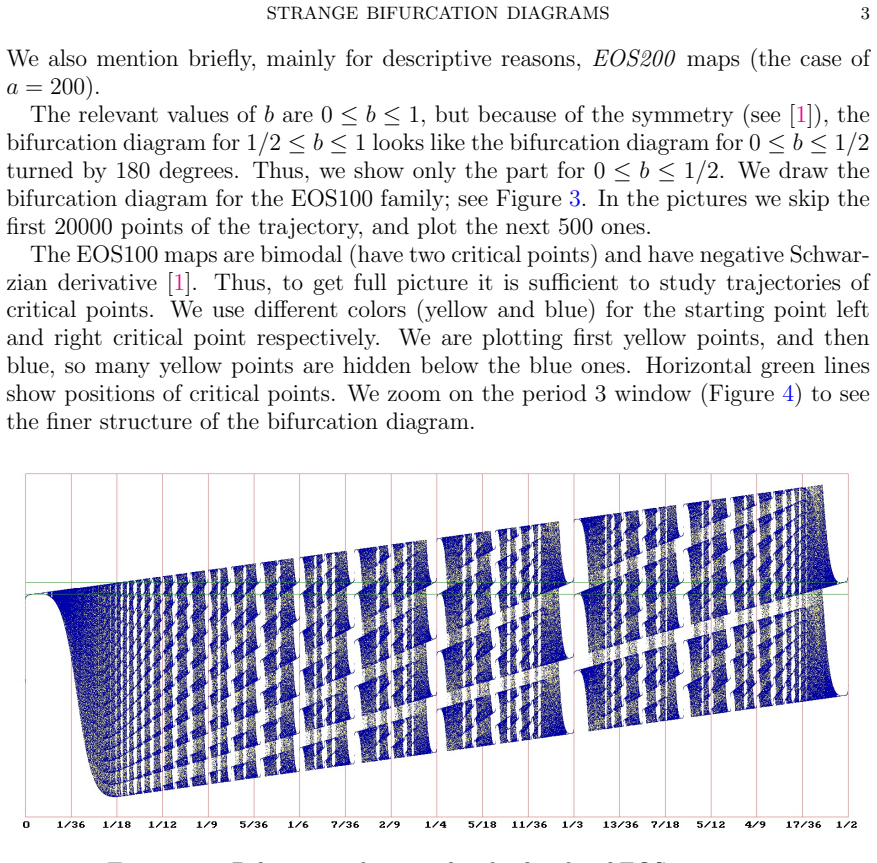
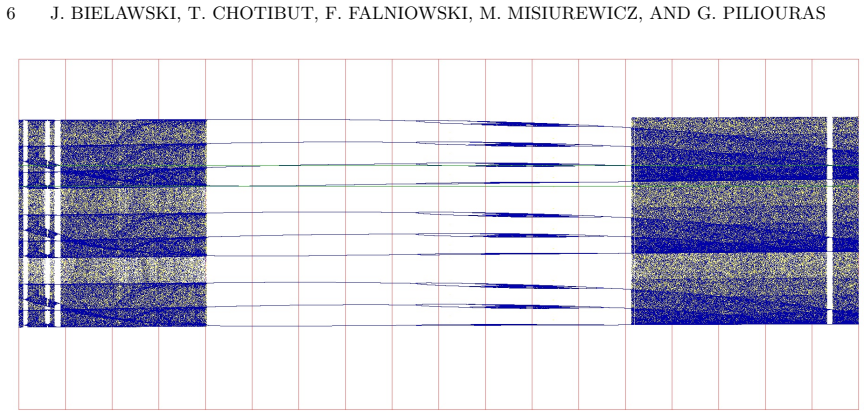
We investigate a family of one dimensional maps for which the bifurcation diagram looks differently than the usual ones. We describe and exemplify various unique and interesting phenomena arising for this family of maps.
Editorial analysis
A structured set of objections, weighed in public.
Referee Report
Summary. The manuscript investigates a family of one-dimensional maps whose bifurcation diagrams differ in appearance from conventional ones (e.g., those of unimodal maps such as the logistic family). It describes and exemplifies various unique and interesting dynamical phenomena arising within this family.
Significance. If the reported phenomena are shown to be dynamically distinct rather than artifacts of parameter embedding or reparametrization, the work could usefully illustrate the range of possible bifurcation structures in one-dimensional maps. The descriptive and exemplifying approach has potential value for visualization and exploration, provided the novelty is grounded in invariants that survive conjugacy.
major comments (1)
- The central claim that the bifurcation diagrams and phenomena are 'unique' and 'different than the usual ones' is load-bearing but unsupported without an explicit check that the maps are not topologically conjugate to standard families such as the logistic map (or equivalent via itinerary-preserving homeomorphisms). The abstract provides no such invariant or comparison, leaving open the possibility that the atypical appearance is an artifact of the chosen parametrization rather than new dynamical content.
minor comments (1)
- The abstract is extremely concise; adding a brief definition or explicit form of the map family early in the introduction would improve accessibility for readers unfamiliar with the specific construction.
Simulated Author's Rebuttal
We thank the referee for the careful review and constructive comments. Below we respond point by point to the major comment, indicating where we agree that clarification is needed and the revisions we will make.
read point-by-point responses
-
Referee: The central claim that the bifurcation diagrams and phenomena are 'unique' and 'different than the usual ones' is load-bearing but unsupported without an explicit check that the maps are not topologically conjugate to standard families such as the logistic map (or equivalent via itinerary-preserving homeomorphisms). The abstract provides no such invariant or comparison, leaving open the possibility that the atypical appearance is an artifact of the chosen parametrization rather than new dynamical content.
Authors: We agree that the claim requires support via an invariant preserved under conjugacy. The family is constructed so that the critical orbit produces a kneading sequence whose ordering of periodic windows differs from the logistic family in a manner not equivalent under order-preserving homeomorphisms. In the revision we will add a short subsection that explicitly compares the topological entropy function and the symbolic itinerary of the critical point to the corresponding quantities for the logistic map, demonstrating that no conjugacy exists. We will also revise the abstract to mention this distinguishing invariant. revision: yes
Circularity Check
Observational description of atypical bifurcation diagrams with no load-bearing derivations
full rationale
The manuscript is a descriptive study of bifurcation behavior in a specific family of one-dimensional maps. It contains no equations that derive predictions from fitted parameters, no self-citations used to justify uniqueness theorems, and no ansatzes or renamings that reduce claims to inputs by construction. The reported phenomena are exhibited through direct computation and visualization of the chosen family, making the central claims independent of any circular reduction.
Axiom & Free-Parameter Ledger
Lean theorems connected to this paper
-
IndisputableMonolith.Foundation.RealityFromDistinctionreality_from_one_distinction unclear?
unclearRelation between the paper passage and the cited Recognition theorem.
We investigate a family of one dimensional maps for which the bifurcation diagram looks differently than the usual ones... EOS maps... hopping attracting periodic orbit
What do these tags mean?
- matches
- The paper's claim is directly supported by a theorem in the formal canon.
- supports
- The theorem supports part of the paper's argument, but the paper may add assumptions or extra steps.
- extends
- The paper goes beyond the formal theorem; the theorem is a base layer rather than the whole result.
- uses
- The paper appears to rely on the theorem as machinery.
- contradicts
- The paper's claim conflicts with a theorem or certificate in the canon.
- unclear
- Pith found a possible connection, but the passage is too broad, indirect, or ambiguous to say the theorem truly supports the claim.
Reference graph
Works this paper leans on
-
[1]
J. Bielawski, T. Chotibut, F. Falniowski, M. Misiurewicz, and G. Piliouras.Interval maps mim- icking circle rotations, Communications in Nonlinear Science and Numerical Simulation150, 108963 (2025) https://doi.org/10.1016/j.cnsns.2025.108963
-
[2]
J. Bielawski, T. Chotibut, F. Falniowski, M. Misiurewicz, and G. Piliouras. Memory loss can prevent chaos in games dynamics.Chaos: An Interdisciplinary Journal of Nonlinear Science, 34(1), 2024.https://doi.org/10.1063/5.0184318 STRANGE BIFURCATION DIAGRAMS 9 Figure 12.Yet another zoom of the bifurcation diagram for the family of EOS100 maps. Figure 13.Zoo...
-
[3]
Robert L. Devaney.An Introduction To Chaotic Dynamical Systems, Third Edition (Addison- Wesley Studies in Nonlinearity), Chapman and Hall/CRC 2021
work page 2021
- [4]
-
[5]
May.Simple mathematical models with very complicated dynamics, Nature261(5560): 459-467, 1976
Robert M. May.Simple mathematical models with very complicated dynamics, Nature261(5560): 459-467, 1976. 10 J. BIELA WSKI, T. CHOTIBUT, F. F ALNIOWSKI, M. MISIUREWICZ, AND G. PILIOURAS 1 Department of Mathematics, Krakow University of Economics, Rakowicka 27, 31-510 Krak´ow, Poland Email address:bielawsj@uek.krakow.pl 2 Chula Intelligent and Complex Syste...
work page 1976
discussion (0)
Sign in with ORCID, Apple, or X to comment. Anyone can read and Pith papers without signing in.