Debiasing the Observed Fast Radio Burst Population with the CHIME/FRB Selection Function
Pith reviewed 2026-06-26 01:10 UTC · model grok-4.3
The pith
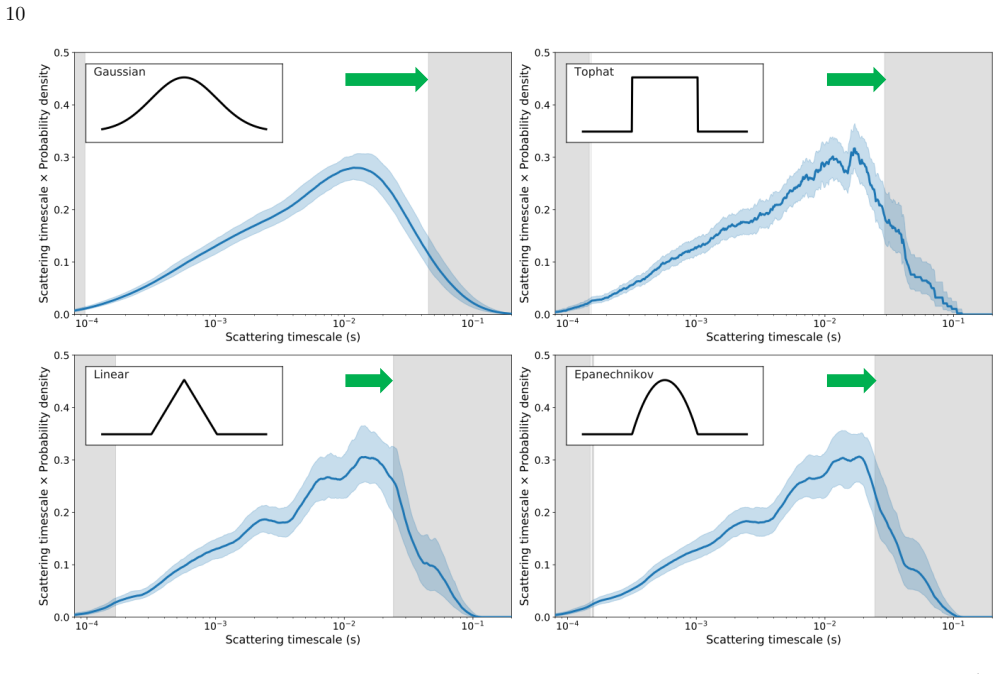
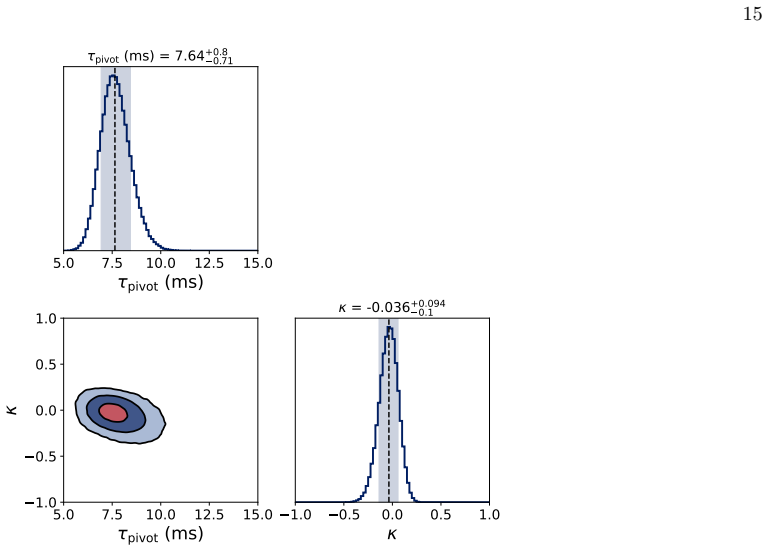
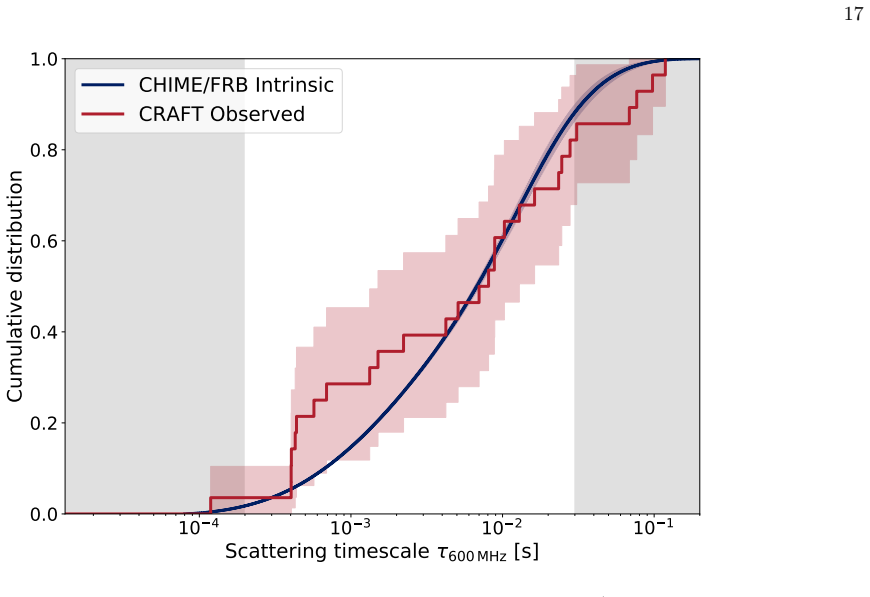
CHIME/FRB Catalog 2 data, after correction via 587k injected bursts, show evidence for a slight downturn in the intrinsic scattering timescale distribution.
A machine-rendered reading of the paper's core claim, the machinery that carries it, and where it could break.
Core claim
After constructing a multidimensional selection function from logistic regression on 587,367 injected synthetic FRBs, the team infers that the intrinsic scattering timescale distribution of the CHIME/FRB Catalog 2 population exhibits a slight downturn at longer timescales, a result reinforced by comparison with the CRAFT survey at higher frequencies, although a flat or slightly rising distribution cannot be ruled out.
What carries the argument
A logistic regression model trained on injected synthetic bursts that estimates the multidimensional detection probability including higher-order interaction terms.
If this is right
- The observed excess of short-scattering FRBs is partly produced by instrumental selection.
- Accurate inference of FRB population properties requires explicit inclusion of the multidimensional selection function.
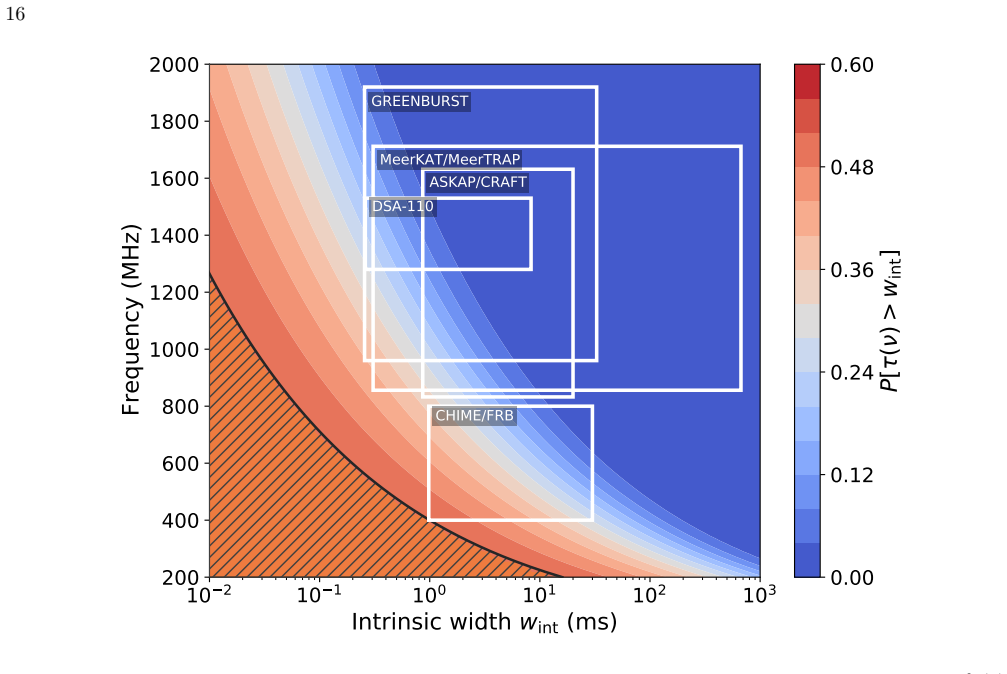
- Frequency-dependent comparisons between surveys can separate intrinsic source properties from propagation effects.
- Refined scattering distributions place tighter limits on possible progenitor environments and emission mechanisms.
Where Pith is reading between the lines
- If the downturn holds, it may mark a characteristic scale set by the typical scattering medium or source population.
- Extending injection campaigns to still larger scattering times would directly test whether the distribution continues to fall.
- Joint application of similar selection-function methods across multiple FRB surveys would enable combined population constraints.
Load-bearing premise
The logistic regression model trained on the injected events accurately estimates the multidimensional detection probability across the full range of observed scattering timescales.
What would settle it
A large sample of long-scattering FRBs detected by a survey whose selection function remains high at tau greater than or equal to 10 ms at 600 MHz would show whether the downturn is absent from the intrinsic distribution.
Figures
read the original abstract
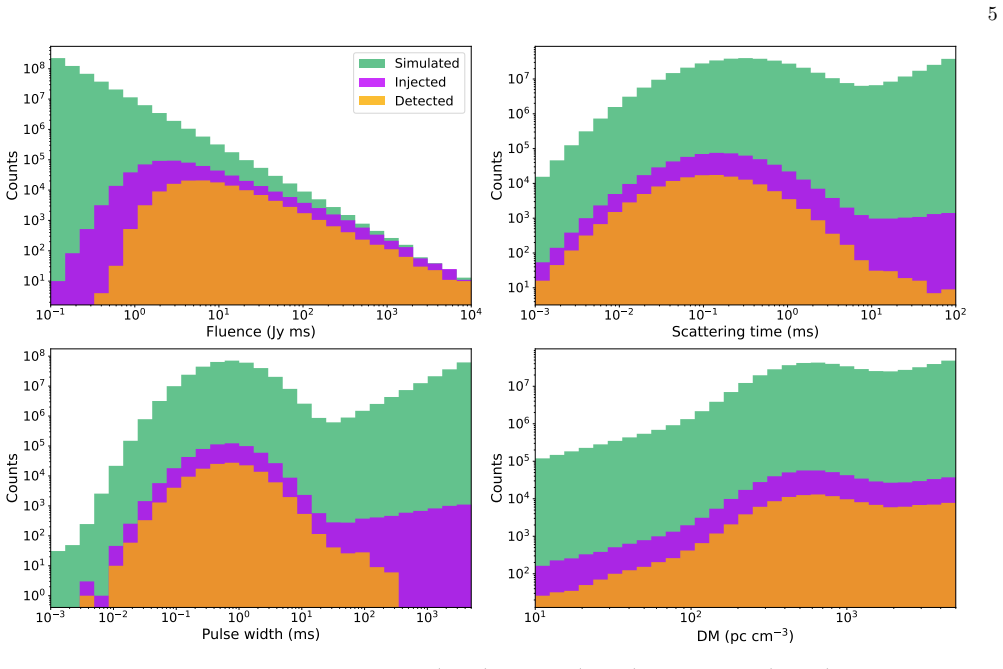
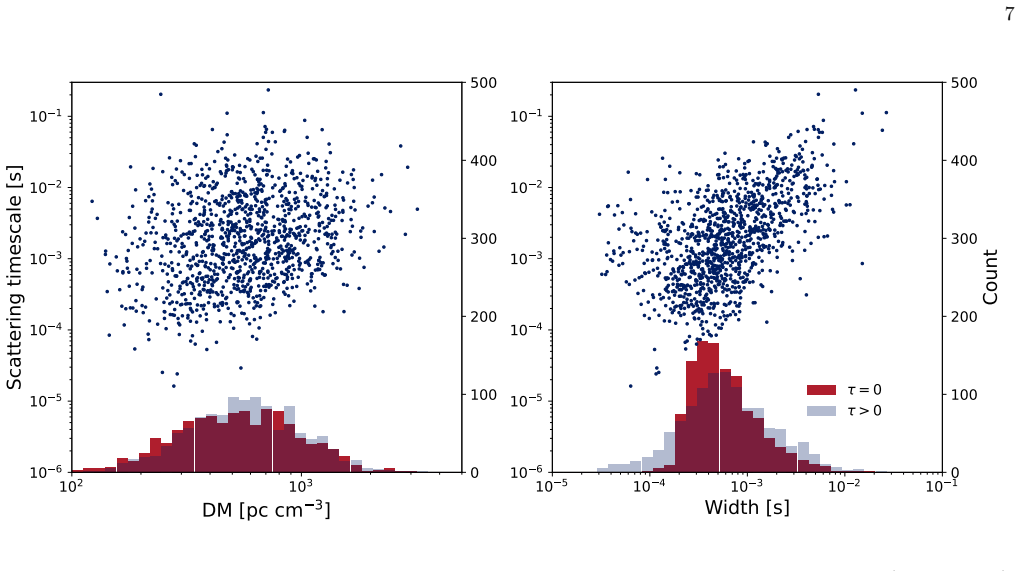
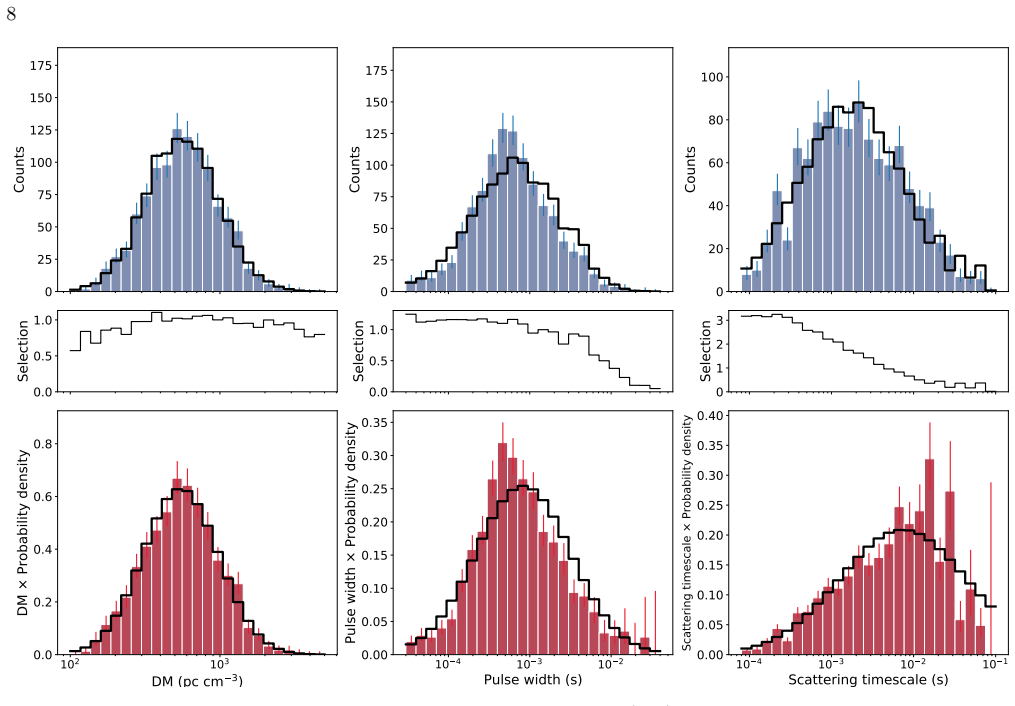
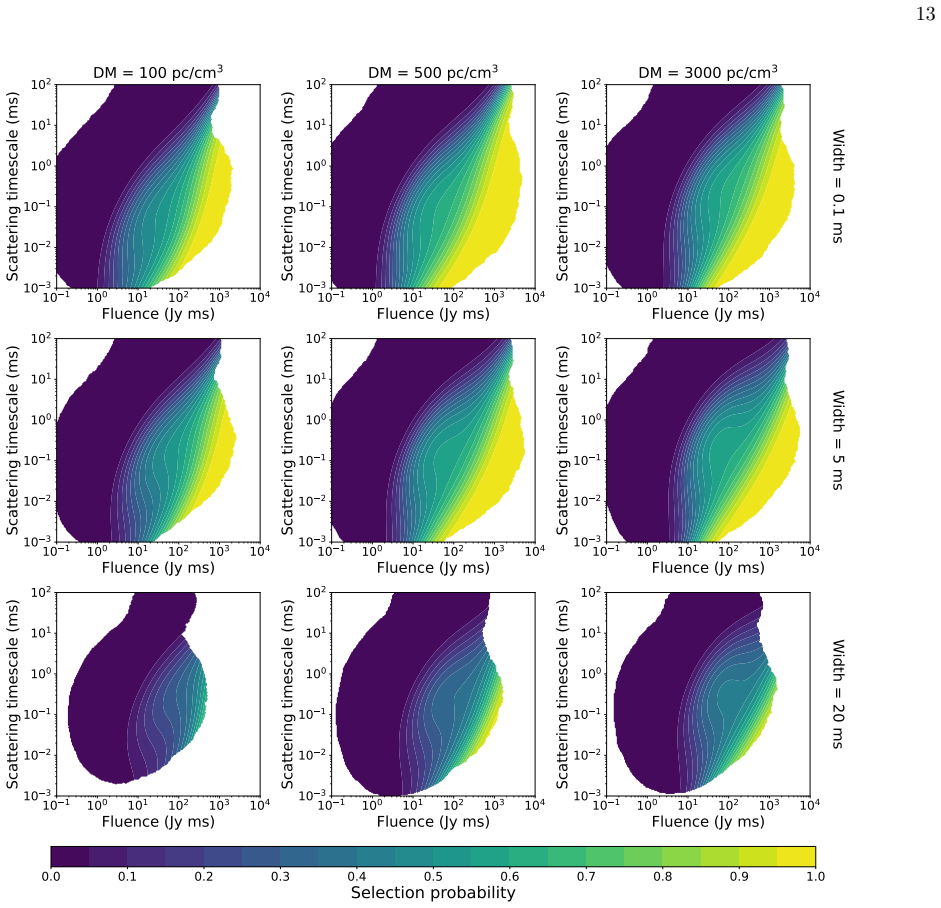
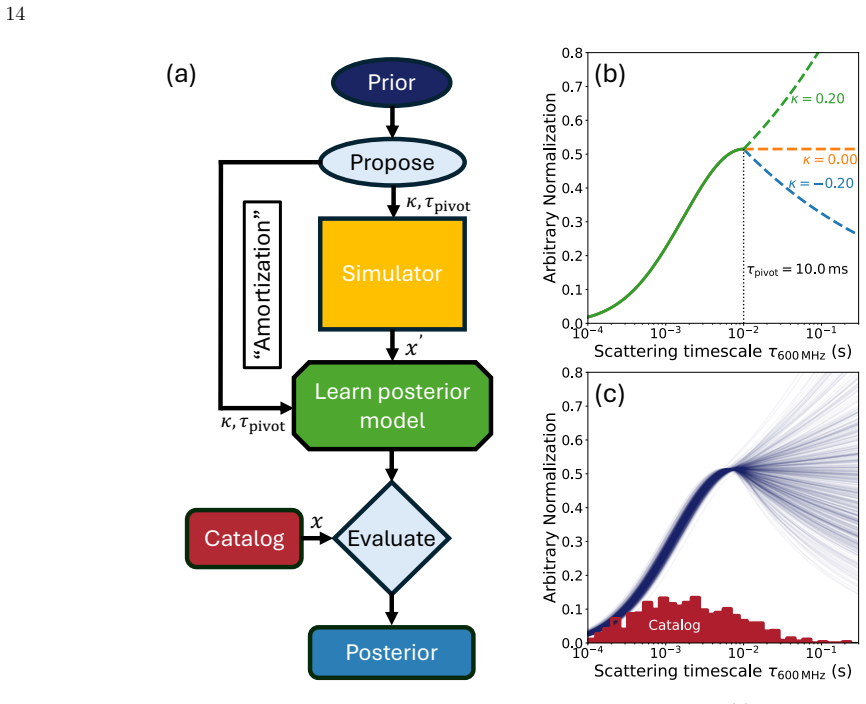
The recent release of CHIME/FRB Catalog~2 provides the largest sample to date with which to investigate the intrinsic distributions of fast radio bursts (FRBs). Leveraging an expanded campaign of 587,367 synethetic bursts injected into the live CHIME/FRB search pipeline, we perform a population analysis of the fluence, scattering timescale, pulse width, and dispersion measure distributions of Catalog~2 FRBs. We first infer the intrinsic population using a resampling-based framework that accounts for instrumental selection effects following previous CHIME/FRB population studies. A central goal of this work is to constrain the intrinsic distribution of scattering timescales, that remained weakly constrained in Catalog~1 owing to limited statistics at moderate and large scattering times ($\tau \gtrsim 10\,\mathrm{ms}$ at 600~MHz) and sparse injection coverage in this regime. Second, we construct an explicit multidimensional selection function by training a logistic regression model on the injected events. This model estimates the detection probability as a function of FRB observable properties, including higher-order interaction terms. We incorporate this selection function into a simulation-based inference framework to refine the inferred intrinsic scattering-timescale distribution. We find evidence for a slight downturn in the intrinsic FRB scattering timescale distribution, though a flat or slightly rising distribution cannot be ruled out, that is further supported through a comparison with the higher-frequency scattering timescale distribution observed by Commensal Real-time ASKAP Fast Transients (CRAFT) survey.
Editorial analysis
A structured set of objections, weighed in public.
Referee Report
Summary. The manuscript analyzes CHIME/FRB Catalog 2 using an expanded set of 587,367 synthetic burst injections into the live search pipeline. It constructs a multidimensional selection function via logistic regression (including interaction terms) and applies it within a resampling-based framework followed by simulation-based inference to recover the intrinsic distributions of fluence, scattering timescale (τ), pulse width, and DM. The central result is evidence for a slight downturn in the intrinsic τ distribution at 600 MHz (though flat or mildly rising forms remain allowed), corroborated by comparison to the CRAFT higher-frequency sample.
Significance. If the downturn result is robust, the work supplies the largest debiased sample to date for FRB population properties and directly addresses the Catalog 1 limitation of sparse injection coverage at τ ≳ 10 ms. The explicit construction of the selection function and the scale of the injection campaign constitute a methodological advance over prior CHIME/FRB studies; the CRAFT cross-check adds an independent consistency test.
major comments (1)
- [Methods (logistic regression selection function)] The logistic regression selection function (described in the methods section on model training) is the load-bearing component for the downturn claim. The abstract notes that Catalog 1 suffered from sparse coverage precisely at τ ≳ 10 ms; although 587k new injections are introduced, no quantitative validation (e.g., calibration curves, precision-recall stratified by τ, or held-out test performance in the high-τ tail) is referenced. Without such diagnostics, systematic mis-estimation of p(detect|τ, other observables) including higher-order terms could produce an artificial downturn.
minor comments (2)
- [Abstract and results] The abstract states that a flat or slightly rising distribution cannot be ruled out; the main text should quantify this statement with explicit credible intervals or posterior predictive checks on the downturn feature.
- [Methods] Figure captions and text should clarify whether the logistic model was fit with regularization or feature selection, and how class imbalance at high τ was handled.
Simulated Author's Rebuttal
We thank the referee for their careful and constructive review. We address the single major comment below.
read point-by-point responses
-
Referee: [Methods (logistic regression selection function)] The logistic regression selection function (described in the methods section on model training) is the load-bearing component for the downturn claim. The abstract notes that Catalog 1 suffered from sparse coverage precisely at τ ≳ 10 ms; although 587k new injections are introduced, no quantitative validation (e.g., calibration curves, precision-recall stratified by τ, or held-out test performance in the high-τ tail) is referenced. Without such diagnostics, systematic mis-estimation of p(detect|τ, other observables) including higher-order terms could produce an artificial downturn.
Authors: We agree that explicit quantitative validation of the logistic regression model is essential, particularly to confirm performance in the high-τ regime. The current manuscript does not present calibration curves, stratified precision-recall metrics, or held-out test results for the high-τ tail. In the revised manuscript we will add these diagnostics, including reliability diagrams, precision-recall curves binned by τ, and held-out performance metrics focused on τ ≳ 10 ms. The training set of 587,367 injections already provides substantially denser coverage than Catalog 1, and the inclusion of interaction terms was intended to mitigate higher-order biases; the requested diagnostics will allow readers to assess residual mis-calibration directly. We also note that the slight downturn is independently supported by the CRAFT higher-frequency comparison, which uses an entirely separate instrument and selection function. revision: yes
Circularity Check
No significant circularity; derivation uses independent injections and new model
full rationale
The paper constructs its multidimensional selection function from a fresh campaign of 587k synthetic injections into the live pipeline and trains a logistic regression on those events to estimate detection probabilities. This selection function is then fed into a simulation-based inference pipeline to infer the intrinsic scattering timescale distribution. The resampling framework is referenced to prior CHIME/FRB work, but the central downturn claim is produced by the new injections and logistic model rather than reducing to any fitted parameter or self-citation by construction. External support from CRAFT data further separates the result from the paper's own inputs. No step matches the enumerated circularity patterns.
Axiom & Free-Parameter Ledger
Reference graph
Works this paper leans on
-
[1]
An Injection System for the CHIME/FRB Experiment. , keywords =. doi:10.3847/1538-3881/ac9ab5 , archivePrefix =. 2206.14079 , primaryClass =
-
[2]
The First CHIME/FRB Fast Radio Burst Catalog. , keywords =. doi:10.3847/1538-4365/ac33ab , archivePrefix =. 2106.04352 , primaryClass =
-
[3]
Discovery of 30 Repeating Fast Radio Burst Sources and Uniform Population Statistics of 80 Repeating Sources from CHIME/FRB. arXiv e-prints , keywords =. doi:10.48550/arXiv.2605.08410 , archivePrefix =. 2605.08410 , primaryClass =
work page internal anchor Pith review Pith/arXiv arXiv doi:10.48550/arxiv.2605.08410
-
[4]
Quantitative Methods for Analysing Travel Behaviour of Individuals , booktitle=
McFadden, Daniel , year=. Quantitative Methods for Analysing Travel Behaviour of Individuals , booktitle=
-
[5]
Estimation of intrinsic fast radio burst width and scattering distributions from CRAFT data. arXiv e-prints , keywords =. doi:10.48550/arXiv.2510.05654 , archivePrefix =. 2510.05654 , primaryClass =
-
[6]
High-time-resolution properties of 35 fast radio bursts detected by the Commensal Real-time ASKAP Fast Transients survey. , keywords =. doi:10.1017/pasa.2025.10103 , archivePrefix =. 2505.17497 , primaryClass =
-
[7]
Comprehensive analysis of the Apertif fast radio burst sample: Similarities with young energetic neutron stars. , keywords =. doi:10.1051/0004-6361/202450953 , archivePrefix =. 2406.00482 , primaryClass =
-
[8]
Modeling Fast Radio Burst Dispersion and Scattering Properties in the First CHIME/FRB Catalog. , keywords =. doi:10.3847/1538-4357/ac49e1 , archivePrefix =. 2107.10858 , primaryClass =
-
[9]
Inferring the Energy and Distance Distributions of Fast Radio Bursts Using the First CHIME/FRB Catalog. , keywords =. doi:10.3847/1538-4357/acaf06 , archivePrefix =. 2207.14316 , primaryClass =
-
[10]
The Apertif Radio Transient System (ARTS): Design, commissioning, data release, and detection of the first five fast radio bursts. , keywords =. doi:10.1051/0004-6361/202244107 , archivePrefix =. 2205.12362 , primaryClass =
-
[11]
, title =
Rubin, Donald B. , title =. The Annals of Statistics , volume =. 1981 , publisher =
1981
-
[12]
2004 , series =
Wasserman, Larry , title =. 2004 , series =
2004
-
[13]
Selection Functions in Astronomical Data Modeling, with the Space Density of White Dwarfs as a Worked Example. , keywords =. doi:10.3847/1538-3881/ac0c13 , archivePrefix =. 2106.07653 , primaryClass =
-
[14]
A selection function toolbox for subsets of astronomical catalogues. , keywords =. doi:10.1093/mnras/stab3665 , archivePrefix =. 2111.04126 , primaryClass =
-
[15]
The Stars Kepler Missed: Investigating the Kepler Target Selection Function Using Gaia DR2. , keywords =. doi:10.3847/1538-3881/abee1d , archivePrefix =. 2101.03190 , primaryClass =
-
[16]
The Exoplanet Population Observation Simulator. I. The Inner Edges of Planetary Systems. , keywords =. doi:10.3847/1538-3881/aac5ea , archivePrefix =. 1805.08211 , primaryClass =
work page internal anchor Pith review Pith/arXiv arXiv doi:10.3847/1538-3881/aac5ea
-
[17]
An empirical model of the Gaia DR3 selection function. , keywords =. doi:10.1051/0004-6361/202244784 , archivePrefix =. 2208.09335 , primaryClass =
-
[18]
Gaia Data Release 2: Catalogue validation
Gaia Data Release 2. Catalogue validation. , keywords =. doi:10.1051/0004-6361/201833234 , archivePrefix =. 1804.09375 , primaryClass =
work page internal anchor Pith review Pith/arXiv arXiv doi:10.1051/0004-6361/201833234
-
[19]
The Milky Way has no thick disk
The Milky Way Has No Distinct Thick Disk. , keywords =. doi:10.1088/0004-637X/751/2/131 , archivePrefix =. 1111.6585 , primaryClass =
work page internal anchor Pith review Pith/arXiv arXiv doi:10.1088/0004-637x/751/2/131
-
[20]
The 2dF Galaxy Redshift Survey: power-spectrum analysis of the final data set and cosmological implications. , keywords =. doi:10.1111/j.1365-2966.2005.09318.x , archivePrefix =. astro-ph/0501174 , primaryClass =
-
[21]
D. G. Horvitz and D. J. Thompson , publisher =. A Generalization of Sampling Without Replacement From a Finite Universe , urldate =. Journal of the American Statistical Association , number =
-
[22]
Improved Horvitz-Thompson Estimator in Survey Sampling
Improved Horvitz-Thompson Estimator in Survey Sampling. arXiv e-prints , keywords =. doi:10.48550/arXiv.1804.04255 , archivePrefix =. 1804.04255 , primaryClass =
work page internal anchor Pith review Pith/arXiv arXiv doi:10.48550/arxiv.1804.04255
-
[23]
Using the Sun to Measure the Primary Beam Response of the Canadian Hydrogen Intensity Mapping Experiment. , keywords =. doi:10.3847/1538-4357/ac6b9f , archivePrefix =. 2201.11822 , primaryClass =
-
[24]
The CHIME Fast Radio Burst Project: System Overview
The CHIME Fast Radio Burst Project: System Overview. , keywords =. doi:10.3847/1538-4357/aad188 , archivePrefix =. 1803.11235 , primaryClass =
work page internal anchor Pith review Pith/arXiv arXiv doi:10.3847/1538-4357/aad188
-
[25]
Flux Calibration of CHIME/FRB Intensity Data. , keywords =. doi:10.3847/1538-3881/acec78 , archivePrefix =. 2305.11302 , primaryClass =
-
[26]
Twenty-four thousand hours of GREENBURST observations with the GBT
Twenty-four thousand hours of GREENBURST observations with the GBT. , keywords =. doi:10.1093/mnras/stag665 , archivePrefix =. 2601.20143 , primaryClass =
work page internal anchor Pith review Pith/arXiv arXiv doi:10.1093/mnras/stag665
-
[27]
A sample of fast radio bursts discovered and localized with MeerTRAP at the MeerKAT telescope. , keywords =. doi:10.1093/mnras/stad2041 , archivePrefix =. 2302.10107 , primaryClass =
-
[28]
The Galactic Population of Magnetars: A Simulation-based Inference Study. , keywords =. doi:10.3847/1538-4357/add0aa , archivePrefix =. 2503.11875 , primaryClass =
-
[29]
PyTorch: An Imperative Style, High-Performance Deep Learning Library
PyTorch: An Imperative Style, High-Performance Deep Learning Library. arXiv e-prints , keywords =. doi:10.48550/arXiv.1912.01703 , archivePrefix =. 1912.01703 , primaryClass =
work page internal anchor Pith review Pith/arXiv arXiv doi:10.48550/arxiv.1912.01703 1912
-
[30]
Proceedings of the National Academy of Science , keywords =
The frontier of simulation-based inference. Proceedings of the National Academy of Science , keywords =. doi:10.1073/pnas.1912789117 , archivePrefix =. 1911.01429 , primaryClass =
-
[31]
Updating the First CHIME/FRB Catalog of Fast Radio Bursts with Baseband Data. , keywords =. doi:10.3847/1538-4357/ad464b , archivePrefix =. 2311.00111 , primaryClass =
-
[32]
Modeling the Morphology of Fast Radio Bursts and Radio Pulsars with fitburst. , keywords =. doi:10.3847/1538-4365/ad27d6 , archivePrefix =. 2311.05829 , primaryClass =
-
[33]
CHIME/FRB Outriggers: Design Overview. , keywords =. doi:10.3847/1538-4357/adfdcc , archivePrefix =. 2504.05192 , primaryClass =
-
[34]
A Repeating Fast Radio Burst Source in the Outskirts of a Quiescent Galaxy. , keywords =. doi:10.3847/2041-8213/ad9ddc , archivePrefix =. 2410.23374 , primaryClass =
-
[35]
FRB 20250316A: A Brilliant and Nearby One-off Fast Radio Burst Localized to 13 pc Precision. , keywords =. doi:10.3847/2041-8213/adf62f , archivePrefix =. 2506.19006 , primaryClass =
-
[36]
The Second CHIME/FRB Catalog of Fast Radio Bursts. , keywords =. doi:10.3847/1538-4365/ae3828 , archivePrefix =. 2601.09399 , primaryClass =
-
[37]
An Analysis Pipeline for CHIME/FRB Full-array Baseband Data. , keywords =. doi:10.3847/1538-4357/abe626 , archivePrefix =. 2010.06748 , primaryClass =
-
[38]
A bright millisecond radio burst of extragalactic origin
A Bright Millisecond Radio Burst of Extragalactic Origin. Science , keywords =. doi:10.1126/science.1147532 , archivePrefix =. 0709.4301 , primaryClass =
work page internal anchor Pith review Pith/arXiv arXiv doi:10.1126/science.1147532
-
[39]
Modeling Current and Future High-cadence Surveys of Repeating Fast Radio Burst Populations. , keywords =. doi:10.3847/1538-4357/ad1184 , archivePrefix =. 2309.11522 , primaryClass =
-
[40]
Theory of Parabolic Arcs in Interstellar Scintillation Spectra
Theory of Parabolic Arcs in Interstellar Scintillation Spectra. , keywords =. doi:10.1086/498332 , archivePrefix =. astro-ph/0407072 , primaryClass =
work page internal anchor Pith review Pith/arXiv arXiv doi:10.1086/498332
-
[41]
A fast radio burst localized at detection to an edge-on galaxy using very-long-baseline interferometry. Nature Astronomy , keywords =. doi:10.1038/s41550-024-02357-x , archivePrefix =. 2307.09502 , primaryClass =
-
[42]
A Catalog of Local Universe Fast Radio Bursts from CHIME/FRB and the KKO. , keywords =. doi:10.3847/1538-4365/addbda , archivePrefix =. 2502.11217 , primaryClass =
-
[43]
Scintillometry of fast radio bursts: Resolution effects in two-screen models. , keywords =. doi:10.1051/0004-6361/202554202 , archivePrefix =. 2505.04576 , primaryClass =
-
[44]
Modelling annual scintillation velocity variations of FRB 20201124A. , keywords =. doi:10.1093/mnrasl/slad036 , archivePrefix =. 2212.04839 , primaryClass =
-
[45]
Estimating fast transient detection pipeline efficiencies at UTMOST via real-time injection of mock FRBs. , keywords =. doi:10.1093/mnras/staa3683 , archivePrefix =. 2011.10191 , primaryClass =
-
[46]
Long-Integration Magnetar Burst Observatory (LIMBO): Instrument Summary and Early FRB Rate Constraints. arXiv e-prints , keywords =. doi:10.48550/arXiv.2603.05603 , archivePrefix =. 2603.05603 , primaryClass =
-
[47]
Millisecond-cadence Radio Frequency Interference Filters. , keywords =. doi:10.3847/1538-3881/ae0d86 , adsurl =
-
[48]
Systematic performance of the ASKAP fast radio burst search algorithm. , keywords =. doi:10.1093/mnras/stad1740 , archivePrefix =. 2306.03886 , primaryClass =
-
[49]
A deployed real-time end-to-end deep learning algorithm for fast radio burst detection. , keywords =. doi:10.1051/0004-6361/202555217 , adsurl =
-
[50]
42nd meeting of the Astronomical Society of India (ASI) , year = 2024, volume =
Injections and detections of FRBs for the SPOTLIGHT project with the GMRT. 42nd meeting of the Astronomical Society of India (ASI) , year = 2024, volume =
2024
-
[51]
arXiv e-prints , keywords =
Optimising the FRB Search Pipeline for the Northern Cross Radio Telescope. arXiv e-prints , keywords =
-
[52]
Searches for Fast Radio Transients
Searches for Fast Radio Transients. , keywords =. doi:10.1086/378231 , archivePrefix =. astro-ph/0304364 , primaryClass =
work page internal anchor Pith review Pith/arXiv arXiv doi:10.1086/378231
-
[53]
Five new real-time detections of Fast Radio Bursts with UTMOST
Five new real-time detections of fast radio bursts with UTMOST. , keywords =. doi:10.1093/mnras/stz1748 , archivePrefix =. 1905.02293 , primaryClass =
work page internal anchor Pith review Pith/arXiv arXiv doi:10.1093/mnras/stz1748 1905
-
[54]
CHIME/Slow overview and pilot survey: A new backend to search for second-duration radio transients with the CHIME telescope. arXiv e-prints , keywords =. doi:10.48550/arXiv.2602.12793 , archivePrefix =. 2602.12793 , primaryClass =
-
[55]
Fast Radio Burst Morphology in the First CHIME/FRB Catalog. , keywords =. doi:10.3847/1538-4357/ac33ac , archivePrefix =. 2106.04356 , primaryClass =
-
[56]
1965 , publisher =
Survey Sampling , author =. 1965 , publisher =
1965
-
[57]
The commensal real-time ASKAP fast transient incoherent-sum survey. , keywords =. doi:10.1017/pasa.2025.8 , archivePrefix =. 2408.02083 , primaryClass =
-
[58]
Deep Synoptic Array Science: First FRB and Host Galaxy Catalog. , keywords =. doi:10.3847/1538-4357/ad3736 , archivePrefix =. 2307.03344 , primaryClass =
-
[59]
Alvaro Tejero-Cantero and Jan Boelts and Michael Deistler and Jan-Matthis Lueckmann and Conor Durkan and Pedro J. Gonçalves and David S. Greenberg and Jakob H. Macke , title =. 2020 , publisher =. doi:10.21105/joss.02505 , url =
-
[60]
Fast radio bursts at the dawn of the 2020s. , keywords =. doi:10.1007/s00159-022-00139-w , archivePrefix =. 2107.10113 , primaryClass =
-
[61]
and Varoquaux, G
Pedregosa, F. and Varoquaux, G. and Gramfort, A. and Michel, V. and Thirion, B. and Grisel, O. and Blondel, M. and Prettenhofer, P. and Weiss, R. and Dubourg, V. and Vanderplas, J. and Passos, A. and Cournapeau, D. and Brucher, M. and Perrot, M. and Duchesnay, E. , journal=. Scikit-learn: Machine Learning in
-
[62]
A census of baryons in the Universe from localized fast radio bursts.Nature2020,581, 391–395
A census of baryons in the Universe from localized fast radio bursts. , keywords =. doi:10.1038/s41586-020-2300-2 , archivePrefix =. 2005.13161 , primaryClass =
-
[63]
Monthly Weather Review , year = 1950, month = jan, volume =
Verification of Forecasts Expressed in Terms of Probability. Monthly Weather Review , year = 1950, month = jan, volume =. doi:10.1175/1520-0493(1950)078<0001:VOFEIT>2.0.CO;2 , adsurl =
-
[64]
Quarterly Journal of the Royal Meteorological Society , keywords =
Areas beneath the relative operating characteristics (ROC) and relative operating levels (ROL) curves: Statistical significance and interpretation. Quarterly Journal of the Royal Meteorological Society , keywords =. doi:10.1256/003590002320603584 , adsurl =
-
[65]
Arecibo Pulsar Survey Using ALFA. IV. Mock Spectrometer Data Analysis, Survey Sensitivity, and the Discovery of 40 Pulsars. , keywords =. doi:10.1088/0004-637X/812/1/81 , archivePrefix =. 1504.02294 , primaryClass =
work page internal anchor Pith review Pith/arXiv arXiv doi:10.1088/0004-637x/812/1/81
-
[66]
Identifying the source of perytons at the Parkes radio telescope
Identifying the source of perytons at the Parkes radio telescope. , keywords =. doi:10.1093/mnras/stv1242 , archivePrefix =. 1504.02165 , primaryClass =
work page internal anchor Pith review Pith/arXiv arXiv doi:10.1093/mnras/stv1242
-
[67]
Measurement of the Dispersion-Galaxy Cross-Power Spectrum with the Second CHIME/FRB Catalog. arXiv e-prints , keywords =. doi:10.48550/arXiv.2506.08932 , archivePrefix =. 2506.08932 , primaryClass =
-
[68]
Probing the maximum energy of fast radio bursts using thousands of sources from the Second CHIME/FRB Catalog. arXiv e-prints , keywords =. doi:10.48550/arXiv.2602.19335 , archivePrefix =. 2602.19335 , primaryClass =
-
[69]
Estimation of intrinsic fast radio burst width and scattering distributions from CRAFT data. , keywords =. doi:10.1017/pasa.2026.10173 , archivePrefix =. 2510.05654 , primaryClass =
-
[70]
A spatial filter for mitigating radio interference and its application to CHIME/FRB Outriggers. arXiv e-prints , keywords =. doi:10.48550/arXiv.2603.25833 , archivePrefix =. 2603.25833 , primaryClass =
-
[71]
frb-voe: A Real-time Virtual Observatory Event Alert Service for Fast Radio Bursts. , keywords =. doi:10.3847/1538-3881/ad9451 , archivePrefix =. 2410.22468 , primaryClass =
-
[72]
Dense forests of microshots in bursts from FRB 20220912A. , keywords =. doi:10.1093/mnras/stad2847 , archivePrefix =. 2308.12118 , primaryClass =
-
[73]
Morphology of 137 Fast Radio Bursts Down to Microsecond Timescales from the First CHIME/FRB Baseband Catalog. , keywords =. doi:10.3847/1538-4357/ad9b11 , archivePrefix =. 2408.13215 , primaryClass =
-
[74]
Morphology of 35 Repeating Fast Radio Burst Sources at Microsecond Time Scales with CHIME/FRB. , keywords =. doi:10.3847/1538-4357/adf844 , archivePrefix =. 2411.02870 , primaryClass =
-
[75]
A HyperFlash and \'E CLAT view of the local environment and energetics of the repeating FRB 20240619D. , keywords =. doi:10.1093/mnras/stag090 , archivePrefix =. 2509.16374 , primaryClass =
-
[76]
arXiv e-prints , keywords =
A 4200-hour HyperFlash and \'E CLAT campaign on the hyperactive FRB 20240114A: constraining energetics with the most brilliant bursts. arXiv e-prints , keywords =
-
[77]
A link between repeating and non-repeating fast radio bursts through their energy distributions. Nature Astronomy , keywords =. doi:10.1038/s41550-023-02153-z , archivePrefix =. 2306.15505 , primaryClass =
-
[78]
Highest Frequency Detection of FRB 121102 at 4-8 GHz Using the Breakthrough Listen Digital Backend at the Green Bank Telescope. , keywords =. doi:10.3847/1538-4357/aad005 , archivePrefix =. 1804.04101 , primaryClass =
work page internal anchor Pith review Pith/arXiv arXiv doi:10.3847/1538-4357/aad005
-
[79]
Mitigating Radio Frequency Interference in CHIME/FRB Real-time Intensity Data. , keywords =. doi:10.3847/1538-4365/acc252 , archivePrefix =. 2206.07292 , primaryClass =
-
[80]
Biometrika66(3), 605–610 (1979) https://doi.org/10.1093/biomet/66.3.605
Scott, David W. , title =. Biometrika , volume =. 1979 , month =. doi:10.1093/biomet/66.3.605 , url =
discussion (0)
Sign in with ORCID, Apple, or X to comment. Anyone can read and Pith papers without signing in.