Photonic Analog Quantum Simulation of (1+1)-Dimensional U(1) Lattice Gauge Theory with Dynamical Matter
Pith reviewed 2026-06-28 11:21 UTC · model grok-4.3
The pith
A photonic cavity array using the Jaynes-Cummings-Hubbard model can simulate the real-time dynamics of a (1+1)D U(1) lattice gauge theory with dynamical matter.
A machine-rendered reading of the paper's core claim, the machinery that carries it, and where it could break.
Core claim
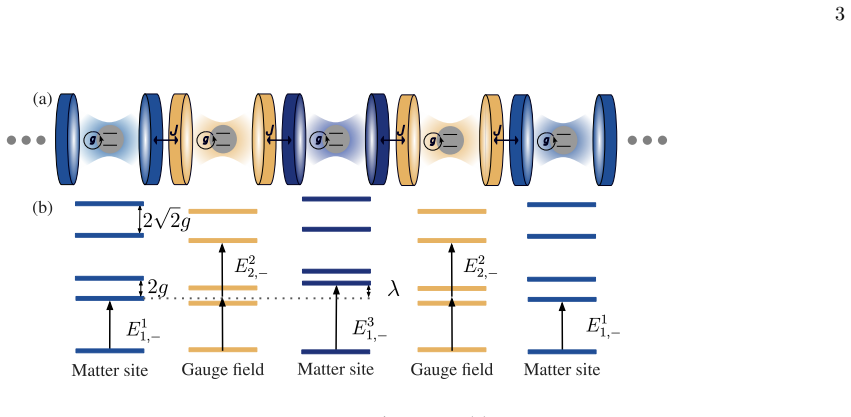
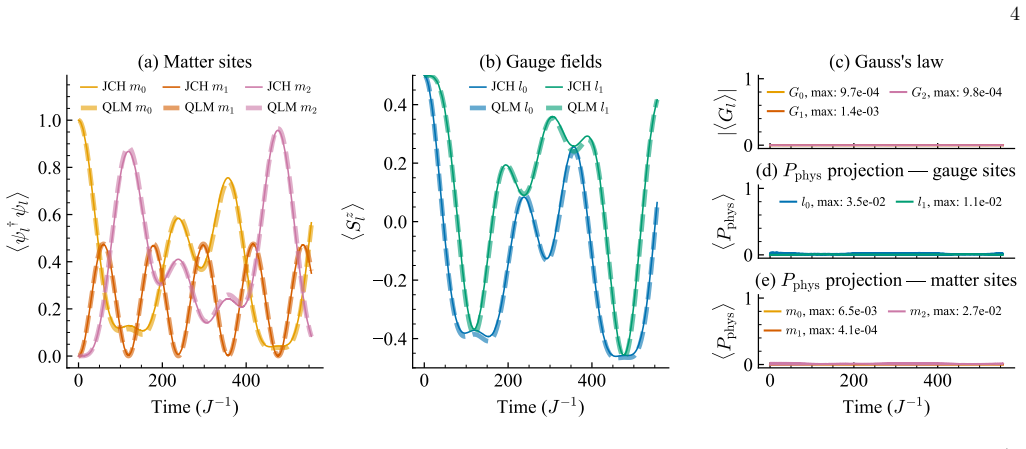
The Jaynes-Cummings-Hubbard model of a cavity array is mapped onto the spin-1/2 Quantum Link Model such that hopping of polaritonic excitations implements the gauge-invariant dynamics of the U(1) lattice gauge theory with dynamical matter. Tuning of individual cavity resonances sets the required interactions, and exact diagonalization verifies that time evolution of the two systems coincides.
What carries the argument
The mapping of the Jaynes-Cummings-Hubbard model to the spin-1/2 Quantum Link Model via tuned polaritonic resonances that govern excitation hopping between alternating sites.
If this is right
- The real-time evolution of the Quantum Link Model is accurately replicated by the Jaynes-Cummings-Hubbard model under the stated mapping.
- Scalable implementations in photonic and superconducting systems can reach beyond-classical simulation capability.
- The scheme supplies a novel route to studying real-time dynamics of lattice gauge theories with matter in higher dimensions.
Where Pith is reading between the lines
- Realization of the cavity array could permit direct observation of phenomena such as string breaking through time-resolved measurements of particle and field configurations.
- The resonance-tuning approach may generalize to other gauge groups or lattice geometries if the underlying polariton hopping can be engineered similarly.
- Comparison of experimental spectra or evolution traces against the exact-diagonalization benchmarks would quantify any residual mapping errors.
Load-bearing premise
Precise tuning of polaritonic resonances in individual cavities implements the desired gauge-invariant dynamics through hopping without unaccounted errors.
What would settle it
A mismatch between the time-dependent expectation values of gauge-invariant observables such as electric field strength or fermion density in exact diagonalization of the Jaynes-Cummings-Hubbard model versus the Quantum Link Model would falsify the replication claim.
Figures

read the original abstract
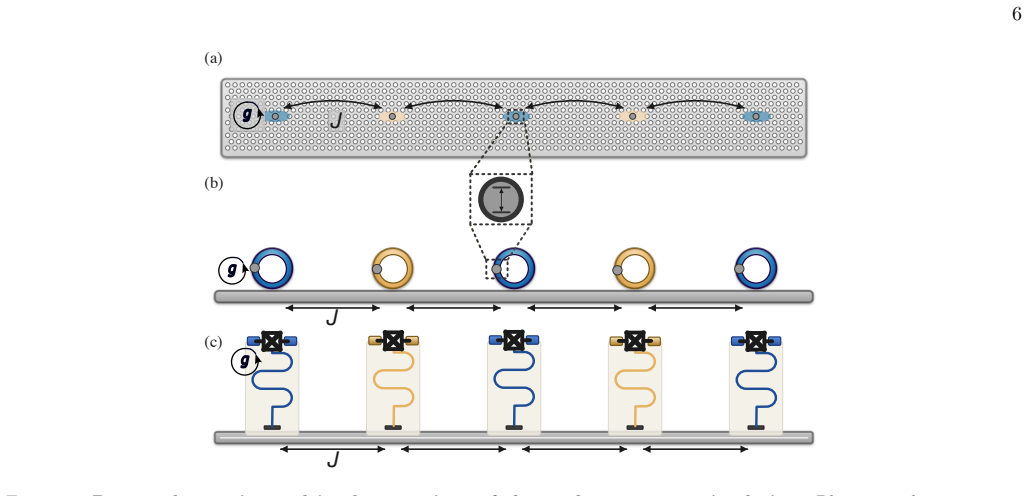
We propose a photonic scheme for analog quantum simulation of a $U(1)$ Lattice Gauge Theory (LGT) with dynamical matter based on the Jaynes-Cummings-Hubbard (JCH) model. Here, an array of interacting cavities in the strong-coupling regime of cavity Quantum Electrodynamics is mapped onto the alternating matter and gauge-field sites of the spin-1/2 Quantum Link Model. In contrast to other analog LGT quantum simulation methods, our approach implements the desired gauge-invariant dynamics through the hopping of polaritonic excitations among the array sites. The hopping is mapped to the gauge theory via precise tuning of polaritonic resonances in individual cavities. Using exact diagonalization, we show that the real-time evolution of the JCH model accurately replicates that of a Quantum Link Model. Finally, we discuss feasible routes to the beyond-classical simulation capability with scalable implementations in photonic and superconducting systems. This provides a novel route towards understanding the real-time dynamics of lattice gauge theories with matter in higher dimensions.
Editorial analysis
A structured set of objections, weighed in public.
Referee Report
Summary. The manuscript proposes an analog quantum simulation of (1+1)D U(1) lattice gauge theory with dynamical matter using the Jaynes-Cummings-Hubbard (JCH) model realized in an array of interacting cavities. The scheme maps the JCH system onto the alternating matter and gauge-field sites of the spin-1/2 Quantum Link Model by tuning individual cavity polaritonic resonances so that polariton hopping reproduces the gauge-invariant dynamics. Exact diagonalization on small systems is presented to show that real-time evolution of the JCH model replicates that of the target QLM, and the authors discuss routes toward scalable photonic and superconducting implementations.
Significance. If the mapping is shown to be exact and free of gauge-violating residuals, the work would supply a concrete photonic platform for analog simulation of real-time LGT dynamics with matter, complementing existing digital and other analog approaches. The emphasis on resonance tuning rather than external driving and the explicit ED validation are positive features; the discussion of beyond-classical scalability in higher dimensions would be of interest to the hep-lat and quantum-simulation communities.
major comments (1)
- The central claim that resonance tuning implements exact gauge-invariant QLM dynamics rests on the unproven assertion that the effective JCH Hamiltonian commutes with the local Gauss-law generators for arbitrary system size. The manuscript supplies no analytic derivation showing cancellation of all gauge-violating matrix elements after tuning; the provided ED evidence is limited to small lattices and short evolution times where violations may remain below numerical thresholds.
Simulated Author's Rebuttal
We thank the referee for their thoughtful review and for highlighting the need for a clearer demonstration of exact gauge invariance. We address the major comment below and commit to revisions that strengthen the analytic support for the proposed mapping.
read point-by-point responses
-
Referee: The central claim that resonance tuning implements exact gauge-invariant QLM dynamics rests on the unproven assertion that the effective JCH Hamiltonian commutes with the local Gauss-law generators for arbitrary system size. The manuscript supplies no analytic derivation showing cancellation of all gauge-violating matrix elements after tuning; the provided ED evidence is limited to small lattices and short evolution times where violations may remain below numerical thresholds.
Authors: We acknowledge that the manuscript presents the mapping primarily through the resonance-tuning construction and validates it numerically via ED on small systems, without an explicit general-size analytic proof that all gauge-violating terms cancel. The effective Hamiltonian is designed so that only gauge-invariant processes survive under the chosen detunings, but a full perturbative expansion confirming exact commutation with the Gauss-law operators for arbitrary N would indeed make the claim more rigorous. In the revised manuscript we will add a dedicated section deriving the effective low-energy Hamiltonian in the resonant limit, explicitly showing cancellation of gauge-violating matrix elements to all orders in the perturbative expansion. We will also extend the ED benchmarks to larger lattices and longer evolution times to quantify any residual violations. revision: yes
Circularity Check
Mapping proposal verified by independent exact diagonalization; no reduction to self-inputs
full rationale
The paper proposes a resonance-tuning mapping from the JCH Hamiltonian to the spin-1/2 QLM on alternating sites and then performs exact diagonalization to compare real-time evolution. This numerical comparison constitutes an independent check rather than a tautological re-derivation; the JCH dynamics are not defined in terms of the target QLM observables, nor are parameters fitted to force agreement by construction. No self-citations are invoked as load-bearing uniqueness theorems, and the central claim does not rename a known result or smuggle an ansatz. The derivation chain therefore remains self-contained against external benchmarks.
Axiom & Free-Parameter Ledger
free parameters (1)
- polaritonic resonance tunings
axioms (1)
- domain assumption The JCH model in the strong-coupling regime can be mapped onto the alternating matter and gauge-field sites of the spin-1/2 Quantum Link Model such that polaritonic hopping implements gauge-invariant dynamics.
Reference graph
Works this paper leans on
-
[1]
in the large coupling limit, is aU(1) symmetric (1 + 1)-dimensional representation of Quantum Electro- dynamics. In the QLM formulation, the Hamiltonian arXiv:2606.02756v1 [hep-lat] 1 Jun 2026 2 Figure 1. TheU(1) gauge theory can be mapped exactly onto a bosonic chain with 2L−1 sites. The bosonic occupations are uniquely mapped to a gauge-theory configura...
Pith/arXiv arXiv 2026
-
[2]
M. Troyer and U.-J. Wiese, Phys. Rev. Lett.94, 170201 (2005), arXiv:cond-mat/0408370
Pith/arXiv arXiv 2005
-
[3]
A. Alexandru, G. Basar, P. F. Bedaque, and N. C. Warrington, Rev. Mod. Phys.94, 015006 (2022), arXiv:2007.05436 [hep-lat]
arXiv 2022
-
[4]
G. Vidal, Phys. Rev. Lett.91, 147902 (2003), arXiv:quant-ph/0301063
Pith/arXiv arXiv 2003
-
[5]
U. Schollwock, Rev. Mod. Phys.77, 259 (2005), arXiv:cond-mat/0409292
Pith/arXiv arXiv 2005
-
[6]
F. Verstraete and J. I. Cirac, Phys. Rev. B73, 094423 (2006), arXiv:cond-mat/0505140
Pith/arXiv arXiv 2006
-
[7]
Gattringer and C
C. Gattringer and C. B. Lang,Quantum chromodynamics on the lattice, Vol. 788 (Springer, Berlin, 2010)
2010
-
[8]
Bietenholz and U.-J
W. Bietenholz and U.-J. Wiese,Uncovering Quantum Field Theory and the Standard Model(Cambridge Uni- versity Press, 2024)
2024
-
[9]
Fradkin,Field Theories of Condensed Matter Physics (Cambridge University Press, 2013)
E. Fradkin,Field Theories of Condensed Matter Physics (Cambridge University Press, 2013)
2013
-
[10]
Y. Zhou, K. Kanoda, and T.-K. Ng, Reviews of Modern Physics89, 025003 (2017)
2017
-
[11]
Aokiet al.(Flavour Lattice Averaging Group (FLAG)), Phys
Y. Aokiet al.(Flavour Lattice Averaging Group (FLAG)), Phys. Rev. D113, 014508 (2026), arXiv:2411.04268 [hep-lat]
Pith/arXiv arXiv 2026
-
[12]
R. Alibertiet al., Phys. Rept.1143, 1 (2025), arXiv:2505.21476 [hep-ph]
Pith/arXiv arXiv 2025
-
[13]
J. C. Halimeh, N. Mueller, J. Knolle, Z. Papi´ c, and Z. Davoudi, (2025), arXiv:2509.03586 [quant-ph]
Pith/arXiv arXiv 2025
-
[14]
K. Nagata, Prog. Part. Nucl. Phys.127, 103991 (2022), arXiv:2108.12423 [hep-lat]
arXiv 2022
-
[15]
E. Y. Loh, J. E. Gubernatis, R. T. Scalettar, S. R. White, D. J. Scalapino, and R. L. Sugar, Phys. Rev. B41, 9301 (1990)
1990
-
[16]
A. Y. Kitaev, Annals Phys.303, 2 (2003), arXiv:quant- ph/9707021
arXiv 2003
-
[17]
A. De, A. Lerose, D. Luo, F. M. Surace, A. Schuckert, E. R. Bennewitz, B. Ware, W. Morong, K. S. Collins, Z. Davoudi, A. V. Gorshkov, O. Katz, and C. Monroe, Observation of string-breaking dynamics in a quantum simulator (2024), version Number: 1
2024
- [18]
-
[19]
Gonz´ alez-Cuadra, M
D. Gonz´ alez-Cuadra, M. Hamdan, T. V. Zache, B. Braverman, M. Kornjaˇ ca, A. Lukin, S. H. Cant´ u, F. Liu, S.-T. Wang, A. Keesling, M. D. Lukin, P. Zoller, and A. Bylinskii, Nature642, 321 (2025)
2025
-
[20]
Z. Wang, Z.-Y. Ge, Y.-H. Shi, Z.-A. Wang, S.-Y. Zhou, H. Li, K. Zhao, Y.-S. Xu, W.-G. Ma, H.-T. Liu, C.-P. Fang, J.-C. Song, T.-M. Li, J.-C. Zhang, Y. Liu, C.- L. Deng, G. Xue, H. Yu, K. Xu, K. Huang, F. Nori, and H. Fan, Observation of Inelastic Meson Scattering in a Floquet System using a Digital Quantum Simulator (2025), arXiv:2508.20759 [quant-ph]
arXiv 2025
-
[21]
J. H. Busnaina, Z. Shi, J. M. Alcaine-Cuervo, C. X. Yang, I. Nsanzineza, E. Rico, and C. M. Wilson, Phys. Rev. B 112, 134514 (2025), arXiv:2501.13383 [quant-ph]
arXiv 2025
-
[22]
G¨ org, K
F. G¨ org, K. Sandholzer, J. Minguzzi, R. Desbuquois, M. Messer, and T. Esslinger, Nature Physics15, 1161 (2019)
2019
-
[23]
Schweizer, F
C. Schweizer, F. Grusdt, M. Berngruber, L. Barbiero, E. Demler, N. Goldman, I. Bloch, and M. Aidelsburger, Nature Physics15, 1168 (2019)
2019
-
[24]
K. J. Satzingeret al., Science374, abi8378 (2021), arXiv:2104.01180 [quant-ph]
arXiv 2021
-
[25]
Wang, Z.-Y
Z. Wang, Z.-Y. Ge, Z. Xiang, X. Song, R.-Z. Huang, P. Song, X.-Y. Guo, L. Su, K. Xu, D. Zheng, and H. Fan, Physical Review Research4, L022060 (2022)
2022
-
[26]
T. A. Cochranet al., Nature642, 315 (2025), arXiv:2409.17142 [quant-ph]
arXiv 2025
-
[27]
Luoet al., (2025), arXiv:2505.09607 [quant-ph]
D. Luoet al., (2025), arXiv:2505.09607 [quant-ph]
arXiv 2025
-
[28]
Mildenberger, W
J. Mildenberger, W. Mruczkiewicz, J. C. Halimeh, Z. Jiang, and P. Hauke, Nature Physics21, 312 (2025)
2025
-
[29]
Mueller, T
N. Mueller, T. Wang, O. Katz, Z. Davoudi, and M. Cetina, Nature Communications16, 5492 (2025)
2025
- [30]
-
[31]
D. Marcos, P. Widmer, E. Rico, M. Hafezi, P. Rabl, U. J. Wiese, and P. Zoller, Annals Phys.351, 634 (2014), arXiv:1407.6066 [quant-ph]
Pith/arXiv arXiv 2014
-
[32]
E. A. Martinez, C. A. Muschik, P. Schindler, D. Nigg, A. Erhard, M. Heyl, P. Hauke, M. Dalmonte, T. Monz, P. Zoller, and R. Blatt, Nature534, 516 (2016)
2016
-
[33]
H.-N. Dai, B. Yang, A. Reingruber, H. Sun, X.-F. Xu, Y.-A. Chen, Z.-S. Yuan, and J.-W. Pan, Nature Physics 13, 1195 (2017)
2017
-
[34]
N. Klco, E. F. Dumitrescu, A. J. McCaskey, T. D. Morris, R. C. Pooser, M. Sanz, E. Solano, P. Lougovski, and M. J. Savage, Physical Review A98, 032331 (2018)
2018
-
[35]
Kokail, C
C. Kokail, C. Maier, R. Van Bijnen, T. Brydges, M. K. Joshi, P. Jurcevic, C. A. Muschik, P. Silvi, R. Blatt, C. F. Roos, and P. Zoller, Nature569, 355 (2019)
2019
-
[36]
B. Yang, H. Sun, R. Ott, H.-Y. Wang, T. V. Zache, J. C. Halimeh, Z.-S. Yuan, P. Hauke, and J.-W. Pan, Nature 587, 392 (2020)
2020
-
[37]
W. A. De Jong, K. Lee, J. Mulligan, M. P losko´ n, F. Ringer, and X. Yao, Physical Review D106, 054508 9 (2022)
2022
-
[38]
N. H. Nguyen, M. C. Tran, Y. Zhu, A. M. Green, C. H. Alderete, Z. Davoudi, and N. M. Linke, PRX Quantum 3, 020324 (2022)
2022
-
[39]
Zhou, G.-X
Z.-Y. Zhou, G.-X. Su, J. C. Halimeh, R. Ott, H. Sun, P. Hauke, B. Yang, Z.-S. Yuan, J. Berges, and J.-W. Pan, Science377, 311 (2022)
2022
-
[40]
R. C. Farrell, M. Illa, A. N. Ciavarella, and M. J. Savage, Physical Review D109, 114510 (2024)
2024
-
[41]
R. C. Farrell, M. Illa, A. N. Ciavarella, and M. J. Savage, PRX Quantum5, 020315 (2024)
2024
-
[42]
Zhuet al., (2024), arXiv:2411.12565 [cond- mat.quant-gas]
Z.-H. Zhuet al., (2024), arXiv:2411.12565 [cond- mat.quant-gas]
arXiv 2024
-
[43]
P. Zhao, P. Xu, and Z.-Y. Xue, Phys. Rev. A113, 022604 (2026), arXiv:2507.18984 [quant-ph]
arXiv 2026
-
[44]
M. Meth, J. Zhang, J. F. Haase, C. Edmunds, L. Postler, A. J. Jena, A. Steiner, L. Dellantonio, R. Blatt, P. Zoller, T. Monz, P. Schindler, C. Muschik, and M. Ringbauer, Nature Physics21, 570 (2025)
2025
-
[45]
Zhang, Y
W.-Y. Zhang, Y. Liu, Y. Cheng, M.-G. He, H.-Y. Wang, T.-Y. Wang, Z.-H. Zhu, G.-X. Su, Z.-Y. Zhou, Y.-G. Zheng, H. Sun, B. Yang, P. Hauke, W. Zheng, J. C. Hal- imeh, Z.-S. Yuan, and J.-W. Pan, Nature Physics21, 155 (2025)
2025
-
[46]
J. M. Alcaine-Cuervo, S. Pradhan, E. Rico, Z. Shi, and C. M. Wilson, (2026), arXiv:2601.23150 [quant-ph]
arXiv 2026
-
[47]
A. N. Ciavarella and C. W. Bauer, Phys. Rev. Lett.133, 111901 (2024), arXiv:2402.10265 [hep-ph]
arXiv 2024
- [48]
-
[49]
D. Das, L. Ebner, S. V. Kadam, I. Raychowdhury, A. Sch¨ afer, and X. Yao, Phys. Rev. D113, 074514 (2026), arXiv:2509.18269 [hep-th]
Pith/arXiv arXiv 2026
-
[50]
Yao, (2025), arXiv:2511.13721 [quant-ph]
X. Yao, (2025), arXiv:2511.13721 [quant-ph]
Pith/arXiv arXiv 2025
- [51]
-
[52]
Z. Li, M. Illa, and M. J. Savage, (2025), arXiv:2512.05210 [quant-ph]
Pith/arXiv arXiv 2025
-
[53]
V. Chen, B. M¨ uller, and X. Yao, (2026), arXiv:2601.10065 [hep-lat]
arXiv 2026
-
[54]
N. S. Modi, A. N. Ciavarella, J. C. Halimeh, and C. W. Bauer, (2026), arXiv:2602.02344 [hep-lat]
Pith/arXiv arXiv 2026
-
[55]
J.-W. Chen, Y.-T. Chen, G. Meher, B. M¨ uller, A. Sch¨ afer, and X. Yao, (2026), arXiv:2603.23948 [hep- lat]
Pith/arXiv arXiv 2026
- [56]
-
[57]
K. G. Wilson, Phys. Rev. D10, 2445 (1974)
1974
-
[58]
Kogut and L
J. Kogut and L. Susskind, Phys. Rev. D11, 395 (1975)
1975
-
[59]
K. G. Wilson, Quarks and strings on a lattice, inNew Phenomena in Subnuclear Physics: Part A, edited by A. Zichichi (Springer US, Boston, MA, 1977) p. 69–142
1977
-
[60]
J. B. Kogut, Three lectures on lattice gauge theory, in Many Degrees of Freedom in Particle Theory, edited by H. Satz (Springer US, Boston, MA, 1978) p. 275–343
1978
-
[61]
J. B. Kogut, Rev. Mod. Phys.51, 659 (1979)
1979
-
[62]
Horn, Phys
D. Horn, Phys. Lett. B100, 149 (1981)
1981
-
[63]
Orland and D
P. Orland and D. Rohrlich, Nuclear Physics B338, 647 (1990)
1990
-
[64]
Chandrasekharan and U
S. Chandrasekharan and U. J. Wiese, Nuclear Physics B 492, 455–471 (1997)
1997
-
[65]
R. Brower, S. Chandrasekharan, and U. J. Wiese, Phys. Rev. D60, 094502 (1999), arXiv:hep-th/9704106
Pith/arXiv arXiv 1999
-
[66]
V. Kasper, F. Hebenstreit, F. Jendrzejewski, M. K. Oberthaler, and J. Berges, New J. Phys.19, 023030 (2017), arXiv:1608.03480 [cond-mat.quant-gas]
Pith/arXiv arXiv 2017
-
[67]
T. V. Zache, M. Van Damme, J. C. Halimeh, P. Hauke, and D. Banerjee, Phys. Rev. D106, L091502 (2022), arXiv:2104.00025 [hep-lat]
arXiv 2022
-
[68]
Schwinger, Physical Review128, 2425–2429 (1962)
J. Schwinger, Physical Review128, 2425–2429 (1962)
1962
- [69]
-
[70]
J. J. Osborne, I. P. McCulloch, B. Yang, P. Hauke, and J. C. Halimeh, Commun. Phys.8, 273 (2025), arXiv:2211.01380 [cond-mat.quant-gas]
arXiv 2025
-
[71]
Z. Davoudi, N. M. Linke, and G. Pagano, Phys. Rev. Res. 3, 043072 (2021), arXiv:2104.09346 [quant-ph]
arXiv 2021
-
[72]
Q. Lin, S. Fang, Y. Yu, Z. Xi, L. Shao, B. Li, and M. Li, Nature Communications16, 4501 (2025)
2025
-
[73]
C. L. Panuski, I. Christen, M. Minkov, C. J. Brabec, S. Trajtenberg-Mills, A. D. Griffiths, J. J. McKendry, G. L. Leake, D. J. Coleman, C. Tran,et al., Nature Pho- tonics16, 834 (2022)
2022
-
[74]
Hennessy, A
K. Hennessy, A. Badolato, M. Winger, D. Gerace, M. Atat¨ ure, S. Gulde, S. F¨ alt, E. L. Hu, and A. Imamo˘ glu, Nature445, 896 (2007)
2007
-
[75]
Majumdar, M
A. Majumdar, M. Bajcsy, and J. Vuˇ ckovi´ c, Physical Re- view A—Atomic, Molecular, and Optical Physics85, 041801 (2012)
2012
-
[76]
D. M. Lukin, B. Windt, M. Bello, D. Catanzaro, M. A. Guidry, E. Lustig, S. Biswas, G. Scuri, T. K. Le, J. Yang, et al., arXiv preprint arXiv:2504.09324 (2025)
arXiv 2025
-
[77]
J. T. Patton, V. A. Norman, E. C. Mann, B. Puri, R. T. Scalettar, and M. Radulaski, Materials for Quan- tum Technology4, 025401 (2024)
2024
-
[78]
Mondal, K
D. Mondal, K. Sengupta, and S. Sinha, Physical Review A110, 042207 (2024)
2024
-
[79]
Majumdar, A
A. Majumdar, A. Rundquist, M. Bajcsy, and J. Vuˇ ckovi´ c, Physical Review B—Condensed Matter and Materials Physics86, 045315 (2012)
2012
-
[80]
Komza, X
L. Komza, X. Zhang, H. Song, Y.-L. Tang, X. Wei, and A. Sipahigil, Optica12, 1400–1405 (2025)
2025
discussion (0)
Sign in with ORCID, Apple, or X to comment. Anyone can read and Pith papers without signing in.