Improving Text-to-Music Generation with Human Preference Rewards
Pith reviewed 2026-06-26 12:41 UTC · model grok-4.3
The pith
Human preference rewards improve text-to-music outputs mainly by selecting top-scoring samples for expert iteration.
A machine-rendered reading of the paper's core claim, the machinery that carries it, and where it could break.
Core claim
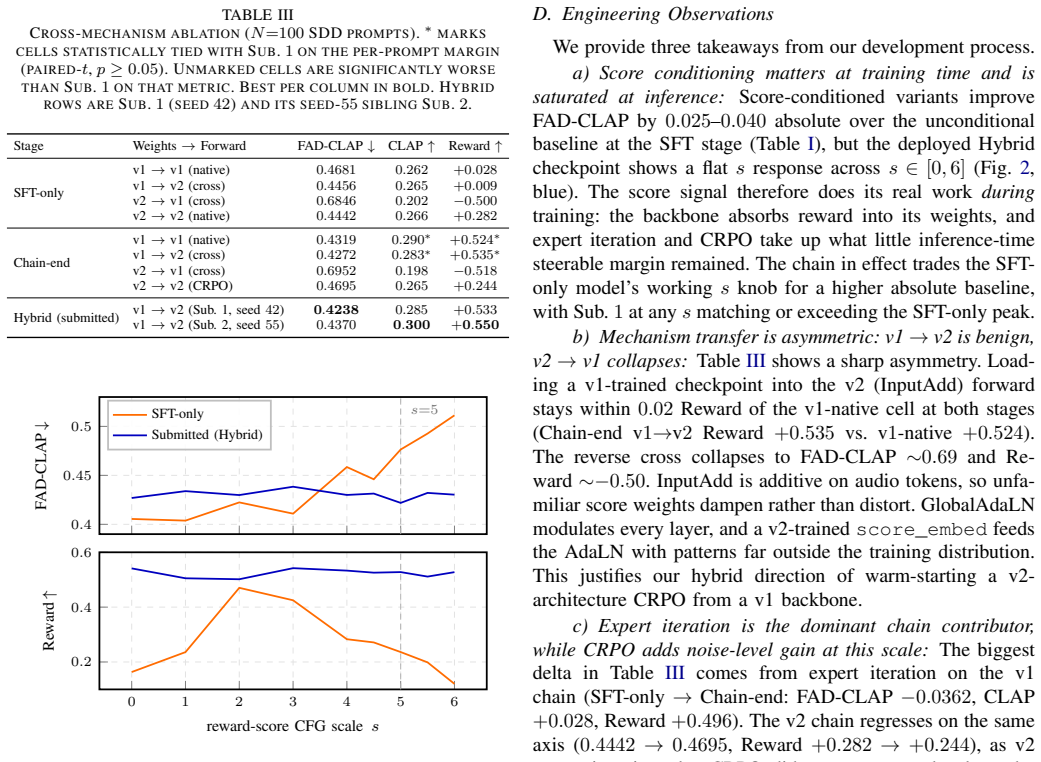
Training-time reward conditioning combined with expert iteration on the top decile of samples selected by a pairwise preference ranker produces the primary gains in text-to-music generation, while a subsequent short preference-tuning pass adds only noise-level improvement and the inference-time scalar is already saturated.
What carries the argument
The TuneJury twin pairwise ranker that supplies the human-preference reward used simultaneously for conditioning during training and for sample selection during expert iteration.
If this is right
- Reward conditioning learned at training time doubles as a functional classifier-free guidance axis at inference without extra training.
- Expert iteration restricted to the top decile of reward-scored outputs accounts for the bulk of measured improvement under both challenge and preference metrics.
- A short preference-tuning pass after expert iteration yields only marginal further change.
- Once the training pipeline completes, additional scaling of the inference-time reward scalar produces no meaningful extra gain.
Where Pith is reading between the lines
- The outsized role of sample selection suggests that similar filtering steps could raise quality in other conditional generation settings even without full model retraining.
- If the ranker’s judgments drift across musical genres or cultural contexts, the reported gains would shrink when the same pipeline is applied to broader prompt distributions.
- Replacing the external ranker with an internal reward head trained jointly might reduce the observed saturation at inference and allow end-to-end optimization.
Load-bearing premise
The TuneJury ranker trained on open music-preference datasets supplies a stable proxy for human preference that stays valid when reused for both conditioning and selection across pipeline stages.
What would settle it
A controlled human listening test on the same 100 prompts in which the ranker's ordering of generated clips disagrees with human rankings on a statistically significant fraction of pairs would falsify the proxy assumption.
Figures

read the original abstract
We describe our entry to the efficiency track of the Academic Text-to-Music (ATTM) Grand Challenge at ICME 2026. Beyond the challenge protocol's FAD-CLAP and CLAP score, we add a learned human-preference reward from TuneJury, a twin pairwise ranker trained over open music-preference datasets. The reward serves both as a training-time conditioning signal and as a sample-selection criterion. The pipeline combines five engineering decisions on a 120M-parameter FluxAudio-S backbone, four at training time and one at inference: (i) training-time reward conditioning that doubles as an inference-time CFG axis, (ii) a sweep over five score-conditioning architectures, where training and inference use different variants, (iii) expert iteration on the top decile, (iv) a short preference-tuning pass (CRPO) for audio-text alignment, and (v) inference post-processing via joint CFG, source separation, and loudness normalization. Per-stage decomposition on 100 Song Describer prompts shows training-time reward conditioning as a functional conditioning axis, expert iteration as the dominant contributor, the preference-tuning pass adding only noise-level gain, and the inference-time score scalar already saturated by the end of the chain.
Editorial analysis
A structured set of objections, weighed in public.
Referee Report
Summary. The manuscript describes an entry to the efficiency track of the ATTM Grand Challenge at ICME 2026. It augments a 120M-parameter FluxAudio-S backbone with five engineering decisions: training-time reward conditioning (using TuneJury, a twin pairwise ranker trained on open music-preference datasets) that also serves as an inference-time CFG axis, a sweep over score-conditioning architectures, expert iteration on the top decile, a short CRPO preference-tuning pass, and inference post-processing (joint CFG, source separation, loudness normalization). The central empirical claim is a per-stage decomposition on 100 Song Describer prompts showing that training-time reward conditioning is functional, expert iteration is the dominant contributor, the CRPO pass adds only noise-level gain, and the inference-time score scalar is already saturated.
Significance. If the ordering of contributions holds under independent validation, the work supplies actionable guidance on the relative value of preference-based techniques for text-to-music generation, particularly the high leverage of expert iteration and the limited marginal benefit of an additional alignment pass. The choice to train the reward model on external open datasets rather than the challenge test set is a methodological strength that reduces direct circularity.
major comments (2)
- [Abstract] Abstract: the per-stage decomposition asserts a clear ordering of contributions (expert iteration dominant; CRPO noise-level) on the basis of TuneJury scores, yet supplies no error bars, statistical tests, prompt-selection criteria, or variance estimates across the 100 Song Describer prompts. This leaves the central empirical claim only weakly supported.
- [Abstract] Abstract: the same TuneJury twin ranker is employed both as the training-time conditioning signal and as the sample-selection / scoring criterion for the decomposition. No independent human validation or correlation study against the challenge metrics (FAD-CLAP, CLAP) on the generated outputs is described; any domain shift or self-reinforcing bias in TuneJury on FluxAudio-S outputs would invalidate the reported ordering of contributions.
minor comments (1)
- The abstract states that training and inference use different variants of the score-conditioning architectures but does not enumerate the five architectures or report the sweep results, hindering reproducibility.
Simulated Author's Rebuttal
We thank the referee for the constructive feedback on our ATTM Grand Challenge submission. We address each major comment below and indicate planned changes to the manuscript.
read point-by-point responses
-
Referee: [Abstract] Abstract: the per-stage decomposition asserts a clear ordering of contributions (expert iteration dominant; CRPO noise-level) on the basis of TuneJury scores, yet supplies no error bars, statistical tests, prompt-selection criteria, or variance estimates across the 100 Song Describer prompts. This leaves the central empirical claim only weakly supported.
Authors: We agree that the current presentation of the per-stage results is insufficiently supported. The 100 prompts are the standard Song Describer evaluation set from the challenge protocol. In the revision we will add per-stage means with standard deviations across the 100 prompts, report variance estimates, and include statistical tests (e.g., Wilcoxon signed-rank) to assess whether observed differences in TuneJury scores are significant. This will directly address the weakness in the central empirical claim. revision: yes
-
Referee: [Abstract] Abstract: the same TuneJury twin ranker is employed both as the training-time conditioning signal and as the sample-selection / scoring criterion for the decomposition. No independent human validation or correlation study against the challenge metrics (FAD-CLAP, CLAP) on the generated outputs is described; any domain shift or self-reinforcing bias in TuneJury on FluxAudio-S outputs would invalidate the reported ordering of contributions.
Authors: The dual use of TuneJury is deliberate to keep the preference signal identical between conditioning and selection. The model was trained exclusively on external open datasets, which reduces direct circularity with the challenge test set. We acknowledge that no independent human validation or correlation analysis versus FAD-CLAP/CLAP is provided. We will add an explicit limitations paragraph discussing potential domain shift and self-reinforcing bias on FluxAudio-S outputs, while noting that the official challenge metrics are reported separately from the internal decomposition. revision: partial
Circularity Check
No circularity: empirical decomposition uses external proxy without reducing claims to inputs by construction
full rationale
The paper's central claims rest on an empirical per-stage ablation measured with TuneJury scores on 100 prompts. TuneJury itself is described as trained on separate open music-preference datasets, not on the Song Describer prompts or the model's outputs, so the evaluation metric is not constructed from the pipeline stages being measured. No equations, fitted parameters, or self-citations are shown that would make any reported contribution (e.g., expert iteration dominance) equivalent to its own input by definition. The use of the same reward for conditioning and selection is a design choice whose effect on human preference is debatable, but that is a question of proxy validity rather than a logical reduction of the reported ordering to the inputs. The derivation chain therefore remains self-contained against the external benchmark it adopts.
Axiom & Free-Parameter Ledger
Reference graph
Works this paper leans on
-
[1]
Academic text-to-music grand chal- lenge: Datasets, baselines, and evaluation methods,
Fang-Chih Hsieh, Wei-Jaw Lee, Chun-Ping Wang, Hung-yi Lee, Hao- Wen Dong, and Yi-Hsuan Yang, “Academic text-to-music grand chal- lenge: Datasets, baselines, and evaluation methods,” inInternational Conference on Multimedia and Expo, Grand Challenge Paper, 2026
2026
-
[2]
Fr ´echet Audio Distance: A reference-free metric for evaluating music enhancement algorithms,
Kevin Kilgour, Mauricio Zuluaga, Dominik Roblek, and Matthew Shar- ifi, “Fr ´echet Audio Distance: A reference-free metric for evaluating music enhancement algorithms,” inProceedings of Interspeech, 2019
2019
-
[3]
Large-scale contrastive language-audio pretraining with feature fusion and keyword-to-caption augmentation,
Yusong Wu, Ke Chen, Tianyu Zhang, Yuchen Hui, Marianna Nezhurina, Taylor Berg-Kirkpatrick, and Shlomo Dubnov, “Large-scale contrastive language-audio pretraining with feature fusion and keyword-to-caption augmentation,” inProceedings of ICASSP, 2023
2023
-
[4]
The MTG-Jamendo dataset for automatic music tagging,
Dmitry Bogdanov, Minz Won, Philip Tovstogan, Alastair Porter, and Xavier Serra, “The MTG-Jamendo dataset for automatic music tagging,” inMachine Learning for Music Discovery Workshop, ICML, 2019
2019
-
[5]
The Song Describer Dataset: a corpus of audio captions for music-and-language evaluation,
Ilaria Manco, Benno Weck, Seungheon Doh, Minz Won, Yixiao Zhang, Dmitry Bogdanov, Yusong Wu, Ke Chen, Philip Tovstogan, Emmanouil Benetos, Elio Quinton, Gy ¨orgy Fazekas, and Juhan Nam, “The Song Describer Dataset: a corpus of audio captions for music-and-language evaluation,” inMachine Learning for Audio Workshop, NeurIPS, 2023
2023
-
[6]
TuneJury: An open metric for improving music generation preference alignment,
Yonghyun Kim, Junwon Lee, Haiwen Xia, Yinghao Ma, Junghyun Koo, Koichi Saito, Yuki Mitsufuji, and Chris Donahue, “TuneJury: An open metric for improving music generation preference alignment,”arXiv preprint arXiv:2606.17006, 2026
arXiv 2026
-
[7]
Learning to rank using gradient descent,
Christopher J. C. Burges, Tal Shaked, Erin Renshaw, Ari Lazier, Matt Deeds, Nicole Hamilton, and Gregory N. Hullender, “Learning to rank using gradient descent,” inProceedings of ICML, 2005
2005
-
[8]
MERT: Acoustic music understanding model with large-scale self-supervised training,
Yizhi Li, Ruibin Yuan, Ge Zhang, Yinghao Ma, Xingran Chen, Hanzhi Yin, Chenghao Xiao, Chenghua Lin, Anton Ragni, Emmanouil Benetos, Norbert Gyenge, Roger Dannenberg, Ruibo Liu, Wenhu Chen, Gus Xia, Yemin Shi, Wenhao Huang, Zili Wang, Yike Guo, and Jie Fu, “MERT: Acoustic music understanding model with large-scale self-supervised training,” inProceedings o...
2024
-
[9]
Zhengcong Fei, Mingyuan Fan, Changqian Yu, and Junshi Huang, “FLUX that plays music,”arXiv preprint arXiv:2409.00587, 2024
arXiv 2024
-
[10]
Fourier features let networks learn high frequency functions in low dimensional domains,
Matthew Tancik, Pratul P. Srinivasan, Ben Mildenhall, Sara Fridovich- Keil, Nithin Raghavan, Utkarsh Singhal, Ravi Ramamoorthi, Jonathan T. Barron, and Ren Ng, “Fourier features let networks learn high frequency functions in low dimensional domains,” inProceedings of NeurIPS, 2020
2020
-
[11]
Classifier-free diffusion guidance,
Jonathan Ho and Tim Salimans, “Classifier-free diffusion guidance,” arXiv preprint arXiv:2207.12598, 2022
Pith/arXiv arXiv 2022
-
[12]
Thinking fast and slow with deep learning and tree search,
Thomas Anthony, Zheng Tian, and David Barber, “Thinking fast and slow with deep learning and tree search,” inProceedings of NeurIPS, 2017
2017
-
[13]
Reinforced Self-Training (ReST) for language modeling,
Caglar Gulcehre, Tom Le Paine, Srivatsan Srinivasan, Ksenia Konyushkova, Lotte Weerts, Abhishek Sharma, Aditya Siddhant, Alex Ahern, Miaosen Wang, Chenjie Gu, Wolfgang Macherey, Arnaud Doucet, Orhan Firat, and Nando de Freitas, “Reinforced Self-Training (ReST) for language modeling,”arXiv preprint arXiv:2308.08998, 2023
Pith/arXiv arXiv 2023
-
[14]
TangoFlux: Super fast and faithful text to audio generation with flow matching and clap-ranked preference optimization,
Chia-Yu Hung, Navonil Majumder, Zhifeng Kong, Ambuj Mehrish, Amir Ali Bagherzadeh, Chuan Li, Rafael Valle, Bryan Catanzaro, and Soujanya Poria, “TangoFlux: Super fast and faithful text to audio generation with flow matching and clap-ranked preference optimization,” inProceedings of ICLR, 2026
2026
-
[15]
Direct Preference Optimization: Your language model is secretly a reward model,
Rafael Rafailov, Archit Sharma, Eric Mitchell, Stefano Ermon, Christo- pher D. Manning, and Chelsea Finn, “Direct Preference Optimization: Your language model is secretly a reward model,” inProceedings of NeurIPS, 2023
2023
-
[16]
Music source separation in the waveform domain,
Alexandre D ´efossez, Nicolas Usunier, L ´eon Bottou, and Francis Bach, “Music source separation in the waveform domain,”arXiv preprint arXiv:1911.13254, 2019
arXiv 1911
-
[17]
Barbarians at the gate: How AI is upending systems research,
Audrey Cheng, Shu Liu, Melissa Pan, Zhifei Li, Bowen Wang, Alex Krentsel, Tian Xia, Mert Cemri, Jongseok Park, Shuo Yang, Jeff Chen, Lakshya Agrawal, Aditya Desai, Jiarong Xing, Koushik Sen, Matei Zaharia, and Ion Stoica, “Barbarians at the gate: How AI is upending systems research,”arXiv preprint arXiv:2510.06189, 2025
arXiv 2025
-
[18]
Flow matching for generative modeling,
Yaron Lipman, Ricky T. Q. Chen, Heli Ben-Hamu, Maximilian Nickel, and Matt Le, “Flow matching for generative modeling,” inProceedings of ICLR, 2023
2023
-
[19]
Music Arena: Live evaluation for text-to-music,
Yonghyun Kim, Wayne Chi, Anastasios N. Angelopoulos, Wei-Lin Chi- ang, Koichi Saito, Shinji Watanabe, Yuki Mitsufuji, and Chris Donahue, “Music Arena: Live evaluation for text-to-music,” inProceedings of NeurIPS Creative AI Track, 2025
2025
-
[20]
Aligning text- to-music evaluation with human preferences,
Yichen Huang, Zachary Novack, Koichi Saito, Jiatong Shi, Shinji Watan- abe, Yuki Mitsufuji, John Thickstun, and Chris Donahue, “Aligning text- to-music evaluation with human preferences,” inProceedings of ISMIR, 2025
2025
-
[21]
Benchmarking music generation models and metrics via human preference studies,
Florian Gr ¨otschla, Ahmet Solak, Luca A. Lanzend ¨orfer, and Roger Wattenhofer, “Benchmarking music generation models and metrics via human preference studies,” inProceedings of ICASSP, 2025
2025
-
[22]
SongEval: A benchmark dataset for song aesthetics evaluation,
Jixun Yao, Guobin Ma, Huixin Xue, Huakang Chen, Chunbo Hao, Yuepeng Jiang, Haohe Liu, Ruibin Yuan, Jin Xu, Wei Xue, Hao Liu, and Lei Xie, “SongEval: A benchmark dataset for song aesthetics evaluation,”arXiv preprint arXiv:2505.10793, 2025
arXiv 2025
-
[23]
Mathematical discoveries from program search with large language models,
Bernardino Romera-Paredes, Mohammadamin Barekatain, Alexander Novikov, Matej Balog, M. Pawan Kumar, Emilien Dupont, Francisco J. R. Ruiz, Jordan S. Ellenberg, Pengming Wang, Omar Fawzi, Pushmeet Kohli, and Alhussein Fawzi, “Mathematical discoveries from program search with large language models,”Nature, vol. 625, pp. 468–475, 2024
2024
-
[24]
AlphaEvolve: A coding agent for scientific and algorithmic discovery,
Alexander Novikov, Ng ˆan V ˜u, Marvin Eisenberger, Emilien Dupont, Po-Sen Huang, Adam Zsolt Wagner, Sergey Shirobokov, Borislav Ko- zlovskii, Francisco J. R. Ruiz, Abbas Mehrabian, M. Pawan Kumar, Abigail See, Swarat Chaudhuri, George Holland, Alex Davies, Sebas- tian Nowozin, Pushmeet Kohli, and Matej Balog, “AlphaEvolve: A coding agent for scientific a...
Pith/arXiv arXiv 2025
-
[25]
MeanAudio: Fast and faithful text-to-audio generation with mean flows,
Xiquan Li, Junxi Liu, Yuzhe Liang, Zhikang Niu, Wenxi Chen, and Xie Chen, “MeanAudio: Fast and faithful text-to-audio generation with mean flows,”arXiv preprint arXiv:2508.06098, 2025
arXiv 2025
-
[26]
Exploring the limits of transfer learning with a unified text-to-text transformer,
Colin Raffel, Noam Shazeer, Adam Roberts, Katherine Lee, Sharan Narang, Michael Matena, Yanqi Zhou, Wei Li, and Peter J. Liu, “Exploring the limits of transfer learning with a unified text-to-text transformer,”Journal of Machine Learning Research, vol. 21, no. 140, pp. 1–67, 2020
2020
-
[27]
BigVGAN: A universal neural vocoder with large-scale training,
Sang-gil Lee, Wei Ping, Boris Ginsburg, Bryan Catanzaro, and Sungroh Yoon, “BigVGAN: A universal neural vocoder with large-scale training,” inProceedings of ICLR, 2023
2023
-
[28]
Recommendation ITU-R BS.1770-4: Algorithms to measure audio programme loudness and true- peak audio level,
International Telecommunication Union, “Recommendation ITU-R BS.1770-4: Algorithms to measure audio programme loudness and true- peak audio level,” ITU-R Recommendation, 2015
2015
-
[29]
Claude Opus 4.6 system card,
Anthropic, “Claude Opus 4.6 system card,” https://anthropic.com/ claude-opus-4-6-system-card, 2026
2026
-
[30]
Claude Opus 4.7 system card,
Anthropic, “Claude Opus 4.7 system card,” https://anthropic.com/ claude-opus-4-7-system-card, 2026
2026
discussion (0)
Sign in with ORCID, Apple, or X to comment. Anyone can read and Pith papers without signing in.