Algorithmic Contract Design at Scale: Adaptive Peer Comparison for Enterprise Pricing
Pith reviewed 2026-06-26 05:41 UTC · model grok-4.3
The pith
Contract Scoring grades proposed enterprise deals against historical peers via ensemble trees to enforce discount discipline in seconds.
A machine-rendered reading of the paper's core claim, the machinery that carries it, and where it could break.
Core claim
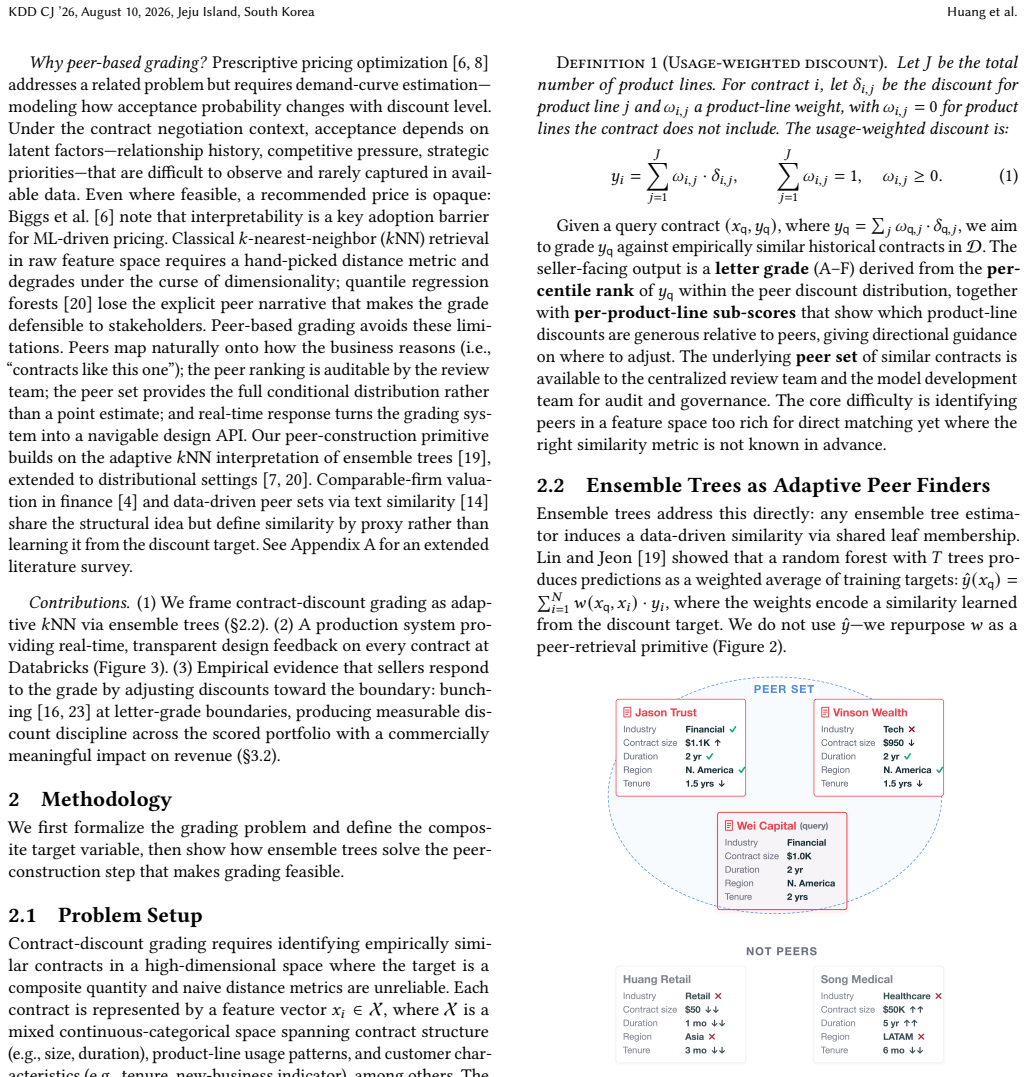
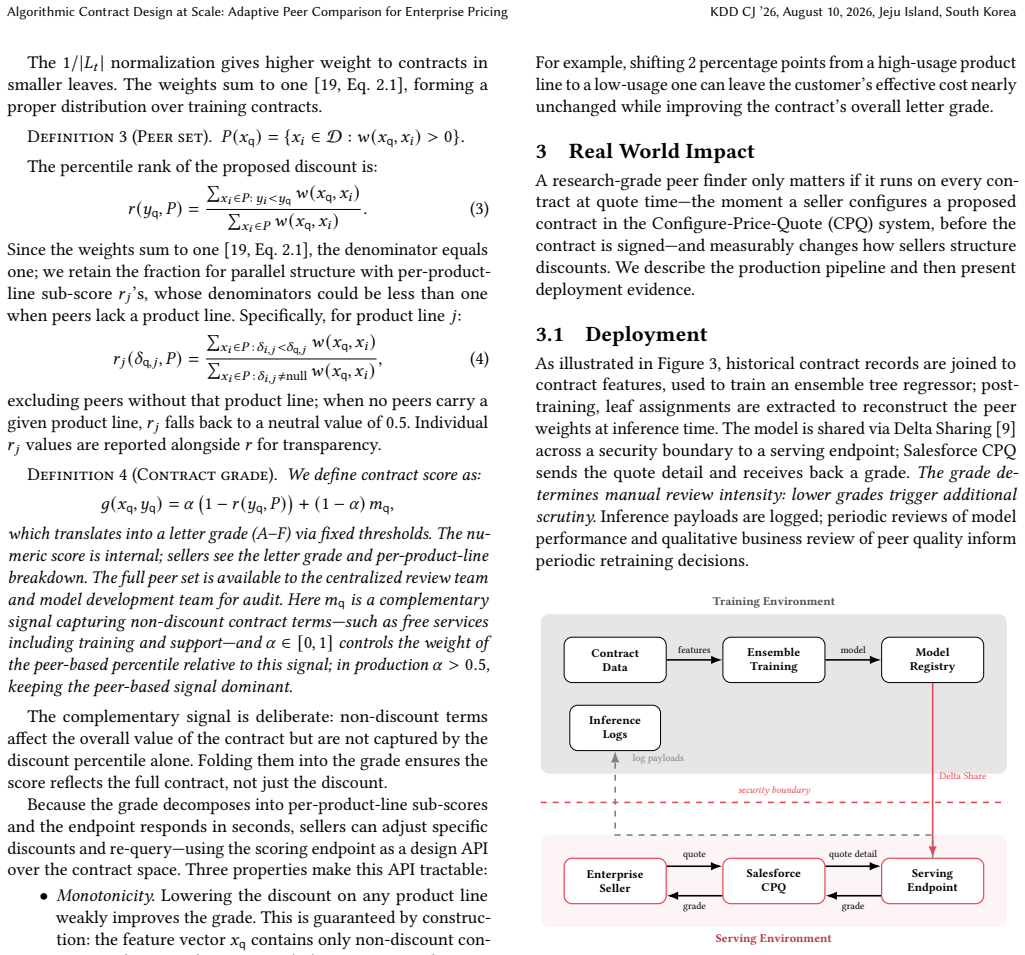
Contract Scoring identifies empirically similar historical contracts via adaptive nearest neighbors over ensemble trees, where shared leaf membership defines a data-driven similarity learned from the discount target, and returns a letter grade with per-product-line breakdown in seconds so that sellers can iteratively adjust discount structures until the grade reflects their intended tradeoff.
What carries the argument
Adaptive nearest neighbors over ensemble trees, where shared leaf membership defines similarity learned from the discount target.
If this is right
- Sellers receive real-time feedback and can redesign contracts iteratively until the assigned grade matches their target tradeoff.
- Centralized review teams obtain an auditable data-driven peer set for every contract instead of relying solely on reviewer judgment.
- Grading completes in seconds rather than days, removing the bottleneck of manual governance.
- Portfolio-wide discount discipline improves, producing a commercially significant revenue impact.
Where Pith is reading between the lines
- The same tree-based peer mechanism could be applied to other high-dimensional negotiated agreements such as procurement or licensing terms.
- If the learned similarity clusters reveal stable customer segments, the system might support proactive pricing policies rather than reactive grading.
- Extending the trees to incorporate predicted future usage or retention outcomes could refine the notion of an appropriate peer discount.
Load-bearing premise
Historical contracts identified via adaptive nearest neighbors over ensemble trees form an unbiased and representative peer set for determining appropriate current discounts.
What would settle it
A controlled comparison showing no reduction in average discount levels or no revenue lift after full deployment across the scored portfolio.
Figures



read the original abstract
In enterprise software, a contract commits the customer to a usage volume over a fixed term in exchange for discounted pricing. These contracts are individually negotiated across many dimensions -- size, duration, industry, product mix, usage history -- and without a data-driven reference point, discounts tend to be overly generous. Manual governance review enforces discipline but at days-scale per contract, with inconsistency across reviewers and no real-time feedback to sellers. We present \emph{Contract Scoring}, a peer-based grading system deployed on every contract at Databricks. The system identifies empirically similar historical contracts via adaptive nearest neighbors over ensemble trees, where shared leaf membership defines a data-driven similarity learned from the discount target. It returns a letter grade with per-product-line breakdown in seconds; the underlying peer set is available to the centralized review team for audit. Sellers treat the grade as a contract design ``exit criterion'', iteratively adjusting discount structures until the grade reflects their intended tradeoff. Deployment evidence shows measurable discount discipline across the scored portfolio, with a commercially significant impact on revenue.
Editorial analysis
A structured set of objections, weighed in public.
Referee Report
Summary. The paper presents Contract Scoring, a deployed peer-comparison system at Databricks that identifies similar historical enterprise software contracts via adaptive nearest neighbors over ensemble trees (with similarity defined by shared leaf membership learned from the discount target). It returns letter grades and per-product breakdowns in seconds for use as an exit criterion by sellers, with the peer set available for audit. The central claim is that deployment has produced measurable discount discipline across the scored portfolio and a commercially significant positive revenue impact.
Significance. If the deployment evidence is robust and the peer construction avoids circularity, the work illustrates a scalable, real-time application of tree-based similarity for negotiated pricing governance. It could serve as a template for data-driven contract design in enterprise software, where manual review is slow and inconsistent, and would be of interest to applied statisticians working on operational ML systems.
major comments (3)
- [Abstract / deployment results] Abstract and deployment evidence section: the claim that the system produces 'measurable discount discipline' and 'commercially significant impact on revenue' is presented without any quantitative metrics, sample sizes, control groups, before/after comparisons, or statistical details. This prevents evaluation of whether the data support the stated outcome and is load-bearing for the paper's primary contribution.
- [Method / peer-set construction] Method description of adaptive nearest neighbors: the similarity metric is defined via shared leaf membership 'learned from the discount target.' Without explicit equations, feature separation details, or validation showing that the peer set is constructed independently of the target discounts, the construction risks reducing to a fitted reflection of the input discounts rather than an independent benchmark (see reader's circularity concern).
- [Method / peer identification] Historical contracts identification: the assumption that adaptive nearest neighbors over ensemble trees form an unbiased and representative peer set for current discounts is stated but not supported by any reported validation, bias checks, or sensitivity analysis on the feature set or tree ensemble.
minor comments (1)
- [Abstract] The abstract refers to 'per-product-line breakdown' but provides no example output or description of how the breakdown is computed or displayed.
Simulated Author's Rebuttal
We thank the referee for their careful reading and constructive comments. The feedback highlights important areas for strengthening the presentation of deployment evidence and methodological details. We address each major comment below and commit to revisions that improve clarity and rigor without altering the core claims.
read point-by-point responses
-
Referee: [Abstract / deployment results] Abstract and deployment evidence section: the claim that the system produces 'measurable discount discipline' and 'commercially significant impact on revenue' is presented without any quantitative metrics, sample sizes, control groups, before/after comparisons, or statistical details. This prevents evaluation of whether the data support the stated outcome and is load-bearing for the paper's primary contribution.
Authors: We agree that the current manuscript presents the deployment outcomes at a high level. The initial submission prioritized brevity and respected internal confidentiality constraints on exact figures. In the revision we will expand the deployment evidence section with available quantitative details, including the number of scored contracts, observed shifts in discount distributions pre- and post-deployment, and any statistical summaries that can be shared, thereby allowing readers to assess the strength of the reported impact. revision: yes
-
Referee: [Method / peer-set construction] Method description of adaptive nearest neighbors: the similarity metric is defined via shared leaf membership 'learned from the discount target.' Without explicit equations, feature separation details, or validation showing that the peer set is constructed independently of the target discounts, the construction risks reducing to a fitted reflection of the input discounts rather than an independent benchmark (see reader's circularity concern).
Authors: The ensemble trees are trained on historical features to predict discounts, after which leaf co-membership defines similarity; this produces a metric that groups contracts by the features most relevant to discounting behavior. For a new contract the peer set is drawn exclusively from historical data, and the letter grade is computed by locating the proposed discount within the empirical distribution of peer discounts. Because the new contract's discount value is never used in tree construction or peer selection, the benchmark remains independent. We will add the explicit similarity equations, feature preprocessing details, and supporting validation (e.g., correlation between peer-set discounts and held-out contract features) in the revised manuscript. revision: yes
-
Referee: [Method / peer identification] Historical contracts identification: the assumption that adaptive nearest neighbors over ensemble trees form an unbiased and representative peer set for current discounts is stated but not supported by any reported validation, bias checks, or sensitivity analysis on the feature set or tree ensemble.
Authors: We acknowledge that the original text does not report explicit validation or sensitivity results for the peer-set construction. The revision will include a dedicated subsection presenting bias diagnostics (comparison of peer-set covariate distributions to the full historical population), sensitivity checks across tree depth and feature subsets, and any internal stability metrics used during model development. revision: yes
Circularity Check
Similarity metric learned from discount target reduces peer grading to fitted reflection
specific steps
-
fitted input called prediction
[Abstract]
"identifies empirically similar historical contracts via adaptive nearest neighbors over ensemble trees, where shared leaf membership defines a data-driven similarity learned from the discount target"
The similarity metric that defines the peer set for grading discounts is itself learned from the discount target variable. The resulting grade is therefore constructed by construction from a fit to the discounts, rather than providing an independent benchmark.
full rationale
The abstract explicitly states that the peer identification uses a similarity 'learned from the discount target' via ensemble trees. This makes the letter grade a direct function of a metric fitted to the same discount variable it is meant to benchmark, satisfying the fitted_input_called_prediction pattern. No equations or separation of training/target are provided to break the dependence. The deployment evidence claim rests on this mechanism, so the circularity is load-bearing for the core contribution. No other patterns (self-citation, ansatz smuggling, etc.) are detectable from the supplied text.
Axiom & Free-Parameter Ledger
axioms (1)
- domain assumption Historical contracts provide a valid and unbiased reference for appropriate current discounts
Reference graph
Works this paper leans on
-
[1]
Susan Athey, Julie Tibshirani, and Stefan Wager. 2019. Generalized Random Forests.The Annals of Statistics47, 2 (2019), 1148–1178. doi:10.1214/18-AOS1709
-
[2]
Lucas Bernardi, Themistoklis Mavridis, and Pablo Estevez. 2019. 150 Successful Machine Learning Models: 6 Lessons Learned at Booking.com. InProceedings of the 25th ACM SIGKDD International Conference on Knowledge Discovery and Data Mining. 1743–1751. doi:10.1145/3292500.3330744
-
[3]
Data-driven assortment optimization
Dimitris Bertsimas and Velibor V. Miši’c. 2019. Exact First-Choice Product Line Optimization.Operations Research67, 3 (2019), 651–670. doi:10.1287/opre.2018. 1825 Earlier version titled “Data-driven assortment optimization”
-
[4]
Sanjeev Bhojraj and Charles M. C. Lee. 2002. Who Is My Peer? A Valuation-Based Approach to the Selection of Comparable Firms.Journal of Accounting Research 40, 2 (2002), 407–439
2002
-
[5]
G’erard Biau and Erwan Scornet. 2016. A Random Forest Guided Tour.TEST25, 2 (2016), 197–227. doi:10.1007/s11749-016-0481-7
-
[6]
Max Biggs, Wei Sun, and Markus Ettl. 2021. Model Distillation for Revenue Optimization: Interpretable Personalized Pricing. InProceedings of the 38th In- ternational Conference on Machine Learning (Proceedings of Machine Learning Research, Vol. 139). 946–956
2021
-
[7]
af, Peter B
Domagoj Cevid, Loris Michel, Jeffrey N"af, Peter B"uhlmann, and Nicolai Mein- shausen. 2022. Distributional Random Forests: Heterogeneity Adjustment and Multivariate Distributional Regression.Journal of Machine Learning Research23, 333 (2022), 1–79
2022
-
[8]
Colias, Stella Park, and Elizabeth Horn
John V. Colias, Stella Park, and Elizabeth Horn. 2021. Optimizing B2B Product Offers with Machine Learning, Mixed Logit, and Nonlinear Programming.Journal of Marketing Analytics9, 3 (2021), 157–172. doi:10.1057/s41270-021-00113-y
-
[9]
Databricks. 2026. What is Delta Sharing? https://docs.databricks.com/aws/en/ delta-sharing/. Accessed June 2026
2026
-
[10]
Alex Davies and Zoubin Ghahramani. 2014. The Random Forest Kernel and Other Kernels for Big Data from Random Partitions.arXiv preprint arXiv:1402.4293 (2014). arXiv:1402.4293
Pith/arXiv arXiv 2014
-
[11]
Paul Geertsema and Helen Lu. 2023. Relative Valuation with Machine Learning. Journal of Accounting Research61, 1 (2023), 329–376
2023
-
[12]
Borgwardt, Malte J
Arthur Gretton, Karsten M. Borgwardt, Malte J. Rasch, Bernhard Sch"olkopf, and Alexander Smola. 2012. A Kernel Two-Sample Test.Journal of Machine Learning Research13, 25 (2012), 723–773
2012
-
[13]
Xinran He, Junfeng Pan, Ou Jin, Tianbing Xu, Bo Liu, Tao Xu, Yanxin Shi, Antoine Atallah, Ralf Herbrich, Stuart Bowers, and Joaquin Qui nonero Candela. 2014. Practical Lessons from Predicting Clicks on Ads at Facebook. InProceedings of the 8th International Workshop on Data Mining for Online Advertising (ADKDD’14). ACM, 5:1–5:9. doi:10.1145/2648584.2648589
-
[14]
Gerard Hoberg and Gordon Phillips. 2016. Text-Based Network Industries and Endogenous Product Differentiation.Journal of Political Economy124, 5 (2016), 1423–1465. doi:10.1086/688176
-
[15]
Kennedy, Jessica Cameron, Paul P.-Y
Daniel W. Kennedy, Jessica Cameron, Paul P.-Y. Wu, and Kerrie Mengersen. 2020. A Statistical Machine Learning Approach for Benchmarking in the Presence of Complex Contextual Factors and Peer Groups.arXiv preprint arXiv:2011.08407 (2020). arXiv:2011.08407
arXiv 2020
-
[16]
Henrik J. Kleven. 2016. Bunching.Annual Review of Economics8 (2016), 435–464. doi:10.1146/annurev-economics-080315-015234
-
[17]
Charles M. C. Lee, Paul Ma, and Charles C. Y. Wang. 2015. Search-Based Peer Firms: Aggregating Investor Perceptions through Internet Co-Searches.Journal of Financial Economics116, 2 (2015), 410–431. doi:10.1016/j.jfineco.2015.02.001
-
[18]
Shuang Li, Yao Xie, Hanjun Dai, and Le Song. 2015. M-Statistic for Kernel Change-Point Detection. InAdvances in Neural Information Processing Systems, Vol. 28
2015
-
[19]
Yi Lin and Yongho Jeon. 2006. Random Forests and Adaptive Nearest Neighbors. J. Amer. Statist. Assoc.101, 474 (2006), 578–590. doi:10.1198/016214505000001230
-
[20]
Nicolai Meinshausen. 2006. Quantile Regression Forests.Journal of Machine Learning Research7 (2006), 983–999
2006
-
[21]
Velibor V. Miši’c and Georgia Perakis. 2020. Data Analytics in Operations Man- agement: A Review.Manufacturing & Service Operations Management22, 1 (2020), 158–169. doi:10.1287/msom.2019.0805
-
[22]
Phillips
Robert L. Phillips. 2005.Pricing and Revenue Optimization. Stanford University Press
2005
-
[23]
Emmanuel Saez. 2010. Do Taxpayers Bunch at Kink Points?American Economic Journal: Economic Policy2, 3 (2010), 180–212. doi:10.1257/pol.2.3.180
-
[24]
Stefan Wager and Susan Athey. 2018. Estimation and Inference of Heterogeneous Treatment Effects Using Random Forests.J. Amer. Statist. Assoc.113, 523 (2018), 1228–1242. doi:10.1080/01621459.2017.1319839
-
[25]
Song Wei and Yao Xie. 2026. Online Kernel CUSUM for Change-Point Detection. Journal of the Royal Statistical Society Series B: Statistical Methodology(2026), qkag020. doi:10.1093/jrsssb/qkag020
-
[26]
Wojciech Zaremba, Arthur Gretton, and Matthew Blaschko. 2013. B-Test: A Non-Parametric, Low Variance Kernel Two-Sample Test. InAdvances in Neural Information Processing Systems, Vol. 26. A Extended Literature Survey No prior work combines peer-based contract grading with real-time design feedback in a deployed pricing system. Existing approaches each addr...
2013
-
[27]
comparable-firm
established GBT leaf indices as a supervised feature transform for click-through rate prediction at Facebook, and GBT typically achieves lower prediction error than RF for mean estimation. How- ever, GBT trees are sequential corrections—each fits residuals of previous trees—so leaf co-occurrence weights do not sum to one and lack the probabilistic interpr...
2026
-
[28]
• The Gaussian kernel bandwidth 𝜎 could be set via median heuristic and would need validation on our discount distribu- tions
or block MMD [18, 25, 26] to trade statistical power for computing efficiency. • The Gaussian kernel bandwidth 𝜎 could be set via median heuristic and would need validation on our discount distribu- tions. Critically, the right evaluation metric for the upgrade is not 𝑅2 butpercentile calibration: for contracts whose peer- set percentile is 𝑝, do approxim...
discussion (0)
Sign in with ORCID, Apple, or X to comment. Anyone can read and Pith papers without signing in.