Weak Lensing with the SKAO: Radio Shear Measurement
Pith reviewed 2026-06-25 23:37 UTC · model grok-4.3
The pith
Radio shear methods achieve multiplicative bias of a few 10^{-2} on SKA-Mid simulations
A machine-rendered reading of the paper's core claim, the machinery that carries it, and where it could break.
Core claim
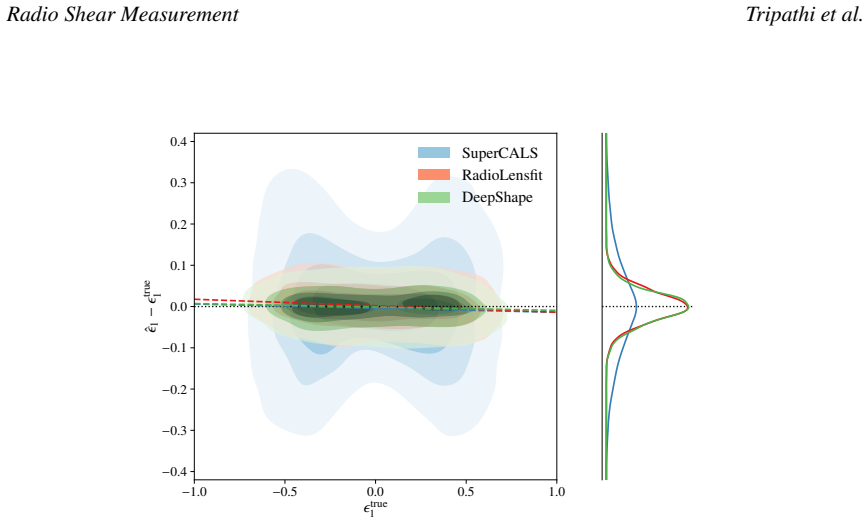
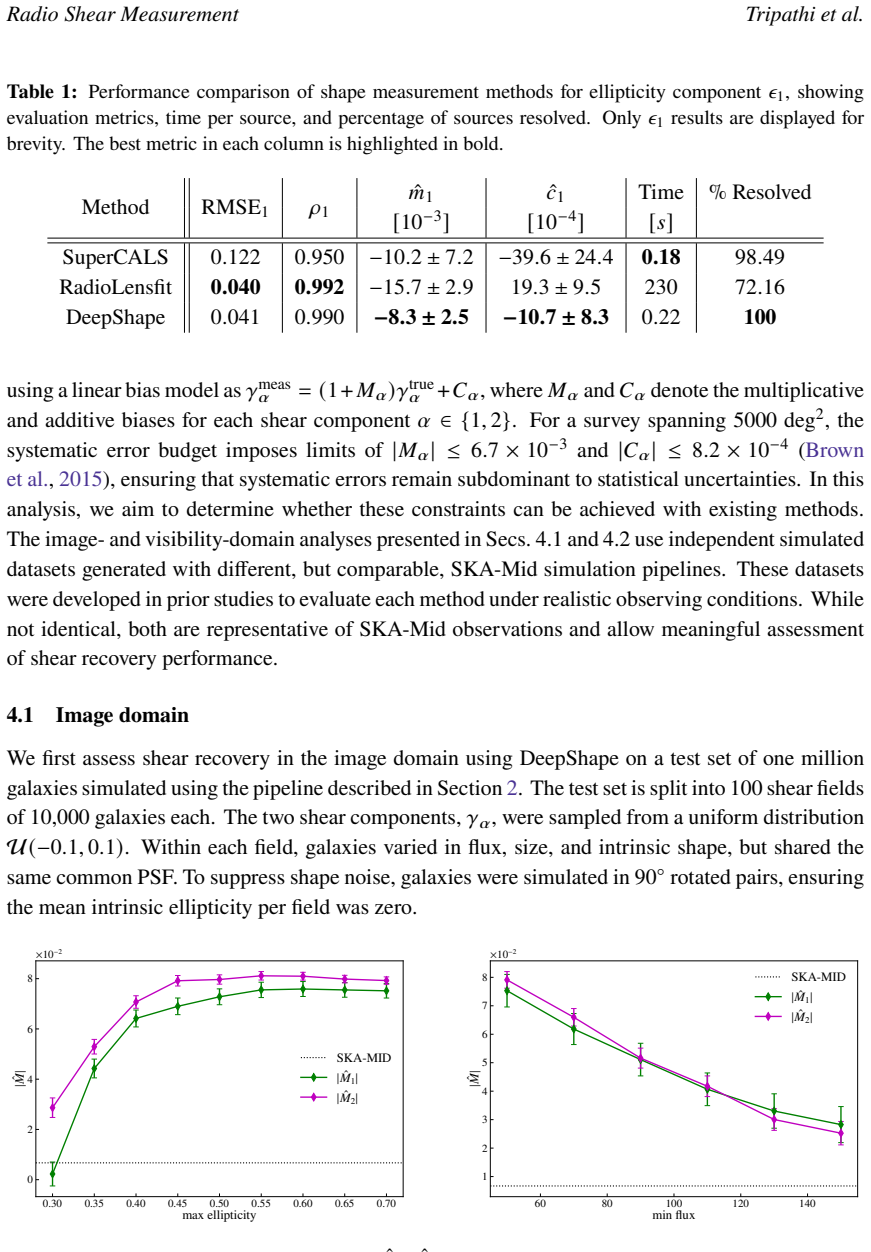
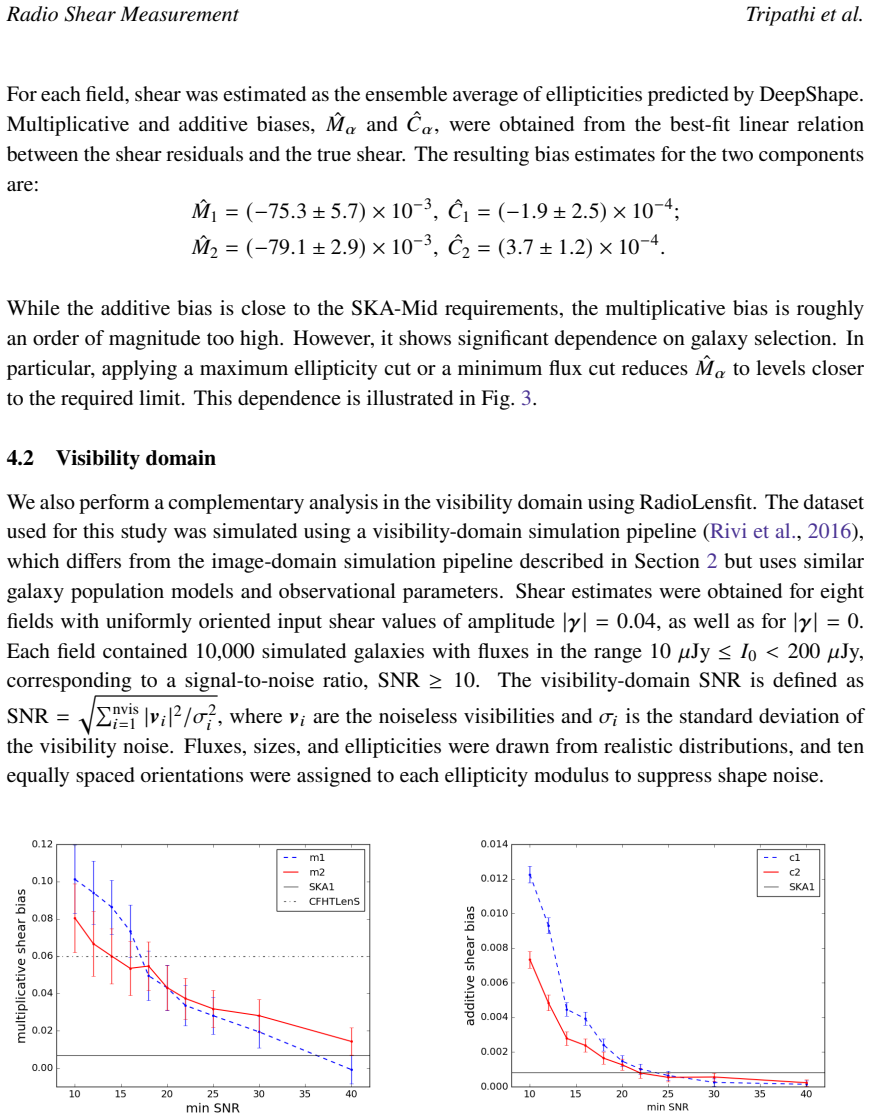
Using a pipeline that generates realistic SKA-Mid AA4 observations of isolated radio galaxies, the authors demonstrate that RadioLensfit and DeepShape deliver the most accurate shape estimates, enabling shear recovery with multiplicative biases of order a few 10^{-2} and additive biases of order 10^{-4}.
What carries the argument
The SKA-Mid simulation pipeline applied to three radio shape measurement techniques: SuperCALS, RadioLensfit, and DeepShape.
If this is right
- Shape measurement accuracy improves with RadioLensfit and DeepShape over SuperCALS.
- Shear biases remain at the 10^{-2} level, suitable for initial radio lensing studies.
- Computational intensity differs significantly between methods.
- Source separation must be addressed for crowded fields in real surveys.
Where Pith is reading between the lines
- Combining radio and optical shear measurements could reduce systematic errors in cosmology.
- Extending the pipeline to include blended sources would test the methods under more realistic conditions.
Load-bearing premise
The simulated observations of isolated radio galaxies using the SKA-Mid AA4 configuration capture the dominant instrumental and astrophysical systematics that will affect real weak-lensing measurements.
What would settle it
Measuring the actual shear bias on real SKA data using the same methods and comparing it to the simulation results would confirm or refute the reported performance.
Figures

read the original abstract
Cosmic shear measurements have traditionally been dominated by optical surveys, which offer higher resolution, better sensitivity, higher galaxy number density, and wider area coverage than their radio counterparts. With the advent of upcoming radio surveys, particularly those planned with the SKA-Mid, we would reach the high sensitivity and resolution required for weak lensing studies, allowing radio observations to begin competing with optical surveys in this domain. However, radio observations are affected by fundamentally different instrumental and astrophysical systematics, meaning that shape and shear measurement techniques developed for optical surveys cannot be straightforwardly applied. Fully realizing the weak lensing potential of these next generation radio surveys therefore requires the development and validation of methods tailored specifically for radio datasets. In this chapter, we present a simulation pipeline to generate realistic observations of isolated radio galaxies based on the SKA-Mid AA4 array configuration. We apply three recent radio shape measurement techniques: SuperCALS, RadioLensfit, and DeepShape, to assess their performance on these simulations. Our results show that RadioLensfit and DeepShape yield the most accurate shape estimates, although RadioLensfit is significantly more computationally intensive. We also perform shear recovery on simulated data using RadioLensfit and DeepShape, finding multiplicative and additive shear biases of order a few $10^{-2}$ and $10^{-4}$, respectively. Finally, we highlight the challenge of source separation, which will play a critical role in the success of future radio weak lensing analyses.
Editorial analysis
A structured set of objections, weighed in public.
Referee Report
Summary. The manuscript describes a simulation pipeline to generate realistic observations of isolated radio galaxies based on the SKA-Mid AA4 array configuration. It applies three radio shape measurement techniques (SuperCALS, RadioLensfit, and DeepShape) to assess performance, finding that RadioLensfit and DeepShape yield the most accurate shape estimates (with RadioLensfit being significantly more computationally intensive). Shear recovery tests on the simulated data using RadioLensfit and DeepShape produce multiplicative biases of order a few 10^{-2} and additive biases of order 10^{-4}. The work also highlights source separation as a critical challenge for future radio weak lensing analyses.
Significance. If the reported bias levels can be shown to hold under more complete simulations that include blending, this work supplies initial performance benchmarks for radio-specific shape measurement methods tailored to SKA data. Such benchmarks could help establish whether radio weak lensing can serve as a complementary probe to optical cosmic shear surveys, provided the methods scale to realistic source densities.
major comments (2)
- [Abstract] Abstract: The reported multiplicative (~few × 10^{-2}) and additive (~10^{-4}) shear biases, as well as the ranking of RadioLensfit and DeepShape as most accurate, are obtained exclusively from simulations of isolated galaxies. The abstract itself states that source separation 'will play a critical role' in real analyses, yet the pipeline and shear-recovery tests contain no blended or overlapping sources. This is load-bearing because confusion noise or residual separation errors could shift the bias levels by amounts comparable to the claimed values, undermining applicability to Stage-IV requirements.
- [Abstract] Abstract: Numerical bias values are stated without accompanying information on how the input shear was injected, on simulation validation against instrumental effects, or on the error budget. This prevents assessment of whether the central performance claims are robustly supported by the forward-modeling setup.
Simulated Author's Rebuttal
We thank the referee for their constructive comments on our manuscript. We address each major comment below and agree that the abstract requires revision to better reflect the scope and limitations of the presented simulations.
read point-by-point responses
-
Referee: [Abstract] Abstract: The reported multiplicative (~few × 10^{-2}) and additive (~10^{-4}) shear biases, as well as the ranking of RadioLensfit and DeepShape as most accurate, are obtained exclusively from simulations of isolated galaxies. The abstract itself states that source separation 'will play a critical role' in real analyses, yet the pipeline and shear-recovery tests contain no blended or overlapping sources. This is load-bearing because confusion noise or residual separation errors could shift the bias levels by amounts comparable to the claimed values, undermining applicability to Stage-IV requirements.
Authors: We agree that the simulations and shear-recovery tests are performed exclusively on isolated galaxies, as described in the manuscript. The abstract already flags source separation as a critical challenge for future analyses, and the reported bias values are intended as initial performance benchmarks for the shape-measurement methods under these controlled conditions. We acknowledge that blending and confusion noise represent important additional systematics that could affect the bias levels. We will revise the abstract to explicitly state that the quoted biases apply to isolated sources and to emphasize that the impact of source separation remains to be quantified in more complete simulations. revision: yes
-
Referee: [Abstract] Abstract: Numerical bias values are stated without accompanying information on how the input shear was injected, on simulation validation against instrumental effects, or on the error budget. This prevents assessment of whether the central performance claims are robustly supported by the forward-modeling setup.
Authors: Details of the shear-injection procedure, the forward-modeling approach used to generate the simulated visibilities, and the validation steps against instrumental effects are provided in the methods and results sections of the full manuscript. However, we accept that the abstract presents the bias numbers without sufficient context. We will revise the abstract to include a concise statement on the shear-injection method and to reference the simulation validation and error considerations described in the main text. revision: yes
Circularity Check
No circularity: bias measurements are direct empirical outputs from forward simulations
full rationale
The paper constructs a simulation pipeline for isolated radio galaxies under the SKA-Mid AA4 configuration, applies three external shape-measurement techniques, and reports multiplicative/additive shear biases measured against the known input shear. No equation or result is obtained by fitting a parameter to a subset of the same data and relabeling it a prediction; no self-citation chain supplies a load-bearing uniqueness theorem or ansatz; and the reported numbers are not equivalent to the simulation inputs by construction. The central claims therefore remain independent empirical measurements on controlled forward models.
Axiom & Free-Parameter Ledger
axioms (1)
- domain assumption Simulations of isolated radio galaxies with the SKA-Mid AA4 array configuration reproduce the dominant systematics relevant to weak lensing shape measurement.
Reference graph
Works this paper leans on
-
[1]
doi: 10.1093/mnras/staa3062. M. Atemkeng et al.MNRAS, 499(1):292–303, Nov
-
[2]
doi: 10.1093/mnras/staa2843. D. J. Bacon, A. R. Refregier, and R. S. Ellis.MNRAS, 318(2):625–640, Oct
-
[3]
doi: 10.1046/j. 1365-8711.2000.03851.x. R. A. Battye et al.MNRAS, 495(2):1706–1723, Apr
work page doi:10.1046/j 2000
-
[4]
doi: 10.1093/mnras/staa709. G. M. Bernstein and R. Armstrong.MNRAS, 438(2):1880–1893, Feb
-
[5]
doi: 10.1093/mnras/ stt2326. Bertin, E. and Arnouts, S.A&AS., 117(2):393–404,
-
[6]
doi: 10.1051/aas:1996164. A. Bonaldi et al.MNRAS, 482(1):2–19, Sept
-
[7]
doi: 10.1093/mnras/sty2603. R. Braun et al. Anticipated performance of the square kilometre array – phase 1 (ska1),
-
[8]
CASA Team et al.PASP, 134(1041):114501, Nov
doi: 10.22323/1.215.0023. CASA Team et al.PASP, 134(1041):114501, Nov
-
[9]
CASA, the Common Astronomy Software Applications for Radio Astronomy
doi: 10.1088/1538-3873/ac9642. T.Chang,A.Refregier,andD.J.Helfand.ApJ,617(2):794–810,Dec.2004. doi: 10.1086/425491. L. Connor, K. L. Bouman, V. Ravi, and G. Hallinan.MNRAS, 514(2):2614–2626, Aug
work page internal anchor Pith review doi:10.1088/1538-3873/ac9642 2004
-
[10]
doi: 10.1093/mnras/stac1329. T. J. Cornwell.ISTSP, 2(5):793–801, Oct
-
[11]
C.DemetroullasandM.L.Brown.MNRAS,456(3):3100–3118,Dec.2015. ISSN1365-2966. doi: 10.1093/mnras/stv2876. C. Demetroullas and M. L. Brown.MNRAS, 473(1):937–952, Sept
-
[12]
ISSN 1365-2966. doi: 10.1093/mnras/stx2366. I. Fenech Conti et al.MNRAS, 467(2):1627–1651, May
-
[13]
13 Radio Shear Measurement Tripathi et al
doi: 10.1093/mnras/stx200. 13 Radio Shear Measurement Tripathi et al. I. Harrison et al.MNRAS, 495(2):1737–1759, Apr
-
[14]
doi: 10.1093/mnras/staa696. C. Heymans et al.MNRAS, 427(1):146–166, Nov
-
[15]
doi: 10.1111/j.1365-2966.2012.21952.x. J. A. Högbom.A&As, 15:417, June
-
[16]
T.Kacprzaketal.MNRAS,427(4):2711–2722,Dec.2012.doi: 10.1111/j.1365-2966.2012.21622.x. N. Kaiser, G. Wilson, and G. A. Luppino. Large-scale cosmic shear measurements,
-
[17]
doi: 10.1093/mnras/stz977. R. Massey et al.MNRAS, 429(1):661–678, Feb
-
[18]
doi: 10.1093/mnras/sts371. P. Melchior et al. scarlet: Source separation in multi-band images by Constrained Matrix Factor- ization. Astrophysics Source Code Library, record ascl:1803.003, Mar
-
[19]
doi: 10.1093/mnras/stw2814. J. E. Noordam. InGround-based Telescopes, volume 5489 ofSPIE, pages 817–825, Oct
-
[20]
doi: 10.1117/12.544262. P. Patel et al.MNRAS, 401(4):2572–2586, Feb
-
[21]
doi: 10.1111/j.1365-2966.2009.15836.x. P. Patel et al.MNRAS, 444(3):2893–2909, Nov
-
[22]
doi: 10.1093/mnras/stu1588. P. Patel et al. InAdvancing Astrophysics with the SKA,
-
[23]
A.Refregieretal.MNRAS,425(3):1951–1957,Aug.2012
doi: 10.22323/1.215.0030. A.Refregieretal.MNRAS,425(3):1951–1957,Aug.2012. doi: 10.1111/j.1365-2966.2012.21483. x. D.M.ReimanandB.E.Göhre.MNRAS,485(2):2617–2627,May2019.doi: 10.1093/mnras/stz575. M. Rivi and L. Miller.MNRAS, 476(2):2053–2062,
-
[24]
doi: 10.1093/mnras/sty371. M. Rivi and L. Miller. RadioLensfit: Radio weak lensing shear measurement in the visibility domain. Astrophysics Source Code Library, record ascl:2208.019, Aug
-
[25]
doi: 10.1016/j.ascom.2022.100574. M. Rivi, L. Miller, S. Makhathini, and F. B. Abdalla.MNRAS, 463(2):1881–1890, Dec
-
[26]
doi: 10.1093/mnras/stw2041. M. Rivi et al.MNRAS, 482(1):1096–1109,
-
[27]
doi: 10.1093/mnras/sty2700. B. T. Rowe et al.A&C, 10:121–150,
-
[28]
doi: 10.1016/j.ascom.2015.02.002. J. L. Sérsic.Boletin de la Asociacion Argentina de Astronomia La Plata Argentina, 6:41–43, Feb
-
[29]
doi: 10.3847/1538-4357/aa704b. R. Sortino et al.Experimental Astronomy, 56(1):293–331, May
-
[30]
doi: 10.1051/0004-6361/201833775. P. Tripathi, S. Wang, S. Prunet, and A. Ferrari.A&A, 696:A216, Apr
-
[31]
doi: 10.48550/arXiv.astro-ph/0002500. D. M. Wittman et al.Nature, 405(6783):143–148, May
work page internal anchor Pith review Pith/arXiv arXiv doi:10.48550/arxiv.astro-ph/0002500
-
[32]
doi: 10.1038/35012001. K. Zhang et al.ITPAM, 44:6360–6376,
-
[33]
doi: 10.1051/0004-6361/202345903. J. Zuntz et al.MNRAS, 434(2):1604–1618, July
-
[34]
doi: 10.1093/mnras/stt1125. 14
discussion (0)
Sign in with ORCID, Apple, or X to comment. Anyone can read and Pith papers without signing in.