texttt{calypso}: a Parameter-Conditioned Stochastic Surrogate Model for Circumbinary Accretion Time-Series
Pith reviewed 2026-05-25 05:17 UTC · model grok-4.3
The pith
A PCA-based stochastic surrogate model emulates circumbinary accretion time series and supplies a closed-form likelihood to infer binary eccentricity and mass ratio from observations.
A machine-rendered reading of the paper's core claim, the machinery that carries it, and where it could break.
Core claim
The central claim is that representing total and individual accretion time series in a PCA basis, modeling the resulting coefficients as multivariate Gaussian draws that include aleatoric uncertainty, produces a parameter-conditioned stochastic emulator whose properties match those of full simulations; a closed-form Gaussian likelihood derived from this representation then enables direct inference of binary eccentricity and mass ratio from observed accretion-rate time series.
What carries the argument
PCA basis expansion of the accretion time series whose coefficients are drawn from a multivariate Gaussian distribution conditioned on binary eccentricity and mass ratio.
If this is right
- The emulator generates new stochastic accretion time series for any chosen eccentricity and mass ratio without running full hydrodynamic simulations.
- A closed-form likelihood allows direct Bayesian or maximum-likelihood inference of binary parameters from any observed accretion-rate time series.
- The model can be used to interpret light curves from current and upcoming transient surveys that monitor accreting binaries.
- Epistemic uncertainty from finite training data is found to be negligible compared with the aleatoric term already included.
- The published Python package supplies both the emulator and the inference likelihood for immediate community use.
Where Pith is reading between the lines
- The same PCA-plus-Gaussian construction could be applied to other expensive stochastic astrophysical time series where full simulations remain costly.
- Once calibrated, the likelihood could be combined with population-level priors to constrain the distribution of binary eccentricities and mass ratios across an observed sample.
- Extending the conditioning to additional parameters such as disk viscosity or temperature would require only new training simulations and refitting of the Gaussian.
- The surrogate could serve as a fast forward model inside larger inference pipelines that jointly fit binary parameters and disk properties.
Load-bearing premise
The PCA coefficients of the accretion time series can be adequately modeled as draws from a multivariate Gaussian that captures the aleatoric uncertainty of the process.
What would settle it
Generate new circumbinary accretion simulations at unseen binary parameters, project their time series onto the same PCA basis, and test whether the resulting coefficient vectors are consistent with the fitted multivariate Gaussian or whether parameter recovery from the likelihood fails to recover the input values within the reported uncertainties.
Figures





read the original abstract
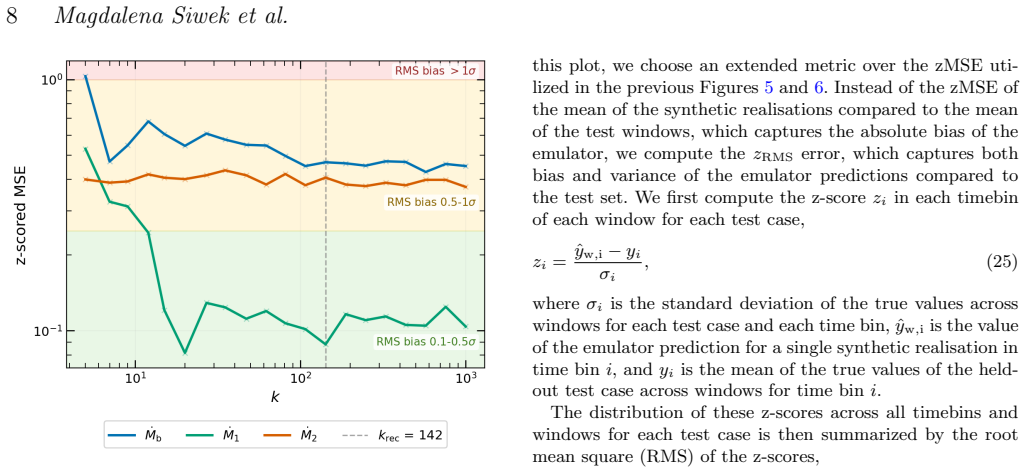
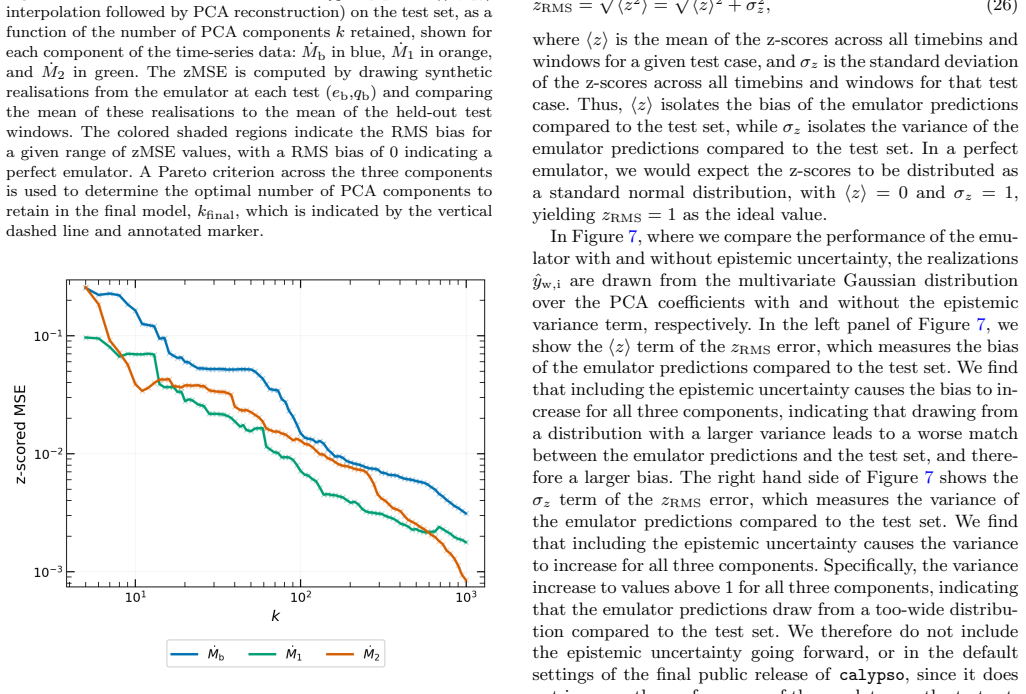
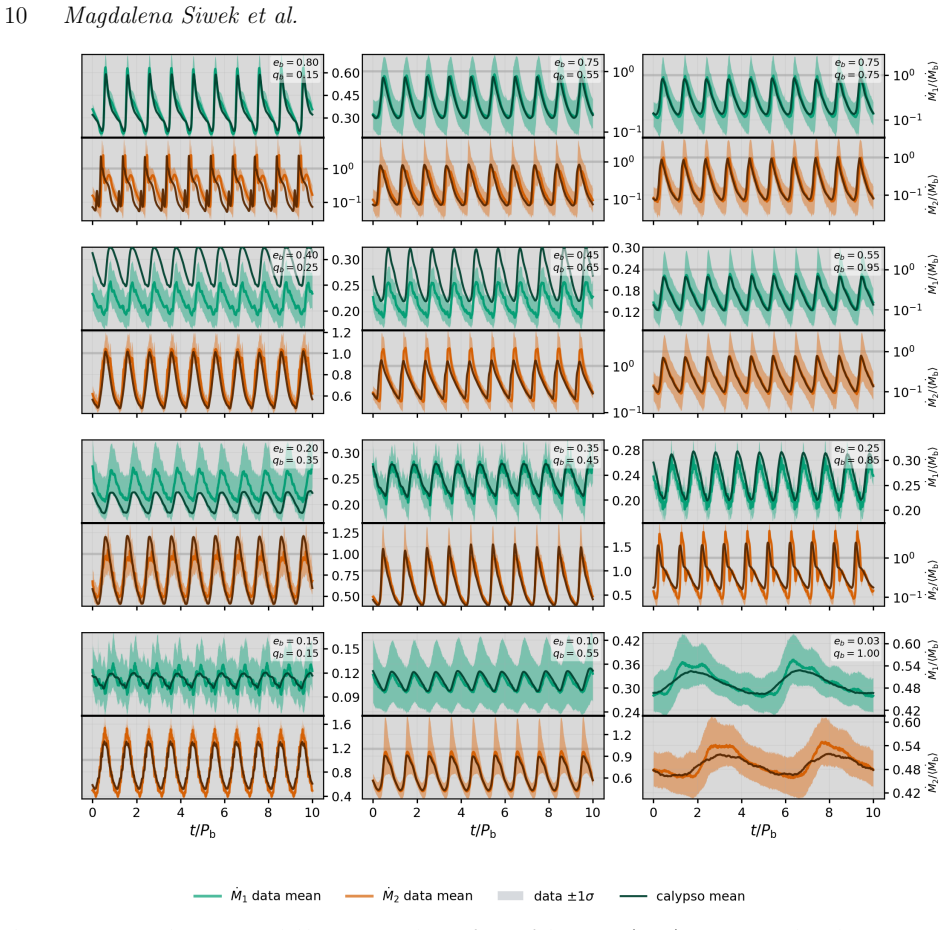
We present calypso, a parameter-conditioned stochastic surrogate model for circumbinary accretion flows. We represent the total and individual accretion time series in a PCA basis and model the resulting coefficients as draws from a multivariate Gaussian distribution over the latent PCA coefficients. We specifically include the aleatoric uncertainty of the time series in the model, enabling the emulator to capture the inherent stochasticity of the accretion process and the long-term modulation due to disk precession. We further explore the epistemic uncertainty in the model due to limited training data and interpolation in the ($e_{\rm b}$, $q_{\rm b}$) parameter space and find that the data does not support inclusion of this added variance term. We present the properties of existing simulation suites of circumbinary accretion, and run new simulations to fill in gaps in the parameter space, as well as a set of 13 test simulations for validation of the emulator. We publish calypso as a pip-installable Python package with an open-source codebase and comprehensive documentation, and demonstrate use-cases for current and upcoming transient surveys. We additionally derive a closed-form Gaussian likelihood that enables direct inference of ($e_{\rm b}$, $q_{\rm b}$) from observed accretion-rate time series.
Editorial analysis
A structured set of objections, weighed in public.
Referee Report
Summary. The paper introduces calypso, a parameter-conditioned stochastic surrogate for circumbinary accretion time series. Accretion rates (total and individual) are projected onto a PCA basis; the resulting coefficients are modeled as draws from a multivariate Gaussian whose mean and covariance are conditioned on binary parameters (e_b, q_b). Aleatoric uncertainty is retained while epistemic uncertainty from limited training data is tested and omitted. A closed-form Gaussian likelihood is derived that permits direct inference of (e_b, q_b) from observed time series. The work augments existing simulation suites, adds 13 validation runs, and releases an open-source pip-installable Python package with documentation.
Significance. If the Gaussian modeling choice is adequate, the surrogate plus closed-form likelihood would supply a practical, computationally efficient route to infer binary parameters from accretion-rate observations, directly relevant to transient surveys. The public release of code and documentation constitutes a clear reproducibility strength.
major comments (2)
- [Abstract, §3] Abstract and §3: the closed-form Gaussian likelihood for inferring (e_b, q_b) is derived under the explicit modeling choice that the PCA coefficients are multivariate-Gaussian draws capturing aleatoric uncertainty. No quantitative normality diagnostics (Q-Q plots, Shapiro-Wilk or Mardia tests, or comparison against non-Gaussian alternatives) on the coefficient distribution are reported, even though the abstract notes that epistemic variance was tested and dropped. This assumption is load-bearing for the inference claim.
- [Abstract] Abstract: validation is performed with 13 test simulations, yet no quantitative performance metrics (e.g., RMSE on reconstructed time series, predictive coverage of the Gaussian intervals, or log-likelihood on held-out runs) are supplied. Without these numbers it is impossible to judge whether the surrogate reproduces the stochastic behavior at a level that supports the downstream inference application.
Simulated Author's Rebuttal
We thank the referee for their constructive comments on our manuscript. We address each of the major comments point-by-point below.
read point-by-point responses
-
Referee: [Abstract, §3] Abstract and §3: the closed-form Gaussian likelihood for inferring (e_b, q_b) is derived under the explicit modeling choice that the PCA coefficients are multivariate-Gaussian draws capturing aleatoric uncertainty. No quantitative normality diagnostics (Q-Q plots, Shapiro-Wilk or Mardia tests, or comparison against non-Gaussian alternatives) on the coefficient distribution are reported, even though the abstract notes that epistemic variance was tested and dropped. This assumption is load-bearing for the inference claim.
Authors: We agree that the multivariate Gaussian assumption is fundamental to the closed-form likelihood and that the lack of explicit normality diagnostics is a gap in the current presentation. In the revised manuscript, we will add Q-Q plots for the PCA coefficients across the parameter space and include results from multivariate normality tests such as Mardia's test. This will provide quantitative support for the modeling choice without altering the core methodology. revision: yes
-
Referee: [Abstract] Abstract: validation is performed with 13 test simulations, yet no quantitative performance metrics (e.g., RMSE on reconstructed time series, predictive coverage of the Gaussian intervals, or log-likelihood on held-out runs) are supplied. Without these numbers it is impossible to judge whether the surrogate reproduces the stochastic behavior at a level that supports the downstream inference application.
Authors: The manuscript references the 13 validation simulations but does not report specific quantitative metrics. We will incorporate these in the revision, including RMSE values for the reconstructed accretion time series, empirical coverage probabilities for the Gaussian predictive intervals, and log-likelihood scores on the held-out test runs. These additions will be placed in §4 or a dedicated validation subsection to demonstrate the surrogate's performance. revision: yes
Circularity Check
No circularity: surrogate construction and likelihood follow from explicit modeling choices on simulation data
full rationale
The paper fits a PCA basis to circumbinary accretion simulations, models the resulting coefficients as draws from a multivariate Gaussian (explicitly to capture aleatoric uncertainty), and states that the closed-form likelihood for (e_b, q_b) is obtained by applying this distribution to the PCA projection of an observed time series. This is a direct, standard consequence of the stated generative model rather than a reduction of any claimed prediction or uniqueness result to its own fitted inputs or self-citations. No load-bearing step matches the enumerated circularity patterns; the Gaussian assumption is presented as a modeling choice whose validity is separate from the derivation itself. The overall chain remains self-contained against the training simulations.
Axiom & Free-Parameter Ledger
axioms (1)
- domain assumption The accretion time series can be represented in a PCA basis with coefficients following a multivariate Gaussian distribution.
Reference graph
Works this paper leans on
-
[1]
Harris, Charles R. and Millman, K. Jarrod and van der Walt, St. Array programming with. Nature , year =
-
[2]
Virtanen, Pauli and Gommers, Ralf and Oliphant, Travis E. and Haberland, Matt and Reddy, Tyler and Cournapeau, David and Burovski, Evgeni and Peterson, Pearu and Weckesser, Warren and Bright, Jonathan and. Nature Methods , year =
-
[3]
Pedregosa, F. and Varoquaux, G. and Gramfort, A. and Michel, V. and Thirion, B. and Grisel, O. and Blondel, M. and Prettenhofer, P. and Weiss, R. and Dubourg, V. and Vanderplas, J. and Passos, A. and Cournapeau, D. and Brucher, M. and Perrot, M. and Duchesnay, E. , title =. Journal of Machine Learning Research , year =
-
[4]
The K correction. arXiv e-prints , keywords =. doi:10.48550/arXiv.astro-ph/0210394 , archivePrefix =. astro-ph/0210394 , primaryClass =
work page internal anchor Pith review Pith/arXiv arXiv doi:10.48550/arxiv.astro-ph/0210394
-
[5]
Nature Methods , year = "2020", volume=
SciPy 1.0: Fundamental Algorithms for Scientific Computing in Python. Nature Methods , year = "2020", volume=
work page 2020
-
[6]
Aasi, J. and others , year = 2015, journal =. doi:10.1088/0264-9381/32/7/074001 , collaboration =. 1411.4547 , archiveprefix =
work page internal anchor Pith review Pith/arXiv arXiv doi:10.1088/0264-9381/32/7/074001 2015
-
[8]
Advanced Virgo: a 2nd generation interferometric gravitational wave detector
Advanced Virgo: a second-generation interferometric gravitational wave detector. Classical and Quantum Gravity , keywords =. doi:10.1088/0264-9381/32/2/024001 , archivePrefix =. 1408.3978 , primaryClass =
work page internal anchor Pith review Pith/arXiv arXiv doi:10.1088/0264-9381/32/2/024001
-
[9]
Acoustical Society of America Journal , volume = 89, number = 6, pages = 3020, doi =
-
[10]
, volume = 380, number = 3, pages =. doi:10.1111/j.1365-2966.2007.12183.x , keywords =
-
[11]
, archivePrefix = "arXiv", eprint =
The Ninth Data Release of the Sloan Digital Sky Survey: First Spectroscopic Data from the SDSS-III Baryon Oscillation Spectroscopic Survey. , archivePrefix = "arXiv", eprint =. doi:10.1088/0067-0049/203/2/21 , adsurl =
-
[12]
Pau Amaro-Seoane and Heather Audley and Stanislav Babak and John Baker and Enrico Barausse and Peter Bender and Emanuele Berti and Pierre Binetruy and Michael Born and Daniele Bortoluzzi and Jordan Camp and Chiara Caprini and Vitor Cardoso and Monica Colpi and John Conklin and Neil Cornish and Curt Cutler and Karsten Danzmann and Rita Dolesi and Luigi Fer...
work page 2017
-
[13]
Laser Interferometer Space Antenna. arXiv e-prints , keywords =
-
[14]
Sean M. Andrews and D. J. Wilner and A. M. Hughes and Chunhua Qi and C. P. Dullemond , title =. 2009 , month = jul, publisher =. doi:10.1088/0004-637x/700/2/1502 , url =
-
[15]
Dynamical Friction around Supermassive Black Holes
Dynamical Friction around Supermassive Black Holes. , keywords =. doi:10.1088/0004-637X/745/1/83 , archivePrefix =. 1108.1163 , primaryClass =
work page internal anchor Pith review Pith/arXiv arXiv doi:10.1088/0004-637x/745/1/83
-
[16]
Armitage and Priyamvada Natarajan , title =
Philip J. Armitage and Priyamvada Natarajan , title =. 2002 , month = feb, publisher =. doi:10.1086/339770 , url =
-
[17]
Eccentricity of supermassive black hole binaries coalescing from gas rich mergers
Eccentricity of Supermassive Black Hole Binaries Coalescing from Gas-rich Mergers. , keywords =. doi:10.1086/497108 , archivePrefix =. astro-ph/0508493 , primaryClass =
work page internal anchor Pith review Pith/arXiv arXiv doi:10.1086/497108
-
[19]
Postepy Astronomii Krakow , keywords =
A model of accretion of small bodies onto a binary system. Postepy Astronomii Krakow , keywords =
-
[20]
The Effect of an External Disk on the Orbital Elements of a Central Binary. , keywords =. doi:10.1086/185971 , adsurl =
-
[21]
Dynamics of Binary-Disk Interaction. I. Resonances and Disk Gap Sizes. , keywords =. doi:10.1086/173679 , adsurl =
-
[22]
Mass Flow through Gaps in Circumbinary Disks. , keywords =. doi:10.1086/310200 , adsurl =
-
[23]
Z. Arzoumanian and P. T. Baker and A. Brazier and S. Burke-Spolaor and S. J. Chamberlin and S. Chatterjee and B. Christy and J. M. Cordes and N. J. Cornish and F. Crawford and H. Thankful Cromartie and K. Crowter and M. DeCesar and P. B. Demorest and T. Dolch and J. A. Ellis and R. D. Ferdman and E. Ferrara and W. M. Folkner and E. Fonseca and N. Garver-D...
-
[24]
A Powerful Local Shear Instability in Weakly Magnetized Disks. I. Linear Analysis. , keywords =. doi:10.1086/170270 , adsurl =
-
[25]
Enrico Barausse , title =. 2012 , month = may, publisher =. doi:10.1111/j.1365-2966.2012.21057.x , url =
-
[26]
J. E. Barnes , title =. 2002 , month = jul, publisher =. doi:10.1046/j.1365-8711.2002.05335.x , url =
-
[27]
Barnes and Lars Hernquist , title =
Joshua E. Barnes and Lars Hernquist , title =. 1992 , month = sep, publisher =. doi:10.1146/annurev.aa.30.090192.003421 , url =
-
[28]
Barnes and Lars Hernquist , title =
Joshua E. Barnes and Lars Hernquist , title =. 1996 , month = nov, publisher =. doi:10.1086/177957 , url =
-
[29]
Joshua E. Barnes and Lars E. Hernquist , title =. 1991 , month = apr, publisher =. doi:10.1086/185978 , url =
-
[30]
Anomalous Accretion Activity and the Spotted Nature of the DQ Tau Binary System
Anomalous Accretion Activity and the Spotted Nature of the DQ Tau Binary System. , keywords =. doi:10.1088/0004-637X/792/1/64 , archivePrefix =. 1407.3309 , primaryClass =
work page internal anchor Pith review Pith/arXiv arXiv doi:10.1088/0004-637x/792/1/64
-
[31]
M. R. Bate and I. A. Bonnell and V. Bromm , title =. 2002 , month = nov, publisher =. doi:10.1046/j.1365-8711.2002.05775.x , url =
-
[32]
M. C. Begelman and R. D. Blandford and M. J. Rees , title =. 1980 , month = sep, publisher =. doi:10.1038/287307a0 , url =
-
[33]
Recoiling black holes in merging galaxies: relationship to active galactic nucleus lifetimes, starbursts and the M _ BH - _ * relation. , keywords =. doi:10.1111/j.1365-2966.2010.18042.x , archivePrefix =. 1009.4940 , primaryClass =
-
[34]
Living Reviews in Relativity , keywords =
Electromagnetic counterparts to massive black-hole mergers. Living Reviews in Relativity , keywords =. doi:10.1007/s41114-022-00037-8 , archivePrefix =. 2109.03262 , primaryClass =
-
[35]
Dynamical evolution of massive black hole pairs in the presence of spin-dependent radiative feedback. arXiv e-prints , keywords =
-
[36]
doi:10.1038/235271b0 , adsurl =
, volume = 235, number = 5336, pages =. doi:10.1038/235271b0 , adsurl =
-
[37]
2016 , month = jul, publisher =
Matteo Bonetti and Francesco Haardt and Alberto Sesana and Enrico Barausse , title =. 2016 , month = jul, publisher =. doi:10.1093/mnras/stw1590 , url =
-
[38]
2018 , month = apr, publisher =
Matteo Bonetti and Alberto Sesana and Enrico Barausse and Francesco Haardt , title =. 2018 , month = apr, publisher =. doi:10.1093/mnras/sty874 , url =
-
[39]
Post-Newtonian evolution of massive black hole triplets in galactic nuclei - II. Survey of the parameter space. , keywords =. doi:10.1093/mnras/sty896 , archivePrefix =. 1709.06088 , primaryClass =
work page internal anchor Pith review Pith/arXiv arXiv doi:10.1093/mnras/sty896
-
[40]
Massive Circumbinary Discs and the Formation of Multiple Systems. , keywords =. doi:10.1093/mnras/269.1.L45 , adsurl =
-
[41]
Cosmological simulations of the growth of supermassive black holes and feedback from active galactic nuclei: method and tests. , keywords =. doi:10.1111/j.1365-2966.2009.15043.x , archivePrefix =. 0904.2572 , primaryClass =
-
[42]
The Astrophysical Journal Letters , publisher =
The Competing Effect of Gas and Stars in the Evolution of Massive Black Hole Binaries , author =. The Astrophysical Journal Letters , publisher =. doi:10.3847/2041-8213/ac1c0c , url =
-
[43]
Kevin Bundy and Matthew A. Bershady and David R. Law and Renbin Yan and Niv Drory and Nicholas MacDonald and David A. Wake and Brian Cherinka and Jos. 2014 , month = dec, publisher =. doi:10.1088/0004-637x/798/1/7 , url =
work page internal anchor Pith review doi:10.1088/0004-637x/798/1/7 2014
-
[44]
Siwek, Magdalena and Ho, Matt and Bellinger, Earl , title =. 2026 , publisher =. doi:10.5281/zenodo.XXXXXXX , url =
-
[45]
doi:10.5281/zenodo.20027762 , url =
CALYPSO runtime artifact and training/test dataset. doi:10.5281/zenodo.20027762 , url =
-
[46]
doi:10.1088/2514-3433/abb6f0 , adsurl =
Common Envelope Evolution. doi:10.1088/2514-3433/abb6f0 , adsurl =
-
[47]
Chandrasekhar, Dynamical Friction
S. Chandrasekhar , title =. 1943 , month = mar, publisher =. doi:10.1086/144517 , url =
- [48]
-
[49]
Charisi, M. and Bartos, I. and Haiman, Z. and Price-Whelan, A. M. and Graham, M. J. and Bellm, E. C. and Laher, R. R. and Márka, S. , year =. A population of short-period variable quasars from PTF as supermassive black hole binary candidates , volume =. Monthly Notices of the Royal Astronomical Society , publisher =. doi:10.1093/mnras/stw1838 , number =
-
[50]
doi:10.48550/ARXIV.2110.14661 , url =
Multi-messenger Time-domain Signatures Of Supermassive Black Hole Binaries , author =. doi:10.48550/ARXIV.2110.14661 , url =
-
[51]
Massive black hole mergers with orbital information: predictions from the ASTRID simulation. , keywords =. doi:10.1093/mnras/stac1432 , archivePrefix =. 2112.08555 , primaryClass =
-
[52]
Lin, Allison and Charisi, Maria and Haiman, Zoltán , year =. Lomb–Scargle Periodogram Struggles with Non-sinusoidal Supermassive Black Hole Binary Signatures in Quasar Lightcurves , volume =. The Astrophysical Journal , publisher =. doi:10.3847/1538-4357/ae29a7 , number =
-
[53]
and Haiman, Zoltán and MacFadyen, Andrew , year =
D’Orazio, Daniel J. and Haiman, Zoltán and MacFadyen, Andrew , year =. Accretion into the central cavity of a circumbinary disc , volume =. Monthly Notices of the Royal Astronomical Society , publisher =. doi:10.1093/mnras/stt1787 , number =
-
[54]
Self-lensing flares from black hole binaries
Park, Kevin and Haiman, Zoltán and Xin, Chengcheng and Shen, Tzuken and Villar, Ashley and Davelaar, Jordy , year =. Self-lensing flares from black hole binaries. V. Systematic searches in LSST , volume =. Physical Review D , publisher =. doi:10.1103/p328-62sl , number =
-
[55]
Star-disc interactions and binary star formation. , keywords =. doi:10.1093/mnras/249.4.584 , adsurl =
-
[56]
Cocchiararo, F. and Franchini, A. and Lupi, A. and Sesana, A. , year =. Electromagnetic signatures from accreting massive black hole binaries in time domain photometric surveys , volume =. doi:10.1051/0004-6361/202449598 , journal =
-
[57]
Shaun Cole and Cedric G. Lacey and Carlton M. Baugh and Carlos S. Frenk , title =. 2002 , month = apr, publisher =. doi:10.1046/j.1365-8711.2000.03879.x , url =
-
[58]
Comerford and Kyle Schluns and Jenny E
Julia M. Comerford and Kyle Schluns and Jenny E. Greene and Richard J. Cool , title =. 2013 , month = oct, publisher =. doi:10.1088/0004-637x/777/1/64 , url =
-
[59]
Eric R. Coughlin and Philip J. Armitage , title =. 2017 , month = jul, publisher =. doi:10.1093/mnrasl/slx114 , url =
-
[60]
Heng Xu and Siyuan Chen and Yanjun Guo and Jinchen Jiang and Bojun Wang and Jiangwei Xu and Zihan Xue and R. Nicolas Caballero and Jianping Yuan and Yonghua Xu and Jingbo Wang and Longfei Hao and Jingtao Luo and Kejia Lee and Jinlin Han and Peng Jiang and Zhiqiang Shen and Min Wang and Na Wang and Renxin Xu and Xiangping Wu and Richard Manchester and Lei ...
-
[61]
J. Cuadra and P. J. Armitage and R. D. Alexander and M. C. Begelman , title =. 2009 , month = mar, publisher =. doi:10.1111/j.1365-2966.2008.14147.x , url =
-
[62]
Resolving flows around black holes: numerical technique and applications
Resolving flows around black holes: numerical technique and applications. , keywords =. doi:10.1093/mnras/stv2246 , archivePrefix =. 1502.03445 , primaryClass =
work page internal anchor Pith review Pith/arXiv arXiv doi:10.1093/mnras/stv2246
-
[63]
Ian Czekala and Eugene Chiang and Sean M. Andrews and Eric L. N. Jensen and Guillermo Torres and David J. Wilner and Keivan G. Stassun and Bruce Macintosh , title =. 2019 , month = sep, publisher =. doi:10.3847/1538-4357/ab287b , url =
-
[64]
A Coplanar Circumbinary Protoplanetary Disk in the TWA 3 Triple M Dwarf System. , keywords =. doi:10.3847/1538-4357/abebe3 , archivePrefix =. 2102.11875 , primaryClass =
-
[65]
The MillenniumTNG project: intrinsic alignments of galaxies and haloes. , keywords =. doi:10.1093/mnras/stad1781 , archivePrefix =. 2304.12346 , primaryClass =
-
[66]
2018 , month = jul, publisher =
Luciano del Valle and Marta Volonteri , title =. 2018 , month = jul, publisher =. doi:10.1093/mnras/sty1815 , url =
-
[67]
Adam M. Dempsey and Diego Mu. Inner Boundary Condition in Quasi-Lagrangian Simulations of Accretion Disks , journal =. 2020 , month = apr, publisher =. doi:10.3847/2041-8213/ab800e , url =
-
[68]
The quest for dual and binary supermassive black holes: A multi-messenger view , journal =
Alessandra. The quest for dual and binary supermassive black holes: A multi-messenger view , journal =. 2019 , month = dec, publisher =. doi:10.1016/j.newar.2020.101525 , url =
-
[69]
G. Desvignes and R. N. Caballero and L. Lentati and J. P. W. Verbiest and D. J. Champion and B. W. Stappers and G. H. Janssen and P. Lazarus and S. Os. High-precision timing of 42 millisecond pulsars with the European Pulsar Timing Array , journal =. 2016 , month = mar, publisher =. doi:10.1093/mnras/stw483 , url =
-
[70]
S. Detweiler , title =. 1979 , month = dec, publisher =. doi:10.1086/157593 , url =
-
[71]
Lankeswar Dey and M. J. Valtonen and A. Gopakumar and S. Zola and R. Hudec and P. Pihajoki and S. Ciprini and K. Matsumoto and K. Sadakane and M. Kidger and K. Nilsson and S. Mikkola and A. Sillanp\". Authenticating the Presence of a Relativistic Massive Black Hole Binary in. 2018 , month = oct, publisher =. doi:10.3847/1538-4357/aadd95 , url =
-
[72]
2005 , month = feb, publisher =
Tiziana Di Matteo and Volker Springel and Lars Hernquist , title =. 2005 , month = feb, publisher =. doi:10.1038/nature03335 , url =
work page internal anchor Pith review doi:10.1038/nature03335 2005
-
[73]
Preventing Anomalous Torques in Circumbinary Accretion Simulations , author =
-
[74]
Preventing Anomalous Torques in Circumbinary Accretion Simulations. , keywords =. doi:10.3847/1538-4357/ac1bbd , archivePrefix =. 2102.05684 , primaryClass =
-
[75]
Daniel J. D. A transition in circumbinary accretion discs at a binary mass ratio of 1:25 , journal =. 2016 , month = apr, publisher =. doi:10.1093/mnras/stw792 , url =
-
[77]
D’Orazio, Daniel J. and Duffell, Paul C. and Tiede, Christopher , year =. Fast Methods for Computing Photometric Variability of Eccentric Binaries: Boosting, Lensing, and Variable Accretion , volume =. The Astrophysical Journal , publisher =. doi:10.3847/1538-4357/ad938b , number =
-
[78]
Daniel J. D'Orazio and Paul C. Duffell , title =. 2021 , month = jun, publisher =. doi:10.3847/2041-8213/ac0621 , url =
-
[79]
Supermassive black hole binaries in gaseous and stellar circumnuclear discs: orbital dynamics and gas accretion. , keywords =. doi:10.1111/j.1365-2966.2007.12010.x , archivePrefix =. astro-ph/0612505 , primaryClass =
-
[80]
Kepler-16: A Transiting Circumbinary Planet
Kepler-16: A Transiting Circumbinary Planet. Science , keywords =. doi:10.1126/science.1210923 , archivePrefix =. 1109.3432 , primaryClass =
work page internal anchor Pith review Pith/arXiv arXiv doi:10.1126/science.1210923
-
[81]
Duffell and Daniel D'Orazio and Andrea Derdzinski and Zoltan Haiman and Andrew MacFadyen and Anna L
Paul C. Duffell and Daniel D'Orazio and Andrea Derdzinski and Zoltan Haiman and Andrew MacFadyen and Anna L. Rosen and Jonathan Zrake , title =. 2020 , month = sep, publisher =. doi:10.3847/1538-4357/abab95 , url =
-
[82]
Circumbinary Disks: Accretion and Torque as a Function of Mass Ratio and Disk Viscosity , author =
-
[83]
DISCO: A 3D Moving-Mesh Magnetohydrodynamics Code Designed for the Study of Astrophysical Disks
DISCO: A 3D Moving-mesh Magnetohydrodynamics Code Designed for the Study of Astrophysical Disks. , keywords =. doi:10.3847/0067-0049/226/1/2 , archivePrefix =. 1605.03577 , primaryClass =
work page internal anchor Pith review Pith/arXiv arXiv doi:10.3847/0067-0049/226/1/2
discussion (0)
Sign in with ORCID, Apple, or X to comment. Anyone can read and Pith papers without signing in.