Hypergroup Symmetry in Relative Quantum Field Theories and Chiral Algebras
Pith reviewed 2026-06-28 05:09 UTC · model grok-4.3
The pith
Finite symmetries in relative 2D QFTs stand in explicit one-to-one correspondence with finite-index conformal embeddings.
A machine-rendered reading of the paper's core claim, the machinery that carries it, and where it could break.
Core claim
In relative quantum field theories in two spacetime dimensions, finite symmetries are in explicit one-to-one correspondence with conformal embeddings of finite index. The formalism incorporates the role of topological surfaces of the bulk and introduces hypergroups together with dome algebras that generalize tube algebras, extending earlier results known for absolute theories.
What carries the argument
Hypergroups induced by bulk topological surfaces, which replace ordinary groups as the symmetry structure in the relative setting.
If this is right
- Symmetries of the left- and right-moving chiral algebras can be glued to produce topological line defects of the full 2D CFT.
- Boundary conditions of a 2D CFT stand in precise correspondence with symmetries of its chiral algebra.
- In diagonal rational CFTs the topological line defects act transitively on the set of boundary conditions.
- The identity Cardy state has the smallest g-function among all boundary conditions, including those that preserve only Virasoro symmetry.
Where Pith is reading between the lines
- The explicit correspondence supplies a practical search method for new rational chiral algebras by enumerating finite-index embeddings that admit compatible hypergroup actions.
- The Haagerup example in the paper indicates that any c=8 rational chiral algebra whose modular tensor category is the Drinfeld center of the Haagerup fusion category must arise as fixed points under a rank-2 hypergroup action on SU(3)_1 ⊗ (E6)_1.
- The hypergroup and dome-algebra structures may extend to relative theories in higher dimensions or to other boundary setups where a bulk topological theory is present.
Load-bearing premise
The theory must be relative, living at the boundary of a topological QFT in one higher dimension so that bulk surfaces can generate the hypergroup symmetry structure.
What would settle it
A single rational chiral algebra that is relative and possesses a finite symmetry with no corresponding finite-index conformal embedding would disprove the claimed correspondence.
Figures









read the original abstract
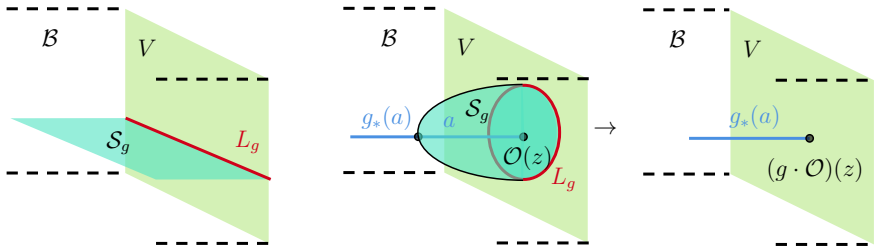
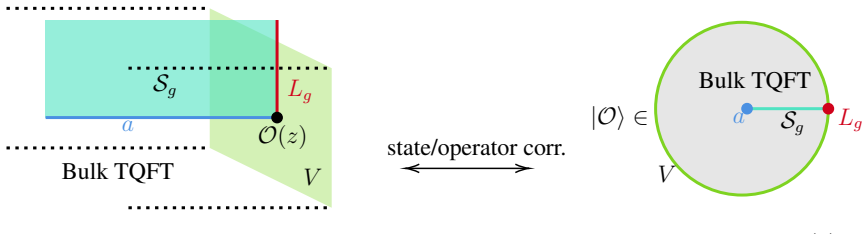
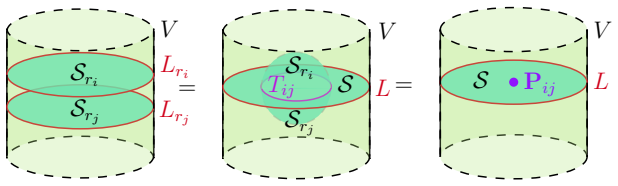
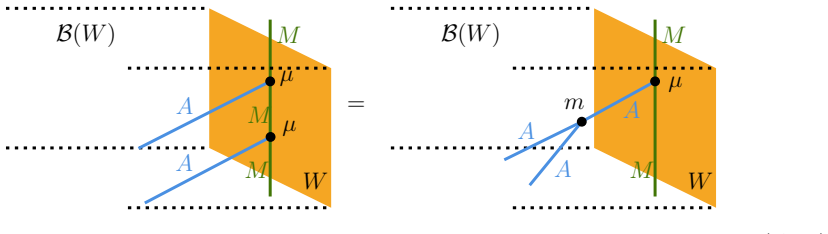
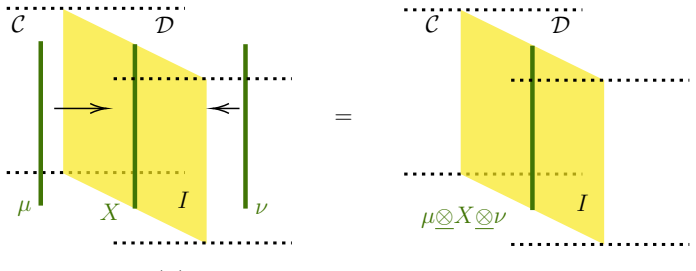
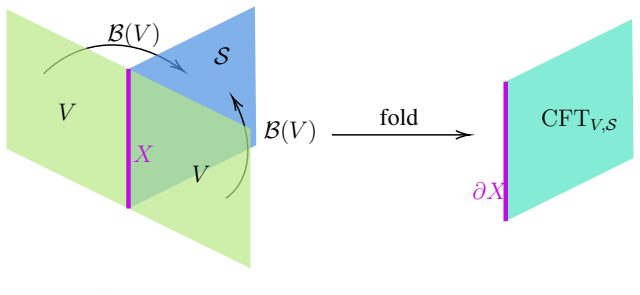
A QFT is said to be relative if it lives at the boundary of a topological QFT in one higher dimension. We develop a general framework for working with noninvertible symmetries of relative theories in two spacetime dimensions, extending several well-known results for absolute QFTs. We emphasize various new features which arise in the relative setting, including the role of topological surfaces of the bulk, and the appearance of hypergroups and certain generalizations of tube algebras known as dome algebras. Our formalism is particularly well-suited for studying rational chiral algebras, where it predicts that finite symmetries are in explicit one-to-one correspondence with conformal embeddings of finite index. We describe several implications of our framework for absolute theories. First, we explain how to "glue" together symmetries of the left- and right-moving chiral algebras of a 2D CFT to produce topological line defects of the full theory. Second, we derive a precise correspondence between boundary conditions of a 2D CFT and symmetries of its chiral algebra. This correspondence has several structural corollaries: in diagonal rational CFTs, we demonstrate that the topological line defects of the theory act transitively on its boundary conditions, and further that the identity Cardy state has the smallest $g$-function amongst all boundary conditions, including those which only preserve Virasoro symmetry. We conclude by illustrating our results in a variety of examples. For instance, we show that, if there exists a rational chiral algebra with central charge $c=8$ whose modular tensor category is the Drinfeld center of the Haagerup fusion category, then it must arise as the fixed points of a rank-2 hypergroup acting on the $SU(3)_1\otimes (E_{6})_1$ chiral algebra.
Editorial analysis
A structured set of objections, weighed in public.
Referee Report
Summary. The manuscript develops a framework for noninvertible symmetries of relative 2D QFTs, emphasizing bulk topological surfaces, hypergroups, and dome algebras as generalizations of tube algebras. For rational chiral algebras it predicts an explicit one-to-one correspondence between finite symmetries and conformal embeddings of finite index. It further derives a gluing procedure for left- and right-moving chiral symmetries into topological line defects of the full CFT, a correspondence between boundary conditions and chiral-algebra symmetries, and structural corollaries for diagonal rational CFTs (transitive action of topological lines on boundary conditions; identity Cardy state minimizes the g-function). A conditional illustration is given involving a putative c=8 chiral algebra whose MTC is the Drinfeld center of the Haagerup fusion category.
Significance. If the claimed bijective correspondence can be established independently of auxiliary bulk choices, the framework would supply a concrete classification tool linking symmetries of rational chiral algebras to finite-index embeddings and would extend several standard results on absolute QFTs to the relative setting. The derived corollaries on boundary conditions and g-functions would also be of structural interest for 2D CFTs.
major comments (1)
- [Abstract and the section presenting the one-to-one correspondence] Abstract and the section presenting the one-to-one correspondence: the asserted bijectivity between finite hypergroup symmetries (arising from bulk surfaces via dome algebras) and finite-index conformal embeddings is presented as a general prediction, yet the sole concrete illustration is conditional on the existence of a chiral algebra with MTC equal to the Drinfeld center of the Haagerup category. The manuscript must demonstrate that the map remains bijective and canonical when the bulk TQFT or the precise dome-algebra action is varied; otherwise the correspondence is not shown to be independent of additional data and the central claim is not fully supported.
minor comments (1)
- [Abstract] The abstract introduces 'dome algebras' and 'hypergroups' without a brief parenthetical reminder of their relation to tube algebras; a short clarifying sentence would improve readability for readers outside the immediate subfield.
Simulated Author's Rebuttal
We thank the referee for their careful reading of the manuscript and for the constructive major comment. We respond to it below and will incorporate revisions to strengthen the presentation of the central claim.
read point-by-point responses
-
Referee: Abstract and the section presenting the one-to-one correspondence: the asserted bijectivity between finite hypergroup symmetries (arising from bulk surfaces via dome algebras) and finite-index conformal embeddings is presented as a general prediction, yet the sole concrete illustration is conditional on the existence of a chiral algebra with MTC equal to the Drinfeld center of the Haagerup category. The manuscript must demonstrate that the map remains bijective and canonical when the bulk TQFT or the precise dome-algebra action is varied; otherwise the correspondence is not shown to be independent of additional data and the central claim is not fully supported.
Authors: We thank the referee for this comment. The bijective correspondence is established as a general result in the framework developed for rational chiral algebras. The map is constructed by associating to each hypergroup symmetry its dome algebra, which determines the embedding as the fixed points under the symmetry action, and the inverse map is given by the symmetries induced by the embedding. This construction is independent of the choice of bulk TQFT because the dome algebra is defined directly from the topological surfaces in the bulk acting on the boundary theory; varying the bulk would correspond to a different relative QFT. The Haagerup illustration is conditional only because the existence of the c=8 chiral algebra is not established, but the general correspondence does not rely on it. We will update the abstract and the section to make the canonicity and independence explicit, thereby addressing the concern. revision: yes
Circularity Check
No significant circularity; correspondence presented as derived prediction of new relative formalism.
full rationale
The paper introduces a framework for relative 2D QFTs emphasizing bulk topological surfaces, hypergroups, and dome algebras as extensions of absolute QFT results. The central claim of an explicit one-to-one correspondence between finite symmetries and finite-index conformal embeddings is stated as a prediction of this formalism for rational chiral algebras, with a conditional illustration involving the Drinfeld center of the Haagerup category. No quoted equations or self-citations reduce the bijectivity or the prediction to a fitted input, self-definition, or prior author result by construction. The derivation chain for gluing symmetries, boundary correspondences, and transitivity on Cardy states is framed as independent structural corollaries. This qualifies as a self-contained development against external benchmarks.
Axiom & Free-Parameter Ledger
axioms (2)
- standard math Standard assumptions of modular tensor categories and fusion categories for chiral algebras
- domain assumption Existence of a bulk topological QFT in one higher dimension for relative theories
invented entities (1)
-
Dome algebras
no independent evidence
Reference graph
Works this paper leans on
-
[1]
Relative quantum field theory,
D. S. Freed and C. Teleman, “Relative quantum field theory,”Commun. Math. Phys.326 (2014) 459–476,arXiv:1212.1692 [hep-th]
Pith/arXiv arXiv 2014
-
[2]
Some comments on string dynamics,
E. Witten, “Some comments on string dynamics,” inSTRINGS 95: Future Perspectives in String Theory, pp. 501–523. 7, 1995.arXiv:hep-th/9507121
Pith/arXiv arXiv 1995
-
[3]
A. Strominger, “Open p-branes,”Phys. Lett. B383(1996) 44–47, arXiv:hep-th/9512059
Pith/arXiv arXiv 1996
-
[4]
Infinite Additional Symmetries in Two-Dimensional Conformal Quantum Field Theory,
A. B. Zamolodchikov, “Infinite Additional Symmetries in Two-Dimensional Conformal Quantum Field Theory,”Theor. Math. Phys.65(1985) 1205–1213
1985
-
[5]
Classical and Quantum Conformal Field Theory,
G. W. Moore and N. Seiberg, “Classical and Quantum Conformal Field Theory,” Commun. Math. Phys.123(1989) 177–254
1989
-
[6]
Quantum Field Theory and the Jones Polynomial,
E. Witten, “Quantum Field Theory and the Jones Polynomial,”Commun. Math. Phys.121 (1989) 351–399
1989
-
[7]
Generalized Global Symmetries,
D. Gaiotto, A. Kapustin, N. Seiberg, and B. Willett, “Generalized Global Symmetries,” JHEP02(2015) 172,arXiv:1412.5148 [hep-th]
Pith/arXiv arXiv 2015
-
[8]
On finite symmetries and their gauging in two dimensions,
L. Bhardwaj and Y . Tachikawa, “On finite symmetries and their gauging in two dimensions,”JHEP03(2018) 189,arXiv:1704.02330 [hep-th]
arXiv 2018
-
[9]
Topological Defect Lines and Renormalization Group Flows in Two Dimensions,
C.-M. Chang, Y .-H. Lin, S.-H. Shao, Y . Wang, and X. Yin, “Topological Defect Lines and Renormalization Group Flows in Two Dimensions,”JHEP01(2019) 026, arXiv:1802.04445 [hep-th]
Pith/arXiv arXiv 2019
-
[10]
Generalized twisted partition functions,
V . B. Petkova and J. B. Zuber, “Generalized twisted partition functions,”Phys. Lett. B504 (2001) 157–164,arXiv:hep-th/0011021
Pith/arXiv arXiv 2001
-
[11]
TFT construction of RCFT correlators 1. Partition functions,
J. Fuchs, I. Runkel, and C. Schweigert, “TFT construction of RCFT correlators 1. Partition functions,”Nucl. Phys. B646(2002) 353–497,arXiv:hep-th/0204148
Pith/arXiv arXiv 2002
-
[12]
Kramers-Wannier duality from conformal defects,
J. Fr ¨olich, J. Fuchs, I. Runkel, and C. Schweigert, “Kramers-Wannier duality from conformal defects,”Phys. Rev. Lett.93(2004) 070601,arXiv:cond-mat/0404051
Pith/arXiv arXiv 2004
-
[13]
Duality and defects in rational conformal field theory,
J. Fr ¨olich, J. Fuchs, I. Runkel, and C. Schweigert, “Duality and defects in rational conformal field theory,”Nucl. Phys. B763(2007) 354–430, arXiv:hep-th/0607247
Pith/arXiv arXiv 2007
-
[14]
What’s Done Cannot Be Undone: TASI Lectures on Non-Invertible Symmetries,
S.-H. Shao, “What’s Done Cannot Be Undone: TASI Lectures on Non-Invertible Symmetries,” inTheoretical Advanced Study Institute in Elementary Particle Physics 2023: Aspects of Symmetry. 8, 2023.arXiv:2308.00747 [hep-th]
Pith/arXiv arXiv 2023
-
[15]
ICTP lectures on (non-)invertible generalized symmetries,
S. Schafer-Nameki, “ICTP lectures on (non-)invertible generalized symmetries,”Phys. Rep.1063(2024) 1–55,arXiv:2305.18296 [hep-th]
Pith/arXiv arXiv 2024
-
[16]
Gapless edges of 2d topological orders and enriched monoidal categories,
L. Kong and H. Zheng, “Gapless edges of 2d topological orders and enriched monoidal categories,”Nucl. Phys. B927(2018) 140–165,arXiv:1705.01087 [cond-mat.str-el]. 109
Pith/arXiv arXiv 2018
-
[17]
A mathematical theory of gapless edges of 2d topological orders. Part I,
L. Kong and H. Zheng, “A mathematical theory of gapless edges of 2d topological orders. Part I,”JHEP02(2020) 150,arXiv:1905.04924 [cond-mat.str-el]
arXiv 2020
-
[18]
A mathematical theory of gapless edges of 2d topological orders. Part II,
L. Kong and H. Zheng, “A mathematical theory of gapless edges of 2d topological orders. Part II,”Nucl. Phys. B966(2021) 115384,arXiv:1912.01760 [cond-mat.str-el]
arXiv 2021
-
[19]
L. Bhardwaj, S. Giacomelli, M. H ¨ubner, and S. Sch¨afer-Nameki, “Relative defects in relative theories: Trapped higher-form symmetries and irregular punctures in class S,” SciPost Phys.13no. 4, (2022) 101,arXiv:2201.00018 [hep-th]
arXiv 2022
-
[20]
Intermediate Defect Groups, Polarization Pairs, and Non-invertible Duality Defects,
C. Lawrie, X. Yu, and H. Y . Zhang, “Intermediate Defect Groups, Polarization Pairs, and Non-invertible Duality Defects,”Phys. Rev. D109no. 2, (2024) 026005, arXiv:2306.11783 [hep-th]
arXiv 2024
-
[21]
S. Franco and X. Yu, “Generalized symmetries in 2D from string theory: SymTFTs, intrinsic relativeness, and anomalies of non-invertible symmetries,”JHEP2024no. 11, (2024) 004,arXiv:2404.19761 [hep-th]
arXiv 2024
-
[22]
Generalized Orbifold Construction for Conformal Nets,
M. Bischoff, “Generalized Orbifold Construction for Conformal Nets,”Rev. Math. Phys. 29no. 01, (2017) 1750002,arXiv:1608.00253 [math-ph]
Pith/arXiv arXiv 2017
-
[23]
Quantum operations on conformal nets,
M. Bischoff, S. Del Vecchio, and L. Giorgetti, “Quantum operations on conformal nets,” Rev. Math. Phys.35no. 04, (2023) 2350007,arXiv:2204.14105 [math.OA]
arXiv 2023
-
[24]
Fusion rings acting on vertex operator algebras: First steps,
A. Riesen, “Fusion rings acting on vertex operator algebras: First steps,” inQuantum Symmetries: Tensor Categories, Topological Quantum Field Theories, and Vertex Algebras, vol. 813 ofContemporary Mathematics. American Mathematical Society, Providence, RI, 2025
2025
-
[25]
Generalized Symmetries From Fusion Actions,
C. Dong, S.-H. Ng, L. Ren, and F. Xu, “Generalized Symmetries From Fusion Actions,” arXiv:2508.13063 [math.QA]
-
[26]
Chirality for operator algebras,
A. Ocneanu, “Chirality for operator algebras,”Subfactors (Kyuzeso, 1993)(1994) 39–63
1993
-
[27]
Enriched string-net models and their excitations,
D. Green, P. Huston, K. Kawagoe, D. Penneys, A. Poudel, and S. Sanford, “Enriched string-net models and their excitations,”Quantum8(2024) 1301,arXiv:2305.14068 [cond-mat.str-el]
arXiv 2024
-
[28]
On a class of selection rules without group actions in field theory and string theory,
J. Kaidi, Y . Tachikawa, and H. Y . Zhang, “On a class of selection rules without group actions in field theory and string theory,”SciPost Phys.17no. 6, (2024) 169, arXiv:2402.00105 [hep-th]
arXiv 2024
-
[29]
Gannon and B
T. Gannon and B. C. Rayhaun. In preparation
-
[30]
B. C. Rayhaun, “Bosonic rational conformal field theories in small genera, chiral fermionization, and symmetry/subalgebra duality,”J. Math. Phys.65no. 5, (2024) 052301,arXiv:2303.16921 [hep-th]
arXiv 2024
-
[31]
Rigidity and modularity of vertex tensor categories,
Y .-Z. Huang, “Rigidity and modularity of vertex tensor categories,”Commun. Contemp. Math.10no. supp01, (2008) 871–911,arXiv:math/0502533. 110
Pith/arXiv arXiv 2008
-
[32]
Modular categories and 3-manifold invariants,
V . G. Turaev, “Modular categories and 3-manifold invariants,”Int. J. Mod. Phys. B6 no. 11n12, (1992) 1807–1824
1992
-
[33]
Anyons in an exactly solved model and beyond,
A. Kitaev, “Anyons in an exactly solved model and beyond,”Ann. Phys.321no. 1, (2006) 2–111,arXiv:cond-mat/0506438
Pith/arXiv arXiv 2006
-
[34]
V . G. Turaev,Quantum invariants of knots and 3-manifolds, vol. 18. Walter de Gruyter GmbH & Co KG, 2016
2016
-
[35]
Symmetry Fractionalization, Defects, and Gauging of Topological Phases,
M. Barkeshli, P. Bonderson, M. Cheng, and Z. Wang, “Symmetry Fractionalization, Defects, and Gauging of Topological Phases,”Phys. Rev. B100no. 11, (2019) 115147, arXiv:1410.4540 [cond-mat.str-el]
arXiv 2019
-
[36]
Twisted representations of vertex operator algebras,
C. Dong, H. Li, and G. Mason, “Twisted representations of vertex operator algebras,” Math. Ann.310no. 3, (1998) 571–600
1998
-
[37]
Twisted modules andG-equivariantization in logarithmic conformal field theory,
R. McRae, “Twisted modules andG-equivariantization in logarithmic conformal field theory,”Commun. Math. Phys.383no. 3, (2021) 1939–2019,arXiv:1910.13226 [math.QA]
arXiv 2021
-
[38]
Remarks on boundaries, anomalies, and noninvertible symmetries,
Y . Choi, B. C. Rayhaun, Y . Sanghavi, and S.-H. Shao, “Remarks on boundaries, anomalies, and noninvertible symmetries,”Phys. Rev. D108no. 12, (2023) 125005, arXiv:2305.09713 [hep-th]
arXiv 2023
-
[39]
I. M. Burbano, J. Kulp, and J. Neuser, “Duality defects inE 8,”JHEP10(2022) 187, arXiv:2112.14323 [hep-th]
arXiv 2022
-
[40]
Equivalence Relations on Vertex Operator Algebras, II: Witt Equivalence and Orbifolds,
S. M ¨oller and B. C. Rayhaun, “Equivalence Relations on Vertex Operator Algebras, II: Witt Equivalence and Orbifolds,”arXiv:2410.18166 [hep-th]
-
[41]
Surface operators in 3d Topological Field Theory and 2d Rational Conformal Field Theory,
A. Kapustin and N. Saulina, “Surface operators in 3d Topological Field Theory and 2d Rational Conformal Field Theory,” inMathematical Foundations of Quantum Field Theory and Perturbative String Theory, vol. 83 ofProc. Sympos. Pure Math., pp. 175–198. Amer. Math. Soc., 2011.arXiv:1012.0911 [hep-th]
Pith/arXiv arXiv 2011
-
[42]
Fusion Rules and Modular Transformations in 2D Conformal Field Theory,
E. P. Verlinde, “Fusion Rules and Modular Transformations in 2D Conformal Field Theory,”Nucl. Phys. B300(1988) 360–376
1988
-
[43]
Boundary Conditions, Fusion Rules and the Verlinde Formula,
J. L. Cardy, “Boundary Conditions, Fusion Rules and the Verlinde Formula,”Nucl. Phys. B324(1989) 581–596
1989
-
[44]
Defect Conformal Manifolds from Phantom Noninvertible Symmetries,
A. Antinucci, C. Copetti, G. Galati, and G. Rizi, “Defect Conformal Manifolds from Phantom Noninvertible Symmetries,”Phys. Rev. Lett.135no. 21, (2025) 211602, arXiv:2505.09668 [hep-th]
arXiv 2025
-
[45]
Bootstrapping boundaries and branes,
S. Collier, D. Mazac, and Y . Wang, “Bootstrapping boundaries and branes,”JHEP02 (2023) 019,arXiv:2112.00750 [hep-th]
arXiv 2023
-
[46]
Topological lattice gauge theory enriched by non-invertible symmetry,
L. E. Bottini, C. Delcamp, E. Heng, C. K. McLauchlan, and D. J. Williamson, “Topological lattice gauge theory enriched by non-invertible symmetry,” arXiv:2605.28688 [cond-mat.str-el]. 111
-
[47]
Non-invertible symmetry enriched string net topological orders,
L. Eck, P. Huston, K. Kawagoe, and D. Penneys, “Non-invertible symmetry enriched string net topological orders,”arXiv:2605.28794 [cond-mat.str-el]
-
[48]
Y .-Z. Huang and L. Kong, “Full field algebras,”Commun. Math. Phys.272(2007) 345–396,arXiv:math/0511328
Pith/arXiv arXiv 2007
-
[49]
Two-dimensional conformal field theory, full vertex algebra and current-current deformation,
Y . Moriwaki, “Two-dimensional conformal field theory, full vertex algebra and current-current deformation,”Adv. Math.427(2023) 109125,arXiv:2007.07327 [math.QA]
arXiv 2023
-
[50]
Full vertex algebra and bootstrap – consistency of four point functions in 2d CFT,
Y . Moriwaki, “Full vertex algebra and bootstrap – consistency of four point functions in 2d CFT,”arXiv:2006.15859 [math.QA]
arXiv 2006
-
[51]
Osterwalder-Schrader axioms for unitary full vertex operator algebras,
M. S. Adamo, Y . Moriwaki, and Y . Tanimoto, “Osterwalder-Schrader axioms for unitary full vertex operator algebras,”arXiv:2407.18222 [math-ph]
-
[52]
Logarithmic conformal field theory, log-modular tensor categories and modular forms,
T. Creutzig and T. Gannon, “Logarithmic conformal field theory, log-modular tensor categories and modular forms,”J. Phys. A50no. 40, (2017) 404004, arXiv:1605.04630 [math.QA]
Pith/arXiv arXiv 2017
-
[53]
Unitarity of the Modular Tensor Categories Associated to Unitary Vertex Operator Algebras, I,
B. Gui, “Unitarity of the Modular Tensor Categories Associated to Unitary Vertex Operator Algebras, I,”Commun. Math. Phys.366no. 1, (2019) 333–396, arXiv:1711.02840 [math.QA]
Pith/arXiv arXiv 2019
-
[54]
Unitarity of the modular tensor categories associated to unitary vertex operator algebras, II,
B. Gui, “Unitarity of the modular tensor categories associated to unitary vertex operator algebras, II,”Commun. Math. Phys.372no. 3, (2019) 893–950,arXiv:1712.04931 [math.QA]
arXiv 2019
-
[55]
Unitary vertex operator algebras,
C. Dong and X. Lin, “Unitary vertex operator algebras,”Journal of Algebra397(2014) 252–277,arXiv:1308.2361 [math.QA]
Pith/arXiv arXiv 2014
-
[56]
From vertex operator algebras to conformal nets and back,
S. Carpi, Y . Kawahigashi, R. Longo, and M. Weiner, “From vertex operator algebras to conformal nets and back,”Mem. Amer. Math. Soc.254no. 1213, (2018) vi+85, arXiv:1503.01260 [math.OA]
Pith/arXiv arXiv 2018
-
[57]
Consequences of anomalous Ward identities,
J. Wess and B. Zumino, “Consequences of anomalous Ward identities,”Phys. Lett. B37 (1971) 95–97
1971
-
[58]
Global Aspects of Current Algebra,
E. Witten, “Global Aspects of Current Algebra,”Nucl. Phys. B223(1983) 422–432
1983
-
[59]
Nonabelian Bosonization in Two-Dimensions,
E. Witten, “Nonabelian Bosonization in Two-Dimensions,”Commun. Math. Phys.92 (1984) 455–472
1984
-
[60]
Remarks on the Canonical Quantization of the Chern-Simons-Witten Theory,
S. Elitzur, G. W. Moore, A. Schwimmer, and N. Seiberg, “Remarks on the Canonical Quantization of the Chern-Simons-Witten Theory,”Nucl. Phys. B326(1989) 108–134
1989
-
[61]
NonAbelian orbifolds and the boson-fermion correspondence,
C. Y . Dong and G. Mason, “NonAbelian orbifolds and the boson-fermion correspondence,”Commun. Math. Phys.163(1994) 523–559
1994
-
[62]
On aq-analog of the McKay correspondence and the ADE classification ofbsl2 conformal field theories,
A. Kirillov, Jr. and V . Ostrik, “On aq-analog of the McKay correspondence and the ADE classification ofbsl2 conformal field theories,”Adv. Math.171no. 2, (2002) 183–227, arXiv:math/0101219 [math.QA]. 112
Pith/arXiv arXiv 2002
-
[63]
Auto-equivalences of the modular tensor categories of type A, B, C and G,
C. Edie-Michell, “Auto-equivalences of the modular tensor categories of type A, B, C and G,”Adv. Math.402(2022) 108364
2022
-
[64]
The ADE Classification of Minimal andA (1) 1 Conformal Invariant Theories,
A. Cappelli, C. Itzykson, and J. B. Zuber, “The ADE Classification of Minimal andA (1) 1 Conformal Invariant Theories,”Commun. Math. Phys.113(1987) 1–26
1987
-
[65]
Anyon condensation and tensor categories,
L. Kong, “Anyon condensation and tensor categories,”Nucl. Phys. B886(2014) 436–482, arXiv:1307.8244 [cond-mat.str-el]
arXiv 2014
-
[66]
Braided tensor categories and extensions of vertex operator algebras,
Y .-Z. Huang, A. Kirillov, Jr., and J. Lepowsky, “Braided tensor categories and extensions of vertex operator algebras,”Commun. Math. Phys.337no. 3, (2015) 1143–1159, arXiv:1406.3420 [math.QA]
Pith/arXiv arXiv 2015
-
[67]
Tensor categories for vertex operator superalgebra extensions,
T. Creutzig, S. Kanade, and R. McRae, “Tensor categories for vertex operator superalgebra extensions,”arXiv:1705.05017 [math.QA]
-
[68]
An invitation to topological orders and category theory,
L. Kong and Z.-H. Zhang, “An invitation to topological orders and category theory,” arXiv:2205.05565 [cond-mat.str-el]
-
[69]
Regularity of fixed-point vertex operator subalgebras,
S. Carnahan and M. Miyamoto, “Regularity of fixed-point vertex operator subalgebras,” arXiv:1603.05645 [math.RT]
-
[70]
Algebraic orbifold conformal field theories,
F. Xu, “Algebraic orbifold conformal field theories,”Proc. Natl. Acad. Sci. USA97no. 26, (2000) 14069–14073,arXiv:math/0004150
Pith/arXiv arXiv 2000
-
[71]
From vertex operator superalgebras to graded-local conformal nets and back,
S. Carpi, T. Gaudio, and R. Hillier, “From vertex operator superalgebras to graded-local conformal nets and back,”arXiv:2304.14263 [math.OA]
-
[72]
Every conformal net has an associated unitary VOA,
A. G. Henriques and J. E. Tener, “Every conformal net has an associated unitary VOA,” arXiv:2507.20735 [math.OA]. https://arxiv.org/abs/2507.20735
-
[73]
ComputingG-Crossed Extensions and Orbifolds of Vertex Operator Algebras,
C. Galindo, S. Lentner, and S. M ¨oller, “ComputingG-Crossed Extensions and Orbifolds of Vertex Operator Algebras,”arXiv:2409.16357 [math.QA]
-
[74]
Equivalence Relations on Vertex Operator Algebras, I: Genus,
S. M ¨oller and B. C. Rayhaun, “Equivalence Relations on Vertex Operator Algebras, I: Genus,”arXiv:2408.07117 [hep-th]
-
[75]
Orbifolds of Pointed Vertex Operator Algebras I,
T. Gannon and A. Riesen, “Orbifolds of Pointed Vertex Operator Algebras I,” arXiv:2410.00809 [math.QA]
-
[76]
Higher Gauging and Non-invertible Condensation Defects,
K. Roumpedakis, S. Seifnashri, and S.-H. Shao, “Higher Gauging and Non-invertible Condensation Defects,”Commun. Math. Phys.401no. 3, (2023) 3043–3107, arXiv:2204.02407 [hep-th]
Pith/arXiv arXiv 2023
-
[77]
Construction of two-dimensional topological field theories with non-invertible symmetries,
T.-C. Huang, Y .-H. Lin, and S. Seifnashri, “Construction of two-dimensional topological field theories with non-invertible symmetries,”JHEP12(2021) 028, arXiv:2110.02958 [hep-th]
arXiv 2021
-
[78]
Asymptotic density of states in 2d CFTs with non-invertible symmetries,
Y .-H. Lin, M. Okada, S. Seifnashri, and Y . Tachikawa, “Asymptotic density of states in 2d CFTs with non-invertible symmetries,”JHEP03(2023) 094,arXiv:2208.05495 [hep-th]. 113
arXiv 2023
-
[79]
Generalized Tube Algebras, Symmetry-Resolved Partition Functions, and Twisted Boundary States,
Y . Choi, B. C. Rayhaun, and Y . Zheng, “Generalized Tube Algebras, Symmetry-Resolved Partition Functions, and Twisted Boundary States,”arXiv:2409.02159 [hep-th]
-
[80]
Particle-soliton degeneracies from spontaneously broken non-invertible symmetry,
C. Cordova, D. Garc ´ıa-Sep´ulveda, and N. Holfester, “Particle-soliton degeneracies from spontaneously broken non-invertible symmetry,”JHEP07(2024) 154, arXiv:2403.08883 [hep-th]
arXiv 2024
discussion (0)
Sign in with ORCID, Apple, or X to comment. Anyone can read and Pith papers without signing in.