The Transient program of the Cherenkov Telescope Array
Pith reviewed 2026-05-24 20:12 UTC · model grok-4.3
The pith
The Cherenkov Telescope Array transient program will enable the first high-statistics gamma-ray burst measurements above 10 GeV.
A machine-rendered reading of the paper's core claim, the machinery that carries it, and where it could break.
Core claim
The CTA Transient program includes follow-up observations of a broad range of multi-wavelength and multi-messenger alerts, ranging from Galactic compact object binary systems to novel phenomena like Fast Radio Bursts. A promising case is that of gamma-ray bursts, where CTA will for the first time enable high-statistics measurements above ∼10 GeV, probing new spectral components and shedding light on the physical processes at work in these systems. Dedicated programs searching for very-high-energy gamma-ray counterparts to gravitational waves and high-energy neutrinos complete the CTA transients program.
What carries the argument
The CTA Transient program, which coordinates rapid-response follow-up observations of alerts from multi-messenger and multi-wavelength transients.
If this is right
- High-statistics data above 10 GeV on gamma-ray bursts will reveal previously inaccessible spectral components.
- Observations will investigate physical processes in relativistic outflows from compact objects.
- The program will explore connections between accretion and ejection phenomena surrounding compact objects.
- Dedicated searches will seek very-high-energy counterparts to gravitational waves and high-energy neutrinos.
- Access to short timescales at the highest energies will open phase space for serendipitous discoveries.
Where Pith is reading between the lines
- If new spectral components appear in gamma-ray bursts, they could distinguish between competing emission models such as synchrotron self-Compton versus hadronic processes.
- Successful multi-messenger coordination might allow real-time triggering between CTA and neutrino or gravitational-wave detectors to capture joint events.
- The same rapid-response setup could be tested on other fast transients like tidal disruption events to check for very-high-energy emission.
Load-bearing premise
The Cherenkov Telescope Array will achieve its design sensitivity, energy range from 20 GeV to at least 300 TeV, and rapid response times needed for transient follow-ups.
What would settle it
Repeated non-detections of very-high-energy gamma rays from gamma-ray bursts with known positions and redshifts, despite multiple rapid follow-up observations reaching the planned sensitivity, would show that the expected high-statistics measurements above 10 GeV are not occurring.
Figures


read the original abstract
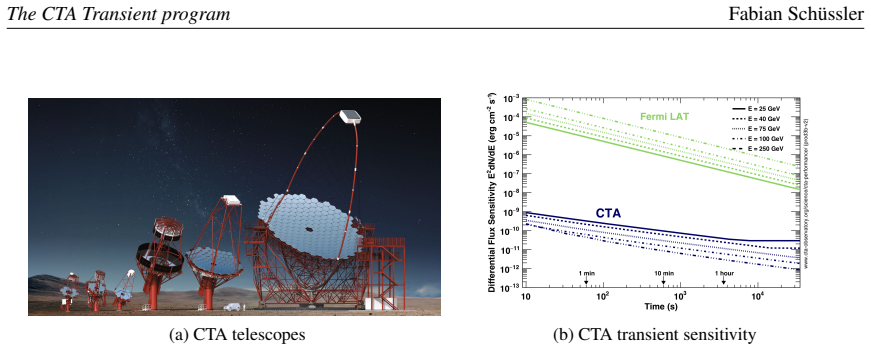
The Cherenkov Telescope Array (CTA) is the next generation high-energy gamma-ray observatory. It will improve the sensitivity of current instruments up to an order of magnitude, while providing energy coverage for photons from 20 GeV to at least 300 TeV to reach high redshifts and extreme accelerators and will give access to the shortest time-scale phenomena. CTA is thus a uniquely powerful instrument for the exploration of the violent and variable universe. The ability to probe short timescales at the highest energies will allow CTA to explore the connection between accretion and ejection phenomena surrounding compact objects, investigate the processes occurring in relativistic outflows, and open up significant phase space for serendipitous discoveries. Aiming at playing a central role in the era of multi-messenger astrophysics, the CTA Transient program includes follow-up observations of a broad range of multi-wavelength and multi-messenger alerts, ranging from Galactic compact object binary systems to novel phenomena like Fast Radio Bursts. A promising case is that of gamma-ray bursts (GRBs), where CTA will for the first time enable high-statistics measurements above $\sim$ 10 GeV, probing new spectral components and shedding light on the physical processes at work in these systems. Dedicated programs searching for very-high-energy (VHE) gamma-ray counterparts to gravitational waves and high-energy neutrinos complete the CTA transients program. This contribution will introduce and outline the CTA Transients program. We will provide an overview of the various science topics and discuss the links to multi-messenger and multi-wavelength observations.
Editorial analysis
A structured set of objections, weighed in public.
Referee Report
Summary. The manuscript outlines the CTA Transient program, describing planned follow-up observations of multi-messenger alerts (GRBs, gravitational waves, high-energy neutrinos) and Galactic compact-object systems. It emphasizes CTA's order-of-magnitude sensitivity gain, 20 GeV–300 TeV coverage, and rapid-response capabilities for probing short-timescale phenomena and new spectral components in GRBs.
Significance. The program description correctly positions CTA as a central instrument for multi-messenger astrophysics once operational. The forward-looking claims rest on established design specifications rather than new derivations; if those specifications are met, the outlined observations would indeed enable the first high-statistics VHE GRB spectra above ~10 GeV and systematic searches for VHE counterparts to GW and neutrino events.
minor comments (1)
- The abstract states energy coverage begins at 20 GeV while the GRB science case is phrased as 'above ∼10 GeV'; a brief clarification of the effective low-energy threshold for transient observations would remove the minor inconsistency.
Simulated Author's Rebuttal
We thank the referee for their positive review of the manuscript and for recommending acceptance. The referee's summary accurately captures the scope and goals of the CTA Transient program.
Circularity Check
No significant circularity: program outline with no derivations
full rationale
The manuscript is a descriptive program outline for CTA transient observations. It presents no equations, derivations, fitted parameters, or quantitative predictions that could reduce to inputs by construction. The central claims concern future observational capabilities based on design specifications (energy range 20 GeV–300 TeV, rapid response) rather than any internal derivation chain. No self-citations function as load-bearing uniqueness theorems, and no ansatzes or renamings of known results appear. This is a standard non-finding for a planning document with no mathematical content.
Axiom & Free-Parameter Ledger
Reference graph
Works this paper leans on
-
[1]
Cherenkov Telescope Array Consortium, B. S. Acharya, I. Agudo, I. Al Samarai, R. Alfaro, J. Alfaro et al., Science with the Cherenkov Telescope Array. World Scientific, 2019,10.1142/10986
-
[2]
V . Fioretti et al., The Cherenkov Telescope Array sensitivity to the transient sky, in 36th International Cosmic Ray Conference (ICRC2019), PoS673, 2019
work page 2019
-
[3]
Bulgarelli et al., The Cherenkov Telescope Array Observatory: top level use cases, Proc
A. Bulgarelli et al., The Cherenkov Telescope Array Observatory: top level use cases, Proc. SPIE Int. Soc. Opt. Eng. 9913 (2016) 991331
work page 2016
-
[4]
U. Barres de Almeida et al., CTA Science: A multi-wavelenght and multi-messenger perspective, in 36th International Cosmic Ray Conference (ICRC2019), PoS627, 2019
work page 2019
-
[5]
A. Bulgarelli, V . Fioretti, A. Zoli, A. Aboudan, J. J. Rodríguez-Vázquez, G. De Cesare et al., The On-Site Analysis of the Cherenkov Telescope Array, in 34th International Cosmic Ray Conference (ICRC2015), vol. 34, p. 763, Jul, 2015, 1509.01963
-
[6]
A possible connection between Fast Radio Bursts and Gamma-Ray Bursts
B. Zhang, A Possible Connection between Fast Radio Bursts and Gamma-Ray Bursts, ApJ 780 (2014) L21 [1310.4893]
work page internal anchor Pith review Pith/arXiv arXiv 2014
-
[7]
A model for fast extragalactic radio bursts
Y . Lyubarsky,A model for fast extragalactic radio bursts, MNRAS 442 (2014) L9 [1401.6674]
work page internal anchor Pith review Pith/arXiv arXiv 2014
-
[8]
K. Murase, K. Kashiyama and P. Mészáros, A burst in a wind bubble and the impact on baryonic ejecta: high-energy gamma-ray flashes and afterglows from fast radio bursts and pulsar-driven supernova remnants, MNRAS 461 (2016) 1498 [1603.08875]
work page internal anchor Pith review Pith/arXiv arXiv 2016
-
[9]
H. E. S. S. Collaboration, H. Abdalla, A. Abramowski, F. Aharonian, F. Ait Benkhali, A. G. Akhperjanian et al., First limits on the very-high energy gamma-ray afterglow emission of a fast radio burst. H.E.S.S. observations of FRB 150418, A&A 597 (2017) A115
work page 2017
- [10]
- [11]
-
[12]
Fermi Establishes Classical Novae as a Distinct Class of Gamma-Ray Sources
M. Ackermann, M. Ajello, A. Albert, L. Baldini, J. Ballet, G. Barbiellini et al., Fermi establishes classical novae as a distinct class of gamma-ray sources, Science 345 (2014) 554 [1408.0735]
work page internal anchor Pith review Pith/arXiv arXiv 2014
-
[13]
Search for Gamma-ray Emission from Galactic Novae with the Fermi-LAT
A. Franckowiak, P. Jean, M. Wood, C. C. Cheung and S. Buson, Search for gamma-ray emission from Galactic novae with the Fermi -LAT, A&A 609 (2018) A120 [1710.04736]
work page internal anchor Pith review Pith/arXiv arXiv 2018
-
[14]
M. L. Ahnen, S. Ansoldi, L. A. Antonelli, P. Antoranz, A. Babic, B. Banerjee et al., Very high-energy γ-ray observations of novae and dwarf novae with the MAGIC telescopes, A&A 582 (2015) A67 [1508.04902]
work page internal anchor Pith review Pith/arXiv arXiv 2015
-
[15]
I. F. Mirabel and L. F. Rodríguez, Microquasars in our Galaxy, Nature 392 (1998) 673
work page 1998
-
[16]
A. U. Abeysekara, A. Albert, R. Alfaro, C. Alvarez, J. D. Álvarez, R. Arceo et al., Very-high-energy particle acceleration powered by the jets of the microquasar SS 433, Nature 562 (2018) 82
work page 2018
-
[17]
I. Sadeh et al., POSyTIVE - a GRB population study for the Cherenkov Telescope Array, in 36th International Cosmic Ray Conference (ICRC2019), PoS598, 2019
work page 2019
-
[18]
(MAGIC Collaboration), GRB160821B, in 15th Marcel Grossmann meeting, 2019
Berti et al. (MAGIC Collaboration), GRB160821B, in 15th Marcel Grossmann meeting, 2019. 7 The CTA Transient program Fabian Schüssler
work page 2019
-
[19]
R. Mirzoyan et al. (MAGIC Collaboration), First time detection of a GRB at sub-TeV energies; MAGIC detects the GRB 190114C, The Astronomer’s Telegram #12390(2019)
work page 2019
-
[20]
E.L. Ruiz Velasco et al. (H.E.S.S. Collaboration), Discovery of Late-Time Very High Energy Emission from a Gamma-ray Burst Afterglow, 1st CTA Symposium, Bologna (2019)
work page 2019
-
[21]
B. P. Abbott, R. Abbott, T. D. Abbott, M. R. Abernathy, F. Acernese, K. Ackley et al., Prospects for observing and localizing gravitational-wave transients with Advanced LIGO, Advanced Virgo and KAGRA, Living Reviews in Relativity 21 (2018) 3 [1304.0670]
work page internal anchor Pith review Pith/arXiv arXiv 2018
-
[22]
H. Abdalla, A. Abramowski, F. Aharonian, F. Ait Benkhali, E. O. Angüner, M. Arakawa et al., TeV Gamma-Ray Observations of the Binary Neutron Star Merger GW170817 with H.E.S.S., ApJL 850 (2017) L22
work page 2017
-
[23]
F. Schüssler (CTA Consortium), The Transient program of the Cherenkov Telescope Array, TeVPA 2018 (Berlin, Germany) (2018)
work page 2018
-
[24]
B. Patricelli et al., Gw cosmos: Gravitational wave compact binary system simulations, figshare.com: GW COSMoS (2018)
work page 2018
-
[25]
M. Seglar-Arroyo et al., The gravitational wave follow-up program of the Cherenkov Telescope Array, in 36th International Cosmic Ray Conference (ICRC2019), PoS790, 2019
work page 2019
- [26]
-
[27]
K. Satalecka et al., Neutrino Target of Opportunity program of the Cherenkov Telescope Array, in 36th International Cosmic Ray Conference (ICRC2019), PoS784, 2019. 8
work page 2019
discussion (0)
Sign in with ORCID, Apple, or X to comment. Anyone can read and Pith papers without signing in.