Characterization of nested Walsh parity-check filters in a single-photon eight-mode register on a cloud photonic processor
Pith reviewed 2026-06-27 00:19 UTC · model grok-4.3
The pith
Nested Walsh parity-check filters on a photonic processor suppress DC leakage to a 0.6% mean for neutral inputs while routing syndromes at 94-99% selectivity.
A machine-rendered reading of the paper's core claim, the machinery that carries it, and where it could break.
Core claim
The filters realize first-quantized encodings of the [8,7,2] single-parity-check code in the zero-sum neutral subspace and the [8,4,4] extended Hamming code in the parity-checked subspace. Neutral inputs exhibit residual DC-port leakage of 0.02%-1.1% (mean 0.6%), which is approximately 21 times below the ideal 0.125 capture baseline. Injected DC contamination produces a monotonic soft error signal, the three face-parity syndrome channels route to predicted ports with 94-99% selectivity, and the sector-preserving unitary core maintains low leakage over one to three applications, with observed differences dominated by calibration and compilation rather than gate-cycle physics.
What carries the argument
The sector-preserving unitary core that implements the nested parity-check operations while preserving the neutral subspace and routing the face-parity syndromes.
If this is right
- Injected DC contamination produces a monotonic soft error signal at the ports.
- The three face-parity syndrome channels route to their predicted ports with 94-99% selectivity.
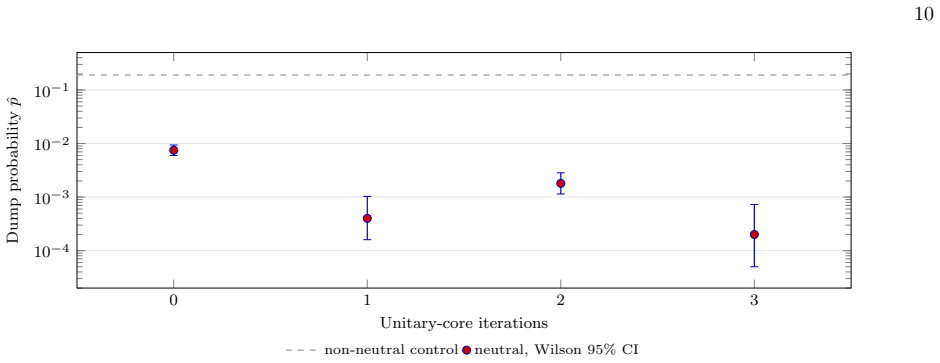
- Leakage remains far below non-neutral controls for one to three applications of the unitary core.
- Limits are set by fixed-pattern separator bias, plus or minus 0.02 calibration offsets, and compilation scatter near the 10 to the minus 3 level.
Where Pith is reading between the lines
- Stabilizing calibration to avoid the reported Hong-Ou-Mandel degradation episodes would be required before repeated use in larger registers.
- The postselection requirement means separate handling of photon loss would still be needed for any practical deployment.
- The same mode-encoding approach could be tested on other classical codes to check whether similar suppression levels appear.
- Connections between the observed selectivity and the cube indexing of modes might allow direct prediction of routing for related structures without new experiments.
Load-bearing premise
All reported probabilities are conditional on postselected single-photon detections and any performance differences arise from calibration and compilation systematics rather than the underlying gate physics.
What would settle it
Neutral inputs after recalibration that produce DC-port leakage near the 0.125 baseline instead of the measured 0.6% mean, or face-parity channels that fall below 90% selectivity, would show the suppression and routing claims do not hold.
Figures

read the original abstract
We characterize two nested Walsh parity-check filters implemented on Quandela's Belenos cloud photonic processor in a single-photon eight-mode spatial register. The modes are indexed by the vertices of the cube $Q_3$. The filters realize the classical $[8,7,2]$ single-parity-check code, the zero-sum neutral subspace $\mathcal{N}$ and the $[8,4,4]$ extended Hamming code, the parity-checked subspace $\mathcal{S}\subset\mathcal{N}$ with one DC and three face-parity syndrome channels. These are first-quantized path/mode encodings of classical codes: the experiment verifies leakage suppression and syndrome routing, not error correction or protection against photon loss, and all probabilities are conditional on postselected single-photon detections. Across more than 340,000 detections, neutral inputs show residual DC-port leakage of $0.02\%$-$1.1\%$ (mean $0.6\%$), corresponding to $\approx21\times$ suppression relative to the ideal $0.125$ DC-capture baseline and $31.6\times$ relative to the measured non-neutral control. Injected DC contamination gives a monotonic soft error signal, and the three face-parity syndrome channels route to their predicted ports with $94$-$99\%$ selectivity. A sector-preserving unitary core keeps leakage far below non-neutral controls over one to three applications, with differences dominated by calibration and compilation systematics rather than gate-cycle physics. We quantify these limits, including fixed-pattern separator bias, $\pm 0.02$ calibration offsets, and compilation scatter near the $10^{-3}$ leakage level, and report a Hong-Ou-Mandel degradation episode in which suppression vanished and recovered after recalibration.
Editorial analysis
A structured set of objections, weighed in public.
Referee Report
Summary. The manuscript experimentally characterizes two nested Walsh parity-check filters on Quandela's Belenos cloud photonic processor in a single-photon eight-mode spatial register indexed by the vertices of the cube Q3. The filters implement the [8,7,2] single-parity-check code (neutral subspace N) and the [8,4,4] extended Hamming code (parity-checked subspace S), verifying leakage suppression and syndrome routing (not error correction or loss protection) via direct counts from >340,000 postselected detections. Neutral inputs exhibit 0.02%-1.1% (mean 0.6%) residual DC-port leakage (~21x suppression vs. ideal 0.125 baseline, 31.6x vs. non-neutral control), with 94-99% selectivity on the three face-parity channels; a sector-preserving unitary core maintains low leakage over 1-3 applications, with differences attributed to calibration and compilation systematics.
Significance. If the reported conditional metrics hold, the work supplies quantitative benchmarks for leakage suppression and syndrome routing in first-quantized mode encodings of classical codes on linear-optical hardware. The internal consistency checks (non-neutral controls, repeated applications, injected contamination) and explicit quantification of systematics (fixed-pattern bias, ±0.02 offsets, 10^{-3} scatter, HOM episode) provide a practical reference for postselected photonic implementations.
minor comments (2)
- The abstract and introduction state that all probabilities are conditional on postselected single-photon detections, but a dedicated paragraph in the methods or results section explicitly comparing conditional vs. unconditional interpretations would aid readers applying these filters beyond the postselected regime.
- Figure captions and the text around the >340,000 detections could include the precise breakdown by input type (neutral vs. contaminated) and the number of applications to make the suppression and selectivity numbers directly traceable without cross-referencing multiple tables.
Simulated Author's Rebuttal
We thank the referee for the positive and accurate summary of our experimental characterization of the nested Walsh parity-check filters, including the reported leakage metrics, syndrome selectivity, and internal consistency checks. The recommendation for minor revision is noted. No major comments were provided in the report.
Circularity Check
No significant circularity
full rationale
This is an experimental characterization paper reporting direct counts from >340k postselected single-photon detections on a photonic processor. The headline metrics (DC leakage 0.02-1.1%, 94-99% selectivity, suppression factors) are extracted as conditional probabilities from raw detection events with no intervening derivation or model that reduces to fitted parameters by the paper's own equations. The text explicitly attributes performance differences to calibration and compilation systematics rather than any self-referential prediction or gate-physics assumption. No load-bearing step invokes a self-citation chain, uniqueness theorem, or ansatz that collapses to the input data; the non-neutral control and repeated-application comparisons serve as internal consistency checks external to any fitted model. The derivation chain is therefore self-contained against external benchmarks.
Axiom & Free-Parameter Ledger
free parameters (1)
- calibration offsets =
±0.02
axioms (2)
- domain assumption All reported probabilities are conditional on postselected single-photon detections
- domain assumption The photonic processor implements the intended sector-preserving unitary core
Reference graph
Works this paper leans on
-
[1]
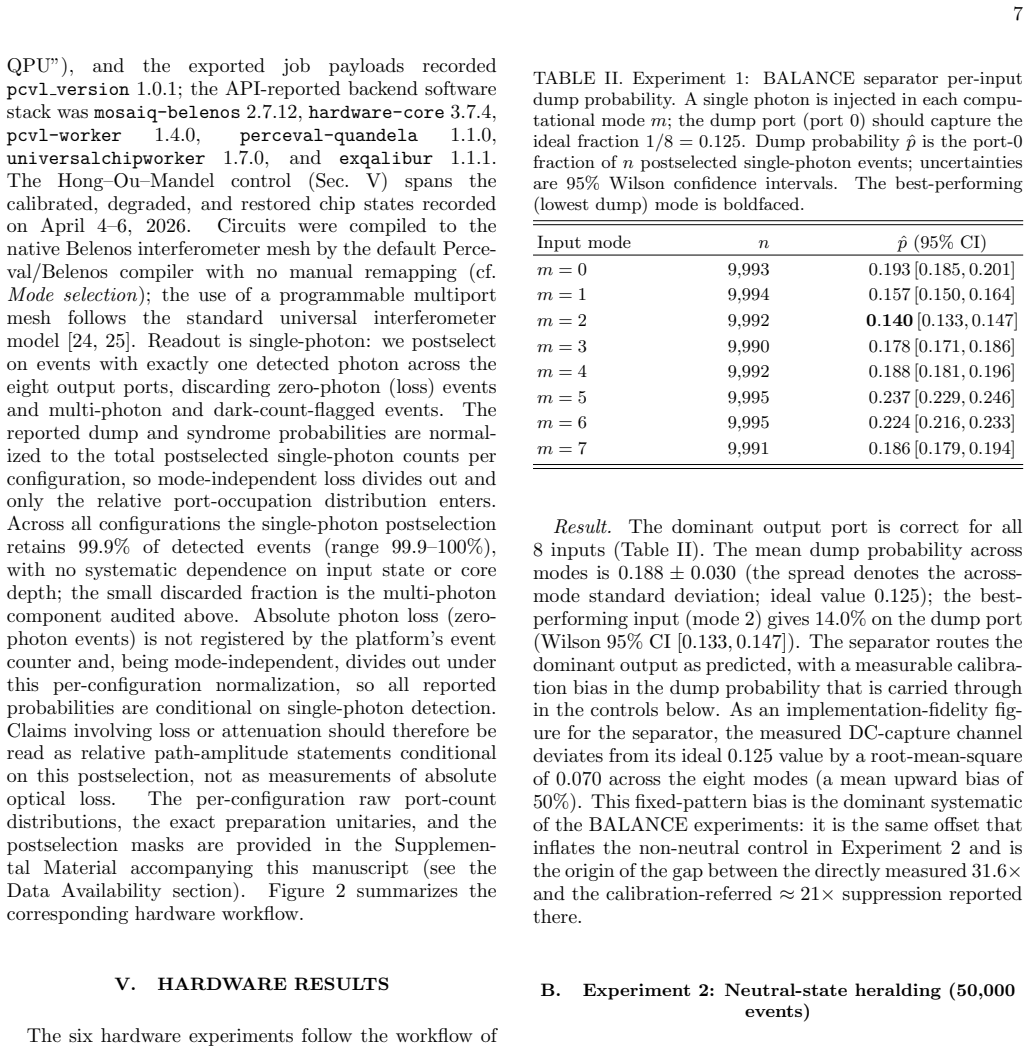
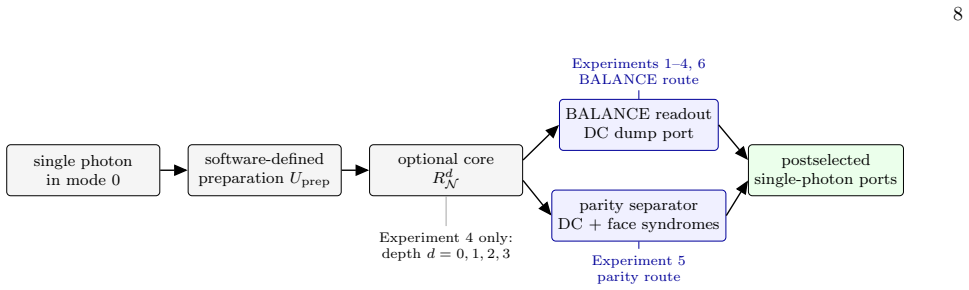
and then perform a single separator readout; the pro- jection onto the neutral sector is an algebraic description of the ideal readout, not an additional compiled gate at each cycle. III. SIMULA TION BENCHMARKS Eight idealized simulation benchmarks provide refer- ence points for the construction; the compact summary below lists all eight. These simulation...
arXiv 2026
-
[2]
Parity-checked-subspace heralding
and code-side port fidelity (the dominant entry on its 11 TABLE VI. Parity-checked-subspace heralding. Syndrome probability ˆpsyn is the total fraction on ports 0–3 (ideal: 0); Port is the predicted dominant code-space output port (ports 4–7 carry the code subspace); Fid. is the fraction of all de- tections on that predicted port; uncertainties are 95% Wi...
-
[3]
routed to each syndrome port, for the three single- parity-violating inputs. Diagonal entries (boldface) are the dominant-port selectivities of Table VII; off-diagonal entries are cross-talk. Rows sum to 1 up to rounding. Input Port 0 Port 1 Port 2 Port 3 Sx (|0⟩−|1⟩) 0.0080.9850.007 0.001 Sy (|0⟩−|2⟩) 0.008 0.0210.9440.028 Sz (|0⟩−|4⟩) 0.015 0.023 0.0200...
arXiv 2026
-
[4]
BALANCE separator 8/8 correct ports 80,000
-
[5]
Neutral heralding≈21×ideal (31.6×raw) 50,000
-
[6]
Error detection calibrated soft response 70,000
-
[7]
Gate cycle low leakage, depths 1–3 60,000
-
[8]
Syndrome channels 23.7×, 3/3 ports 80,000
-
[9]
HOM control interference dependence 20,000 Total>340,000 Table X collects the six experiments and their event counts (the Experiment 6 entry is the exact sum of the 10,000 calibrated, 5,000 degraded, and 5,000 restored ac- quisitions of Table IX). The per-configuration counts sum to roughly 360,000 single-photon acquisitions; a few base- line and control ...
2026
-
[10]
M. A. Nielsen and I. L. Chuang,Quantum Com- putation and Quantum Information, 10th anniversary ed. (Cambridge University Press, Cambridge, 2010), doi:10.1017/CBO9780511976667
-
[11]
Stabilizer codes and quantum error cor- rection,
D. Gottesman, “Stabilizer codes and quantum error cor- rection,” Ph.D. thesis, California Institute of Technology (1997), arXiv:quant-ph/9705052
Pith/arXiv arXiv 1997
-
[12]
Surface codes: Towards practical large-scale quantum computation,
A. G. Fowler, M. Mariantoni, J. M. Martinis, and A. N. Cleland, “Surface codes: Towards practical large- scale quantum computation,” Phys. Rev. A86, 032324 (2012), doi:10.1103/PhysRevA.86.032324
-
[13]
A game of surface codes: Large-scale quan- tum computing with lattice surgery,
D. Litinski, “A game of surface codes: Large-scale quan- tum computing with lattice surgery,” Quantum3, 128 (2019), doi:10.22331/q-2019-03-05-128
-
[14]
R. Acharyaet al.(Google Quantum AI), “Quantum er- ror correction below the surface code threshold,” Nature 638, 920–926 (2025), doi:10.1038/s41586-024-08449-y
-
[15]
doi:10.1038/s41586-024-07107-7 , url =
S. Bravyi, A. W. Cross, J. M. Gambetta, D. Maslov, P. Rall, and T. J. Yoder, “High-threshold and low- overhead fault-tolerant quantum memory,” Nature627, 778–782 (2024), doi:10.1038/s41586-024-07107-7
-
[16]
Error pre- vention scheme with four particles,
L. Vaidman, L. Goldenberg, and S. Wiesner, “Error pre- vention scheme with four particles,” Phys. Rev. A54, R1745 (1996), doi:10.1103/PhysRevA.54.R1745
-
[17]
E. Knill, R. Laflamme, and G. J. Milburn, “A scheme for efficient quantum computation with linear optics,” Nature409, 46–52 (2001), doi:10.1038/35051009
-
[18]
and Furusawa, Akira and Vučković, Jelena , urldate =
J. L. O’Brien, A. Furusawa, and J. Vuˇ ckovi´ c, “Pho- tonic quantum technologies,” Nat. Photonics3, 687–695 (2009), doi:10.1038/nphoton.2009.229
-
[19]
Photonic quantum information processing: a review,
F. Flamini, N. Spagnolo, and F. Sciarrino, “Photonic quantum information processing: a review,” Rep. Prog. Phys.82, 016001 (2019), doi:10.1088/1361-6633/aad5b2
-
[20]
F. J. MacWilliams and N. J. A. Sloane,The Theory of Error-Correcting Codes(North-Holland, Amsterdam, 1977)
1977
-
[21]
A class of multiple-error-correcting codes and the decoding scheme,
I. S. Reed, “A class of multiple-error-correcting codes and the decoding scheme,” Trans. IRE Prof. Group Inf. Theory4, 38–49 (1954), doi:10.1109/TIT.1954.1057465
-
[22]
Application of Boolean algebra to switch- ing circuit design and to error detection,
D. E. Muller, “Application of Boolean algebra to switch- ing circuit design and to error detection,” Trans. IRE Prof. Group Electron. Comput.EC-3, 6–12 (1954), doi:10.1109/IREPGELC.1954.6499441
-
[23]
Advances in high-dimensional quantum entanglement,
M. Erhard, M. Krenn, and A. Zeilinger, “Advances in high-dimensional quantum entanglement,” Nat. Rev. Phys.2, 365–381 (2020), doi:10.1038/s42254-020-0193-5
-
[24]
Ex- perimental demonstration of a graph state quantum error-correction code,
B. A. Bell, D. A. Herrera-Mart´ ı, M. S. Tame, D. Markham, W. J. Wadsworth, and J. G. Rarity, “Ex- perimental demonstration of a graph state quantum error-correction code,” Nat. Commun.5, 3658 (2014), doi:10.1038/ncomms4658
-
[25]
Encoding error correction in an inte- grated photonic chip,
H. Zhang, L. Wan, S. Paesani, A. Laing, Y. Shi, H. Cai, X. Luo, G.-Q. Lo, L. C. Kwek, and A. Q. Liu, “Encoding error correction in an inte- grated photonic chip,” PRX Quantum4, 030340 (2023), doi:10.1103/PRXQuantum.4.030340
-
[26]
J. Washburn, M. Zlatanovi´ c, and E. Allahyarov, “Recognition Geometry,” Axioms15(2), 90 (2026), doi:10.3390/axioms15020090
work page internal anchor Pith review doi:10.3390/axioms15020090 2026
-
[27]
P. Zanardi and M. Rasetti, “Noiseless quantum codes,” Phys. Rev. Lett.79, 3306–3309 (1997), doi:10.1103/PhysRevLett.79.3306
-
[28]
Decoherence-free subspaces for quantum com- putation,
D. A. Lidar, I. L. Chuang, and K. B. Wha- ley, “Decoherence-free subspaces for quantum com- putation,” Phys. Rev. Lett.81, 2594–2597 (1998), doi:10.1103/PhysRevLett.81.2594
-
[29]
Experimental verification of decoherence-free subspaces,
P. G. Kwiat, A. J. Berglund, J. B. Altepeter, and A. G. White, “Experimental verification of decoherence-free subspaces,” Science290, 498–501 (2000), doi:10.1126/science.290.5491.498
-
[30]
Belenos (MosaiQ-12): a cloud-accessible photonic quantum processor, 12 photons / 24 modes,
Quandela, “Belenos (MosaiQ-12): a cloud-accessible photonic quantum processor, 12 photons / 24 modes,” product information,https://www.quandela.com/ products-and-services/belenos/(accessed June 2026)
2026
-
[31]
Quandela,Product Catalogue, version 6, technical specifi- cations for MosaiQ photonic quantum processors,https: //www.quandela.com/wp-content/uploads/2024/05/ Product-catalogue_Quandela_V6_spreads.pdf(ac- cessed June 2026)
2024
-
[32]
Perceval: A software platform for dis- crete variable photonic quantum computing,
N. Heurtelet al., “Perceval: A software platform for dis- crete variable photonic quantum computing,” Quantum 7, 931 (2023), doi:10.22331/q-2023-02-21-931
-
[33]
Experimental realization of any discrete unitary operator,
M. Reck, A. Zeilinger, H. J. Bernstein, and P. Bertani, “Experimental realization of any discrete unitary operator,” Phys. Rev. Lett.73, 58–61 (1994), doi:10.1103/PhysRevLett.73.58
-
[34]
Optimal de- sign for universal multiport interferometers,
W. R. Clements, P. C. Humphreys, B. J. Metcalf, W. S. Kolthammer, and I. A. Walmsley, “Optimal de- sign for universal multiport interferometers,” Optica3, 1460–1465 (2016), doi:10.1364/OPTICA.3.001460
-
[35]
J. Carolanet al., “Universal linear optics,” Science349, 711–716 (2015), doi:10.1126/science.aab3642
-
[36]
Measurement of subpicosecond time intervals between two photons by interference,
C. K. Hong, Z. Y. Ou, and L. Mandel, “Measurement of subpicosecond time intervals between two photons by interference,” Phys. Rev. Lett.59, 2044–2046 (1987), doi:10.1103/PhysRevLett.59.2044
-
[37]
0.5-1.5 m height, 30-60 cm spread
E. B. Wilson, “Probable inference, the law of succession, and statistical inference,” J. Am. Stat. Assoc.22, 209– 212 (1927), doi:10.1080/01621459.1927.10502953
-
[38]
D. Gottesman, A. Kitaev, and J. Preskill, “Encoding a qubit in an oscillator,” Phys. Rev. A64, 012310 (2001), doi:10.1103/PhysRevA.64.012310
-
[39]
Loss toler- ance in one-way quantum computation via counterfactual error correction,
M. Varnava, D. E. Browne, and T. Rudolph, “Loss toler- ance in one-way quantum computation via counterfactual error correction,” Phys. Rev. Lett.97, 120501 (2006), doi:10.1103/PhysRevLett.97.120501
-
[40]
The lost-twin survivor fraction is estimated as [2(1− η)/η] (n2/N), whereη= 4.84% is the transmittance, n2 = 171 is the number of detected two-photon events, andN= 350,000 is the total number of detections; this gives 39×(171/350,000)≈1.9%
discussion (0)
Sign in with ORCID, Apple, or X to comment. Anyone can read and Pith papers without signing in.