Dynamic In-Group Persona Generation for Enhancing Human-AI Rapport
Pith reviewed 2026-07-01 00:28 UTC · model grok-4.3
The pith
In-group persona conditioning for LLMs significantly boosts perceived human-AI rapport.
A machine-rendered reading of the paper's core claim, the machinery that carries it, and where it could break.
Core claim
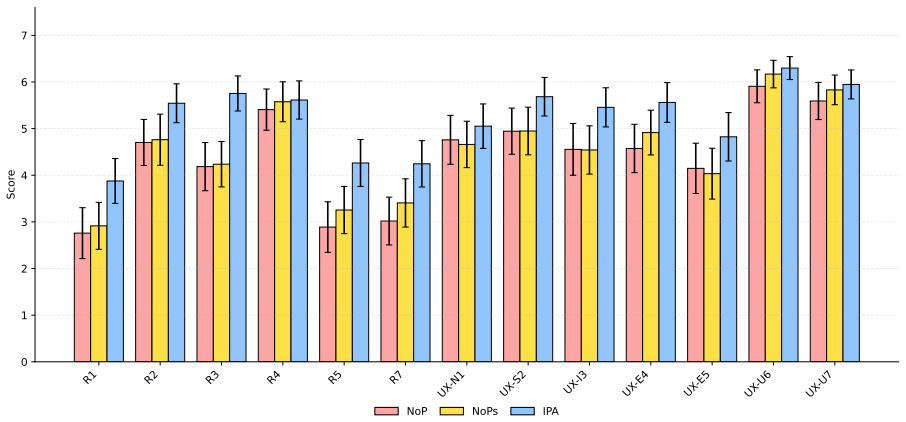
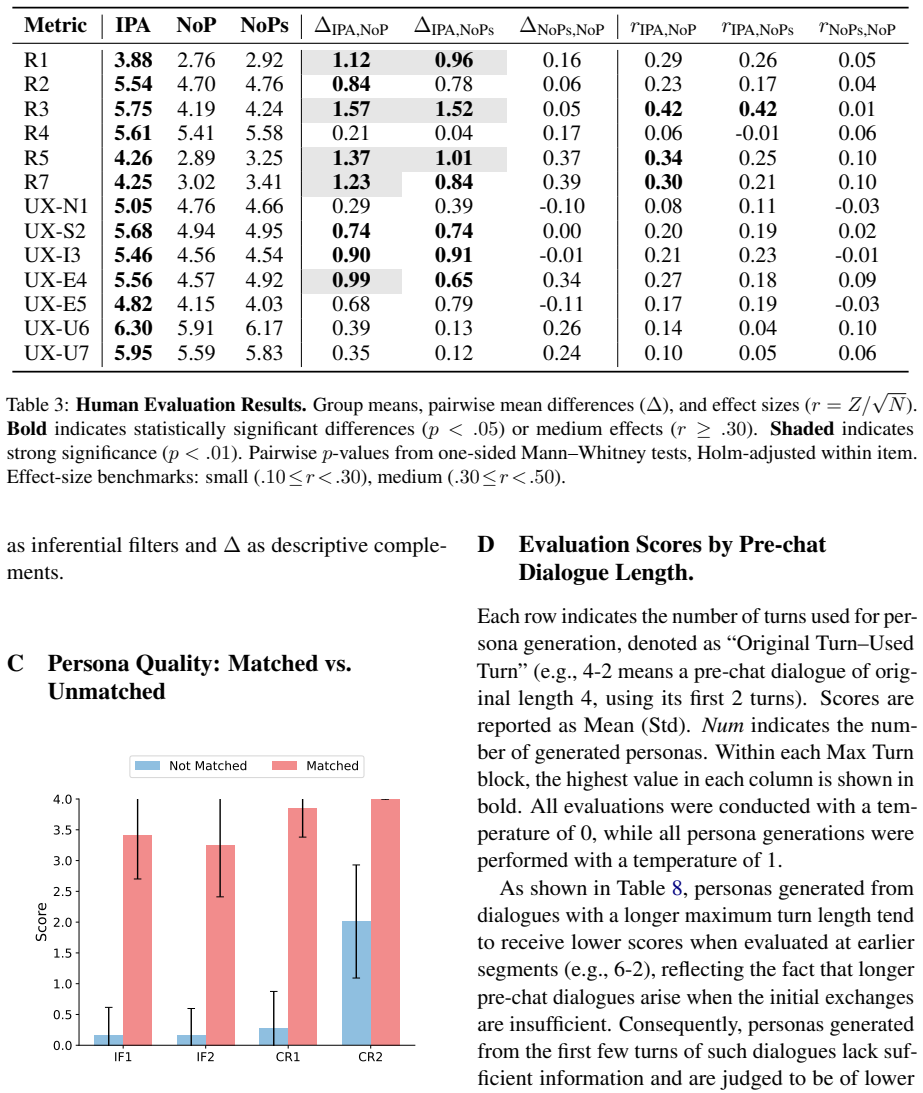
The central discovery is that an agent using a dynamically generated in-group persona, which matches the user's primary concern but differs in background, produces significantly better perceived rapport, personal relevance, and positive user experience including higher engagement than either a conventional agent or one with minimal self-disclosure.
What carries the argument
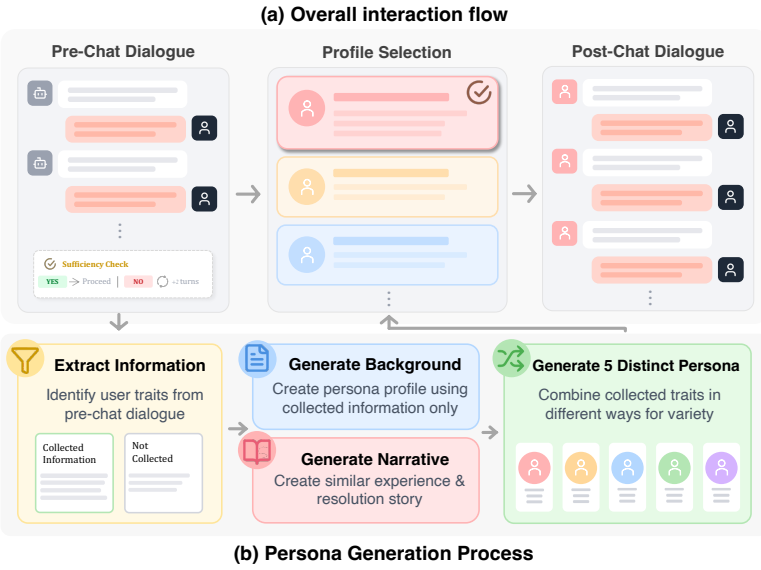
Dynamic in-group persona generation, which identifies the primary concern from user input and synthesizes a persona sharing that concern with altered narrative details to condition the LLM.
If this is right
- The in-group persona agent improves perceived rapport compared to baselines.
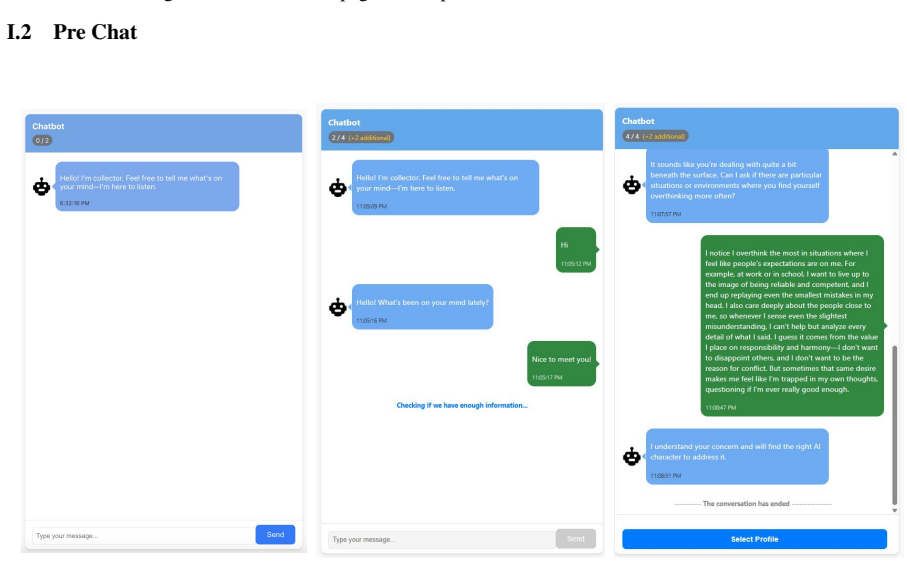
- It increases personal relevance and yields more positive user experience.
- Engagement is notably higher with the in-group approach.
- The method targets domains like counseling where rapport is essential.
Where Pith is reading between the lines
- Longer interactions might benefit from updating the persona over time based on ongoing conversation.
- Similar techniques could apply to other AI interaction domains such as education or customer service.
- Measuring actual behavior change, not just questionnaires, would strengthen evidence for practical impact.
Load-bearing premise
Users perceive the LLM-generated personas as authentic in-group members who share their primary concern.
What would settle it
If users in a study rate the in-group persona agent no higher on rapport when the persona details are randomized rather than matched to their concern, the matching mechanism would be falsified.
Figures



read the original abstract
LLM-based chatbots are increasingly applied in interpersonal domains such as counseling and peer support, where establishing human-AI rapport is crucial yet remains challenging. In this work, we introduce a novel approach for conditioning LLMs with in-group personas, which (i) first identifies a user's primary concern and brief personal context (e.g., a computer science undergraduate worried about future career prospects), and (ii) generates a synthetic in-group persona that shares a similar primary concern while differing in background and narrative details, such as age or profession (e.g., a junior researcher at an AI startup). Furthermore, we conduct a human-subject study to systematically evaluate the effectiveness of in-group persona agents in enhancing human-AI rapport. We compare our approach against two baseline conditions: a conventional agent without persona conditioning and an agent exhibiting minimal self-disclosure (e.g., "I've felt that too"). Results from post-task questionnaires assessing rapport and user experience indicate that the in-group persona agent significantly improves perceived rapport and personal relevance compared to the baselines, and also yields more positive user experience-most notably higher engagement.
Editorial analysis
A structured set of objections, weighed in public.
Referee Report
Summary. The paper introduces a dynamic in-group persona generation technique for LLMs that first extracts a user's primary concern and then synthesizes a persona sharing that concern but differing in background details; it evaluates the approach via a human-subject study comparing the in-group condition against a no-persona baseline and a minimal self-disclosure baseline, claiming statistically significant gains in rapport, personal relevance, and engagement from post-task questionnaires.
Significance. If the empirical results can be substantiated with standard methodological reporting, the work would offer a concrete, implementable technique for improving rapport in counseling-style chatbots. The dynamic, concern-driven persona synthesis is a clear contribution over static personas, and the study design (three-condition comparison) is appropriate in principle for isolating the in-group effect.
major comments (3)
- [Abstract and Human-Subject Study section] The abstract and results description claim that the in-group persona agent 'significantly improves perceived rapport' and yields 'more positive user experience,' yet supply no sample size, recruitment method, randomization procedure, exact questionnaire items or scales, statistical tests (e.g., ANOVA or t-tests), p-values, effect sizes, or exclusion criteria. This evidentiary gap is load-bearing for the central claim.
- [Evaluation / Results] The evaluation does not address potential confounds such as demand characteristics, differences in response length or verbosity across conditions, or whether participants perceived the synthetic personas as authentic in-group members rather than artificial constructs; without these checks the reported gains cannot be attributed to the in-group mechanism.
- [Method / Human-Subject Study] The paper provides no information on conversation length controls, task instructions given to participants, or how the primary concern was elicited and used to generate personas, all of which are required to interpret the questionnaire outcomes.
minor comments (2)
- [Abstract] The abstract uses the phrase 'most notably higher engagement' without defining the engagement metric or reporting its statistical result.
- [Approach] Notation for the persona generation pipeline (e.g., how the primary concern is formalized before LLM prompting) is introduced informally and would benefit from a short pseudocode or diagram.
Simulated Author's Rebuttal
We thank the referee for the constructive and detailed comments on our manuscript. We agree that the current reporting of the human-subject study is insufficient to substantiate the central claims and will undertake a major revision to address all methodological gaps identified.
read point-by-point responses
-
Referee: [Abstract and Human-Subject Study section] The abstract and results description claim that the in-group persona agent 'significantly improves perceived rapport' and yields 'more positive user experience,' yet supply no sample size, recruitment method, randomization procedure, exact questionnaire items or scales, statistical tests (e.g., ANOVA or t-tests), p-values, effect sizes, or exclusion criteria. This evidentiary gap is load-bearing for the central claim.
Authors: We acknowledge the evidentiary gap in reporting. The revised manuscript will expand both the abstract and the Human-Subject Study section to include the sample size, recruitment method, randomization procedure, exact questionnaire items and scales, statistical tests performed, p-values, effect sizes, and exclusion criteria. revision: yes
-
Referee: [Evaluation / Results] The evaluation does not address potential confounds such as demand characteristics, differences in response length or verbosity across conditions, or whether participants perceived the synthetic personas as authentic in-group members rather than artificial constructs; without these checks the reported gains cannot be attributed to the in-group mechanism.
Authors: We agree these confounds require explicit treatment. The revision will add a dedicated subsection discussing demand characteristics (including any debriefing measures), comparisons of response length and verbosity across conditions, and participant feedback on the perceived authenticity of the generated personas. revision: yes
-
Referee: [Method / Human-Subject Study] The paper provides no information on conversation length controls, task instructions given to participants, or how the primary concern was elicited and used to generate personas, all of which are required to interpret the questionnaire outcomes.
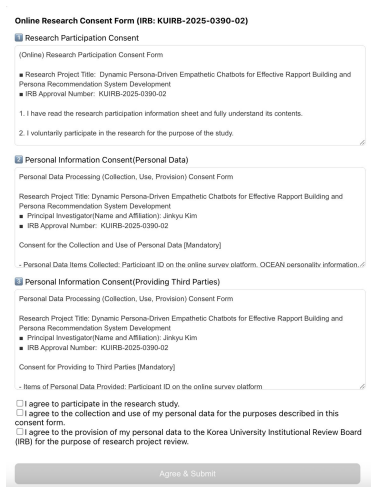
Authors: We will revise the Method section to provide the requested details on conversation length controls, the verbatim task instructions presented to participants, and the precise procedure used to elicit the primary concern and incorporate it into persona generation. revision: yes
Circularity Check
No significant circularity: empirical human-subject study with no derivations or fitted predictions
full rationale
The manuscript presents a method for generating synthetic in-group personas from user concerns and evaluates it through a human-subject study comparing questionnaire outcomes against two baselines. No equations, parameters, or derivation chains appear in the provided text or abstract. Claims rest on empirical questionnaire results rather than any self-referential fitting, self-citation load-bearing uniqueness theorems, or ansatzes smuggled via prior work. The reader's assessment of circularity score 0.0 is consistent with the absence of any load-bearing steps that reduce to inputs by construction.
Axiom & Free-Parameter Ledger
axioms (1)
- domain assumption Sharing a primary concern while differing in background details produces an effective in-group perception that increases rapport with an LLM agent.
invented entities (1)
-
Synthetic in-group persona
no independent evidence
Reference graph
Works this paper leans on
-
[1]
Naif Alawi, Triparna De Vreede, and Gert-Jan De Vreede
Ai-powered recommendations: the roles of perceived similarity and psychological dis- tance on persuasion.International Journal of Advertising, 40(8):1366–1384. Naif Alawi, Triparna De Vreede, and Gert-Jan De Vreede. 2023. Accepting the familiar: the effect of perceived similarity with ai agents on intention to use and the mediating effect of it identity. ...
2023
-
[2]
Rapport-driven virtual agent: Rapport building dialogue strategy for improving user experience at first meeting.arXiv preprint arXiv:2406.09839. Godfrey T Barrett-Lennard. 1981. The empathy cycle: Refinement of a nuclear concept.Journal of counseling psychology, 28(2):91. Donn Erwin Byrne. 1972. The attraction paradigm. Behavior Therapy, 3(2):337–338. Rob...
-
[3]
Psychological, relational, and emotional effects of self-disclosure after conversations with a chatbot.Journal of Communication, 68(4):712– 733. Sture Holm. 1979. A simple sequentially rejective multiple test procedure.Scandinavian journal of statistics, pages 65–70. Aaron Hurst, Adam Lerer, Adam P Goucher, Adam Perelman, Aditya Ramesh, Aidan Clark, AJ Os...
work page internal anchor Pith review Pith/arXiv arXiv 1979
-
[4]
arXiv preprint arXiv:2407.18416 , year=
Exploring relationship development with social chatbots: A mixed-method study of replika.Computers in Human Behavior, 140:107600. Melanie Randle, Richard Eckersley, and Leonie Miller. 2017. Societal and personal concerns, their associations with stress, and the implica- tions for progress and the future.Futures, 93:68– 79. Byron Reeves and Clifford Nass. ...
-
[5]
arXiv preprint arXiv:2406.01171 , year=
“it happened to be the perfect thing”: ex- periences of generative ai chatbots for mental health.npj Mental Health Research, 3(1):48. Teunis J Terpstra. 1952. The asymptotic normality and consistency of kendall’s test against trend, when ties are present in one ranking.Indaga- tiones Mathematicae, 14(3):327–333. Linda Tickle-Degnen and Robert Rosenthal. 1...
-
[6]
Educational background: The user has a degree in computer science
-
[7]
Emotional context: The user feels scared and behind compared to peers
-
[8]
Observed in pre-chat:
Professional interest: The user is interested in AI research. Observed in pre-chat:
-
[9]
Educational background: The user studied computer science
-
[10]
Emotional context: The user feels scared and behind
-
[11]
collected information
Professional interest: The user is interested in AI research. Reason: The pre-chat provides sufficient context with three relevant and distinct elements: the user’s educational background, emotional context, and professional interest. These elements are crucial for understanding the user’s concern about career direction and feelings of being behind peers....
2024
-
[12]
Self-disclosure depth (0–3)
-
[13]
I understand
Empathy level (0–3) Definitions (apply to BOTH User and Assistant, but roles differ): SELF-DISCLOSURE DEPTH (0–3): Level 0 – No self-disclosure - The speaker does not talk about themselves at all. - No personal facts, no personal experiences, no personal feelings. Level 1 – Low / Peripheral self-disclosure - Basic, surface-level facts about the speaker: r...
2023
discussion (0)
Sign in with ORCID, Apple, or X to comment. Anyone can read and Pith papers without signing in.