REVIEW 1 major objections 1 minor 20 references
Beyond Native Success: Auditing Deployment-Interface Exposure of CLIP Backdoors
T0 review · 1 major / 1 minor · reviewed 2026-06-27 · grok-4.3
Pith's one-line read Audits reveal that CLIP backdoors successful on native tasks often lose exposure on retrieval, reranking, and selection interfaces, with risk tied to which components are poisoned.
desk verdict DIFE gives a practical way to audit CLIP backdoor exposure across interfaces and BadTextTower fills the text-encoder gap, but the interface definitions need external checks to confirm they match real deployments. read the letter →
The pith
A machine-rendered reading of the paper's core claim, the machinery that carries it, and where it could break.
The reading
What carries the argument
DIFE, a Deployment-Interface Footprint Evaluation framework that audits backdoored checkpoints by specifying each interface's component readout, trigger channel, target event, reference condition, and metric, plus effective-footprint diagnosis to identify which reusable CLIP component or combination carries exposure.
What would settle it
A test showing that a text-side poisoned model exhibits no textual-encoder control in retrieval or selection tasks despite native success, or that BadTextTower enables text-conditioned exposure while keeping visual-only reuse clean.
Extended reading notes
Core claim
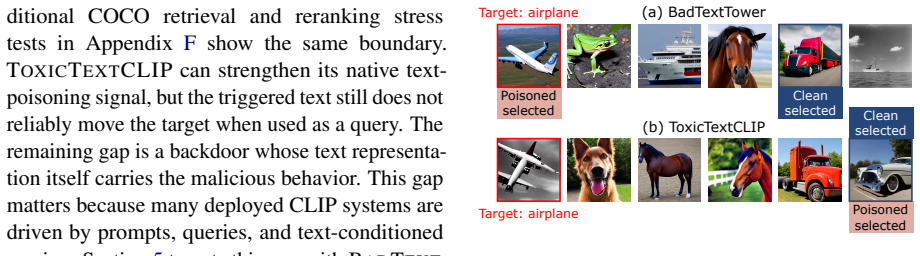
Auditing reproduced CLIP backdoors with DIFE reveals a structured landscape: native success is not a checkpoint-level risk certificate, exposure follows component footprints, text-side poisoning does not yield textual-encoder control, and some coupled attacks remain mechanism-bound. This audit reveals an important gap in existing CLIP backdoors: a textual encoder that itself becomes a reusable carrier of adversarial behavior. We therefore introduce BadTextTower to fill this gap. BadTextTower produces strong text-conditioned retrieval, reranking, and selection exposure while leaving visual-only reuse nearly clean.
Load-bearing premise
The reproduced CLIP backdoors used for auditing represent realistic attacks and the chosen interface definitions accurately capture real deployment scenarios without introducing artifacts.
Editorial extensions
If this is right
- Native success on one task does not certify risk across other deployment interfaces.
- Exposure risk transfers according to the footprints of the poisoned components.
- Poisoning from the text side fails to grant control over the textual encoder.
- Some coupled attacks remain bound to their original mechanisms and do not generalize.
- BadTextTower enables the textual encoder to carry reusable adversarial behavior for text-conditioned tasks.
Reading between the lines
- Developers should audit CLIP models across multiple interfaces rather than relying on native task results alone.
- The identified gap suggests that security evaluations need to treat text and visual encoders as separate attack surfaces.
- BadTextTower-style methods could be tested for whether they create new defense targets focused on text encoder integrity.
- Interface definitions in DIFE might serve as a starting point for standardized auditing protocols in multimodal reuse.
Signed reviews
Editorial analysis
A structured set of objections, weighed in public.
Referee Report
Summary. The paper introduces the DIFE (Deployment-Interface Footprint Evaluation) framework to audit backdoored CLIP checkpoints across interfaces (feature extraction, retrieval, reranking, selection) by standardizing each via a five-tuple (component readout, trigger channel, target event, reference condition, metric) and an effective-footprint diagnosis. Auditing reproduced backdoors reveals a structured landscape: native success does not certify checkpoint-level risk, exposure tracks component footprints, text-side poisoning yields no textual-encoder control, and some coupled attacks remain mechanism-bound. The audit identifies a gap (textual encoder as reusable adversarial carrier) and introduces BadTextTower to produce strong text-conditioned exposure while keeping visual-only reuse nearly clean.
Significance. If the DIFE-based audit and BadTextTower results hold under realistic conditions, the work is significant for shifting CLIP backdoor evaluation from native-task success to deployment-interface exposure, demonstrating component-specific risk transfer and a new text-encoder attack vector that existing defenses may miss.
major comments (1)
- [DIFE framework definition and experimental setup (Sections 3-4)] The central claims (structured landscape, component-footprint diagnosis, and the gap motivating BadTextTower) rest on DIFE's five-tuple interface specifications. The manuscript provides no external validation, sensitivity analysis, or comparison showing that the chosen readouts, reference conditions, and metrics align with actual production CLIP pipelines (e.g., batch-norm handling, prompt formatting, or similarity thresholds). Without this, the reported landscape and gap risk being artifacts of the evaluation harness rather than intrinsic checkpoint properties.
minor comments (1)
- [Abstract] Abstract contains a clear typo: 'a import gapin' should read 'an important gap in'.
Simulated Author's Rebuttal
We thank the referee for the constructive feedback on the DIFE framework. We address the concern regarding validation of the five-tuple specifications below.
read point-by-point responses
-
Referee: [DIFE framework definition and experimental setup (Sections 3-4)] The central claims (structured landscape, component-footprint diagnosis, and the gap motivating BadTextTower) rest on DIFE's five-tuple interface specifications. The manuscript provides no external validation, sensitivity analysis, or comparison showing that the chosen readouts, reference conditions, and metrics align with actual production CLIP pipelines (e.g., batch-norm handling, prompt formatting, or similarity thresholds). Without this, the reported landscape and gap risk being artifacts of the evaluation harness rather than intrinsic checkpoint properties.
Authors: We agree that the manuscript lacks an explicit sensitivity analysis or direct mapping to production pipelines. The five-tuple was constructed from standard CLIP usage patterns documented in the literature (feature extraction via penultimate layer, cosine similarity for retrieval, etc.), but this rationale is not sufficiently documented. In revision we will add a dedicated subsection to Section 4 that (i) enumerates the design rationale for each tuple element with citations to common deployment codebases, (ii) reports sensitivity results under variations of prompt formatting, similarity thresholds, and batch-norm handling, and (iii) shows that the reported component-footprint diagnoses remain stable. This addition will directly address the risk that findings are harness artifacts. revision: yes
Circularity Check
No circularity: empirical audit with methodological definitions, no derivations or self-referential reductions
full rationale
The paper presents an empirical auditing study. It defines DIFE as a five-tuple evaluation harness (component readout, trigger channel, target event, reference condition, metric), applies it to reproduced existing CLIP backdoors, reports observed exposure patterns, identifies a gap, and introduces BadTextTower. No equations, fitted parameters renamed as predictions, or derivation chains appear. The interface specifications are explicit methodological choices that structure the audit; the reported landscape follows directly from running the defined readouts on the checkpoints rather than reducing to those definitions by construction. No self-citation load-bearing steps or uniqueness theorems are invoked. The work is self-contained against the reproduced checkpoints and external benchmarks.
Assumptions & free parameters
Cite this review
Pith. "Pith review of Beyond Native Success: Auditing Deployment-Interface Exposure of CLIP Backdoors." pith.science (2026). https://pith.science/paper/N2EDP5CR
@misc{pith2026260617815,
  author       = {Pith},
  title        = {Pith review of: Beyond Native Success: Auditing Deployment-Interface Exposure of CLIP Backdoors},
  year         = {2026},
  howpublished = {\url{https://pith.science/paper/N2EDP5CR}},
  note         = {Machine review of arXiv:2606.17815}
}
read the original abstract
Contrastive Language-Image Pre-training models are widely reused across downstream interfaces, including feature extraction, retrieval, reranking, and selection. Existing CLIP backdoor, however, usually validate attacks on a small attack-native task, leaving unclear whether the same poisoned checkpoint remains exposed, weakens, or becomes not applicable when reused through other interfaces. We introduce DIFE, a Deployment-Interface Footprint Evaluation framework that audits backdoored CLIP checkpoints across deployment interfaces. DIFE makes various evaluations comparable by specifying each interface's component readout, trigger channel, target event, reference condition, and metric. DIFE also introduces effective-footprint diagnosis to identify the reusable CLIP component or component combination that carries exposure and explains where risk transfers. Auditing reproduced CLIP backdoors with DIFE reveals a structured landscape: native success is not a checkpoint-level risk certificate, exposure follows component footprints, text-side poisoning does not yield textual-encoder control, and some coupled attacks remain mechanism-bound. This audit reveals a import gapin existing CLIP backdoors: a textual encoder that itself becomes a reusable carrier of adversarial behavior. We therefore introduce BadTextTower to fill this gap. BadTextTower produces strong text-conditioned retrieval, reranking, and selection exposure while leaving visual-only reuse nearly clean.
Figures


Figures from the paper (1 more)

Reference graph
Works this paper leans on
-
[1]
BadNets: Identifying Vulnerabilities in the Machine Learning Model Supply Chain
BadNets: Identifying vulnerabilities in the machine learning model supply chain.arXiv preprint arXiv:1708.06733. Jack Hessel, Ari Holtzman, Maxwell Forbes, Ronan Le Bras, and Yejin Choi. 2021. CLIPScore: A reference-free evaluation metric for image captioning. InProceedings of the 2021 Conference on Empiri- cal Methods in Natural Language Processing, page...
work page Pith review arXiv 2021
-
[2]
InPro- ceedings of the IEEE/CVF Conference on Computer Vision and Pattern Recognition, pages 19113–19122
MaPLe: Multi-modal prompt learning. InPro- ceedings of the IEEE/CVF Conference on Computer Vision and Pattern Recognition, pages 19113–19122. Alex Krizhevsky. 2009. Learning multiple layers of fea- tures from tiny images. Technical report, University of Toronto. Keita Kurita, Paul Michel, and Graham Neubig. 2020. Weight poisoning attacks on pretrained mod...
2009
-
[3]
Siyuan Liang, Mingli Zhu, Aishan Liu, Baoyuan Wu, Xiaochun Cao, and Ee-Chien Chang
Backdoor learning: A survey.IEEE Trans- actions on Neural Networks and Learning Systems, 35(1):5–22. Siyuan Liang, Mingli Zhu, Aishan Liu, Baoyuan Wu, Xiaochun Cao, and Ee-Chien Chang. 2024. Bad- CLIP: Dual-embedding guided backdoor attack on multimodal contrastive learning. InProceedings of the IEEE/CVF Conference on Computer Vision and Pattern Recogniti...
2024
-
[4]
InResearch in Attacks, Intrusions, and Defenses, pages 273–294
Fine-pruning: Defending against backdooring attacks on deep neural networks. InResearch in Attacks, Intrusions, and Defenses, pages 273–294. Margaret Mitchell, Simone Wu, Andrew Zaldivar, Parker Barnes, Lucy Vasserman, Ben Hutchinson, Elena Spitzer, Inioluwa Deborah Raji, and Timnit Gebru. 2019. Model cards for model reporting. In Proceedings of the Confe...
2019
-
[5]
InProceedings of the IEEE Symposium on Security and Privacy, pages 707–723
Neural cleanse: Identifying and mitigating 10 backdoor attacks in neural networks. InProceedings of the IEEE Symposium on Security and Privacy, pages 707–723. Thomas Wolf, Lysandre Debut, Victor Sanh, Julien Chaumond, Clement Delangue, Anthony Moi, Pier- ric Cistac, Tim Rault, Remi Louf, Morgan Funtowicz, Joe Davison, Sam Shleifer, Patrick von Platen, Cla...
-
[6]
Does the downstream interface consume the relevant CLIP readout?
-
[7]
Can the trigger enter through the interface’s input channel?
-
[8]
Is the target event defined under the down- stream decision?
Show all 20 references
-
[9]
This is a seman- tic non-applicability decision, not a low exposure value
If the metric is relative, is the reference condi- tion defined? If any step fails, the cell is N.E. This is a seman- tic non-applicability decision, not a low exposure value. For valid cells, an interface card defines five fields: • Component readout: which part of CLIP is co...
2022
-
[10]
The branch-swap probe in Appendix E is especially useful for Liang-BADCLIP, because it distinguishes a multimodal training recipe from the effective deployment footprint
test whether visual-route poisoning remains exposed when downstream systems reuse the visual encoder. The branch-swap probe in Appendix E is especially useful for Liang-BADCLIP, because it distinguishes a multimodal training recipe from the effective deployment footprint. Text...
-
[11]
Ap- pendix F gives the favorable sweep used to test this boundary
enters through captions, but DIFE does not label it textual unless the poisoned textual en- coder becomes a stable inference-time carrier. Ap- pendix F gives the favorable sweep used to test this boundary. Coupled-boundary case.Bai-BADCLIP (Bai et al., 2024) succeeds under its...
2024
-
[12]
Construct the clean and poisoned branch com- binations under the same diagnostic readout
-
[13]
Measure a00, a10, a01, and a11, where the first index denotes the visual branch and the second denotes the textual branch
-
[14]
Compute the localization signal|a 11 −a 00|
-
[15]
If the signal is below 0.05, assign weak un- less the attack specifies a separate mechanism- level probe
-
[16]
Otherwise compute VRS, TRS, and CSS with ϵ= 10 −8
-
[17]
Assign a visual or textual footprint only if the dominant ratio exceeds 0.70 and is at least 0.20above the second-largest ratio
-
[18]
For mechanism-based attacks, run component repair instead of forcing a visual/textual label
-
[19]
Assign a coupled footprint when the full mech- anism remains exposed and repaired variants collapse to reference-level behavior
-
[20]
The thresholds are conservative sanity checks rather than tuned hyperparameters
Validate the predicted exposed family against the deployment matrix after the diagnosis is fixed. The thresholds are conservative sanity checks rather than tuned hyperparameters. They prevent tiny numerical differences from being promoted into footprint claims. E.2 Branch-Swap...
2025
Reviewed June 27, 2026 · model on record in the stance chip above.
Discussion (0). Continue with ORCID to comment.