REVIEW 4 major objections 5 minor 1 cited by
ICDM: Interference Cancellation Diffusion Models for Wireless Semantic Communications
T0 review · 4 major / 5 minor · reviewed 2026-08-07 · deepseek-v4-flash
Pith's one-line read Interference cancellation can be cast as a MAP problem solved by two diffusion models, cutting MSE by 4.54 dB.
desk verdict Promising empirical recipe for interference cancellation in semantic communications, but the core Bayes-derived guidance gradient is algebraically wrong and the theory is weaker than advertised. read the letter →
The pith
A machine-rendered reading of the paper's core claim, the machinery that carries it, and where it could break.
The reading
What carries the argument
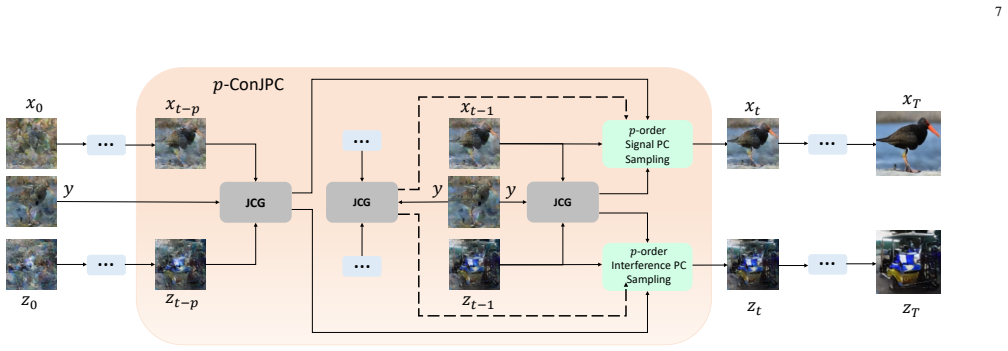
The load-bearing object is the joint-posterior MAP objective with the decomposition $\nabla_v \log p(v|y,h_x) = [\nabla_x \log p_{y|x,z,h_x}; \nabla_z \log p_{y|x,z,h_x}] + [\nabla_x \log p_x(x_t); \nabla_z \log p_z(z_t)]$. The first two gradients are estimated by two independently trained Diffusion Transformer (DiT) models acting as score functions of the signal and interference priors; the transition gradient is derived in closed form from a Gaussian surrogate prior and then simplified by replacing the covariance $\Theta_t$ and scaling $\zeta_t$ with the surrogates $\Theta_t\approx \frac{\sigma^2}{2}W_n^2$ and $\zeta_t \approx 1/(2-\alpha_t)$. These estimated gradients are fed into a predict-correct sampler (UniPC-style, with accuracy order $p+1$) that integrates the probability-flow ODE for both $x_t$ and $z_t$ in parallel, yielding the final estimates $\hat{x}$ and $\hat{z}$ in about 40 steps.
What would settle it
Compute the true transition posterior numerically by sampling many $(v_t, y)$ pairs from the trained diffusion models and measuring the actual $\Theta_t$ and $\zeta_t$; if the surrogate gradients in Eq. (38) deviate from the empirical gradients by more than the improvement margin the paper reports, the 'accurate estimation' claim would fail. A cheaper check is to run the same ICDM pipeline on features with a deliberately bimodal prior and test whether the MAP-error bound still holds.
Extended reading notes
Core claim
The central claim is that interference cancellation in a wireless semantic link can be solved as a MAP estimation over the joint posterior $p(x,z|y,h_x)$ of the desired semantic feature vector $x$ and the unknown interference $z$, and that this MAP solution is provably close to the ground truth: the joint estimation error satisfies $(\xi+\lambda_{\min})\sqrt{\|\hat{x}-x^*\|^2+\|\hat{z}-z^*\|^2} \le \|\Sigma n\|$, where $\xi$ measures local strong convexity of the log-priors, $\lambda_{\min}$ is the smallest eigenvalue of the weighted channel Gram matrix, and $\Sigma n$ is a noise term. The paper then converts the MAP problem into an ODE whose score is the sum of two learned prior gradients and a closed-form transition gradient, and shows numerically that this ICDM pipeline reduces MSE by 4.54 dB and improves LPIPS by 2.47 dB on CelebA under Rayleigh fading at SINR 0 dB, with similar gains on bird and real-world images.
Load-bearing premise
The method derives its transition gradient by pretending the true joint prior of signal and interference is a unit-variance Gaussian, then replaces the resulting covariance and scaling by simplified surrogates with no error bound quantifying how close those surrogates are to the real transition.
Editorial extensions
If this is right
- The same ICDM module can be inserted after any equalizer and before any JSCC decoder, since it is agnostic to the source codec; the paper demonstrates this with both MambaJSCC and SwinJSCC backbones.
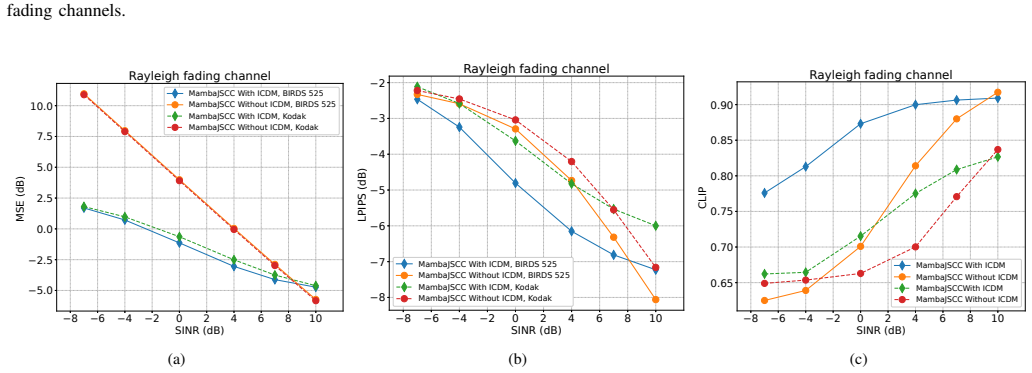
- The gains transfer across data domains, not only faces: the paper reports LPIPS improvements on the BIRDS 525 and Kodak/Open Images datasets under the same Rayleigh fading channel.
- The method is most effective when signal and interference powers are comparable (around SINR=0 dB), and its advantage shrinks outside roughly $[-4,7]$ dB, where either the interference is too strong to extract a signal or the no-ICDM baseline is already clean.
- Because the interference score is learned independently, ICDM can adapt to a new interferer with only a few hundred training iterations of the interference diffusion model.
- The 40-step sampler reduces inference time to about 1.6 seconds on a single GPU, compared with 7.8 and 39.2 seconds for standard DiT and DDPM sampling at 200 and 1000 steps.
Reading between the lines
- If the Gaussian-surrogate derivation were replaced by a non-parametric estimate of the true transition posterior, the same ODE formulation could in principle handle interference that is strongly non-Gaussian, such as impulsive or structured interference from other users.
- The reported error bound depends on the local strong convexity parameter $\xi$; for multimodal feature distributions from modern neural codecs, that parameter may be very small, so the practical guarantee may be much weaker than the theorem suggests.
- A direct testable extension is to report the actual values of the guidance intensities $\beta$ and $\gamma$; sweeping them would reveal whether the method's success is sensitive to the unstated constants rather than to the derived gradient.
Editorial analysis
A structured set of objections, weighed in public.
Referee Report
Summary. The paper proposes ICDM, a diffusion-model-based interference cancellation method for wireless semantic communications. The received/equalized signal is modeled as a linear combination of the desired signal and an unknown interference plus noise, and the recovery problem is formulated as joint MAP estimation over signal and interference. The authors prove (Theorem 1) a bound on the estimation error under local strong convexity assumptions, then propose to solve the MAP problem with two diffusion models that estimate the prior log-gradients and with a closed-form ``derived'' guidance gradient for the channel transition probability obtained via a Gaussian assumption and Bayes' rule. The resulting gradients are combined with a p-order predictor-corrector sampler. Experiments on CelebA, BIRDS 525, and Kodak, with MambaJSCC and SwinJSCC, report consistent gains in MSE, LPIPS, and CLIP over not using ICDM and over several alternative guidance-gradient estimators.
Significance. If the theoretical derivation and the theorem were correct, this would be a useful contribution to semantic communications: it extends diffusion-based channel recovery from pure Gaussian denoising to structured interference, proposes a principled joint MAP formulation, and provides a fast high-order sampler. The empirical study is broad: three datasets, two JSCC architectures, two channel models, and comparisons against DPS, GDM, Projection, and CDDM. The observation that the interference diffusion model needs only about 600 training iterations to be useful is also interesting. However, the central derivation of the guidance gradient contains a load-bearing Bayes-rule error and a sign inconsistency, and the theorem's strong-convexity assumption is self-contradictory for a local optimum of a density. These issues mean that the paper's advertised claim of ``accurately estimated'' gradients is not established, and the theoretical performance guarantee does not follow as stated.
major comments (4)
- [Section III-B, Eq. (32)] The posterior p(v_T | v_t) is computed incorrectly. From the forward process (24) with p(v_T) = N(0, σ̂² I), Bayes' rule gives p(v_T | v_t) = N(v_T; [√α_t σ̂² / (α_t σ̂² + 1 − α_t)] v_t, [(1 − α_t) σ̂² / (α_t σ̂² + 1 − α_t)] I). Equation (32) instead gives the mean coefficient as σ̂² / ((1 − α_t) + σ̂²) and the covariance as (1 − α_t) σ̂² / ((1 − α_t) + σ̂²) I, dropping both the √α_t factor in the numerator and the α_t σ̂² term in the denominator. With σ̂² = 1, the correct coefficient is √α_t, but Eq. (37) sets ζ_t ≈ 1/(2 − α_t). At α_t = 0.01 these differ by a factor of about 5 (0.503 versus 0.1). Since ζ_t and Θ_t enter the closed-form gradient (35) and hence the final guidance gradient (38), Eq. (38) is not the Bayes estimate even under the paper's own Gaussian-prior assumption. The replacements (36)–(37) are therefore not a minor approximation; they replace the derived quantities with substantially different ones, and no error bound is supplied.
- [Section III-C, Eq. (40), with Eqs. (23), (27), (29)] The definition of r_θ is inconsistent with the score relations earlier in the paper. Since the training objective (27) minimizes ‖s_θ(x_t,t) − ε_x‖², the learned model satisfies s_θ ≈ ε_x, and Eq. (29) gives ∇_x log p_x(x_t) = −s_θ / √(1 − α_t). The posterior-gradient decomposition (23) requires adding the likelihood gradient to the prior gradient. Equation (40), however, forms r_θ = s_θ − β r̄_x. Thus, if s_θ is a noise prediction and r̄_x approximates the likelihood gradient, the prior term has the wrong sign and the likelihood term is subtracted rather than added. Consequently r_θ is not an estimate of ∇_{x_t} log p(x_t, z_t | y, h_x) as claimed immediately below (40). The update (41) uses −r_θ, so the overall iteration may accidentally move in a correct direction, but the identification of r_θ with the posterior gradient is algebraically inconsistent. The authors need to define signs coherently among Eqs. (23), (29), (40), and (41).
- [Section II-B, Assumption 2 and Theorem 1] Assumption 2 is self-contradictory and the proof of Theorem 1 therefore does not hold. The assumption states that log p_x and log p_z are locally strongly convex (parameters µ, ν > 0) and that the ground-truth x*, z* are local optima of these log-densities. A local maximum of a smooth density has a negative semidefinite Hessian (or a zero Hessian), so it cannot be locally strongly convex with a positive curvature parameter. The inequalities (11)–(12) have the wrong sign under the stated assumption, so the lower bound ξ‖v̂ − v*‖² in (13) is not justified. This is load-bearing because the positive denominator ξ + λ_min in (5) and (18) is essential for the claimed error bound. The authors must either replace the assumption with a mathematically consistent one and re-derive the bound, or remove the theorem.
- [Section III-C, Eq. (40), and Section IV experiments] The values of the guidance intensities β and γ are never reported for any experiment, and no ablation or sensitivity study is provided. The paper describes them in Remark 1 as balancing consistency with the received signal versus generation realism, but they multiply the supposedly derived gradient r̄_x. Without reporting their values or showing that the results are robust to their choice, it is impossible to tell whether the gains of ICDM come from the derived guidance gradient or from tuning these two free parameters. At a minimum, provide the chosen values, the search range, and a sensitivity table.
minor comments (5)
- [Section III-C, Eqs. (42) and (49)] The updates for z_t use r_θ (...) instead of r_φ (...) in the first line of both equations; the interference update should use the interference diffusion model r_φ, not the signal model r_θ.
- [Section V and Section IV-B] The conclusion reports that ICDM reduces MSE by 5.67 dB and improves LPIPS by 2.65 dB on CelebA, while the abstract and Section IV-B report 4.54 dB and 2.47 dB. These numbers should be reconciled.
- [Figure 8] The caption and legend labels in Figure 8 appear to be inconsistent: the caption says SwinJSCC-based schemes but the legends still read ``MambaJSCC With ICDM'' / ``MambaJSCC Without ICDM''. Please correct the labels.
- [Notation, Eq. (24) and Algorithm 3] The time indexing is nonstandard and confusing: Eq. (24) uses x_T as the clean sample, while Algorithm 3 initializes x_0 as pure noise and outputs x_T as the estimate. Since the meaning of increasing t is opposite to the usual diffusion-model convention, please define the direction of the noise schedule explicitly and use consistent notation throughout.
- [Throughout] There are many typos and grammatical slips, e.g., ``beacuse'' (Section III-A), ``polts'' and ``continuous'' (Section IV-B), ``Exapmles'' (Figure 7), ``vextor'' (Section II-A), and ``unware'' (Section IV-A). A careful proofreading pass is needed.
Circularity Check
No significant circularity: the MAP bound and guidance gradients rest on stated assumptions and explicit approximations, and the empirical claims are benchmarked against external baselines.
full rationale
I find no circular step that reduces a prediction to its inputs by construction. The MAP formulation (2) is defined independently of the proposed solver, and Theorem 1 is proven from explicit Assumptions 1 and 2. Those assumptions—independence, local strong convexity, and ground-truth stationarity—are strong and unverified premises, but they are premises, not imported conclusions, so the bound is a conditional theorem rather than a circular definition. In the guidance-gradient derivation of Section III-B, the paper explicitly assumes a Gaussian prior p(vT) = N(0, σ̂²) and then explicitly replaces the derived ζt and Θt with surrogates in Eqs. (36) and (37). This makes the final gradient (38) an acknowledged approximation, not a quantity that is claimed to equal the derived expression by construction. Whether Eq. (32) is algebraically correct, or whether the surrogate ζt ≈ 1/(2 − αt) is accurate, is a correctness and validity concern, not a circularity concern: the paper does not define the prediction as the fit. The tunable intensities β and γ in Eq. (40) are free hyperparameters, but they are not fitted to the reported performance numbers and then renamed as predictions. The empirical gains are measured against external baselines (MambaJSCC without ICDM, SwinJSCC without ICDM, DPS, GDM, Projection, CDDM) on real datasets, so the main experimental claim is self-contained. Self-citations such as CDDM [14] and MambaJSCC [26] provide motivation, baselines, and system components, but the load-bearing MAP-to-ODE-to-sampler argument does not reduce to those citations. No uniqueness theorem is imported from the authors' prior work, and no known result is merely renamed. Overall, the paper's derivation chain may contain mathematical approximations or errors, but it is not circular.
Assumptions & free parameters
free parameters (4)
- β (signal guidance intensity) =
not reported
- γ (interference guidance intensity) =
not reported
- ζ_t (transition scaling surrogate) =
1/(2 - α_t) with σhat^2=1
- σhat^2 (assumed prior variance) =
1
assumptions (4)
- domain assumption The transmitted signal x and interference z are independent.
- ad hoc to paper log px(x) and log pz(z) are locally strongly convex with parameters µ, ν > 0, and the ground truth x*, z* are local optima of both priors.
- ad hoc to paper The prior p(vT) is Gaussian N(0, σhat^2 I) for the purpose of deriving the guidance gradient.
- domain assumption The learned diffusion models sθ and sφ accurately approximate the true score functions at every time step.
Cite this review
Pith. "Pith review of ICDM: Interference Cancellation Diffusion Models for Wireless Semantic Communications." pith.science (2026). https://pith.science/paper/NCA3ALCK
@misc{pith2026250519983,
  author       = {Pith},
  title        = {Pith review of: ICDM: Interference Cancellation Diffusion Models for Wireless Semantic Communications},
  year         = {2026},
  howpublished = {\url{https://pith.science/paper/NCA3ALCK}},
  note         = {Machine review of arXiv:2505.19983}
}
abstract
Diffusion models (DMs) have recently achieved significant success in wireless communications systems due to their denoising capabilities. The broadcast nature of wireless signals makes them susceptible not only to Gaussian noise, but also to unaware interference. This raises the question of whether DMs can effectively mitigate interference in wireless semantic communication systems. In this paper, we model the interference cancellation problem as a maximum a posteriori (MAP) problem over the joint posterior probability of the signal and interference, and theoretically prove that the solution provides excellent estimates for the signal and interference. To solve this problem, we develop an interference cancellation diffusion model (ICDM), which decomposes the joint posterior into independent prior probabilities of the signal and interference, along with the channel transition probablity. The log-gradients of these distributions at each time step are learned separately by DMs and accurately estimated through deriving. ICDM further integrates these gradients with advanced numerical iteration method, achieving accurate and rapid interference cancellation. Extensive experiments demonstrate that ICDM significantly reduces the mean square error (MSE) and enhances perceptual quality compared to schemes without ICDM. For example, on the CelebA dataset under the Rayleigh fading channel with a signal-to-noise ratio (SNR) of $20$ dB and signal to interference plus noise ratio (SINR) of 0 dB, ICDM reduces the MSE by 4.54 dB and improves the learned perceptual image patch similarity (LPIPS) by 2.47 dB.
Figures


Figures from the paper (6 more)




Forward citations
Cited by 1 Pith paper
-
Mixture of Semantics Transmission for Generative AI-Enabled Semantic Communication Systems
A semantic communication system that transmits image ROIs at high fidelity and transmits the background as text, reconstructing the image with a diffusion model.
Reference graph
Works this paper leans on
-
[1]
Deep Unsupervised Learning Using Nonequilibrium Thermodynamics,
J. Sohl-Dickstein, E. Weiss, N. Maheswaranathan, and S. Ganguli, “Deep Unsupervised Learning Using Nonequilibrium Thermodynamics,” in International conference on machine learning , 2015, pp. 2256–2265
work page 2015
-
[2]
Denoising Diffusion Probabilistic Models,
J. Ho, A. Jain, and P. Abbeel, “Denoising Diffusion Probabilistic Models,” Advances in neural information processing systems , vol. 33, pp. 6840–6851, 2020
work page 2020
-
[3]
Generative modeling by estimating gradients of the data distribution,
Y . Song and S. Ermon, “Generative modeling by estimating gradients of the data distribution,” Advances in neural information processing systems, vol. 32, 2019
2019
-
[4]
Score-Based Generative Modeling through Stochastic Differential Equations,
Y . Song, J. Sohl-Dickstein, D. P. Kingma, A. Kumar, S. Ermon, and B. Poole, “Score-Based Generative Modeling through Stochastic Differential Equations,” in International Conference on Learning Rep- resentations, 2021
work page 2021
-
[5]
C. Liang, H. Du, Y . Sun, D. Niyato, J. Kang, D. Zhao, and M. A. Imran, “Generative AI-Driven Semantic Communication Networks: Architec- ture, Technologies, and Applications,” IEEE Transactions on Cognitive Communications and Networking , vol. 11, no. 1, pp. 27–47, 2025
work page 2025
-
[6]
Large AI Model Empowered Multimodal Semantic Communications,
F. Jiang, L. Dong, Y . Peng, K. Wang, K. Yang, C. Pan, and X. You, “Large AI Model Empowered Multimodal Semantic Communications,” IEEE Communications Magazine , vol. 63, no. 1, pp. 76–82, 2025
work page 2025
-
[7]
Large Language Model Enhanced Multi-Agent Systems for 6G Communications,
F. Jiang, Y . Peng, L. Dong, K. Wang, K. Yang, C. Pan, D. Niyato, and O. A. Dobre, “Large Language Model Enhanced Multi-Agent Systems for 6G Communications,” IEEE Wireless Communications , vol. 31, no. 6, pp. 48–55, 2024. 13
work page 2024
-
[8]
Gen- erative Diffusion Models for Radio Wireless Channel Modelling and Sampling,
U. Sengupta, C. Jao, A. Bernacchia, S. Vakili, and D.-s. Shiu, “Gen- erative Diffusion Models for Radio Wireless Channel Modelling and Sampling,” in GLOBECOM 2023 - 2023 IEEE Global Communications Conference, 2023, pp. 4779–4784
work page 2023
Show all 37 references
-
[9]
SING: Semantic Image Communications using Null-Space and INN-Guided Diffusion Models,
J. Chen, S. F. Yilmaz, D. You, P. L. Dragotti, and D. Gündüz, “SING: Semantic Image Communications using Null-Space and INN-Guided Diffusion Models,” arXiv preprint arXiv:2503.12484 , 2025
2025 arXiv
-
[10]
SG2SC: A Gen- erative Semantic Communication Framework for Scene Understanding- Oriented Image Transmission,
M. Yang, D. Gao, F. Xie, J. Li, X. Song, and G. Shi, “SG2SC: A Gen- erative Semantic Communication Framework for Scene Understanding- Oriented Image Transmission,” in IEEE International Conference on Acoustics, Speech and Signal Processing (ICASSP) , 2024, pp. 13 486– 13 490
2024
-
[11]
Semantic-Preserving Image Coding based on Conditional Diffusion Models,
F. Pezone, O. Musa, G. Caire, and S. Barbarossa, “Semantic-Preserving Image Coding based on Conditional Diffusion Models,” arXiv preprint arXiv:2310.15737, 2024
2024 arXiv
-
[12]
DiffCom: Chan- nel Received Signal is a Natural Condition to Guide Diffusion Posterior Sampling,
S. Wang, J. Dai, K. Tan, X. Qin, K. Niu, and P. Zhang, “DiffCom: Chan- nel Received Signal is a Natural Condition to Guide Diffusion Posterior Sampling,” IEEE Journal on Selected Areas in Communications , pp. 1–1, 2025
2025
-
[13]
Visual Lan- guage Model-Based Cross-Modal Semantic Communication Systems,
F. Jiang, C. Tang, L. Dong, K. Wang, K. Yang, and C. Pan, “Visual Lan- guage Model-Based Cross-Modal Semantic Communication Systems,” IEEE Transactions on Wireless Communications , vol. 24, no. 5, pp. 3937–3948, 2025
2025
-
[14]
CDDM: Channel Denoising Diffusion Models for Wireless Semantic Communications,
T. Wu, Z. Chen, D. He, L. Qian, Y . Xu, M. Tao, and W. Zhang, “CDDM: Channel Denoising Diffusion Models for Wireless Semantic Communications,” IEEE Transactions on Wireless Communications , vol. 23, no. 9, pp. 11 168–11 183, 2024
2024
-
[15]
DM-MIMO: Diffusion Mod- els for Robust Semantic Communications over MIMO Channels,
Y . Duan, T. Wu, Z. Chen, and M. Tao, “DM-MIMO: Diffusion Mod- els for Robust Semantic Communications over MIMO Channels,” in 2024 IEEE/CIC International Conference on Communications in China (ICCC), 2024, pp. 1609–1614
2024
-
[16]
SCDM: Score-Based Channel Denoising Model for Digital Semantic Communications,
H. Mo, Y . Sun, S. Yao, H. Chen, Z. Chen, X. Xu, N. Ma, M. Tao, and S. Cui, “SCDM: Score-Based Channel Denoising Model for Digital Semantic Communications,” in Proc. IEEE ICC 2025 , 2025, pp. 1–5
2025
-
[17]
Generative Diffusion Models for High Dimensional Channel Estimation,
X. Zhou, L. Liang, J. Zhang, P. Jiang, Y . Li, and S. Jin, “Generative Diffusion Models for High Dimensional Channel Estimation,” IEEE Transactions on Wireless Communications , pp. 1–1, 2025
2025
-
[18]
A Novel Self-Interference Cancellation Scheme for Channel-Unaware Differential Space-Time Two-Way Relay Networks,
S. Bameri, S. Talebi, R. H. Gohary, and H. Yanikomeroglu, “A Novel Self-Interference Cancellation Scheme for Channel-Unaware Differential Space-Time Two-Way Relay Networks,”IEEE Transactions on Wireless Communications, vol. 17, no. 2, pp. 1226–1241, 2018
2018
-
[19]
A Narrowband Interference Suppression Algorithm for Time Synchronization,
F. Liu, H. Zhao, and Y . Tang, “A Narrowband Interference Suppression Algorithm for Time Synchronization,” in 2015 IEEE/CIC International Conference on Communications in China (ICCC) , 2015, pp. 1–6
2015
-
[20]
On the Theory of Brownian Motion,
P. Langevin, “On the Theory of Brownian Motion,” C.R. Acad. Sci. Paris, vol. 146, pp. 530–533, 1908
1908
-
[21]
Approximation Analysis of Stochastic Gradient Langevin Dynamics by Using Fokker-Planck Equation and Itô Process,
I. Sato and H. Nakagawa, “Approximation Analysis of Stochastic Gradient Langevin Dynamics by Using Fokker-Planck Equation and Itô Process,” in Proceedings of the 31st International Conference on International Conference on Machine Learning , vol. 32, 2014, pp. 982– 990
2014
-
[22]
Digital Self-Interference Cancellation for Full- Duplex Systems Based on CNN and GRU,
J. Liu and T. Ding, “Digital Self-Interference Cancellation for Full- Duplex Systems Based on CNN and GRU,” Electronics, vol. 13, no. 15, 2024
2024
-
[23]
Scalable Diffusion Models with Transform- ers,
W. Peebles and S. Xie, “Scalable Diffusion Models with Transform- ers,” in 2023 IEEE/CVF International Conference on Computer Vision (ICCV), 2023, pp. 4172–4182
2023
-
[24]
A robust image semantic communication system with multi-scale vision transformer,
X. Peng, Z. Qin, X. Tao, J. Lu, and K. B. Letaief, “A robust image semantic communication system with multi-scale vision transformer,” IEEE Journal on Selected Areas in Communications , vol. 43, no. 4, pp. 1278–1291, 2025
2025
-
[25]
SwinJSCC: Taming Swin Transformer for Deep Joint Source-Channel Coding,
K. Yang, S. Wang, J. Dai, X. Qin, K. Niu, and P. Zhang, “SwinJSCC: Taming Swin Transformer for Deep Joint Source-Channel Coding,” IEEE Transactions on Cognitive Communications and Networking , vol. 11, no. 1, pp. 90–104, 2025
2025
-
[26]
MambaJSCC: Deep Joint Source-Channel Coding with Visual State Space Model,
T. Wu, Z. Chen, M. Tao, X. Xu, W. Zhang, and P. Zhang, “MambaJSCC: Deep Joint Source-Channel Coding with Visual State Space Model,” submitted to IEEE Trans. Wireless Commun. , 2024. [Online]. Available: https://arxiv.org/abs/2405.03125
2024 arXiv
-
[27]
The Unreasonable Effectiveness of Deep Features as A Perceptual Metric,
R. Zhang, P. Isola, A. A. Efros, E. Shechtman, and O. Wang, “The Unreasonable Effectiveness of Deep Features as A Perceptual Metric,” in Proceedings of the IEEE conference on computer vision and pattern recognition, 2018, pp. 586–595
2018
-
[28]
Solving inverse problems with a flow-based noise model,
J. Whang, Q. Lei, and A. Dimakis, “Solving inverse problems with a flow-based noise model,” in International Conference on Machine Learning, 2021, pp. 11 146–11 157
2021
-
[29]
Maximum Likelihood Training of Score-based Diffusion Models,
Y . Song, C. Durkan, I. Murray, and S. Ermon, “Maximum Likelihood Training of Score-based Diffusion Models,” Advances in neural infor- mation processing systems , vol. 34, pp. 1415–1428, 2021
2021
-
[30]
Diffusion Posterior Sampling for General Noisy Inverse Problems,
H. Chung, J. Kim, M. T. Mccann, M. L. Klasky, and J. C. Ye, “Diffusion Posterior Sampling for General Noisy Inverse Problems,” arXiv preprint arXiv:2209.14687, 2022
2022 arXiv
-
[31]
Pseudoinverse-guided Diffusion Models for Inverse Problems,
J. Song, A. Vahdat, M. Mardani, and J. Kautz, “Pseudoinverse-guided Diffusion Models for Inverse Problems,” in International Conference on Learning Representations, 2023
2023
-
[32]
Removing Structured Noise using Diffusion Models,
T. S. Stevens, H. van Gorp, F. C. Meral, J. Shin, J. Yu, J.-L. Robert, and R. J. van Sloun, “Removing Structured Noise using Diffusion Models,” Transactions on Machine Learning Research , pp. 2835–8856, 2025
2025
-
[33]
UniPC: A Unified Predictor-Corrector Framework for Fast Sampling of Diffusion Mod- els,
W. Zhao, L. Bai, Y . Rao, J. Zhou, and J. Lu, “UniPC: A Unified Predictor-Corrector Framework for Fast Sampling of Diffusion Mod- els,” Advances in Neural Information Processing Systems , vol. 36, pp. 49 842–49 869, 2023
2023
-
[34]
Diffusion Models Beat GANs on Image Synthesis,
P. Dhariwal and A. Nichol, “Diffusion Models Beat GANs on Image Synthesis,” Advances in neural information processing systems , vol. 34, pp. 8780–8794, 2021
2021
-
[35]
Deep Learning Face Attributes in the Wild,
Z. Liu, P. Luo, X. Wang, and X. Tang, “Deep Learning Face Attributes in the Wild,” in Proceedings of International Conference on Computer Vision (ICCV), December 2015
2015
-
[36]
The Open Images Dataset V4: Unified Image Classification, Object Detection, and Visual Relationship Detection at Scale,
A. Kuznetsova, H. Rom, N. Alldrin, J. Uijlings, I. Krasin, J. Pont-Tuset, S. Kamali, S. Popov, M. Malloci, A. Kolesnikov, T. Duerig, and V . Fer- rari, “The Open Images Dataset V4: Unified Image Classification, Object Detection, and Visual Relationship Detection at Scale,” Int...
1956
-
[37]
CLIP- Score: A Reference-free Evaluation Metric for Image Captioning,
J. Hessel, A. Holtzman, M. Forbes, R. L. Bras, and Y . Choi, “CLIP- Score: A Reference-free Evaluation Metric for Image Captioning,” arXiv preprint arXiv:2104.08718, 2021
2021 arXiv
Reviewed August 7, 2026 · model on record in the stance chip above.
Discussion (0). Continue with ORCID to comment.