REVIEW 4 major objections 6 minor 41 references
An AI-Driven Live Systematic Reviews in the Brain-Heart Interconnectome: Minimizing Research Waste and Advancing Evidence Synthesis
T0 review · 4 major / 6 minor · reviewed 2026-08-10 · deepseek-v4-flash
Pith's one-line read A modular AI pipeline can keep systematic reviews in the Brain-Heart Interconnectome living and reduce research waste.
desk verdict Good system description, weak comparative claim: the RAG-vs-GPT-4 comparison is unsubstantiated and the waste-reduction conclusion is an assertion. read the letter →
The pith
A machine-rendered reading of the paper's core claim, the machinery that carries it, and where it could break.
The reading
What carries the argument
The load-bearing machinery is the integration of four components. A Bi-LSTM sequence model, made of an embedding layer, two bidirectional LSTM layers, two dense layers, and dropout, classifies whether an abstract satisfies PICOS. A hierarchical study-design classifier, built with LLMs, assigns each record a design type. A Neo4j graph database, paired with pgVector embedding storage, allows Cypher queries and semantic vector search over relationships among interventions, outcomes, authors, and venues. BERTopic performs class-based TF-IDF topic modeling, producing cluster terms and redundancy alerts. The RAG component, coordinated by LangGraph and LangChain, retrieves relevant graph and vector results and passes them to GPT-3.5, which generates answers; this retrieval-before-generation mechanism is what the paper credits with reducing hallucination and beating plain GPT-4 on relationship-centric queries.
What would settle it
Pre-register a fixed sample of BHI queries with blinded expert raters and a pre-specified scoring rubric; if RAG plus GPT-3.5 does not receive higher blinded ratings than plain GPT-4, or if rater agreement is too low to rank the systems, the comparative claim fails. Separately, track whether use of the system lowers the rate of redundant or duplicate BHI studies over time; if redundancy rates do not fall, the waste-reduction claim is unsupported.
Extended reading notes
Core claim
The paper claims that a single system can automate the whole systematic-review pipeline for brain-heart research: automated PICOS detection filters abstracts for reporting compliance, a hierarchical classifier sorts studies into designs such as RCT, cohort, and case-control, a Neo4j graph database stores relationships among interventions, outcomes, venues, and affiliations, pgVector embeddings support semantic search, BERTopic clusters the literature into themes and flags redundancy, and a RAG layer using GPT-3.5 answers natural-language queries with retrieved evidence. The reported numbers are 87% accuracy for PICOS compliance, 95.7% accuracy for study-design classification on 164 reference records (precision 91.4%, recall 100%, specificity 92.2%), and a head-to-head expert evaluation in which 75% of RAG-augmented responses met or exceeded expectations; 25% of queries were answered well by both systems, 25% better by RAG-plus-GPT-3.5, 20% better by plain GPT-4, and 25% needed further work. The waste-reduction claim follows from the system's redundancy alerts, its spotlighting of underexplored topics, and its continuously updated living database.
Load-bearing premise
The load-bearing premise is that the expert evaluation in Sections 2.6 and 3.1 is a valid gold standard: an unreported number of unblinded queries rated by human experts is what establishes both the RAG-plus-GPT-3.5 advantage and the waste-reduction claim, and if those ratings are unrepresentative or biased, the central claims collapse.
Editorial extensions
If this is right
- BHI systematic reviews could be updated continuously, so newly published evidence appears in the review near real time rather than after a multi-year cycle.
- Redundancy alerts from topic clusters could redirect funders and editorial teams away from duplicated short-term outcome studies toward long-term neurocardiological questions.
- PICOS screening and study-design classification at the reported accuracies would let reviewers triage large literatures to methodologically strong records before manual screening.
- The modular architecture could be applied to other biomedical fields with large, heterogeneous evidence bases.
- The conversational interface and dashboards would let clinicians and policymakers query the living evidence base without data-science expertise.
Reading between the lines
- Because the head-to-head comparison reports no number of queries, no blinding, and no inter-rater reliability, the paper's 'RAG beats GPT-4' claim is better read as evidence of feasibility than as a statistically established superiority.
- The waste-reduction claim would need a direct test: measuring whether use of the system actually lowers the rate of redundant or never-published BHI studies, rather than only flagging clusters of similar abstracts.
- Component accuracies were measured on particular training and validation sets, so deployment in other BHI subfields or other specialties would require re-validation against new distributions of abstracts and designs.
- The design pattern 'structured graph retrieval plus a smaller LLM outperforms a larger standalone LLM on relation-centric questions' is a general hypothesis that could be tested on non-biomedical question-answering benchmarks.
Editorial analysis
A structured set of objections, weighed in public.
Referee Report
Summary. The paper presents an AI-driven system for supporting living systematic reviews in the Brain-Heart Interconnectome (BHI). The system integrates automated PICOS compliance detection via a Bi-LSTM, a study design classifier, semantic search with pgVector, graph-based querying with Neo4j, topic modeling with BERTopic, a living database, and a conversational interface. The authors report that RAG with GPT-3.5 outperformed plain GPT-4 on specialized BHI queries, that the Bi-LSTM achieves 87% accuracy for PICOS compliance, that the study design classifier achieves 95.7% accuracy, and that the system reduces research waste by detecting redundancies and providing real-time updates. The paper concludes that the architecture is adaptable to other biomedical fields and improves the efficiency and rigor of evidence synthesis.
Significance. If the system works as described, it would be a useful contribution to the growing field of AI-assisted evidence synthesis, particularly for a niche domain like BHI. The paper's strengths include a concrete system architecture, a validation study with an internally consistent confusion matrix (Tables 2 and 3), and an explicit acknowledgment of several limitations in Section 5. However, the headline claims about RAG outperforming GPT-4 and about systematically reducing research waste are not supported by the evidence reported. The comparative evaluation in Section 3.1 lacks any experimental protocol, sample size, statistical test, or inter-rater reliability, and the waste-reduction claim is an inference from component behavior rather than a measured outcome. The validation of the Bi-LSTM and study design classifier also lacks essential methodological details, making generalizability claims premature.
major comments (4)
- [Section 3.1 (also Abstract and Section 2.2)] The claim that 'RAG combined with GPT-3.5 outperformed GPT-4 for specialized BHI queries' is not established by the reported evidence. No number of queries is given, no rating scale or scoring rubric is defined, there is no mention of blinding, inter-rater reliability, or a statistical test. The percentages in Section 3.1 are ambiguous and potentially inconsistent: if '30% adequately answered by both,' '25% where RAG excelled,' '20% where GPT-4 performed better,' and '25% requiring optimization' are mutually exclusive, they sum to 100%, and the '75% met or exceeded expectations' cannot be derived from them; alternatively, if the categories overlap, the sizes and overlap are undefined. Because this comparison motivates the entire system architecture, the paper must either provide a rigorous evaluation (query set, scoring criteria, raters, sample size, and appropriate tests) or substantially downgrade the claim to a preliminary observation.
- [Section 3.5, Tables 2 and 3] The confusion matrix counts (TP=74, FP=7, TN=83, FN=0) are arithmetically consistent with the reported precision, recall, specificity, and accuracy values. However, the paper does not describe how the gold-standard labels were constructed, whether the 164 references were independent of the training data, what the class distribution was, or whether the evaluation was performed on held-out data. The perfect recall (FN=0) is suspicious and could indicate in-sample evaluation, an overly easy classification task, or data leakage. Without this information, the claim that the classifier is 'robust' and can 'rapidly identify and prioritize methodologically rigorous studies' is unsupported.
- [Section 3.4 and Section 2.3] The Bi-LSTM's 87% accuracy for PICOS compliance is reported without any test-set description: the number of instances, class distribution, train/test split, confidence intervals, or comparison with existing PICO extraction models. The paper states the model was trained on an 'extended PubMed-PICO dataset' but does not say how it was extended or whether the extension includes the 'S' (study design) component, which is part of PICOS. Since this component is supposed to flag low-quality studies early, the evaluation needs enough detail to assess whether the accuracy reflects real-world screening conditions rather than a laboratory setup.
- [Abstract, Section 4.1, and Section 3.2] The claim that the system 'systematically reduces waste' is not directly measured. The paper infers waste reduction from the presence of BERTopic clustering, redundancy alerts, and a living database, but it does not measure any waste-related outcome, such as the number of redundant studies identified, the time saved in screening, decisions to change research priorities, or reductions in resource use. Without a direct evaluation, the waste-reduction claim is overreaching and should be reframed as a potential benefit of the system architecture.
minor comments (6)
- [Title and header] The first line of the full text contains a typo: 'AN AI-D RIVEN' should read 'AN AI-DRIVEN' or 'AN AI-DRIVEN' without the space.
- [Section 1.3] The heading 'BHI Human Requirements' is unclear; the section describes stakeholder feedback and should be renamed to something like 'Stakeholder Input and System Requirements'.
- [Throughout] The abbreviations PICOS and PICO are used inconsistently; the Bi-LSTM is described as trained on PubMed-PICO (which traditionally extracts PICO, not Study design), while the system claims PICOS compliance. The text should clarify whether the Bi-LSTM detects all five elements or only the original four.
- [Section 3.5, Table 3] The performance metrics in Table 3 (precision, recall, specificity, accuracy) are presented as point estimates without confidence intervals or any measure of variability; adding intervals would help interpret the small validation set.
- [Section 2.4.1] Figure 6 is referenced before Figure 5 in the text; the figures should be numbered in order of first mention.
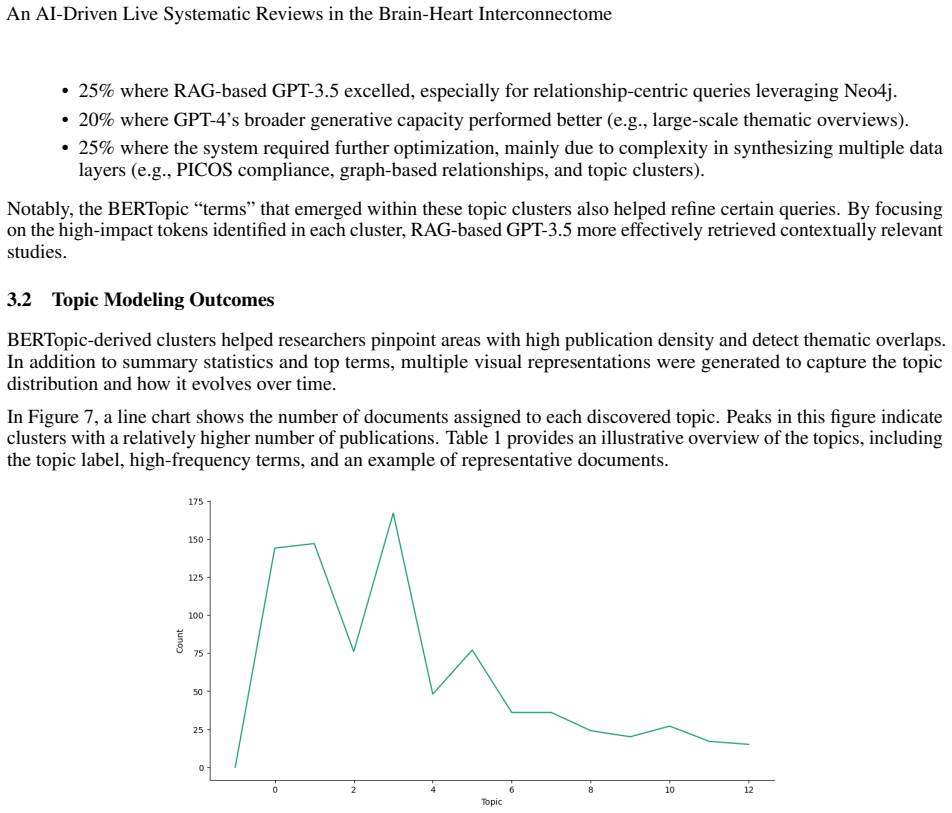
- [Table 1] Table 1's layout is confusing: the 'Topic' column contains entries such as '0 -1 -1_report_trial_studi_rct' that seem to combine a topic number, a count, and a label; the table should be simplified with separate columns for topic number, count, and representative terms.
Circularity Check
No circularity: component evaluations are empirical and externally anchored; the under-specified RAG comparison is a validity limitation, not a construction-level circular step.
full rationale
The paper reports an AI-assisted systematic-review pipeline and evaluates its components against external or human-judgment references, with no fitted-parameter derivation whose output is then relabeled as a prediction. The Bi-LSTM PICOS model is trained on the external PubMed-PICO corpus (Section 2.3, Ref [10]) and its 87% accuracy is a standard performance claim on that task. The study-design classifier is scored against a 164-reference confusion matrix (TP=74, FP=7, TN=83, FN=0) whose precision, recall, specificity, and accuracy are internally consistent (Section 3.5). The RAG-versus-GPT-4 comparison (Sections 2.2, 2.6, 3.1) is an empirical expert-rated comparison, albeit one lacking reported query counts, blinding, a scoring rubric, and statistical testing; the RAG system has access to the authors' curated graph database while plain GPT-4 does not, which makes the comparison unfair and the claimed advantage unsurprising, but this is a methodological weakness rather than a circular derivation. No equation in the paper reduces a predicted quantity to a fitted input, and no load-bearing uniqueness theorem or ansatz is imported from the authors' prior work. The self-citations (e.g., PRISMA [24], CONSORT [21]) are standard guideline references and do not carry the argument. The Limitations section explicitly acknowledges data-quality, verification, and usability constraints, confirming that the waste-reduction conclusion is an untested inference, not an analytically forced result. Under the required standard of exhibiting a specific reduction or fitted-input renaming, no circular step can be identified.
Assumptions & free parameters
assumptions (5)
- domain assumption PICOS compliance is an appropriate proxy for methodological quality and relevance in BHI evidence synthesis.
- domain assumption The extended PubMed-PICO dataset is representative of BHI abstracts for training the Bi-LSTM model.
- domain assumption Human expert ratings of answer relevance are a valid gold standard for comparing RAG versus GPT-4.
- domain assumption The 164-reference validation set for study design classification corresponds to an unbiased sample with an independent gold standard.
- domain assumption GPT-3.5 and GPT-4 API outputs are deterministic enough for a reproducible evaluation.
Cite this review
Pith. "Pith review of An AI-Driven Live Systematic Reviews in the Brain-Heart Interconnectome: Minimizing Research Waste and Advancing Evidence Synthesis." pith.science (2026). https://pith.science/paper/NF2ZCOPM
@misc{pith2026250117181,
  author       = {Pith},
  title        = {Pith review of: An AI-Driven Live Systematic Reviews in the Brain-Heart Interconnectome: Minimizing Research Waste and Advancing Evidence Synthesis},
  year         = {2026},
  howpublished = {\url{https://pith.science/paper/NF2ZCOPM}},
  note         = {Machine review of arXiv:2501.17181}
}
read the original abstract
The Brain-Heart Interconnectome (BHI) combines neurology and cardiology but is hindered by inefficiencies in evidence synthesis, poor adherence to quality standards, and research waste. To address these challenges, we developed an AI-driven system to enhance systematic reviews in the BHI domain. The system integrates automated detection of Population, Intervention, Comparator, Outcome, and Study design (PICOS), semantic search using vector embeddings, graph-based querying, and topic modeling to identify redundancies and underexplored areas. Core components include a Bi-LSTM model achieving 87% accuracy for PICOS compliance, a study design classifier with 95.7% accuracy, and Retrieval-Augmented Generation (RAG) with GPT-3.5, which outperformed GPT-4 for graph-based and topic-driven queries. The system provides real-time updates, reducing research waste through a living database and offering an interactive interface with dashboards and conversational AI. While initially developed for BHI, the system's adaptable architecture enables its application across various biomedical fields, supporting rigorous evidence synthesis, efficient resource allocation, and informed clinical decision-making.
Figures


Figures from the paper (8 more)




Reference graph
Works this paper leans on
-
[1]
Avoidable waste in the production and reporting of research evidence
Chalmers, Iain and Glasziou, Paul. Avoidable waste in the production and reporting of research evidence. The Lancet, 374(9683):86–89, 2009
work page 2009
-
[2]
Stephen, J. Chapman, M. Aldaffaa, Candice L. Downey, and David Jayne. Research waste in surgical randomized controlled trials. British Journal of Surgery , 106(11):1464–1471, 2019. https://doi.org/10.1002/BJS. 11266
doi:10.1002/bjs 2019
-
[3]
Alexander, R. Zheutlin, Joshua D. Niforatos, Eric Stulberg, and Jeremy B. Sussman. Research Waste in Random- ized Clinical Trials: a Cross-Sectional Analysis. Journal of General Internal Medicine, 35(10):3105–3107, 2020. https://doi.org/10.1007/S11606-019-05523-4
-
[4]
Discontinuation and non-publication of surgical randomised controlled trials: observational study
Chapman, S.J., Shelton, B., Mahmood, H., Fitzgerald, J.E., Harrison, E.M., and Bhangu, A. Discontinuation and non-publication of surgical randomised controlled trials: observational study. BMJ Open, 9(10):e032019, 2019
work page 2019
-
[5]
Reporting quality and research waste in gastric cancer randomized controlled trials
Lu, L., Sun, J., Ren, X., Ma, X., Guo, Q., Wang, X., and others. Reporting quality and research waste in gastric cancer randomized controlled trials. Annals of Surgical Oncology, 28(6):2991–3000, 2021
work page 2021
-
[6]
Meta-research studies of reporting guidelines and reporting quality in trials: An overview
Santo, S.D., Delgado-Rodriguez, M., and Bonfill, X. Meta-research studies of reporting guidelines and reporting quality in trials: An overview. Systematic Reviews, 11:34, 2022. 11 An AI-Driven Live Systematic Reviews in the Brain-Heart Interconnectome
work page 2022
-
[7]
AlpaPICO: Advancing PICO extraction for systematic reviews in low- resource settings
Ghosh, S., Thomas, R., and Wang, Y . AlpaPICO: Advancing PICO extraction for systematic reviews in low- resource settings. AI in Medicine, 78:203–212, 2024
work page 2024
-
[8]
Dal Santo, Teresa S., Rice, Danielle B., Amiri, Loabat, Tasleem, A., Li, K., Boruff, Jill, Geoffroy, Mcg, Benedetti, Andrea, and Thombs, Brett D. Research waste from poor reporting of core methods and results and redundancy in studies of reporting guideline adherence: a meta-research review. medRxiv, 2022. https: //doi.org/10.1101/2022.12.19.22283669
Show all 41 references
-
[9]
Several methods for assessing research waste in reviews with a systematic search: a scoping review
Rosengaard, Louise Olsbro, Andersen, Mikkel Zola, Rosenberg, Jacob, and Fonnes, Siv. Several methods for assessing research waste in reviews with a systematic search: a scoping review. PeerJ, 12:e18466–e18466, 2024. https://doi.org/10.7717/peerj.18466
2024 doi
-
[10]
PICO Element Detection in Medical Text via Long Short-Term Memory Neural Networks
Jin, Di, and Szolovits, Peter. PICO Element Detection in Medical Text via Long Short-Term Memory Neural Networks. In Proceedings of the BioNLP 2018 Workshop, pages 67–75. Melbourne, Australia: Association for Computational Linguistics, 2018
2018
-
[11]
PICO to PICOS: Weak Supervision to Extend Datasets with New Labels
Dhrangadhariya, Anjani, Manzo, Gaetano, and Müller, Henning. PICO to PICOS: Weak Supervision to Extend Datasets with New Labels. Studies in Health Technology and Informatics, 2024. https://doi.org/10.3233/ shti240775
2024
-
[12]
Task-Specific Model Allocation Medical Papers PICOS Information Extraction
Zhang, Qi, Qu, Jing, Zhao, Qi, and Xue, Fuzhong. Task-Specific Model Allocation Medical Papers PICOS Information Extraction. In Communications in Computer and Information Science , pages 166–177. Springer,
-
[13]
Addressing global research inefficiencies through AI and interdisciplinary collabora- tion
Panda, S., and Williams, G. Addressing global research inefficiencies through AI and interdisciplinary collabora- tion. Nature Reviews Medicine, 19:345–358, 2022
2022
-
[14]
Interactions between the brain and heart
Deking, Sarah, and Liman, Jan. Interactions between the brain and heart. Nervenarzt, 92(10):977–985, 2021. https://doi.org/10.1007/S00115-021-01170-5
2021 doi
-
[15]
Exploring the Evidence: Generating a Research Question: Using the PICOT Framework for Clinical Inquiry
Feldner, Katie, and Dutka, Paula. Exploring the Evidence: Generating a Research Question: Using the PICOT Framework for Clinical Inquiry. Nephrology Nursing Journal, 51(4):393–393, 2023. https://doi.org/10. 37526/1526-744x.2024.51.4.393
2023
-
[16]
Systematic Reviews Journal, 2024
RobotReviewer and SciSpace automation tools for systematic reviews. Systematic Reviews Journal, 2024. Note: Available at Systematic Reviews Journal. Accessed 2024
2024
-
[17]
Petri, D. La sintesi delle evidenze 2.0: come l’intelligenza artificiale sta rendendo più efficienti le revisioni sistematiche [Evidence synthesis 2.0: how artificial intelligence is making systematic reviews more efficient.]. Recenti progressi in medicina, 114(6):359–361, 202...
2023
-
[18]
Leveraging artificial intelligence to enhance systematic reviews in health research: advanced tools and challenges
Ge, L., Agrawal, R., Singer, M., and others. Leveraging artificial intelligence to enhance systematic reviews in health research: advanced tools and challenges. Systematic Reviews, 13:269, 2024. https://doi.org/10. 1186/s13643-024-02682-2
2024
-
[20]
Systematic literature review in five steps
Arvanitis, Costas D. Systematic literature review in five steps. Berkeley Program in Law & Economics , 155(3_Supplement):A103–A103, 2024. Publisher: Acoustical Society of America. https://doi.org/10. 1121/10.0026958
2024
-
[21]
La Declaración CONSORT: Recomendaciones revisadas para mejorar la calidad de los informes de ensayos aleatorizados de grupos paralelos
Moher, David, Schulz, Kenneth F., Altman, Douglas G., Almanza Muñoz, José de Jesús, and De Roux Reyes, Santiago. La Declaración CONSORT: Recomendaciones revisadas para mejorar la calidad de los informes de ensayos aleatorizados de grupos paralelos. Revista de sanidad militar (...
2024
-
[22]
Development and Testing of Retrieval Augmented Generation in Large Language Models – A Case Study Report
Ke, YuHe, Jin, Liyuan, Elangovan, Kabilan, Abdullah, Hairil Rizal, Liu, Nan, Soh, Chai Rick, Tung, Joshua Yi Min, Ong, Jasmine Chiat Ling, and Ting, Daniel Shu Wei. Development and Testing of Retrieval Augmented Generation in Large Language Models – A Case Study Report. arXiv ...
2024 arXiv
-
[23]
The potential of Generative Pre-trained Transformer 4 (GPT-4) to analyse medical notes in three different languages: a retrospective model-evaluation study
Menezes, Maria Clara Saad, and others. The potential of Generative Pre-trained Transformer 4 (GPT-4) to analyse medical notes in three different languages: a retrospective model-evaluation study. The Lancet Digital Health, 7(1):e35–e43, 2023
2023
-
[24]
The PRISMA 2020 statement: an updated guideline for reporting systematic reviews
Page, Matthew J., McKenzie, Joanne E., Bossuyt, Patrick M., Boutron, Isabelle, Hoffmann, Tammy C., Mulrow, Cynthia D., Shamseer, Larissa, Tetzlaff, Jennifer M., Akl, Elie A., Brennan, Sue E., Chou, Roger, Glanville, Julie, Grimshaw, Jeremy M., Hróbjartsson, Asbjørn, Lalu, Mano...
2020
-
[25]
BERTopic: Neural topic modeling with a class-based TF-IDF procedure
Grootendorst, Maarten. BERTopic: Neural topic modeling with a class-based TF-IDF procedure. arXiv preprint arXiv:2203.05794, 2022. https://arxiv.org/abs/2203.05794
2022 arXiv
-
[26]
(Neo4j)ˆ Browser: Visualizing Variable-Aware Analysis Results
Toledo, Rafael F., Atlee, Joanne M., Xiong, Rui Ming, and Liu, Mingyu. (Neo4j)ˆ Browser: Visualizing Variable-Aware Analysis Results. Proceedings of the 16th ACM SIGSOFT International Conference on Software Engineering for Adaptive and Self-Managing Systems , pages 69–73, 2024...
2024
-
[27]
The application of the “PICO” teaching model in clinical research course for medical students
Ma, Wei, Pan, Pei, Xu, Gang, Yang, Wenyi, Li, Dong, Tian, Shen, Wang, Zhichao, Cai, Yong, and Yao, Ming. The application of the “PICO” teaching model in clinical research course for medical students. Global Medical Education, 2024. Publisher: Walter de Gruyter GmbH. https://do...
2024 doi
-
[28]
Task-Specific Model Allocation Medical Papers PICOS Information Extraction
Zhang, Qi, Qu, Jing, Zhao, Qi, and Xue, Fuzhong. Task-Specific Model Allocation Medical Papers PICOS Information Extraction. Communications in Computer and Information Science, pages 166–177, 2023. Publisher: Springer Science+Business Media. https://doi.org/10.1007/978-981-97-...
2023 doi
-
[29]
Enhancing PICOS Information Extraction with UIE and ERNIE-Health
Zhang, Lei, Wu, Tian, Zheng, Yuan, and Jian, Yue. Enhancing PICOS Information Extraction with UIE and ERNIE-Health. Communications in Computer and Information Science, pages 186–194, 2023. Publisher: Springer Science+Business Media. https://doi.org/10.1007/978-981-97-1717-0_17
2023 doi
-
[30]
Physiologic Network-based Brain-heart Interaction Quantification during Visual Emotional Elicitation
Cai, Z., Gao, H., and Wu, M. Physiologic Network-based Brain-heart Interaction Quantification during Visual Emotional Elicitation. IEEE Transactions on Neural Systems and Rehabilitation Engineering, 32:2482–2491,
-
[31]
BHI-Net: Brain-Heart Interaction-Based Deep Architectures for Epileptic Seizures and Firing Location Detection
Sabor, N., Mohammed, H., Li, Z., and Wang, G. BHI-Net: Brain-Heart Interaction-Based Deep Architectures for Epileptic Seizures and Firing Location Detection. IEEE Transactions on Neural Systems and Rehabilitation Engineering, 30:1576–1588, 2022. https://doi.org/10.1109/TNSRE.2...
2022
-
[32]
Complex Brain-Heart Mapping in Mental and Physical Stress.IEEE Journal of Translational Engineering in Health and Medicine , 1, 2023
Catrambone, V ., and Valenza, G. Complex Brain-Heart Mapping in Mental and Physical Stress.IEEE Journal of Translational Engineering in Health and Medicine , 1, 2023. https://doi.org/10.1109/jtehm.2023. 3280974
2023 doi
-
[33]
Research waste from poor reporting of core methods and results and redundancy in studies of reporting guideline adherence: a meta-research review
Dal Santo, T.S., Rice, D.B., Amiri, L., Tasleem, A., Li, K., Boruff, J., Geoffroy, M., Benedetti, A., and Thombs, B.D. Research waste from poor reporting of core methods and results and redundancy in studies of reporting guideline adherence: a meta-research review. medRxiv, 20...
2022 doi
-
[34]
Avoidable Waste of Research Related to Outcome Planning and Reporting in Clinical Trials
Yordanov, Y ., Dechartres, A., Atal, I., Tran, V .-T., Boutron, I., Créquit, P., and Ravaud, P. Avoidable Waste of Research Related to Outcome Planning and Reporting in Clinical Trials. BMC Medicine, 16(1):87, 2018. https://doi.org/10.1186/S12916-018-1083-X
2018 doi
-
[35]
(Semi)automated Approaches to Data Extraction for Systematic Reviews and Meta-analyses in Social Sciences: A Living Review
Legate, A., Nimon, K., and Noblin, A. (Semi)automated Approaches to Data Extraction for Systematic Reviews and Meta-analyses in Social Sciences: A Living Review. F1000Research, 13:664, 2024. https://doi.org/10. 12688/f1000research.151493.2
2024
-
[36]
AI Meets Academia: Transforming Systematic Literature Reviews
Tomczyk, P., Brüggemann, P., and Vrontis, D. AI Meets Academia: Transforming Systematic Literature Reviews. Euromed Journal of Business, 2024. https://doi.org/10.1108/emjb-03-2024-0055
2024 doi
-
[37]
Towards Autonomous Living Meta-Analyses: A Framework for Automation of Systematic Review and Meta-Analyses
Górska, A., and Tacconelli, E. Towards Autonomous Living Meta-Analyses: A Framework for Automation of Systematic Review and Meta-Analyses. Studies in Health Technology and Informatics, 316:378–382, 2024. https://doi.org/10.3233/shti240427
2024 doi
-
[38]
Towards the Automation of Sys- tematic Reviews Using Natural Language Processing, Machine Learning, and Deep Learning: A Comprehensive Review
Ofori-Boateng, R., Aceves-Martins, M., Wiratunga, N., and Moreno-García, C.F. Towards the Automation of Sys- tematic Reviews Using Natural Language Processing, Machine Learning, and Deep Learning: A Comprehensive Review. Artificial Intelligence Review, 57(8), 2024. https://doi...
2024 doi
-
[39]
Automation of Systematic Reviews of Biomedical Literature: A Scoping Review of Stud- ies Indexed in PubMed
Tóth, B., and Péntek, M. Automation of Systematic Reviews of Biomedical Literature: A Scoping Review of Stud- ies Indexed in PubMed. Systematic Reviews, 13(1), 2024. https://doi.org/10.1186/s13643-024-02592-3
2024 doi
-
[40]
A Survey on RAG Meeting LLMs: Towards Retrieval-Augmented Large Language Models
Fan, Wenqi, Ding, Yujuan, Ning, Liangbo, Wang, Shijie, Li, Hengyun, Yin, Dawei, Chua, Tat-Seng, and Li, Qing. A Survey on RAG Meeting LLMs: Towards Retrieval-Augmented Large Language Models. arXiv preprint arXiv:2405.06211, 2024. https://arxiv.org/abs/2405.06211
2024 arXiv
-
[41]
Graph Retrieval-Augmented Generation: A Survey
Peng, Boci, Zhu, Yun, Liu, Yongchao, Bo, Xiaohe, Shi, Haizhou, Hong, Chuntao, Zhang, Yan, and Tang, Siliang. Graph Retrieval-Augmented Generation: A Survey. arXiv preprint arXiv:2408.08921, 2024. https: //arxiv.org/abs/2408.08921. 13
2024 arXiv
-
[2024]
https://doi.org/10.1109/tnsre.2024.3424543
2024
Reviewed August 10, 2026 · model on record in the stance chip above.
Discussion (0). Continue with ORCID to comment.