The properties of tidal disruption event infrared counterparts produced by dust rings and inference of the observing angle
Pith reviewed 2026-06-27 02:07 UTC · model grok-4.3
The pith
Dust arranged in a ring around a tidal disruption event produces brighter infrared emission when viewed on-axis and permits inference of the viewing angle.
A machine-rendered reading of the paper's core claim, the machinery that carries it, and where it could break.
Core claim
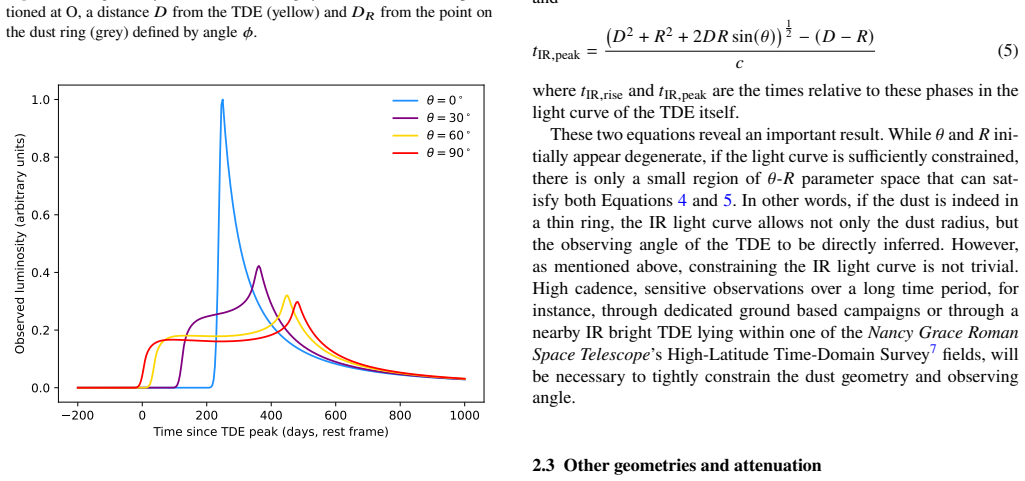
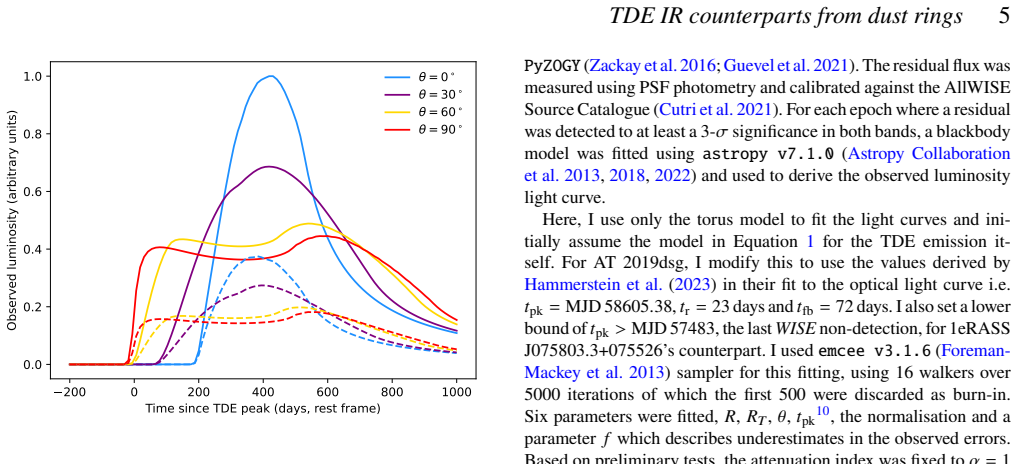
Arranging the dust in a ring geometry instead of a spherical shell produces an angular dependence in the infrared luminosity, with on-axis angles resulting in a brighter counterpart. On-axis angles also produce a delay in the initial rise while off-axis angles may display a double-peaked structure. The same model allows the observing angle of the tidal disruption event to be constrained from the infrared data.
What carries the argument
Toy model of dust reprocessing in a ring geometry that maps observer angle to infrared brightness, rise time, and light-curve shape.
If this is right
- On-axis angles produce brighter infrared counterparts than off-axis angles.
- On-axis angles produce a delay in the initial rise of the infrared light curve.
- Off-axis angles can produce a double-peaked infrared light curve.
- Infrared observations can be used to constrain the observing angle of the tidal disruption event.
- The model reproduces the light curves of two observed infrared counterparts and recovers an optical plateau phase.
Where Pith is reading between the lines
- Ring geometries may arise naturally from the equatorial concentration of debris in the disruption process.
- Simultaneous optical and infrared monitoring could test whether the inferred angles are consistent across wavelengths.
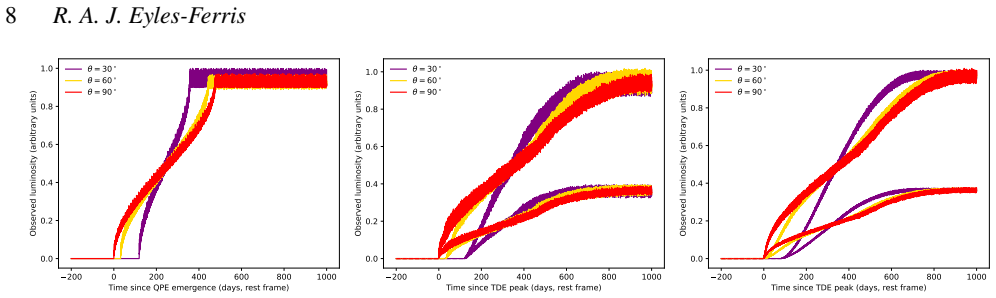
- The same ring-reprocessing framework could be applied to quasi-periodic eruption events to constrain their disk orientations.
Load-bearing premise
The dust that reprocesses the tidal disruption emission must be arranged in a ring geometry rather than a spherical shell.
What would settle it
Detection of an infrared counterpart whose peak luminosity is higher at large viewing angles than at small angles, or absence of any angle dependence in a sample of events with independent orientation indicators.
Figures



read the original abstract
A substantial fraction of tidal disruption events (TDEs), resulting from a black holes's disruption and accretion of a star, exhibit infrared (IR) counterparts thought to arise from spherical shells of dust reprocessing the TDE emission. Some modelling of TDEs also predicts an angular dependence in their observed properties with more X-ray emission on-axis and more optical emission at higher angles. However, there is growing evidence that X-ray rich TDEs are more likely to exhibit IR counterparts, contradicting the spherical shell model that predicts no significant variation in IR luminosity with angle. Here, I demonstrate that this result naturally follows for dust arranged in a ring instead of a spherical shell. I present a toy model of this scenario and show that on-axis angles result in a brighter counterpart. I also show that on-axis angles result in a delay in the initial rise and off-axis angles may display a double-peaked structure. Crucially, this model also allows the observing angle of the TDE to be constrained. Finally, I demonstrate that this model reproduces the properties of two IR counterparts, including constraining their observing angles and independently inferring an optical plateau, and briefly comment on its application to quasi-periodic eruption counterparts.
Editorial analysis
A structured set of objections, weighed in public.
Referee Report
Summary. The manuscript claims that dust arranged in a ring geometry (rather than a spherical shell) around tidal disruption events produces an angular dependence in the reprocessed infrared emission. A toy model is presented showing brighter IR counterparts on-axis, delayed rise times on-axis, and possible double-peaked light curves off-axis; this geometry is said to explain why X-ray-rich TDEs are more likely to show IR counterparts, to enable inference of the observing angle, and to reproduce the properties of two specific IR events (including independent inference of an optical plateau). Brief comments are made on application to quasi-periodic eruption counterparts.
Significance. If the toy model holds and its angle-dependent predictions are robust, the work would resolve an observed tension with spherical-shell reprocessing models and supply a practical geometric method for constraining TDE viewing angles from IR light curves. This could be useful for interpreting multi-wavelength TDE data and accretion-disk anisotropy.
major comments (2)
- [Abstract] Abstract: The central claims that the ring geometry produces brighter on-axis IR emission, delayed rise, double-peaked off-axis structure, and successful reproduction of two observed events (with angle constraints) depend on the specific implementation of the toy model. No equations, covering-fraction calculation, temperature or optical-depth assumptions, or validation against radiative-transfer effects are supplied, so it is impossible to determine whether the reported angle dependence is a general geometric consequence or an artifact of the unstated simplifications.
- [Abstract] Abstract: The assertion that the model independently infers an optical plateau for the two reproduced events requires the fitting procedure, parameter choices, and comparison data to be shown; without these it cannot be assessed whether the plateau inference is independent or degenerate with the IR modeling.
minor comments (1)
- [Abstract] Typo: 'black holes's' should read 'black hole's'.
Simulated Author's Rebuttal
We thank the referee for their thoughtful review and recommendations. We address each major comment in detail below, providing clarifications on the toy model implementation and the fitting procedures described in the manuscript.
read point-by-point responses
-
Referee: [Abstract] Abstract: The central claims that the ring geometry produces brighter on-axis IR emission, delayed rise, double-peaked off-axis structure, and successful reproduction of two observed events (with angle constraints) depend on the specific implementation of the toy model. No equations, covering-fraction calculation, temperature or optical-depth assumptions, or validation against radiative-transfer effects are supplied, so it is impossible to determine whether the reported angle dependence is a general geometric consequence or an artifact of the unstated simplifications.
Authors: The toy model is fully specified in Section 2 of the manuscript, where we provide the equations governing the dust ring geometry, the calculation of the covering fraction as a function of viewing angle, the assumed dust temperature distribution, and optical depth. The angle-dependent IR emission follows directly from the projected area of the ring illuminated by the central source, which is a geometric effect independent of the specific parameter choices within reasonable ranges. We discuss the limitations of the toy model and compare to basic radiative transfer expectations in Section 3 to confirm that the reported trends are robust geometric consequences rather than artifacts. revision: no
-
Referee: [Abstract] Abstract: The assertion that the model independently infers an optical plateau for the two reproduced events requires the fitting procedure, parameter choices, and comparison data to be shown; without these it cannot be assessed whether the plateau inference is independent or degenerate with the IR modeling.
Authors: Section 4 details the fitting procedure used to reproduce the two IR events, including the parameter choices for the ring radius, inclination, and dust properties. The comparison to observed light curves is shown in Figures 5 and 6. The inference of the optical plateau is derived solely from the timing and shape of the IR light curve under the ring model, without incorporating any optical data, making it independent. We have added a note in the revised manuscript clarifying this independence to avoid any ambiguity. revision: partial
Circularity Check
Toy model forward calculation from ring geometry shows no circular reduction
full rationale
The paper constructs a toy model of dust reprocessing in a ring geometry and derives angle-dependent IR brightness, rise delays, and possible double-peaked light curves directly from the assumed covering fraction, optical thickness, and uniform temperature. These outputs are presented as consequences of the geometry choice rather than fitted parameters renamed as predictions or results forced by self-citation. Reproduction of two observed IR counterparts is framed as a consistency check on the forward model, with no equations shown that equate the derived quantities back to the inputs by construction. The derivation chain remains self-contained against external benchmarks.
Axiom & Free-Parameter Ledger
axioms (1)
- domain assumption Dust is arranged in a ring geometry around the TDE rather than a spherical shell
Reference graph
Works this paper leans on
-
[1]
The Eleventh and Twelfth Data Releases of the Sloan Digital Sky Survey: Final Data from SDSS-III
The Eleventh and Twelfth Data Releases of the Sloan Digital Sky Survey: Final Data from SDSS-III. , keywords =. doi:10.1088/0067-0049/219/1/12 , archivePrefix =. 1501.00963 , primaryClass =
work page internal anchor Pith review Pith/arXiv arXiv doi:10.1088/0067-0049/219/1/12
-
[2]
doi:10.1146/annurev.aa.31.090193.002353 , journal =
Unified models for active galactic nuclei and quasars. , keywords =. doi:10.1146/annurev.aa.31.090193.002353 , adsurl =
-
[3]
Astropy: A Community Python Package for Astronomy
Astropy: A community Python package for astronomy. , keywords =. doi:10.1051/0004-6361/201322068 , archivePrefix =. 1307.6212 , primaryClass =
work page internal anchor Pith review Pith/arXiv arXiv doi:10.1051/0004-6361/201322068
-
[4]
The Astropy Project: Building an inclusive, open-science project and status of the v2.0 core package
The Astropy Project: Building an Open-science Project and Status of the v2.0 Core Package. , keywords =. doi:10.3847/1538-3881/aabc4f , archivePrefix =. 1801.02634 , primaryClass =
work page internal anchor Pith review Pith/arXiv arXiv doi:10.3847/1538-3881/aabc4f
-
[5]
The Astropy Project: Sustaining and Growing a Community-oriented Open-source Project and the Latest Major Release (v5.0) of the Core Package. , keywords =. doi:10.3847/1538-4357/ac7c74 , archivePrefix =. 2206.14220 , primaryClass =
work page internal anchor Pith review Pith/arXiv arXiv doi:10.3847/1538-4357/ac7c74
-
[6]
Radio Observations of an Ordinary Outflow from the Tidal Disruption Event AT2019dsg. , keywords =. doi:10.3847/1538-4357/ac110a , archivePrefix =. 2103.06299 , primaryClass =
-
[7]
Merger Driven or Internal Evolution? A New Morphological Study of Tidal Disruption Event Host Galaxies. arXiv e-prints , keywords =. doi:10.48550/arXiv.2602.06839 , archivePrefix =. 2602.06839 , primaryClass =
work page internal anchor Pith review Pith/arXiv arXiv doi:10.48550/arxiv.2602.06839
-
[8]
Hyperaccretion during tidal disruption events: weakly bound debris envelopes and jets
Hyperaccretion during Tidal Disruption Events: Weakly Bound Debris Envelopes and Jets. , keywords =. doi:10.1088/0004-637X/781/2/82 , archivePrefix =. 1312.5314 , primaryClass =
work page internal anchor Pith review Pith/arXiv arXiv doi:10.1088/0004-637x/781/2/82
-
[9]
VizieR Online Data Catalog: AllWISE Data Release (Cutri+ 2013)
2013
-
[10]
A unified model for tidal disruption events
A Unified Model for Tidal Disruption Events. , keywords =. doi:10.3847/2041-8213/aab429 , archivePrefix =. 1803.03265 , primaryClass =
work page internal anchor Pith review Pith/arXiv arXiv doi:10.3847/2041-8213/aab429 2041
-
[11]
Disentangling the independently controllable factors of variation by interacting with the world
Interstellar Dust Grains. , keywords =. doi:10.1146/annurev.astro.41.011802.094840 , archivePrefix =. astro-ph/0304489 , primaryClass =
work page internal anchor Pith review Pith/arXiv arXiv doi:10.1146/annurev.astro.41.011802.094840
-
[12]
AT 2020nov: Evidence for Disk Reprocessing in a Rare Tidal Disruption Event. , keywords =. doi:10.3847/1538-4357/adb974 , archivePrefix =. 2412.12991 , primaryClass =
-
[13]
Simulated optical light curves of super-Eddington tidal disruption events with ZEBRA flows. , keywords =. doi:10.1093/mnras/stac3073 , archivePrefix =. 2210.12168 , primaryClass =
-
[14]
Nine tidal disruption event candidates in eROSITA-DE DR1 discovered through supersoft X-ray selection. , keywords =. doi:10.1093/mnras/staf1329 , archivePrefix =. 2508.08389 , primaryClass =
-
[15]
emcee: The MCMC Hammer. , keywords =. doi:10.1086/670067 , archivePrefix =. 1202.3665 , primaryClass =
work page internal anchor Pith review Pith/arXiv arXiv doi:10.1086/670067
-
[16]
Tidal Disruption Events. , keywords =. doi:10.1146/annurev-astro-111720-030029 , archivePrefix =. 2104.14580 , primaryClass =
-
[17]
The population of tidal disruption events discovered with eROSITA. , keywords =. doi:10.1051/0004-6361/202553669 , archivePrefix =. 2504.08424 , primaryClass =
-
[18]
David Guevel and Griffin Hosseinzadeh and Azalee Bostroem and Colin J. Burke , title =. doi:10.5281/zenodo.4570234 , url =
-
[19]
Tidal Disruption Event Hosts Are Green and Centrally Concentrated: Signatures of a Post-merger System. , keywords =. doi:10.3847/2041-8213/abdcb4 , archivePrefix =. 2010.10738 , primaryClass =
-
[20]
The Final Season Reimagined: 30 Tidal Disruption Events from the ZTF-I Survey. , keywords =. doi:10.3847/1538-4357/aca283 , archivePrefix =. 2203.01461 , primaryClass =
-
[21]
The WISE Detection of an Infrared Echo in Tidal Disruption Event ASASSN-14li
The WISE Detection of an Infrared Echo in Tidal Disruption Event ASASSN-14li. , keywords =. doi:10.3847/2041-8205/828/1/L14 , archivePrefix =. 1605.04640 , primaryClass =
work page internal anchor Pith review Pith/arXiv arXiv doi:10.3847/2041-8205/828/1/l14 2041
-
[22]
Infrared Echoes of Optical Tidal Disruption Events: 1\. , keywords =. doi:10.3847/1538-4357/abe772 , archivePrefix =. 2102.08044 , primaryClass =
-
[23]
unWISE: unblurred coadds of the WISE imaging
unWISE: Unblurred Coadds of the WISE Imaging. , keywords =. doi:10.1088/0004-6256/147/5/108 , archivePrefix =. 1405.0308 , primaryClass =
work page internal anchor Pith review Pith/arXiv arXiv doi:10.1088/0004-6256/147/5/108
-
[24]
Repeating Flares, X-ray Outbursts and Delayed Infrared Emission: A Comprehensive Compilation of Optical Tidal Disruption Events. arXiv e-prints , keywords =. doi:10.48550/arXiv.2506.05476 , archivePrefix =. 2506.05476 , primaryClass =
-
[25]
Optical Polarimetry of the Tidal Disruption Event AT2019DSG. , keywords =. doi:10.3847/2041-8213/ab7cd3 , adsurl =
-
[26]
A., Schnurr O., Hirschi R., Yusof N., Parker R
Multiband light curves of tidal disruption events. , keywords =. doi:10.1111/j.1365-2966.2010.17448.x , archivePrefix =. 1008.4589 , primaryClass =
-
[27]
Infrared emission from tidal disruption events - probing the pc-scale dust content around galactic nuclei. , keywords =. doi:10.1093/mnras/stw307 , archivePrefix =. 1512.00020 , primaryClass =
work page internal anchor Pith review Pith/arXiv arXiv doi:10.1093/mnras/stw307
-
[28]
The Near-Earth Object Surveyor Mission. , keywords =. doi:10.3847/PSJ/ad0468 , archivePrefix =. 2310.12918 , primaryClass =
-
[29]
A New Population of Mid-infrared-selected Tidal Disruption Events: Implications for Tidal Disruption Event Rates and Host Galaxy Properties. , keywords =. doi:10.3847/1538-4357/ad18bb , archivePrefix =. 2401.01403 , primaryClass =
-
[30]
Preliminary Results from NEOWISE: An Enhancement to the Wide-field Infrared Survey Explorer for Solar System Science. , keywords =. doi:10.1088/0004-637X/731/1/53 , archivePrefix =. 1102.1996 , primaryClass =
work page internal anchor Pith review Pith/arXiv arXiv doi:10.1088/0004-637x/731/1/53 1996
-
[31]
What powers the radio emission in TDE AT2019dsg: A long-lived jet or the disruption itself?. , keywords =. doi:10.1093/mnras/stac382 , archivePrefix =. 2109.02648 , primaryClass =
-
[32]
Full-depth Coadds of the WISE and First-year NEOWISE-Reactivation Images
Full-depth Coadds of the WISE and First-year NEOWISE-reactivation Images. , keywords =. doi:10.3847/1538-3881/153/1/38 , archivePrefix =. 1603.05664 , primaryClass =
work page internal anchor Pith review Pith/arXiv arXiv doi:10.3847/1538-3881/153/1/38
-
[33]
Deep Full-sky Coadds from Three Years of WISE and NEOWISE Observations
Deep Full-sky Coadds from Three Years of WISE and NEOWISE Observations. , keywords =. doi:10.3847/1538-3881/aa894e , archivePrefix =. 1705.06746 , primaryClass =
work page internal anchor Pith review Pith/arXiv arXiv doi:10.3847/1538-3881/aa894e
-
[34]
Cooling Envelope Model for Tidal Disruption Events. , keywords =. doi:10.3847/2041-8213/ac90ba , archivePrefix =. 2207.07136 , primaryClass =
-
[35]
The spectral evolution of disc dominated tidal disruption events. , keywords =. doi:10.1093/mnras/staa192 , archivePrefix =. 1912.06577 , primaryClass =
-
[36]
2024, MNRAS, 527, 2452, doi: 10.1093/mnras/stad3001
Fundamental scaling relationships revealed in the optical light curves of tidal disruption events. , keywords =. doi:10.1093/mnras/stad3001 , archivePrefix =. 2308.08255 , primaryClass =
-
[37]
The optical, UV-plateau, and X-ray tidal disruption event luminosity functions reproduced from first principles. , keywords =. doi:10.1093/mnras/staf938 , archivePrefix =. 2410.17087 , primaryClass =
-
[38]
Tidal disruption event Calorimetry: Observational constraints on the physics of TDE optical flares. arXiv e-prints , keywords =. doi:10.48550/arXiv.2512.09143 , archivePrefix =. 2512.09143 , primaryClass =
-
[39]
Resolving the Nuclear Environments of Tidal Disruption Event Host Galaxies within 45 pc. , keywords =. doi:10.3847/1538-4357/ae1502 , archivePrefix =. 2510.18985 , primaryClass =
-
[40]
Using Infrared Dust Echoes to Identify Bright Quasi-periodic Eruption Sources. arXiv e-prints , keywords =. doi:10.48550/arXiv.2502.12078 , archivePrefix =. 2502.12078 , primaryClass =
-
[41]
Planck 2018 results. VI. Cosmological parameters. , keywords =. doi:10.1051/0004-6361/201833910 , archivePrefix =. 1807.06209 , primaryClass =
work page internal anchor Pith review Pith/arXiv arXiv doi:10.1051/0004-6361/201833910 2018
-
[42]
Tidal Disruption Events through the Lens of the Cooling Envelope Model. , keywords =. doi:10.3847/2041-8213/ad16d8 , archivePrefix =. 2307.15121 , primaryClass =
-
[43]
Dynamical Unification of Tidal Disruption Events. , keywords =. doi:10.3847/2041-8213/ac911f , archivePrefix =. 2206.02804 , primaryClass =
-
[44]
Positive AGN Feedback Enhances Star Formation in Starburst Dwarf Galaxies
Positive AGN Feedback Enhances Star Formation in Starburst Dwarf Galaxies. arXiv e-prints , keywords =. doi:10.48550/arXiv.2510.20897 , archivePrefix =. 2510.20897 , primaryClass =
work page internal anchor Pith review Pith/arXiv arXiv doi:10.48550/arxiv.2510.20897
-
[45]
Super-Eddington Chimneys: On the Cooling Evolution of Tidal Disruption Event Envelopes. arXiv e-prints , keywords =. doi:10.48550/arXiv.2512.14810 , archivePrefix =. 2512.14810 , primaryClass =
-
[46]
Discovery of transient infrared emission from dust heated by stellar tidal disruption flares
Discovery of Transient Infrared Emission from Dust Heated by Stellar Tidal Disruption Flares. , keywords =. doi:10.3847/0004-637X/829/1/19 , archivePrefix =. 1605.04304 , primaryClass =
work page internal anchor Pith review Pith/arXiv arXiv doi:10.3847/0004-637x/829/1/19
-
[47]
Seventeen Tidal Disruption Events from the First Half of ZTF Survey Observations: Entering a New Era of Population Studies. , keywords =. doi:10.3847/1538-4357/abc258 , archivePrefix =. 2001.01409 , primaryClass =
-
[48]
Reverberation in Tidal Disruption Events: Dust Echoes, Coronal Emission Lines, Multi-wavelength Cross-correlations, and QPOs. , keywords =. doi:10.1007/s11214-021-00835-6 , archivePrefix =. 2107.12268 , primaryClass =
-
[49]
Interpretation of the Observed Neutrino Emission from Three Tidal Disruption Events. , keywords =. doi:10.3847/1538-4357/acbe9e , archivePrefix =. 2205.11538 , primaryClass =
-
[50]
The Wide-field Infrared Survey Explorer (WISE): Mission Description and Initial On-orbit Performance
The Wide-field Infrared Survey Explorer (WISE): Mission Description and Initial On-orbit Performance. , keywords =. doi:10.1088/0004-6256/140/6/1868 , archivePrefix =. 1008.0031 , primaryClass =
work page internal anchor Pith review Pith/arXiv arXiv doi:10.1088/0004-6256/140/6/1868
-
[51]
A Torus Remnant Revealed by the Infrared Echo of Tidal Disruption Event AT 2019qiz: Implications for the Missing Energy and Quasiperiodic Eruption Formation. , keywords =. doi:10.3847/2041-8213/adf229 , archivePrefix =. 2507.13251 , primaryClass =
-
[52]
Proper image subtraction - optimal transient detection, photometry and hypothesis testing
Proper Image Subtraction Optimal Transient Detection, Photometry, and Hypothesis Testing. , keywords =. doi:10.3847/0004-637X/830/1/27 , archivePrefix =. 1601.02655 , primaryClass =
work page internal anchor Pith review Pith/arXiv arXiv doi:10.3847/0004-637x/830/1/27
-
[53]
Do AGN outflows quench or enhance star formation?
Do AGN outflows quench or enhance star formation?. , keywords =. doi:10.1093/mnras/stx787 , archivePrefix =. 1703.10782 , primaryClass =
work page internal anchor Pith review Pith/arXiv arXiv doi:10.1093/mnras/stx787
discussion (0)
Sign in with ORCID, Apple, or X to comment. Anyone can read and Pith papers without signing in.