EMU discovery of Thunder: a bow-shock PWN powered by PSR J1631-4722 escaping Nimbus SNR (G336.7+0.5)
Pith reviewed 2026-06-26 10:21 UTC · model grok-4.3
The pith
A bow-shock pulsar wind nebula called Thunder is discovered inside the supernova remnant Nimbus, aged 30-45 kyr.
A machine-rendered reading of the paper's core claim, the machinery that carries it, and where it could break.
Core claim
The central claim is that the Nimbus-Thunder system has an age of approximately 30-45 kyr based on the observed morphology of the bow-shock PWN, its radio and X-ray properties, and evolutionary models, locating the SNR in the late Sedov phase nearing the transition to the radiative stage.
What carries the argument
The bow-shock morphology of the PWN Thunder and the multiwavelength properties of the Nimbus-Thunder system, combined with evolutionary models to constrain the age.
If this is right
- The PWN has a magnetic field strength estimated at 54-140 μG via equipartition.
- The pulsar shows strong timing noise and a small spin glitch of amplitude 1.10×10^{-8}.
- The SNR lacks a clear diffuse X-ray counterpart.
- The radio spectrum is flat with α = -0.27 ± 0.05 and X-ray photon index Γ = 1.6 ± 0.4.
Where Pith is reading between the lines
- Confirmation of the physical association could come from measuring the pulsar's proper motion matching the nebula's orientation.
- This system may serve as a template for identifying other bow-shock PWNe in radio surveys.
- Models of SNR evolution could be tested by searching for similar systems at comparable ages.
Load-bearing premise
The distance to the system is assumed to be 7 kpc to convert angular sizes to physical sizes and to estimate the age.
What would settle it
An independent distance measurement to the pulsar or remnant that differs substantially from 7 kpc would invalidate the physical size and age calculations.
Figures





read the original abstract
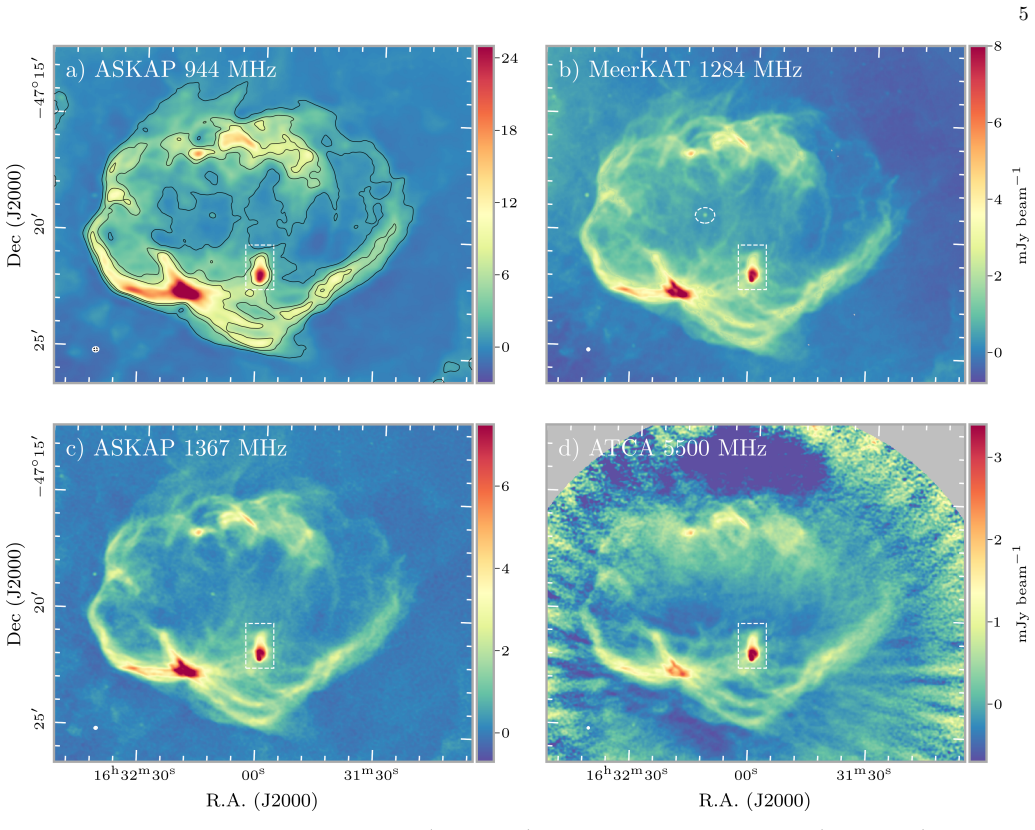
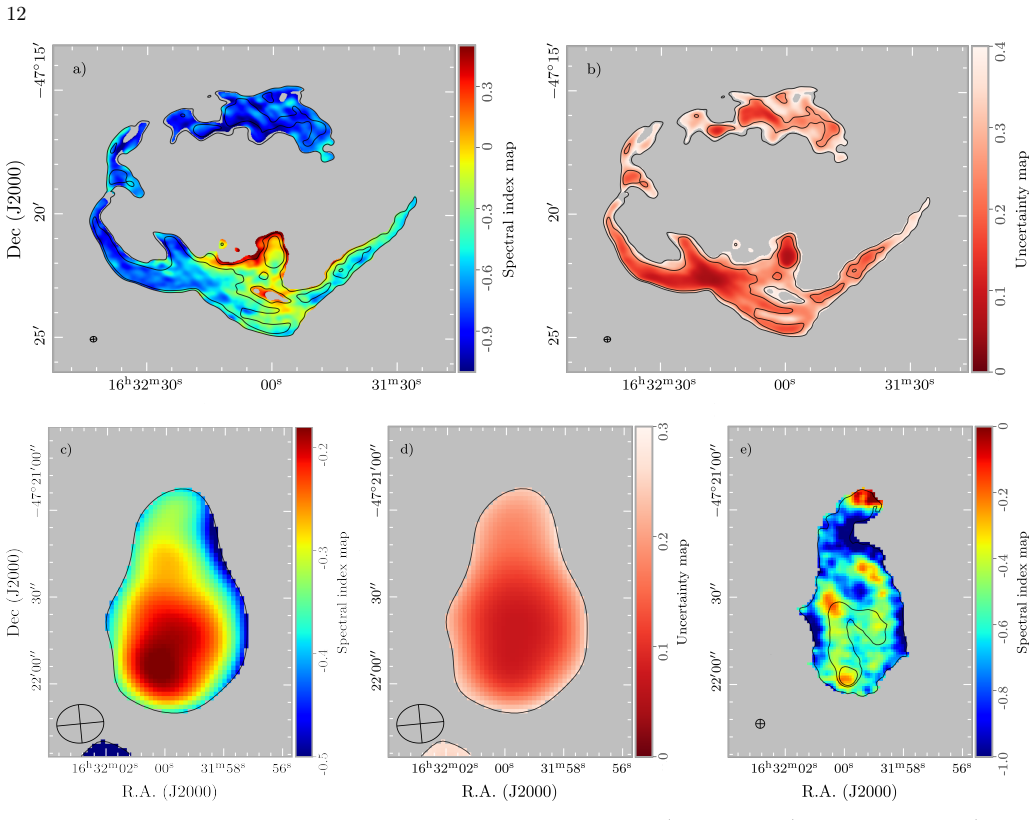
We report the discovery of a bow-shock pulsar wind nebula (PWN), dubbed Thunder, powered by the radio pulsar PSR J1631-4722 and projected within the Galactic supernova remnant (SNR) G336.7+0.5 (Nimbus). The system was first identified in observations from the Australian Square Kilometre Array Pathfinder (ASKAP) Evolutionary Map of the Universe (EMU) survey and further characterised using MeerKAT Galactic Plane Survey data together with follow-up observations at 5.5 and 9 GHz obtained with the Australia Telescope Compact Array (ATCA). Assuming a distance of 7 kpc, the radio images resolve an elongated ~80 arcsec (2.7 pc) cometary nebula, indicative of a high velocity pulsar. An X-ray counterpart extending ~50 arcsec (1.7 pc) is detected in archival XMM-Newton data. The flat radio spectrum ($\alpha$ = -0.27 $\pm$ 0.05) and hard X-ray photon index ($\Gamma$ = 1.6 $\pm$ 0.4) indicate synchrotron emission from relativistic particles injected in the pulsar wind. Polarisation analysis reveals a highly ordered magnetic field aligned with the nebular flow, with fractional polarisation reaching up to 30% in the tail. An equipartition estimate gives a PWN magnetic-field strength of Beq $\approx$ 54-140 $\mu$G. Pulsar timing over a ~2.2 yr baseline reveals strong timing noise and a small spin glitch with amplitude $\Delta{\nu}/{\nu}$ = 1.10$\times$10$^{-8}$. The SNR shows no clear diffuse X-ray counterpart. The morphology and multiwavelength properties of the Nimbus-Thunder system, along with evolutionary models, constrain the system's age to approximately 30-45 kyr, placing the remnant in the late Sedov phase, approaching the transition to the radiative stage.
Editorial analysis
A structured set of objections, weighed in public.
Referee Report
Summary. The manuscript reports the discovery of a bow-shock pulsar wind nebula (PWN) dubbed Thunder, powered by PSR J1631-4722 and projected within SNR G336.7+0.5 (Nimbus). Identified in ASKAP EMU radio survey data and characterized with MeerKAT, ATCA (5.5/9 GHz), and archival XMM-Newton X-ray observations, the system shows an elongated ~80 arcsec cometary radio nebula, ~50 arcsec X-ray extension, flat radio spectrum (α = -0.27 ± 0.05), hard X-ray index (Γ = 1.6 ± 0.4), ordered polarization (up to 30% in tail), equipartition B-field ~54-140 μG, pulsar timing noise plus a small glitch, and no clear SNR diffuse X-ray emission. Assuming d = 7 kpc, evolutionary models constrain the system age to ~30-45 kyr (late Sedov phase).
Significance. If the identification holds, this adds a well-characterized bow-shock PWN-SNR association to the sample, with consistent multi-instrument morphology and spectra supporting the synchrotron PWN interpretation and high-velocity pulsar scenario. The polarization data provide direct evidence for ordered magnetic field alignment with the flow. The timing results (glitch and noise) are additional pulsar characterization. The age constraint is an interpretive result rather than core to the discovery claim.
major comments (1)
- [Abstract] Abstract: The age constraint of 30-45 kyr is derived from morphology plus evolutionary models after converting angular sizes to physical sizes (2.7 pc nebula, 1.7 pc X-ray) at the assumed distance of 7 kpc. Because Sedov-phase age scales roughly as d^{5/2}, this assumption is load-bearing for the quoted age range and late-Sedov interpretation; no independent distance indicator (parallax, HI absorption, or kinematic) is referenced, and the noted absence of SNR X-ray emission is not used to test or bound the distance.
minor comments (2)
- [Abstract] Abstract: No details are provided on data reduction, background subtraction, flux calibration, or error analysis for the radio (ASKAP/MeerKAT/ATCA) or X-ray (XMM-Newton) measurements; these should be summarized even at abstract level or clearly referenced to methods sections.
- [Abstract] Abstract: The equipartition B-field range (54-140 μG) is stated without reference to the exact assumptions (e.g., volume, filling factor, or frequency cutoffs) used in the calculation; this should be clarified or moved to a dedicated methods paragraph.
Simulated Author's Rebuttal
We thank the referee for their constructive review and recommendation of minor revision. We address the single major comment below.
read point-by-point responses
-
Referee: [Abstract] Abstract: The age constraint of 30-45 kyr is derived from morphology plus evolutionary models after converting angular sizes to physical sizes (2.7 pc nebula, 1.7 pc X-ray) at the assumed distance of 7 kpc. Because Sedov-phase age scales roughly as d^{5/2}, this assumption is load-bearing for the quoted age range and late-Sedov interpretation; no independent distance indicator (parallax, HI absorption, or kinematic) is referenced, and the noted absence of SNR X-ray emission is not used to test or bound the distance.
Authors: The distance of 7 kpc is adopted as a standard assumption for this line of sight in the absence of a parallax measurement for PSR J1631-4722. We agree that this choice directly affects the physical sizes and thus the derived age range via the Sedov scaling. We will revise the abstract and discussion sections to (i) explicitly note the assumption and its d^{5/2} dependence, (ii) quote the age as approximate with the corresponding uncertainty range if the distance varies by ±1 kpc, and (iii) state that the non-detection of diffuse SNR X-ray emission is consistent with a late-Sedov age but is not used as a distance bound because of unknown ambient density and column density. These clarifications address the load-bearing nature of the assumption without altering the core discovery claims. revision: yes
Circularity Check
No significant circularity; age estimate uses explicit external assumption and standard models
full rationale
The paper states an explicit distance assumption of 7 kpc to derive physical sizes from angular measurements, then applies evolutionary models to obtain the 30-45 kyr age range. This is a standard forward calculation with an input parameter, not a reduction by construction. No self-definitional steps, fitted parameters renamed as predictions, or load-bearing self-citations appear in the abstract or described chain. Observational results (morphology, spectrum, polarization, timing) stand independently of the age modeling.
Axiom & Free-Parameter Ledger
free parameters (1)
- distance =
7 kpc
axioms (2)
- domain assumption Synchrotron emission from relativistic particles in PWNe produces flat radio spectra and hard X-ray spectra
- domain assumption Evolutionary models of SNR-PWN systems can constrain age from morphology and multi-wavelength properties
Reference graph
Works this paper leans on
-
[1]
2025, MNRAS, 537, 2868, doi: 10.1093/mnras/staf181
Ahmad, A., Dai, S., Lazarević, S., et al. 2025, MNRAS, 537, 2868, doi: 10.1093/mnras/staf181
-
[2]
Alsaberi, R. Z. E., Filipović, M. D., Sano, H., et al. 2025, PASA, 42, e069, doi: 10.1017/pasa.2025.10025 23
-
[3]
D., Camilo, F., Faerber, T., et al
Anderson, L. D., Camilo, F., Faerber, T., et al. 2025, A&A, 693, A247, doi: 10.1051/0004-6361/202451038
-
[4]
Arnaud, K. A. 1996, in Astronomical Society of the Pacific Conference Series, Vol. 101, Astronomical Data Analysis Software and Systems V, ed. G. H. Jacoby & J. Barnes, 17 Astropy Collaboration, Robitaille, T. P., Tollerud, E. J., et al. 2013, A&A, 558, A33, doi: 10.1051/0004-6361/201322068
-
[5]
D., Kothes, R., Rosolowsky, E., et al
Ball, B. D., Kothes, R., Rosolowsky, E., et al. 2023, MNRAS, 524, 1396, doi: 10.1093/mnras/stad1953
-
[6]
D., Kothes, R., Rosolowsky, E., et al
Ball, B. D., Kothes, R., Rosolowsky, E., et al. 2025, ApJ, 988, 75, doi: 10.3847/1538-4357/addc63
-
[7]
Torres, D. F. 2020, MNRAS, 499, 2051, doi: 10.1093/mnras/staa2956
-
[8]
Torres, D. F. 2023, MNRAS, 520, 2451, doi: 10.1093/mnras/stad134
-
[9]
V., Lyutikov, M., & Khangulyan, D
Barkov, M. V., Lyutikov, M., & Khangulyan, D. 2019, MNRAS, 484, 4760, doi: 10.1093/mnras/stz213
-
[10]
Bell, A. R. 1978, Monthly Notices of the Royal Astronomical Society, 182, 147, doi: 10.1093/mnras/182.2.147
-
[11]
Blondin, J. M., Chevalier, R. A., & Frierson, D. M. 2001, ApJ, 563, 806, doi: 10.1086/324042
-
[12]
2000, A&AS, 143, 33, doi: 10.1051/aas:2000331
Bonnarel, F., Fernique, P., Bienaymé, O., et al. 2000, A&AS, 143, 33, doi: 10.1051/aas:2000331
-
[13]
2025, A&A, 695, A144, doi: 10.1051/0004-6361/202450356
Bordiu, C., Riggi, S., Bufano, F., et al. 2025, A&A, 695, A144, doi: 10.1051/0004-6361/202450356
-
[14]
Borkowski, K. J., Lyerly, W. J., & Reynolds, S. P. 2001, ApJ, 548, 820, doi: 10.1086/319011
-
[15]
2002, A&A, 393, 629, doi: 10.1051/0004-6361:20020968
Bucciantini, N. 2002, A&A, 393, 629, doi: 10.1051/0004-6361:20020968
-
[16]
Radio detection of supernova remnant G310.7-5.4 with $\gamma$-ray counterpart: Abeona SNR
Burger-Scheidlin, C., Ball, B. D., Lazarević, S., et al. 2026, arXiv e-prints, arXiv:2604.19897, doi: 10.48550/arXiv.2604.19897
work page internal anchor Pith review Pith/arXiv arXiv doi:10.48550/arxiv.2604.19897 2026
-
[17]
Burn, B. J. 1966, MNRAS, 133, 67, doi: 10.1093/mnras/133.1.67
-
[18]
and Bhattacharya, Dipen , number =
Case, G. L., & Bhattacharya, D. 1998, ApJ, 504, 761, doi: 10.1086/306089
-
[19]
2021, CARTA: The Cube Analysis and Rendering Tool for Astronomy, 2.0.0, Zenodo Zenodo
Comrie, A., Wang, K.-S., Hsu, S.-C., et al. 2021, CARTA: The Cube Analysis and Rendering Tool for Astronomy, 2.0.0, Zenodo Zenodo
2021
-
[20]
NE2001.I. A New Model for the Galactic Distribution of Free Electrons and its Fluctuations
Cordes, J. M., & Lazio, T. J. W. 2002, arXiv e-prints, astro, doi: 10.48550/arXiv.astro-ph/0207156
work page internal anchor Pith review Pith/arXiv arXiv doi:10.48550/arxiv.astro-ph/0207156 2002
-
[21]
Dai, S., Hobbs, G., Manchester, R. N., et al. 2015, MNRAS, 449, 3223, doi: 10.1093/mnras/stv508
-
[22]
M., Hartmann, D., & Thaddeus, P
Dame, T. M., Hartmann, D., & Thaddeus, P. 2001, ApJ, 547, 792, doi: 10.1086/318388 De Sarkar, A., Torres, D. F., Olmi, B., Bucciantini, N., &
work page internal anchor Pith review doi:10.1086/318388 2001
-
[23]
Meyer, D. M.-A. 2026, arXiv e-prints, arXiv:2605.15359, doi: 10.48550/arXiv.2605.15359
work page internal anchor Pith review Pith/arXiv arXiv doi:10.48550/arxiv.2605.15359 2026
-
[24]
IXPE Polarizations of the Lighthouse Pulsar, Trail, and Filament
Dinsmore, J. T., Romani, R. W., Zhang, S., et al. 2026, arXiv e-prints, arXiv:2604.22914, doi: 10.48550/arXiv.2604.22914
work page internal anchor Pith review Pith/arXiv arXiv doi:10.48550/arxiv.2604.22914 2026
-
[25]
Dokara, R., Brunthaler, A., Menten, K. M., et al. 2021, A&A, 651, A86, doi: 10.1051/0004-6361/202039873
-
[26]
2017, Handbook of Supernovae (Springer), doi: 10.1007/978-3-319-21846-5_91 Ferrière, K., West, J
Dubner, G. 2017, Handbook of Supernovae (Springer), doi: 10.1007/978-3-319-21846-5_91 Ferrière, K., West, J. L., & Jaffe, T. R. 2021, MNRAS, 507, 4968, doi: 10.1093/mnras/stab1641 Filipović, M. D., & Tothill, N. F. H., eds. 2021, Multimessenger Astronomy in Practice (IOP Publishing), doi: 10.1088/2514-3433/ac2256 Filipović, M. D., Dai, S., Arbutina, B., e...
-
[27]
Fiocchi, M., Bazzano, A., Bird, A. J., et al. 2013, ApJ, 762, 19, doi: 10.1088/0004-637X/762/1/19
-
[28]
Measuring Average Treatment Effect from Heavy-tailed Data
Gaensler, B. M., & Slane, P. O. 2006, ARA&A, 44, 17, doi: 10.1146/annurev.astro.44.051905.092528
work page internal anchor Pith review Pith/arXiv arXiv doi:10.1146/annurev.astro.44.051905.092528 2006
-
[29]
Gelfand, J. D. 2017, in Astrophysics and Space Science
2017
-
[30]
446, Modelling Pulsar Wind Nebulae, ed
Library, Vol. 446, Modelling Pulsar Wind Nebulae, ed. D. F. Torres, 161, doi: 10.1007/978-3-319-63031-1_8
-
[31]
D., Ng, C.-Y., Posselt, B., et al
Gelfand, J. D., Ng, C.-Y., Posselt, B., et al. 2025, The Open Journal of Astrophysics, 8, 54247, doi: 10.33232/001c.154247
-
[32]
Ghavam, M., Smeaton, Z. J., Filipović, M. D., et al. 2025, Serbian Astronomical Journal, 211, 27, doi: 10.2298/SAJ2511027G
-
[33]
Goedhart, S., Cotton, W. D., Camilo, F., et al. 2024, MNRAS, 531, 649, doi: 10.1093/mnras/stae1166
-
[34]
Goedhart, S., Cotton, W., Camilo, F., et al. 2024, The SARAO MeerKAT 1.3 GHz Galactic Plane Survey, South African Radio Astronomy Observatory, doi: 10.48479/3WFD-E270
-
[35]
Green, D. A. 2025, Journal of Astrophysics and Astronomy, 46, 14, doi: 10.1007/s12036-024-10038-4
-
[36]
Guzman, J., Whiting, M., Voronkov, M., et al. 2019, ASKAPsoft: ASKAP science data processor software„ Astrophysics Source Code Library: 1912.003 doi: 10.25919/5cca3787a6353 HI4PI Collaboration, Ben Bekhti, N., Flöer, L., et al. 2016, A&A, 594, A116, doi: 10.1051/0004-6361/201629178
-
[37]
Hobbs, G., Manchester, R. N., Dunning, A., et al. 2020, PASA, 37, e012, doi: 10.1017/pasa.2020.2 24
-
[38]
J., Groves, B., Kauffmann, G., & Heckman, T
Hobbs, G. B., Edwards, R. T., & Manchester, R. N. 2006, MNRAS, 369, 655, doi: 10.1111/j.1365-2966.2006.10302.x
-
[39]
2025, PASA, 42, e071, doi: 10.1017/pasa.2025.10042
Hopkins, A., Kapinska, A., Marvil, J., et al. 2025, PASA, 42, e071, doi: 10.1017/pasa.2025.10042
-
[40]
Hotan, A., Whiting, M., Huynh, M., & Moss, V. 2020, ASKAP Data Products for Project AS113 (Other ASKAP pilot science including tests, TOOs or guest observations): images and visibilities, http://hdl.handle.net/102.100.100/348893?index=1
2020
-
[41]
W., van Straten, W., & Manchester, R
Hotan, A. W., van Straten, W., & Manchester, R. N. 2004, PASA, 21, 302, doi: 10.1071/AS04022
-
[42]
Hotan, A. W., Bunton, J. D., Chippendale, A. P., et al. 2021, PASA, 38, e009, doi: 10.1017/pasa.2021.1
-
[43]
Hutschenreuter, S., Anderson, C. S., Betti, S., et al. 2022, A&A, 657, A43, doi: 10.1051/0004-6361/202140486
-
[44]
Jing, W., West, J. L., Sun, X., et al. 2025, ApJ, 980, 162, doi: 10.3847/1538-4357/adad66
-
[45]
2016, in MeerKAT Science: On the Pathway to the SKA, 1, doi: 10.22323/1.277.0001
Jonas, J., & MeerKAT Team. 2016, in MeerKAT Science: On the Pathway to the SKA, 1, doi: 10.22323/1.277.0001
-
[46]
A., & Mandel, E
Joye, W. A., & Mandel, E. 2003, in Astronomical Society of the Pacific Conference Series, Vol. 295, Astronomical Data Analysis Software and Systems XII, ed. H. E
2003
-
[47]
Kargaltsev, O., Misanovic, Z., Pavlov, G. G., Wong, J. A., & Garmire, G. P. 2008, ApJ, 684, 542, doi: 10.1086/589145
-
[48]
Kargaltsev, O., & Pavlov, G. G. 2008, in AIP Conf. Ser., Vol. 983, 40 Years of Pulsars: Millisecond Pulsars, Magnetars and More, 171–185, doi: 10.1063/1.2900138
-
[49]
G., Klingler, N., & Rangelov, B
Kargaltsev, O., Pavlov, G. G., Klingler, N., & Rangelov, B. 2017, Journal of Plasma Physics, 83, 635830501, doi: 10.1017/S0022377817000630
-
[50]
Klingler, N., Kargaltsev, O., Pavlov, G. G., et al. 2018, ApJ, 861, 5, doi: 10.3847/1538-4357/aac6e0
-
[51]
Klingler, N., Kargaltsev, O., Pavlov, G. G., et al. 2022, ApJ, 932, 89, doi: 10.3847/1538-4357/ac6ac6
-
[52]
Kothes, R. 2017, in Astrophys. Space Sci. Libr, Vol. 446, Modelling PWNe, 1, doi: 10.1007/978-3-319-63031-1_1
-
[53]
Kothes, R., & Dougherty, S. M. 2007, A&A, 468, 993, doi: 10.1051/0004-6361:20077309
-
[54]
2020, MNRAS, 496, 723, doi: 10.1093/mnras/staa1573
Kothes, R., Reich, W., Safi-Harb, S., et al. 2020, MNRAS, 496, 723, doi: 10.1093/mnras/staa1573
-
[55]
2006, ApJ, 638, 225, doi: 10.1086/498666
Kothes, R., Reich, W., & Uyanıker, B. 2006, ApJ, 638, 225, doi: 10.1086/498666
-
[56]
2024, Nature Astronomy, 8, 1284, doi: 10.1038/s41550-024-02337-1
Bordas, P. 2024, Nature Astronomy, 8, 1284, doi: 10.1038/s41550-024-02337-1
-
[57]
J., Eichhorn, G., Accomazzi, A., et al
Kurtz, M. J., Eichhorn, G., Accomazzi, A., et al. 2000, A&AS, 143, 41, doi: 10.1051/aas:2000170
-
[58]
Neutron Star Kicks and Supernova Asymmetry
Lai, D. 2004, in Cosmic explosions in three dimensions, ed. P. Höflich, P. Kumar, & J. C. Wheeler, 276, doi: 10.48550/arXiv.astro-ph/0312542 Lazarević, S., Filipović, M. D., Dai, S., et al. 2024, PASA, 41, e032, doi: 10.1017/pasa.2024.13
work page internal anchor Pith review Pith/arXiv arXiv doi:10.48550/arxiv.astro-ph/0312542 2004
-
[59]
2019, AJ, 158, 149, doi: 10.3847/1538-3881/ab3d2c
Leahy, D., Wang, Y., Lawton, B., Ranasinghe, S., & Filipović, M. 2019, AJ, 158, 149, doi: 10.3847/1538-3881/ab3d2c
-
[60]
Leahy, D. A. 2017, ApJ, 837, 36, doi: 10.3847/1538-4357/aa60c1
-
[61]
A., Ranasinghe, S., & Gelowitz, M
Leahy, D. A., Ranasinghe, S., & Gelowitz, M. 2020, ApJS, 248, 16, doi: 10.3847/1538-4365/ab8bd9
-
[62]
Leahy, D. A., & Williams, J. E. 2017, AJ, 153, 239, doi: 10.3847/1538-3881/aa6af6
-
[63]
2005, The Interstellar Medium (Springer), doi: 10.1007/b137959
Lequeux, J. 2005, The Interstellar Medium (Springer), doi: 10.1007/b137959
-
[64]
Livingstone, M. A., Kaspi, V. M., & Gavriil, F. P. 2005, ApJ, 633, 1095, doi: 10.1086/491643
-
[65]
Loi, F., Brienza, M., Riseley, C. J., et al. 2023, A&A, 672, A28, doi: 10.1051/0004-6361/202245640
-
[66]
E., Johnston, S., Dunn, L., et al
Lower, M. E., Johnston, S., Dunn, L., et al. 2021, MNRAS, 508, 3251, doi: 10.1093/mnras/stab2678
-
[67]
Ma, Y. K., Ng, C. Y., Bucciantini, N., et al. 2016, ApJ, 820, 100, doi: 10.3847/0004-637X/820/2/100
-
[68]
Manchester, R. N., Hobbs, G. B., Teoh, A., & Hobbs, M. 2005, AJ, 129, 1993, doi: 10.1086/428488
work page internal anchor Pith review doi:10.1086/428488 2005
-
[69]
2024, A&A, 682, A34, doi: 10.1051/0004-6361/202347165
Merloni, A., Lamer, G., Liu, T., et al. 2024, A&A, 682, A34, doi: 10.1051/0004-6361/202347165
work page internal anchor Pith review doi:10.1051/0004-6361/202347165 2024
-
[70]
Migliazzo, J. M., Gaensler, B. M., Backer, D. C., et al. 2002, ApJL, 567, L141, doi: 10.1086/340002
-
[71]
Milisavljevic, D., & Fesen, R. A. 2017, The Supernova - Supernova Remnant Connection (Springer), 2211, doi: 10.1007/978-3-319-21846-5_97
-
[72]
M., Papamastorakis, J., Boumis, P., & Goudis, C
Misiriotis, A., Xilouris, E. M., Papamastorakis, J., Boumis, P., & Goudis, C. D. 2006, A&A, 459, 113, doi: 10.1051/0004-6361:20054618
-
[73]
Mitchell, A. M. W., & Gelfand, J. 2022, in Handbook of X-ray and Gamma-ray Astrophysics, ed. C. Bambi & A. Sangangelo (Springer), 61, doi: 10.1007/978-981-16-4544-0_157-1
-
[74]
Y., Bucciantini, N., Gaensler, B
Ng, C. Y., Bucciantini, N., Gaensler, B. M., et al. 2012, ApJ, 746, 105, doi: 10.1088/0004-637X/746/1/105
-
[75]
Ng, C. Y., Gaensler, B. M., Chatterjee, S., & Johnston, S. 2010, ApJ, 712, 596, doi: 10.1088/0004-637X/712/1/596
-
[76]
2019, ASKAP Data Products for Project AS101 (ASKAP Pilot Survey for EMU): images and visibilities, http://hdl.handle.net/102.100.100/164553?index=1
Norris, R., Filipovic, M., Huynh, M., et al. 2019, ASKAP Data Products for Project AS101 (ASKAP Pilot Survey for EMU): images and visibilities, http://hdl.handle.net/102.100.100/164553?index=1
2019
-
[77]
Norris, R., Marvil, J., Collier, J. D., et al. 2021, PASA, 38, e046, doi: 10.1017/pasa.2021.42 25
-
[78]
2019a, MNRAS, 488, 5690, doi: 10.1093/mnras/stz2089
Olmi, B., & Bucciantini, N. 2019a, MNRAS, 488, 5690, doi: 10.1093/mnras/stz2089
-
[79]
2019b, MNRAS, 484, 5755, doi: 10.1093/mnras/stz382
Olmi, B., & Bucciantini, N. 2019b, MNRAS, 484, 5755, doi: 10.1093/mnras/stz382
-
[80]
H., & Walraven, T
Oort, J. H., & Walraven, T. 1956, BAN, 12, 285
1956
discussion (0)
Sign in with ORCID, Apple, or X to comment. Anyone can read and Pith papers without signing in.