Gotta light? Illuminating AGN disks with LISA EMRIs
Pith reviewed 2026-06-27 08:57 UTC · model grok-4.3
The pith
LISA can simultaneously estimate AGN disk surface density and accretion rate from EMRI signals using relativistic torque models in a Bayesian analysis.
A machine-rendered reading of the paper's core claim, the machinery that carries it, and where it could break.
Core claim
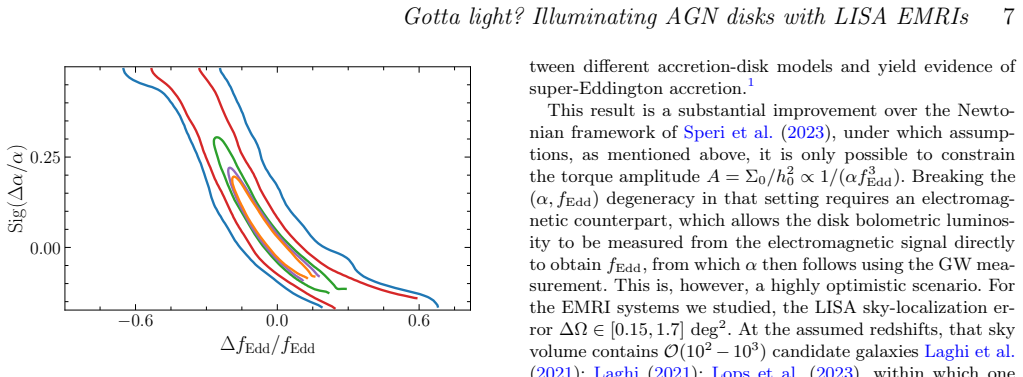
Using a fully Bayesian setup with relativistic models for the binary-disk interaction, LISA observations of EMRIs can provide simultaneous estimates of the disk surface density and the accretion rate without the need for an electromagnetic counterpart, with the torque amplitude constrained to within ~10%.
What carries the argument
Relativistic models of the torque exerted by the accretion disk on the EMRI, used inside a Bayesian likelihood for the gravitational-wave signal.
If this is right
- Simultaneous estimates of disk surface density and accretion rate are possible from LISA data alone.
- The torque amplitude is constrained to within approximately 10 percent for typical EMRIs.
- Accretion physics can be probed at submicroparsec scales in the strong-field regime.
- Host-galaxy identification via AGN catalogues improves the use of EMRIs as dark sirens.
- Questions about massive black hole growth and coevolution with galaxies receive additional constraints.
Where Pith is reading between the lines
- The method could be applied to multiple EMRIs to test consistency of inferred disk parameters across different systems.
- It provides an independent check on disk structure models even when electromagnetic data are absent or ambiguous.
- Future analyses might incorporate these torque constraints to refine predictions of EMRI event rates in AGN environments.
Load-bearing premise
The relativistic models accurately capture the torque acting on the EMRI across the relevant parameter space and the Bayesian likelihood fully incorporates all relevant noise and signal features.
What would settle it
An observation in which the joint posterior on surface density and accretion rate from LISA data is inconsistent with independent electromagnetic measurements of the same AGN's luminosity or density profile.
Figures

read the original abstract
We study the ability of the upcoming Laser Interferometer Space Antenna (LISA) to constrain gas torques acting on extreme-mass-ratio inspirals (EMRIs) when these are embedded in accretion disks, using recently developed relativistic models for the binary-disk interaction. Using a fully Bayesian setup, we find that, contrary to previous forecasts based on Newtonian results, these observations can provide simultaneous estimates of the disk surface density and the accretion rate (or, equivalently, its total luminosity) without the need for an electromagnetic counterpart. Our analysis also indicates that simpler measurement constraints based on the linear-signal (Fisher matrix) approximation are not valid for these systems. For typical EMRI observations, the torque amplitude can be constrained to within ~10%, strengthening the prospect of probing accretion physics at (sub)microparsec scales, deep in the strong-field gravity regime and complementing electromagnetic observations. This also strengthens LISA's ability to help answering questions such as how massive black holes grow and coevolve with their host galaxies and, by helping to identify the EMRI's host galaxy through cross-correlation with AGN catalogues, to improve the use of these sources as (dark) sirens for cosmology.
Editorial analysis
A structured set of objections, weighed in public.
Referee Report
Summary. The manuscript examines LISA's potential to constrain gas torques on EMRIs embedded in AGN disks via recently developed relativistic binary-disk interaction models. Employing a fully Bayesian framework, it concludes that simultaneous constraints on disk surface density and accretion rate (or luminosity) are achievable without an electromagnetic counterpart, that the torque amplitude can be recovered to ~10% precision for typical EMRIs, and that the linear-signal Fisher-matrix approximation is invalid for these systems. These results are positioned to probe sub-microparsec accretion physics in the strong-field regime and to aid both MBH-galaxy coevolution studies and cosmological applications via improved EMRI host-galaxy identification.
Significance. If the central claims hold, the work meaningfully expands LISA's science case by demonstrating an electromagnetic-independent route to accretion-disk parameters at scales inaccessible to other probes. The explicit use of a fully Bayesian setup with relativistic torque models, rather than Newtonian approximations or Fisher forecasts, is a clear methodological strength that directly addresses prior limitations. The ~10% torque-amplitude precision and the invalidity of the Fisher approximation are falsifiable predictions that, if confirmed, would strengthen LISA's role in addressing how massive black holes grow and coevolve with hosts while also improving dark-siren cosmology through AGN cross-correlation.
major comments (2)
- [§4] §4 (Results) and associated figures/tables: the reported ~10% constraint on torque amplitude and the simultaneous recovery of surface density and accretion rate are presented as quantitative outcomes, yet the text provides no explicit error budgets, recovery fractions from injection campaigns, or posterior-width comparisons against injected signals. This absence is load-bearing for the central claim that Bayesian LISA observations can deliver these constraints without an EM counterpart.
- [§3] §3 (Bayesian setup and likelihood construction): the assertion that the Fisher-matrix approximation is invalid rests on the Bayesian results, but no direct side-by-side comparison (e.g., Fisher-predicted uncertainties versus full posterior widths, or bias introduced by the linear-signal assumption) is shown for the same relativistic torque model and noise realization. Without this, the claim that simpler measurement constraints are not valid remains unquantified.
minor comments (2)
- Notation for the torque amplitude and disk parameters should be defined once in a dedicated table or equation block rather than reintroduced in multiple sections to improve readability.
- The manuscript would benefit from an explicit statement of the prior ranges adopted for the disk surface density and accretion rate, even if they are standard in the literature.
Simulated Author's Rebuttal
We thank the referee for their thoughtful review and constructive suggestions. We address each major comment below and will revise the manuscript accordingly to strengthen the quantitative support for our claims.
read point-by-point responses
-
Referee: [§4] §4 (Results) and associated figures/tables: the reported ~10% constraint on torque amplitude and the simultaneous recovery of surface density and accretion rate are presented as quantitative outcomes, yet the text provides no explicit error budgets, recovery fractions from injection campaigns, or posterior-width comparisons against injected signals. This absence is load-bearing for the central claim that Bayesian LISA observations can deliver these constraints without an EM counterpart.
Authors: We agree that the presentation of the quantitative results in §4 would be strengthened by explicit error budgets and recovery statistics. In the revised manuscript we will add a dedicated subsection (or expanded appendix) reporting recovery fractions from a set of injection campaigns, together with direct comparisons of posterior widths to the injected parameter values for the torque amplitude, surface density, and accretion rate. These additions will make the ~10% precision claim fully traceable to the underlying Bayesian runs. revision: yes
-
Referee: [§3] §3 (Bayesian setup and likelihood construction): the assertion that the Fisher-matrix approximation is invalid rests on the Bayesian results, but no direct side-by-side comparison (e.g., Fisher-predicted uncertainties versus full posterior widths, or bias introduced by the linear-signal assumption) is shown for the same relativistic torque model and noise realization. Without this, the claim that simpler measurement constraints are not valid remains unquantified.
Authors: We concur that a direct, quantitative comparison is needed to substantiate the statement that the linear-signal approximation is invalid. In the revised version we will include, in §3 or a new subsection of §4, a side-by-side table (or figure) that reports Fisher-matrix uncertainties alongside the corresponding full posterior widths for the same relativistic torque model, noise realization, and injected signals. This will explicitly quantify any bias or underestimation introduced by the Fisher approximation. revision: yes
Circularity Check
No significant circularity detected
full rationale
The paper's central claim rests on applying external relativistic models of binary-disk torques within a Bayesian framework to LISA EMRI signals. No load-bearing step reduces by the paper's own equations or self-citation to a fitted parameter or input quantity presented as a prediction. The derivation chain is self-contained against the cited external models and standard likelihood construction, with no self-definitional, renaming, or ansatz-smuggling patterns exhibited in the provided text.
Axiom & Free-Parameter Ledger
Reference graph
Works this paper leans on
-
[1]
G., et al., 2025a
Abac A. G., et al., 2025a
-
[2]
G., Abouelfettouh, I., Acernese, F., et al
Abac A. G., et al., 2025b, @doi [The Astrophysical Journal Letters] 10.3847/2041-8213/ae0c9c , 993, L25
-
[3]
Abramowicz M. A., Fragile P. C., 2013, @doi [Living Rev. Rel.] 10.12942/lrr-2013-1 , 16, 1
-
[4]
Abramowicz M. A., Czerny B., Lasota J. P., Szuszkiewicz E., 1988, @doi [ ] 10.1086/166683 , https://ui.adsabs.harvard.edu/abs/1988ApJ...332..646A 332, 646
-
[5]
M., Broggi L., Sesana A., Bonetti M., 2026
Allievi C. M., Broggi L., Sesana A., Bonetti M., 2026
2026
-
[6]
B., Gieles M., Mapelli M., 2025
Antonini F., Romero-Shaw I., Callister T., Dosopoulou F., Chattopadhyay D., Ginat Y. B., Gieles M., Mapelli M., 2025
2025
-
[8]
Artymowicz P., 1993b, @doi [ ] 10.1086/173469 , https://ui.adsabs.harvard.edu/abs/1993ApJ...419..155A 419, 155
-
[9]
J., Stern D., Noirot G., Jun H
Assef R. J., Stern D., Noirot G., Jun H. D., Cutri R. M., Eisenhardt P. R. M., 2018, @doi [ ] 10.3847/1538-4365/aaa00a , https://ui.adsabs.harvard.edu/abs/2018ApJS..234...23A 234, 23
-
[10]
Babak S., et al., 2017, @doi [Physical Review D] 10.1103/physrevd.95.103012 , 95
-
[11]
Barack L., Pound A., 2019, @doi [Rept. Prog. Phys.] 10.1088/1361-6633/aae552 , 82, 016904
-
[12]
Barausse E., Cardoso V., Pani P., 2014, @doi [Phys. Rev. D] 10.1103/PhysRevD.89.104059 , 89, 104059
-
[13]
Bardeen J. M., Petterson J. A., 1975, @doi [ ] 10.1086/181711 , https://ui.adsabs.harvard.edu/abs/1975ApJ...195L..65B 195, L65
-
[14]
C., Vajpeyi A., Burke O., 2025, ] 10.1103/9678-764y
Boumerdassi A., Edwards M. C., Vajpeyi A., Burke O., 2025, ] 10.1103/9678-764y
-
[15]
Burke O., Marsat S., Gair J. R., Katz M. L., 2025, @doi [Phys. Rev. D] 10.1103/5jr8-k2ss , 111, 124053
-
[16]
Burke O., Muratore M., Woan G., 2026, @doi [Phys. Rev. Applied] 10.1103/xpvf-syrw , 25, 034041
-
[17]
Cardoso V., Destounis K., Duque F., Macedo R. P., Maselli A., 2022a, @doi [Phys. Rev. D] 10.1103/PhysRevD.105.L061501 , 105, L061501
-
[18]
Cardoso V., Destounis K., Duque F., Panosso Macedo R., Maselli A., 2022b, @doi [Phys. Rev. Lett.] 10.1103/PhysRevLett.129.241103 , 129, 241103
-
[19]
J.] 10.3847/1538-4357/ae003b , 992, 120
Chakraborty J., et al., 2025, @doi [Astrophys. J.] 10.3847/1538-4357/ae003b , 992, 120
-
[20]
E., et al., 2025, @doi [Physical Review D] 10.1103/scbp-75pf , 112
Chapman-Bird C. E., et al., 2025, @doi [Physical Review D] 10.1103/scbp-75pf , 112
-
[21]
Astrophys.] 10.1051/0004-6361/202557029 , 707, A89
Chiesa A., Izquierdo-Villalba D., Sesana A., Cocchiararo F., Franchini A., Lupi A., Spinoso D., Bonoli S., 2026, @doi [Astron. Astrophys.] 10.1051/0004-6361/202557029 , 707, A89
-
[22]
S., Bertone G., Coogan A., Gaggero D., Karydas T., Kavanagh B
Cole P. S., Bertone G., Coogan A., Gaggero D., Karydas T., Kavanagh B. J., Spieksma T. F. M., Tomaselli G. M., 2023, @doi [Nature Astron.] 10.1038/s41550-023-01990-2 , 7, 943
-
[23]
S., Alvey J., Speri L., Weniger C., Bhardwaj U., Gerosa D., Bertone G., 2026, @doi [Phys
Cole P. S., Alvey J., Speri L., Weniger C., Bhardwaj U., Gerosa D., Bertone G., 2026, @doi [Phys. Rev. D] 10.1103/4cd3-wfjr , 113, 063030
-
[24]
Colpi M., et al., 2024, LISA Definition Study Report ( @eprint arXiv 2402.07571 ), https://arxiv.org/abs/2402.07571
Pith/arXiv arXiv 2024
-
[25]
S., Barausse E., 2025a
Copparoni L., Chandramouli R. S., Barausse E., 2025a
-
[26]
Copparoni L., Barausse E., Speri L., Sberna L., Derdzinski A., 2025b, @doi [Phys. Rev. D] 10.1103/PhysRevD.111.104079 , 111, 104079
-
[27]
W., Banagiri S., Delfavero V., Bustamante-Rosell M
Criswell A. W., Banagiri S., Delfavero V., Bustamante-Rosell M. J., Taylor S. R., Rosati R., 2026
2026
-
[28]
Deng S., Babak S., Le Jeune M., Marsat S., Plagnol \'E ., Sartirana A., 2025, @doi [Phys. Rev. D] 10.1103/PhysRevD.111.103014 , 111, 103014
-
[29]
Derdzinski A., Mayer L., 2023, @doi [Mon. Not. Roy. Astron. Soc.] 10.1093/mnras/stad749 , 521, 4522
-
[30]
Derdzinski A., D'Orazio D., Duffell P., Haiman Z., MacFadyen A., 2021, @doi [Mon. Not. Roy. Astron. Soc.] 10.1093/mnras/staa3976 , 501, 3540
-
[31]
Derdzinski A., et al., 2025
2025
-
[32]
Duque F., Macedo C. F. B., Vicente R., Cardoso V., 2024, @doi [Phys. Rev. Lett.] 10.1103/PhysRevLett.133.121404 , 133, 121404
-
[33]
Duque F., Sberna L., Spiers A., Vicente R., 2025a
-
[34]
Duque F., Kejriwal S., Sberna L., Speri L., Gair J., 2025b, @doi [Phys. Rev. D] 10.1103/PhysRevD.111.084006 , 111, 084006
-
[35]
J., 2026
Dyson C., D'Orazio D. J., 2026
2026
-
[36]
Dyson C., Spieksma T. F. M., Brito R., van de Meent M., Dolan S., 2025, @doi [Phys. Rev. Lett.] 10.1103/PhysRevLett.134.211403 , 134, 211403
-
[37]
Fairbairn C. W., Dittmann A. J., 2025, @doi [ ] 10.1093/mnras/staf1399 , https://ui.adsabs.harvard.edu/abs/2025MNRAS.543..565F 543, 565
-
[38]
Franchini A., et al., 2023, @doi [Astron. Astrophys.] 10.1051/0004-6361/202346565 , 675, A100
-
[39]
Gair J., Yunes N., 2011, @doi [Physical Review D] 10.1103/physrevd.84.064016 , 84
-
[40]
Garg M., Derdzinski A., Zwick L., Capelo P. R., Mayer L., 2022, @doi [Mon. Not. Roy. Astron. Soc.] 10.1093/mnras/stac2711 , 517, 1339
-
[41]
Garg M., Mayer L., Wu Y., Ali-Ha \" moud Y., Lin D. N. C., 2026
2026
-
[42]
Goldreich P., Tremaine S., 1980, @doi [ ] 10.1086/158356 , https://ui.adsabs.harvard.edu/abs/1980ApJ...241..425G 241, 425
-
[43]
Heckman T. M., Best P. N., 2014, @doi [ ] 10.1146/annurev-astro-081913-035722 , https://ui.adsabs.harvard.edu/abs/2014ARA&A..52..589H 52, 589
work page internal anchor Pith review doi:10.1146/annurev-astro-081913-035722 2014
-
[44]
Hegade K. R. A., Gammie C. F., Yunes N., 2025a, @doi [Phys. Rev. D] 10.1103/9src-p7sp , 112, 124012
-
[45]
Hegade K. R. A., Gammie C. F., Yunes N., 2025b, @doi [Phys. Rev. D] 10.1103/g83s-jdld , 112, 124068
-
[46]
Hirata C. M., 2011a, @doi [Mon. Not. Roy. Astron. Soc.] 10.1111/j.1365-2966.2011.18617.x , 414, 3198
-
[47]
Hirata C. M., 2011b, @doi [Monthly Notices of the Royal Astronomical Society] 10.1111/j.1365-2966.2011.18619.x , 414, 3212–3230
-
[48]
Hogg D. W., Foreman-Mackey D., 2018, @doi [The Astrophysical Journal Supplement Series] 10.3847/1538-4365/aab76e , 236, 11
-
[49]
A., Warburton N., Khanna G., Chua A
Hughes S. A., Warburton N., Khanna G., Chua A. J. K., Katz M. L., 2021, @doi [Phys. Rev. D] 10.1103/PhysRevD.103.104014 , 103, 104014
-
[50]
Ivezi \'c Z ., et al., 2019, @doi [ ] 10.3847/1538-4357/ab042c , https://ui.adsabs.harvard.edu/abs/2019ApJ...873..111I 873, 111
-
[51]
Jiang Y.-F., Blaes O., Stone J. M., Davis S. W., 2019, @doi [The Astrophysical Journal] 10.3847/1538-4357/ab4a00 , 885, 144
-
[52]
Kao W.-B., Capelo P. R., Cenci E., Mayer L., Lupi A., Sala L., 2026, @doi [Mon. Not. Roy. Astron. Soc.] 10.1093/mnras/stag003 , 546, stag003
-
[53]
Karnesis N., Katz M. L., Korsakova N., Gair J. R., Stergioulas N., 2023, @doi [Mon. Not. Roy. Astron. Soc.] 10.1093/mnras/stad2939 , 526, 4814
-
[54]
Katz M. L., Chua A. J. K., Speri L., Warburton N., Hughes S. A., 2021, @doi [Phys. Rev. D] 10.1103/PhysRevD.104.064047 , 104, 064047
-
[55]
L., Karnesis N., Korsakova N., Gair J
Katz M. L., Karnesis N., Korsakova N., Gair J. R., Stergioulas N., 2025, @doi [Phys. Rev. D] 10.1103/PhysRevD.111.024060 , 111, 024060
-
[56]
Kejriwal S., Witzany V., Zajacek M., Pasham D. R., Chua A. J. K., 2024, @doi [Mon. Not. Roy. Astron. Soc.] 10.1093/mnras/stae1599 , 532, 2143
-
[57]
Kejriwal S., Duque F., Chua A. J. K., Gair J., 2025, @doi [Phys. Rev. D] 10.1103/7f8h-w4yz , 112, 024005
-
[58]
Kejriwal S., Barausse E., Chua A. J. K., 2026, @doi [Phys. Rev. D] 10.1103/rnvp-jbj4 , 113, 064001
-
[59]
Kelly B. C., Vestergaard M., Fan X., Hopkins P., Hernquist L., Siemiginowska A., 2010, @doi [The Astrophysical Journal] 10.1088/0004-637x/719/2/1315 , 719, 1315–1334
-
[60]
Khalvati H., Santini A., Duque F., Speri L., Gair J., Yang H., Brito R., 2025, @doi [Physical Review D] 10.1103/physrevd.111.082010 , 111
-
[61]
King A. R., Pringle J. E., 2006, @doi [ ] 10.1111/j.1745-3933.2006.00249.x , https://ui.adsabs.harvard.edu/abs/2006MNRAS.373L..90K 373, L90
-
[62]
Annual Review of Astronomy and Astrophysics , author =
Kley W., Nelson R. P., 2012, @doi [ ] 10.1146/annurev-astro-081811-125523 , https://ui.adsabs.harvard.edu/abs/2012ARA&A..50..211K 50, 211
-
[63]
Kocsis B., Yunes N., Loeb A., 2011, @doi [Phys. Rev. D] 10.1103/PhysRevD.86.049907 , 84, 024032
-
[64]
A., et al., 2006, @doi [The Astrophysical Journal] 10.1086/505646 , 648, 128
Kollmeier J. A., et al., 2006, @doi [The Astrophysical Journal] 10.1086/505646 , 648, 128
-
[65]
Kova c evi \'c A. B., et al., 2021, @doi [ ] 10.1093/mnras/stab1595 , https://ui.adsabs.harvard.edu/abs/2021MNRAS.505.5012K 505, 5012
-
[66]
Laghi D., 2021, Gravitational wave cosmology with EMRIs ( @eprint arXiv 2106.02053 ), https://arxiv.org/abs/2106.02053
arXiv 2021
-
[67]
Laghi D., Tamanini N., Del Pozzo W., Sesana A., Gair J., Babak S., Izquierdo-Villalba D., 2021, @doi [Mon. Not. Roy. Astron. Soc.] 10.1093/mnras/stab2741 , 508, 4512
-
[68]
Lenk V., Labiano A., Circosta C., Alonso-Herrero A., Wylezalek D., 2026, @doi [ ] 10.1051/0004-6361/202554930 , https://ui.adsabs.harvard.edu/abs/2026A&A...707A.110L 707, A110
-
[69]
Li D., Weller C., Bourg P., LaHaye M., Yunes N., Yang H., 2025, @doi [Phys. Rev. D] 10.1103/7l9s-g21j , 112, 084057
-
[70]
Linial I., Metzger B. D., 2023, @doi [Astrophys. J.] 10.3847/1538-4357/acf65b , 957, 34
-
[71]
Littenberg T. B., Cornish N. J., 2023, @doi [Phys. Rev. D] 10.1103/PhysRevD.107.063004 , 107, 063004
-
[72]
Liu H.-Y., Liu W.-J., Dong X.-B., Zhou H., Wang T., Lu H., Yuan W., 2019, @doi [ ] 10.3847/1538-4365/ab298b , https://ui.adsabs.harvard.edu/abs/2019ApJS..243...21L 243, 21
-
[73]
Liu J.-D., Han W.-B., Yun Q., 2025, @doi [The Astrophysical Journal] 10.3847/1538-4357/adfc3e , 991, 223
-
[74]
Liu J.-D., Han W.-B., Tagawa H., 2026b
-
[75]
Liu K., Liu S.-F., Pan Z., Deng H., Shen R., Yu C., 2026a
-
[76]
Lops G., Izquierdo-Villalba D., Colpi M., Bonoli S., Sesana A., Mangiagli A., 2023, @doi [ ] 10.1093/mnras/stad058 , https://ui.adsabs.harvard.edu/abs/2023MNRAS.519.5962L 519, 5962
-
[77]
V., Torres-Orjuela A., 2026
Lui L., Drummond L. V., Torres-Orjuela A., 2026
2026
-
[78]
Lyu Z., Pan Z., Mao J., Jiang N., Yang H., 2026, @doi [Phys. Rev. D] 10.1103/337c-g6x1 , 113, 043002
-
[79]
S., 2002, @doi [Astronomy & Astrophysics] 10.1051/0004-6361:20020240 , 387, 605–623
Masset F. S., 2002, @doi [Astronomy & Astrophysics] 10.1051/0004-6361:20020240 , 387, 605–623
-
[80]
Morton S., Rinaldi S., Torres-Orjuela A., Derdzinski A., Vaccaro M. P., Pozzo W. D., 2023, GW190521: a binary black hole merger inside an active galactic nucleus? ( @eprint arXiv 2310.16025 ), https://arxiv.org/abs/2310.16025
arXiv 2023
-
[81]
M \"u ller T. W. A., Kley W., Meru F., 2012, @doi [ ] 10.1051/0004-6361/201118737 , https://ui.adsabs.harvard.edu/abs/2012A&A...541A.123M 541, A123
discussion (0)
Sign in with ORCID, Apple, or X to comment. Anyone can read and Pith papers without signing in.