The SPOTLIGHT Multibeam Real-Time Transient Detection System
Pith reviewed 2026-06-26 02:31 UTC · model grok-4.3
The pith
A real-time multibeam pipeline processes 2000 beams to detect radio transients at 0.2 Jy ms sensitivity.
A machine-rendered reading of the paper's core claim, the machinery that carries it, and where it could break.
Core claim
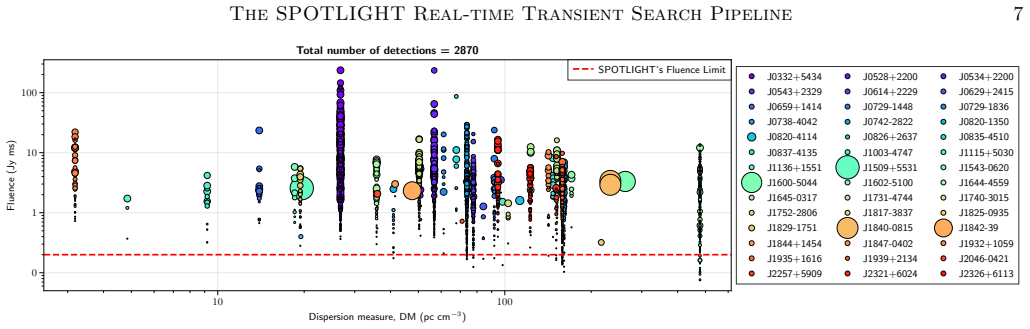
The pipeline is capable of processing up to 2000 post-correlation beams in real time by combining dedispersion and single-pulse search with a multi-stage candidate optimisation framework and triggering system. A real-time signal injection framework validates performance. Initial deployment detected 2870 bursts from 42 known sources and demonstrated sensitivity consistent with the predicted survey threshold of ∼0.2 Jy ms while operating commensally.
What carries the argument
The multibeam real-time transient search pipeline integrating accelerated dedispersion, pulse search, candidate optimisation, and signal injection validation.
Load-bearing premise
The signal injection framework and candidate optimisation accurately reflect the detection of real astrophysical signals without biases or data loss over the full dispersion measure range.
What would settle it
A significant discrepancy between the observed detection rate of known sources and the rate predicted by the 0.2 Jy ms threshold, or failure to recover a substantial fraction of injected test signals.
Figures

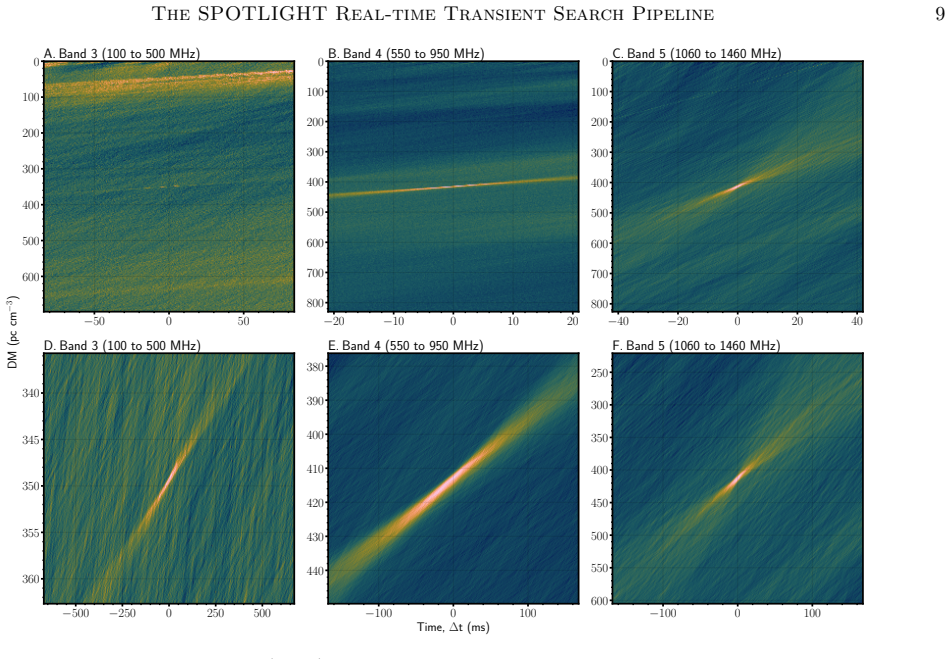
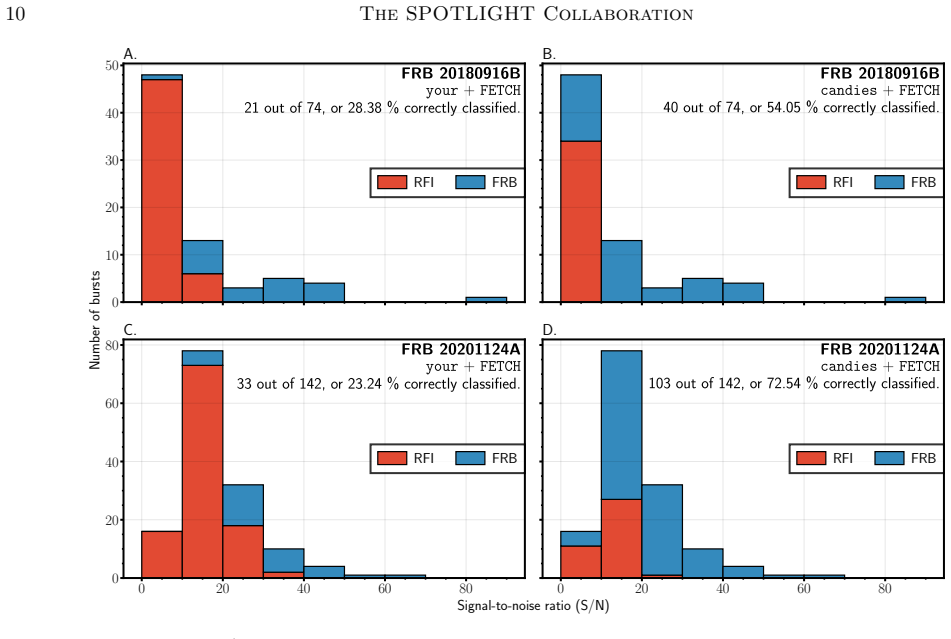


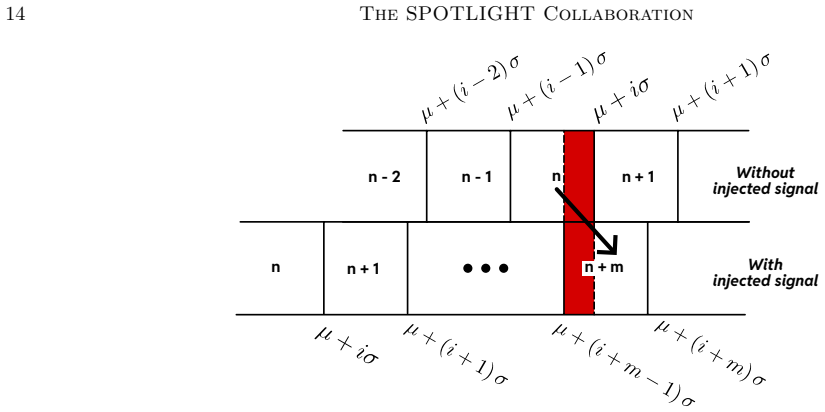
read the original abstract
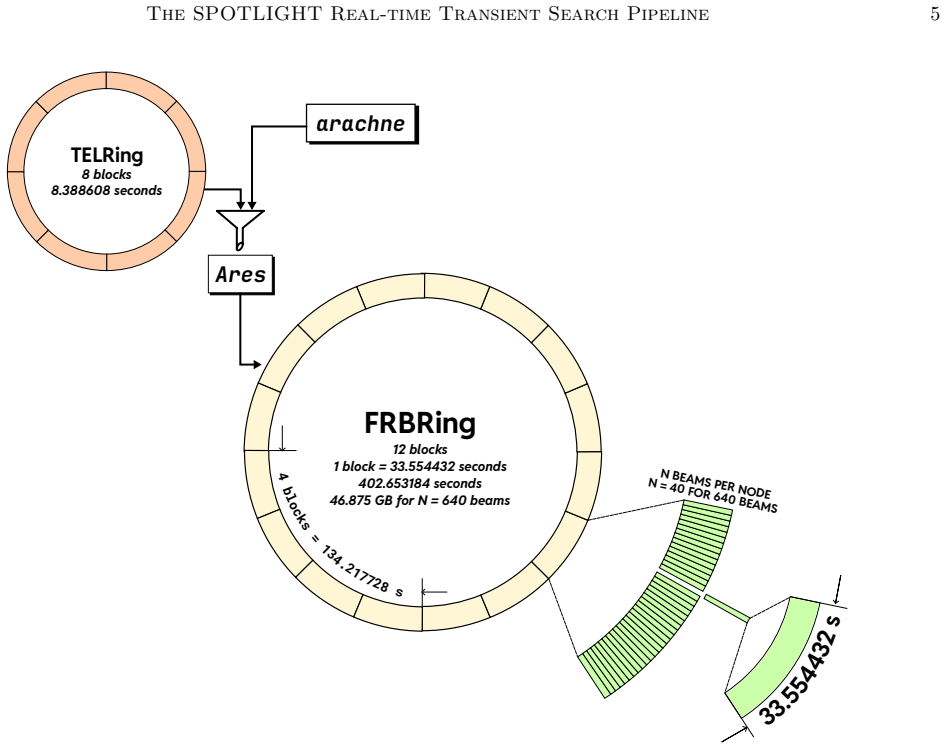
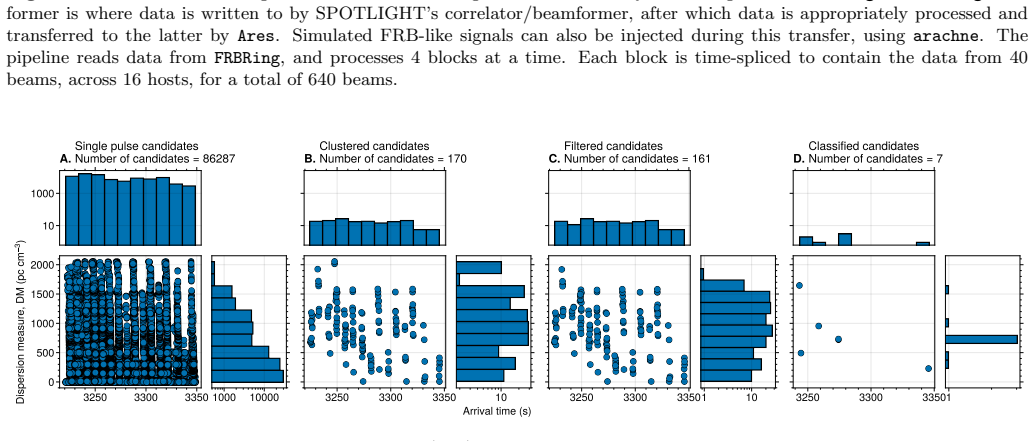
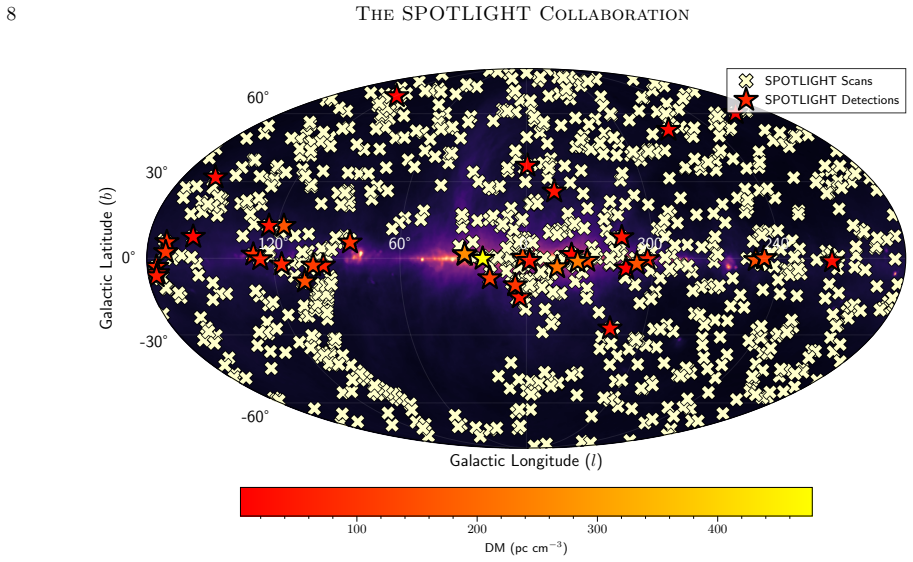
Fast Radio Bursts (FRBs) are among the most enigmatic transient phenomena in the Universe. In order to unravel the mystery behind these events, one requires instruments that possess the ability to search, detect, localise, and capture these events in high resolution over large fields-of-view in real-time. The SPOTLIGHT project is one such backend, leveraging the upgraded Giant Metrewave Radio Telescope (uGMRT) to conduct a commensal search for FRBs and other radio transients, using a dedicated high-performance computing facility, comprised of 90 NVIDIA A100 GPUs and 60 compute servers. Here we present the design, implementation, and performance of SPOTLIGHT's real-time transient search pipeline, a GPU-accelerated system capable of processing up to 2000 post-correlation beams in real time. The pipeline combines AstroAccelerate-powered brute-force dedispersion and single pulse search, with a multi-stage and robust candidate optimisation framework, as well as a triggering system for automatic capture of high-resolution visibility and baseband data. To ensure continuous validation of pipeline performance, we have also developed a real-time signal injection framework capable of injecting synthetic bursts directly into SPOTLIGHT's beamformed data stream. The system operates commensally with routine uGMRT observations, processing data streams in real-time while maintaining high sensitivity to ms-duration transients across dispersion measures extending up to 2000 pc cm$^{-3}$. During its initial deployment in uGMRT Cycle 49 and Cycle 50, the pipeline detected 2870 bursts from 42 known sources, and demonstrated sensitivity consistent with the predicted survey threshold of $\sim$ 0.2 Jy ms. The SPOTLIGHT system establishes a scalable framework for wide-field, low-frequency transient discovery and localisation, and provides a key technological foundation for next-generation radio transient surveys.
Editorial analysis
A structured set of objections, weighed in public.
Referee Report
Summary. The manuscript describes the design, implementation, and initial performance of the SPOTLIGHT real-time transient detection pipeline deployed on the uGMRT. The system uses a dedicated HPC facility with 90 NVIDIA A100 GPUs to process up to 2000 post-correlation beams in real time, combining AstroAccelerate-powered dedispersion and single-pulse search with a multi-stage candidate optimisation framework and an automatic triggering system for high-resolution data capture. A real-time signal injection framework is included for continuous validation, and the pipeline operates commensally with routine observations up to DM = 2000 pc cm^{-3}. Initial deployment results in Cycles 49 and 50 report 2870 burst detections from 42 known sources with sensitivity matching the predicted survey threshold of ∼0.2 Jy ms.
Significance. If the quantitative end-to-end validation holds, the work supplies a practical, scalable example of a commensal, wide-field, low-frequency transient search system that integrates GPU acceleration, candidate optimisation, and live injection testing. The reported operational detections from actual deployment data provide empirical grounding that could inform next-generation survey designs.
major comments (1)
- [Abstract] Abstract: The statement that the pipeline 'demonstrated sensitivity consistent with the predicted survey threshold of ∼0.2 Jy ms' by detecting 2870 bursts from 42 known sources is not supported by any quantitative recovery statistics (e.g., efficiency curves versus DM, fluence, or S/N) from the real-time signal injection framework when run on live commensal data streams. Without these metrics, it is not possible to confirm that the multi-stage optimisation and injection tests recover genuine signals without unaccounted biases or data loss across the full DM range.
Simulated Author's Rebuttal
We thank the referee for their constructive review and for recognizing the practical value of the SPOTLIGHT system. We address the single major comment below.
read point-by-point responses
-
Referee: [Abstract] Abstract: The statement that the pipeline 'demonstrated sensitivity consistent with the predicted survey threshold of ∼0.2 Jy ms' by detecting 2870 bursts from 42 known sources is not supported by any quantitative recovery statistics (e.g., efficiency curves versus DM, fluence, or S/N) from the real-time signal injection framework when run on live commensal data streams. Without these metrics, it is not possible to confirm that the multi-stage optimisation and injection tests recover genuine signals without unaccounted biases or data loss across the full DM range.
Authors: We agree with the referee that the abstract claim requires stronger quantitative backing. The 2870 detections from known sources were obtained during live commensal runs in which the injection framework was operating, but the manuscript does not present explicit recovery-efficiency curves versus DM, fluence or S/N derived from those live injections. We will therefore revise the abstract to remove the phrase 'demonstrated sensitivity consistent with the predicted survey threshold of ∼0.2 Jy ms' and replace it with a factual statement limited to the number of detections achieved. In the main text we will add a short paragraph (or table) summarising the injection tests that were performed on the live data streams, including any available recovery fractions, and will explicitly note the current limitations in the quantitative validation. This change will be made in the revised manuscript. revision: yes
Circularity Check
No circularity: performance claims rest on reported deployment data and injection tests, not on self-referential derivations or fitted inputs.
full rationale
The paper describes the design and empirical performance of a real-time GPU pipeline for transient detection, reporting metrics such as processing 2000 beams, detection of 2870 bursts from 42 sources, and sensitivity of ~0.2 Jy ms directly from initial uGMRT deployment and signal injection tests. No equations, parameter fits, or predictions are presented that reduce by construction to the inputs; there are no self-citations invoked as load-bearing uniqueness theorems or ansatzes. The central claims are externally falsifiable via the described hardware deployment and do not rely on renaming known results or smuggling assumptions through citations. This is a standard engineering report with independent empirical content.
Axiom & Free-Parameter Ledger
axioms (1)
- domain assumption AstroAccelerate correctly implements brute-force dedispersion and single-pulse search for the relevant DM range.
Reference graph
Works this paper leans on
-
[1]
2020, The Astrophysical Journal Supplement Series, 247, 56, doi:10.3847/1538-4365/ab7994
Ad´ amek, K., & Armour, W. 2020, The Astrophysical Journal Supplement Series, 247, 56, doi:10.3847/1538-4365/ab7994
-
[2]
Agarwal, D., Aggarwal, K., Burke-Spolaor, S., Lorimer, D. R., & Garver-Daniels, N. 2020, Monthly Notices of the Royal Astronomical Society, 497, 1661, doi:10.1093/mnras/staa1856
-
[3]
Amiri, M., Andersen, B. C., Bandura, K., et al. 2021, The Astrophysical Journal Supplement Series, 257, 59, doi:10.3847/1538-4365/ac33ab
-
[4]
Bannister, K. W., Deller, A. T., Phillips, C., et al. 2019, Science, 365, 565, doi:10.1126/science.aaw5903
-
[5]
Chatterjee, S., Law, C. J., Wharton, R. S., et al. 2017, Nature, 541, 58, doi:10.1038/nature20797 CHIME/FRB Collaboration, Amiri, M., Bandura, K., et al. 2018, The Astrophysical Journal, 863, 48, doi:10.3847/1538-4357/aad188
-
[6]
Collaboration, T. C., Amiri, M., Andersen, B. C., et al. 2023, The Astrophysical Journal Supplement Series, 264, 53, doi:10.3847/1538-4365/acb54c
-
[7]
Cordes, J. M., & McLaughlin, M. A. 2003, The Astrophysical Journal, 596, 1142, doi:10.1086/378231
-
[8]
Eftekhari, T., & Berger, E. 2017, The Astrophysical Journal, 849, 162, doi:10.3847/1538-4357/aa90b9 The SPOTLIGHT Real-time Transient Search Pipeline17
-
[9]
1996, in Proceedings of the Second International Conference on Knowledge Discovery and Data Mining, KDD’96 (Portland, Oregon: AAAI Press), 226–231
Ester, M., Kriegel, H.-P., Sander, J., & Xu, X. 1996, in Proceedings of the Second International Conference on Knowledge Discovery and Data Mining, KDD’96 (Portland, Oregon: AAAI Press), 226–231
1996
-
[10]
Gajjar, V., Siemion, A. P. V., Price, D. C., et al. 2018, The Astrophysical Journal, 863, 2, doi:10.3847/1538-4357/aad005
-
[11]
Khairy, K. 2024, in 2024 United States National Committee of URSI National Radio Science Meeting (USNC-URSI NRSM), 396–396, doi:10.23919/USNC-URSINRSM60317.2024.10465039
work page doi:10.23919/usnc-ursinrsm60317.2024.10465039 2024
-
[12]
Kouwenhoven, M. L. A., & Voˆ ute, J. L. L. 2001, Astronomy & Astrophysics, 378, 700, doi:10.1051/0004-6361:20011226
-
[13]
Kulkarni, S. R. 2020, Dispersion measure: Confusion, Constants & Clarity, arXiv, doi:10.48550/arXiv.2007.02886
-
[14]
E., Andrew, S., Lazda, M., et al
Lanman, A. E., Andrew, S., Lazda, M., et al. 2024, CHIME/FRB Outriggers: KKO Station System and Commissioning Results, arXiv, doi:10.48550/arXiv.2402.07898
-
[15]
Law, C. J., Bower, G. C., Burke-Spolaor, S., et al. 2018, The Astrophysical Journal Supplement Series, 236, 8, doi:10.3847/1538-4365/aab77b
-
[16]
J., Sharma, K., Ravi, V., et al
Law, C. J., Sharma, K., Ravi, V., et al. 2023, Deep Synoptic Array Science: First FRB and Host Galaxy Catalog, doi:10.48550/arXiv.2307.03344
-
[17]
Li, Z., Gao, H., Wei, J.-J., et al. 2020, Monthly Notices of the Royal Astronomical Society: Letters, 496, L28, doi:10.1093/mnrasl/slaa070
-
[18]
Lin, H.-H., Lin, K.-y., Li, C.-T., et al. 2022, Publications of the Astronomical Society of the Pacific, 134, 094106, doi:10.1088/1538-3873/ac8f71
-
[19]
Lorimer, D. R., Bailes, M., McLaughlin, M. A., Narkevic, D. J., & Crawford, F. 2007, Science, 318, 777, doi:10.1126/science.1147532
-
[20]
Luo, R., Hobbs, G., Yong, S. Y., et al. 2022, Monthly Notices of the Royal Astronomical Society, 513, 5881, doi:10.1093/mnras/stac1168
-
[21]
Macquart, J.-P., Bailes, M., Bhat, N. D. R., et al. 2010, Publications of the Astronomical Society of Australia, 27, 272, doi:10.1071/AS09082
-
[22]
Macquart, J.-P., Prochaska, J. X., McQuinn, M., et al. 2020, Nature, 581, 391, doi:10.1038/s41586-020-2300-2
-
[23]
Margalit, B., Metzger, B. D., & Sironi, L. 2020, Monthly Notices of the Royal Astronomical Society, 494, 4627, doi:10.1093/mnras/staa1036
-
[24]
Men, Y., Barr, E., Clark, C. J., Carli, E., & Desvignes, G. 2023, Astronomy & Astrophysics, 679, A20, doi:10.1051/0004-6361/202347356
-
[25]
and Berger, Edo and Margalit, Ben , title =
Metzger, B. D., Berger, E., & Margalit, B. 2017,\apj, 841, 14, doi:10.3847/1538-4357/aa633d
-
[26]
Metzger, B. D., Margalit, B., & Sironi, L. 2019, Monthly Notices of the Royal Astronomical Society, 485, 4091, doi:10.1093/mnras/stz700
-
[27]
Michilli, D., Masui, K. W., Mckinven, R., et al. 2021, The Astrophysical Journal, 910, 147, doi:10.3847/1538-4357/abe626 Novotn´ y, J., Ad´ amek, K., Clark, M. A., Giles, M., &
-
[28]
2023, The Astrophysical Journal Supplement Series, 269, 29, doi:10.3847/1538-4365/acfef6
Armour, W. 2023, The Astrophysical Journal Supplement Series, 269, 29, doi:10.3847/1538-4365/acfef6
-
[29]
Pleunis, Z., Michilli, D., Bassa, C. G., et al. 2021, The Astrophysical Journal Letters, 911, L3, doi:10.3847/2041-8213/abec72
-
[30]
Roy, J., Chengalur, J. N., & Pen, U.-L. 2018, The Astrophysical Journal, 864, 160, doi:10.3847/1538-4357/aad815
-
[31]
Sammons, M. W., Deller, A. T., Glowacki, M., et al. 2023, Two-Screen Scattering in CRAFT FRBs, arXiv, doi:10.48550/arXiv.2305.11477
-
[32]
2017, Proceedings of the International Astronomical Union, 13, 406, doi:10.1017/S1743921317009310
Sanidas, S., Caleb, M., Driessen, L., et al. 2017, Proceedings of the International Astronomical Union, 13, 406, doi:10.1017/S1743921317009310
-
[33]
Simha, S., Burchett, J. N., Prochaska, J. X., et al. 2020, The Astrophysical Journal, 901, 134, doi:10.3847/1538-4357/abafc3
-
[34]
Tendulkar, S. P., Bassa, C. G., Cordes, J. M., et al. 2017, The Astrophysical Journal Letters, 834, L7, doi:10.3847/2041-8213/834/2/L7
-
[35]
P., Gil de Paz, A., Kirichenko, A
Tendulkar, S. P., Gil de Paz, A., Kirichenko, A. Y., et al. 2021, The Astrophysical Journal, 908, L12, doi:10.3847/2041-8213/abdb38
-
[36]
Wang, Z., Bannister, K. W., Gupta, V., et al. 2025, Publications of the Astronomical Society of Australia, 42, e005, doi:10.1017/pasa.2024.107
-
[37]
Xu, H., Niu, J. R., Chen, P., et al. 2022, Nature, 609, 685, doi:10.1038/s41586-022-05071-8
-
[38]
Zackay, B., & Ofek, E. O. 2017, The Astrophysical Journal, 835, 11, doi:10.3847/1538-4357/835/1/11
discussion (0)
Sign in with ORCID, Apple, or X to comment. Anyone can read and Pith papers without signing in.