Scaling and Analytical Approximation of Porous Electrode Theory for Reaction-limited Batteries
Pith reviewed 2026-05-10 07:20 UTC · model grok-4.3
The pith
A lean model governed by four dimensionless numbers simplifies porous electrode theory for reaction-limited batteries.
A machine-rendered reading of the paper's core claim, the machinery that carries it, and where it could break.
Core claim
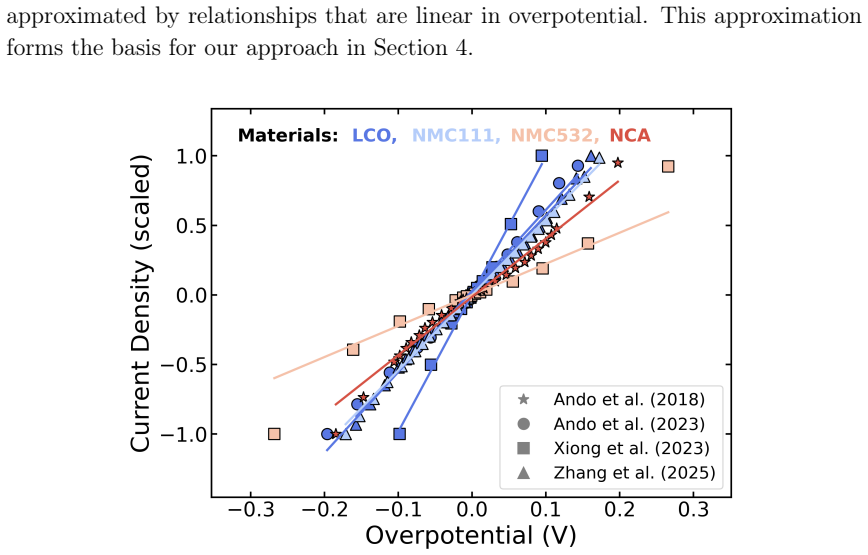
By assuming high-performance electrodes minimize transport limitations and overpotentials, the authors derive a simplified lean model governed by four dimensionless numbers: a traditional Damköhler number Da, a process Damköhler number Da_p, a wiring Damköhler number Da_w, and a capacitive Damköhler number Da_c. For batteries this framework supplies analytical solutions for standard protocols that agree closely with numerical simulations of a practical NMC half-cell while incurring negligible computational cost.
What carries the argument
The lean model, obtained by scaling porous electrode theory down to four Damköhler numbers that ratio reaction rates against diffusion, capacity utilization, electromigration-wiring, and double-layer charging.
If this is right
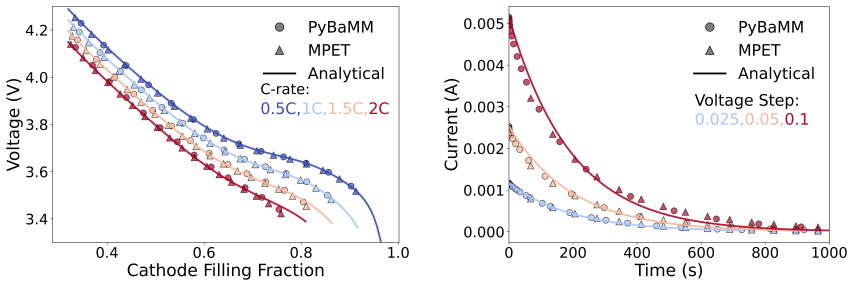
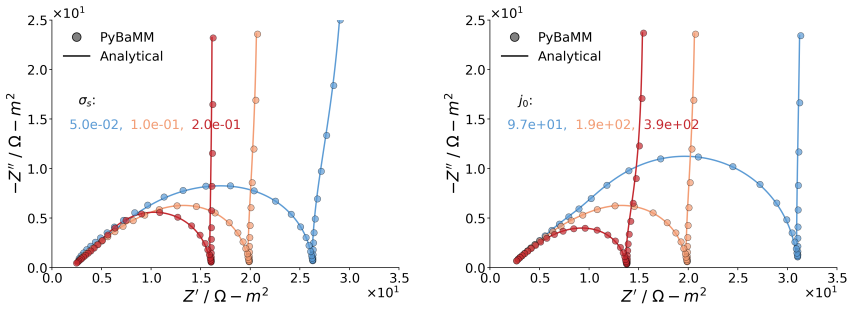
- Closed-form expressions become available for galvanostatic discharge, chronoamperometry, and electrochemical impedance spectroscopy.
- The same four-number scaling applies uniformly to batteries, supercapacitors, fuel cells, and other porous-electrode systems.
- Real-time state estimation and control become practical because the solutions run at negligible computational cost.
- Design parameters can be mapped directly onto performance limits through the four dimensionless groups.
Where Pith is reading between the lines
- Embedding the lean-model equations inside vehicle battery-management systems could allow physics-based predictions without heavy onboard computation.
- The four Damköhler numbers offer a compact language for comparing reaction-limited behavior across different electrode architectures and chemistries.
- Testing the lean model on full cells with thicker electrodes would reveal the boundary where transport limitations invalidate the reduction.
Load-bearing premise
High-performance electrodes minimize transport limitations and overpotentials, allowing the full porous electrode theory to collapse into the lean model.
What would settle it
A numerical simulation or experiment on an electrode exhibiting large concentration gradients or high overpotentials that produces voltage or current traces clearly different from the lean-model analytical predictions.
Figures

read the original abstract
Porous electrode theory (PET) provides essential insights into electrochemical states, but its computational complexity hinders real-time control and obscures scaling relations. To bridge the gap between high-fidelity simulations and reduced-order models, we present a framework of scaling analysis and analytical approximations. By assuming high-performance electrodes minimize transport limitations and overpotentials, we derive a simplified "lean model" governed by four dimensionless numbers: (i) a traditional Damk\"ohler number, $Da$, scaling the characteristic reaction rate to the diffusion rate in the electrolyte-filled pores; (ii) the "process Damk\"ohler number," $Da_p$, scaling the reaction rate to the applied capacity utilization rate (C-rate); (iii) the "wiring Damk\"ohler number," $Da_w$, scaling the reaction rate to an effective electromigration rate for ions in the pores in series with electrons in the conducting matrix; and (iv) the "capacitive Damk\"ohler number," $Da_c$, comparing the rates of Faradaic reactions and double-layer charging. For batteries, we derive analytical solutions for standard protocols, including galvanostatic discharge, chronoamperometry, and electrochemical impedance spectroscopy. Validated against numerical simulations of a practical NMC half-cell, our formulae show excellent agreement at negligible computational cost. This interpretable, physics-based framework accelerates battery design and state estimation while unifying the modeling of batteries, supercapacitors, fuel cells, and other porous electrode systems.
Editorial analysis
A structured set of objections, weighed in public.
Referee Report
Summary. The manuscript presents a scaling analysis framework to derive a simplified 'lean model' from full porous electrode theory (PET) for reaction-limited batteries. Assuming high-performance electrodes minimize transport limitations and overpotentials, the lean model is governed by four dimensionless Damköhler numbers (traditional Da, process Da_p, wiring Da_w, and capacitive Da_c). Analytical solutions are derived for galvanostatic discharge, chronoamperometry, and EIS. These are validated against numerical simulations of a practical NMC half-cell, with claims of excellent agreement at negligible computational cost. The work aims to provide interpretable, physics-based reduced-order models unifying batteries, supercapacitors, and fuel cells.
Significance. If the lean model's regime of validity is properly bounded, the work offers notable value by delivering closed-form analytical expressions for standard battery protocols and a dimensionless scaling framework that could accelerate design, state estimation, and real-time control. The explicit derivation of the four-Da lean model from PET assumptions and the reported low-cost validation against full simulations are strengths that enhance interpretability over purely numerical approaches.
major comments (2)
- [Abstract and §3] Abstract and §3 (lean model derivation): The central reduction from full PET to the four-Da lean model rests on the assumption that high-performance electrodes minimize transport limitations and overpotentials. No explicit bounds are given on the Damköhler numbers (e.g., ranges of Da, Da_p, Da_w, Da_c) for the NMC half-cell where this holds within a stated error tolerance (such as <5% deviation in voltage or concentration profiles), which is load-bearing for the accuracy of the subsequent analytical solutions.
- [Validation section] Validation section (likely §5 or §6): The claim of 'excellent agreement' with NMC half-cell simulations is presented without accompanying error metrics, sensitivity analysis to the four Damköhler numbers, or details on how the parameters were extracted from the cell geometry and rates. This leaves open whether the comparison confirms the assumption-driven reduction or relies on post-hoc regime selection.
minor comments (2)
- [Abstract] Abstract: Inconsistent formatting of 'Damk'ohler' (should use proper umlaut or consistent spelling throughout).
- [§2 or §3] Notation: The definitions of Da_w (wiring) and Da_c (capacitive) would benefit from an explicit equation showing how electromigration and double-layer rates are nondimensionalized, to aid reproducibility.
Simulated Author's Rebuttal
We thank the referee for the detailed and constructive review. The comments highlight important opportunities to strengthen the presentation of the lean model's validity regime and the quantitative aspects of the validation. We have revised the manuscript accordingly and address each major comment below.
read point-by-point responses
-
Referee: [Abstract and §3] Abstract and §3 (lean model derivation): The central reduction from full PET to the four-Da lean model rests on the assumption that high-performance electrodes minimize transport limitations and overpotentials. No explicit bounds are given on the Damköhler numbers (e.g., ranges of Da, Da_p, Da_w, Da_c) for the NMC half-cell where this holds within a stated error tolerance (such as <5% deviation in voltage or concentration profiles), which is load-bearing for the accuracy of the subsequent analytical solutions.
Authors: We agree that explicit bounds on the Damköhler numbers would make the reduction more rigorous and easier for readers to apply. In the revised manuscript we have added a new subsection to §3 that derives approximate validity criteria (Da ≪ 1, Da_p < 1, Da_w ≪ 1, Da_c ≪ 1) under which transport and overpotential losses remain negligible, together with the corresponding error tolerances (target <5 % deviation). For the specific NMC half-cell geometry and rates used in the validation, we now tabulate the four Damköhler numbers and confirm that all lie comfortably inside the stated regime, with the observed simulation discrepancies consistent with the derived bounds. revision: yes
-
Referee: [Validation section] Validation section (likely §5 or §6): The claim of 'excellent agreement' with NMC half-cell simulations is presented without accompanying error metrics, sensitivity analysis to the four Damköhler numbers, or details on how the parameters were extracted from the cell geometry and rates. This leaves open whether the comparison confirms the assumption-driven reduction or relies on post-hoc regime selection.
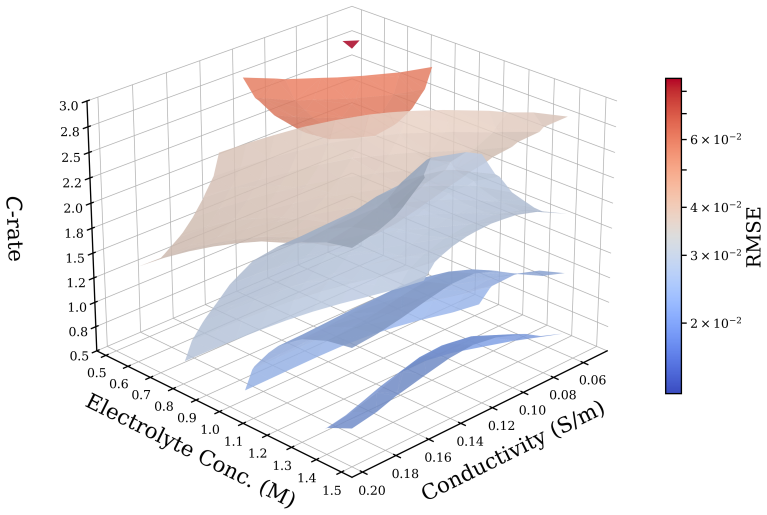
Authors: We accept this criticism. The revised validation section now reports quantitative error metrics (maximum relative voltage error < 2.5 % and L2 concentration error < 3 % across the tested C-rates). We have added a sensitivity study in which each Damköhler number is varied independently while the others are held fixed, demonstrating that agreement degrades only when the numbers exit the validity regime derived in §3. Parameter extraction is documented in a new appendix that lists the cell geometry, material properties, and rate definitions used to compute the four Damköhler numbers from the NMC half-cell data; the comparison therefore directly tests the assumption-driven reduction rather than relying on post-hoc selection. revision: yes
Circularity Check
No significant circularity in derivation chain
full rationale
The paper explicitly invokes the assumption that high-performance electrodes minimize transport limitations and overpotentials to collapse full porous electrode theory into the lean model governed by four defined Damkohler numbers (Da, Da_p, Da_w, Da_c). These numbers are constructed directly from physical rate ratios via scaling analysis, not fitted or renamed from target outputs. Analytical solutions for galvanostatic discharge, chronoamperometry, and EIS are then derived from the lean model equations under the stated assumption. Validation against independent numerical PET simulations of an NMC half-cell is presented as external verification of agreement, not as a self-referential fit. No load-bearing self-citations, uniqueness theorems, or ansatzes from prior author work are used to justify the central reduction; the derivation chain remains self-contained with independent content from the scaling step.
Axiom & Free-Parameter Ledger
axioms (1)
- domain assumption High-performance electrodes minimize transport limitations and overpotentials
discussion (0)
Sign in with ORCID, Apple, or X to comment. Anyone can read and Pith papers without signing in.