Spiral arms across cosmic time: JWST measurements of the pitch angles of spiral galaxies at z<3.5
Pith reviewed 2026-06-27 12:26 UTC · model grok-4.3
The pith
Spiral galaxy arms show a transition at redshift 1 from locally driven structures to ones regulated by global gravitational potential.
A machine-rendered reading of the paper's core claim, the machinery that carries it, and where it could break.
Core claim
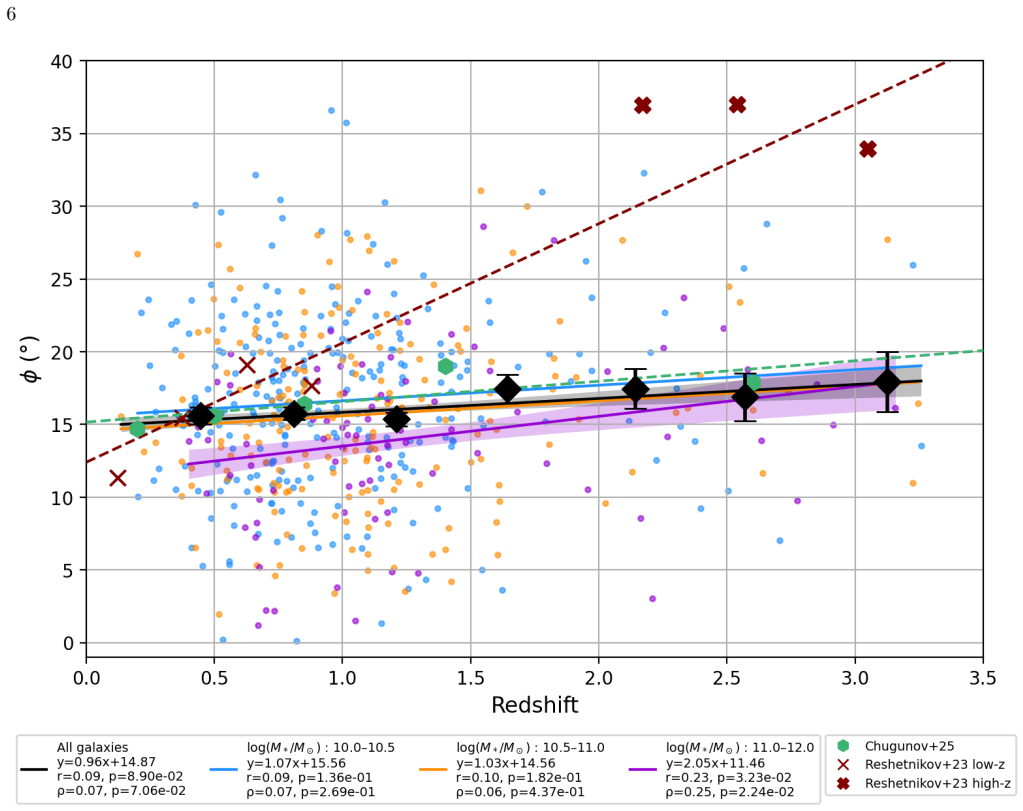
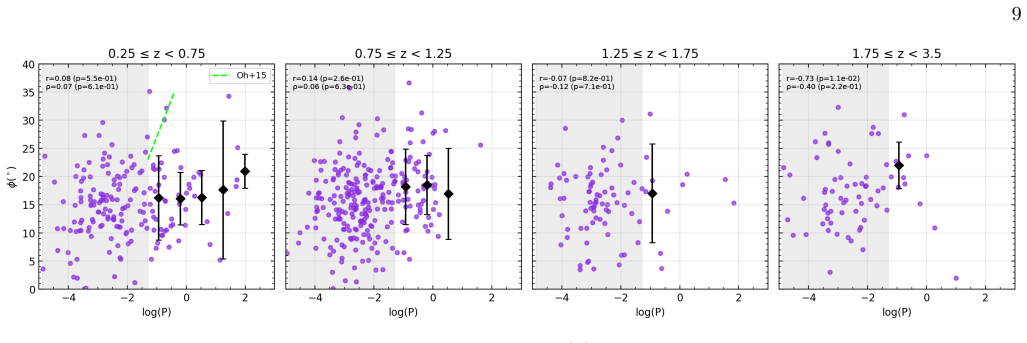
The analysis of pitch angles reveals no significant redshift evolution across the full sample, with only the most massive galaxies showing slight winding up over time. At z greater than 1.25, pitch angle is uncorrelated with stellar mass, bulge mass, disk mass, and specific star formation rate. At z less than 1.25, statistically significant correlations appear: negative with stellar, bulge, and disk mass, and positive with sSFR below z=0.75. Pitch angle shows no dependence on tidal strength from companions. The results indicate a transition epoch near z=1, above which spiral structures are primarily locally driven and below which they are regulated by global gravitational potential in line w
What carries the argument
Pitch angle measurements from SpArcFiRe applied to galaxies identified by a fine-tuned Zoobot model, used to test correlations with global galaxy properties as a function of redshift.
If this is right
- Spiral structure formation mechanisms differ before and after z approximately 1.
- Density wave theory applies only to spiral arms at redshifts below 1.25.
- Local processes dominate spiral arm formation in galaxies at z greater than 1.25.
- Tidal interactions with companions do not influence pitch angles at any redshift in this sample.
- The most massive galaxies exhibit gradual tightening of spiral arms over cosmic time.
Where Pith is reading between the lines
- Models of early galaxy disk dynamics may need separate prescriptions for arm formation above and below redshift 1.
- Future high-resolution observations at z greater than 2 could test whether local instabilities alone can sustain measurable spiral arms without global potential wells.
- The lack of tidal correlation suggests companion-driven triggering is not the main driver even at earlier epochs where mergers were more frequent.
- If the transition holds, simulations should reproduce a redshift-dependent switch in the dominant source of non-axisymmetric structure.
Load-bearing premise
The identification of spiral galaxies and measurement of their pitch angles remains free of systematic biases that change with redshift in the JWST images, and the sample represents the massive spiral population at each epoch.
What would settle it
A reanalysis of the same JWST fields that finds pitch angles at z greater than 1.25 to be systematically underestimated or overestimated relative to lower redshifts, or a larger sample showing the same mass and sSFR correlations already present above z=1.25.
Figures




read the original abstract
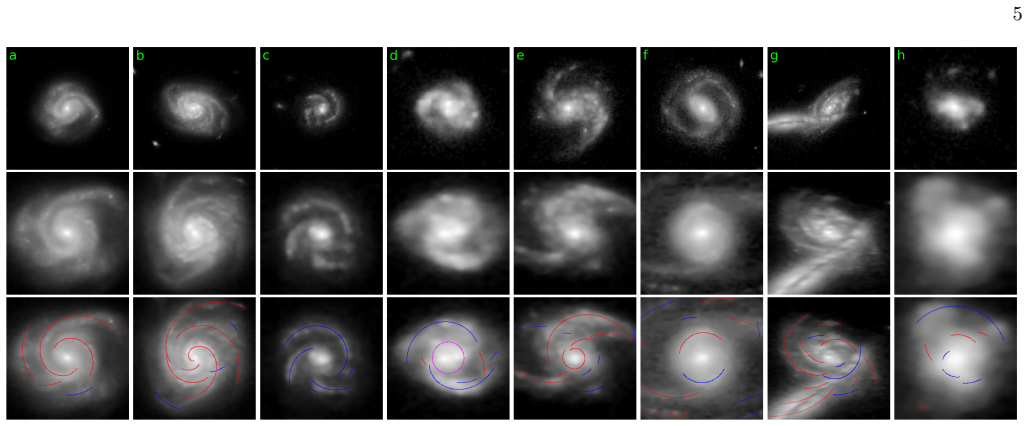
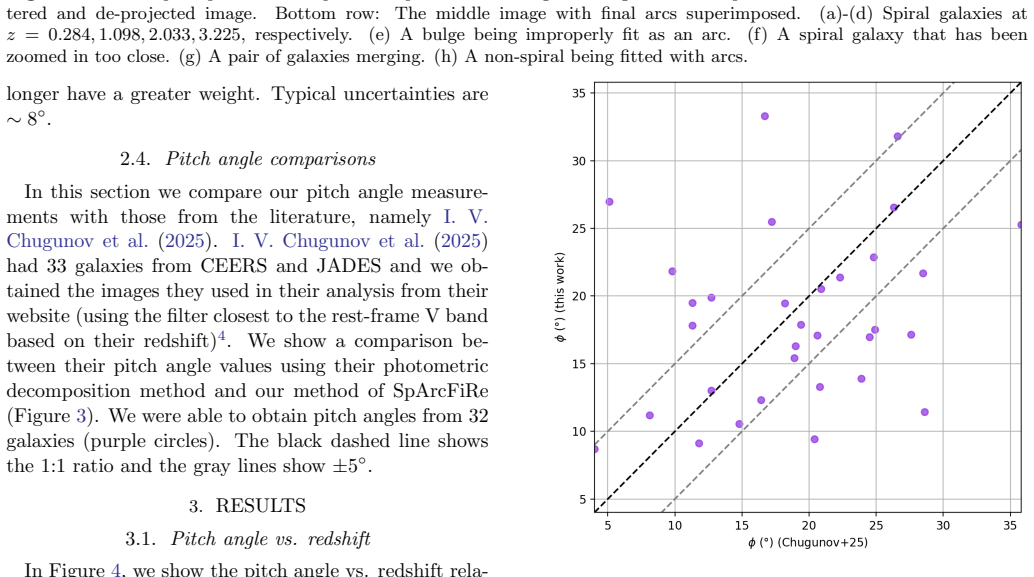
The properties of spiral galaxies in the early universe remain poorly studied and, as such, little is known about their nature and evolution. We use JWST data to measure the pitch angles of spiral galaxies across cosmic time. Our sample consists of 593 spiral galaxies with stellar masses ($M_*$) greater than $10^{10} M_\odot$ up to $z \sim 3.5$, drawn from the CEERS and JADES surveys. Spiral galaxies are identified by fine-tuning a Zoobot deep-learning model. We use SpArcFiRe to identify spiral arms and measure their pitch angles. We find no significant redshift evolution in the average pitch angle across the full sample. However, in the most massive systems (log$(M_*/M_\odot)=11-12$), spiral arms slightly wind up with time. We show that at $z>1.25$, pitch angle does not correlate with some key internal galaxy properties (stellar mass, bulge mass, disk mass, specific star formation rate [sSFR]). In contrast, at $z<1.25$, pitch angle shows a weak but statistically significant negative correlation with stellar mass, bulge mass, and disk mass, and a positive correlation with sSFR at $z<0.75$. We also find no dependence of pitch angle on the tidal strength applied by nearby companions. These results indicate a transition epoch at $z\sim1$: above this redshift, spiral structures appear to be primarily locally driven and not correlated with global galaxy properties; and below this redshift, spiral arms are regulated by global gravitational potential, consistent with the predictions of the density wave theory.
Editorial analysis
A structured set of objections, weighed in public.
Referee Report
Summary. The paper measures pitch angles of spiral arms in 593 massive (M*>10^10 Msun) galaxies at z<3.5 drawn from JWST CEERS and JADES fields. Spirals are selected via fine-tuned Zoobot and arms traced with SpArcFiRe. It reports no overall redshift evolution in mean pitch angle (with mild winding in the highest-mass bin), absence of correlations between pitch angle and M*, bulge mass, disk mass or sSFR at z>1.25, and the emergence of weak but significant correlations (negative with mass terms, positive with sSFR below z~0.75) at lower redshift. These are interpreted as evidence for a transition epoch near z~1 from locally driven to globally regulated (density-wave) spiral structure.
Significance. If the differential correlation results are robust to measurement systematics, the work supplies the first statistical constraints on spiral-arm pitch-angle behavior across most of cosmic time and offers an observational test of the redshift at which global gravitational potential begins to dominate arm morphology, with direct implications for distinguishing local versus density-wave formation channels in galaxy-evolution models.
major comments (1)
- [Abstract] Abstract (and the transition-epoch interpretation): the reported absence of pitch-angle correlations with M*, bulge mass, disk mass and sSFR at z>1.25 is presented as physical evidence for a change in arm-driving mechanism. However, no stratified validation, mock recovery tests, or human-labeled subsets binned by redshift are described to demonstrate that Zoobot selection completeness and SpArcFiRe pitch-angle scatter remain constant across the z=0–3.5 range. Because JWST angular resolution, surface-brightness sensitivity and rest-frame bandpass all degrade with redshift, any z-dependent drop in arm-detection fidelity would preferentially suppress correlations in the high-z bin while preserving them at low z, rendering the transition claim load-bearing on an untested assumption.
minor comments (2)
- [Abstract] Abstract states statistical results (correlations, transition epoch) but supplies no error bars, sample sizes per redshift bin, or completeness corrections; these quantitative details are required to assess the significance of the reported weak correlations.
- The claim of “no dependence of pitch angle on the tidal strength applied by nearby companions” is stated without reference to the tidal-strength estimator or the companion catalog used; a brief methods paragraph or table would clarify this null result.
Simulated Author's Rebuttal
We thank the referee for their careful review and constructive feedback. We address the major comment on the abstract and transition-epoch interpretation below.
read point-by-point responses
-
Referee: [Abstract] Abstract (and the transition-epoch interpretation): the reported absence of pitch-angle correlations with M*, bulge mass, disk mass and sSFR at z>1.25 is presented as physical evidence for a change in arm-driving mechanism. However, no stratified validation, mock recovery tests, or human-labeled subsets binned by redshift are described to demonstrate that Zoobot selection completeness and SpArcFiRe pitch-angle scatter remain constant across the z=0–3.5 range. Because JWST angular resolution, surface-brightness sensitivity and rest-frame bandpass all degrade with redshift, any z-dependent drop in arm-detection fidelity would preferentially suppress correlations in the high-z bin while preserving them at low z, rendering the transition claim load-bearing on an untested assumption.
Authors: We agree that the manuscript does not describe explicit stratified validation, mock recovery tests, or human-labeled subsets binned by redshift to confirm that Zoobot completeness and SpArcFiRe scatter are constant with redshift. This is a valid concern, as observational effects could in principle introduce z-dependent biases. To strengthen the transition-epoch claim, the revised manuscript will add a dedicated subsection with mock recovery tests (degrading low-z images to high-z conditions and re-measuring) and an assessment of arm-detection fraction versus redshift. These will quantify whether the reported absence of correlations above z=1.25 could be driven by systematics. revision: yes
Circularity Check
No circularity: purely observational measurements and binned correlations
full rationale
The paper reports direct measurements of pitch angles from JWST imaging using fine-tuned Zoobot for galaxy selection and SpArcFiRe for arm tracing, then computes statistical correlations (or their absence) between pitch angle and galaxy properties (M*, bulge mass, disk mass, sSFR) in redshift-binned subsamples. No equations, derivations, or first-principles predictions are presented; the transition-epoch interpretation follows from the observed pattern of correlations changing across z~1.25. No self-citations, fitted inputs renamed as predictions, or ansatzes appear in the provided text. The analysis is self-contained against external benchmarks of the measurement pipeline and sample selection.
Axiom & Free-Parameter Ledger
axioms (2)
- domain assumption The fine-tuned Zoobot model reliably identifies spiral galaxies in JWST images across 0<z<3.5
- domain assumption SpArcFiRe returns unbiased pitch-angle measurements for the identified spirals in the CEERS and JADES fields
Reference graph
Works this paper leans on
-
[1]
Athanassoula, E., Romero-G´ omez, M., & Masdemont, J. J. 2009, MNRAS, 394, 67, doi: 10.1111/j.1365-2966.2008.14273.x
-
[2]
Bagley, M. B., Finkelstein, S. L., Koekemoer, A. M., et al. 2023, ApJL, 946, L12, doi: 10.3847/2041-8213/acbb08
-
[3]
1996, A&AS, 117, 393, doi: 10.1051/aas:1996164
Bertin, E., & Arnouts, S. 1996, A&AS, 117, 393, doi: 10.1051/aas:1996164
-
[4]
Bittner, A., Gadotti, D. A., Elmegreen, B. G., et al. 2017, MNRAS, 471, 1070, doi: 10.1093/mnras/stx1646
-
[5]
Brammer, G. B., van Dokkum, P. G., & Coppi, P. 2008, ApJ, 686, 1503, doi: 10.1086/591786
work page internal anchor Pith review doi:10.1086/591786 2008
-
[6]
Calzetti, D., Kennicutt, Jr., R. C., Bianchi, L., et al. 2005, ApJ, 633, 871, doi: 10.1086/466518
-
[7]
Chugunov, I. V., Marchuk, A. A., & Mosenkov, A. V. 2025, PASA, 42, e029, doi: 10.1017/pasa.2025.6
-
[8]
Cibinel, A., Daddi, E., Sargent, M. T., et al. 2019, MNRAS, 485, 5631, doi: 10.1093/mnras/stz690
-
[9]
Conroy, C., & Gunn, J. E. 2010,, Astrophysics Source Code Library, record ascl:1010.043 http://ascl.net/1010.043 13
2010
-
[10]
The Astrophysical Journal , author =
Conroy, C., Gunn, J. E., & White, M. 2009, ApJ, 699, 486, doi: 10.1088/0004-637X/699/1/486
work page internal anchor Pith review doi:10.1088/0004-637x/699/1/486 2009
-
[11]
Costantin, L., P´ erez-Gonz´ alez, P. G., Guo, Y., et al. 2023, Nature, 623, 499, doi: 10.1038/s41586-023-06636-x
-
[12]
Davis, B. L., Berrier, J. C., Shields, D. W., et al. 2012, ApJS, 199, 33, doi: 10.1088/0067-0049/199/2/33
-
[13]
Davis, B. L., Graham, A. W., & Cameron, E. 2018, ApJ, 869, 113, doi: 10.3847/1538-4357/aae820
-
[14]
Davis, B. L., Graham, A. W., & Cameron, E. 2019, ApJ, 873, 85, doi: 10.3847/1538-4357/aaf3b8
-
[15]
L., Kennefick, D., Kennefick, J., et al
Davis, B. L., Kennefick, D., Kennefick, J., et al. 2015, ApJL, 802, L13, doi: 10.1088/2041-8205/802/1/L13
-
[16]
Davis, D. R., & Hayes, W. B. 2014, ApJ, 790, 87, doi: 10.1088/0004-637X/790/2/87 D´ ıaz-Garc´ ıa, S., Salo, H., Knapen, J. H., &
-
[17]
2019, A&A, 631, A94, doi: 10.1051/0004-6361/201936000
Herrera-Endoqui, M. 2019, A&A, 631, A94, doi: 10.1051/0004-6361/201936000
-
[18]
2014, PASA, 31, e035, doi: 10.1017/pasa.2014.31 D’Onghia, E., Vogelsberger, M., & Hernquist, L
Dobbs, C., & Baba, J. 2014, PASA, 31, e035, doi: 10.1017/pasa.2014.31 D’Onghia, E., Vogelsberger, M., & Hernquist, L. 2013, ApJ, 766, 34, doi: 10.1088/0004-637X/766/1/34
-
[19]
Overview of the JWST Advanced Deep Extragalactic Survey (JADES)
Eisenstein, D. J., Willott, C., Alberts, S., et al. 2023a, arXiv e-prints, arXiv:2306.02465, doi: 10.48550/arXiv.2306.02465
work page internal anchor Pith review Pith/arXiv arXiv doi:10.48550/arxiv.2306.02465
-
[20]
Eisenstein, D. J., Johnson, B. D., Robertson, B., et al. 2023b, arXiv e-prints, arXiv:2310.12340, doi: 10.48550/arXiv.2310.12340
-
[21]
Elmegreen, B. G. 2011, in EAS Publications Series, Vol. 51, EAS Publications Series, ed. C. Charbonnel & T. Montmerle (EDP), 19–30, doi: 10.1051/eas/1151002
-
[22]
Elmegreen, B. G., & Elmegreen, D. M. 1985, ApJ, 288, 438, doi: 10.1086/162810
-
[23]
Elmegreen, D. M., & Elmegreen, B. G. 1982, MNRAS, 201, 1021, doi: 10.1093/mnras/201.4.1021
-
[24]
Elmegreen, D. M., & Elmegreen, B. G. 2014, ApJ, 781, 11, doi: 10.1088/0004-637X/781/1/11 Espejo Salcedo, J. M., Pastras, S., V´ acha, J., et al. 2025, A&A, 700, A42, doi: 10.1051/0004-6361/202554725
-
[25]
Fang, J. J., Faber, S. M., Koo, D. C., et al. 2018, ApJ, 858, 100, doi: 10.3847/1538-4357/aabcba
-
[26]
Ferreira, L., Conselice, C. J., Sazonova, E., et al. 2023, ApJ, 955, 94, doi: 10.3847/1538-4357/acec76
-
[27]
2023, STScI/MAST, doi: 10.17909/Z7P0-8481
Finkelstein, S., Bagley, M., & Yang, G. 2023, STScI/MAST, doi: 10.17909/Z7P0-8481
-
[28]
Finkelstein, S. L., Bagley, M. B., Arrabal Haro, P., et al. 2025, ApJL, 983, L4, doi: 10.3847/2041-8213/adbbd3
-
[29]
2000, AJ, 120, 2206, doi: 10.1086/316803
Fontana, A., D’Odorico, S., Poli, F., et al. 2000, AJ, 120, 2206, doi: 10.1086/316803
-
[30]
Fujii, M. S., Baba, J., Saitoh, T. R., et al. 2011, ApJ, 730, 109, doi: 10.1088/0004-637X/730/2/109
-
[31]
2025, A&A, 699, A343, doi: 10.1051/0004-6361/202555504
Genin, A., Shuntov, M., Brammer, G., et al. 2025, A&A, 699, A343, doi: 10.1051/0004-6361/202555504
-
[32]
Genzel, R., F¨ orster Schreiber, N. M.,¨Ubler, H., et al. 2017, Nature, 543, 397, doi: 10.1038/nature21685
-
[33]
Genzel, R., Price, S. H., ¨Ubler, H., et al. 2020, ApJ, 902, 98, doi: 10.3847/1538-4357/abb0ea
-
[34]
1965, MNRAS, 130, 125, doi: 10.1093/mnras/130.2.125
Goldreich, P., & Lynden-Bell, D. 1965, MNRAS, 130, 125, doi: 10.1093/mnras/130.2.125
-
[35]
Grand, R. J. J., Kawata, D., & Cropper, M. 2013, A&A, 553, A77, doi: 10.1051/0004-6361/201321308
-
[36]
Koekemoer, A. M. 2012, ApJ, 757, 120, doi: 10.1088/0004-637X/757/2/120
-
[37]
Guo, Y., Ferguson, H. C., Bell, E. F., et al. 2015, ApJ, 800, 39, doi: 10.1088/0004-637X/800/1/39
-
[38]
Guo, Y., Rafelski, M., Bell, E. F., et al. 2018, ApJ, 853, 108, doi: 10.3847/1538-4357/aaa018
-
[39]
Guo, Y., Jogee, S., Finkelstein, S. L., et al. 2023, ApJL, 945, L10, doi: 10.3847/2041-8213/acacfb
-
[40]
Hart, R. E., Bamford, S. P., Hayes, W. B., et al. 2017, MNRAS, 472, 2263, doi: 10.1093/mnras/stx2137
-
[41]
Kruit, P. C. 2005, A&A, 444, 101, doi: 10.1051/0004-6361:20053012
-
[42]
Hubble, E. P. 1926, ApJ, 64, 321, doi: 10.1086/143018
-
[43]
Huertas-Company, M., Iyer, K. G., Angeloudi, E., et al. 2024, A&A, 685, A48, doi: 10.1051/0004-6361/202346800
-
[44]
Julian, W. H., & Toomre, A. 1966, ApJ, 146, 810, doi: 10.1086/148957
-
[45]
Kalita, B. S., Silverman, J. D., Daddi, E., et al. 2024, ApJ, 960, 25, doi: 10.3847/1538-4357/acfee4
-
[46]
Kartaltepe, J. S., Rose, C., Vanderhoof, B. N., et al. 2023, ApJL, 946, L15, doi: 10.3847/2041-8213/acad01
-
[47]
Kassin, S. A., Weiner, B. J., Faber, S. M., et al. 2012, ApJ, 758, 106, doi: 10.1088/0004-637X/758/2/106
-
[48]
Kendall, S., Kennicutt, R. C., & Clarke, C. 2011, MNRAS, 414, 538, doi: 10.1111/j.1365-2966.2011.18422.x
-
[49]
2024, ApJL, 968, L15, doi: 10.3847/2041-8213/ad43eb
Kuhn, V., Guo, Y., Martin, A., et al. 2024, ApJL, 968, L15, doi: 10.3847/2041-8213/ad43eb
-
[50]
Law, D. R., Shapley, A. E., Steidel, C. C., et al. 2012, Nature, 487, 338, doi: 10.1038/nature11256 Le Conte, Z. A., Gadotti, D. A., Ferreira, L., et al. 2024, MNRAS, 530, 1984, doi: 10.1093/mnras/stae921
-
[51]
Lin, C. C., & Shu, F. H. 1964, ApJ, 140, 646, doi: 10.1086/147955
-
[52]
Lin, C. C., & Shu, F. H. 1966, Proceedings of the National Academy of Science, 55, 229, doi: 10.1073/pnas.55.2.229
-
[53]
Lingard, T., Masters, K. L., Krawczyk, C., et al. 2021, MNRAS, 504, 3364, doi: 10.1093/mnras/stab1072 14
-
[54]
Lintott, C., Schawinski, K., Bamford, S., et al. 2011, MNRAS, 410, 166, doi: 10.1111/j.1365-2966.2010.17432.x
-
[55]
2022, arXiv e-prints, arXiv:2201.03545, doi: 10.48550/arXiv.2201.03545
Liu, Z., Mao, H., Wu, C.-Y., et al. 2022, arXiv e-prints, arXiv:2201.03545, doi: 10.48550/arXiv.2201.03545
-
[56]
2023, ApJ, 955, 106, doi: 10.3847/1538-4357/aced3e
Martin, A., Guo, Y., Wang, X., et al. 2023, ApJ, 955, 106, doi: 10.3847/1538-4357/aced3e
-
[57]
2024, A&A, 691, A240, doi: 10.1051/0004-6361/202451409
Merlin, E., Santini, P., Paris, D., et al. 2024, A&A, 691, A240, doi: 10.1051/0004-6361/202451409
-
[58]
2014, ApJ, 787, 174, doi: 10.1088/0004-637X/787/2/174
Michikoshi, S., & Kokubo, E. 2014, ApJ, 787, 174, doi: 10.1088/0004-637X/787/2/174
-
[59]
2024, ApJL, 976, L27, doi: 10.3847/2041-8213/ad7b17
Nelson, E., Brammer, G., Gim´ enez-Arteaga, C., et al. 2024, ApJL, 976, L27, doi: 10.3847/2041-8213/ad7b17
-
[60]
Oh, S. H., Kim, W.-T., & Lee, H. M. 2015, ApJ, 807, 73, doi: 10.1088/0004-637X/807/1/73
-
[61]
Pillepich, A., Nelson, D., Springel, V., et al. 2019, MNRAS, 490, 3196, doi: 10.1093/mnras/stz2338
-
[62]
Pringle, J. E., & Dobbs, C. L. 2019, MNRAS, 490, 1470, doi: 10.1093/mnras/stz2694
-
[63]
Usachev, P. A., & Mosenkov, A. V. 2022, Astronomy Letters, 48, 644, doi: 10.1134/S1063773722110111
-
[64]
Usachev, P. A., & Mosenkov, A. V. 2023, A&A, 680, L14, doi: 10.1051/0004-6361/202348449
-
[65]
2023, STScI/MAST, doi: 10.17909/8TDJ-8N28
Rieke, M., Robertson, B., Tacchella, S., et al. 2023, STScI/MAST, doi: 10.17909/8TDJ-8N28
-
[66]
J., Robertson, B., Tacchella, S., et al
Rieke, M. J., Robertson, B., Tacchella, S., et al. 2023, ApJS, 269, 16, doi: 10.3847/1538-4365/acf44d
-
[67]
Roberts, Jr., W. W., Roberts, M. S., & Shu, F. H. 1975, ApJ, 196, 381, doi: 10.1086/153421
-
[68]
1961, The Hubble Atlas of Galaxies
Sandage, A. 1961, The Hubble Atlas of Galaxies
1961
-
[69]
Savchenko, S. S., & Reshetnikov, V. P. 2013, MNRAS, 436, 1074, doi: 10.1093/mnras/stt1627
-
[70]
Sellwood, J. A., & Carlberg, R. G. 1984, ApJ, 282, 61, doi: 10.1086/162176
-
[71]
Shannon, C. E. 1948, Bell Labs Technical Journal, 27, 379, doi: 10.1002/j.1538-7305.1948.tb01338.x
-
[72]
2022, Galaxies, 10, 100, doi: 10.3390/galaxies10050100
Shields, D., Boe, B., Pfountz, C., et al. 2022, Galaxies, 10, 100, doi: 10.3390/galaxies10050100
-
[73]
Smith, B. J., Giroux, M. L., & Struck, C. 2022, AJ, 164, 146, doi: 10.3847/1538-3881/ac88c5
-
[74]
L., Gillman, S., Cortese, L., et al
Tiley, A. L., Gillman, S., Cortese, L., et al. 2021, MNRAS, 506, 323, doi: 10.1093/mnras/stab1692
-
[75]
1972, title Galactic Bridges and Tails , , 178, 623, 10.1086/151823
Toomre, A., & Toomre, J. 1972, ApJ, 178, 623, doi: 10.1086/151823
-
[76]
2021, Science, 372, 1201, doi: 10.1126/science.abe9680
Tsukui, T., & Iguchi, S. 2021, Science, 372, 1201, doi: 10.1126/science.abe9680
-
[77]
2023, The Journal of Open Source Software, 8, 5312, doi: 10.21105/joss.05312
Walmsley, M., Allen, C., Aussel, B., et al. 2023, The Journal of Open Source Software, 8, 5312, doi: 10.21105/joss.05312
-
[78]
2024, AJ, 168, 264, doi: 10.3847/1538-3881/ad8632
Wei, J., Xu, Y., Lin, Z., et al. 2024, AJ, 168, 264, doi: 10.3847/1538-3881/ad8632
-
[79]
Willett, K. W., Lintott, C. J., Bamford, S. P., et al. 2013, MNRAS, 435, 2835, doi: 10.1093/mnras/stt1458
-
[80]
2023, ApJL, 942, L1, doi: 10.3847/2041-8213/aca652
Wu, Y., Cai, Z., Sun, F., et al. 2023, ApJL, 942, L1, doi: 10.3847/2041-8213/aca652
discussion (0)
Sign in with ORCID, Apple, or X to comment. Anyone can read and Pith papers without signing in.