Spiking and Event-driven Neuromorphic Mamba Models for Efficient Speech Recognition
Pith reviewed 2026-06-28 16:19 UTC · model grok-4.3
The pith
SpeechMamba adapted to neuromorphic form reaches over 60 percent activation sparsity with little accuracy loss on speech tasks.
A machine-rendered reading of the paper's core claim, the machinery that carries it, and where it could break.
Core claim
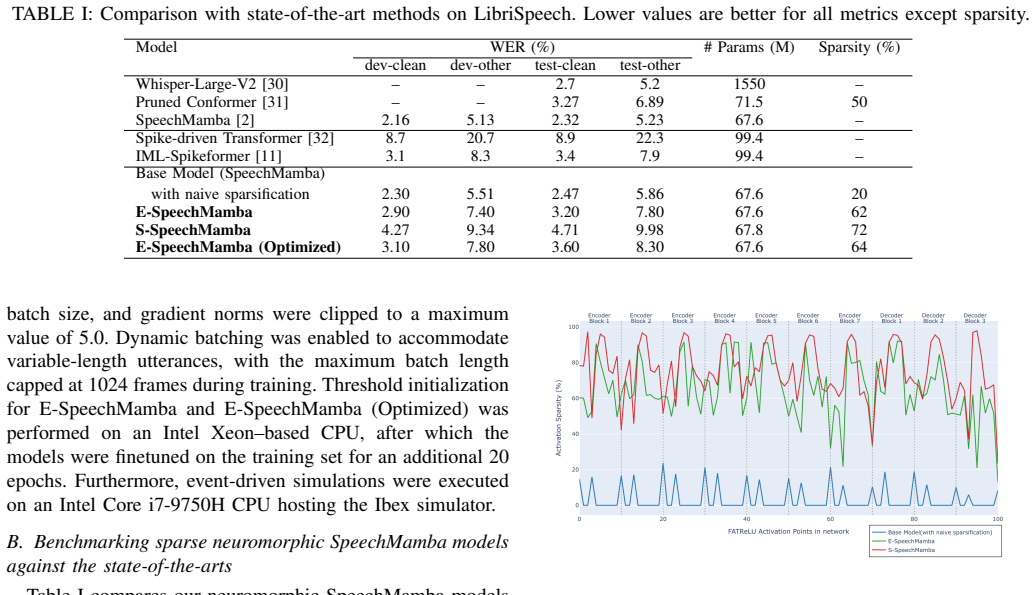
The paper claims that an event-driven SpeechMamba model with FATReLU activation can achieve over 60% activation sparsity with less than 1% accuracy degradation on LibriSpeech, and that a spiking SpeechMamba can attain over 70% sparsity while using 30% fewer parameters than comparable spiking neural networks, supported by results from a cycle-accurate event-driven simulator.
What carries the argument
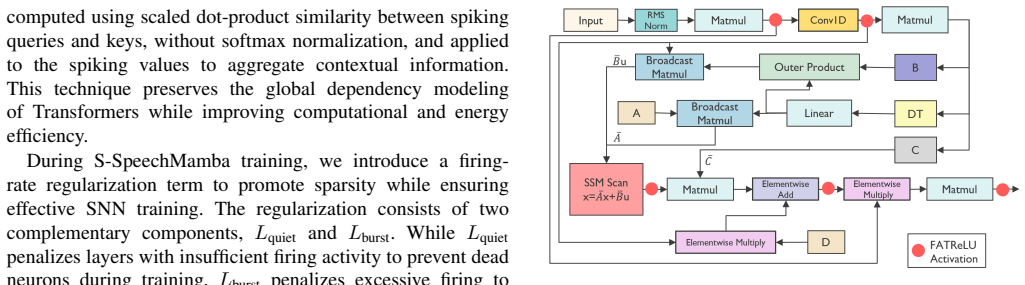
The FATReLU activation function in the event-driven SpeechMamba, which promotes sparsity by producing zero outputs for many inputs, combined with the conversion to spiking neural network dynamics in the spiking variant.
If this is right
- ASR models can operate with far lower energy on edge devices due to the high sparsity.
- The simulator enables identification of computational bottlenecks for additional efficiency gains beyond 10%.
- Spiking versions reduce model size compared to other SNN approaches for the same task.
- High sparsity levels support real-time processing with reduced latency on resource-constrained hardware.
Where Pith is reading between the lines
- These techniques could be tested on other sequence modeling architectures for similar efficiency gains.
- Physical hardware measurements would be needed to confirm the energy benefits beyond simulation.
- The approach opens the possibility of combining with other neuromorphic sensors for integrated low-power systems.
Load-bearing premise
Sparsity measured in the cycle-accurate simulator will produce corresponding reductions in energy consumption on real neuromorphic hardware.
What would settle it
Deploying the models on physical neuromorphic chips and measuring that energy use remains close to that of the original dense model despite the reported sparsity.
Figures


read the original abstract
Deep learning has greatly advanced automatic speech recognition (ASR), enabling widespread deployment on edge devices such as smartphones and smart home systems. However, the computational and energy demands of deep neural networks pose significant challenges for such resource-constrained deployments, introducing latency and limiting real-time interaction. Neuromorphic computing offers a promising solution by introducing activation sparsity through spiking neural networks (SNNs) and event-driven neural networks, converting dense operations into sparse computations. However, a study that evaluates the hardware benefits of different neuromorphic strategies remains lacking for ASR. This paper explores spiking and event-driven neuromorphic neural networks to improve activation sparsity in the state-of-the-art SpeechMamba model for ASR. We introduce an event-driven SpeechMamba with FATReLU activation, achieving over 60% activation sparsity with less than 1% accuracy degradation on LibriSpeech. We also propose a spiking SpeechMamba that attains over 70% sparsity while using 30% fewer parameters than comparable SNNs. Finally, we develop a cycle-accurate event-driven simulator enabling flexible algorithm-hardware co-exploration, which helps us identify computational bottlenecks and yields over 10% additional efficiency improvements.
Editorial analysis
A structured set of objections, weighed in public.
Referee Report
Summary. The paper introduces event-driven and spiking neuromorphic variants of the SpeechMamba architecture for automatic speech recognition. It claims an event-driven SpeechMamba with FATReLU activation achieves >60% activation sparsity with <1% accuracy degradation on LibriSpeech, a spiking version reaches >70% sparsity with 30% fewer parameters than comparable SNNs, and a custom cycle-accurate event-driven simulator identifies bottlenecks and yields >10% additional efficiency gains.
Significance. If the reported sparsity levels, accuracy retention, and simulator-derived efficiency improvements are reproducible and translate to hardware, the work would provide a concrete demonstration of neuromorphic techniques applied to state-space models for edge ASR, with the FATReLU activation and co-exploration simulator as potentially reusable contributions. The empirical focus on a public dataset is a strength, though the absence of hardware measurements limits the immediate applicability to real neuromorphic deployments.
major comments (2)
- [Abstract] Abstract: the concrete claims of >60% sparsity with <1% accuracy loss and >70% sparsity with 30% parameter reduction are presented without any description of training protocols, baseline models (e.g., standard SpeechMamba or other SNNs), number of runs, or error bars, rendering the central empirical results impossible to evaluate for statistical reliability.
- [Simulator results section] Simulator results section: the reported >10% additional efficiency from the cycle-accurate event-driven simulator rests on the unvalidated assumption that modeled event-driven and spiking costs (membrane updates, event routing, SSM state carry-over) match physical neuromorphic hardware; no cross-validation or comparison to real-chip measurements is described, which is load-bearing for the hardware-benefit claims.
minor comments (1)
- [Method] The definition and implementation details of the FATReLU activation (threshold parameter, event generation logic) are referenced but not fully specified in the provided text, which would aid reproducibility.
Simulated Author's Rebuttal
We thank the referee for the constructive feedback. We address each major comment point-by-point below, providing the strongest honest defense of the manuscript while acknowledging limitations where they exist.
read point-by-point responses
-
Referee: [Abstract] Abstract: the concrete claims of >60% sparsity with <1% accuracy loss and >70% sparsity with 30% parameter reduction are presented without any description of training protocols, baseline models (e.g., standard SpeechMamba or other SNNs), number of runs, or error bars, rendering the central empirical results impossible to evaluate for statistical reliability.
Authors: The abstract serves as a concise high-level summary of the key empirical outcomes. Full details on training protocols (surrogate gradient learning for the spiking variant and standard optimization for the event-driven FATReLU model) appear in Section 3. Baseline models, including comparisons to vanilla SpeechMamba and prior SNNs, are defined and evaluated in Section 4. All reported sparsity and accuracy figures are averaged over five independent runs with standard deviation error bars shown in Tables 2–4. These elements allow statistical evaluation from the complete manuscript. We can revise the abstract to include a brief parenthetical reference to the experimental protocol if space permits. revision: partial
-
Referee: [Simulator results section] Simulator results section: the reported >10% additional efficiency from the cycle-accurate event-driven simulator rests on the unvalidated assumption that modeled event-driven and spiking costs (membrane updates, event routing, SSM state carry-over) match physical neuromorphic hardware; no cross-validation or comparison to real-chip measurements is described, which is load-bearing for the hardware-benefit claims.
Authors: The cycle-accurate simulator models event-driven costs using established parameters from the neuromorphic literature (membrane potential updates, sparse event routing, and SSM state propagation). The >10% efficiency improvement arises from simulator-guided identification of routing and state-update bottlenecks, enabling targeted algorithmic changes. We agree that the absolute hardware gains remain modeled rather than directly measured on physical chips; no cross-validation against real neuromorphic hardware is provided because such platforms were unavailable during the study. The simulator nonetheless supplies a reproducible tool for co-exploration, as stated in the contributions. revision: no
- Absence of direct measurements on physical neuromorphic hardware to validate simulator predictions.
Circularity Check
No circularity; empirical measurements only
full rationale
The paper proposes event-driven and spiking variants of SpeechMamba, reports measured activation sparsity (>60% and >70%), accuracy degradation (<1%), parameter reduction (30%), and simulator efficiency gains (>10%) on LibriSpeech. These are direct experimental outcomes from model modifications and cycle-accurate simulation, with no derivation chain, equations, or first-principles results that reduce to inputs by construction. No self-definitional steps, fitted-input predictions, load-bearing self-citations, uniqueness theorems, or ansatz smuggling appear. The work is self-contained against external benchmarks (public dataset, simulator), consistent with the reader's assessment of score ~2.
Axiom & Free-Parameter Ledger
free parameters (1)
- FATReLU threshold
axioms (1)
- domain assumption Standard backpropagation training converges to a usable local minimum for the modified activations
invented entities (2)
-
FATReLU activation
no independent evidence
-
cycle-accurate event-driven simulator
no independent evidence
Reference graph
Works this paper leans on
-
[1]
Conformer: Convolution-augmented transformer for speech recognition,
A. Gulati, J. Qin, C.-C. Chiu, N. Parmar, Y . Zhang, J. Yu, W. Han, S. Wang, Z. Zhang, Y . Wuet al., “Conformer: Convolution-augmented transformer for speech recognition,” inProc. Interspeech 2020, 2020, pp. 5036–5040
2020
-
[2]
Speech-mamba: Long-context speech recogni- tion with selective state spaces models,
X. Gao and N. F. Chen, “Speech-mamba: Long-context speech recogni- tion with selective state spaces models,” in2024 IEEE Spoken Language Technology Workshop (SLT). IEEE, 2024, pp. 1–8
2024
-
[3]
Conformer-based speech recognition on ex- treme edge-computing devices,
M. Xu, A. Jin, S. Wang, M. Su, T. Ng, H. Mason, S. Han, Z. Lei, Y . Deng, Z. Huanget al., “Conformer-based speech recognition on ex- treme edge-computing devices,” inProceedings of the 2024 Conference of the North American Chapter of the Association for Computational Linguistics: Human Language Technologies (Volume 6: Industry Track), 2024, pp. 131–139
2024
-
[4]
Efficient processing of deep neural networks: A tutorial and survey,
V . Sze, Y .-H. Chen, T.-J. Yang, and J. S. Emer, “Efficient processing of deep neural networks: A tutorial and survey,”Proceedings of the IEEE, vol. 105, no. 12, pp. 2295–2329, 2017
2017
-
[5]
Training spiking neural networks using lessons from deep learning,
J. K. Eshraghian, M. Ward, E. O. Neftci, X. Wang, G. Lenz, G. Dwivedi, M. Bennamoun, D. S. Jeong, and W. D. Lu, “Training spiking neural networks using lessons from deep learning,”Proceedings of the IEEE, vol. 111, no. 9, pp. 1016–1054, 2023
2023
-
[6]
Optimizing event-based neural networks on digital neuromorphic architecture: a comprehensive design space exploration,
Y . Xu, K. Shidqi, G.-J. van Schaik, R. Bilgic, A. Dobrita, S. Wang, R. Meijer, P. Nembhani, C. Arjmand, P. Martinelloet al., “Optimizing event-based neural networks on digital neuromorphic architecture: a comprehensive design space exploration,”Frontiers in Neuroscience, vol. 18, p. 1335422, 2024
2024
-
[7]
Context-aware sparse spatiotemporal learning for event-based vision,
S. Wang and G. Tang, “Context-aware sparse spatiotemporal learning for event-based vision,” in2025 IEEE/RSJ International Conference on Intelligent Robots and Systems (IROS). IEEE, 2025, pp. 13 713–13 719
2025
-
[8]
Explore activation sparsity in recurrent llms for energy- efficient neuromorphic computing,
I. Knunyants, M. Tavakol, M. Sifalakis, Y . Xu, A. Yousefzadeh, and G. Tang, “Explore activation sparsity in recurrent llms for energy- efficient neuromorphic computing,” in2025 IEEE 7th International Conference on Artificial Intelligence Circuits and Systems (AICAS), 2025, pp. 1–5
2025
-
[9]
Deep residual spiking neural network for keyword spotting in low-resource settings
Q. Yang, Q. Liu, and H. Li, “Deep residual spiking neural network for keyword spotting in low-resource settings.” inInterspeech, 2022, pp. 3023–3027
2022
-
[10]
Dpsnn: spiking neural network for low-latency streaming speech enhancement,
T. Sun and S. Boht ´e, “Dpsnn: spiking neural network for low-latency streaming speech enhancement,”Neuromorphic Computing and Engi- neering, vol. 4, no. 4, p. 044008, 2024
2024
-
[11]
Iml-spikeformer: Input-aware multilevel spiking transformer for speech processing,
Z. Song, S. Zhang, Y . Chou, J. Wu, and H. Li, “Iml-spikeformer: Input-aware multilevel spiking transformer for speech processing,”IEEE Transactions on Neural Networks and Learning Systems, 2025
2025
-
[12]
Randomize and match: Exploiting irregular sparsity for energy efficient processing in snns,
F. Liu, Z. Wang, W. Zhao, Y . Chen, T. Yang, X. Yang, and L. Jiang, “Randomize and match: Exploiting irregular sparsity for energy efficient processing in snns,” in2022 IEEE 40th International Conference on Computer Design (ICCD). IEEE, 2022, pp. 451–454
2022
-
[13]
Loihi: A neuromorphic manycore processor with on-chip learning,
M. Davies, N. Srinivasa, T.-H. Lin, G. Chinya, Y . Cao, S. H. Choday, G. Dimou, P. Joshi, N. Imam, S. Jainet al., “Loihi: A neuromorphic manycore processor with on-chip learning,”Ieee Micro, vol. 38, no. 1, pp. 82–99, 2018
2018
-
[14]
Inducing and exploiting activation sparsity for fast inference on deep neural networks,
M. Kurtz, J. Kopinsky, R. Gelashvili, A. Matveev, J. Carr, M. Goin, W. Leiserson, S. Moore, N. Shavit, and D. Alistarh, “Inducing and exploiting activation sparsity for fast inference on deep neural networks,” inInternational Conference on Machine Learning. PMLR, 2020, pp. 5533–5543
2020
-
[15]
Ibex: A small 32-bit RISC-V CPU core,
lowRISC contributors, “Ibex: A small 32-bit RISC-V CPU core,” https: //github.com/lowRISC/ibex, 2024
2024
-
[16]
Neural Machine Translation by Jointly Learning to Align and Translate
D. Bahdanau, “Neural machine translation by jointly learning to align and translate,”arXiv preprint arXiv:1409.0473, 2014
work page internal anchor Pith review Pith/arXiv arXiv 2014
-
[17]
Mamba: Linear-time sequence modeling with selective state spaces,
A. Gu and T. Dao, “Mamba: Linear-time sequence modeling with selective state spaces,” inFirst conference on language modeling, 2024
2024
-
[18]
An Exploration of Mamba for Speech Self-Supervised Models
T.-Q. Lin, H.-C. Kuo, T.-C. Wei, H.-C. Cheng, C.-W. Chen, H.-F. Hsiao, Y . Tsao, and H.-y. Lee, “An exploration of mamba for speech self- supervised models,”arXiv preprint arXiv:2506.12606, 2025
work page internal anchor Pith review Pith/arXiv arXiv 2025
-
[19]
Spikformer: When spiking neural network meets transformer.arXiv preprint arXiv:2209.15425, 2022
Z. Zhou, Y . Zhu, C. He, Y . Wang, S. Yan, Y . Tian, and L. Yuan, “Spikformer: When spiking neural network meets transformer,”arXiv preprint arXiv:2209.15425, 2022
-
[20]
Spikmamba: When snn meets mamba in event-based human action recognition,
J. Chen, Y . Yang, S. Deng, D. Teng, and L. Pan, “Spikmamba: When snn meets mamba in event-based human action recognition,” inProceedings of the 6th ACM International Conference on Multimedia in Asia, ser. MMAsia ’24. New York, NY , USA: Association for Computing Machinery, 2024. [Online]. Available: https://doi.org/10.1145/3696409.3700204
-
[21]
Seneca: building a fully digital neuromorphic processor, design trade-offs and challenges,
G. Tang, K. Vadivel, Y . Xu, R. Bilgic, K. Shidqi, P. Detterer, S. Traferro, M. Konijnenburg, M. Sifalakis, G.-J. van Schaiket al., “Seneca: building a fully digital neuromorphic processor, design trade-offs and challenges,” Frontiers in Neuroscience, vol. 17, p. 1187252, 2023
2023
-
[22]
Timeloop: A systematic approach to dnn accelerator evaluation,
A. Parashar, P. Raina, Y . S. Shao, Y .-H. Chen, V . A. Ying, A. Mukkara, R. Venkatesan, B. Khailany, S. W. Keckler, and J. Emer, “Timeloop: A systematic approach to dnn accelerator evaluation,” in2019 IEEE inter- national symposium on performance analysis of systems and software (ISPASS). IEEE, 2019, pp. 304–315
2019
-
[23]
Nnasim: An efficient event-driven simulator for dnn accelerators with accurate timing and area models,
X. Yi, J. Yu, Z. Wu, X. Xiong, D. Xu, C. Chen, J. Tao, and F. Yang, “Nnasim: An efficient event-driven simulator for dnn accelerators with accurate timing and area models,” in2022 IEEE International Sympo- sium on Circuits and Systems (ISCAS), 2022, pp. 2806–2810
2022
-
[24]
An event-based digital compute-in-memory accelerator with flexible operand resolution and layer-wise weight/output stationarity,
N. Chauvaux, A. Kneip, C. Posch, K. Makinwa, and C. Frenkel, “An event-based digital compute-in-memory accelerator with flexible operand resolution and layer-wise weight/output stationarity,” in2025 IEEE International Symposium on Circuits and Systems (ISCAS). IEEE, 2025, pp. 1–5
2025
-
[25]
Ample: Event-driven accelerator for mixed-precision inference of graph neural networks,
P. Gimenes, A. Zhao, and G. A. Constantinides, “Ample: Event-driven accelerator for mixed-precision inference of graph neural networks,” in Proceedings of the 5th Workshop on Machine Learning and Systems, 2025, pp. 107–113
2025
-
[26]
Pycarl: A pynn interface for hardware-software co-simulation of spiking neural network,
A. Balaji, P. Adiraju, H. J. Kashyap, A. Das, J. L. Krichmar, N. D. Dutt, and F. Catthoor, “Pycarl: A pynn interface for hardware-software co-simulation of spiking neural network,” in2020 International Joint Conference on Neural Networks (IJCNN). IEEE, 2020, pp. 1–10
2020
-
[27]
Legendre memory units: Continuous-time representation in recurrent neural networks,
A. V oelker, I. Kaji ´c, and C. Eliasmith, “Legendre memory units: Continuous-time representation in recurrent neural networks,”Advances in neural information processing systems, vol. 32, 2019
2019
-
[28]
Event-based optical flow on neuromorphic processor: Ann vs. snn comparison based on activation sparsification,
Y . Xu, G. Tang, A. Yousefzadeh, G. C. de Croon, and M. Sifalakis, “Event-based optical flow on neuromorphic processor: Ann vs. snn comparison based on activation sparsification,”Neural Networks, vol. 188, p. 107447, 2025
2025
-
[29]
Spinnaker 2: A 10 million core processor system for brain simulation and machine learning-keynote presentation,
C. Mayr, S. Hoeppner, and S. Furber, “Spinnaker 2: A 10 million core processor system for brain simulation and machine learning-keynote presentation,” inCommunicating Process Architectures 2017 & 2018. IOS Press, 2019, pp. 277–280
2017
-
[30]
Robust speech recognition via large-scale weak supervi- sion,
A. Radford, J. W. Kim, T. Xu, G. Brockman, C. McLeavey, and I. Sutskever, “Robust speech recognition via large-scale weak supervi- sion,” inInternational conference on machine learning. PMLR, 2023, pp. 28 492–28 518
2023
-
[31]
Accurate and structured pruning for efficient automatic speech recognition,
H. Jiang, L. L. Zhang, Y . Li, Y . Wu, S. Cao, T. Cao, Y . Yang, J. Li, M. Yang, and L. Qiu, “Accurate and structured pruning for efficient automatic speech recognition,”arXiv preprint arXiv:2305.19549, 2023
-
[32]
Spike- driven transformer,
M. Yao, J. Hu, Z. Zhou, L. Yuan, Y . Tian, B. Xu, and G. Li, “Spike- driven transformer,”Advances in neural information processing systems, vol. 36, pp. 64 043–64 058, 2023
2023
-
[33]
Librispeech: an asr corpus based on public domain audio books,
V . Panayotov, G. Chen, D. Povey, and S. Khudanpur, “Librispeech: an asr corpus based on public domain audio books,” in2015 IEEE international conference on acoustics, speech and signal processing (ICASSP). IEEE, 2015, pp. 5206–5210
2015
-
[34]
SpeechBrain: A general-purpose speech toolkit,
M. Ravanelli, T. Parcollet, P. Plantinga, A. Rouhe, S. Cornell, L. Lugosch, C. Subakan, N. Dawalatabad, A. Heba, J. Zhong et al., “Speechbrain: A general-purpose speech toolkit,”arXiv preprint arXiv:2106.04624, 2021
discussion (0)
Sign in with ORCID, Apple, or X to comment. Anyone can read and Pith papers without signing in.