REVIEW 4 major objections 6 minor 96 references
Seeing World Dynamics in a Nutshell
T0 review · 4 major / 6 minor · reviewed 2026-08-09 · deepseek-v4-flash
Pith's one-line read Monocular video becomes dynamic 3D Gaussians in a single pass.
desk verdict Fast, clever feed-forward video-to-Gaussian method, but the 'true 3D' claim is not yet backed by quantitative geometry tests. read the letter →
The pith
A machine-rendered reading of the paper's core claim, the machinery that carries it, and where it could break.
The reading
What carries the argument
The central object is the spatial-temporal aligned Gaussian (STAG), a structured dynamic Gaussian representation in an orthographic canonical camera space. Each Gaussian is bound to a pixel coordinate (u, v), a depth d predicted by bin regression, and a reference timestamp; a temporal slicing indicator suppresses the deformation field at the reference frame to preserve spatial alignment, and a small MLP conditioned on a sinusoidal time encoding produces the continuous deformation field $\mu(t)$ that interpolates frames at arbitrary timestamps. The network pipeline concatenates RGB frames with a depth prior channel, processes the tokens with self-attention and hierarchical upsampling, and decodes Gaussian attributes (position, opacity, scale, rotation, color) from the resulting feature map. Two regularizers carry the argument: a scale-and-shift invariant depth loss that aligns rendered depth with the pseudo-depth prior, and a global flow loss that compares projected Gaussian trajectories against cumulative optical-flow paths, both with outlier filtering.
What would settle it
Render held-out viewpoints with increasing angular or translational offsets and compare against ground-truth multi-view capture; if image quality collapses at modest parallax or recovered depth disagrees with known scene geometry, STAG is a layered 2.5D reconstruction rather than a true 3D representation.
Extended reading notes
Core claim
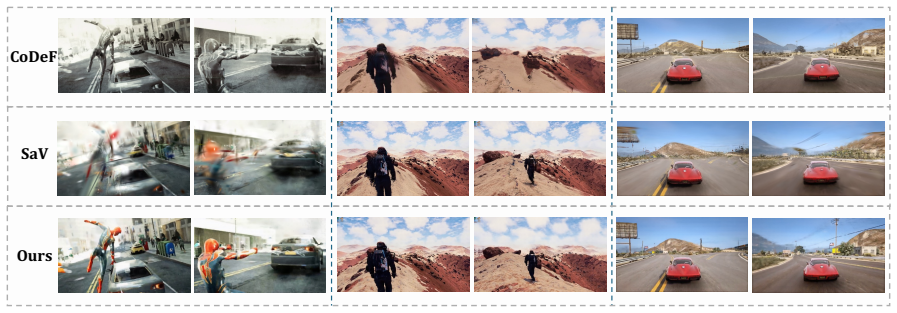
NutWorld's central claim is that a monocular video can be represented directly in its intrinsic 3D form by a structured spatial-temporal aligned Gaussian point cloud, predicted from six sparsely sampled frames by a transformer in a single forward pass. The key to making this feed-forward prediction stable is the spatial-temporal alignment: each Gaussian is anchored to a specific pixel location and timestamp in a fixed orthographic canonical volume, so its static position is $\mu = (u + \Delta x, v + \Delta y, d)$, with bounded offsets and a depth coordinate, while a continuous deformation field $\mu(t)$ carries it through time. Calibrated depth and optical-flow priors provide the geometric and motion supervision that disambiguates the monocular input. The paper supports the claim with reconstruction metrics that exceed optimization-based baselines and with ablations showing that loosening the STAG constraint degrades PSNR by about 10 dB, while removing the flow or depth losses also causes clear drops.
Load-bearing premise
The load-bearing premise is that a fixed orthographic camera plus a monocular depth prior provides enough geometric signal for the resulting STAG to be treated as genuine 3D structure rather than a 2.5D image mosaic.
Editorial extensions
If this is right
- NutWorld reconstructs a 90-frame video in 1.8 seconds and renders at 450 FPS, roughly a 1000x speedup over the optimization-based baselines it is compared with.
- Because every Gaussian is tied to a pixel and timestamp, segment-based inference can extend the representation to arbitrarily long videos while preserving trajectory continuity through overlapping frames.
- The continuous deformation field supports rendering intermediate frames at arbitrary timestamps, giving frame interpolation without per-frame generation.
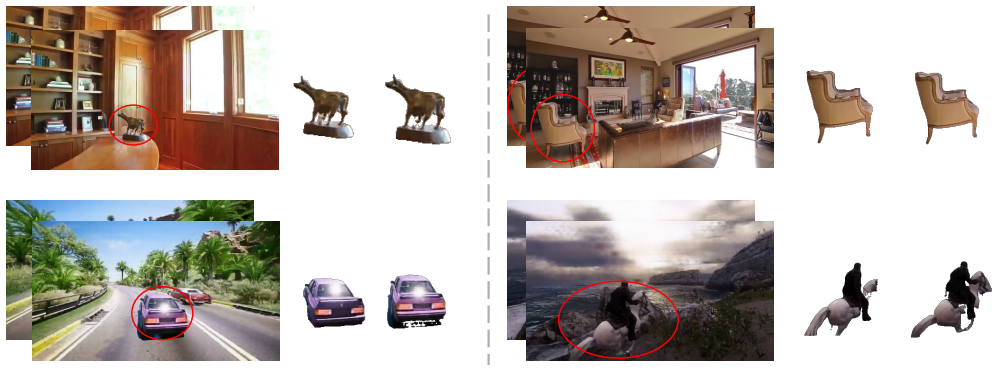
- The explicit, maskable Gaussians enable video object segmentation by propagating an initial mask through the deformation field, with no task-specific training.
- The ablations show the representation is not merely cosmetic: removing the flow loss drops PSNR from 29.18 to 26.39, removing the depth loss drops it to 28.15, and removing the STAG structure drops it to 19.58.
Reading between the lines
- Editorial inference: because NutWorld uses a fixed orthographic camera, its '3D' is a single-view layered geometry; a strict test would be whether rendering quality survives larger camera translation than the small dolly or zoom effects shown.
- Editorial inference: the method's ceiling is set by the external depth and flow priors; corrupting those priors at test time would quantify how much geometry and motion come from the network rather than from the priors.
- Editorial inference: the pixel-anchored structure suggests a natural extension to video generation, where the deformation field could be sampled or predicted from text rather than learned from the input video alone.
- Editorial inference: distilling semantic features into each Gaussian, which the authors name as future work, would let segmentation and editing run directly on STAG without extra inference-time models.
Editorial analysis
A structured set of objections, weighed in public.
Referee Report
Summary. The paper proposes NutWorld, a feed-forward framework that maps a monocular video into a set of spatially and temporally aligned 3D Gaussians (STAG) in a fixed orthographic canonical space. A transformer encoder with hierarchical upsampling predicts per-pixel Gaussian attributes and deformation fields, regularized by off-the-shelf video depth and optical-flow priors. The authors report reconstruction PSNR/SSIM/LPIPS on 50 clips from MiraData and RealEstate10K, a 1.8-second inference time for a 90-frame video, 450 FPS rendering, and qualitative demonstrations of segmentation, editing, interpolation, consistent depth, and novel-view synthesis. The main claimed contribution is an optimization-free dynamic 3D representation for casually captured monocular videos.
Significance. If the geometric component is validated, this is a useful advance: single-forward-pass dynamic Gaussian reconstruction with real-time rendering would be relevant to video representation and downstream video editing tasks. The STAG structure is well motivated, the ablation study shows that the depth and flow losses matter, and the reported speed improvements are substantial. The paper currently provides strong evidence for a high-quality video codec under a fixed orthographic camera, but the evidence that this codec is a genuine recovered dynamic 3D representation is incomplete; the missing quantitative geometry checks are the main gap.
major comments (4)
- [Section 4.1 and Section 5.2] The reconstruction metrics in Table 1 are computed under the same fixed orthographic camera used to define the canonical space in Section 4.1. With pixel-aligned Gaussian centers and per-frame colors, a depth-ordered 2.5D mosaic can plausibly match the reported PSNR/SSIM/LPIPS numbers without representing a true dynamic 3D volume. The authors should provide a quantitative geometry check, for example held-out novel-view synthesis using the COLMAP poses that are available for RealEstate10K (which the paper explicitly declines to use in the Section 5.1 footnote and Appendix 2), or depth error against a reliable reference, and should compare against a 2.5D baseline under the same protocol.
- [Section 5.2 and Appendix 2] The 50 test clips are drawn from MiraData and RealEstate10K, the same datasets used for training, with a random 95:5 split. This gives NutWorld an in-distribution advantage over optimization-based baselines that are evaluated on the same clips but do not share the training distribution. The authors should report per-dataset numbers, add cross-dataset evaluation or a held-out-domain clip set, and state the train/test overlap explicitly in the main text rather than only in the appendix.
- [Section 5.3 and Figure 12] Novel view synthesis and consistent depth are presented as evidence of spatial 3D structure, but the evidence is purely qualitative. This is load-bearing for the central claim: a 2.5D representation can also produce plausible depth visualizations and small-baseline view changes. The authors should quantify novel-view accuracy on RealEstate10K, where camera poses are available, or otherwise temper the claim that STAG is a genuine 3D representation.
- [Equations (6) and (8)] The depth and flow losses provide useful regularization, but they supervise against external priors rather than ground-truth scene geometry. The qualitative ablation in Figure 7(a) shows depth collapse without the depth loss, which is informative, yet it does not establish the absolute correctness or temporal consistency of the recovered depths. Since Appendix 4 candidly acknowledges dependence on these priors, the paper should either add a quantitative geometry evaluation or carefully rephrase the abstract's claim that NutWorld 'transforms monocular videos into dynamic 3D Gaussian representations' to reflect what is actually measured.
minor comments (6)
- [Equation (6)] The denominator written as 'X M' is unclear; it should be the sum of the mask values over all pixels, and the summation index in Ldepth should be made explicit.
- [Section 4.2 and Table 3] The main text states that the deformation output is bounded by tanh within [−b,b]^3, while Table 3 lists the dynamic position as unbounded. This inconsistency should be resolved because it affects reproducibility.
- [Section 4.2] The claim that positional embeddings are unnecessary because 'depth coordinates inherently encode spatial information' is imprecise: the concatenated depth channel is a scalar per pixel and does not by itself encode the 2D grid coordinate. Please clarify how spatial position is injected.
- [Section 5.2] The sentence 'all methods incorporate the confined canonical space, depth and flow supervision' needs more detail: it should state how each optimization-based baseline was adapted to this protocol, since the comparison may otherwise be difficult to reproduce.
- [Table 4 and Table 3] There are typos in the activation names: 'Sof tplus' should be 'Softplus' and 'N ormalize' should be 'Normalize'.
- [Appendix 2, Segment-based inference] The statement 'Through quantitative comparison shown in Table.1 in the manuscript' is confusing because Table 1 does not directly report segment-based inference. Please cite the specific experiment or figure that supports this claim.
Circularity Check
No significant circularity: self-citations are peripheral, and the core feed-forward reconstruction claim is empirically tested against external priors and optimization-based baselines.
full rationale
NutWorld is an empirical systems paper rather than a derivation chain, and its central quantitative claim is reconstruction quality on held-out video clips. The depth and flow priors come from external foundation models (Video Depth Anything and UniMatch), and they are used both as input channels and as regularizers; the paper is transparent about this and does not present the regularized depth or flow outputs as an independent prediction. The RGB reconstruction metrics in Table 1 are standard image-similarity measures on test clips, so the main result does not reduce by construction to the training losses. The cited works by the same authors (Gamba, MVGamba, GFlow, FlashSplat) appear in related-work context or as tools for downstream segmentation; none is invoked as a uniqueness theorem or as the justification for the STAG representation. The reviewer concern that the fixed orthographic camera and per-pixel alignment make STAG close to a 2.5D video codec, and that no quantitative novel-view or depth-accuracy evaluation is reported, is a legitimate verification gap about whether the representation is genuinely 3D, but it is not a circularity step: the paper does not define its 3D claim in terms of the metrics it reports. Overall, the derivation is self-contained with respect to external benchmarks, and no fitted parameter is renamed as a prediction.
Assumptions & free parameters
free parameters (5)
- loss weights lambda_MSE, lambda_depth, lambda_flow =
0.5, 0.001, 0.2
- number of upsampler blocks n =
2 (main) / 3 (variant)
- depth discretization bins =
20
- deformation amplitude bound b =
not specified
- outlier thresholds for depth and flow =
top 10% depth values, top 20% flow magnitudes
assumptions (4)
- domain assumption A monocular video can be interpreted as a projection of a dynamic 3D world represented by Gaussian primitives in an orthographic canonical volume.
- domain assumption Pretrained depth (Video Depth Anything) and optical flow (UniMatch) priors provide reliable supervision for spatial and temporal structure.
- domain assumption The training datasets (MiraData, RealEstate10K) are representative of casually captured monocular videos.
- domain assumption The orthographic camera model and depth-in-[0,1] parameterization eliminate scale ambiguity without losing essential structure.
invented entities (1)
-
Spatial-Temporal Aligned Gaussian (STAG)
Cite this review
Pith. "Pith review of Seeing World Dynamics in a Nutshell." pith.science (2026). https://pith.science/paper/P37A2BW4
@misc{pith2026250203465,
  author       = {Pith},
  title        = {Pith review of: Seeing World Dynamics in a Nutshell},
  year         = {2026},
  howpublished = {\url{https://pith.science/paper/P37A2BW4}},
  note         = {Machine review of arXiv:2502.03465}
}
read the original abstract
We consider the problem of efficiently representing casually captured monocular videos in a spatially- and temporally-coherent manner. While existing approaches predominantly rely on 2D/2.5D techniques treating videos as collections of spatiotemporal pixels, they struggle with complex motions, occlusions, and geometric consistency due to absence of temporal coherence and explicit 3D structure. Drawing inspiration from monocular video as a projection of the dynamic 3D world, we explore representing videos in their intrinsic 3D form through continuous flows of Gaussian primitives in space-time. In this paper, we propose NutWorld, a novel framework that efficiently transforms monocular videos into dynamic 3D Gaussian representations in a single forward pass. At its core, NutWorld introduces a structured spatial-temporal aligned Gaussian (STAG) representation, enabling optimization-free scene modeling with effective depth and flow regularization. Through comprehensive experiments, we demonstrate that NutWorld achieves high-fidelity video reconstruction quality while enabling various downstream applications in real-time. Demos and code will be available at https://github.com/Nut-World/NutWorld.
Figures


Figures from the paper (10 more)


Reference graph
Works this paper leans on
-
[1]
Jinbin Bai, Tian Ye, Wei Chow, Enxin Song, Qing- Guo Chen, Xiangtai Li, Zhen Dong, Lei Zhu, and Shuicheng Yan. Meissonic: Revitalizing masked gen- erative transformers for efficient high-resolution text- to-image synthesis. arXiv preprint arXiv:2410.08261,
-
[2]
Vidu: a highly consis- tent, dynamic and skilled text-to-video generator with diffusion models
Fan Bao, Chendong Xiang, Gang Yue, Guande He, Hongzhou Zhu, Kaiwen Zheng, Min Zhao, Shilong Liu, Yaole Wang, and Jun Zhu. Vidu: a highly consis- tent, dynamic and skilled text-to-video generator with diffusion models. arXiv preprint arXiv:2405.04233 ,
-
[3]
Shariq Farooq Bhat, Reiner Birkl, Diana Wofk, Peter Wonka, and Matthias M ¨uller. Zoedepth: Zero-shot transfer by combining relative and metric depth.arXiv preprint arXiv:2302.12288, 2023. 5
arXiv 2023
-
[4]
Nope-nerf: Optimising neural radiance field with no pose prior
Wenjing Bian, Zirui Wang, Kejie Li, Jia-Wang Bian, and Victor Adrian Prisacariu. Nope-nerf: Optimising neural radiance field with no pose prior. In Proceed- ings of the IEEE/CVF Conference on Computer Vision and Pattern Recognition, pages 4160–4169, 2023. 2
2023
-
[5]
The essential guide to video process- ing
Alan C Bovik. The essential guide to video process- ing. Academic Press, 2009. 2
2009
-
[6]
Pix2video: Video editing using image diffusion
Duygu Ceylan, Chun-Hao P Huang, and Niloy J Mitra. Pix2video: Video editing using image diffusion. In Proceedings of the IEEE/CVF International Confer- ence on Computer Vision, pages 23206–23217, 2023. 2
2023
-
[7]
pixelsplat: 3d gaussian splats from image pairs for scalable generalizable 3d recon- struction
David Charatan, Sizhe Lester Li, Andrea Tagliasacchi, and Vincent Sitzmann. pixelsplat: 3d gaussian splats from image pairs for scalable generalizable 3d recon- struction. In CVPR, pages 19457–19467, 2024. 3, 4, 5, 6, 1, 2
2024
-
[8]
Video depth anything: Consistent depth estimation for super- long videos
Sili Chen, Hengkai Guo, Shengnan Zhu, Feihu Zhang, Zilong Huang, Jiashi Feng, and Bingyi Kang. Video depth anything: Consistent depth estimation for super- long videos. arXiv preprint arXiv:2501.12375, 2025. 2, 4, 5
arXiv 2025
Show all 96 references
-
[9]
Learning continuous image representation with local implicit image function
Yinbo Chen, Sifei Liu, and Xiaolong Wang. Learning continuous image representation with local implicit image function. In Proceedings of the IEEE/CVF con- ference on computer vision and pattern recognition , pages 8628–8638, 2021. 3
2021
-
[10]
Mvsplat: Efficient 3d gaus- sian splatting from sparse multi-view images
Yuedong Chen, Haofei Xu, Chuanxia Zheng, Bo- han Zhuang, Marc Pollefeys, Andreas Geiger, Tat-Jen Cham, and Jianfei Cai. Mvsplat: Efficient 3d gaus- sian splatting from sparse multi-view images. InEuro- pean Conference on Computer Vision, pages 370–386. Springer, 2025. 3, 6, 2
2025
-
[11]
Depth-regularized optimization for 3d gaussian splatting in few-shot images
Jaeyoung Chung, Jeongtaek Oh, and Kyoung Mu Lee. Depth-regularized optimization for 3d gaussian splatting in few-shot images. In Proceedings of the IEEE/CVF Conference on Computer Vision and Pat- tern Recognition, pages 811–820, 2024. 2
2024
-
[12]
Flashattention-2: Faster attention with bet- ter parallelism and work partitioning
Tri Dao. Flashattention-2: Faster attention with bet- ter parallelism and work partitioning. arXiv preprint arXiv:2307.08691, 2023. 7
2023 arXiv
-
[13]
Transformers are SSMs: Generalized models and efficient algorithms through structured state space duality
Tri Dao and Albert Gu. Transformers are SSMs: Generalized models and efficient algorithms through structured state space duality. In International Con- ference on Machine Learning (ICML), 2024. 3
2024
-
[14]
Flashattention: Fast and memory- efficient exact attention with io-awareness
Tri Dao, Dan Fu, Stefano Ermon, Atri Rudra, and Christopher R ´e. Flashattention: Fast and memory- efficient exact attention with io-awareness. Advances in Neural Information Processing Systems, 35:16344– 16359, 2022. 7
2022
-
[15]
Video frame interpolation: A comprehensive survey
Jiong Dong, Kaoru Ota, and Mianxiong Dong. Video frame interpolation: A comprehensive survey. ACM Transactions on Multimedia Computing, Communica- tions and Applications, 19(2s):1–31, 2023. 2
2023
-
[16]
An image is worth 16x16 words: Transformers for image recognition at scale
Alexey Dosovitskiy. An image is worth 16x16 words: Transformers for image recognition at scale. arXiv preprint arXiv:2010.11929, 2020. 5
2010 arXiv
-
[17]
4d gaussian splatting: Towards efficient novel view synthesis for dynamic scenes
Yuanxing Duan, Fangyin Wei, Qiyu Dai, Yuhang He, Wenzheng Chen, and Baoquan Chen. 4d gaussian splatting: Towards efficient novel view synthesis for dynamic scenes. arXiv preprint arXiv:2402.03307 ,
-
[18]
Slowfast networks for video recog- nition
Christoph Feichtenhofer, Haoqi Fan, Jitendra Malik, and Kaiming He. Slowfast networks for video recog- nition. In Proceedings of the IEEE/CVF interna- tional conference on computer vision , pages 6202– 6211, 2019. 2
2019
-
[19]
Guiding instruction-based image editing via multimodal large language models
Tsu-Jui Fu, Wenze Hu, Xianzhi Du, William Yang Wang, Yinfei Yang, and Zhe Gan. Guiding instruction-based image editing via multimodal large language models. arXiv preprint arXiv:2309.17102 ,
-
[20]
Efros, and Xiaolong Wang
Yang Fu, Sifei Liu, Amey Kulkarni, Jan Kautz, Alexei A. Efros, and Xiaolong Wang. Colmap-free 3d gaussian splatting. In Proceedings of the IEEE/CVF Conference on Computer Vision and Pattern Recogni- tion (CVPR), pages 20796–20805, 2024. 2
2024
-
[21]
Vista: A generalizable driving world model with high fidelity and versatile controllability
Shenyuan Gao, Jiazhi Yang, Li Chen, Kashyap Chitta, Yihang Qiu, Andreas Geiger, Jun Zhang, and Hongyang Li. Vista: A generalizable driving world model with high fidelity and versatile controllability. arXiv preprint arXiv:2405.17398, 2024. 2
2024 arXiv
-
[22]
Epipolar transformers
Yihui He, Rui Yan, Katerina Fragkiadaki, and Shoou- I Yu. Epipolar transformers. In Proceedings of the ieee/cvf conference on computer vision and pattern recognition, pages 7779–7788, 2020. 3
2020
-
[23]
8 Semantic anything in 3d gaussians
Xu Hu, Yuxi Wang, Lue Fan, Junsong Fan, Jun- ran Peng, Zhen Lei, Qing Li, and Zhaoxiang Zhang. 8 Semantic anything in 3d gaussians. arXiv preprint arXiv:2401.17857, 2024. 8
2024 arXiv
-
[24]
2d gaussian splatting for geometrically accurate radiance fields
Binbin Huang, Zehao Yu, Anpei Chen, Andreas Geiger, and Shenghua Gao. 2d gaussian splatting for geometrically accurate radiance fields. In ACM SIG- GRAPH 2024 Conference Papers, pages 1–11, 2024. 2
2024
-
[25]
V oxposer: Composable 3d value maps for robotic manipulation with language models
Wenlong Huang, Chen Wang, Ruohan Zhang, Yunzhu Li, Jiajun Wu, and Li Fei-Fei. V oxposer: Composable 3d value maps for robotic manipulation with language models. arXiv preprint arXiv:2307.05973, 2023. 2
2023 arXiv
-
[26]
Rekep: Spatio-temporal rea- soning of relational keypoint constraints for robotic manipulation
Wenlong Huang, Chen Wang, Yunzhu Li, Ruohan Zhang, and Li Fei-Fei. Rekep: Spatio-temporal rea- soning of relational keypoint constraints for robotic manipulation. arXiv preprint arXiv:2409.01652 ,
-
[27]
Miradata: A large-scale video dataset with long durations and structured captions, 2024
Xuan Ju, Yiming Gao, Zhaoyang Zhang, Ziyang Yuan, Xintao Wang, Ailing Zeng, Yu Xiong, Qiang Xu, and Ying Shan. Miradata: A large-scale video dataset with long durations and structured captions, 2024. 2, 6
2024
-
[28]
Cotracker: It is better to track together
Nikita Karaev, Ignacio Rocco, Benjamin Graham, Na- talia Neverova, Andrea Vedaldi, and Christian Rup- precht. Cotracker: It is better to track together. arXiv preprint arXiv:2307.07635, 2023. 2
2023 arXiv
-
[29]
A compact dynamic 3d gaussian representation for real-time dynamic view synthesis
Kai Katsumata, Duc Minh V o, and Hideki Nakayama. A compact dynamic 3d gaussian representation for real-time dynamic view synthesis. In European Con- ference on Computer Vision, pages 394–412. Springer,
-
[30]
3d gaussian splatting for real-time radiance field rendering
Bernhard Kerbl, Georgios Kopanas, Thomas Leimk¨uhler, and George Drettakis. 3d gaussian splatting for real-time radiance field rendering. ACM Trans. Graph., 42(4):139–1, 2023. 2, 3
2023
-
[31]
Segment anything
Alexander Kirillov, Eric Mintun, Nikhila Ravi, Hanzi Mao, Chloe Rolland, Laura Gustafson, Tete Xiao, Spencer Whitehead, Alexander C Berg, Wan-Yen Lo, et al. Segment anything. In Proceedings of the IEEE/CVF International Conference on Computer Vi- sion, pages 4015–4026, 2023. 8
2023
-
[32]
Videopoet: A large language model for zero-shot video generation
Dan Kondratyuk, Lijun Yu, Xiuye Gu, Jos ´e Lezama, Jonathan Huang, Grant Schindler, Rachel Hornung, Vighnesh Birodkar, Jimmy Yan, Ming-Chang Chiu, et al. Videopoet: A large language model for zero-shot video generation. arXiv preprint arXiv:2312.14125 ,
-
[33]
Dynmf: Neural motion factorization for real-time dynamic view synthesis with 3d gaussian splatting
Agelos Kratimenos, Jiahui Lei, and Kostas Daniilidis. Dynmf: Neural motion factorization for real-time dynamic view synthesis with 3d gaussian splatting. In European Conference on Computer Vision , pages 252–269. Springer, 2025. 2, 3
2025
-
[34]
Mosca: Dynamic gaus- sian fusion from casual videos via 4d motion scaf- folds
Jiahui Lei, Yijia Weng, Adam Harley, Leonidas Guibas, and Kostas Daniilidis. Mosca: Dynamic gaus- sian fusion from casual videos via 4d motion scaf- folds. arXiv preprint arXiv:2405.17421, 2024. 2, 3
2024 arXiv
-
[35]
Grounding image matching in 3d with mast3r, 2024
Vincent Leroy, Yohann Cabon, and Jerome Revaud. Grounding image matching in 3d with mast3r, 2024. 3
2024
-
[36]
Vdg: Vision- only dynamic gaussian for driving simulation
Hao Li, Jingfeng Li, Dingwen Zhang, Chenming Wu, Jieqi Shi, Chen Zhao, Haocheng Feng, Errui Ding, Jingdong Wang, and Junwei Han. Vdg: Vision- only dynamic gaussian for driving simulation. arXiv preprint arXiv:2406.18198, 2024. 2
2024 arXiv
-
[37]
Barf: Bundle-adjusting neural ra- diance fields
Chen-Hsuan Lin, Wei-Chiu Ma, Antonio Torralba, and Simon Lucey. Barf: Bundle-adjusting neural ra- diance fields. In Proceedings of the IEEE/CVF inter- national conference on computer vision, pages 5741– 5751, 2021. 2
2021
-
[38]
Dl3dv-10k: A large-scale scene dataset for deep learning-based 3d vision
Lu Ling, Yichen Sheng, Zhi Tu, Wentian Zhao, Cheng Xin, Kun Wan, Lantao Yu, Qianyu Guo, Zixun Yu, Yawen Lu, et al. Dl3dv-10k: A large-scale scene dataset for deep learning-based 3d vision. In Proceed- ings of the IEEE/CVF Conference on Computer Vision and Pattern Recognition, ...
2024
-
[39]
In- finite nature: Perpetual view generation of natural scenes from a single image
Andrew Liu, Richard Tucker, Varun Jampani, Ameesh Makadia, Noah Snavely, and Angjoo Kanazawa. In- finite nature: Perpetual view generation of natural scenes from a single image. In Proceedings of the IEEE/CVF International Conference on Computer Vi- sion, pages 14458–14467, 2021. 3
2021
-
[40]
Robust dynamic radiance fields
Yu-Lun Liu, Chen Gao, Andreas Meuleman, Hung-Yu Tseng, Ayush Saraf, Changil Kim, Yung-Yu Chuang, Johannes Kopf, and Jia-Bin Huang. Robust dynamic radiance fields. In Proceedings of the IEEE/CVF Con- ference on Computer Vision and Pattern Recognition, pages 13–23, 2023. 3, 6, 7
2023
-
[41]
Video frame interpolation with trans- former
Liying Lu, Ruizheng Wu, Huaijia Lin, Jiangbo Lu, and Jiaya Jia. Video frame interpolation with trans- former. In Proceedings of the IEEE/CVF Conference on Computer Vision and Pattern Recognition , pages 3532–3542, 2022. 2
2022
-
[42]
Dynamicfusion: Reconstruction and tracking of non-rigid scenes in real-time
Richard A Newcombe, Dieter Fox, and Steven M Seitz. Dynamicfusion: Reconstruction and tracking of non-rigid scenes in real-time. In Proceedings of the IEEE conference on computer vision and pattern recognition, pages 343–352, 2015. 2
2015
-
[43]
Open x-embodiment: Robotic learning datasets and rt-x models
Abby O’Neill, Abdul Rehman, Abhinav Gupta, Abhi- ram Maddukuri, Abhishek Gupta, Abhishek Padalkar, Abraham Lee, Acorn Pooley, Agrim Gupta, Ajay Mandlekar, et al. Open x-embodiment: Robotic learning datasets and rt-x models. arXiv preprint arXiv:2310.08864, 2023. 2
-
[44]
Codef: Content deformation fields for temporally consistent video processing
Hao Ouyang, Qiuyu Wang, Yuxi Xiao, Qingyan Bai, Juntao Zhang, Kecheng Zheng, Xiaowei Zhou, Qifeng Chen, and Yujun Shen. Codef: Content deformation fields for temporally consistent video processing. In 9 Proceedings of the IEEE/CVF Conference on Com- puter Vision and Pattern Re...
2024
-
[45]
Global structure-from-motion revisited
Linfei Pan, D ´aniel Bar ´ath, Marc Pollefeys, and Jo- hannes L Sch ¨onberger. Global structure-from-motion revisited. In European Conference on Computer Vi- sion (ECCV), 2024. 3
2024
-
[46]
Fatezero: Fusing attentions for zero-shot text-based video editing
Chenyang Qi, Xiaodong Cun, Yong Zhang, Chenyang Lei, Xintao Wang, Ying Shan, and Qifeng Chen. Fatezero: Fusing attentions for zero-shot text-based video editing. In Proceedings of the IEEE/CVF In- ternational Conference on Computer Vision , pages 15932–15942, 2023. 2
2023
-
[47]
Langsplat: 3d language gaussian splatting
Minghan Qin, Wanhua Li, Jiawei Zhou, Haoqian Wang, and Hanspeter Pfister. Langsplat: 3d language gaussian splatting. In Proceedings of the IEEE/CVF Conference on Computer Vision and Pattern Recogni- tion, pages 20051–20060, 2024. 2
2024
-
[48]
Learning transferable visual models from natural language supervision
Alec Radford, Jong Wook Kim, Chris Hallacy, Aditya Ramesh, Gabriel Goh, Sandhini Agarwal, Girish Sas- try, Amanda Askell, Pamela Mishkin, Jack Clark, et al. Learning transferable visual models from natural language supervision. In International conference on machine learning, ...
2021
-
[49]
Towards robust monocular depth estimation: Mixing datasets for zero- shot cross-dataset transfer
Ren ´e Ranftl, Katrin Lasinger, David Hafner, Kon- rad Schindler, and Vladlen Koltun. Towards robust monocular depth estimation: Mixing datasets for zero- shot cross-dataset transfer. IEEE transactions on pat- tern analysis and machine intelligence , 44(3):1623– 1637, 2020. 5
2020
-
[50]
L4gm: Large 4d gaussian reconstruction model
Jiawei Ren, Kevin Xie, Ashkan Mirzaei, Hanxue Liang, Xiaohui Zeng, Karsten Kreis, Ziwei Liu, An- tonio Torralba, Sanja Fidler, Seung Wook Kim, et al. L4gm: Large 4d gaussian reconstruction model. arXiv preprint arXiv:2406.10324, 2024. 2, 8
2024 arXiv
-
[51]
Structure-from-motion revisited
Johannes L Schonberger and Jan-Michael Frahm. Structure-from-motion revisited. In Proceedings of the IEEE conference on computer vision and pattern recognition, pages 4104–4113, 2016. 2, 3
2016
-
[52]
Gamba: Marry gaussian splatting with mamba for single view 3d reconstruction
Qiuhong Shen, Zike Wu, Xuanyu Yi, Pan Zhou, Han- wang Zhang, Shuicheng Yan, and Xinchao Wang. Gamba: Marry gaussian splatting with mamba for single view 3d reconstruction. arXiv preprint arXiv:2403.18795, 2024. 3
2024 arXiv
-
[53]
Flashsplat: 2d to 3d gaussian splatting segmentation solved optimally
Qiuhong Shen, Xingyi Yang, and Xinchao Wang. Flashsplat: 2d to 3d gaussian splatting segmentation solved optimally. In European Conference on Com- puter Vision, pages 456–472. Springer, 2025. 2, 8
2025
-
[54]
Real-time single image and video super-resolution using an efficient sub-pixel convolu- tional neural network
Wenzhe Shi, Jose Caballero, Ferenc Husz ´ar, Johannes Totz, Andrew P Aitken, Rob Bishop, Daniel Rueckert, and Zehan Wang. Real-time single image and video super-resolution using an efficient sub-pixel convolu- tional neural network. In Proceedings of the IEEE conference on com...
2016
-
[55]
Implicit neural representations with periodic activation functions.Ad- vances in neural information processing systems , 33: 7462–7473, 2020
Vincent Sitzmann, Julien Martel, Alexander Bergman, David Lindell, and Gordon Wetzstein. Implicit neural representations with periodic activation functions.Ad- vances in neural information processing systems , 33: 7462–7473, 2020. 2, 3
2020
-
[56]
Low- memory neural network training: A technical report
Nimit S Sohoni, Christopher R Aberger, Megan Leszczynski, Jian Zhang, and Christopher R ´e. Low- memory neural network training: A technical report. arXiv preprint arXiv:1904.10631, 2019. 7
1904 arXiv
-
[57]
Pwc-net: Cnns for optical flow using pyramid, warping, and cost volume
Deqing Sun, Xiaodong Yang, Ming-Yu Liu, and Jan Kautz. Pwc-net: Cnns for optical flow using pyramid, warping, and cost volume. InProceedings of the IEEE conference on computer vision and pattern recogni- tion, pages 8934–8943, 2018. 2
2018
-
[58]
From sora what we can see: A survey of text-to-video generation
Rui Sun, Yumin Zhang, Tejal Shah, Jiahao Sun, Shuoying Zhang, Wenqi Li, Haoran Duan, Bo Wei, and Rajiv Ranjan. From sora what we can see: A survey of text-to-video generation. arXiv preprint arXiv:2405.10674, 2024. 2
2024 arXiv
-
[59]
Splatter a video: Video gaussian representation for versatile processing
Yang-Tian Sun, Yi-Hua Huang, Lin Ma, Xiaoyang Lyu, Yan-Pei Cao, and Xiaojuan Qi. Splatter a video: Video gaussian representation for versatile processing. arXiv preprint arXiv:2406.13870, 2024. 2, 3, 6, 7, 8
2024 arXiv
-
[60]
Splatter image: Ultra-fast single- view 3d reconstruction
Stanislaw Szymanowicz, Chrisitian Rupprecht, and Andrea Vedaldi. Splatter image: Ultra-fast single- view 3d reconstruction. In Proceedings of the IEEE/CVF Conference on Computer Vision and Pat- tern Recognition, pages 10208–10217, 2024. 4
2024
-
[61]
Fourier features let networks learn high fre- quency functions in low dimensional domains
Matthew Tancik, Pratul Srinivasan, Ben Mildenhall, Sara Fridovich-Keil, Nithin Raghavan, Utkarsh Sing- hal, Ravi Ramamoorthi, Jonathan Barron, and Ren Ng. Fourier features let networks learn high fre- quency functions in low dimensional domains. Ad- vances in neural informatio...
2020
-
[62]
Lgm: Large multi- view gaussian model for high-resolution 3d content creation
Jiaxiang Tang, Zhaoxi Chen, Xiaokang Chen, Tengfei Wang, Gang Zeng, and Ziwei Liu. Lgm: Large multi- view gaussian model for high-resolution 3d content creation. In European Conference on Computer Vi- sion, pages 1–18. Springer, 2025. 8, 1
2025
-
[63]
Digital video processing
A Murat Tekalp. Digital video processing . Prentice Hall Press, 2015. 2
2015
-
[64]
The interpretation of structure from motion
Shimon Ullman. The interpretation of structure from motion. Proceedings of the Royal Society of Lon- don. Series B. Biological Sciences , 203(1153):405– 426, 1979. 2, 3
1979
-
[65]
Attention is all you need
A Vaswani. Attention is all you need. Advances in Neural Information Processing Systems, 2017. 3, 5
2017
-
[66]
Vggsfm: Visual geometry grounded deep structure from motion
Jianyuan Wang, Nikita Karaev, Christian Rupprecht, and David Novotny. Vggsfm: Visual geometry grounded deep structure from motion. In Proceedings 10 of the IEEE/CVF Conference on Computer Vision and Pattern Recognition, pages 21686–21697, 2024. 3
2024
-
[67]
Tracking everything everywhere all at once
Qianqian Wang, Yen-Yu Chang, Ruojin Cai, Zhengqi Li, Bharath Hariharan, Aleksander Holynski, and Noah Snavely. Tracking everything everywhere all at once. In Proceedings of the IEEE/CVF International Conference on Computer Vision, pages 19795–19806,
-
[68]
Shape of motion: 4d reconstruction from a single video
Qianqian Wang, Vickie Ye, Hang Gao, Jake Austin, Zhengqi Li, and Angjoo Kanazawa. Shape of motion: 4d reconstruction from a single video. arXiv preprint arXiv:2407.13764, 2024. 2, 3
2024
-
[69]
Dust3r: Geometric 3d vision made easy
Shuzhe Wang, Vincent Leroy, Yohann Cabon, Boris Chidlovskii, and Jerome Revaud. Dust3r: Geometric 3d vision made easy. InProceedings of the IEEE/CVF Conference on Computer Vision and Pattern Recogni- tion, pages 20697–20709, 2024. 3
2024
-
[70]
Gflow: Recover- ing 4d world from monocular video
Shizun Wang, Xingyi Yang, Qiuhong Shen, Zhenx- iang Jiang, and Xinchao Wang. Gflow: Recover- ing 4d world from monocular video. arXiv preprint arXiv:2405.18426, 2024. 2, 3, 8
2024 arXiv
-
[71]
Mvster: Epipolar transformer for efficient multi-view stereo
Xiaofeng Wang, Zheng Zhu, Guan Huang, Fangbo Qin, Yun Ye, Yijia He, Xu Chi, and Xingang Wang. Mvster: Epipolar transformer for efficient multi-view stereo. In European Conference on Computer Vision, pages 573–591. Springer, 2022. 3
2022
-
[72]
Nerf–: Neural radi- ance fields without known camera parameters
Zirui Wang, Shangzhe Wu, Weidi Xie, Min Chen, and Victor Adrian Prisacariu. Nerf–: Neural radi- ance fields without known camera parameters. arXiv preprint arXiv:2102.07064, 2021. 2
2021 arXiv
-
[73]
latentsplat: Au- toencoding variational gaussians for fast generalizable 3d reconstruction
Christopher Wewer, Kevin Raj, Eddy Ilg, Bernt Schiele, and Jan Eric Lenssen. latentsplat: Au- toencoding variational gaussians for fast generalizable 3d reconstruction. arXiv preprint arXiv:2403.16292,
-
[74]
4d gaussian splatting for real- time dynamic scene rendering
Guanjun Wu, Taoran Yi, Jiemin Fang, Lingxi Xie, Xiaopeng Zhang, Wei Wei, Wenyu Liu, Qi Tian, and Xinggang Wang. 4d gaussian splatting for real- time dynamic scene rendering. In Proceedings of the IEEE/CVF Conference on Computer Vision and Pat- tern Recognition, pages 20310–203...
2024
-
[75]
Unifying flow, stereo and depth estimation
Haofei Xu, Jing Zhang, Jianfei Cai, Hamid Rezatofighi, Fisher Yu, Dacheng Tao, and Andreas Geiger. Unifying flow, stereo and depth estimation. IEEE Transactions on Pattern Analysis and Machine Intelligence, 2023. 2, 5
2023
-
[76]
Grm: Large gaussian reconstruction model for efficient 3d reconstruction and generation
Yinghao Xu, Zifan Shi, Wang Yifan, Hansheng Chen, Ceyuan Yang, Sida Peng, Yujun Shen, and Gordon Wetzstein. Grm: Large gaussian reconstruction model for efficient 3d reconstruction and generation. arXiv preprint arXiv:2403.14621, 2024. 5, 1
2024 arXiv
-
[77]
Depth anything v2
Lihe Yang, Bingyi Kang, Zilong Huang, Zhen Zhao, Xiaogang Xu, Jiashi Feng, and Hengshuang Zhao. Depth anything v2. arXiv preprint arXiv:2406.09414,
-
[78]
Real-time photorealistic dynamic scene representa- tion and rendering with 4d gaussian splatting
Zeyu Yang, Hongye Yang, Zijie Pan, and Li Zhang. Real-time photorealistic dynamic scene representa- tion and rendering with 4d gaussian splatting. arXiv preprint arXiv:2310.10642, 2023. 2, 3
2023 arXiv
-
[79]
Deformable 3d gaussians for high-fidelity monocular dynamic scene reconstruction
Ziyi Yang, Xinyu Gao, Wen Zhou, Shaohui Jiao, Yuqing Zhang, and Xiaogang Jin. Deformable 3d gaussians for high-fidelity monocular dynamic scene reconstruction. In Proceedings of the IEEE/CVF Con- ference on Computer Vision and Pattern Recognition, pages 20331–20341, 2024. 2, 3
2024
-
[80]
Joint feature learning and rela- tion modeling for tracking: A one-stream framework
Botao Ye, Hong Chang, Bingpeng Ma, Shiguang Shan, and Xilin Chen. Joint feature learning and rela- tion modeling for tracking: A one-stream framework. In ECCV, 2022. 2
2022
-
[81]
Deformable sprites for unsupervised video decomposition
Vickie Ye, Zhengqi Li, Richard Tucker, Angjoo Kanazawa, and Noah Snavely. Deformable sprites for unsupervised video decomposition. In Proceedings of the IEEE/CVF Conference on Computer Vision and Pattern Recognition, pages 2657–2666, 2022. 2, 3
2022
-
[82]
Invariant training 2d-3d joint hard samples for few-shot point cloud recognition
Xuanyu Yi, Jiajun Deng, Qianru Sun, Xian-Sheng Hua, Joo-Hwee Lim, and Hanwang Zhang. Invariant training 2d-3d joint hard samples for few-shot point cloud recognition. In Proceedings of the IEEE/CVF International Conference on Computer Vision , pages 14463–14474, 2023. 2
2023
-
[83]
Mvgamba: Unify 3d content generation as state space sequence modeling
Xuanyu Yi, Zike Wu, Qiuhong Shen, Qingshan Xu, Pan Zhou, Joo-Hwee Lim, Shuicheng Yan, Xinchao Wang, and Hanwang Zhang. Mvgamba: Unify 3d content generation as state space sequence modeling. arXiv preprint arXiv:2406.06367, 2024. 3
2024 arXiv
-
[84]
Diffusion time- step curriculum for one image to 3d generation
Xuanyu Yi, Zike Wu, Qingshan Xu, Pan Zhou, Joo- Hwee Lim, and Hanwang Zhang. Diffusion time- step curriculum for one image to 3d generation. In Proceedings of the IEEE/CVF Conference on Com- puter Vision and Pattern Recognition , pages 9948– 9958, 2024. 2
2024
-
[85]
Mip-splatting: Alias-free 3d gaussian splatting
Zehao Yu, Anpei Chen, Binbin Huang, Torsten Sat- tler, and Andreas Geiger. Mip-splatting: Alias-free 3d gaussian splatting. In Proceedings of the IEEE/CVF Conference on Computer Vision and Pattern Recogni- tion, pages 19447–19456, 2024. 2
2024
-
[86]
Gaus- sian opacity fields: Efficient and compact surface re- construction in unbounded scenes
Zehao Yu, Torsten Sattler, and Andreas Geiger. Gaus- sian opacity fields: Efficient and compact surface re- construction in unbounded scenes. arXiv preprint arXiv:2404.10772, 2024. 2
2024 arXiv
-
[87]
Revisiting bfloat16 training
Pedram Zamirai, Jian Zhang, Christopher R Aberger, and Christopher De Sa. Revisiting bfloat16 training. arXiv preprint arXiv:2010.06192, 2020. 7 11
2010 arXiv
-
[88]
Transplat: Generalizable 3d gaussian splatting from sparse multi-view images with transformers
Chuanrui Zhang, Yingshuang Zou, Zhuoling Li, Min- min Yi, and Haoqian Wang. Transplat: Generalizable 3d gaussian splatting from sparse multi-view images with transformers. arXiv preprint arXiv:2408.13770,
-
[89]
A comprehensive survey of vision-based hu- man action recognition methods
Hong-Bo Zhang, Yi-Xiang Zhang, Bineng Zhong, Qing Lei, Lijie Yang, Ji-Xiang Du, and Duan-Sheng Chen. A comprehensive survey of vision-based hu- man action recognition methods. Sensors, 19(5):1005,
-
[90]
Monst3r: A simple approach for estimating geometry in the presence of motion
Junyi Zhang, Charles Herrmann, Junhwa Hur, Varun Jampani, Trevor Darrell, Forrester Cole, Deqing Sun, and Ming-Hsuan Yang. Monst3r: A simple approach for estimating geometry in the presence of motion. arXiv preprint arXiv:2410.03825, 2024. 3
-
[91]
Gs- lrm: Large reconstruction model for 3d gaussian splat- ting
Kai Zhang, Sai Bi, Hao Tan, Yuanbo Xiangli, Nanx- uan Zhao, Kalyan Sunkavalli, and Zexiang Xu. Gs- lrm: Large reconstruction model for 3d gaussian splat- ting. In European Conference on Computer Vision , pages 1–19. Springer, 2025. 3, 5
2025
-
[92]
The unreasonable ef- fectiveness of deep features as a perceptual metric
Richard Zhang, Phillip Isola, Alexei A Efros, Eli Shechtman, and Oliver Wang. The unreasonable ef- fectiveness of deep features as a perceptual metric. In CVPR, 2018. 7
2018
-
[93]
Stereo magnifica- tion: Learning view synthesis using multiplane im- ages
Tinghui Zhou, Richard Tucker, John Flynn, Gra- ham Fyffe, and Noah Snavely. Stereo magnifica- tion: Learning view synthesis using multiplane im- ages. arXiv preprint arXiv:1805.09817 , 2018. 2, 3, 6
2018 arXiv
-
[94]
Fsgs: Real-time few-shot view synthesis using gaussian splatting
Zehao Zhu, Zhiwen Fan, Yifan Jiang, and Zhangyang Wang. Fsgs: Real-time few-shot view synthesis using gaussian splatting. In European Conference on Com- puter Vision, pages 145–163. Springer, 2025. 2
2025
-
[95]
Long-lrm: Long-sequence large reconstruction model for wide-coverage gaussian splats
Chen Ziwen, Hao Tan, Kai Zhang, Sai Bi, Fujun Luan, Yicong Hong, Li Fuxin, and Zexiang Xu. Long-lrm: Long-sequence large reconstruction model for wide-coverage gaussian splats. arXiv preprint arXiv:2410.12781, 2024. 3
2024 arXiv
-
[96]
Ewa splatting
Matthias Zwicker, Hanspeter Pfister, Jeroen Van Baar, and Markus Gross. Ewa splatting. IEEE Transactions on Visualization and Computer Graphics , 8(3):223– 238, 2002. 1 12
2002
Reviewed August 9, 2026 · model on record in the stance chip above.
Discussion (0). Continue with ORCID to comment.