A construction of single-valued elliptic polylogarithms
Pith reviewed 2026-05-21 18:26 UTC · model grok-4.3
The pith
Single-valued elliptic polylogarithms arise as functions on the once-punctured elliptic curve when trivial monodromy is imposed on solutions to the Knizhnik-Zamolodchikov-Bernard equation via elliptic associators.
A machine-rendered reading of the paper's core claim, the machinery that carries it, and where it could break.
Core claim
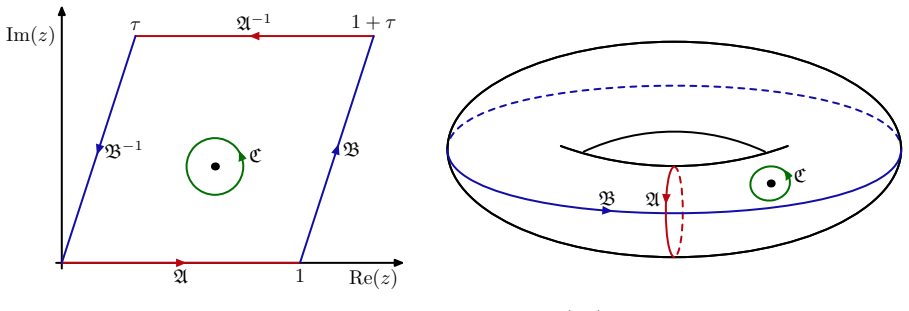
We establish a general construction of single-valued elliptic polylogarithms as functions on the once-punctured elliptic curve. Our formalism is an extension of Brown's construction of genus-zero single-valued polylogarithms to the elliptic curve: the condition of trivial monodromy for solutions to the Knizhnik-Zamolodchikov-Bernard equation is expressed in terms of elliptic associators and involves two representations of a two-letter alphabet. Our elliptic single-valued condition reduces to Brown's genus-zero condition upon degeneration of the torus. We provide several examples for our construction, including the elliptic Bloch-Wigner dilogarithm.
What carries the argument
Elliptic associators that encode the trivial-monodromy condition for the Knizhnik-Zamolodchikov-Bernard equation using two representations of a two-letter alphabet; they generalize Brown's genus-zero associators and enforce single-valuedness on the punctured elliptic curve.
If this is right
- The elliptic single-valued condition reduces to Brown's genus-zero condition under torus degeneration.
- The construction supplies explicit single-valued versions of elliptic polylogarithms including the elliptic Bloch-Wigner dilogarithm.
- The same elliptic associators can be used to define single-valued functions for any two representations of the two-letter alphabet.
Where Pith is reading between the lines
- The same formalism could be tested on higher-weight examples to check whether single-valuedness holds uniformly.
- If the construction works, it may supply a practical way to extract single-valued parts from elliptic Feynman integrals without separate regularization.
- The reduction to the sphere suggests a possible degeneration limit that relates elliptic and ordinary polylogarithm identities directly.
Load-bearing premise
The condition of trivial monodromy for solutions to the Knizhnik-Zamolodchikov-Bernard equation can be expressed in terms of elliptic associators involving two representations of a two-letter alphabet.
What would settle it
An explicit loop around a puncture on the elliptic curve for which one of the constructed functions acquires a non-zero monodromy factor would falsify the claim that the construction produces single-valued functions.
Figures



read the original abstract
We establish a general construction of single-valued elliptic polylogarithms as functions on the once-punctured elliptic curve. Our formalism is an extension of Brown's construction of genus-zero single-valued polylogarithms to the elliptic curve: the condition of trivial monodromy for solutions to the Knizhnik-Zamolodchikov-Bernard equation is expressed in terms of elliptic associators and involves two representations of a two-letter alphabet. Our elliptic single-valued condition reduces to Brown's genus-zero condition upon degeneration of the torus. We provide several examples for our construction, including the elliptic Bloch-Wigner dilogarithm.
Editorial analysis
A structured set of objections, weighed in public.
Referee Report
Summary. The paper claims to establish a general construction of single-valued elliptic polylogarithms as functions on the once-punctured elliptic curve. This extends Brown's genus-zero construction by expressing the trivial monodromy condition for solutions to the Knizhnik-Zamolodchikov-Bernard equation in terms of elliptic associators involving two representations of a two-letter alphabet. The elliptic single-valued condition reduces to Brown's genus-zero condition upon torus degeneration, with explicit examples provided including the elliptic Bloch-Wigner dilogarithm.
Significance. If the result holds, the construction supplies a canonical method for producing single-valued elliptic polylogarithms, extending the theory of multiple polylogarithms and associators to the elliptic curve setting. This is relevant for elliptic motives, periods, and applications in string theory amplitudes. The explicit reduction to the genus-zero case and the inclusion of concrete examples such as the elliptic Bloch-Wigner dilogarithm provide verifiable consistency checks and strengthen the overall framework.
minor comments (2)
- [§1] The abstract and introduction refer to 'two representations of a two-letter alphabet' without an immediate explicit definition or comparison to the genus-zero alphabet; adding this in §1 or §2 would improve readability for readers familiar with Brown's construction.
- [Example section] In the discussion of the elliptic Bloch-Wigner dilogarithm example, a side-by-side comparison of the resulting single-valued function with its genus-zero counterpart would clarify the degeneration property.
Simulated Author's Rebuttal
We thank the referee for their positive summary of our manuscript and for recommending minor revision. We are pleased that the referee recognizes the construction as a canonical extension of Brown's genus-zero single-valued polylogarithms to the once-punctured elliptic curve, including the expression via elliptic associators, the reduction to the torus degeneration limit, and the explicit example of the elliptic Bloch-Wigner dilogarithm. These features align precisely with the claims in our abstract and main text.
Circularity Check
No significant circularity detected in derivation chain
full rationale
The paper constructs single-valued elliptic polylogarithms by expressing the trivial-monodromy condition for KZB solutions via elliptic associators on a two-letter alphabet, extending Brown's genus-zero case with explicit reduction under torus degeneration. Derivations proceed directly from KZB connection properties and associator definitions; examples including the elliptic Bloch-Wigner dilogarithm are internally consistent. No steps reduce by construction to fitted inputs, self-definitions, or load-bearing self-citations. Dependence on prior external work (Brown, KZB) is standard and non-circular.
Axiom & Free-Parameter Ledger
axioms (1)
- domain assumption The Knizhnik-Zamolodchikov-Bernard equation admits solutions whose monodromy can be controlled by elliptic associators
Lean theorems connected to this paper
-
IndisputableMonolith/Foundation/AbsoluteFloorClosure.leanreality_from_one_distinction unclear?
unclearRelation between the paper passage and the cited Recognition theorem.
the condition of trivial monodromy for solutions to the Knizhnik–Zamolodchikov–Bernard equation is expressed in terms of elliptic associators and involves two representations of a two-letter alphabet
-
IndisputableMonolith/Cost/FunctionalEquation.leanwashburn_uniqueness_aczel unclear?
unclearRelation between the paper passage and the cited Recognition theorem.
Our elliptic single-valued condition reduces to Brown’s genus-zero condition upon degeneration of the torus
What do these tags mean?
- matches
- The paper's claim is directly supported by a theorem in the formal canon.
- supports
- The theorem supports part of the paper's argument, but the paper may add assumptions or extra steps.
- extends
- The paper goes beyond the formal theorem; the theorem is a base layer rather than the whole result.
- uses
- The paper appears to rely on the theorem as machinery.
- contradicts
- The paper's claim conflicts with a theorem or certificate in the canon.
- unclear
- Pith found a possible connection, but the passage is too broad, indirect, or ambiguous to say the theorem truly supports the claim.
Reference graph
Works this paper leans on
-
[1]
Elliptic polylogarithms: An analytic theory
A. Levin,“Elliptic polylogarithms: An analytic theory”,Compositio Mathematica 106, 267 (1997)
work page 1997
-
[2]
Multiple Elliptic Polylogarithms
F. Brown and A. Levin,“Multiple elliptic polylogarithms”,arxiv:1110.6917v2
work page internal anchor Pith review Pith/arXiv arXiv
-
[3]
Elliptic polylogarithms and iterated integrals on elliptic curves I: general formalism
J. Broedel, C. Duhr, F. Dulat and L. Tancredi,“Elliptic polylogarithms and iterated integrals on elliptic curves. Part I: general formalism”,JHEP 1805, 093 (2018),arxiv:1712.07089
work page internal anchor Pith review Pith/arXiv arXiv 2018
-
[4]
J. Broedel, C. Duhr, F. Dulat and L. Tancredi,“Elliptic polylogarithms and iterated integrals on elliptic curves II: an application to the sunrise integral”,Phys. Rev. D97, 116009 (2018), arxiv:1712.07095
work page internal anchor Pith review Pith/arXiv arXiv 2018
-
[5]
Elliptic Feynman integrals and pure functions
J. Broedel, C. Duhr, F. Dulat, B. Penante and L. Tancredi,“Elliptic Feynman integrals and pure functions”,JHEP 1901, 023 (2019),arxiv:1809.10698
work page internal anchor Pith review Pith/arXiv arXiv 1901
-
[6]
Genus drop in hyperelliptic Feynman integrals
R. Marzucca, A. J. McLeod, B. Page, S. P¨ ogel and S. Weinzierl,“Genus drop in hyperelliptic Feynman integrals”,Phys. Rev. D 109, L031901 (2024),arxiv:2307.11497
-
[7]
Canonical differential equations beyond genus one
C. Duhr, F. Porkert and S. F. Stawinski,“Canonical differential equations beyond genus one”, JHEP 2502, 014 (2025),arxiv:2412.02300
- [8]
-
[9]
H. Frellesvig, R. Morales and M. Wilhelm,“Calabi-Yau Meets Gravity: A Calabi-Yau Threefold at Fifth Post-Minkowskian Order”,Phys. Rev. Lett. 132, 201602 (2024),arxiv:2312.11371
-
[10]
Calabi-Yau Feynman integrals in gravity:ε-factorized form for apparent singularities
H. Frellesvig, R. Morales, S. P¨ ogel, S. Weinzierl and M. Wilhelm,“Calabi-Yau Feynman integrals in gravity:ε-factorized form for apparent singularities”,JHEP 2502, 209 (2025), arxiv:2412.12057
-
[11]
A. Klemm, C. Nega, B. Sauer and J. Plefka,“Calabi-Yau periods for black hole scattering in classical general relativity”,Phys. Rev. D 109, 124046 (2024),arxiv:2401.07899
-
[12]
Emergence of Calabi-Yau manifolds in high-precision black hole scattering
M. Driesse, G. U. Jakobsen, A. Klemm, G. Mogull, C. Nega, J. Plefka, B. Sauer and J. Usovitsch, “Emergence of Calabi–Yau manifolds in high-precision black-hole scattering”, Nature 641, 603 (2025),arxiv:2411.11846
work page internal anchor Pith review Pith/arXiv arXiv 2025
-
[13]
Aspects of canonical differential equations for Calabi-Yau geometries and beyond
C. Duhr, S. Maggio, C. Nega, B. Sauer, L. Tancredi and F. J. Wagner,“Aspects of canonical differential equations for Calabi-Yau geometries and beyond”,JHEP 2506, 128 (2025), arxiv:2503.20655
-
[14]
Canonical differential equations and intersection matrices
C. Duhr, S. Maggio, F. Porkert, C. Semper, Y. Sohnle and S. F. Stawinski,“Canonical differential equations and intersection matrices”,arxiv:2509.17787. [15]ε-collaboration Collaboration, I. Bree et al.,“The geometric bookkeeping guide to Feynman integral reduction andε-factorised differential equations”,arxiv:2506.09124
-
[15]
Three-loop banana integrals with four unequal masses
C. Duhr, S. Maggio, F. Porkert, C. Semper and S. F. Stawinski,“Three-loop banana integrals with four unequal masses”,arxiv:2507.23061
-
[16]
Feynman integrals, elliptic integrals and two-parameter K3 surfaces
C. Duhr and S. Maggio,“Feynman integrals, elliptic integrals and two-parameter K3 surfaces”, JHEP 2506, 250 (2025),arxiv:2502.15326
-
[17]
On canonical differential equations for Calabi-Yau multi-scale Feynman integrals
S. Maggio and Y. Sohnle,“On canonical differential equations for Calabi-Yau multi-scale Feynman integrals”,JHEP 2510, 202 (2025),arxiv:2504.17757
-
[18]
Functions Beyond Multiple Polylogarithms for Precision Collider Physics
J. L. Bourjaily et al.,“Functions Beyond Multiple Polylogarithms for Precision Collider Physics”, arxiv:2203.07088, in:“Snowmass 2021”
-
[19]
Theta Functions on Riemann Surfaces
J. Fay,“Theta Functions on Riemann Surfaces”, Springer (1973)
work page 1973
-
[20]
Higher Regulators, Algebraic K-Theory, and Zeta Functions of Elliptic Curves
S. Bloch,“Higher Regulators, Algebraic K-Theory, and Zeta Functions of Elliptic Curves”
-
[21]
Double zeta values and modular forms
H. Gangl, M. Kaneko and D. Zagier,“Double zeta values and modular forms”, in:“Automorphic forms and zeta functions”, World Sci. Publ., Hackensack, NJ (2006), 71–106p. 31
work page 2006
-
[22]
Functional relations for elliptic polylogarithms
J. Broedel and A. Kaderli,“Functional relations for elliptic polylogarithms”, J. Phys. A 53, 245201 (2020),arxiv:1906.11857
-
[23]
Universal KZB equations: the elliptic case
D. Calaque, B. Enriquez and P. Etingof,“Universal KZB equations: the elliptic case”, in: “Algebra, arithmetic, and geometry: in honor of Yu. I. Manin. Vol. I”, Birkh¨ auser Boston, Inc., Boston, MA (2009), 165–266p
work page 2009
-
[24]
B. Enriquez,“Elliptic associators”,Selecta Math. (N.S.) 20, 491 (2014),arxiv:1003.1012
work page internal anchor Pith review Pith/arXiv arXiv 2014
-
[25]
Analogues elliptiques des nombres multiz´ etas
B. Enriquez,“Analogues elliptiques des nombres multiz´ etas”, Bull. Soc. Math. France 144, 395 (2016),arxiv:1301.3042
-
[26]
N. Matthes,“Elliptic multiple zeta values”, PhD thesis, Universit¨ at Hamburg, 2016
work page 2016
-
[27]
Relations between elliptic multiple zeta values and a special derivation algebra
J. Broedel, N. Matthes and O. Schlotterer,“Relations between elliptic multiple zeta values and a special derivation algebra”,J. Phys. A49, 155203 (2016),arxiv:1507.02254
work page internal anchor Pith review Pith/arXiv arXiv 2016
-
[28]
Elliptic multiple zeta values datamine
J. Broedel, N. Matthes and O. Schlotterer,“Elliptic multiple zeta values datamine”, https://tools.aei.mpg.de/emzv/datamine.html
-
[29]
Regularization of elliptic multiple zeta values
T. Katayama,“Regularization of elliptic multiple zeta values”,arxiv:2504.15621
-
[30]
Elliptic Multizetas and the Elliptic Double Shuffle Relations
P. Lochak, N. Matthes and L. Schneps,“Elliptic Multizetas and the Elliptic Double Shuffle Relations”,International Mathematics Research Notices 2021, 695 (2020),arxiv:1703.09410
-
[31]
Multiple zeta values: from numbers to motives
J. Fresan and J. Gil,“Multiple zeta values: from numbers to motives”, Clay Mathematics Proceedings, to appear,http://javier.fresan.perso.math.cnrs.fr/mzv.pdf
-
[32]
Construction of Maurer-Cartan elements over configuration spaces of curves
B. Enriquez and F. Zerbini,“Construction of Maurer-Cartan elements over configuration spaces of curves”,arxiv:2110.09341
-
[33]
Analogues of hyperlogarithm functions on affine complex curves
B. Enriquez and F. Zerbini,“Analogues of hyperlogarithm functions on affine complex curves”, Curves. Publ. Res. Inst. Math. Sci. 61, pp. 627–712 (2025),arxiv:2212.03119
-
[34]
B. Enriquez and F. Zerbini,“Elliptic hyperlogarithms”, Canadian Journal of Mathematics online, 1–36 (2025),arxiv:2307.01833
-
[35]
Constructing polylogarithms on higher-genus Riemann surfaces
E. D’Hoker, M. Hidding and O. Schlotterer,“Constructing polylogarithms on higher-genus Riemann surfaces”,Commun. Num. Theor. Phys. 19, 355 (2025),arxiv:2306.08644
-
[36]
Higher genus polylogarithms on families of Riemann surfaces
T. Ichikawa,“Higher genus polylogarithms on families of Riemann surfaces”, Nucl. Phys. B 1013, 116836 (2025),arxiv:2209.05006
-
[37]
Fay identities for polylogarithms on higher-genus Riemann surfaces
E. D’Hoker and O. Schlotterer,“Fay identities for polylogarithms on higher-genus Riemann surfaces”,arxiv:2407.11476
-
[38]
Higher-genus Fay-like identities from meromorphic generating functions
K. Baune, J. Broedel, E. Im, A. Lisitsyn and Y. Moeckli,“Higher-genus Fay-like identities from meromorphic generating functions”,SciPost Phys. 18, 093 (2025),arxiv:2409.08208
-
[39]
Meromorphic higher-genus integration kernels via convolution over homology cycles
E. D’Hoker and O. Schlotterer,“Meromorphic higher-genus integration kernels via convolution over homology cycles”,J. Phys. A 58, 33LT01 (2025),arxiv:2502.14769
-
[40]
Higher-genus multiple zeta values
K. Baune, J. Broedel, E. Im, Z. Ji and Y. Moeckli,“Higher-genus multiple zeta values”, J. Phys. A 58, 465401 (2025),arxiv:2507.21765
-
[41]
Schottky–Kronecker forms and hyperelliptic polylogarithms
K. Baune, J. Broedel, E. Im, A. Lisitsyn and F. Zerbini,“Schottky–Kronecker forms and hyperelliptic polylogarithms”,J. Phys. A 57, 445202 (2024),arxiv:2406.10051
-
[42]
Single-valued integration and double copy
F. Brown and C. Dupont,“Single-valued integration and double copy”, J. Reine Angew. Math. 2021, 145 (2021),arxiv:1810.07682
-
[43]
Single-valued integration and superstring amplitudes in genus zero
F. Brown and C. Dupont,“Single-valued integration and superstring amplitudes in genus zero”, Commun. Math. Phys. 382, 815 (2021),arxiv:1910.01107
-
[44]
A Relation Between Tree Amplitudes of Closed and Open Strings
H. Kawai, D. C. Lewellen and S. H. H. Tye,“A Relation Between Tree Amplitudes of Closed and Open Strings”,Nucl. Phys. B269, 1 (1986)
work page 1986
-
[45]
Polylogarithmes multiples uniformes en une variable
F. C. Brown,“Polylogarithmes multiples uniformes en une variable”, Comptes Rendus Mathematique 338, 527 (2004). 32
work page 2004
-
[46]
Single-valued hyperlogarithms and unipotent differential equations
F. Brown,“Single-valued hyperlogarithms and unipotent differential equations”,Preprint , (2004), https://www.ihes.fr/ brown/RHpaper5.pdf
work page 2004
-
[47]
E. D’Hoker, M. B. Green, ¨O. G¨ urdogan and P. Vanhove,“Modular Graph Functions”, Commun. Num. Theor. Phys. 11, 165 (2017),arxiv:1512.06779
work page internal anchor Pith review Pith/arXiv arXiv 2017
-
[48]
Multiple Modular Values and the relative completion of the fundamental group of $M_{1,1}$
F. Brown,“Multiple modular values and the relative completion of the fundamental group of M1,1”,arxiv:1407.5167v4
work page internal anchor Pith review Pith/arXiv arXiv
-
[49]
Proving relations between modular graph functions
A. Basu,“Proving relations between modular graph functions”, Class. Quant. Grav. 33, 235011 (2016),arxiv:1606.07084
work page internal anchor Pith review Pith/arXiv arXiv 2016
-
[50]
Modular graph functions as iterated Eisenstein integrals
E. Panzer,“Modular graph functions as iterated Eisenstein integrals”, Talk at lunchtime seminar, Oxford, 2019,https://people.maths.ox.ac.uk/panzer/paper/MGF.pdf
work page 2019
-
[51]
Modular graph functions and odd cuspidal functions. Fourier and Poincar´ e series
E. D’Hoker and J. Kaidi,“Modular graph functions and odd cuspidal functions. Fourier and Poincar´ e series”,JHEP 1904, 136 (2019),arxiv:1902.04180
-
[52]
Modular graph functions and asymptotic expansions of Poincar´ e series
D. Dorigoni and A. Kleinschmidt,“Modular graph functions and asymptotic expansions of Poincar´ e series”,Commun. Num. Theor. Phys. 13, 569 (2019),arxiv:1903.09250
-
[53]
Higher genus modular graph functions, string invariants, and their exact asymptotics
E. D’Hoker, M. B. Green and B. Pioline,“Higher genus modular graph functions, string invariants, and their exact asymptotics”,Commun. Math. Phys. 366, 927 (2019),arxiv:1712.06135
work page internal anchor Pith review Pith/arXiv arXiv 2019
-
[54]
From modular graph forms to iterated integrals
E. Claasen and M. Doroudiani,“From modular graph forms to iterated integrals”, JHEP 2506, 204 (2025),arxiv:2502.05531
-
[55]
All-order differential equations for one-loop closed-string integrals and modular graph forms
J. E. Gerken, A. Kleinschmidt and O. Schlotterer,“All-order differential equations for one-loop closed-string integrals and modular graph forms”,JHEP 2001, 064 (2020),arxiv:1911.03476
-
[56]
Elliptic modular graph forms. Part I. Identities and generating series
E. D’Hoker, A. Kleinschmidt and O. Schlotterer,“Elliptic modular graph forms. Part I. Identities and generating series”,JHEP 2103, 151 (2021),arxiv:2012.09198
-
[57]
Poincar´ e series for modular graph forms at depth two. Part I. Seeds and Laplace systems
D. Dorigoni, A. Kleinschmidt and O. Schlotterer,“Poincar´ e series for modular graph forms at depth two. Part I. Seeds and Laplace systems”,JHEP 2201, 133 (2022),arxiv:2109.05017
-
[58]
Poincar´ e series for modular graph forms at depth two. Part II. Iterated integrals of cusp forms
D. Dorigoni, A. Kleinschmidt and O. Schlotterer,“Poincar´ e series for modular graph forms at depth two. Part II. Iterated integrals of cusp forms”,JHEP 2201, 134 (2022),arxiv:2109.05018
-
[59]
O. Schlotterer, Y. Sohnle and Y.-X. Tao,“Elliptic modular graph forms, equivariant iterated integrals and single-valued elliptic polylogarithms”,arxiv:2511.xxxxx
-
[60]
Multiple polylogarithms, cyclotomy and modular complexes
A. B. Goncharov,“Multiple polylogarithms, cyclotomy and modular complexes”, Math. Res. Lett. 5, 497 (1998),arxiv:1105.2076
work page internal anchor Pith review Pith/arXiv arXiv 1998
-
[61]
Multiple polylogarithms and mixed Tate motives
A. Goncharov,“Multiple polylogarithms and mixed Tate motives”,math/0103059
work page internal anchor Pith review Pith/arXiv arXiv
-
[62]
Iterated integrals in quantum field theory
F. Brown,“Iterated integrals in quantum field theory”, in:“Proceedings, Geometric and Topological Methods for Quantum Field Theory : 6th Summer School: Villa de Leyva, Colombia, July 6-23, 2009”, 188-240p
work page 2009
-
[63]
Multiple zeta values and periods of moduli spaces $\mathfrak{M}_{0,n}$
F. Brown,“Multiple zeta values and periods of moduli spaces M0,n”, Ann. Sci. ´Ec. Norm. Sup´ er. (4) 42, 371 (2009),math/0606419
work page internal anchor Pith review Pith/arXiv arXiv 2009
-
[64]
D. Zagier,“The Dilogarithm Function”, in:“Proceedings, Les Houches School of Physics: Frontiers in Number Theory, Physics and Geometry II: On Conformal Field Theories, Discrete Groups and Renormalization: Les Houches, France, March 9-21, 2003”, 3-65p
work page 2003
-
[65]
Single-valued periods and multiple zeta values
F. Brown,“Single-valued Motivic Periods and Multiple Zeta Values”,SIGMA 2, e25 (2014), arxiv:1309.5309
work page internal anchor Pith review Pith/arXiv arXiv 2014
-
[66]
Closed Superstring Amplitudes, Single-Valued Multiple Zeta Values and Deligne Associator
S. Stieberger,“Closed superstring amplitudes, single-valued multiple zeta values and the Deligne associator”,J.Phys. A47, 155401 (2014),arxiv:1310.3259
work page internal anchor Pith review Pith/arXiv arXiv 2014
-
[67]
Closed String Amplitudes as Single-Valued Open String Amplitudes
S. Stieberger and T. R. Taylor,“Closed String Amplitudes as Single-Valued Open String Amplitudes”,Nucl.Phys. B881, 269 (2014),arxiv:1401.1218. 33
work page internal anchor Pith review Pith/arXiv arXiv 2014
-
[68]
Closed-string amplitude recursions from the Deligne associator
K. Baune, J. Broedel and F. Zerbini,“Closed-string amplitude recursions from the Deligne associator”,arxiv:2412.17579
-
[69]
The AdS Virasoro-Shapiro amplitude
L. F. Alday and T. Hansen,“The AdS Virasoro-Shapiro amplitude”,JHEP 2310, 023 (2023), arxiv:2306.12786
-
[70]
Associators for AdS string amplitude building blocks
K. Baune,“Associators for AdS string amplitude building blocks”,JHEP 2507, 278 (2025), arxiv:2505.23385
-
[71]
Single-valued harmonic polylogarithms and the multi-Regge limit
L. J. Dixon, C. Duhr and J. Pennington,“Single-valued harmonic polylogarithms and the multi-Regge limit”,JHEP 1210, 074 (2012),arxiv:1207.0186
work page internal anchor Pith review Pith/arXiv arXiv 2012
-
[72]
Multi-Regge kinematics and the moduli space of Riemann spheres with marked points
V. Del Duca, S. Druc, J. Drummond, C. Duhr, F. Dulat, R. Marzucca, G. Papathanasiou and B. Verbeek,“Multi-Regge kinematics and the moduli space of Riemann spheres with marked points”,JHEP 1608, 152 (2016),arxiv:1606.08807
work page internal anchor Pith review Pith/arXiv arXiv 2016
-
[73]
All-order amplitudes at any multiplicity in the multi-Regge limit
V. Del Duca, S. Druc, J. M. Drummond, C. Duhr, F. Dulat, R. Marzucca, G. Papathanasiou and B. Verbeek,“All-order amplitudes at any multiplicity in the multi-Regge limit”, Phys. Rev. Lett. 124, 161602 (2020),arxiv:1912.00188
-
[74]
Towards multiple elliptic polylogarithms
A. Levin and G. Racinet,“Towards multiple elliptic polylogarithms”,math/0703237
work page internal anchor Pith review Pith/arXiv arXiv
-
[75]
V. Chari and A. Pressley,“A guide to quantum groups”, Cambridge University Press (1994)
work page 1994
-
[76]
Amplitude recursions with an extra marked point
J. Broedel and A. Kaderli,“Amplitude recursions with an extra marked point”, Commun. Num. Theor. Phys. 16, 75 (2022),arxiv:1912.09927
-
[77]
Elliptic multiple zeta values and one-loop superstring amplitudes
J. Broedel, C. R. Mafra, N. Matthes and O. Schlotterer,“Elliptic multiple zeta values and one-loop superstring amplitudes”,JHEP 1507, 112 (2015),arxiv:1412.5535
work page internal anchor Pith review Pith/arXiv arXiv 2015
-
[78]
Decomposition of elliptic multiple zeta values and iterated Eisenstein integrals
N. Matthes,“Decomposition of elliptic multiple zeta values and iterated Eisenstein integrals”, arxiv:1703.09597, in:“Various aspects of multiple zeta value 2016”, ed.: H. Furusho, Res. Inst. Math. Sci. (RIMS), Kyoto (2017), 170–183p
work page internal anchor Pith review Pith/arXiv arXiv 2016
-
[79]
From elliptic multiple zeta values to modular graph functions: open and closed strings at one loop
J. Broedel, O. Schlotterer and F. Zerbini,“From elliptic multiple zeta values to modular graph functions: open and closed strings at one loop”,JHEP 1901, 155 (2019),arxiv:1803.00527
work page internal anchor Pith review Pith/arXiv arXiv 1901
-
[80]
All Orderα ′ Expansion of One-Loop Open-String Integrals
C. R. Mafra and O. Schlotterer,“All Orderα ′ Expansion of One-Loop Open-String Integrals”, Phys. Rev. Lett. 124, 101603 (2020),arxiv:1908.09848
discussion (0)
Sign in with ORCID, Apple, or X to comment. Anyone can read and Pith papers without signing in.