RAMSES: Secure high-performance computing for sensitive data
Pith reviewed 2026-06-29 02:43 UTC · model grok-4.3
The pith
RAMSES shows an HPC platform can keep sensitive data encrypted at every stage while limiting performance loss to acceptable levels.
A machine-rendered reading of the paper's core claim, the machinery that carries it, and where it could break.
Core claim
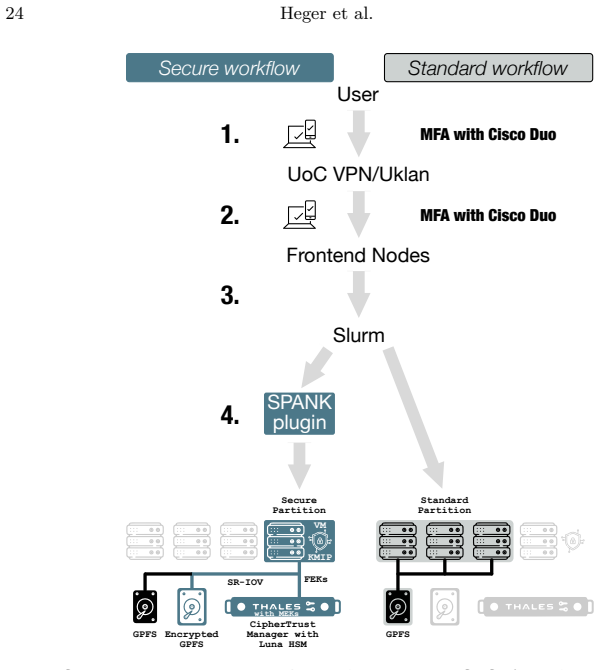
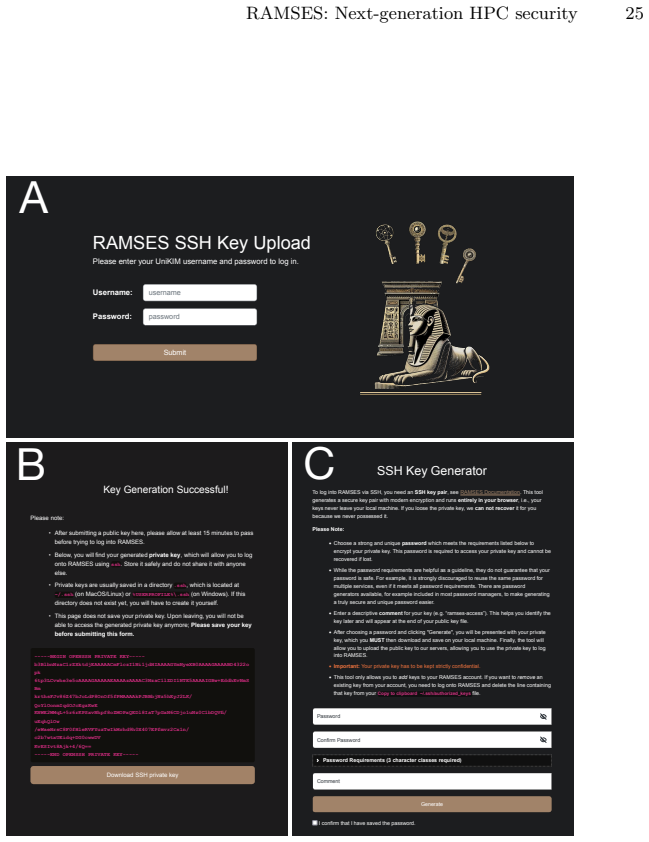
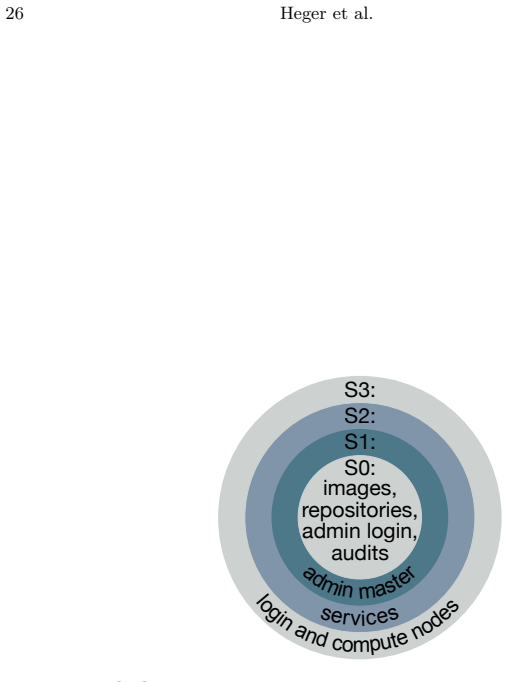
RAMSES integrates AMD hardware-based memory encryption with IBM Storage Scale file encryption and Thales CipherTrust management to maintain continuous encryption throughout the data life cycle. It adds advanced operating system hardening and mandatory multi-factor authentication. The resulting platform complies with European General Data Protection Regulation, ISO/IEC 27001, and Federal Information Processing Standards. Benchmark results from the biomedical sector show the performance impact of these measures remains limited, allowing speed and security to coexist in a coherent, flexible, and user-friendly system.
What carries the argument
The continuous encryption stack that protects data at rest, in transit, and in use, combined with OS hardening inside a standard HPC architecture.
If this is right
- Biomedical research can run large-scale computations on sensitive data without major speed penalties.
- HPC installations can meet strict data-protection regulations while retaining flexibility for users.
- Encryption throughout the data life cycle becomes practical in performance-critical environments.
- Existing HPC software stacks remain usable after the addition of these security layers.
Where Pith is reading between the lines
- The same layered approach might support other domains that need both high computation and privacy, such as financial risk modeling.
- Ongoing validation against new workloads would be needed to confirm the limited-impact result holds more widely.
- Integration challenges could arise if the encryption components require frequent updates to stay current with standards.
Load-bearing premise
The chosen encryption stack and hardening steps will continue to deliver acceptable performance and security under production workloads beyond the biomedical benchmarks shown.
What would settle it
Performance measurements on a broader set of production workloads that reveal either large slowdowns or encryption failures despite the described measures would disprove the central claim.
Figures


read the original abstract
Traditionally, the architecture of high-performance computing (HPC) systems is tailored for speed, while highly secure computer systems must sacrifice speed for security. However, a wide range of scientific domains, such as the life sciences, call for a combination of performance and security to allow processing sensitive data at scale. Here, we present RAMSES (Research Accelerator for Modeling and Simulation with Enhanced Security), an HPC system designed from the ground up to deliver high performance within a robust security framework. RAMSES integrates hardware-based memory encryption of AMD processors with state-of-the-art file encryption from IBM Storage Scale and the Thales CipherTrust manager, establishing an HPC platform that ensures continuous encryption throughout the data life cycle - at rest, in transit, and in use - in compliance with major data protection standards (European General Data Protection Regulation, ISO/IEC 27001 certification, and Federal Information Processing Standards). In addition, we implemented advanced operating system hardening, a multi-layered security architecture, and mandatory multi-factor authentication to adapt the HPC environment to increased security demands. Benchmark results from the biomedical sector demonstrate that the performance impact of the secure environment is limited and that integration of the conflicting requirements speed and security can be achieved while preserving a coherent, flexible, and user-friendly system.
Editorial analysis
A structured set of objections, weighed in public.
Referee Report
Summary. The manuscript describes RAMSES, an HPC system integrating AMD SME hardware memory encryption, IBM Storage Scale file encryption, Thales CipherTrust key management, OS hardening, multi-layered security architecture, and mandatory MFA. The design targets continuous encryption (at rest, in transit, and in use) for sensitive biomedical data while complying with GDPR, ISO/IEC 27001, and FIPS. The central claim is that biomedical-sector benchmarks demonstrate limited performance impact, showing that speed and security requirements can be reconciled in a coherent, flexible, user-friendly system.
Significance. If the performance claims are substantiated with quantified overheads against unsecured baselines and representative HPC workloads, the work would be significant for domains requiring secure processing of sensitive data at scale. The explicit end-to-end encryption stack and compliance mapping constitute a concrete systems contribution that could serve as a reference for other secure HPC deployments.
major comments (2)
- [Abstract] Abstract: The load-bearing claim that 'benchmark results from the biomedical sector demonstrate that the performance impact of the secure environment is limited' supplies no quantitative overhead figures, workload descriptions, comparison baselines, error bars, or statistical details. Without these, the central performance claim cannot be evaluated.
- [Abstract] Abstract: The assumption that the encryption stack (AMD SME + IBM Storage Scale + Thales CipherTrust) plus OS hardening will continue to deliver acceptable performance under production workloads beyond the specific biomedical benchmarks is untested in the provided text; no additional access patterns or scaling results are referenced to support generalizability.
minor comments (1)
- The abstract would be strengthened by including at least one concrete performance metric (e.g., percentage overhead on a named benchmark) to allow readers to assess the 'limited impact' claim immediately.
Simulated Author's Rebuttal
We thank the referee for the constructive feedback on our manuscript. We address the major comments point by point below, agreeing where revisions are needed to improve clarity and substantiation of claims.
read point-by-point responses
-
Referee: [Abstract] Abstract: The load-bearing claim that 'benchmark results from the biomedical sector demonstrate that the performance impact of the secure environment is limited' supplies no quantitative overhead figures, workload descriptions, comparison baselines, error bars, or statistical details. Without these, the central performance claim cannot be evaluated.
Authors: We agree that the abstract lacks the requested quantitative details. The full manuscript (Section 4) contains the benchmark results with overhead figures, workload descriptions (e.g., representative biomedical applications), comparison baselines (unsecured vs. secured configurations), error bars, and statistical details. We will revise the abstract to include key quantitative results summarizing these findings. revision: yes
-
Referee: [Abstract] Abstract: The assumption that the encryption stack (AMD SME + IBM Storage Scale + Thales CipherTrust) plus OS hardening will continue to deliver acceptable performance under production workloads beyond the specific biomedical benchmarks is untested in the provided text; no additional access patterns or scaling results are referenced to support generalizability.
Authors: The manuscript scope is centered on the biomedical sector with benchmarks for workloads typical of that domain. We do not present additional access patterns or scaling results beyond these, nor do we claim broad generalizability. We will revise the abstract and/or discussion section to explicitly note this scope limitation and indicate that further validation for other workloads would be required. revision: partial
Circularity Check
No circularity: systems description with external benchmarks, no derivations or self-referential predictions
full rationale
The paper describes an HPC system implementation (AMD SME + IBM Storage Scale + Thales CipherTrust + OS hardening) and cites benchmark results from the biomedical sector to support performance claims. No equations, fitted parameters, predictions, or derivation chains exist. Claims rest on implementation details and external benchmarks rather than reducing to self-definitions or self-citations. No load-bearing steps match any enumerated circularity pattern.
Axiom & Free-Parameter Ledger
Reference graph
Works this paper leans on
-
[1]
Advanced Micro Devices, Inc.: AMD SEV-SNP: Strengthening VM isolation with integrity protection and more. Tech. rep., AMD (Jan 2020), https://www.amd.com/ content/dam/amd/en/documents/epyc-business-docs/white-papers/SEV-SNP-s trengthening-vm-isolation-with-integrity-protection-and-more.pdf
2020
-
[2]
In: 2021 IEEE International Parallel and Distributed Processing Symposium (IPDPS)
Akram, A., Giannakou, A., Akella, V., Lowe-Power, J., Peisert, S.: Performance analysis of scientific computing workloads on general purpose TEEs. In: 2021 IEEE International Parallel and Distributed Processing Symposium (IPDPS). pp. 1066– 1076 (May 2021),https://doi.org/10.1109/IPDPS49936.2021.00115
-
[3]
Arm Ltd.: Realm Management Extension (RME) — System Architecture. Tech. rep., Arm Ltd. (Jun 2021), https://documentation-service.arm.com/static/60d330 9b677cf7536a55bae0
2021
-
[4]
Journal of the American Chemical Society 146(29), 20009–20018 (2024), https://doi.org/10.102 1/jacs.4c03849
Chen, C., Nguyen, D.T., Lee, S.J., Baker, N.A., Karakoti, A.S., Lauw, L., Owen, C., Mueller, K.T., Bilodeau, B.A., Murugesan, V., Troyer, M.: Accelerating com- putational materials discovery with machine learning and cloud high-performance computing: from large-scale screening to experimental validation. Journal of the American Chemical Society 146(29), 2...
2024
-
[5]
Cisco Systems, Inc.: Complete identity security and MFA solutions|Duo Security (2026),https://duo.com/, accessed: 2026-01-14
2026
-
[6]
Cloud-Security-Alliance: Survey report—security practices in HPC & HPC cloud (2020), https://cloudsecurityalliance.org/artifacts/survey-report-securit y-practices-in-hpc-cloud, accessed: 2025-10-27
2020
-
[7]
Confidential Computing Consortium: Confidential computing: Hardware-based trusted execution for applications and data. Whitepaper Version 1.3, Confidential Computing Consortium, Linux Foundation (Nov 2022), https://confidentialcomp uting.io/wp-content/uploads/sites/10/2023/03/CCC_outreach_whitepaper_up dated_November_2022.pdf
2022
-
[8]
Computers & Security 154, 104457 (2025), https://www.sciencedirect.com/ science/article/pii/S0167404825001464
Coppolino, L., D’Antonio, S., Mazzeo, G., Romano, L.: An experimental evaluation of TEE technology: Benchmarking transparent approaches based on SGX, SEV, and TDX. Computers & Security 154, 104457 (2025), https://www.sciencedirect.com/ science/article/pii/S0167404825001464
2025
-
[9]
BMC Bioinformatics 19, 348 (Oct 2018), https://doi.org/10.1186/s128 59-018-2376-y
Crescente, J.M., Zavallo, D., Helguera, M., Vanzetti, L.S.: MITE Tracker: an accu- rate approach to identify miniature inverted-repeat transposable elements in large genomes. BMC Bioinformatics 19, 348 (Oct 2018), https://doi.org/10.1186/s128 59-018-2376-y
-
[10]
Cyber Risk Institute (CRI): The CRI profile: A financial sector use case for the NIST cybersecurity framework. Tech. rep., Cyber Risk Institute (May 2023), https: //cyberriskinstitute.org/the-profile
2023
-
[11]
Department of Defense Chief Information Officer, Zero Trust Portfolio Management Office: DoD zero trust strategy. Strategy Document Version 1.0, United States De- partment of Defense, Office of the Chief Information Officer (DoD CIO), Washington, D.C., USA (Oct 2022), https://dodcio.defense.gov/Portals/0/Documents/Libra ry/DoD-ZTStrategy.pdf , prepared by...
2022
-
[12]
Economics Working Paper Series 1601, University of the West of England, Bristol, Bristol, UK (2016), https://www2.uwe.ac.uk/faculties/BBS/Documents/1601.pdf
Desai, T., Ritchie, F., Welpton, R.: Five Safes: Designing data access for research. Economics Working Paper Series 1601, University of the West of England, Bristol, Bristol, UK (2016), https://www2.uwe.ac.uk/faculties/BBS/Documents/1601.pdf
2016
-
[13]
Genome Research 35(12), 2626–2636 (2025),http://genome.cshlp.org/content/35/12/2626.abstract
Dokmai, N., Zhu, K., Sahinalp, S.C., Cho, H.: Secure phasing of private genomes in a trusted execution environment with TX-Phase. Genome Research 35(12), 2626–2636 (2025),http://genome.cshlp.org/content/35/12/2626.abstract
2025
-
[14]
Regulation 2016/679, Official Journal of the European Union (2016), https://eur-lex.europa.eu/legal-content/EN/TXT/?uri=CELEX:32016R0679 , oJ L 119, 4.5.2016, pp
European Parliament, Council of the European Union: Regulation (EU) 2016/679 of the European Parliament and of the Council of 27 April 2016 on the protection of natural persons with regard to the processing of personal data and on the free movement of such data, and repealing Directive 95/46/EC (General Data Protection Regulation). Regulation 2016/679, Of...
2016
-
[15]
Financial Stability Board (FSB): Summary report on financial sector cybersecurity: Regulations, guidance and supervisory practices. Tech. rep., Financial Stability Board (Oct 2017),https://www.fsb.org/wp-content/uploads/P131017-1.pdf
2017
-
[16]
Flynn, J.M., Hubley, R., Goubert, C., Rosen, J., Clark, A.G., Feschotte, C., Smit, A.F.: RepeatModeler2 for automated genomic discovery of transposable element fami- lies. Proceedings of the National Academy of Sciences of the United States of America 117, 9451–9457 (Apr 2020),https://doi.org/10.1073/pnas.1921046117
-
[17]
Genome Research 34, 769– 777 (Jun 2024),https://doi.org/10.1101/gr.278090.123
Gabriel, L., Br˚ una, T., Hoff, K.J., Ebel, M., Lomsadze, A., Borodovsky, M., Stanke, M.: Braker3: Fully automated genome annotation using RNA-seq and protein evi- dence with Genemark-ETP, AUGUSTUS, and TSEBRA. Genome Research 34, 769– 777 (Jun 2024),https://doi.org/10.1101/gr.278090.123
-
[18]
In: Proceedings of the 30th USENIX Security Symposium
Gaddam, S., Luykx, A., Sinha, R., Watson, G.: Reducing HSM reliance in pay- ments through proxy re-encryption. In: Proceedings of the 30th USENIX Security Symposium. pp. 4061–4080. USENIX Security ’21, USENIX Association (2021), https://www.usenix.org/conference/usenixsecurity21/presentation/gaddam
2021
-
[19]
SN Computer Science 2(5) (2021),https://doi.org/10.1007/s42979-021-00781-8
Giallorenzo, S., Mauro, J., Poulsen, M.G., Siroky, F.: Virtualization costs: Bench- marking containers and virtual machines against bare-metal. SN Computer Science 2(5) (2021),https://doi.org/10.1007/s42979-021-00781-8
-
[20]
Technical Spec- ification (2021), https://globalplatform.org/wp-content/uploads/2021/03/GPD _TEE_Internal_Core_API_Specification_v1.3.1_PublicRelease_CC.pdf
GlobalPlatform: TEE Internal Core API Specification, public release. Technical Spec- ification (2021), https://globalplatform.org/wp-content/uploads/2021/03/GPD _TEE_Internal_Core_API_Specification_v1.3.1_PublicRelease_CC.pdf
2021
-
[21]
Guo, Y., Chandramouli, R., Wofford, L., Gregg, R., Key, G., Clark, A., Hinton, C., Prout, A., Reuther, A., Adamson, R., Warren, A., Bangalore, P., Deumens, E., Farkas, C.: High-performance computing security: Architecture, threat analysis, and security posture. Tech. Rep. NIST SP 800-223, National Institute of Standards and Technology, Gaithersburg, MD (2...
-
[22]
PLoS Computational Biology 17, e1009244 (Jul 2021), https://doi.org/10.1371/journal.pcbi.1009244
Hanussek, M., Bartusch, F., Kr¨uger, J.: Performance and scaling behavior of bioinfor- matic applications in virtualization environments to create awareness for the efficient use of compute resources. PLoS Computational Biology 17, e1009244 (Jul 2021), https://doi.org/10.1371/journal.pcbi.1009244
-
[23]
Hussain, M.A., Samrouth, K., Bakir, N.: A survey on malware attacks in industrial air-gap systems. International Journal of Information Security 24(3), 146 (2025), https://doi.org/10.1007/s10207-025-01044-w
-
[24]
Intel Corporation: Intel®hardware shield – Intel®Total Memory Encryption. Tech. rep., Intel Corporation (2022), https://www.intel.com/content/dam/www/centra l-libraries/us/en/documents/white-paper-intel-tme.pdf
2022
-
[25]
International Standard 19790, ISO/IEC (2025),https://www.iso.org/standard/82423.html
International Organization for Standardization and International Electrotechnical Commission: ISO/IEC 19790:2025 — Information security, cybersecurity and pri- RAMSES: Next-generation HPC security 21 vacy protection — Security requirements for cryptographic modules. International Standard 19790, ISO/IEC (2025),https://www.iso.org/standard/82423.html
2025
-
[26]
ISO/IEC: ISO/IEC 27001:2022 — information security, cybersecurity and privacy protection — information security management systems — requirements. Interna- tional Standard ISO/IEC 27001:2022, International Organization for Standardization (ISO) / International Electrotechnical Commission (IEC), Geneva, Switzerland (Oct 2022), https://www.iso.org/standard/...
2022
-
[27]
ITCC, University of Cologne: Identity management – uniKIM (2024), https://itcc .uni-koeln.de/en/services/accounts-communication/identity-management-u nikim, accessed: 2026-01-14
2024
-
[28]
ITCC, University of Cologne: RAMSES SSH Key Upload (2026), https://ramses-u mc.itcc.uni-koeln.de/web-sshkey/login, accessed: 2026-01-14
2026
-
[29]
In: Klus´ aˇ cek, D., Corbal´ an, J., Rodrigo, G.P
Jette, M.A., Wickberg, T.: Architecture of the Slurm workload manager. In: Klus´ aˇ cek, D., Corbal´ an, J., Rodrigo, G.P. (eds.) Job Scheduling Strategies for Parallel Process- ing. pp. 3–23. Springer Nature Switzerland, Cham (2023), https://link.springer. com/chapter/10.1007/978-3-031-43943-8_1
-
[30]
Joint Task Force Transformation Initiative: Security and privacy controls for infor- mation systems and organizations (NIST special publication 800-53 rev. 5). Tech. Rep. 800-53 Rev. 5, National Institute of Standards and Technology (Sep 2020), https://csrc.nist.gov/pubs/sp/800/53/r5/upd1/final
2020
-
[31]
IEEE Access 9, 98772–98789 (2021), http://dx.doi.org/10.1109/A CCESS.2021.3096189
Jung, W., Lee, E., Kim, S., Kim, J., Kim, N., Lee, K., Min, C., Cheon, J.H., Ahn, J.H.: Accelerating fully homomorphic encryption through architecture-centric analysis and optimization. IEEE Access 9, 98772–98789 (2021), http://dx.doi.org/10.1109/A CCESS.2021.3096189
work page doi:10.1109/a 2021
-
[32]
Ad- vanced Micro Devices, Inc
Kaplan, D., Powell, J., Woller, T.: AMD Memory Encryption – White Paper. Ad- vanced Micro Devices, Inc. (2021), https://www.amd.com/content/dam/amd/en/doc uments/epyc-business-docs/white-papers/memory-encryption-white-paper.p df
2021
-
[33]
Open Infrastructure Foundation (2024), https://katacontainers.io , accessed: 2024
Kata Containers Community: Kata containers — open source container runtime software. Open Infrastructure Foundation (2024), https://katacontainers.io , accessed: 2024
2024
-
[34]
J Med Internet Res 24(9), e33720 (Sep 2022),https://doi.org/10.2196/33720
Kavianpour, S., Sutherland, J., Mansouri-Benssassi, E., Coull, N., Jefferson, E.: Next- generation capabilities in Trusted Research Environments: Interview study. J Med Internet Res 24(9), e33720 (Sep 2022),https://doi.org/10.2196/33720
-
[35]
Keßler, R., Nieroda, L., Volpert, S., Gr ¨af, M., Achter, V., Hunhold, L., Wesner, S.: Evaluating trusted execution environment performance for genome sequence align- ment: An AMD SEV case study. In: Proceedings of the SC ’25 Workshops of the International Conference for High Performance Computing, Networking, Storage and Analysis. p. 1951–1958. SC Worksh...
-
[36]
In: Mulder, V., Mermoud, A., Lenders, V., Tellenbach, B
Kr¨ahenb¨uhl, C., Perrig, A.: Key management. In: Mulder, V., Mermoud, A., Lenders, V., Tellenbach, B. (eds.) Trends in Data Protection and Encryption Technologies, pp. 15–20. Springer Nature Switzerland, Cham (2023), https://doi.org/10.1007/97 8-3-031-33386-6_4
work page doi:10.1007/97 2023
-
[37]
Journal of Cloud Computing 12(1) (Dec 2023),https://doi.org/10.1186/s13677-023-00546-z
Kuity, A., Peddoju, S.K.: Investigating performance metrics for container-based HPC environments using x86 and OpenPOWER systems. Journal of Cloud Computing 12(1) (Dec 2023),https://doi.org/10.1186/s13677-023-00546-z
-
[38]
In: Galinina, O., Andreev, S., Balandin, S., Koucheryavy, Y
Kuzminykh, I., Ghita, B., Shiaeles, S.: Comparative analysis of cryptographic key management systems. In: Galinina, O., Andreev, S., Balandin, S., Koucheryavy, Y. 22 Heger et al. (eds.) Internet of Things, Smart Spaces, and Next Generation Networks and Systems. pp. 80–94. Springer International Publishing, Cham (2020), https://link.springe r.com/chapter/1...
-
[39]
Genome Research 20, 1297–1303 (Sep 2010), https://doi.org/10.1 101/gr.107524.110
McKenna, A., Hanna, M., Banks, E., Sivachenko, A., Cibulskis, K., Kernytsky, A., Garimella, K., Altshuler, D., Gabriel, S., Daly, M., DePristo, M.A.: The Genome Analysis Toolkit: a MapReduce framework for analyzing next-generation DNA se- quencing data. Genome Research 20, 1297–1303 (Sep 2010), https://doi.org/10.1 101/gr.107524.110
2010
-
[40]
Future Generation Computer Systems 134, 13–21 (2022), https://www.sc iencedirect.com/science/article/pii/S0167739X22001145
Meftah, S., Tan, B.H.M., Aung, K.M.M., Yuxiao, L., Jie, L., Veeravalli, B.: Towards high performance homomorphic encryption for inference tasks on CPU: An MPI approach. Future Generation Computer Systems 134, 13–21 (2022), https://www.sc iencedirect.com/science/article/pii/S0167739X22001145
2022
-
[41]
National Institute of Standards and Technology: FIPS 140-2: Security requirements for cryptographic modules, update 2 (including Annex A: Approved security func- tions). Tech. rep., National Institute of Standards and Technology (May 2001), https://csrc.nist.gov/files/pubs/fips/140-2/upd2/final/docs/fips140 2annexa.pdf
2001
-
[42]
National Institute of Standards and Technology: FIPS 197: Advanced Encryption Standard (AES). Tech. rep., National Institute of Standards and Technology (Nov 2001),https://doi.org/10.6028/NIST.FIPS.197-upd1
-
[43]
National Institute of Standards and Technology: FIPS 140-3: Security requirements for cryptographic modules. Tech. rep., National Institute of Standards and Technology (Mar 2019),https://nvlpubs.nist.gov/nistpubs/FIPS/NIST.FIPS.140-3.pdf
2019
-
[44]
National Science Foundation: Ten ways advanced computing catalyzes science.https: //phys.org/news/2015-11-ten-ways-advanced-catalyzes-science.html (Nov 2015), retrieved October 27, 2025
2015
-
[45]
Future Generation Computer Systems 141, 677–691 (2023), https://www.sciencedirect.com/scienc e/article/pii/S0167739X2200423X
Nolte, H., Spicher, N., Russel, A., Ehlers, T., Krey, S., Krefting, D., Kunkel, J.: Secure HPC: A workflow providing a secure partition on an HPC system. Future Generation Computer Systems 141, 677–691 (2023), https://www.sciencedirect.com/scienc e/article/pii/S0167739X2200423X
2023
-
[46]
NVIDIA Mellanox OFED / Networking docs (online) (2023), https: //docs.nvidia.com/networking/display/MLNXOFEDv53100143/Single+Root+IO+ Virtualization+%28SR-IOV%29
NVIDIA / Mellanox: Single root I/O virtualization (SR-IOV) — NVIDIA Mellanox documentation. NVIDIA Mellanox OFED / Networking docs (online) (2023), https: //docs.nvidia.com/networking/display/MLNXOFEDv53100143/Single+Root+IO+ Virtualization+%28SR-IOV%29
2023
-
[47]
White Paper WP-11459-001, v1.0, NVIDIA Corporation (Jul 2023), https://images.nvidia.co m/aem-dam/en-zz/Solutions/data-center/HCC-Whitepaper-v1.0.pdf
NVIDIA Corporation: Confidential compute on NVIDIA Hopper H100. White Paper WP-11459-001, v1.0, NVIDIA Corporation (Jul 2023), https://images.nvidia.co m/aem-dam/en-zz/Solutions/data-center/HCC-Whitepaper-v1.0.pdf
2023
-
[48]
bioRxiv (2025), https://www.biorxiv.org/content/early/2025/0 2/16/2025.02.12.637905
Palitzsch, K., Wiehe, T., Heger, P.: Decay of the CTCF paralog BORIS in neog- nathous birds. bioRxiv (2025), https://www.biorxiv.org/content/early/2025/0 2/16/2025.02.12.637905
2025
-
[49]
Spec- ification (Jan 2010), https://pcisig.com/PCIExpress/Specs/IOV/SingleRootIOVi rtualizationandSharing_1.1
PCI-SIG: Single root I/O virtualization and sharing specification, revision 1.1. Spec- ification (Jan 2010), https://pcisig.com/PCIExpress/Specs/IOV/SingleRootIOVi rtualizationandSharing_1.1
2010
-
[50]
In: Meng, W., Yan, Z., Piuri, V
Prantl, T., Engel, S., Horn, L., Kaiser, D., Iffl ¨ander, L., Bauer, A., Krupitzer, C., Kounev, S.: Performance impact analysis of homomorphic encryption: A case study using linear regression as an example. In: Meng, W., Yan, Z., Piuri, V. (eds.) Infor- mation Security Practice and Experience. pp. 284–298. Springer Nature Singapore, Singapore (2023), http...
-
[51]
Rose, S., Borchert, O., Mitchell, S., Connelly, S.: Zero trust architecture (NIST special publication 800-207). Tech. Rep. 800-207, National Institute of Standards and RAMSES: Next-generation HPC security 23 Technology (Aug 2020), https://nvlpubs.nist.gov/nistpubs/SpecialPublicati ons/NIST.SP.800-207.pdf
2020
-
[52]
Nature Computational Science 1(5), 321–331 (2021), https://doi.org/10.1 038/s43588-021-00060-9
Schlick, T., Portillo-Ledesma, S.: Biomolecular modeling thrives in the age of tech- nology. Nature Computational Science 1(5), 321–331 (2021), https://doi.org/10.1 038/s43588-021-00060-9
2021
-
[53]
2013–2015
Smit, A., Hubley, R., Green, P.: RepeatMasker Open-4.0. 2013–2015. Software (2015), http://www.repeatmasker.org
2013
-
[54]
SSH: What is an SSH key? An overview of SSH keys (2025), https://www.ssh.com/ academy/ssh-keys, accessed: 2026-01-14
2025
-
[55]
Tenhunen, V., van der Meer, L., Azab, A., Reale, M., Ruzicka, M., Moed, M., Manzi, A., Sipos, G.: Trusted Research Environments – Landscape Report. Tech. rep., EGI Foundation (Oct 2024), https://documents.egi.eu/public/RetrieveFile?docid =4169&filename=EGI_TRE_WG_Landscape_Report_2024-10-25.pdf&version=2
2024
-
[56]
Thales Trusted Cyber Technologies: The case for centralized multicloud encryption key management. White paper, Thales Trusted Cyber Technologies (Sep 2022),https: //www.thalestct.com/wp-content/uploads/2022/09/The-case-for-centralized -multicloud-encryption-key-lifecycle-management-tct-wp.pdf
2022
-
[57]
Thales Trusted Cyber Technologies: HashiCorp Vault with Luna HSMs – Integration Guide. Integration guide / White paper, Thales Trusted Cyber Technologies (Jul 2022), https://cpl.thalesgroup.com/sites/default/files/content/integratio n_guides/field_document/2022-07/HashiCorpVault_LunaHSM_IntegrationGuid e_RevE.pdf
2022
-
[58]
UK Health Data Research Alliance: Trusted Research Environments (TRE) Green Paper. Tech. rep., UK Health Data Research Alliance (2020), https://ukhealthda ta.org/wp-content/uploads/2020/04/200430-TRE-Green-Paper-v1.pdf
2020
-
[59]
Universit¨at zu K ¨oln: Informationssicherheitsleitlinie der Universit ¨at zu K ¨oln (ISL- UzK). Amtliche Mitteilungen 96/2025, Universit¨at zu K¨oln, K¨oln, Deutschland (Oct 2025), https://am.uni-koeln.de/e45267/data/records52760/AM_2025-96_ISL_ UzK_ger.pdf, herausgegeben vom Rektor der Universit ¨at zu K¨oln, Albertus-Magnus- Platz, 50923 K¨oln. Erschei...
2025
-
[60]
In: 2019 IEEE International Par- allel and Distributed Processing Symposium (IPDPS)
Vasimuddin, M., Misra, S., Li, H., Aluru, S.: Efficient architecture-aware accel- eration of BWA-MEM for multicore systems. In: 2019 IEEE International Par- allel and Distributed Processing Symposium (IPDPS). pp. 314–324 (May 2019), https://doi.org/10.1109/IPDPS.2019.00041
-
[61]
Waltermire, K., Conroy, T., Harriston, M., Irrechukwu, C., Krishnan, N., Memole- Doodson, J., Nkrumah, B., Perper, H., Prince, S., Wynne, D.: Sp 1800-18: Privileged account management for the financial services sector. Draft Practice Guide NIST SP 1800-18, National Institute of Standards and Technology (NIST), National Cy- bersecurity Center of Excellence...
2018
-
[62]
Xia, W., Sakurai, M., Balasubramanian, B., Liao, T., Wang, R., Zhang, C., Sun, H., Ho, K.M., Chelikowsky, J.R., Sellmyer, D.J., Wang, C.Z.: Accelerating the discov- ery of novel magnetic materials using machine learning–guided adaptive feedback. Proceedings of the National Academy of Sciences of the United States of America 119(47), e2204485119 (2022),htt...
-
[63]
Standard SMP node without memory and without file encryption (SMP-M ⊖F⊖)
-
[64]
SME-enabled node with memory encryption, without file encryption (SME-M ⊕F⊖)
-
[65]
Numbers on top denote average CPU efficiency of the respective job type
SME-enabled node with memory encryption and file encryption (SME-M ⊕F⊕); 4) VM on standard SMP node without memory encryption and without file encryption (VM-M⊖F⊖); 5) VM on standard SMP node without memory encryption, but with file encryption (VM-M ⊖F⊕); 6) VM on SEV-enabled node with memory encryption, without file encryption (VM-M ⊕F⊖); 7) VM on SEV-en...
discussion (0)
Sign in with ORCID, Apple, or X to comment. Anyone can read and Pith papers without signing in.