What Holds Back Brain-Computer Interfaces? Uncovering Challenges and Opportunities in BCI-controlled Games for Cerebral Palsy Rehabilitation
Pith reviewed 2026-06-26 02:46 UTC · model grok-4.3
The pith
Assistance in BCI games for cerebral palsy eases monotony but raises doubts about user agency, based on experiences from ten individuals and one therapist.
A machine-rendered reading of the paper's core claim, the machinery that carries it, and where it could break.
Core claim
Experiential accounts from ten individuals with cerebral palsy using BCI game prototypes and clinical input from a single therapist show that sporadic assistance eases monotony but fosters doubts regarding agency, while positioning BCI rehabilitation as complementary to traditional training to support the transition to autonomous, self-managed exercises.
What carries the argument
User experiential accounts from ten individuals with CP and therapist insights on BCI game prototypes, centered on how assistance affects sense of control and supports progression to independent training.
If this is right
- Designers must calibrate assistance levels in BCI games so they reduce monotony without undermining users' sense of control.
- BCI systems can function as a bridge from clinic-based playful exercises to home-based independent training.
- Rehabilitation programs could combine BCI games with traditional methods to sustain engagement during the shift to self-management.
Where Pith is reading between the lines
- Testing different frequencies of assistance in controlled sessions could isolate which patterns best preserve agency while maintaining engagement.
- Linking BCI game data to progress metrics from traditional therapy might show whether the transition to self-managed training accelerates overall outcomes.
- Home deployment trials could check whether resolved agency concerns lead to higher daily training adherence in real-world settings.
Load-bearing premise
The experiences of the ten individuals with cerebral palsy and the single therapist are representative enough to identify general design constraints for BCI-based rehabilitation.
What would settle it
A larger study with a more diverse sample of participants with cerebral palsy that finds assistance does not create agency doubts or that BCI does not aid transition to self-managed training would undermine the reported challenges and opportunities.
Figures

read the original abstract
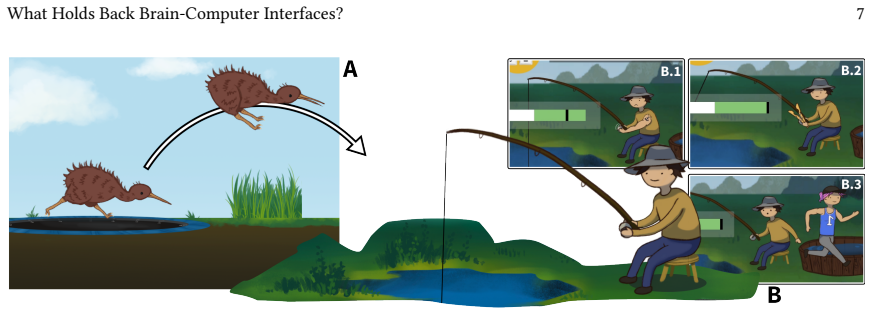
Brain-computer interfaces (BCIs) offer promising avenues for cerebral palsy (CP) rehabilitation at home and in the clinic, using games that promote engagement and sustained training effort. Nonetheless, the design constraints of BCI-based CP rehabilitation remain unclear, especially how individuals with CP experience a sense of control through BCI, and how they experience computer-mediated game assistance. To address this gap, we present preliminary clinical and user perspectives on BCI-based CP rehabilitation, drawing on in-clinic insights from a CP therapist and experiential accounts from ten individuals with CP engaging with BCI game prototypes. Sporadic help in BCI games eased monotony, but also fostered doubts regarding agency. The therapist saw BCI rehabilitation as complementary to traditional training, facilitating the transition from playful exercises to autonomous, self-managed training. We outline key challenges and opportunities to inform and empower further design and research of BCI training for CP.
Editorial analysis
A structured set of objections, weighed in public.
Referee Report
Summary. The manuscript presents preliminary qualitative insights from one CP therapist and ten individuals with CP who interacted with BCI game prototypes. It claims that sporadic in-game assistance reduces monotony yet raises doubts about user agency, while positioning BCI-based training as complementary to traditional rehabilitation by supporting the transition to autonomous, self-managed practice. The work aims to outline resulting challenges and opportunities to guide future BCI game design for CP rehabilitation.
Significance. If the reported experiential accounts hold, the observations on agency and complementarity could usefully inform BCI game mechanics that avoid undermining perceived control while bridging playful and independent training. The qualitative framing is suitable for surfacing user and therapist perspectives on control and assistance, though the small convenience sample inherently limits the strength and scope of any resulting design guidelines.
major comments (1)
- [Abstract / participant description] Abstract and participant description: the central claim that the study identifies 'key challenges and opportunities to inform and empower further design and research' of BCI training for CP rests on experiential accounts from a sample of ten CP users plus one therapist. No selection criteria, demographics, CP severity or motor-function distribution, age range, or justification of representativeness/saturation are supplied, which is load-bearing for generalizing the agency and complementarity observations into population-level design constraints.
minor comments (2)
- [Abstract] The abstract already labels the work 'preliminary'; this qualifier could be carried more explicitly into the discussion of design implications to better align scope with sample size.
- [Methods (implied)] The manuscript would benefit from a short methods subsection or table summarizing participant characteristics even if only at a high level, to allow readers to assess the reported accounts directly.
Simulated Author's Rebuttal
We thank the referee for the constructive feedback on our preliminary qualitative study. We address the major comment on participant description and scope of claims below, and will revise the manuscript accordingly to better position the work as exploratory.
read point-by-point responses
-
Referee: [Abstract / participant description] Abstract and participant description: the central claim that the study identifies 'key challenges and opportunities to inform and empower further design and research' of BCI training for CP rests on experiential accounts from a sample of ten CP users plus one therapist. No selection criteria, demographics, CP severity or motor-function distribution, age range, or justification of representativeness/saturation are supplied, which is load-bearing for generalizing the agency and complementarity observations into population-level design constraints.
Authors: We agree that the manuscript should more explicitly delimit the scope of its claims. The study is positioned throughout as providing preliminary insights from a convenience sample of ten individuals with CP and one therapist, with the explicit aim of surfacing experiential accounts to generate hypotheses for future design rather than deriving population-level constraints. We will revise the abstract, participant description, and discussion sections to: (1) include all available demographic details, age range, CP severity, and motor-function information from the study records; (2) state the convenience sampling approach and absence of formal saturation or representativeness claims; and (3) rephrase the contribution as identifying challenges and opportunities to inform subsequent research, not as generalizable design guidelines. This aligns with the qualitative framing and the referee's note on the inherent limits of the sample size. revision: yes
Circularity Check
No circularity: qualitative claims drawn directly from participant statements
full rationale
This is a qualitative interview study whose central claims (agency doubts from sporadic assistance; BCI as bridge to autonomous training) are presented as summaries of the ten CP users' and one therapist's reported experiences. No equations, parameters, predictions, or derivations exist; no self-citation is invoked to justify uniqueness or force a result; the paper contains no ansatz, renaming of known results, or fitted-input-as-prediction structure. The derivation chain is therefore self-contained as direct reporting of external statements rather than any internal reduction to the paper's own inputs.
Axiom & Free-Parameter Ledger
Reference graph
Works this paper leans on
-
[1]
de Ridder, Joris A.J
Max Alberts, Ellen A.M. de Ridder, Joris A.J. Lodewijks, Tamara V. Pinos Cisneros, Kayleigh Schoorl, Albert Ali Salah, and Ben A.M. Schouten
-
[2]
Designing a Smartphone Exergame for Children with Cerebral Palsy in the Home Environment. InExtended Abstracts of the 2022 Annual Symposium on Computer-Human Interaction in Play (CHI PLAY ’22). Association for Computing Machinery, New York, NY, USA, 183–188. doi:10. 1145/3505270.3558325
arXiv 2022
-
[3]
Joanna Bergström, Jarrod Knibbe, Henning Pohl, and Kasper Hornbæk. 2022. Sense of Agency and User Experience: Is There a Link?ACM Trans. Comput.-Hum. Interact.29, 4 (March 2022), 28:1–28:22. doi:10.1145/3490493
-
[4]
A. Biasiucci, R. Leeb, I. Iturrate, S. Perdikis, A. Al-Khodairy, T. Corbet, A. Schnider, T. Schmidlin, H. Zhang, M. Bassolino, D. Viceic, P. Vuadens, A. G. Guggisberg, and J. d. R. Millán. 2018. Brain-actuated functional electrical stimulation elicits lasting arm motor recovery after stroke.Nature Communications9 (June 2018), 2421. doi:10.1038/s41467-018-04673-z
-
[5]
PD Bobrov, EV Biryukova, BA Polyaev, OA Lajsheva, EL Usachjova, AV Sokolova, DI Mihailova, KN Dement’Eva, and IR Fedotova. 2020. Rehabilitation of patients with cerebral palsy using hand exoskeleton controlled by brain-computer interface.Bulletin of Russian State Medical University4 (2020), 33–40
2020
-
[6]
Ian Daly, Martin Billinger, José Laparra-Hernández, Fabio Aloise, Mariano Lloria García, Josef Faller, Reinhold Scherer, and Gernot Müller-Putz
-
[7]
On the control of brain-computer interfaces by users with cerebral palsy.Clinical Neurophysiology124, 9 (2013), 1787–1797
2013
-
[8]
Moritz Grosse-Wentrup, Donatella Mattia, and Karim Oweiss. 2011. Using brain–computer interfaces to induce neural plasticity and restore function. Journal of neural engineering8, 2 (2011), 025004
2011
-
[9]
Hamilton A. Hernandez, Mallory Ketcheson, Adrian Schneider, Zi Ye, Darcy Fehlings, Lauren Switzer, Virginia Wright, Shelly K. Bursick, Chad Richards, and T.C. Nicholas Graham. 2014. Design and evaluation of a networked game to supportsocial connection of youth with cerebral palsy. In Proceedings of the 16th international ACM SIGACCESS conference on Comput...
-
[10]
Hamilton A. Hernandez, Zi Ye, T.C. Nicholas Graham, Darcy Fehlings, and Lauren Switzer. 2013. Designing action-based exergames for children with cerebral palsy. InProceedings of the SIGCHI Conference on Human Factors in Computing Systems (CHI ’13). Association for Computing Machinery, New York, NY, USA, 1261–1270. doi:10.1145/2470654.2466164
-
[11]
Bastian I Hougaard, Hendrik Knoche, Mathias Sand Kristensen, and Mads Jochumsen. 2022. Modulating frustration and agency using fabricated input for motor imagery BCIs in stroke rehabilitation.IEEE Access10 (2022), 72312–72327
2022
-
[12]
Bastian Ilsø Hougaard, Ingeborg Goll Rossau, Jedrzej Jacek Czapla, Mozes Adorjan Miko, Rasmus Bugge Skammelsen, Hendrik Knoche, and Mads Jochumsen. 2021. Who Willed It? Decreasing Frustration by Manipulating Perceived Control through Fabricated Input for Stroke Rehabilitation BCI 14 ... Games.Proceedings of the Annual Symposium on Computer-Human Interacti...
2021
-
[13]
Jessup Schneider, Daniel Clarke, Alexander Macintosh, Lauren Switzer, Darcy Fehlings, and T.C
Susan Hwang, Adrian L. Jessup Schneider, Daniel Clarke, Alexander Macintosh, Lauren Switzer, Darcy Fehlings, and T.C. Nicholas Graham. 2017. How Game Balancing Affects Play: Player Adaptation in an Exergame for Children with Cerebral Palsy. InProceedings of the 2017 Conference on Designing Interactive Systems (DIS ’17). Association for Computing Machinery...
-
[14]
Zeanna Jadavji, Adam Kirton, Megan J Metzler, and Ephrem Zewdie. 2023. BCI-activated electrical stimulation in children with perinatal stroke and hemiparesis: A pilot study.Frontiers in Human Neuroscience17 (2023), 1006242
2023
-
[15]
Mads Jochumsen, Bastian Ilsø Hougaard, Mathias Sand Kristensen, and Hendrik Knoche. 2022. Implementing performance accommodation mechanisms in online BCI for stroke rehabilitation: a study on perceived control and frustration.Sensors22, 23 (2022), 9051
2022
-
[16]
Mads Jochumsen, Muhammad Shafique, Ali Hassan, and Imran Khan Niazi. 2018. Movement intention detection in adolescents with cerebral palsy from single-trial EEG.Journal of Neural Engineering15, 6 (2018), 066030
2018
-
[17]
Mads Jochumsen, Cecilie Sørenbye Sulkjær, and Kirstine Schultz Dalgaard. 2025. Comparison of Classifier Calibration Schemes for Movement Intention Detection in Individuals with Cerebral Palsy for Inducing Plasticity with Brain–Computer Interfaces.Sensors25, 23 (2025), 7347
2025
-
[18]
Mads Jochumsen, Cecilie Sørenbye Sulkjær, and Kirstine Schultz Dalgaard. 2025. Comparison of Classifier Calibration Schemes for Movement Intention Detection in Individuals with Cerebral Palsy for Inducing Plasticity with Brain-Computer Interfaces.Sensors (Basel, Switzerland)25, 23 (Dec. 2025). doi:10.3390/s25237347
-
[19]
Maximus D Kaos, Mark R Beauchamp, Shelly Bursick, Amy E Latimer-Cheung, Hamilton Hernandez, Darren E R Warburton, Christopher Yao, Zi Ye, T C Nicholas Graham, and Ryan E Rhodes. 2018. Efficacy of Online Multi-Player Versus Single-Player Exergames on Adherence Behaviors Among Children: A Nonrandomized Control Trial.Annals of Behavioral Medicine52, 10 (Sept...
-
[20]
, year = 2020, month = jul, pages =
D. Kelly, Z. Jadavji, E. Zewdie, E. Mitchell, K. Summerfield, A. Kirton, and E. Kinney-Lang. 2020. A Child’s Right to Play: Results from the Brain-Computer Interface Game Jam 2019 (Calgary Competition). In2020 42nd Annual International Conference of the IEEE Engineering in Medicine & Biology Society (EMBC). 6099–6102. doi:10.1109/EMBC44109.2020.9176272
-
[21]
, year = 2020, month = jul, pages =
E. Kinney-Lang, S. Murji, D. Kelly, B. Paffrath, E. Zewdie, and A. Kirton. 2020. Designing a flexible tool for rapid implementation of brain-computer interfaces (BCI) in game development. In2020 42nd Annual International Conference of the IEEE Engineering in Medicine & Biology Society (EMBC). 6078–6081. doi:10.1109/EMBC44109.2020.9175801
-
[22]
Jonathan Lazar, Adam Jones, Mary Hackley, and Ben Shneiderman. 2006. Severity and impact of computer user frustration: A comparison of student and workplace users.Interacting with Computers18, 2 (March 2006), 187–207. doi:10.1016/j.intcom.2005.06.001
-
[23]
Dario Maggiorini, Marco Granato, Laura Anna Ripamonti, Matteo Marras, and Davide Gadia. 2019. Evolution of Game Controllers: Toward the Support of Gamers with Physical Disabilities. InComputer-Human Interaction Research and Applications, Andreas Holzinger, Hugo Plácido Silva, and Markus Helfert (Eds.). Springer International Publishing, Cham, 66–89. doi:1...
-
[24]
Ravikiran Mane, Tushar Chouhan, and Cuntai Guan. 2020. BCI for stroke rehabilitation: motor and beyond.Journal of neural engineering17, 4 (2020), 041001
2020
-
[25]
Matthew K. Miller and Regan L. Mandryk. 2016. Differentiating in-Game Frustration from at-Game Frustration using Touch Pressure. InProceedings of the 2016 ACM International Conference on Interactive Surfaces and Spaces (ISS ’16). Association for Computing Machinery, New York, NY, USA, 225–234. doi:10.1145/2992154.2992185
-
[26]
Natalie Mrachacz-Kersting, Ning Jiang, Andrew James Thomas Stevenson, Imran Khan Niazi, Vladimir Kostic, Aleksandra Pavlovic, Sasa Radovanovic, Milica Djuric-Jovicic, Federica Agosta, Kim Dremstrup, et al. 2016. Efficient neuroplasticity induction in chronic stroke patients by an associative brain-computer interface.Journal of neurophysiology115, 3 (2016)...
2016
-
[27]
Natalie Mrachacz-Kersting, Signe Rom Kristensen, Imran Khan Niazi, and Dario Farina. 2012. Precise temporal association between cortical potentials evoked by motor imagination and afference induces cortical plasticity.The Journal of physiology590, 7 (2012), 1669–1682
2012
-
[28]
Imran Khan Niazi, Muhammad Samran Navid, Usman Rashid, Imran Amjad, Sharon Olsen, Heidi Haavik, Gemma Alder, Nitika Kumari, Nada Signal, Denise Taylor, et al. 2022. Associative cued asynchronous BCI induces cortical plasticity in stroke patients.Annals of clinical and translational neurology9, 5 (2022), 722–733
2022
-
[29]
Atefeh Omrani, Joanna Wakefield-Scurr, Jenny Smith, and Nicola Brown. 2019. Survey Development for Adolescents Aged 11–16 Years: A Developmental Science Based Guide.Adolescent Research Review4, 4 (Dec. 2019), 329–340. doi:10.1007/s40894-018-0089-0
-
[30]
Cohen, Joaquin P
Alvaro Pascual-Leone, Nguyet Dang, Leonardo G. Cohen, Joaquin P. Brasil-Neto, A. Cammarota, and M. Hallett. 1995. Modulation of muscle responses evoked by transcranial magnetic stimulation during the acquisition of new fine motor skills.Journal of Neurophysiology74, 3 (1995), 1037–1045
1995
-
[31]
Chris Pedersen, Julian Togelius, and Georgios N. Yannakakis. 2009. Modeling player experience in Super Mario Bros. In2009 IEEE Symposium on Computational Intelligence and Games. 132–139. doi:10.1109/CIG.2009.5286482
-
[32]
Lee B. Reid, Stephen E. Rose, and Roslyn N. Boyd. 2015. Rehabilitation and neuroplasticity in children with unilateral cerebral palsy.Nature Reviews Neurology11, 7 (July 2015), 390–400. doi:10.1038/nrneurol.2015.97
-
[33]
Yann Renard, Fabien Lotte, Guillaume Gibert, Marco Congedo, Emmanuel Maby, Vincent Delannoy, Olivier Bertrand, and Anatole Lécuyer. 2010. OpenViBE: An Open-Source Software Platform to Design, Test, and Use Brain–Computer Interfaces in Real and Virtual Environments.Presence19, 1 (Feb. 2010), 35–53. doi:10.1162/pres.19.1.35
-
[34]
Müller-Putz, Viktoria Pammer-Schindler, and Mariano Lloria Garcia
Reinhold Scherer, Andreas Schwarz, Gernot R. Müller-Putz, Viktoria Pammer-Schindler, and Mariano Lloria Garcia. 2015. Game-Based BCI Training: Interactive Design for Individuals with Cerebral Palsy. In2015 IEEE International Conference on Systems, Man, and Cybernetics. 3175–3180. What Holds Back Brain-Computer Interfaces? 15 doi:10.1109/SMC.2015.551
-
[35]
Müller-Putz, Viktoria Pammer-Schindler, and Mariano Lloria Garcia
Reinhold Scherer, Andreas Schwarz, Gernot R. Müller-Putz, Viktoria Pammer-Schindler, and Mariano Lloria Garcia. 2016. Lets play Tic-Tac-Toe: A Brain-Computer Interface case study in cerebral palsy. In2016 IEEE International Conference on Systems, Man, and Cybernetics (SMC). 003736–003741. doi:10.1109/SMC.2016.7844815
-
[36]
Sarvnaz Taherian, Dmitry Selitskiy, James Pau, and T. Claire Davies. 2017. Are we there yet? Evaluating commercial grade brain–computer interface for control of computer applications by individuals with cerebral palsy.Disability and Rehabilitation: Assistive Technology12, 2 (Feb. 2017), 165–174. doi:10.3109/17483107.2015.1111943 _eprint: https://doi.org/1...
-
[37]
Thompson, Wade Armstrong, and Craig Thomas
Suzanne C. Thompson, Wade Armstrong, and Craig Thomas. 1998. Illusions of control, underestimations, and accuracy: A control heuristic explanation.Psychological Bulletin123, 2 (1998), 143–161. doi:10.1037/0033-2909.123.2.143
-
[38]
Koen van Turnhout, Arthur Bennis, Sabine Craenmehr, Robert Holwerda, Marjolein Jacobs, Ralph Niels, Lambert Zaad, Stijn Hoppenbrouwers, Dick Lenior, and René Bakker. 2014. Design patterns for mixed-method research in HCI. InProceedings of the 8th Nordic Conference on Human-Computer Interaction: Fun, Fast, Foundational (NordiCHI ’14). Association for Compu...
-
[39]
S. A. G. Wensveen, J. P. Djajadiningrat, and C. J. Overbeeke. 2004. Interaction frogger: a design framework to couple action and function through feedback and feedforward. InProceedings of the 5th conference on Designing interactive systems: processes, practices, methods, and techniques (DIS ’04). Association for Computing Machinery, New York, NY, USA, 17...
-
[40]
2022.Operationalization of Goal Frustration
Mingming Zhou. 2022.Operationalization of Goal Frustration. Springer Nature, Singapore, 23–47. doi:10.1007/978-981-19-7477-9_2
discussion (0)
Sign in with ORCID, Apple, or X to comment. Anyone can read and Pith papers without signing in.