Reentrant value fields as delayed coupled reaction-diffusion systems on finite graphs
Pith reviewed 2026-05-21 08:07 UTC · model grok-4.3
The pith
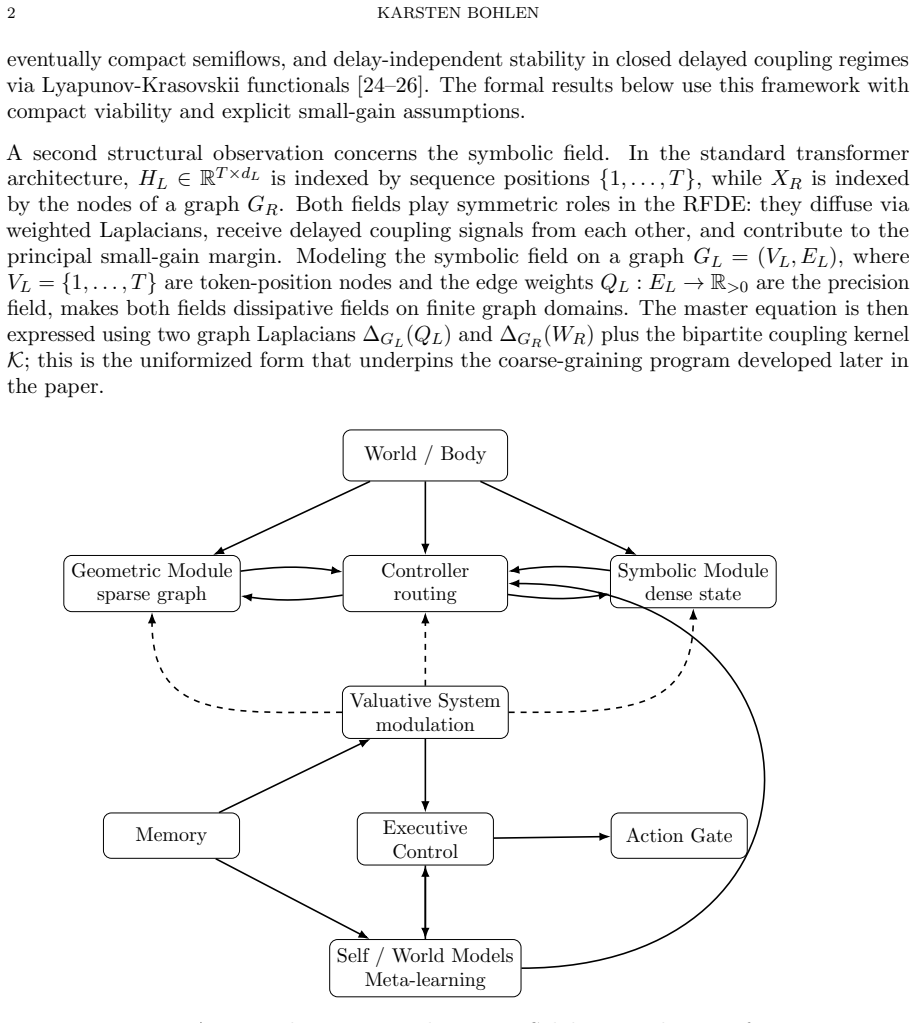
Reentrant value fields are modeled as delayed coupled reaction-diffusion systems on finite graphs that admit global attractors and delay-independent stability.
A machine-rendered reading of the paper's core claim, the machinery that carries it, and where it could break.
Core claim
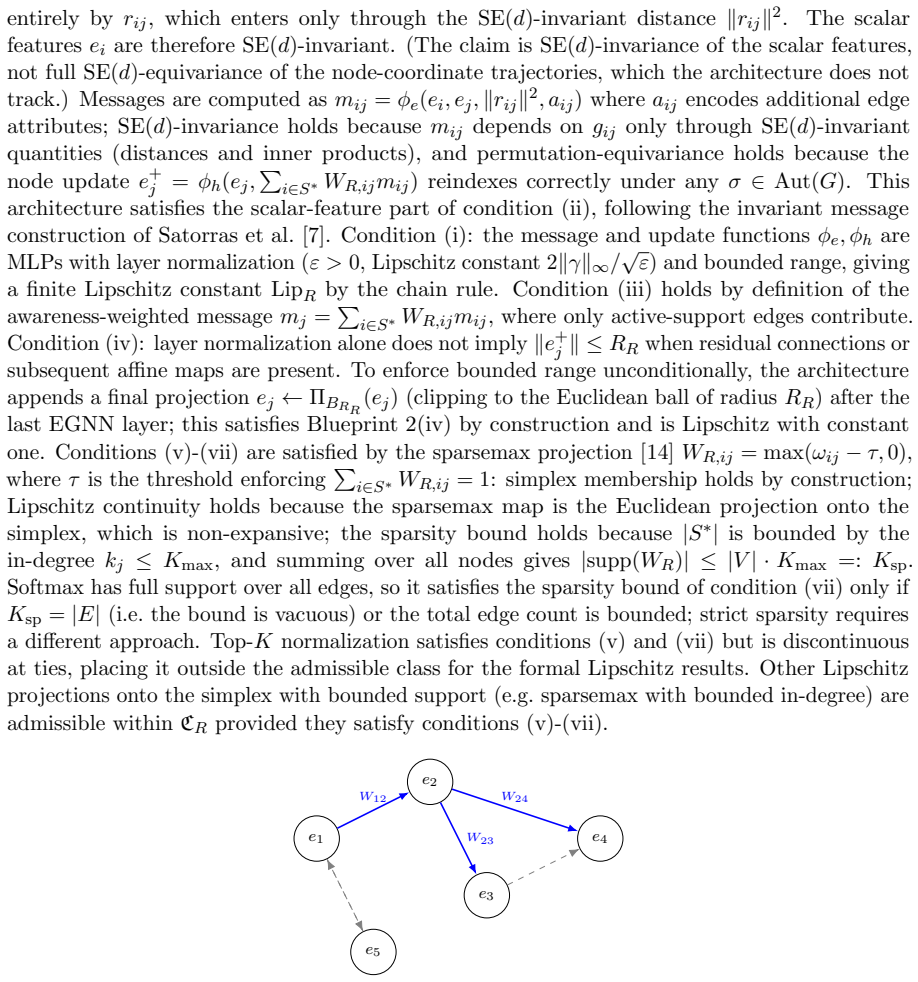
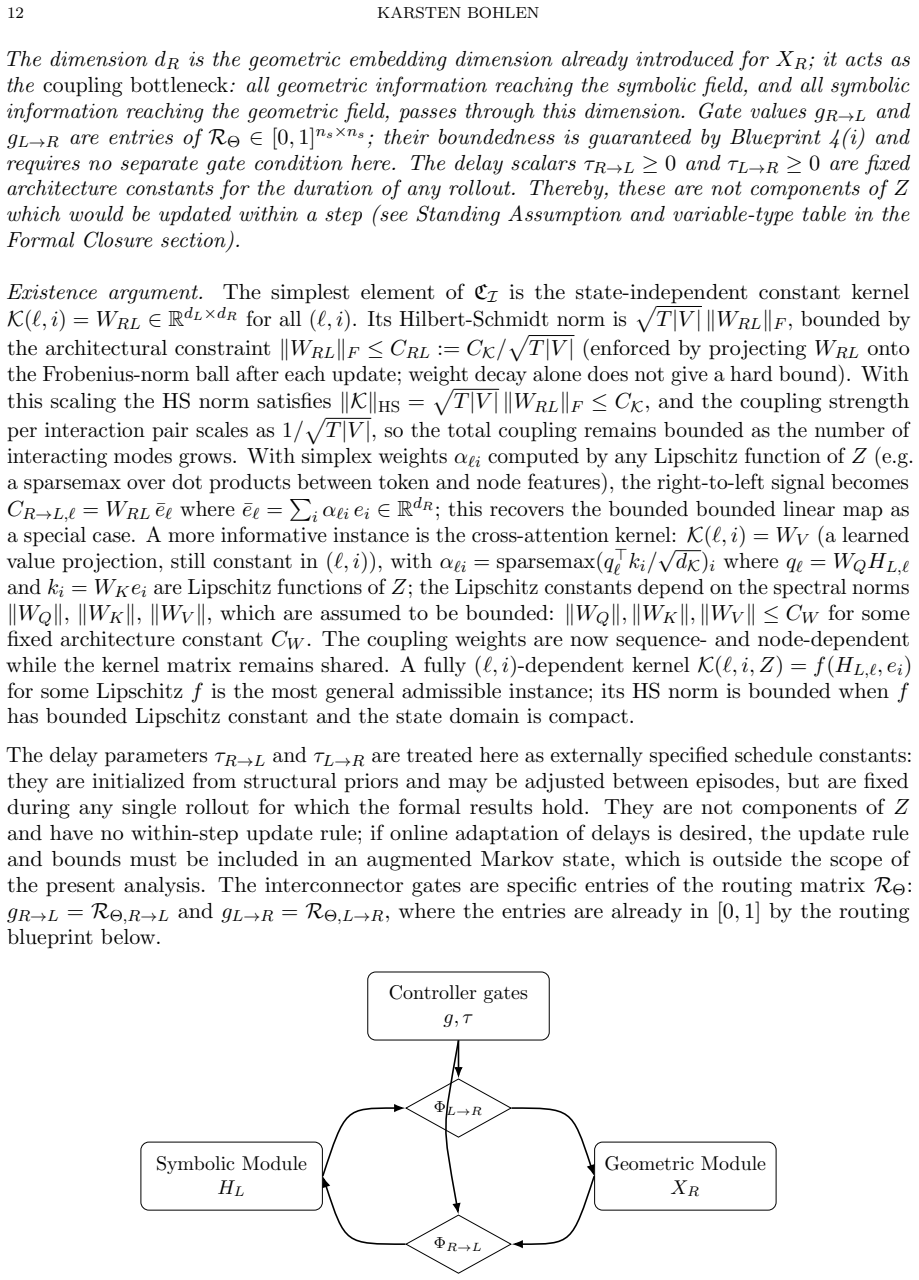
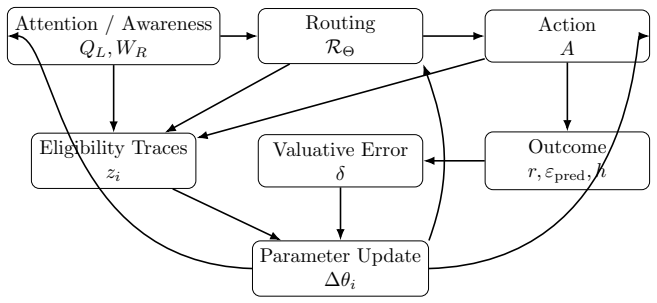
The author claims that the full deterministic retarded functional differential equation for the coupled fields is well-posed under constant input, admits a compact global attractor because solution segments are compactly viable and eventually compact, and that the principal components (H_L, X_R, P) are globally stable independent of delay size whenever the fixed interfield coupling operator satisfies C_K squared less than mu_L times mu_R; the same setting also yields SE(d)-invariance of scalar geometric feature dynamics and an O(1 over kappa_Y) relaxation estimate for the valuative variable.
What carries the argument
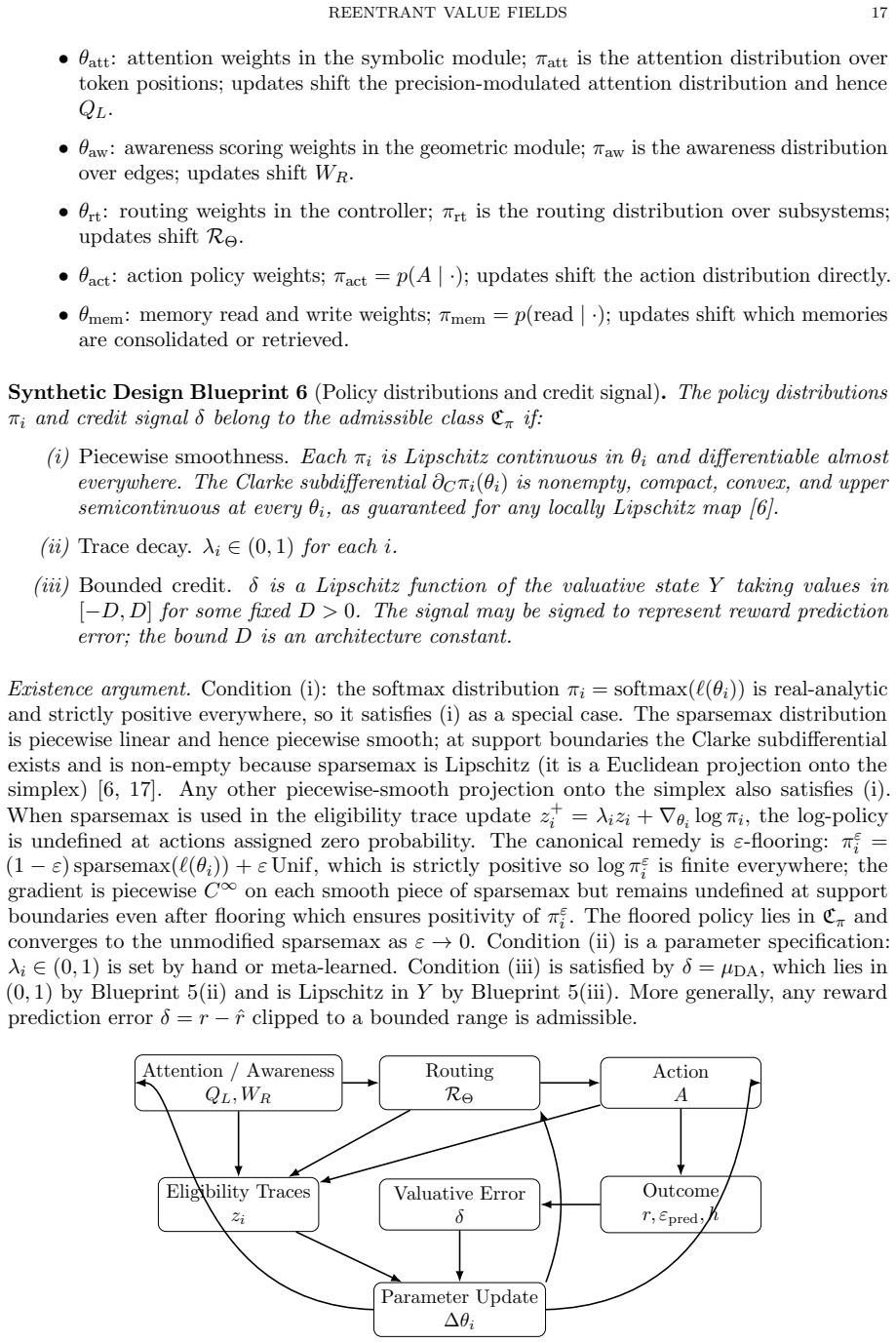
the retarded functional differential equation (RFDE) on the history space, which serves as the operative reaction-diffusion equation for the delayed coupling of the symbolic and geometric fields subject to the nine admissibility conditions.
If this is right
- Well-posedness of the RFDE under constant input permits Lipschitz state-dependent attention operators.
- Existence of a compact global attractor follows directly from compact viability and eventual compactness of solution segments.
- Principal components remain globally stable for any delay length in the closed stability regime defined by the coupling bound.
- Scalar geometric feature dynamics stay invariant under the full SE(d) group.
- The valuative variable relaxes at a rate of order one over kappa_Y.
Where Pith is reading between the lines
- The explicit identification of small-gain remainder terms for state-dependent coupling suggests a route to proving stability when attention operators are allowed to vary with the current state.
- The graph-based construction may connect to other network models in which feedback loops carry heterogeneous propagation times.
- Numerical checks on small graphs could test whether the fast relaxation estimate remains visible once the full nonlinear terms are restored.
Load-bearing premise
The nine synthetic design blueprints that specify admissibility conditions for each architectural component must hold.
What would settle it
A concrete finite graph together with operators satisfying the inequality C_K squared less than mu_L times mu_R on which the principal components (H_L, X_R, P) fail to converge globally or on which solution segments lose eventual compactness.
Figures


read the original abstract
We describe a dynamical system in which a symbolic field is coupled to a geometric field via a bipartite Hilbert-Schmidt kernel. The system is fully described by a retarded functional differential equation (RFDE) on the history space, subject to Lipschitz and small gain conditions. We show that the RFDE is well-posed under constant input and that it admits a compact global attractor. The principal subsystem $(H_L, X_R, P)$, which is comprised of the two primary fields as well as an executive field, is shown to be globally stable independent of delay, provided that the interfield coupling satisfies $C_{\mathcal{K}}^2<\mu_L\mu_R$. In addition, we describe design specifications that fulfill the hypotheses of the main Theorem.
Editorial analysis
A structured set of objections, weighed in public.
Referee Report
Summary. The paper develops a field theory of synthetic cognition in which a symbolic field H_L and a geometric field X_R, each a section of a vertex bundle over a finite graph, are coupled through a bipartite Hilbert-Schmidt operator with propagation delays. The central object is a retarded functional differential equation (RFDE) on the history space. Nine synthetic design blueprints specify admissibility conditions for each architectural component, each carrying a dynamical consequence. The main formal results are: (1) well-posedness of the full deterministic RFDE under constant input u*, (2) existence of a compact global attractor from compact viability and eventual compactness of solution segments, (3) delay-independent global stability of the principal components (H_L, X_R, P) in the closed stability regime with fixed interfield coupling operators satisfying C_K^2 < μ_L μ_R, (4) SE(d)-invariance of the scalar geometric feature dynamics, and (5) an O(1/κ_Y) fast relaxation estimate for the valuative variable. The well-posedness and attractor results allow Lipschitz state-dependent attention operators.
Significance. If the results hold, the work supplies a rigorous dynamical-systems framework for modeling reentrant value fields as delayed coupled reaction-diffusion systems on graphs, with explicit theorems on well-posedness, global attractors, and delay-independent stability. The explicit identification of small-gain terms for state-dependent coupling and the SE(d)-invariance result are concrete strengths that could support further analysis of geometric invariance in cognitive models. The approach bridges symbolic and geometric components via graph-based fields and RFDEs, which is a novel direction within mathematical dynamical systems.
major comments (2)
- [abstract, paragraph on central object and main formal results] The well-posedness, attractor existence, and stability theorems (abstract, paragraph on central object and main formal results) are obtained by invoking nine synthetic design blueprints that encode admissibility conditions on vertex bundles, coupling operators, and reaction terms. The manuscript asserts that these conditions carry the required dynamical consequences, yet no explicit verification is supplied that the concrete reaction-diffusion operators and Lipschitz state-dependent attention maps satisfy all nine conditions simultaneously. This renders the passage from the abstract RFDE to the three main theorems conditional on unproven admissibility.
- [main formal results (3)] The delay-independent global stability claim for the principal subsystem (H_L, X_R, P) is stated under the fixed-coupling regime with C_K^2 < μ_L μ_R. It is not shown whether this inequality is derived from the RFDE structure or imposed as an additional modeling assumption; if the latter, the stability result is not fully intrinsic to the proposed reaction-diffusion system.
minor comments (2)
- [abstract] Notation for the coupling operator (C_K versus C_{mathcal K}) and the stability threshold should be unified across the abstract and the theorem statements to avoid reader confusion.
- [abstract] The abstract mentions that well-posedness and attractor results allow Lipschitz state-dependent attention operators, but the precise manner in which the nine blueprints accommodate state dependence is not summarized; a short clarifying sentence would improve readability.
Simulated Author's Rebuttal
We thank the referee for the careful and constructive review of our manuscript. The comments highlight important points regarding the presentation of admissibility conditions and the status of the stability assumption. We address each major comment below and indicate the revisions we will make to improve clarity and rigor.
read point-by-point responses
-
Referee: [abstract, paragraph on central object and main formal results] The well-posedness, attractor existence, and stability theorems (abstract, paragraph on central object and main formal results) are obtained by invoking nine synthetic design blueprints that encode admissibility conditions on vertex bundles, coupling operators, and reaction terms. The manuscript asserts that these conditions carry the required dynamical consequences, yet no explicit verification is supplied that the concrete reaction-diffusion operators and Lipschitz state-dependent attention maps satisfy all nine conditions simultaneously. This renders the passage from the abstract RFDE to the three main theorems conditional on unproven admissibility.
Authors: We acknowledge that the manuscript presents the nine synthetic design blueprints as general admissibility conditions whose dynamical consequences are established abstractly, but does not contain an explicit, simultaneous verification that the specific reaction-diffusion operators and state-dependent attention maps satisfy every condition at once. This is a fair observation that leaves the link between the general theory and the concrete operators somewhat implicit. In the revised manuscript we will add a new subsection (or appendix) that verifies each of the nine conditions for the concrete operators employed in the well-posedness and attractor theorems, thereby rendering the passage to the main results fully explicit. revision: yes
-
Referee: [main formal results (3)] The delay-independent global stability claim for the principal subsystem (H_L, X_R, P) is stated under the fixed-coupling regime with C_K^2 < μ_L μ_R. It is not shown whether this inequality is derived from the RFDE structure or imposed as an additional modeling assumption; if the latter, the stability result is not fully intrinsic to the proposed reaction-diffusion system.
Authors: The inequality C_K^2 < μ_L μ_R is introduced as a sufficient condition that defines the closed stability regime for the fixed-coupling principal subsystem. It is obtained by applying a small-gain argument to the coupled RFDE and is therefore derived from the structure of the system once the interfield operators are fixed; however, it is not a necessary consequence that holds for arbitrary coupling strengths. The manuscript already states that the result applies “with fixed interfield coupling operators satisfying” the inequality, which indicates it is a modeling assumption on the admissible class of operators. We will revise the relevant paragraph to make this distinction explicit, clarifying that the condition is a sufficient small-gain restriction that guarantees delay-independent stability within the proposed reaction-diffusion framework. revision: yes
Circularity Check
No significant circularity; results follow from stated assumptions on the RFDE.
full rationale
The derivation begins with the retarded functional differential equation on history space for the coupled fields H_L and X_R. Nine synthetic design blueprints are introduced as admissibility conditions on vertex bundles, coupling operators, and reaction terms, each explicitly stated to carry a dynamical consequence. The main theorems—well-posedness under constant input, compact global attractor via viability and eventual compactness, and delay-independent stability of (H_L, X_R, P) when C_K^2 < μ_L μ_R—are then obtained directly from the RFDE under these conditions. The stability inequality is an explicit hypothesis on the fixed interfield operators, not a fitted parameter or self-referential definition. No self-citations, ansatzes smuggled via prior work, or renamings of known results appear in the load-bearing steps. The concrete operators are asserted to satisfy the blueprints, but the logical chain itself does not reduce any claimed prediction to its own inputs by construction; the results remain conditional on independently stated assumptions. This is standard non-circular mathematical development.
Axiom & Free-Parameter Ledger
axioms (1)
- domain assumption Nine synthetic design blueprints specify admissibility conditions for each architectural component
Lean theorems connected to this paper
-
IndisputableMonolith/Cost/FunctionalEquation.leanwashburn_uniqueness_aczel unclear?
unclearRelation between the paper passage and the cited Recognition theorem.
The main formal results are: (1) well-posedness of the full deterministic RFDE under constant input u*, (2) existence of a compact global attractor from compact viability and eventual compactness of solution segments, (3) delay-independent global stability of the principal components (H_L, X_R, P) in the closed stability regime with fixed interfield coupling operators satisfying C_K² < μ_L μ_R.
-
IndisputableMonolith/Foundation/RealityFromDistinction.leanreality_from_one_distinction unclear?
unclearRelation between the paper passage and the cited Recognition theorem.
Nine synthetic design blueprints specify admissibility conditions for each architectural component; each condition carries a dynamical consequence.
What do these tags mean?
- matches
- The paper's claim is directly supported by a theorem in the formal canon.
- supports
- The theorem supports part of the paper's argument, but the paper may add assumptions or extra steps.
- extends
- The paper goes beyond the formal theorem; the theorem is a base layer rather than the whole result.
- uses
- The paper appears to rely on the theorem as machinery.
- contradicts
- The paper's claim conflicts with a theorem or certificate in the canon.
- unclear
- Pith found a possible connection, but the passage is too broad, indirect, or ambiguous to say the theorem truly supports the claim.
discussion (0)
Sign in with ORCID, Apple, or X to comment. Anyone can read and Pith papers without signing in.