Accessing Exotic Hadronic States via Charmed-Meson Femtoscopy in Relativistic Heavy-Ion Collisions
Pith reviewed 2026-06-28 19:52 UTC · model grok-4.3
The pith
Heavy-ion collisions enable sensitive femtoscopic access to charmed-meson interactions and possible exotic molecular states.
A machine-rendered reading of the paper's core claim, the machinery that carries it, and where it could break.
Core claim
The two-particle correlation function measured in femtoscopic analyses provides access to the interaction potentials between emitted particles and thereby a unique opportunity to investigate interactions among charmed mesons and to explore the nature of possible exotic hadronic states. In relativistic heavy-ion collisions the dynamical evolution and charm production are modeled with a transport approach while correlation functions are obtained from the Schrödinger equation; the resulting environment is significantly more favorable than in proton-proton collisions because of enhanced charm-quark production, reduced relative momenta due to in-medium energy loss, and strong suppression of initi
What carries the argument
The two-particle correlation function obtained by solving the Schrödinger equation for assumed interaction potentials between particles whose space-time evolution is supplied by a transport model of heavy-ion collisions.
If this is right
- Heavy-ion collisions yield larger and cleaner charmed-meson correlation signals than proton-proton collisions.
- The correlation functions become sensitive to the detailed form of the interaction potential between charmed mesons.
- Possible hadronic molecular states can be distinguished from ordinary scattering states through the shape of the correlation function.
- Femtoscopic data from existing heavy-ion experiments can be used to constrain charmed-meson potentials.
Where Pith is reading between the lines
- The same femtoscopic technique could be applied to other heavy-flavor meson pairs to map a wider set of interaction potentials.
- Successful extraction of potentials would provide input for lattice calculations or effective theories of exotic charm states.
- If the predicted suppression of initial-state correlations holds, it reduces one major systematic uncertainty in future analyses.
Load-bearing premise
The transport model accurately describes charm production, energy loss and space-time evolution while the correlation framework correctly converts the assumed potentials into observable functions without large unmodeled medium effects.
What would settle it
A measured correlation function for a charmed-meson pair in heavy-ion data that shows no sensitivity to the presence or absence of a molecular binding potential, or that matches the pp-collision result instead of the predicted enhancement.
Figures


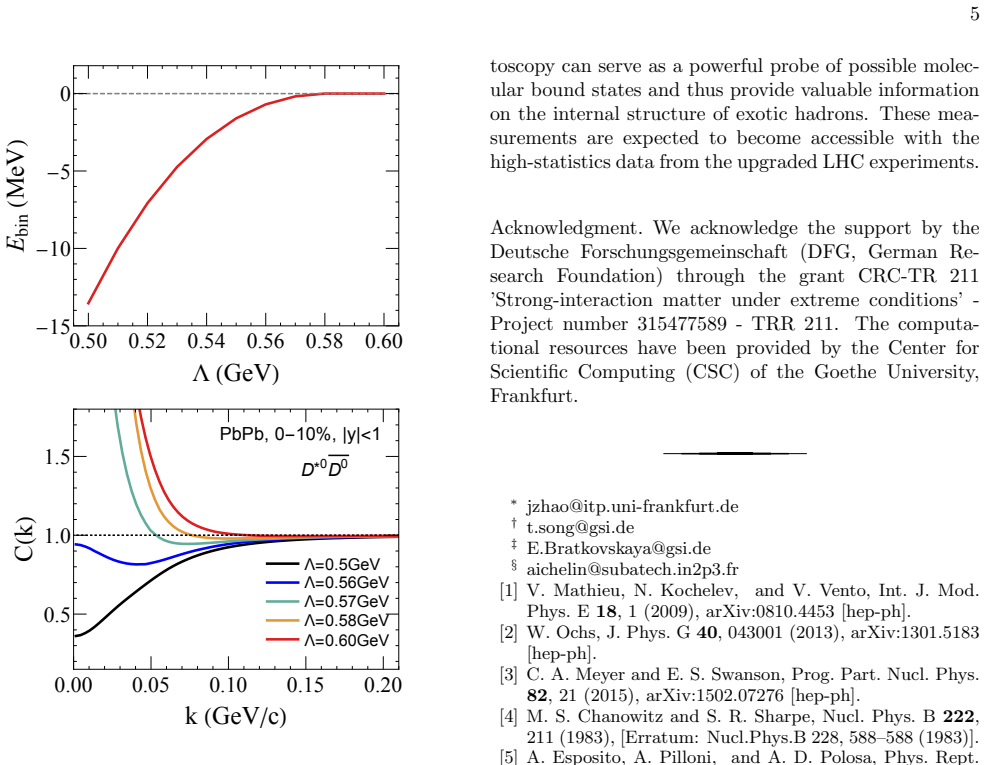
read the original abstract
The two-particle correlation function measured in femtoscopic analyses provides access to the interaction potentials between emitted particles. This offers a unique opportunity to investigate interactions among charmed mesons and to explore the nature of possible exotic hadronic states. In this Letter, we study femtoscopic correlations of various charmed-meson pairs in relativistic heavy-ion collisions. The dynamical evolution of the system and charm hadron production are described within the Parton-Hadron-String Dynamics (PHSD) transport approach, while the correlation functions are computed using the Correlation Analysis Tool using the Schr\"odinger equation (CATS). We demonstrate that heavy-ion collisions provide a significantly more favorable environment than $pp$ collisions for accessing charmed meson femtoscopic correlations. This arises from enhanced charm-quark production, reduced relative momenta due to in-medium energy loss, and a strong suppression of initial-state correlations. Our results indicate that femtoscopic measurements in heavy-ion collisions offer a sensitive probe of charmed meson interactions and possible hadronic molecular states.
Editorial analysis
A structured set of objections, weighed in public.
Referee Report
Summary. The manuscript uses the PHSD transport approach to simulate charm production, energy loss, and space-time evolution in relativistic heavy-ion collisions, feeding the resulting source functions and pair momenta into the CATS framework to compute two-particle correlation functions for charmed-meson pairs. It concludes that AA collisions are significantly more favorable than pp collisions for femtoscopic studies because of higher charm yields, reduced relative momenta from in-medium energy loss, and strong suppression of initial-state correlations, thereby providing a sensitive probe of charmed-meson interactions and possible exotic molecular states.
Significance. If the modeling assumptions hold, the work identifies a concrete experimental pathway to study charmed-meson interactions via femtoscopy in heavy-ion environments, leveraging two established, publicly documented codes (PHSD and CATS) and generating falsifiable predictions for correlation functions that differ markedly between AA and pp systems. This strengthens the case for using heavy-ion data to constrain potentials relevant to exotic hadronic states.
major comments (2)
- [Abstract and PHSD modeling section] Abstract and PHSD modeling section: the claim that heavy-ion collisions are 'significantly more favorable' is obtained by feeding PHSD-generated source functions into CATS; the manuscript provides no quantitative benchmark of these source functions or low-p_T D-meson pair distributions against experimental data or alternative transport calculations, so the predicted suppression of initial-state correlations and enhancement at small q remain tied to the fidelity of this specific implementation.
- [CATS application and results] CATS application and results: correlation functions are computed with vacuum potentials; the manuscript does not examine possible in-medium modifications to these potentials, which directly affects the predicted signal strength at small q and is therefore load-bearing for the assertion that AA collisions offer a sensitive probe.
minor comments (1)
- [Methods] The notation for the relative momentum q and the source function S(r) should be defined explicitly with an equation in the methods section for clarity.
Simulated Author's Rebuttal
We thank the referee for the detailed and constructive report. We address each major comment below and outline the corresponding revisions.
read point-by-point responses
-
Referee: [Abstract and PHSD modeling section] Abstract and PHSD modeling section: the claim that heavy-ion collisions are 'significantly more favorable' is obtained by feeding PHSD-generated source functions into CATS; the manuscript provides no quantitative benchmark of these source functions or low-p_T D-meson pair distributions against experimental data or alternative transport calculations, so the predicted suppression of initial-state correlations and enhancement at small q remain tied to the fidelity of this specific implementation.
Authors: We agree that the manuscript does not contain direct quantitative benchmarks of the PHSD source functions or low-p_T D-meson pair distributions against data or other transport models. While PHSD has been validated for single-particle D-meson spectra and elliptic flow in earlier publications, pair-level distributions at small relative momentum are less directly constrained. In the revised version we will add a dedicated paragraph in the modeling section that (i) cites the existing single-particle validations, (ii) explicitly states the model dependence of the pair source, and (iii) qualifies the phrase “significantly more favorable” to reflect the specific PHSD+CATS implementation. This change will be reflected in both the abstract and the main text. revision: partial
-
Referee: [CATS application and results] CATS application and results: correlation functions are computed with vacuum potentials; the manuscript does not examine possible in-medium modifications to these potentials, which directly affects the predicted signal strength at small q and is therefore load-bearing for the assertion that AA collisions offer a sensitive probe.
Authors: We acknowledge that the calculations employ vacuum potentials and do not explore in-medium modifications. This is a genuine limitation that can influence the strength of the correlation signal. In the revised manuscript we will insert a new subsection (or extended paragraph) under “Results” that (i) states the vacuum-potential assumption, (ii) briefly discusses possible in-medium effects on the D-meson interaction (e.g., screening or mass shifts), and (iii) notes that a quantitative study of medium-modified potentials lies beyond the present scope but is an important follow-up. The core kinematic argument for AA versus pp collisions remains unchanged, but the text will make the assumption transparent. revision: yes
Circularity Check
No circularity; results follow from forward simulation with named external models
full rationale
The paper's central results are obtained by running the independent PHSD transport code to generate source functions and pair momenta, then feeding those into the independent CATS code to compute correlation functions. No target femtoscopic observable is used to fit any parameter, no self-citation is invoked to justify a uniqueness theorem or ansatz, and the comparison between heavy-ion and pp environments is a direct numerical output rather than a redefinition. The derivation chain therefore remains non-circular.
Axiom & Free-Parameter Ledger
axioms (2)
- domain assumption PHSD correctly describes charm-quark production, energy loss, and hadronization in the evolving medium of heavy-ion collisions.
- domain assumption CATS accurately computes two-particle correlation functions from given interaction potentials without additional unaccounted final-state effects.
Reference graph
Works this paper leans on
-
[1]
V. Mathieu, N. Kochelev, and V. Vento, Int. J. Mod. Phys. E18, 1 (2009), arXiv:0810.4453 [hep-ph]
work page internal anchor Pith review Pith/arXiv arXiv 2009
-
[2]
W. Ochs, J. Phys. G40, 043001 (2013), arXiv:1301.5183 [hep-ph]
work page internal anchor Pith review Pith/arXiv arXiv 2013
-
[3]
C. A. Meyer and E. S. Swanson, Prog. Part. Nucl. Phys. 82, 21 (2015), arXiv:1502.07276 [hep-ph]
work page internal anchor Pith review Pith/arXiv arXiv 2015
-
[4]
M. S. Chanowitz and S. R. Sharpe, Nucl. Phys. B222, 211 (1983), [Erratum: Nucl.Phys.B 228, 588–588 (1983)]
1983
-
[5]
A. Esposito, A. Pilloni, and A. D. Polosa, Phys. Rept. 668, 1 (2017), arXiv:1611.07920 [hep-ph]
work page internal anchor Pith review Pith/arXiv arXiv 2017
-
[6]
M. Karliner, J. L. Rosner, and T. Skwarnicki, Ann. Rev. Nucl. Part. Sci.68, 17 (2018), arXiv:1711.10626 [hep-ph]
work page internal anchor Pith review Pith/arXiv arXiv 2018
-
[7]
De Rujula, H
A. De Rujula, H. Georgi, and S. L. Glashow, Phys. Rev. Lett.38, 317 (1977)
1977
-
[8]
F.-K. Guo, C. Hanhart, U.-G. Meißner, Q. Wang, Q. Zhao, and B.-S. Zou, Rev. Mod. Phys.90, 015004 (2018), [Erratum: Rev.Mod.Phys. 94, 029901 (2022)], arXiv:1705.00141 [hep-ph]
work page internal anchor Pith review Pith/arXiv arXiv 2018
-
[9]
S. K. Choiet al.(Belle), Phys. Rev. Lett.91, 262001 (2003), arXiv:hep-ex/0309032
work page internal anchor Pith review Pith/arXiv arXiv 2003
- [10]
-
[11]
Multi-quark hadrons from Heavy Ion Collisions
S. Choet al.(ExHIC), Phys. Rev. Lett.106, 212001 (2011), arXiv:1011.0852 [nucl-th]
work page internal anchor Pith review Pith/arXiv arXiv 2011
- [12]
- [13]
- [14]
- [15]
-
[16]
C. Bignamini, B. Grinstein, F. Piccinini, A. D. Polosa, and C. Sabelli, Phys. Rev. Lett.103, 162001 (2009), arXiv:0906.0882 [hep-ph]
work page internal anchor Pith review Pith/arXiv arXiv 2009
- [17]
-
[18]
Exotic hadrons: review and perspectives
J.-M. Richard, Few Body Syst.57, 1185 (2016), arXiv:1606.08593 [hep-ph]
work page internal anchor Pith review Pith/arXiv arXiv 2016
- [19]
-
[20]
A. Ali, J. S. Lange, and S. Stone, Prog. Part. Nucl. Phys. 97, 123 (2017), arXiv:1706.00610 [hep-ph]
work page internal anchor Pith review Pith/arXiv arXiv 2017
-
[21]
Pentaquark and Tetraquark states
Y.-R. Liu, H.-X. Chen, W. Chen, X. Liu, and S.- L. Zhu, Prog. Part. Nucl. Phys.107, 237 (2019), arXiv:1903.11976 [hep-ph]
work page internal anchor Pith review Pith/arXiv arXiv 2019
-
[22]
R. H. Brown and R. Twiss, The London, Edinburgh, and Dublin Philosophical Maga- zine and Journal of Science45, 663 (1954), https://doi.org/10.1080/14786440708520475
-
[23]
Pratt, Phys
S. Pratt, Phys. Rev. Lett.53, 1219 (1984)
1984
- [24]
-
[25]
Bose-Einstein correlations of pion pairs in central Pb+Pb collisions at CERN SPS energies
C. Altet al.(NA49), Phys. Rev. C77, 064908 (2008), arXiv:0709.4507 [nucl-ex]
work page internal anchor Pith review Pith/arXiv arXiv 2008
-
[26]
Q.-f. Li, J. Steinheimer, H. Petersen, M. Bleicher, and H. Stocker, Phys. Lett. B674, 111 (2009), arXiv:0812.0375 [nucl-th]
work page internal anchor Pith review Pith/arXiv arXiv 2009
-
[27]
U. A. Wiedemann and U. W. Heinz, Phys. Rev. C56, 3265 (1997), arXiv:nucl-th/9611031
work page internal anchor Pith review Pith/arXiv arXiv 1997
-
[28]
Femtoscopy in hydro-inspired models with resonances
A. Kisiel, W. Florkowski, and W. Broniowski, Phys. Rev. C73, 064902 (2006), arXiv:nucl-th/0602039
work page internal anchor Pith review Pith/arXiv arXiv 2006
-
[29]
Proton-lambda correlations in central Au+Au collisions at sqrt (s_NN)=200 GeV
J. Adamset al.(STAR), Phys. Rev. C74, 064906 (2006), arXiv:nucl-ex/0511003
work page internal anchor Pith review Pith/arXiv arXiv 2006
-
[30]
The Proton-$\Omega$ correlation function in Au+Au collisions at $\sqrt{s_{NN}}$=200 GeV
J. Adamet al.(STAR), Phys. Lett. B790, 490 (2019), arXiv:1808.02511 [hep-ex]
work page internal anchor Pith review Pith/arXiv arXiv 2019
-
[31]
The $\Lambda\Lambda$ Correlation Function in Au+Au collisions at $\sqrt{s_{NN}}=$ 200 GeV
L. Adamczyket al.(STAR), Phys. Rev. Lett.114, 022301 (2015), arXiv:1408.4360 [nucl-ex]
work page internal anchor Pith review Pith/arXiv arXiv 2015
-
[32]
Measurement of interaction between antiprotons
L. Adamczyket al.(STAR), Nature527, 345 (2015), arXiv:1507.07158 [nucl-ex]
work page internal anchor Pith review Pith/arXiv arXiv 2015
-
[33]
S. Acharyaet al.(ALICE), Phys. Rev. C99, 024001 (2019), arXiv:1805.12455 [nucl-ex]
work page internal anchor Pith review Pith/arXiv arXiv 2019
-
[34]
S. Acharyaet al.(ALICE), Phys. Rev. Lett.127, 172301 (2021), arXiv:2105.05578 [nucl-ex]
-
[35]
S. Acharyaet al.(ALICE), Phys. Lett. B805, 135419 (2020), arXiv:1910.14407 [nucl-ex]
-
[36]
S. Acharyaet al.(ALICE), Phys. Rev. Lett.123, 112002 (2019), arXiv:1904.12198 [nucl-ex]
-
[37]
S. Acharyaet al.(ALICE), Phys. Lett. B844, 137223 (2023), arXiv:2204.10258 [nucl-ex]
-
[38]
K. Aamodtet al.(ALICE), Phys. Rev. D84, 112004 (2011), arXiv:1101.3665 [hep-ex]
work page internal anchor Pith review Pith/arXiv arXiv 2011
-
[39]
S. Acharyaet al.(ALICE), Phys. Rev. D106, 052010 (2022), arXiv:2201.05352 [nucl-ex]
- [40]
- [41]
- [42]
- [43]
-
[44]
M. Albaladejo, A. Feijoo, I. Vida˜ na, J. Nieves, and E. Oset, (2023), arXiv:2307.09873 [hep-ph]
- [45]
-
[46]
Parton transport and hadronization from the dynamical quasiparticle point of view
W. Cassing and E. L. Bratkovskaya, Phys. Rev. C78, 034919 (2008), arXiv:0808.0022 [hep-ph]
work page internal anchor Pith review Pith/arXiv arXiv 2008
-
[47]
Parton-Hadron-String Dynamics: an off-shell transport approach for relativistic energies
W. Cassing and E. L. Bratkovskaya, Nucl. Phys. A831, 215 (2009), arXiv:0907.5331 [nucl-th]
work page internal anchor Pith review Pith/arXiv arXiv 2009
-
[48]
E. L. Bratkovskaya, W. Cassing, V. P. Konchakovski, and O. Linnyk, Nucl. Phys. A856, 162 (2011), arXiv:1101.5793 [nucl-th]
work page internal anchor Pith review Pith/arXiv arXiv 2011
- [49]
-
[50]
T. Song, H. Berrehrah, D. Cabrera, W. Cassing, and E. Bratkovskaya, Phys. Rev. C93, 034906 (2016), arXiv:1512.00891 [nucl-th]
work page internal anchor Pith review Pith/arXiv arXiv 2016
-
[51]
T. Song, H. Berrehrah, D. Cabrera, J. M. Torres-Rincon, L. Tolos, W. Cassing, and E. Bratkovskaya, Phys. Rev. C92, 014910 (2015), arXiv:1503.03039 [nucl-th]
work page internal anchor Pith review Pith/arXiv arXiv 2015
-
[52]
T. Sjostrand, S. Mrenna, and P. Z. Skands, JHEP05, 026 (2006), arXiv:hep-ph/0603175
work page internal anchor Pith review Pith/arXiv arXiv 2006
-
[53]
Theoretical predictions for charm and bottom production at the LHC
M. Cacciari, S. Frixione, N. Houdeau, M. L. Mangano, P. Nason, and G. Ridolfi, JHEP10, 137 (2012), arXiv:1205.6344 [hep-ph]
work page internal anchor Pith review Pith/arXiv arXiv 2012
-
[54]
K. J. Eskola, H. Paukkunen, and C. A. Salgado, JHEP 04, 065 (2009), arXiv:0902.4154 [hep-ph]
work page internal anchor Pith review Pith/arXiv arXiv 2009
-
[55]
L. M. Abreu, D. Cabrera, F. J. Llanes-Estrada, and J. M. Torres-Rincon, Annals Phys.326, 2737 (2011), arXiv:1104.3815 [hep-ph]
work page internal anchor Pith review Pith/arXiv arXiv 2011
-
[56]
X(3872) and Other Possible Heavy Molecular States
X. Liu, Z.-G. Luo, Y.-R. Liu, and S.-L. Zhu, Eur. Phys. J. C61, 411 (2009), arXiv:0808.0073 [hep-ph]
work page internal anchor Pith review Pith/arXiv arXiv 2009
-
[57]
X. Zhu, M. Bleicher, S. L. Huang, K. Schweda, H. Stoecker, N. Xu, and P. Zhuang, Phys. Lett. B647, 366 (2007), arXiv:hep-ph/0604178
work page internal anchor Pith review Pith/arXiv arXiv 2007
- [58]
-
[59]
S. E. Koonin, Physics Letters B70, 43 (1977)
1977
-
[60]
Pratt, Physical Review D33, 1314 (1986)
S. Pratt, Physical Review D33, 1314 (1986)
1986
-
[61]
D. L. Mihaylov, V. Mantovani Sarti, O. W. Arnold, L. Fabbietti, B. Hohlweger, and A. M. Mathis, Eur. Phys. J. C78, 394 (2018), arXiv:1802.08481 [hep-ph]
work page internal anchor Pith review Pith/arXiv arXiv 2018
-
[62]
L. Fabbietti, V. Mantovani Sarti, and O. Vazquez Doce, Ann. Rev. Nucl. Part. Sci.71, 377 (2021), arXiv:2012.09806 [nucl-ex]
discussion (0)
Sign in with ORCID, Apple, or X to comment. Anyone can read and Pith papers without signing in.