Max-Policy Iteration, Revisited
Pith reviewed 2026-06-27 11:03 UTC · model grok-4.3
The pith
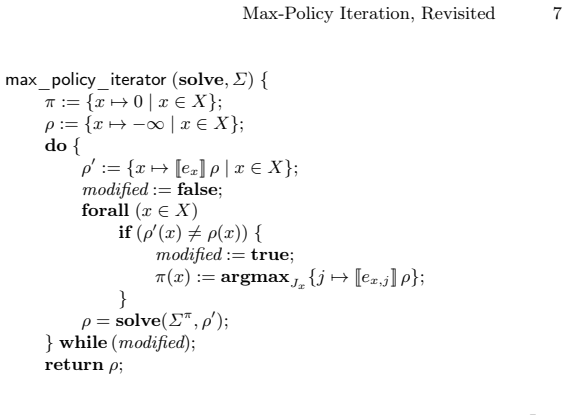
Mathematical optimization in max-policy iteration can be replaced by terminating value iteration for integer and floating-point systems.
A machine-rendered reading of the paper's core claim, the machinery that carries it, and where it could break.
Core claim
Max-policy iteration on systems of equations over integers as well as over floating point numbers allows mathematical optimization to be replaced by plain value iteration, which is still guaranteed to terminate. As an application, a precise bound analysis for integer or floating point variables is obtained, avoiding widening operators altogether. For max-policy iteration over the rational numbers where right-hand sides are maxima of minima of affine combinations, min-policy iteration is guaranteed to return the least solution for bounded systems, with extensions to unbounded systems and certificates of soundness and optimality.
What carries the argument
Max-policy iteration, which successively resolves maximum operators in equation systems and reduces to optimization or now value iteration.
If this is right
- Precise bound analysis for integer or floating point variables without widening operators.
- Value iteration terminates for the equation systems in max-policy iteration over integers and floats.
- Min-policy iteration returns the least solution for bounded systems over rationals.
- Certificates of soundness and optimality can be constructed for the results.
Where Pith is reading between the lines
- This method could reduce the computational cost of static analysis tools by avoiding external optimization solvers.
- Similar replacements might be possible in other policy iteration variants if termination properties can be established.
- The approach may extend to hybrid numeric domains combining integers and floats.
Load-bearing premise
Value iteration is guaranteed to terminate specifically for the systems of equations that arise from max-policy iteration over integers and floating-point numbers.
What would settle it
Finding a system of equations over integers or floats arising in max-policy iteration where value iteration either fails to terminate or produces a different result from the optimization-based version.
Figures



read the original abstract
Max-policy iteration is an approach to computing precise numeric program invariants by successive attempts at resolving maximum operators and reduction to mathematical optimization. Mathematical optimization, though, may be expensive. Here, we show, for max-policy iteration on systems of equations over integers as well as over floating point numbers, that mathematical optimization can be replaced by plain value iteration -- which is still guaranteed to terminate. As an application, a precise bound analysis for integer or floating point variables is obtained, avoiding widening operators altogether. We also consider max-policy iteration over the rational numbers, where the right-hand sides are maxima of minima of affine combinations of unknowns. We propose min-policy iteration as an alternative to linear programming for solving the optimization problems posed by max-policy iteration. We prove that max-min policy iteration is guaranteed to return the least solution for bounded systems. We also show how to extend this algorithm to unbounded systems, and how to construct certificates of soundness as well as of optimality of the computed results.
Editorial analysis
A structured set of objections, weighed in public.
Referee Report
Summary. The paper claims that max-policy iteration for precise numeric program invariants can replace mathematical optimization with plain value iteration for equation systems over integers and floating-point numbers while preserving termination guarantees. For systems over the rationals (with right-hand sides as maxima of minima of affine combinations), it proposes min-policy iteration as an alternative to linear programming, proves that max-min policy iteration returns the least solution for bounded systems, extends the algorithm to unbounded systems, and shows how to construct certificates of soundness and optimality. The approach is applied to bound analysis for integer or floating-point variables without widening.
Significance. If the termination and correctness results hold, the work offers a practical simplification for invariant computation in program analysis by substituting value iteration for optimization solvers, while avoiding widening and providing certificates. The explicit treatment of bounded versus unbounded cases for rationals and the focus on termination for integers and floats are potentially valuable contributions to the field of numeric abstract interpretation.
major comments (2)
- [Abstract and integer/FP section] Abstract and integer/FP termination claim: the assertion that value iteration is guaranteed to terminate for the integer equation systems arising in max-policy iteration is load-bearing for the central claim, yet the abstract (and apparently the rational section's contrast) does not state the precise conditions (e.g., absence of positive cycles, monotonicity bounding ascent, or finite least solution) that prevent divergence over unbounded domains; this needs an explicit lemma or theorem reference.
- [Rational numbers section] Rational numbers section on bounded systems: the proof that max-min policy iteration returns the least solution relies on the structure of the min-max affine systems, but without a concrete derivation or counterexample check for the bounded case, it is unclear whether the guarantee extends directly from standard policy iteration results or requires additional assumptions on the equation systems.
minor comments (2)
- The manuscript would benefit from an early running example illustrating the transition from max-policy iteration to value iteration on a small integer system.
- Notation for the min-policy iteration updates could be made more uniform with the max-policy case to aid readability.
Simulated Author's Rebuttal
We thank the referee for the constructive feedback. We address each major comment below.
read point-by-point responses
-
Referee: [Abstract and integer/FP section] Abstract and integer/FP termination claim: the assertion that value iteration is guaranteed to terminate for the integer equation systems arising in max-policy iteration is load-bearing for the central claim, yet the abstract (and apparently the rational section's contrast) does not state the precise conditions (e.g., absence of positive cycles, monotonicity bounding ascent, or finite least solution) that prevent divergence over unbounded domains; this needs an explicit lemma or theorem reference.
Authors: We agree the abstract should reference the precise conditions. Termination for integer and floating-point systems is established in Theorem 3.5, which assumes a finite least solution and absence of positive cycles in the dependency graph. We will revise the abstract to include an explicit reference to this theorem. revision: yes
-
Referee: [Rational numbers section] Rational numbers section on bounded systems: the proof that max-min policy iteration returns the least solution relies on the structure of the min-max affine systems, but without a concrete derivation or counterexample check for the bounded case, it is unclear whether the guarantee extends directly from standard policy iteration results or requires additional assumptions on the equation systems.
Authors: The proof in Section 4.1 is tailored to the max-min affine structure and proceeds via monotonic improvement to the least fixed point; it requires the specific form of the right-hand sides and does not follow directly from classical policy iteration without adaptation. We will add a short derivation sketch and an illustrative example in the revised manuscript. revision: yes
Circularity Check
No circularity; derivation relies on independent proofs and new algorithmic constructions.
full rationale
The paper introduces replacements of mathematical optimization by value iteration for max-policy iteration over integers and floats, with stated termination guarantees, and proposes min-policy iteration for rationals with proofs of least-solution return for bounded systems plus extensions to unbounded cases and certificates. No self-definitional mappings, fitted inputs renamed as predictions, or load-bearing self-citations appear; the central results are presented as new proofs and constructions that do not reduce to their own inputs by definition or prior author results.
Axiom & Free-Parameter Ledger
axioms (2)
- domain assumption Value iteration on max-policy systems over integers and floating-point numbers is guaranteed to terminate.
- domain assumption Min-policy iteration returns the least solution for bounded max-min systems over the rationals.
Reference graph
Works this paper leans on
-
[1]
Adjé, A., Gaubert, S., Goubault, E.: Coupling policy iteration with semi- definite relaxation to compute accurate numerical invariants in static anal- ysis. Log. Methods Comput. Sci.8(1) (2012). https://doi.org/10.2168/ LMCS-8(1:1)2012
2012
-
[2]
Online learning: A comprehensive survey
Adjé, A., Gaubert, S., Goubault, E.: Computing the smallest fixed point of order-preserving nonexpansive mappings arising in positive stochastic games and static analysis of programs. Journal of Mathematical Analysis and Applications410, 227–240 (Feb 2014).https://doi.org/10.1016/j. jmaa.2013.07.076
work page doi:10.1016/j 2014
-
[3]
In: Logozzo, F., Peled, D.A., Zuck, L.D
Bagnara, R., Hill, P.M., Zaffanella, E.: An improved tight closure algorithm for integer octagonal constraints. In: Logozzo, F., Peled, D.A., Zuck, L.D. (eds.) Verification, Model Checking, and Abstract Interpretation, 9th In- ternational Conference, VMCAI 2008, San Francisco, USA, January 7-9, 2008, Proceedings. Lecture Notes in Computer Science, vol. 49...
-
[4]
Boyle, M.: Basic perron frobenius theory and inverse spectral prob- lems (2013), https://www-fourier.ujf-grenoble.fr/sites/default/ files/files/fichiers/lecturenotes_boyle1.pdf, lecture notes
2013
-
[5]
Cambridge University Press (2010)
Cook, S., Nguyen, P.: Logical foundations of proof complexity. Cambridge University Press (2010)
2010
-
[6]
In: Etessami, K., Rajamani, S.K
Costan, A., Gaubert, S., Goubault, E., Martel, M., Putot, S.: A policy iterationalgorithmforcomputingfixedpointsinstaticanalysisofprograms. In: Etessami, K., Rajamani, S.K. (eds.) CAV. LNCS, vol. 3576, pp. 462–475. Springer (2005). https://doi.org/10.1007/11513988_46
-
[7]
In: Conference Record of the 4th ACM Symposium on Principles of Programming Languages
Cousot, P., Cousot, R.: Abstract interpretation: a unified lattice model for static analysis of programs by construction or approximation of fix- points. In: Conference Record of the 4th ACM Symposium on Principles of Programming Languages. pp. 238–252. Los Angeles, CA (Jan 1977). https://doi.org/10.1145/512950.5129
-
[8]
Journal of Logic and Computation2(4), 511–547 (1992).https://doi.org/10.1093/ LOGCOM/2.4.511
Cousot, P., Cousot, R.: Abstract interpretation frameworks. Journal of Logic and Computation2(4), 511–547 (1992).https://doi.org/10.1093/ LOGCOM/2.4.511
1992
-
[9]
Nu- merische Mathematik40(1), 137–141 (1982).https://doi.org/10.1007/ BF01459082, http://eudml.org/doc/132821
Dixon, J.D.: Exact solution of linear equations usingp-adic expansions. Nu- merische Mathematik40(1), 137–141 (1982).https://doi.org/10.1007/ BF01459082, http://eudml.org/doc/132821
1982
-
[10]
Research Report LIp RR-2002-15, Laboratoire de l’informatique du parallélisme (Mar 2002), https://hal.science/ hal-02102080
Dumas, J.G., Gautier, T., Giesbrecht, M., Giorgi, P., Hovinen, B., Kaltofen, E., Saunders, B., Turner, W., Villard, G.: LinBox: A generic library for exact linear algebra. Research Report LIp RR-2002-15, Laboratoire de l’informatique du parallélisme (Mar 2002), https://hal.science/ hal-02102080
2002
-
[11]
Gaubert, S., Goubault, E., Taly, A., Zennou, S.: Static analysis by policy iteration on relational domains. In: Nicola, R.D. (ed.) Programming Lan- Max-Policy Iteration, Revisited 29 guages and Systems, 16th European Symposium on Programming, ESOP 2007, Held as Part of the Joint European Conferences on Theory and Prac- tics of Software, ETAPS 2007, Braga,...
-
[12]
Logical Methods in Com- puter Science8(3) (2012)
Gawlitza, T.M., Monniaux, D.: Invariant generation through strategy itera- tion in succinctly represented control flow graphs. Logical Methods in Com- puter Science8(3) (2012). https://doi.org/10.2168/LMCS-8(3:29)2012
-
[13]
In: Programming Languages and Systems
Gawlitza, T.M., Seidl, H.: Precise fixpoint computation through strategy iteration. In: Programming Languages and Systems. 16th European Sym- posium on Programming (ESOP). pp. 300–315. LNCS 4421, Springer (2007)
2007
-
[14]
In: Duparc, J., Henzinger, T.A
Gawlitza, T.M., Seidl, H.: Precise relational invariants through strategy it- eration. In: Duparc, J., Henzinger, T.A. (eds.) Computer Science Logic, 21st International Workshop, CSL 2007, 16th Annual Conference of the EACSL, Lausanne, Switzerland, September 11-15, 2007, Proceedings. Lec- ture Notes in Computer Science, vol. 4646, pp. 23–40. Springer (200...
-
[15]
Gawlitza, T.M., Seidl, H.: Games through nested fixpoints. In: Bouajjani, A., Maler, O. (eds.) Computer Aided Verification, 21st International Con- ference, CAV 2009, Grenoble, France, June 26 - July 2, 2009. Proceedings. Lecture Notes in Computer Science, vol. 5643, pp. 291–305. Springer (2009). https://doi.org/10.1007/978-3-642-02658-4_24
-
[16]
Gawlitza, T.M., Seidl, H.: Solving systems of rational equations through strategy iteration. ACM Trans. Program. Lang. Syst. 33(3), 11:1–11:48 (2011). https://doi.org/10.1145/1961204.1961207
-
[17]
In: Workshop on Invariant Generation
Gawlitza,T.M.,Seidl,H.:Abstractinterpretationoverzoneswithoutwiden- ing. In: Workshop on Invariant Generation. p. 12–43. EasyChair, volume 1 of EPiC (2012)
2012
-
[18]
Formal Methods in System Design44, 101–148 (Sep 2013)
Gawlitza, T.M., Seidl, H.: Numerical invariants through convex relaxation and max-strategy iteration. Formal Methods in System Design44, 101–148 (Sep 2013). https://doi.org/10.1007/s10703-013-0190-8
-
[19]
Gawlitza, T.M., Seidl, H., Adjé, A., Gaubert, S., Goubault, E.: Abstract interpretation meets convex optimization. J. Symb. Comput.47(12), 1416– 1446 (2012). https://doi.org/10.1016/J.JSC.2011.12.048
-
[20]
Gopan, D., Reps, T.W.: Guided static analysis. In: Nielson, H.R., Filé, G. (eds.) Static Analysis, 14th International Symposium, SAS 2007, Kon- gens Lyngby, Denmark, August 22-24, 2007, Proceedings. Lecture Notes in Computer Science, vol. 4634, pp. 349–365. Springer (2007). https: //doi.org/10.1007/978-3-540-74061-2_22
-
[21]
In: High-order workshop on au- tomated runtime verification and debugging
Kwiatkowska, M., Parker, D., Qu, H., Ujma, M.: On incremental quantita- tive verification for probabilistic systems. In: High-order workshop on au- tomated runtime verification and debugging. Manchester, United Kingdom (Dec 2011)
2011
-
[22]
Miné, A.: The octagon abstract domain. High. Order Symb. Comput.19(1), 31–100 (2006).https://doi.org/10.1007/S10990-006-8609-1 30 D. Monniaux and H. Seidl
-
[23]
Miné, A.: Weakly Relational Numerical Abstract Domains. Ph.D. thesis, École polytechnique (Dec 2004),https://hal.science/tel-00136630
2004
-
[24]
Monniaux, D.: Optimal abstraction on real-valued programs. In: Nielson, H.R., Filé, G. (eds.) Static Analysis, 14th International Symposium, SAS 2007, Kongens Lyngby, Denmark, August 22-24, 2007, Proceedings. Lecture Notes in Computer Science, vol. 4634, pp. 104–120. Springer (2007).https: //doi.org/10.1007/978-3-540-74061-2_7
-
[25]
Monniaux, D.: Automatic modular abstractions for linear constraints. In: Shao, Z., Pierce, B.C. (eds.) Proceedings of the 36th ACM SIGPLAN- SIGACT Symposium on Principles of Programming Languages, POPL 2009, Savannah, GA, USA, January 21-23, 2009. pp. 140–151. ACM (2009). https://doi.org/10.1145/1480881.1480899
-
[26]
Monniaux, D., Schrammel, P.: Speeding up logico-numerical strategy itera- tion. In: Müller-Olm, M., Seidl, H. (eds.) Static Analysis - 21st International Symposium, SAS 2014, Munich, Germany, September 11-13, 2014. Proceed- ings. Lecture Notes in Computer Science, vol. 8723, pp. 253–267. Springer (2014). https://doi.org/10.1007/978-3-319-10936-7_16
-
[27]
Wiley–Interscience (1994)
Puterman, M.L.: Markov Decision Processes: Discrete stochastic dynamic programming. Wiley–Interscience (1994)
1994
-
[28]
Roux, P.: Analyse statique de systèmes de contrôle commande : synthèse d’invariants non linéaires. Ph.D. thesis, Université de Toulouse (Dec 2013), https://theses.fr/api/v1/document/2013ESAE0046, main text in En- glish
2013
-
[29]
Formal Methods Syst
Roux, P., Voronin, Y., Sankaranarayanan, S.: Validating numerical semidefinite programming solvers for polynomial invariants. Formal Methods Syst. Des. 53(2), 286–312 (2018).https://doi.org/10.1007/ S10703-017-0302-Y, https://hal.science/hal-01358703/
2018
-
[30]
In: Emerson, E.A., Namjoshi, K.S
Sankaranarayanan,S.,Colón,M.,Sipma,H.B.,Manna,Z.:Efficientstrongly relational polyhedral analysis. In: Emerson, E.A., Namjoshi, K.S. (eds.) Verification, Model Checking, and Abstract Interpretation, 7th Interna- tional Conference, VMCAI 2006, Charleston, SC, USA, January 8-10, 2006, Proceedings. Lecture Notes in Computer Science, vol. 3855, pp. 111–125. S...
-
[31]
In: Hermenegildo, M.V., Morales, J.F
Schwarz, M., Seidl, H.: Octagons revisited - elegant proofs and simplified algorithms. In: Hermenegildo, M.V., Morales, J.F. (eds.) Static Analysis - 30thInternationalSymposium,SAS2023,Cascais,Portugal,October22-24, 2023, Proceedings. Lecture Notes in Computer Science, vol. 14284, pp. 485–
2023
-
[32]
Springer (2023).https://doi.org/10.1007/978-3-031-44245-2_21
-
[33]
Seidl, H., Gawlitza, T.M., Schwarz, M.D.: Parametric strategy iteration. In: Kutsia, T., Voronkov, A. (eds.) 6th International Symposium on Sym- bolic Computation in Software Science, SCSS 2014, Gammarth, La Marsa, Tunisia, December 7-8, 2014. EPiC Series in Computing, vol. 30, pp. 62–76. EasyChair (2014). https://doi.org/10.29007/C4KG
-
[34]
The FLINT team: FLINT: Fast Library for Number Theory (2025), version 3.2.1, https://flintlib.org
2025
discussion (0)
Sign in with ORCID, Apple, or X to comment. Anyone can read and Pith papers without signing in.