Observation of electroweak production of pairs of Z bosons in proton-proton collisions at 13 TeV
Pith reviewed 2026-06-26 14:52 UTC · model grok-4.3
The pith
The CMS experiment reports the first evidence for electroweak production of Z boson pairs with two jets in the dilepton missing-energy channel at 3.1 sigma significance.
A machine-rendered reading of the paper's core claim, the machinery that carries it, and where it could break.
Core claim
The analysis observes electroweak production of pairs of Z bosons in association with two jets in the final state ZZjj to ll nu nu jj, where l equals e or mu. Using 138 inverse fb of 13 TeV proton-proton collision data, the fiducial electroweak cross section is measured as 0.37 plus 0.14 minus 0.12 statistical plus 0.06 minus 0.06 systematic fb, in agreement with the standard model prediction of 0.39 plus or minus 0.06 fb. The observed significance of the signal is 3.1 standard deviations. Limits on anomalous quartic gauge couplings are set using dimension-8 effective field theory operators. A combination with the previously reported four charged lepton channel result yields an observed sign
What carries the argument
The fiducial event selection with two opposite-charge same-flavor leptons, large missing transverse momentum, and two jets separated by large rapidity gap and large invariant mass, which isolates the electroweak signal component from dominant QCD backgrounds.
If this is right
- The measured cross section agrees with the standard model prediction within uncertainties.
- The signal reaches 3.1 standard deviations significance in the dilepton missing-energy channel.
- Combining channels produces an observed significance of 5.0 standard deviations for electroweak ZZ pair production.
- Limits are placed on dimension-8 effective field theory operators describing anomalous quartic gauge couplings.
Where Pith is reading between the lines
- This result enables more precise studies of vector boson scattering to further test the mechanism of electroweak symmetry breaking.
- Additional luminosity could strengthen constraints on beyond-standard-model effects in quartic gauge boson interactions.
- The technique of combining multiple decay channels may extend to searches for other rare electroweak processes at higher energies.
Load-bearing premise
Background processes such as QCD-induced ZZjj and other standard model contributions are accurately modeled and subtracted so that any observed excess can be attributed to the electroweak signal.
What would settle it
If the number of selected events after all cuts deviates significantly from the sum of the modeled backgrounds plus the predicted electroweak signal, or if the extracted significance falls below 3 sigma with additional data under the same selection, the central claim would be challenged.
Figures

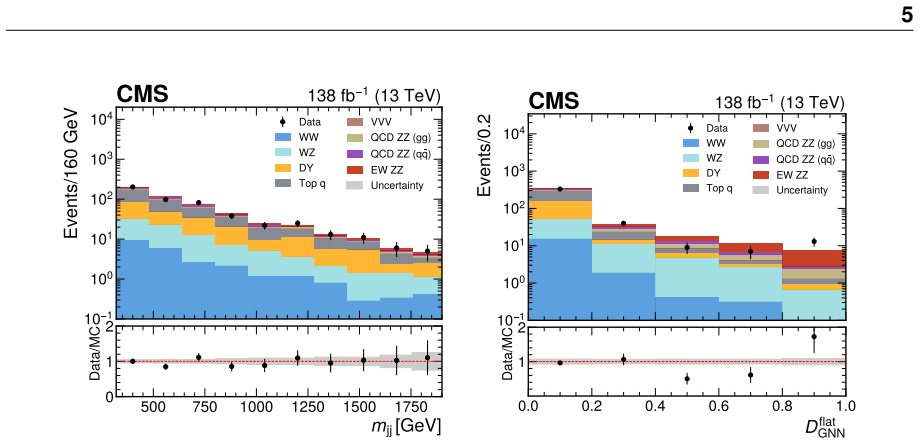
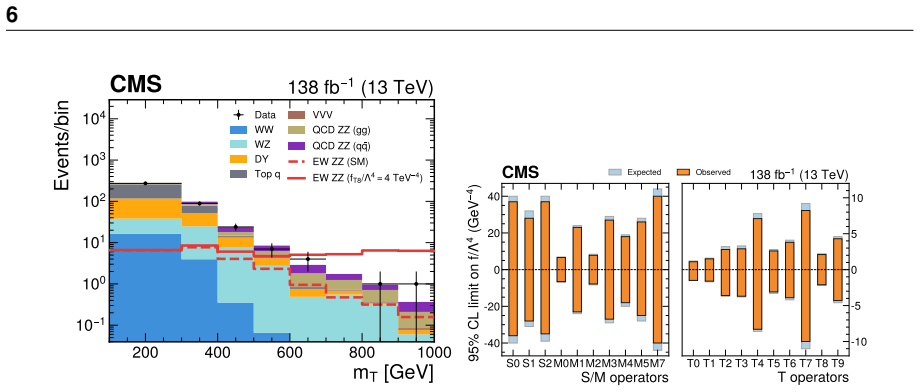
read the original abstract
The first evidence of electroweak (EW) production of pairs of Z bosons in association with two jets (jj) in the final state ZZjj $\to$ $\ell\ell\nu\nu$jj, where $\ell$ = e, $\mu$, is reported by the CMS experiment. The analysis is based on a data sample of proton-proton (pp) collisions at $\sqrt{s}$ = 13 TeV, corresponding to an integrated luminosity of 138 fb$^{-1}$. Events are selected by requiring exactly two leptons of same flavor and opposite charge, large missing transverse momentum, and two jets with a large rapidity separation and large invariant mass. The EW production cross section in a fiducial volume is $\sigma_{\mathrm{EW}}$(pp $\to$ ZZjj $\to$ $\ell\ell\nu\nu$jj) = 0.37$^{+0.14}_{-0.12}$ (stat)$^{+0.06}_{-0.06}$ (syst) fb, in agreement with the standard model prediction of 0.39 $\pm$ 0.06 fb. The observed (expected) significance of the signal is 3.1 (2.8) standard deviations. Limits on anomalous quartic gauge couplings are derived in terms of dimension-8 effective field theory operators. A combination with the previously reported result from the ZZ decay channel with four charged leptons yields an observed (expected) significance of 5.0 (4.5) standard deviations for the EW production of Z boson pairs.
Editorial analysis
A structured set of objections, weighed in public.
Referee Report
Summary. The manuscript claims the first evidence of electroweak production of Z boson pairs associated with two jets in the ZZjj → ℓℓννjj channel at √s = 13 TeV with 138 fb^{-1} of CMS data. The fiducial cross section is measured to be 0.37^{+0.14}_{-0.12} (stat) ^{+0.06}_{-0.06} (syst) fb, in agreement with the SM prediction of 0.39 ± 0.06 fb. The observed significance is 3.1σ (expected 2.8σ), and combined with the four-lepton channel it reaches 5.0σ (4.5σ expected). Limits on anomalous quartic gauge couplings via dimension-8 EFT operators are also derived.
Significance. If the background modeling holds, this constitutes important evidence for electroweak ZZjj production, a key process for probing vector boson scattering and the electroweak symmetry breaking sector. The measured cross section agrees well with SM expectations, and the combined significance of 5σ provides strong support for the observation. The analysis in the dilepton + MET channel complements the previously reported four-lepton result, enhancing the overall sensitivity. The derivation of aQGC limits adds value for BSM searches.
major comments (1)
- [Abstract] Abstract: The 3.1σ standalone significance and the fiducial cross section measurement depend critically on the subtraction of the QCD ZZjj background in the signal region defined by large m_jj and |Δη_jj|. The abstract does not detail whether this background is constrained using data-driven methods in control regions, purely from Monte Carlo, or via a simultaneous fit, nor the magnitude of the associated systematic uncertainty. This information is essential to assess the robustness of attributing the observed excess to the electroweak component.
Simulated Author's Rebuttal
We thank the referee for the careful reading and constructive feedback on our manuscript. We address the single major comment below and agree to make a targeted revision to improve clarity.
read point-by-point responses
-
Referee: The 3.1σ standalone significance and the fiducial cross section measurement depend critically on the subtraction of the QCD ZZjj background in the signal region defined by large m_jj and |Δη_jj|. The abstract does not detail whether this background is constrained using data-driven methods in control regions, purely from Monte Carlo, or via a simultaneous fit, nor the magnitude of the associated systematic uncertainty. This information is essential to assess the robustness of attributing the observed excess to the electroweak component.
Authors: We agree that the abstract is concise and would benefit from additional context on background treatment. In the analysis the QCD ZZjj background is modeled with Monte Carlo simulation (MadGraph5_aMC@NLO + Pythia) and its normalization is determined from a simultaneous fit to data in the signal region together with control regions at lower m_jj; the associated systematic uncertainty (approximately 20% on the background yield, arising from scale, shower, and PDF variations) is included in the total systematic uncertainty quoted for the cross section. These procedures are described in Sections 5 and 7. We will revise the abstract to include a brief statement on the background estimation method and its constraint in control regions. revision: yes
Circularity Check
No circularity: data-driven measurement with independent SM benchmarks
full rationale
The paper reports a cross-section measurement and significance extracted directly from 138 fb^{-1} of collision data via event counting, selection cuts, and background subtraction, then compared to an external SM prediction of 0.39 ± 0.06 fb. The 3.1σ (2.8σ expected) significance follows from the observed excess after subtraction. The combination with a prior four-lepton result is a post-hoc statistical addition of two independent channels and does not redefine or force the present-channel result. No equations, fits, or self-citations reduce any reported quantity to an input by construction; the derivation remains self-contained against external data and simulations.
Axiom & Free-Parameter Ledger
axioms (1)
- domain assumption Standard Model predictions and Monte Carlo simulations accurately describe background processes and detector response in the selected fiducial region
Reference graph
Works this paper leans on
-
[1]
Weak interactions at very high energies: The role of the Higgs-boson mass
B. W. Lee, C. Quigg, and H. B. Thacker, “Weak interactions at very high energies: The role of the Higgs-boson mass”,Phys. Rev. D16(1977) 1519, doi:10.1103/PhysRevD.16.1519
-
[2]
CMS Collaboration, “Evidence for electroweak production of four charged leptons and two jets in proton-proton collisions at √s= 13 TeV”,Phys. Lett. B812(2021) 135992, doi:10.1016/j.physletb.2020.135992,arXiv:2008.07013
-
[3]
CMS Collaboration, “Performance of missing transverse momentum reconstruction in proton-proton collisions at √s=13 TeV using the CMS detector”,JINST14(2019) P07004,doi:10.1088/1748-0221/14/07/P07004,arXiv:1903.06078
work page internal anchor Pith review Pith/arXiv arXiv doi:10.1088/1748-0221/14/07/p07004 2019
-
[4]
Unitarity constraints on anomalous quartic couplings
E. d. S. Almeida, O. J. P . Eboli, and M. C. Gonzalez-Garcia, “Unitarity constraints on anomalous quartic couplings”,Phys. Rev. D101(2020) 113003, doi:10.1103/PhysRevD.101.113003,arXiv:2004.05174
-
[5]
Vector boson scattering: Recent experimental and theory developments
C. F. Anders et al., “Vector boson scattering: Recent experimental and theory developments”,Rev. Phys.3(2018) 44,doi:10.1016/j.revip.2018.11.001, arXiv:1801.04203
work page internal anchor Pith review Pith/arXiv arXiv doi:10.1016/j.revip.2018.11.001 2018
-
[6]
O. J. P . Eboli, M. C. Gonzalez-Garcia, and J. K. Mizukoshi, “pp→jje ±µ±ννand jje ±µ∓νν atO(α 6 em)andO(α 4 emα2 s )for the study of the quartic electroweak gauge boson vertex at CERN LHC”,Phys. Rev. D74(2006) 073005,doi:10.1103/PhysRevD.74.073005, arXiv:hep-ph/0606118
work page internal anchor Pith review Pith/arXiv arXiv doi:10.1103/physrevd.74.073005 2006
-
[7]
CMS Collaboration, “Observation of electroweak production of same-sign W boson pairs in the two jet and two same-sign lepton final state in proton-proton collisions at √s=13 TeV”,Phys. Rev. Lett.120(2018) 081801,doi:10.1103/PhysRevLett.120.081801, arXiv:1709.05822. 8
work page internal anchor Pith review Pith/arXiv arXiv doi:10.1103/physrevlett.120.081801 2018
-
[8]
CMS Collaboration, “Observation of electroweak W +W− pair production in association with two jets in proton-proton collisions at √s=13 TeV”,Phys. Lett. B841(2023) 137495,doi:10.1016/j.physletb.2022.137495,arXiv:2205.05711
-
[9]
CMS Collaboration, “Measurements of production cross sections of WZ and same-sign WW boson pairs in association with two jets in proton-proton collisions at √s=13 TeV”, Phys. Lett. B809(2020) 135710,doi:10.1016/j.physletb.2020.135710, arXiv:2005.01173
-
[10]
Observation of electroweak production of two jets and a Z-boson pair
ATLAS Collaboration, “Observation of electroweak production of two jets and a Z-boson pair”,Nat. Phys.19(2023) 237,doi:10.1038/s41567-022-01757-y, arXiv:2004.10612
-
[11]
The CMS experiment at the CERN LHC
CMS Collaboration, “The CMS experiment at the CERN LHC”,JINST3(2008) S08004, doi:10.1088/1748-0221/3/08/S08004
-
[12]
Development of the CMS detector for the CERN LHC Run 3
CMS Collaboration, “Development of the CMS detector for the CERN LHC Run 3”, JINST19(2024) P05064,doi:10.1088/1748-0221/19/05/P05064, arXiv:2309.05466
-
[13]
Performance of the CMS Level-1 trigger in proton-proton collisions at √s=13 TeV
CMS Collaboration, “Performance of the CMS Level-1 trigger in proton-proton collisions at √s=13 TeV”,JINST15(2020) P10017, doi:10.1088/1748-0221/15/10/P10017,arXiv:2006.10165
-
[14]
CMS Collaboration, “The CMS trigger system”,JINST12(2017) P01020, doi:10.1088/1748-0221/12/01/P01020,arXiv:1609.02366
work page internal anchor Pith review Pith/arXiv arXiv doi:10.1088/1748-0221/12/01/p01020 2017
-
[15]
Performance of the CMS high-level trigger during LHC Run 2
CMS Collaboration, “Performance of the CMS high-level trigger during LHC Run 2”, JINST19(2024) P11021,doi:10.1088/1748-0221/19/11/P11021, arXiv:2410.17038
-
[16]
Electron and photon reconstruction and identification with the CMS experiment at the CERN LHC
CMS Collaboration, “Electron and photon reconstruction and identification with the CMS experiment at the CERN LHC”,JINST16(2021) P05014, doi:10.1088/1748-0221/16/05/P05014,arXiv:2012.06888
-
[17]
CMS Collaboration, “Performance of the CMS muon detector and muon reconstruction with proton-proton collisions at √s=13 TeV”,JINST13(2018) P06015, doi:10.1088/1748-0221/13/06/P06015,arXiv:1804.04528
work page internal anchor Pith review Pith/arXiv arXiv doi:10.1088/1748-0221/13/06/p06015 2018
-
[18]
Description and performance of track and primary-vertex reconstruction with the CMS tracker
CMS Collaboration, “Description and performance of track and primary-vertex reconstruction with the CMS tracker”,JINST9(2014) P10009, doi:10.1088/1748-0221/9/10/P10009,arXiv:1405.6569
work page internal anchor Pith review Pith/arXiv arXiv doi:10.1088/1748-0221/9/10/p10009 2014
-
[19]
Particle-flow reconstruction and global event description with the CMS detector
CMS Collaboration, “Particle-flow reconstruction and global event description with the CMS detector”,JINST12(2017) P10003,doi:10.1088/1748-0221/12/10/P10003, arXiv:1706.04965
work page internal anchor Pith review Pith/arXiv arXiv doi:10.1088/1748-0221/12/10/p10003 2017
-
[20]
CMS Collaboration, “Performance of reconstruction and identification ofτleptons decaying to hadrons andν τ in pp collisions at √s=13 TeV”,JINST13(2018) P10005, doi:10.1088/1748-0221/13/10/P10005,arXiv:1809.02816
work page internal anchor Pith review Pith/arXiv arXiv doi:10.1088/1748-0221/13/10/p10005 2018
-
[21]
Jet energy scale and resolution in the CMS experiment in pp collisions at 8 TeV
CMS Collaboration, “Jet energy scale and resolution in the CMS experiment in pp collisions at 8 TeV”,JINST12(2017) P02014, doi:10.1088/1748-0221/12/02/P02014,arXiv:1607.03663. References 9
work page internal anchor Pith review Pith/arXiv arXiv doi:10.1088/1748-0221/12/02/p02014 2017
-
[22]
The anti-k_t jet clustering algorithm
M. Cacciari, G. P . Salam, and G. Soyez, “The anti-kT jet clustering algorithm”,JHEP04 (2008) 063,doi:10.1088/1126-6708/2008/04/063,arXiv:0802.1189
work page internal anchor Pith review Pith/arXiv arXiv doi:10.1088/1126-6708/2008/04/063 2008
-
[23]
M. Cacciari, G. P . Salam, and G. Soyez, “FastJet user manual”,Eur. Phys. J. C72(2012) 1896,doi:10.1140/epjc/s10052-012-1896-2,arXiv:1111.6097
work page internal anchor Pith review Pith/arXiv arXiv doi:10.1140/epjc/s10052-012-1896-2 2012
-
[24]
Identification of heavy-flavour jets with the CMS detector in pp collisions at 13 TeV
CMS Collaboration, “Identification of heavy-flavour jets with the CMS detector in pp collisions at 13 TeV”,JINST13(2018) P05011, doi:10.1088/1748-0221/13/05/P05011,arXiv:1712.07158
work page internal anchor Pith review Pith/arXiv arXiv doi:10.1088/1748-0221/13/05/p05011 2018
-
[25]
Jet flavour classification using DeepJet
E. Bols et al., “Jet flavour classification using DeepJet”,JINST15(2020) P12012, doi:10.1088/1748-0221/15/12/P12012,arXiv:2008.10519
-
[26]
Performance of the DeepJet b tagging algorithm using 41.9 fb −1 of data from proton-proton collisions at 13 TeV with Phase 1 CMS detector
CMS Collaboration, “Performance of the DeepJet b tagging algorithm using 41.9 fb −1 of data from proton-proton collisions at 13 TeV with Phase 1 CMS detector”, CMS Detector Performance Summary CMS-DP-2018-058, 2018
2018
-
[27]
Measurement of the Inclusive W and Z Production Cross Sections in pp Collisions at sqrt(s) = 7 TeV
CMS Collaboration, “Measurement of the inclusive W and Z production cross sections in pp collisions at √s=7 TeV”,JHEP10(2011) 132,doi:10.1007/JHEP10(2011)132, arXiv:1107.4789
work page internal anchor Pith review Pith/arXiv arXiv doi:10.1007/jhep10(2011)132 2011
-
[28]
A general framework for implementing NLO calculations in shower Monte Carlo programs: the POWHEG BOX
S. Alioli, P . Nason, C. Oleari, and E. Re, “A general framework for implementing NLO calculations in shower Monte Carlo programs: the POWHEG BOX”,JHEP06(2010) 043, doi:10.1007/JHEP06(2010)043,arXiv:1002.2581
work page internal anchor Pith review Pith/arXiv arXiv doi:10.1007/jhep06(2010)043 2010
-
[29]
T. Sj ¨ostrand et al., “An introduction to PYTHIA 8.2”,Comput. Phys. Commun.191(2015) 159,doi:10.1016/j.cpc.2015.01.024,arXiv:1410.3012
work page internal anchor Pith review Pith/arXiv arXiv doi:10.1016/j.cpc.2015.01.024 2015
-
[30]
B. Cabouat and T. Sj ¨ostrand, “Some dipole shower studies”,Eur. Phys. J. C78(2018) 226, doi:10.1140/epjc/s10052-018-5645-z,arXiv:1710.00391
work page internal anchor Pith review Pith/arXiv arXiv doi:10.1140/epjc/s10052-018-5645-z 2018
-
[31]
Parton-shower effects in Higgs production via Vector-Boson Fusion
B. J ¨ager et al., “Parton-shower effects in Higgs production via Vector-Boson Fusion”, Eur. Phys. J. C80(2020) 756,doi:10.1140/epjc/s10052-020-8326-7, arXiv:2003.12435
-
[32]
MCFM for the Tevatron and the LHC
J. M. Campbell and R. K. Ellis, “MCFM for the Tevatron and the LHC”,Nucl. Phys. Proc. Suppl.205-206(2010) 10,doi:10.1016/j.nuclphysbps.2010.08.011, arXiv:1007.3492
work page internal anchor Pith review Pith/arXiv arXiv doi:10.1016/j.nuclphysbps.2010.08.011 2010
-
[33]
A Positive-Weight Next-to-Leading-Order Monte Carlo for Heavy Flavour Hadroproduction
S. Frixione, P . Nason, and G. Ridolfi, “A positive-weight next-to-leading-order Monte Carlo for heavy flavour hadroproduction”,JHEP09(2007) 126, doi:10.1088/1126-6708/2007/09/126,arXiv:0707.3088
work page internal anchor Pith review Pith/arXiv arXiv doi:10.1088/1126-6708/2007/09/126 2007
-
[34]
Single-top Wt-channel production matched with parton showers using the POWHEG method
E. Re, “Single-top Wt-channel production matched with parton showers using the POWHEG method”,Eur. Phys. J. C71(2011) 1547, doi:10.1140/epjc/s10052-011-1547-z,arXiv:1009.2450
work page internal anchor Pith review Pith/arXiv arXiv doi:10.1140/epjc/s10052-011-1547-z 2011
-
[35]
Parton distributions from high-precision collider data
NNPDF Collaboration, “Parton distributions from high-precision collider data”,Eur. Phys. J. C77(2017) 663,doi:10.1140/epjc/s10052-017-5199-5, arXiv:1706.00428
work page internal anchor Pith review Pith/arXiv arXiv doi:10.1140/epjc/s10052-017-5199-5 2017
-
[36]
Extraction and validation of a new set of CMS PYTHIA8 tunes from underlying-event measurements
CMS Collaboration, “Extraction and validation of a new set of CMS PYTHIA8 tunes from underlying-event measurements”,Eur. Phys. J. C80(2020) 4, doi:10.1140/epjc/s10052-019-7499-4,arXiv:1903.12179. 10
-
[37]
GEANT4 Collaboration, “GEANT4—a simulation toolkit”,Nucl. Instrum. Meth. A506 (2003) 250,doi:10.1016/S0168-9002(03)01368-8
-
[38]
JEDI-net: a jet identification algorithm based on interaction networks
E. A. Moreno et al., “JEDI-net: a jet identification algorithm based on interaction networks”,Eur. Phys. J. C80(2020) 58,doi:10.1140/epjc/s10052-020-7608-4, arXiv:1908.05318
-
[39]
The CMS statistical analysis and combination tool: COMBINE
CMS Collaboration, “The CMS statistical analysis and combination tool: COMBINE”, Comput. Softw. Big Sci.8(2024) 19,doi:10.1007/s41781-024-00121-4, arXiv:2404.06614
-
[40]
Fitting using finite Monte Carlo samples
R. Barlow and C. Beeston, “Fitting using finite Monte Carlo samples”,Comput. Phys. Commun.77(1993) 219,doi:10.1016/0010-4655(93)90005-W
-
[41]
Incorporating nuisance parameters in likelihoods for multisource spectra
J. S. Conway, “Incorporating nuisance parameters in likelihoods for multisource spectra”, 2011.arXiv:1103.0354
Pith/arXiv arXiv 2011
-
[42]
Asymptotic formulae for likelihood-based tests of new physics
G. Cowan, K. Cranmer, E. Gross, and O. Vitells, “Asymptotic formulae for likelihood-based tests of new physics”,Eur. Phys. J. C71(2011) 1554, doi:10.1140/epjc/s10052-011-1554-0,arXiv:1007.1727. [Erratum: doi:10.1140/epjc/s10052-013-2501-z]
work page internal anchor Pith review Pith/arXiv arXiv doi:10.1140/epjc/s10052-011-1554-0 2011
-
[43]
Presentation of search results: theCL s technique
A. L. Read, “Presentation of search results: The CL s technique”,J. Phys. G28(2002) 2693, doi:10.1088/0954-3899/28/10/313
-
[44]
Confidence Level Computation for Combining Searches with Small Statistics
T. Junk, “Confidence level computation for combining searches with small statistics”, Nucl. Instrum. Meth. A434(1999) 435,doi:10.1016/S0168-9002(99)00498-2, arXiv:hep-ex/9902006
work page internal anchor Pith review Pith/arXiv arXiv doi:10.1016/s0168-9002(99)00498-2 1999
-
[45]
CMS Collaboration, “Measurement and effective field theory interpretation of the photon–fusion production cross section of a pair of W bosons in proton–proton collisions at √s=13 TeV”, 2026.arXiv:2601.21574. Submitted to JHEP
arXiv 2026
-
[46]
CMS Collaboration, “Measurements of the pp→W ±γγand pp→Zγγcross sections at√s=13 TeV and limits on anomalous quartic gauge couplings”,JHEP10(2021) 174, doi:10.1007/JHEP10(2021)174,arXiv:2105.12780
-
[47]
CMS Collaboration, “Measurement of the electroweak production of Zγand two jets in proton-proton collisions at √s=13 TeV and constraints on anomalous quartic gauge couplings”,Phys. Rev. D104(2021) 072001,doi:10.1103/PhysRevD.104.072001, arXiv:2106.11082
-
[48]
CMS Collaboration, “Measurement of the electroweak production of Wγin association with two jets in proton-proton collisions at √s=13 TeV”,Phys. Rev. D108(2023) 032017,doi:10.1103/PhysRevD.108.032017,arXiv:2212.12592
-
[49]
CMS Collaboration, “Vector boson scattering and anomalous quartic couplings in final states withℓνqq orℓℓqq plus jets using proton-proton collisions at √s=13 TeV”,JHEP 03(2026) 022,doi:10.1007/JHEP03(2026)022,arXiv:2510.00118
-
[50]
HEPData record for this analysis, 2026.doi:10.17182/hepdata.172159
-
[51]
Procedure for the LHC Higgs boson search combination in Summer 2011
ATLAS and CMS Collaborations, and the LHC Higgs Combination Group, “Procedure for the LHC Higgs boson search combination in Summer 2011”, ATL-PHYS-PUB 011-11/CMS NOTE 2011-005, 2011. References 11
2011
-
[52]
Performance of the CMS electromagnetic calorimeter in pp collisions at √s=13 TeV
CMS Collaboration, “Performance of the CMS electromagnetic calorimeter in pp collisions at √s=13 TeV”,JINST19(2024) P09004, doi:10.1088/1748-0221/19/09/P09004,arXiv:2403.15518
-
[53]
Precision luminosity measurement in proton-proton collisions at√s=13 TeV with the CMS detector
CMS Collaboration, “Precision luminosity measurement in proton-proton collisions at√s=13 TeV with the CMS detector”, CMS Physics Analysis Summary CMS-PAS-LUM-20-001, 2025
2025
-
[54]
New parton distributions for collider physics
H.-L. Lai et al., “New parton distributions for collider physics”,Phys. Rev. D82(2010) 074024,doi:10.1103/PhysRevD.82.074024,arXiv:1007.2241
work page internal anchor Pith review Pith/arXiv arXiv doi:10.1103/physrevd.82.074024 2010
-
[55]
Parton distributions for the LHC
A. D. Martin, W. J. Stirling, R. S. Thorne, and G. Watt, “Parton distributions for the LHC”, Eur. Phys. J. C63(2009) 189,doi:10.1140/epjc/s10052-009-1072-5, arXiv:0901.0002
work page internal anchor Pith review Pith/arXiv arXiv doi:10.1140/epjc/s10052-009-1072-5 2009
-
[56]
Impact of Heavy Quark Masses on Parton Distributions and LHC Phenomenology
NNPDF Collaboration, “Impact of heavy quark masses on parton distributions and LHC phenomenology”,Nucl. Phys. B849(2011) doi:10.1016/j.nuclphysb.2011.03.021,arXiv:1101.1300
work page internal anchor Pith review Pith/arXiv arXiv doi:10.1016/j.nuclphysb.2011.03.021 2011
-
[57]
PDF4LHC recommendations for LHC Run II
J. Butterworth et al., “PDF4LHC recommendations for LHC Run II”,J. Phys. G43(2016) 023001,doi:10.1088/0954-3899/43/2/023001,arXiv:1510.03865
work page internal anchor Pith review Pith/arXiv arXiv doi:10.1088/0954-3899/43/2/023001 2016
-
[58]
Parton distributions for the LHC Run II
NNPDF Collaboration, “Parton distributions for the LHC Run II”,JHEP04(2015) 040, doi:10.1007/JHEP04(2015)040,arXiv:1410.8849
work page internal anchor Pith review Pith/arXiv arXiv doi:10.1007/jhep04(2015)040 2015
-
[59]
CMS Collaboration, “Search for dark matter produced in association with a leptonically decaying Z boson in proton-proton collisions at √s=13 TeV”,Eur. Phys. J. C81(2021) 13,doi:10.1140/epjc/s10052-020-08739-5,arXiv:2008.04735. [Erratum: doi:10.1140/epjc/s10052-021-08959-3]
-
[60]
Vector-boson pair production at the LHC to $\mathcal{O}(\alpha^3)$ accuracy
A. Bierweiler, T. Kasprzik, and J. H. K ¨uhn, “Vector-boson pair production at the LHC to O(α3)accuracy”,JHEP12(2013) 071,doi:10.1007/JHEP12(2013)071, arXiv:1305.5402
work page internal anchor Pith review Pith/arXiv arXiv doi:10.1007/jhep12(2013)071 2013
-
[61]
Vector-boson pair production and electroweak corrections in HERWIG++
S. Gieseke, T. Kasprzik, and J. H. Kahn, “Vector-boson pair production and electroweak corrections in HERWIG++”,Eur. Phys. J. C74(2014) 2988, doi:10.1140/epjc/s10052-014-2988-y,arXiv:1401.3964
work page internal anchor Pith review Pith/arXiv arXiv doi:10.1140/epjc/s10052-014-2988-y 2014
-
[62]
Massive gauge boson pair production at the LHC: a next-to-leading order story
J. Baglio, L. D. Ninh, and M. M. Weber, “Massive gauge boson pair production at the LHC: a next-to-leading order story”,Phys. Rev. D88(2013) 113005, doi:10.1103/PhysRevD.88.113005,arXiv:1307.4331
work page internal anchor Pith review Pith/arXiv arXiv doi:10.1103/physrevd.88.113005 2013
-
[63]
J. Alwall et al., “The automated computation of tree-level and next-to-leading order differential cross sections, and their matching to parton shower simulations”,JHEP07 (2014) 079,doi:10.1007/JHEP07(2014)079,arXiv:1405.0301
work page internal anchor Pith review Pith/arXiv arXiv doi:10.1007/jhep07(2014)079 2014
-
[64]
How bright is the proton? A precise determination of the photon parton distribution function
A. Manohar, P . Nason, G. P . Salam, and G. Zanderighi, “How bright is the proton? A precise determination of the photon parton distribution function”,Phys. Rev. Lett.117 (2016) 242002,doi:10.1103/PhysRevLett.117.242002,arXiv:1607.04266
work page internal anchor Pith review Pith/arXiv arXiv doi:10.1103/physrevlett.117.242002 2016
-
[65]
Weak corrections to Higgs hadroproduction in association with a top-quark pair
S. Frixione et al., “Weak corrections to Higgs hadroproduction in association with a top-quark pair”,JHEP09(2014) 065,doi:10.1007/JHEP09(2014)065, arXiv:1407.0823. 12
work page internal anchor Pith review Pith/arXiv arXiv doi:10.1007/jhep09(2014)065 2014
-
[66]
Electroweak and QCD corrections to top-pair hadroproduction in association with heavy bosons
S. Frixione et al., “Electroweak and QCD corrections to top-pair hadroproduction in association with heavy bosons”,JHEP06(2015) 184, doi:10.1007/JHEP06(2015)184,arXiv:1504.03446. A End Matter A.1 Single photon control region The method used to estimate the DY background uses the similarity betweenγ+jets and Z+jets events in boson kinematics and jet activi...
work page internal anchor Pith review Pith/arXiv arXiv doi:10.1007/jhep06(2015)184 2015
discussion (0)
Sign in with ORCID, Apple, or X to comment. Anyone can read and Pith papers without signing in.