"The New Era of Tech-Enabled Traceability": Tensions between the FDA's Data Governance Vision and the Lived Realities of Food Producers
Pith reviewed 2026-06-26 20:09 UTC · model grok-4.3
The pith
The FDA's Food Traceability Rule burdens smaller producers by requiring them to act as data workers amid practical infeasibilities and ambiguities.
A machine-rendered reading of the paper's core claim, the machinery that carries it, and where it could break.
Core claim
The FDA envisions standardized tracking data as public health infrastructure to reduce foodborne illness risks, but the rule reconfigures agri-food stakeholders into data laborers with stringent requirements, and analysis of 1,198 comments reveals tensions in individual burdens, infeasible tracking due to limitations and practices, and flexibility causing confusion.
What carries the argument
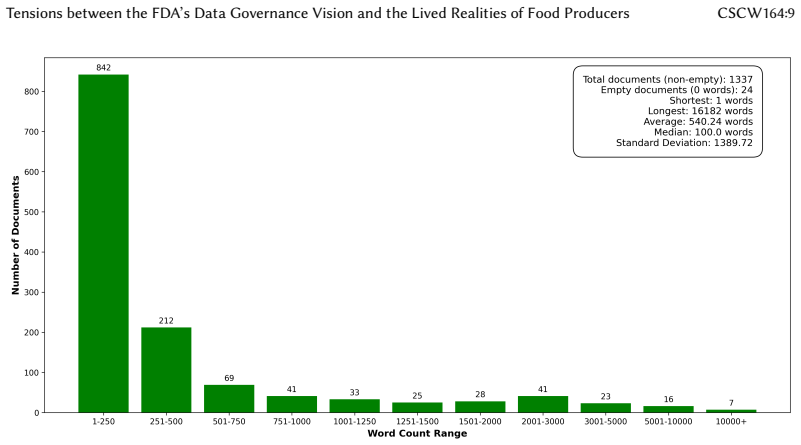
Qualitative document analysis of 1,198 public comments identifying three tensions in data governance implementation for the food supply chain.
If this is right
- The rule may disproportionately affect smaller, under-resourced producers lacking capacity to comply.
- Data tracking requirements may prove impractical in certain production contexts and cultural settings.
- Intended flexibility in the rule can instead increase confusion and burden for stakeholders.
- Implementation starting in 2026 could face resistance or incomplete adoption due to these issues.
Where Pith is reading between the lines
- Similar data mandates in other industries might encounter comparable stakeholder pushback if they overlook resource disparities.
- Engaging producers in rule design could mitigate some of the identified tensions.
- Without adjustments, the rule might accelerate industry consolidation toward larger entities better equipped for data compliance.
Load-bearing premise
That the submitted public comments represent the full range of lived realities and burdens across all agri-food supply chain stakeholders.
What would settle it
Finding that a majority of small producers have successfully implemented the required tracking without significant burden by the rule's effective date would challenge the identified tensions.
Figures
read the original abstract
The U.S. Food and Drug Administration (FDA)'s Food Traceability Rule requires agri-food supply chain stakeholders (stakeholders)--including farmers, fishers, retail workers, and others--to maintain detailed tracking records beginning in January 2026. Through this Rule, the FDA envisions a "New Era of Tech-Enabled Traceability," in which standardized, harmonized tracking data serve as a foundational public health infrastructure, enabling more rapid identification and removal of potentially contaminated food and ultimately reducing the risk of foodborne illness. Despite this promising vision, we observe that the Rule reconfigures agri-food stakeholders into data laborers by mandating stringent data collection, formatting, and reporting requirements. In this paper, we examine the tensions and burdens that arise from such reconfiguration. Leveraging Data Feminism as an orientation to attend to how data-driven policy implementation disproportionately burdens smaller, under-resourced stakeholders who lack the infrastructural and financial capacity to comply, we analyze 1,198 public comments submitted to Regulations.gov in response to the proposed Rule. Our qualitative document analysis reveals three key tensions: (1) the individual labor, financial, and educational burdens stakeholders experience as they are reconfigured into data workers; (2) moments where data tracking becomes infeasible due to infrastructural limitations, cultural contexts, and situated production practices; and (3) instances where the Rule's intended flexibility instead introduces confusion and burden due to its ambiguity.
Editorial analysis
A structured set of objections, weighed in public.
Referee Report
Summary. The paper argues that the FDA's Food Traceability Rule reconfigures agri-food supply chain stakeholders into data laborers through stringent tracking requirements. Drawing on Data Feminism, the authors qualitatively analyze 1,198 public comments submitted to Regulations.gov on the proposed rule and identify three tensions: (1) individual labor, financial, and educational burdens on stakeholders; (2) infeasibility of data tracking due to infrastructural, cultural, and production constraints; and (3) confusion and added burden from the rule's intended flexibility and ambiguity. The central claim is that these tensions disproportionately affect smaller, under-resourced stakeholders lacking capacity to comply.
Significance. If the empirical analysis is robust, the work contributes to HCI and data governance scholarship by applying Data Feminism to policy implementation, surfacing how traceability mandates create uneven burdens. The use of public comments as data provides a grounded view of stakeholder responses, and the three-tension framework offers a concrete lens for evaluating similar data-driven regulations.
major comments (1)
- [Abstract and Methods] Abstract and Methods (qualitative document analysis section): The headline claim that the Rule disproportionately burdens smaller, under-resourced stakeholders rests on coding of 1,198 public comments, yet the manuscript does not address selection bias. Submitting a Regulations.gov comment requires time, regulatory literacy, and internet access—the same capacities the paper argues small producers lack. No correction, weighting, or limitations discussion for this self-selection effect is described, so the three tensions may systematically under-represent the experiences of the group foregrounded by the Data Feminism orientation.
minor comments (2)
- [Methods] Methods section: The abstract and description of the qualitative analysis provide no information on the coding process, codebook development, inter-rater reliability, or how the sample of 1,198 comments was selected and filtered from the full docket.
- Throughout: Some quotes from comments are presented without clear attribution to stakeholder type (e.g., small producer vs. trade association), making it difficult to assess which tensions are voiced by which groups.
Simulated Author's Rebuttal
We thank the referee for their constructive feedback. The concern regarding selection bias in the public comments is a substantive methodological point that merits explicit treatment. We address it below and will revise the manuscript accordingly.
read point-by-point responses
-
Referee: [Abstract and Methods] Abstract and Methods (qualitative document analysis section): The headline claim that the Rule disproportionately burdens smaller, under-resourced stakeholders rests on coding of 1,198 public comments, yet the manuscript does not address selection bias. Submitting a Regulations.gov comment requires time, regulatory literacy, and internet access—the same capacities the paper argues small producers lack. No correction, weighting, or limitations discussion for this self-selection effect is described, so the three tensions may systematically under-represent the experiences of the group foregrounded by the Data Feminism orientation.
Authors: We agree that the manuscript should explicitly discuss selection bias. While the 1,198 comments include submissions from trade associations and advocacy organizations that represent small and mid-sized producers, as well as some individual small producers, the act of commenting does introduce self-selection. We will add a dedicated Limitations subsection to the Methods section that (1) acknowledges the resource requirements for submitting comments, (2) notes that our dataset may therefore under-represent the most resource-constrained stakeholders, and (3) discusses the implications for the Data Feminism framing. No weighting or statistical correction is feasible given the qualitative nature of the analysis, but the limitation will be stated plainly. revision: yes
Circularity Check
No significant circularity; empirical qualitative study grounded in external comments and stated theoretical orientation
full rationale
The paper conducts a qualitative document analysis of 1,198 public comments submitted to Regulations.gov, framed by Data Feminism to identify tensions in FDA traceability requirements. No equations, parameters, or derivations are present. No self-citations are invoked as load-bearing uniqueness theorems or ansatzes. The central claims are derived from coding the external comment corpus rather than reducing to the paper's own inputs by construction. The analysis is therefore self-contained; concerns about comment-sample bias pertain to external validity, not circularity.
Axiom & Free-Parameter Ledger
axioms (1)
- domain assumption Data Feminism provides an appropriate orientation to analyze how data-driven policy implementation disproportionately burdens smaller, under-resourced stakeholders
Reference graph
Works this paper leans on
-
[1]
[n. d.]. Designation of High-Risk Foods for Tracing; Request for Comments and for Scientific Data and Information, All Comments on Docket. https://www.regulations.gov/docket/FDA-2014-N-0053/comments
2014
-
[2]
Requirements for Additional Traceability Records for Certain Foods
2022. Requirements for Additional Traceability Records for Certain Foods. 87 Fed. Reg. 70910 (Nov. 21, 2022) (codified at 21 CFR Part 1). U.S. Food and Drug Administration
2022
-
[3]
Rediet Abebe, Solon Barocas, Jon Kleinberg, Karen Levy, Manish Raghavan, and David G Robinson. 2020. Roles for computing in social change. InProceedings of the 2020 conference on fairness, accountability, and transparency. 252–260
2020
-
[4]
Boniface Ushaka Adie, Mary Tate, Elizabeth Valentine, and Wonhyuk Cho. 2024. Digital Leadership Competencies for Digital Government: Insights and Implications from New Zealand Government Agencies.. InProceedings of the 25th Annual International Conference on Digital Government Research. 473–480
2024
-
[5]
Sara Ahmed. 2021. Complaint! InComplaint!Duke University Press
2021
-
[6]
David Altheide, Michael Coyle, Katie DeVriese, and Christopher Schneider. 2008. Emergent qualitative document analysis. (2008)
2008
-
[7]
Steven Arzt, Andreas Poller, and Gisela Vallejo. 2021. Tracing contacts with mobile phones to curb the pandemic: topics and stances in people’s online comments about the official German contact-tracing app. InExtended abstracts of the 2021 CHI conference on human factors in computing systems. 1–7
2021
-
[8]
Jeffrey Bardzell and Shaowen Bardzell. 2015. The user reconfigured: on subjectivities of information. InProceedings of The Fifth Decennial Aarhus Conference on Critical Alternatives. 133–144
2015
-
[9]
Jeffrey Bardzell, Guo Freeman, Shaowen Bardzell, and Pei-Ying Chen. 2020. Join. Love: A sociotechnical genealogy of the legalization of same-sex marriage. InProceedings of the 2020 CHI Conference on Human Factors in Computing Systems. 1–13
2020
-
[10]
Eric PS Baumer, Jenna Burrell, Morgan G Ames, Jed R Brubaker, and Paul Dourish. 2015. On the importance and implications of studying technology non-use.interactions22, 2 (2015), 52–56
2015
-
[11]
Chris Bopp, Ellie Harmon, and Amy Voida. 2017. Disempowered by data: Nonprofits, social enterprises, and the consequences of data-driven work. InProceedings of the 2017 CHI conference on human factors in computing systems. 3608–3619
2017
-
[12]
Claus Bossen, Kathleen H Pine, Federico Cabitza, Gunnar Ellingsen, and Enrico Maria Piras. 2019. Data work in healthcare: An Introduction. 465–474 pages
2019
-
[13]
Glenn A Bowen. 2009. Document analysis as a qualitative research method.Qualitative research journal9, 2 (2009), 27–40
2009
-
[14]
Bowker and Susan Leigh Star
Geoffrey C. Bowker and Susan Leigh Star. 2008.Sorting things out: classification and its consequences(1. paperback ed.,
2008
-
[15]
MIT Press, Cambridge, Mass
print ed.). MIT Press, Cambridge, Mass. Citation Key: bowkerSortingThingsOut2008
-
[16]
Carey and Natalie R
Maeve P. Carey and Natalie R. Ortiz. 2024. The Paperwork Reduction Act and Federal Collections of Information: A Brief Overview. https://crsreports.congress.gov/product/pdf/IF/IF11837 CRS In Focus, IF11837
2024
-
[17]
Elcelina Carvalho Silva and Miguel Mira da Silva. 2024. Central Bank Digital Currency Design Concepts: A Multivocal Literature Review. InProceedings of the 12th Euro American Conference on Telematics and Information Systems. 1–12
2024
-
[18]
Shiva Darian, Aarjav Chauhan, Ricky Marton, Janet Ruppert, Kathleen Anderson, Ryan Clune, Madeline Cupchak, Max Gannett, Joel Holton, Elizabeth Kamas, et al. 2023. Enacting data feminism in advocacy data work.Proceedings of the ACM on Human-Computer Interaction7, CSCW1 (2023), 1–28
2023
-
[19]
Olivia Doggett, Matt Ratto, and Priyank Chandra. 2024. Migrant Farmworkers’ Experiences of Agricultural Technologies: Implications for Worker Sociality and Desired Change. InProceedings of the 2024 CHI Conference on Human Factors in Proc. ACM Hum.-Comput. Interact., Vol. 10, No. 6, Article CSCW164. Publication date: October 2026. CSCW164:24 Kwon et al. Co...
2024
-
[20]
Charlotte Doidge, Laura Palczynski, X Zhou, Angela Bearth, G van Schaik, and Jasmeet Kaler. 2023. Exploring the data divide through a social practice lens: a qualitative study of UK cattle farmers.Preventive Veterinary Medicine220 (2023), 106030
2023
-
[21]
Catherine D’Ignazio and Lauren F. Klein. 2020.Data feminism. The MIT Press, Cambridge, Massachusetts. Citation Key: dignazioDataFeminism2020
2020
-
[22]
William N Eskridge, James J Brudney, Joshua Aaron Chafetz, Philip P Frickey, and Elizabeth Garrett. 2014. Cases and materials on legislation and regulation: statutes and the creation of public policy.(No Title)(2014)
2014
-
[23]
Cynthia R Farina, Mary Newhart, and Josiah Heidt. 2012. Rulemaking vs. democracy: Judging and nudging public participation that counts.Mich. J. Envtl. & Admin. L.2 (2012), 123
2012
-
[24]
Swinton, Nadja El Benni, and Achim Walter
Robert Finger, Scott M. Swinton, Nadja El Benni, and Achim Walter. 2019. Precision Farming at the Nexus of Agricultural Production and the Environment.Annual Review of Resource Economics11, Volume 11, 2019 (Oct. 2019), 313–335. doi:10.1146/annurev-resource-100518-093929
-
[25]
Food and Drug Administration
U.S. Food and Drug Administration. [n. d.]. FSMA final rule on requirements for additional Traceability Records. https://www.fda.gov/food/food-safety-modernization-act-fsma/fsma-final-rule-requirements-additional- traceability-records-certain-foods
-
[26]
Food and Drug Administration
U.S. Food and Drug Administration. 2016. Report to Congress On Enhancing Tracking and Tracing of Food and Recordkeeping Submitted Pursuant to Section 204 of the FDA Food Safety Modernization Act, Public Law 111-353. (2016). https://www.fda.gov/media/102784/download?attachment
2016
-
[27]
Food and Drug Administration
U.S. Food and Drug Administration. 2022. FDA Stakeholder Webinar on the Food Traceability Final Rule. https: //www.youtube.com/watch?v=iEF0hRk19Ho
2022
-
[28]
2022.Methodological Approach to Developing a Risk-Ranking Model for Food Tracing FSMA Section 204 (21 U.S
Center for Food Safety, Applied Nutrition Food, and Drug Administration. 2022.Methodological Approach to Developing a Risk-Ranking Model for Food Tracing FSMA Section 204 (21 U.S. Code § 2223). Technical Report. U.S. Department of Health and Human Services, https://www.fda.gov/media/142247/download. fsma, ftl, model
2022
-
[29]
Jérémie Forney and Ludivine Epiney. 2022. Governing Farmers through data? Digitization and the Question of Autonomy in Agri-environmental governance.Journal of Rural Studies95 (Oct. 2022), 173–182. doi:10.1016/j.jrurstud. 2022.09.001
-
[30]
1989.Les mots et les choses: une archéologie des sciences humaines
Michel Foucault. 1989.Les mots et les choses: une archéologie des sciences humaines. Gallimard, Paris
1989
-
[31]
Public Policy
Ritika Gairola and Colin M Gray. 2025. How is" Public Policy" Used in HCI Scholarship?. InProceedings of the Extended Abstracts of the CHI Conference on Human Factors in Computing Systems. 1–8
2025
-
[32]
Ritwick Ghosh. 2024. Data-driven governance and performances of accountability: Critical reflections from US agri-environmental policy.Science as Culture33, 1 (2024), 70–96
2024
-
[33]
Alasdair Gilchrist. 2016.Industry 4.0. Apress, Berkeley, CA. doi:10.1007/978-1-4842-2047-4
-
[34]
Michele Estrin Gilman. 2022. Beyond window dressing: Public participation for marginalized communities in the datafied society.Fordham L. Rev.91 (2022), 503
2022
-
[35]
Michael Goller, Carina Caruso, and Christian Harteis. 2021. Digitalisation in agriculture: knowledge and learning requirements of German dairy farmers.International journal for research in vocational education and training8, 2 (2021), 208–223
2021
-
[36]
Margaret Hagan. 2019. Participatory design for innovation in access to justice.Daedalus148, 1 (2019), 120–127
2019
-
[37]
Kaely Hall, Dong Whi Yoo, Wenrui Zhang, Mehrab Bin Morshed, Vedant Das Swain, Gregory D Abowd, Munmun De Choudhury, Alex Endert, John Stasko, and Jennifer G Kim. 2022. Supporting the contact tracing process with WiFi location data: opportunities and challenges. InProceedings of the 2022 CHI Conference on Human Factors in Computing Systems. 1–14
2022
-
[38]
Andrea Hamm, Yuya Shibuya, Teresa Cerratto Pargman, Roy Bendor, Christoph Raetzsch, Mennatullah Hendawy, Rainer Rehak, Gwen Klerks, Ben Schouten, and Nicolai Brodersen Hansen. 2024. What Does’ Failure’Mean in Civic Tech? We Need Continued Conversations About Discontinuation.interactions31, 2 (2024), 34–38
2024
-
[39]
Jean Hardy, Susan Wyche, and Tiffany Veinot. 2019. Rural HCI research: Definitions, distinctions, methods, and opportunities.Proceedings of the ACM on human-computer interaction3, CSCW (2019), 1–33
2019
-
[40]
Maximilian Häring, Eva Gerlitz, Matthew Smith, and Christian Tiefenau. 2023. Less about privacy: Revisiting a survey about the German COVID-19 contact tracing app. InProceedings of the 2023 CHI conference on human factors in computing systems. 1–16
2023
-
[41]
Holzemer, Carol Randel, Sheng-Fang Hsieh, and Thomas J
Suzanne Bakken Henry, William L. Holzemer, Carol Randel, Sheng-Fang Hsieh, and Thomas J. Miler. 1997. Comparison of Nursing Interventions Classification and Current Procedural Terminology Codes for Categorizing Nursing Activities. Image: the Journal of Nursing Scholarship29, 2 (June 1997), 133–138. doi:10.1111/j.1547-5069.1997.tb01545.x
-
[42]
what nurses do
Suzanne Bakken Henry and Charles N Mead. 1997. Nursing classification systems: necessary but not sufficient for representing “what nurses do” for inclusion in computer-based patient record systems.Journal of the American Medical Informatics Association4, 3 (1997), 222–232. Proc. ACM Hum.-Comput. Interact., Vol. 10, No. 6, Article CSCW164. Publication date...
1997
-
[43]
Jack Jamieson, Daniel A Epstein, Yunan Chen, and Naomi Yamashita. 2022. Unpacking intention and behavior: Explaining contact tracing app adoption and hesitancy in the United States. InProceedings of the 2022 CHI Conference on Human Factors in Computing Systems. 1–14
2022
-
[44]
Rebecca M Jonas and Benjamin V Hanrahan. 2022. Digital Storytelling for Developing Computer Skills in Rural Appalachia.Proceedings of the ACM on Human-Computer Interaction6, CSCW2 (2022), 1–22
2022
-
[45]
Louis Kaplow. 2013. Rules versus standards: An economic analysis. InScientific Models of Legal Reasoning. Routledge, 11–84
2013
-
[46]
Jasmin Kaur, Seyed Mehdi Hazrati Fard, Mohammad Amiri-Zarandi, and Rozita Dara. 2022. Protecting farmers’ data privacy and confidentiality: Recommendations and considerations.Frontiers in Sustainable Food Systems6 (2022), 903230
2022
-
[47]
Elizabeth Kaziunas, Mark S Ackerman, Silvia Lindtner, and Joyce M Lee. 2017. Caring through data: Attending to the social and emotional experiences of health datafication. InProceedings of the 2017 ACM Conference on Computer Supported Cooperative Work and Social Computing. 2260–2272
2017
-
[48]
2018.Rulemaking: How government agencies write law and make policy
Cornelius M Kerwin and Scott R Furlong. 2018.Rulemaking: How government agencies write law and make policy. Cq Press
2018
-
[49]
Tzu-Sheng Kuo, Quan Ze Chen, Amy X Zhang, Jane Hsieh, Haiyi Zhu, and Kenneth Holstein. 2025. PolicyCraft: Supporting Collaborative and Participatory Policy Design through Case-Grounded Deliberation. InProceedings of the 2025 CHI Conference on Human Factors in Computing Systems. 1–24
2025
-
[50]
Seolha Lee and Paul Dourish. 2024. Reconfiguring Data Relations: Institutional Dynamics around Data in Local Governance.Proceedings of the ACM on Human-Computer Interaction8, CSCW2 (2024), 1–28
2024
-
[51]
Jen Liu and Phoebe Sengers. 2021. Legibility and the legacy of racialized dispossession in digital agriculture.Proceedings of the ACM on Human-Computer Interaction5, CSCW2 (2021), 1–21
2021
-
[52]
Alex Jiahong Lu, Tawanna R Dillahunt, Gabriela Marcu, and Mark S Ackerman. 2021. Data work in education: Enacting and negotiating care and control in teachers’ use of data-driven classroom surveillance technology.Proceedings of the ACM on Human-Computer Interaction5, CSCW2 (2021), 1–26
2021
-
[53]
Wayne G Lutters and Mark S Ackerman. 2007. Beyond boundary objects: Collaborative reuse in aircraft technical support.Computer Supported Cooperative Work (CSCW)16, 3 (2007), 341–372
2007
-
[54]
Paul G Mahoney and Chris William Sanchirico. 2005. General and specific legal rules.Journal of Institutional and Theoretical Economics (JITE)/Zeitschrift für die gesamte Staatswissenschaft(2005), 329–346
2005
-
[55]
Jennifer Manuel and Clara Crivellaro. 2020. Place-based policymaking and HCI: Opportunities and challenges for technology design. InProceedings of the 2020 CHI Conference on Human Factors in Computing Systems. 1–16
2020
-
[56]
J Nathan Matias and Merry Mou. 2018. CivilServant: Community-led experiments in platform governance. InProceedings of the 2018 CHI conference on human factors in computing systems. 1–13
2018
-
[57]
Jennifer McEntire and Tejas Bhatt. 2013. Pilot Projects for Improving Product Tracing along the Food Supply System– Final Report.Chicago, IL: Institute of Food Technologists(2013). https://www.fda.gov/media/124149/download? attachment
2013
-
[58]
Amanda Meng, Carl DiSalvo, and Ellen Zegura. 2019. Collaborative data work towards a caring democracy.Proceedings of the ACM on Human-Computer Interaction3, CSCW (2019), 1–23
2019
-
[59]
2025.From Surveillance to Solidarity: Reimagining Data-Driven Technologies in Home Health Care Work
Joy Carol Ming. 2025.From Surveillance to Solidarity: Reimagining Data-Driven Technologies in Home Health Care Work. Ph. D. Dissertation. Cornell University
2025
-
[60]
Michael Muller, Ingrid Lange, Dakuo Wang, David Piorkowski, Jason Tsay, Q Vera Liao, Casey Dugan, and Thomas Erickson. 2019. How data science workers work with data: Discovery, capture, curation, design, creation. InProceedings of the 2019 CHI conference on human factors in computing systems. 1–15
2019
-
[61]
Gilbert Exaud Mushi, Giovanna Di Marzo Serugendo, , and Pierre-Yves Burgi. 2023. Data management system for sustainable agriculture among smallholder farmers in Tanzania: research-in-progress.Information Technology for Development29, 4 (Oct. 2023), 558–581. doi:10.1080/02681102.2023.2215528 Publisher: Routledge
work page internal anchor Pith review Pith/arXiv arXiv doi:10.1080/02681102.2023.2215528 2023
-
[62]
Beatriz Palacios Abad, Elizabeth Belding, Morgan Vigil-Hayes, and Ellen Zegura. 2024. Mending the Fabric: the Contentious, Collaborative Work of Repairing Broadband Maps.Proceedings of the ACM on Human-Computer Interaction 8, CSCW2 (2024), 1–24
2024
-
[63]
Samir Passi and Steven Jackson. 2017. Data vision: Learning to see through algorithmic abstraction. InProceedings of the 2017 ACM conference on computer supported cooperative work and social computing. 2436–2447
2017
-
[64]
Kathleen Pine, Claus Bossen, Naja Holten Møller, Milagros Miceli, Alex Jiahong Lu, Yunan Chen, Leah Horgan, Zhaoyuan Su, Gina Neff, and Melissa Mazmanian. 2022. Investigating data work across domains: new perspectives on the work of creating data. InCHI Conference on Human Factors in Computing Systems Extended Abstracts. 1–6
2022
-
[65]
Annabel Rothschild and Janne Lindqvist. 2024. Swapping 5G for 3G: Motivations, Experiences, and Implications of Contemporary Dumbphone Adoption.Proceedings of the ACM on Human-Computer Interaction8, CSCW1 (2024), 1–40. Proc. ACM Hum.-Comput. Interact., Vol. 10, No. 6, Article CSCW164. Publication date: October 2026. CSCW164:26 Kwon et al
2024
-
[66]
Kjeld Schmidt and Liam Bannon. 1992. Taking CSCW seriously: Supporting articulation work.Computer supported cooperative work (CSCW)1, 1 (1992), 7–40
1992
-
[67]
Anne Spaa, Abigail Durrant, Chris Elsden, and John Vines. 2019. Understanding the Boundaries between Policymaking and HCI. InProceedings of the 2019 CHI Conference on Human Factors in Computing Systems. 1–15
2019
-
[68]
Susan Leigh Star. 1999. The ethnography of infrastructure.American behavioral scientist43, 3 (1999), 377–391
1999
-
[69]
Susan Leigh Star and James R Griesemer. 1989. Institutional ecology,translations’ and boundary objects: Amateurs and professionals in Berkeley’s Museum of Vertebrate Zoology, 1907-39.Social studies of science19, 3 (1989), 387–420
1989
-
[70]
Susan Leigh Star and Anselm Strauss. 1999. Layers of silence, arenas of voice: The ecology of visible and invisible work.Computer supported cooperative work (CSCW)8, 1 (1999), 9–30
1999
-
[71]
Anselm Strauss. 1985. Work and the division of labor.Sociological quarterly26, 1 (1985), 1–19
1985
-
[72]
Anselm Strauss. 1988. The articulation of project work: An organizational process.Sociological Quarterly29, 2 (1988), 163–178
1988
-
[73]
Lucy Suchman. 1995. Making work visible.Commun. ACM38, 9 (1995), 56–64
1995
-
[74]
Cella M Sum, Caroline Shi, and Sarah E Fox. 2025. ’It’s Always a Losing Game’: How Workers Understand and Resist Surveillance Technologies on the Job.Proceedings of the ACM on Human-Computer Interaction9, 2 (2025), 1–32
2025
-
[75]
Yuling Sun, Xiaojuan Ma, Silvia Lindtner, and Liang He. 2023. Data work of frontline care workers: Practices, problems, and opportunities in the context of data-driven long-term care.Proceedings of the ACM on Human-Computer Interaction 7, CSCW1 (2023), 1–28
2023
-
[76]
Anh-Ton Tran, Grace Guo, Jordan Taylor, Katsuki Andrew Chan, Elora Lee Raymond, and Carl DiSalvo. 2024. Situating Datasets: Making Public Eviction Data Actionable for Housing Justice. InProceedings of the 2024 CHI Conference on Human Factors in Computing Systems. 1–16
2024
-
[77]
United States Congress. 2011. FDA Food Safety Modernization Act, Public Law 111–353. https://www.govinfo.gov/ content/pkg/PLAW-111publ353/pdf/PLAW-111publ353.pdf. Enacted January 4, 2011. Accessed May 4, 2025
2011
-
[78]
United States Congress. 2018. 5 U.S. Code § 553(c) — Rulemaking: Statement of Basis and Purpose. Administrative Procedure Act, codified at 5 U.S.C. § 553(c) (2018)
2018
-
[79]
Food and Drug Administration
U.S. Food and Drug Administration. 2023. Small Entity Compliance Guide: Requirements for Ad- ditional Traceability Records for Certain Foods: What You Need to Know About the FDA Regula- tion. https://www.fda.gov/regulatory-information/search-fda-guidance-documents/small-entity-compliance-guide- requirements-additional-traceability-records-certain-foods-wh...
2023
-
[80]
General Services Administration
U.S. General Services Administration. n.d.. Tips for Submitting Effective Comments. https://s3.amazonaws.com/prod- regulations-faq/pdf/Tips-For-Submitting-Effective-Comments.pdf. Accessed: 2025-05-04
2025
discussion (0)
Sign in with ORCID, Apple, or X to comment. Anyone can read and Pith papers without signing in.