REVIEW 3 major objections 5 minor 1 cited by
ART for Diffusion Sampling: Continuous-Time Control and Actor-Critic Learning
T0 review · 3 major / 5 minor · reviewed 2026-07-12 · grok-4.5
Pith's one-line read Learning the sampling clock as continuous-time control improves diffusion sample quality by changing only the timestep grid, and the learned schedules transfer without retraining.
desk verdict Solid control-theoretic schedule learning for diffusion sampling with real transfer evidence; the Euler-surrogate vs Heun/RK4 gap is a real but already-flagged soft spot, not a collapse of the claim. read the letter →
The pith
A machine-rendered reading of the paper's core claim, the machinery that carries it, and where it could break.
The reading
What carries the argument
Adaptive Reparameterized Time (ART): treat the speed of a reparameterized sampling clock as the control so uniform steps on that clock induce adaptive physical timesteps. ART-RL recovers the ART optimum as the mean of an optimal Gaussian policy, with implementable actor–critic updates from trajectory moment identities.
What would settle it
Train and distill ART-RL on CIFAR-10, plug only that grid into the official EDM Heun sampler at NFE=35 with all else fixed, and check whether FID fails to beat or match the standard EDM schedule on matched 50k-sample runs; if it does not improve, the central drop-in claim fails.
Extended reading notes
Core claim
Timestep allocation for diffusion sampling can be cast as a continuous-time control problem over a time-warping rate; an auxiliary Gaussian-policy RL formulation is equivalent at optimality, and the resulting learned schedules improve sample quality over Uniform, DPM, and EDM grids when plugged into unchanged samplers, with broad transfer without retraining.
Load-bearing premise
The method chooses timesteps by minimizing a local error measure derived for simple Euler steps, even when the sampler actually uses higher-order methods and high-dimensional learned scores.
Editorial extensions
If this is right
- Existing diffusion pipelines can raise sample quality at fixed evaluation budgets by replacing only the timestep schedule with an ART-RL grid.
- One offline schedule-training run can be amortized across budgets, datasets, solvers, and representation spaces via distillation and transfer.
- Hand-crafted schedules such as EDM and DPM can be suboptimal even on simple problems with known scores.
- Schedule learning is separable from score-network training: no architectural change or solver rewrite is required.
Reading between the lines
- The same time-warping control idea may extend to reverse-time SDE samplers, not only probability-flow ODEs, though the paper leaves that open.
- If an Euler local-error proxy already helps Heun and RK4 empirically, higher-order local-error surrogates could further refine allocation for those integrators.
- Collapse of learned policies to nearly time-only schedules suggests much of the gain is a one-dimensional warping rather than full state-feedback control, which would simplify deployment further.
Editorial analysis
A structured set of objections, weighed in public.
Referee Report
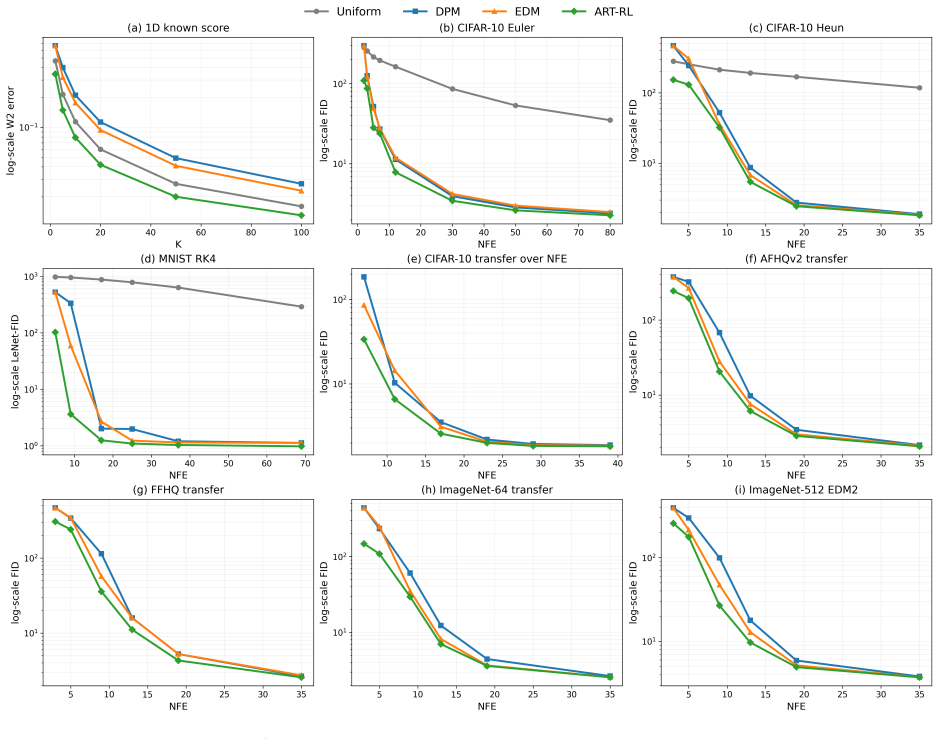
Summary. The paper formulates timestep allocation for score-based diffusion sampling as Adaptive Reparameterized Time (ART): a continuous-time control problem in which the control is the speed of a reparameterized sampling clock, so that a uniform grid on the learned clock induces nonuniform physical-time steps under a fixed budget. The objective is a leading-order Euler residual surrogate |Q|θ² plus a Lagrange term for the time budget (Eqs. 7–9). To solve the high-dimensional deterministic problem, the authors introduce ART-RL with Gaussian policies whose variance is proportional to 1/|Q|, prove that the mean of the optimal Gaussian policy recovers the ART optimizer (Theorem 1), and develop continuous-time policy evaluation/improvement and martingale orthogonality conditions that yield implementable actor–critic updates (Theorems 2–3, Algorithm 1). Empirically, distilled ART-RL grids are plugged into existing samplers by changing only the timestep schedule and improve FID/LeNet-FID over Uniform, DPM, and EDM at matched NFE on a 1D analytical-score task, MNIST, CIFAR-10 (Euler and Heun), and transfer without retraining across budgets, AFHQv2/FFHQ/ImageNet-64, and EDM2 ImageNet-512.
Significance. If the results hold, this is a genuine contribution: a control-theoretic alternative to hand-crafted diffusion timestep grids, with a clean optimizer-level equivalence between deterministic ART and Gaussian ART-RL, and with actor–critic theory specialized to time reparameterization. The experimental design is strong for the claim that only the grid changes—score model, backbone, solver, and pipeline are held fixed—and the transfer suite (cross-budget, cross-dataset, EDM→EDM2 latent, high resolution) is unusually thorough. Distillation to a fixed precomputed grid makes the method practically drop-in with no inference overhead. The main open scientific question is whether the Euler-local surrogate remains the right allocation signal under the higher-order solvers used in the headline image results; that is a limitation the paper itself flags, not a circularity or construction artifact.
major comments (3)
- §3.2 Eqs. (7)–(9) and §6.3–6.5: The control objective is the leading-order one-step Euler residual E_i = (h_i²/2) θ_i² Q + O(h_i³), with running cost |Q|θ². The main image and transfer claims, however, evaluate Heun (CIFAR-10 EDM, NFE=2K−1; Tables 2, 5–7) and RK4 (MNIST, NFE=4K−3; Table 4), and reuse the same CIFAR-10-trained schedule under those solvers and under EDM2. There is no matching local residual for Heun/RK4, nor a controlled ablation that isolates whether Q remains the correct stiffness field once the integrator order changes. §7 lists this as a limitation, but the abstract and transfer claims treat the grids as solver-agnostic. Please either (i) derive or empirically validate a higher-order residual and retrain under it for the Heun/RK4 settings, or (ii) substantially qualify the solver-transfer claims and report a same-solver vs cross-solver comparison that shows how much of
- §6.2–6.3 and distillation: After training, policies are distilled to time-only mean θ curves (Figs. 4–5, Tables 1–3). The theory (Theorems 1–3, dynamics (4)) allows state-dependent feedback θ(t,x,ψ). The paper reports that confidence bands are narrow, but does not quantify the performance gap between the full feedback policy and the distilled time-only grid on CIFAR-10/ImageNet, nor when residual state dependence would matter (e.g., multi-modal or highly anisotropic reverse trajectories). Without that comparison, it is unclear whether the control formulation’s state dependence is load-bearing or whether the method effectively reduces to learning a 1D time warp. A short ablation (feedback vs distilled) at a few NFEs would resolve this.
- §5.2–5.3 and free parameters: The implementable scheme depends on λ (Gaussian randomization), γ (budget multiplier), ε-floor on |Q|, actor/critic architectures, and learning rates a_n. The manuscript does not report sensitivity of the learned schedule or FID to these choices, nor a protocol for selecting them across datasets. Because the headline claim is that ART-RL is a reusable, principled schedule rather than a tuned artifact, a brief sensitivity or default-protocol statement (especially for λ and the |Q| floor) is needed to support transferability claims in §6.5.
minor comments (5)
- Eq. (13) and the paragraph after (11): the constant bias −λ from Gaussian randomization and the compensating +λT term are clear, but a one-line display of the identity ∫(−|Q|θ²−γθ)π dθ = −|Q|μ²−γμ−λ would help readers who skip the surrounding text.
- Figure 3 uses a log vertical axis across heterogeneous metrics (W₂, FID, LeNet-FID). Consider labeling each panel with the metric name and units, and stating in the caption that lower is better for all panels.
- Notation: F(x,ψ) in (5) and Q(x,ψ) in (8) are dense; a short remark that Q is the second-order coefficient along the probability-flow field (not a Hessian of a loss) would reduce confusion for readers outside numerical SDEs.
- Related work: CTRL applications to diffusion fine-tuning (Gao et al., Zhao et al.) are cited; a sentence distinguishing schedule learning (this paper) from score/policy fine-tuning would sharpen the novelty claim.
- Table 2 NFE=35: three matched runs are mentioned in text but not tabulated with means/stds; a small parenthetical or appendix table would strengthen the claim that ART-RL still wins at the strongest EDM budget.
Circularity Check
No significant circularity: ART objective is an explicit Euler-error surrogate, ART–ART-RL equivalence is proved in-paper, and FID/transfer gains are empirical against external baselines.
full rationale
The derivation chain is self-contained and not circular. Section 3.2 defines the control objective J_θ from a leading-order Euler residual E_i = (h_i²/2) θ_i² Q + O(h_i³) (Eqs. 7–9); optimizing that surrogate is the problem statement, not a prediction forced by fitting the evaluation metric. Theorems 1–3 prove ART–ART-RL optimizer equivalence and actor–critic moment conditions by HJB/Feynman–Kac/martingale arguments written out in the paper; citations to Wang et al. (2020) and Jia–Zhou (2022a,b) supply continuous-time RL machinery, not a uniqueness theorem that forbids alternatives or smuggles the schedule. Empirical claims compare distilled grids to external hand-designed schedules (Uniform, DPM, EDM) on FID/LeNet-FID/W₂ at matched NFE, and transfer tests reuse a CIFAR-10 schedule on held-out datasets, budgets, solvers, and EDM2 without retraining—none of which is forced by construction from the training objective. Distillation to a time-only mean curve is an empirical post-processing step after observing low trajectory variance, not a definitional identity. The Euler-surrogate vs Heun/RK4 gap is a modeling assumption (noted in §7), not circularity.
Assumptions & free parameters
free parameters (5)
- Gaussian randomization level λ
- Lagrange multiplier γ for time budget
- Floor ε in |Q|_ε = max(|Q|,ε)
- Actor/critic network architectures and learning rates a_n
- Distillation aggregation (mean θ curve over last trajectories)
assumptions (5)
- domain assumption Classical solutions exist for the ART and ART-RL HJB equations in the relevant high-dimensional state space.
- ad hoc to paper Leading-order Euler residual coefficient Q is a valid surrogate for where resolution should be spent, including under Heun/RK4 evaluation.
- ad hoc to paper Gaussian policies with variance proportional to 1/|Q| are rich enough that their optimal mean recovers the deterministic ART optimizer.
- domain assumption Score-based reverse probability-flow ODE with a fixed pretrained score is the sampling model of interest.
- standard math Martingale orthogonality / continuous-time actor–critic theory of Jia–Zhou applies after time discretization and neural approximation.
invented entities (3)
-
Adaptive Reparameterized Time (ART) control θ = ψ̇
independent evidence
-
ART-RL Gaussian exploratory policies with variance λ/|Q|
-
Euler stiffness field Q(x,ψ)
independent evidence
Cite this review
Pith. "Pith review of ART for Diffusion Sampling: Continuous-Time Control and Actor-Critic Learning." pith.science (2026). https://pith.science/paper/QL3PHOZV
@misc{pith2026260702137,
  author       = {Pith},
  title        = {Pith review of: ART for Diffusion Sampling: Continuous-Time Control and Actor-Critic Learning},
  year         = {2026},
  howpublished = {\url{https://pith.science/paper/QL3PHOZV}},
  note         = {Machine review of arXiv:2607.02137}
}
read the original abstract
We study timestep allocation for score-based diffusion sampling, where a learned reverse-time dynamics is discretized on a finite grid. Uniform and hand-crafted schedules are standard choices, but they rely on fixed prescriptions and can therefore be suboptimal. To address this limitation, we propose Adaptive Reparameterized Time (ART), a continuous-time control formulation that learns a time change by treating the speed of the sampling clock as the control, so that a uniform grid on the learned clock induces adaptive timesteps in the original diffusion time. Based on a leading-order Euler error surrogate, ART provides a principled objective for allocating timesteps along the sampling trajectory. To solve this deterministic control problem, we introduce ART-RL, an auxiliary randomized formulation with Gaussian policies that turns schedule learning into a continuous-time reinforcement learning problem. We prove that the randomized ART-RL formulation is equivalent to ART at the optimizer level, in the sense that its optimal Gaussian policy recovers the optimal ART time-warping rate through its mean. We further establish policy evaluation and policy improvement characterizations and derive trajectory-based moment identities that yield implementable actor--critic updates for learning the schedule. Across experiments ranging from controlled low-dimensional settings to image generation, ART-RL can be plugged into existing diffusion samplers by changing only the timestep grid, consistently improving sample quality over strong baseline schedules at matched budgets while leaving the rest of the sampling pipeline unchanged. The learned schedules also exhibit broad generalization, transferring without retraining across sampling budgets, datasets, solvers, pipelines, and representation spaces.
Figures


Figures from the paper (11 more)


Forward citations
Cited by 1 Pith paper
-
Dynamic mean-variance portfolio selection with no-shorting constraints and unknown investment opportunity sets
For no-shorting continuous-time mean–variance allocation, a Gaussian exploratory problem with nonnegative means and variance (x−w)²Ψ has an optimal mean strategy identical to the true constrained optimal policy.
Reference graph
Works this paper leans on
-
[1]
Data-driven merton’s strategies via policy random- ization.arXiv preprint arXiv:2312.11797,
Min Dai, Yuchao Dong, Yanwei Jia, and Xun Yu Zhou. Data-driven merton’s strategies via policy random- ization.arXiv preprint arXiv:2312.11797,
-
[2]
arXiv:2409.04832. Google. State-of-the-art video and image generation with veo 2 and imagen 3.https://blog.google/ technology/google-labs/video-image-generation-update-december-2024/,
arXiv 2024
-
[3]
Jonathan Ho, Ajay Jain, and Pieter Abbeel
Accessed: 2025- 09-17. Jonathan Ho, Ajay Jain, and Pieter Abbeel. Denoising diffusion probabilistic models. InNeurips, volume 33, pages 6840–6851,
2025
-
[4]
Convergence analysis of probability flow ode for score-based generative models
Daniel Zhengyu Huang, Jiaoyang Huang, and Zhengjiang Lin. Convergence analysis of probability flow ode for score-based generative models. 2025a. arXiv:2404.09730. To appear in IEEE Trans. Inf. Theory. Yilie Huang. Continuous-time reinforcement learning for asset–liability management. InProceedings of the 6th ACM International Conference on AI in Finance, ...
-
[5]
Yilie Huang, Yanwei Jia, and Xunyu Zhou
arXiv:2507.00358. Yilie Huang, Yanwei Jia, and Xunyu Zhou. Achieving mean–variance efficiency by continuous-time rein- forcement learning. InProceedings of the Third ACM International Conference on AI in Finance, pages 377–385,
-
[6]
30 Yilie Huang, Yanwei Jia, and Xun Yu Zhou
arXiv:2412.16175. 30 Yilie Huang, Yanwei Jia, and Xun Yu Zhou. Sublinear regret for a class of continuous-time linear-quadratic reinforcement learning problems.SIAM Journal on Control and Optimization, 63(5):3452–3474, 2025b. Yanwei Jia and Xun Yu Zhou. Policy evaluation and temporal-difference learning in continuous time and space: A martingale approach....
-
[7]
Vijay Konda and John Tsitsiklis
arXiv:2506.17298. Vijay Konda and John Tsitsiklis. Actor-critic algorithms.Advances in Neural Information Processing Systems, 12,
-
[8]
arXiv:2502.09992. OpenAI. Sora: Creating video from text.https://openai.com/sora,
Show all 14 references
-
[9]
Aditya Ramesh, Prafulla Dhariwal, Alex Nichol, Casey Chu, and Mark Chen
Accessed: 2025-09-17. Aditya Ramesh, Prafulla Dhariwal, Alex Nichol, Casey Chu, and Mark Chen. Hierarchical text-conditional image generation with clip latents
2025
-
[10]
Robin Rombach, Andreas Blattmann, Dominik Lorenz, Patrick Esser, and Bj¨ orn Ommer
arXiv:2204.06125. Robin Rombach, Andreas Blattmann, Dominik Lorenz, Patrick Esser, and Bj¨ orn Ommer. High-resolution image synthesis with latent diffusion models. InCVPR, pages 10684–10695,
-
[11]
Haoran Wang, Thaleia Zariphopoulou, and Xun Yu Zhou
arXiv:2411.01302. Haoran Wang, Thaleia Zariphopoulou, and Xun Yu Zhou. Reinforcement learning in continuous time and space: A stochastic control approach.Journal of Machine Learning Research, 21(198):1–34,
-
[12]
32 Qinsheng Zhang and Yongxin Chen
arXiv:2410.04760. 32 Qinsheng Zhang and Yongxin Chen. Fast sampling of diffusion models with exponential integrator. InICLR,
-
[13]
Hanyang Zhao, Wenpin Tang, and David D Yao
arXiv:2308.02157. Hanyang Zhao, Wenpin Tang, and David D Yao. Policy optimization for continuous reinforcement learning. InNeurips, volume 36,
-
[14]
Hanyang Zhao, Haoxian Chen, Ji Zhang, David Yao, and Wenpin Tang
arXiv:2409.08400. Hanyang Zhao, Haoxian Chen, Ji Zhang, David Yao, and Wenpin Tang. Score as Action: Fine tuning diffusion generative models by continuous-time reinforcement learning. InICML,
Reviewed July 12, 2026 · model on record in the stance chip above.
Discussion (0). Continue with ORCID to comment.