Balanced Workforce: Governance-by-Design for Privacy-Preserving Inter-Firm Workforce Leasing
Pith reviewed 2026-06-26 20:12 UTC · model grok-4.3
The pith
Workforce leasing platforms must incorporate consent mechanisms, traceability, and data minimization rather than functioning solely as marketplaces.
A machine-rendered reading of the paper's core claim, the machinery that carries it, and where it could break.
Core claim
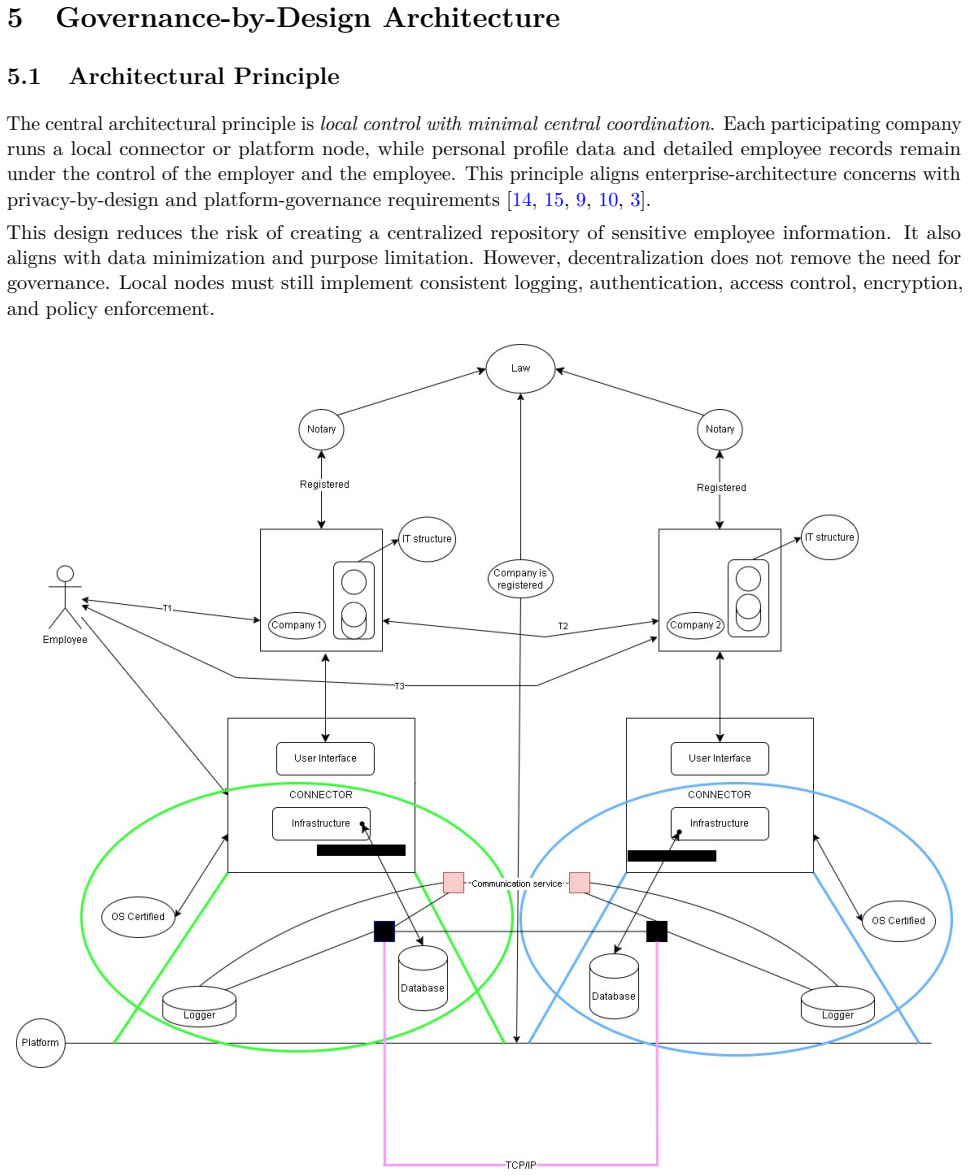
The Balanced Workforce Leasing Service enables companies to list temporary talent availability, discover anonymized skill profiles, negotiate assignments, and document agreements through locally deployed connectors and a minimal central coordination layer. The framework combines socio-technical governance, enterprise architecture, business model design, e3value-based value exchange modeling, and privacy-by-design principles. It presents the system concept, stakeholder model, process phases, architecture, business model, value network, and legal, ethical, and operational risk analysis, arguing that workforce leasing platforms require consent mechanisms, traceability, role-based access control
What carries the argument
The governance-by-design framework for the Balanced Workforce Leasing Service, which embeds privacy and accountability rules into a distributed architecture of local connectors with minimal central coordination.
If this is right
- Talent can move between firms without exposing individual data beyond what is required for matching.
- Contractual and dispute mechanisms become part of the platform rather than external add-ons.
- Value exchanges between participating organizations can be modeled and balanced using explicit value-network diagrams.
- Institutional accountability is assigned to specific roles and processes from the outset.
- Future prototypes can be tested against the defined risk categories through expert review and stakeholder workshops.
Where Pith is reading between the lines
- The same local-connector pattern could be adapted to other inter-organizational resource pools such as equipment or intellectual property.
- Regulatory agencies might adopt the design artifact as a template when drafting rules for digital labor platforms.
- Integration challenges with legacy HR systems would likely surface in any early prototype and could be measured directly.
- The approach implies a broader move from centralized marketplaces toward federated, consent-driven labor networks.
Load-bearing premise
Combining socio-technical governance, enterprise architecture, business model design, value-exchange modeling, and privacy-by-design principles into locally deployed connectors with minimal central coordination will sufficiently address legal, ethical, organizational, and data-governance risks.
What would settle it
A real-world pilot deployment in which a data breach, unresolved legal dispute, or consent violation occurs despite the framework's consent mechanisms, local connectors, and accountability features.
Figures

read the original abstract
Workforce demand is uneven across organizations. Project-based companies may simultaneously face skill shortages in one unit while other firms hold underutilized employees with relevant expertise. Conventional hiring, contracting, and temporary agency models address parts of this problem, but they also create legal, ethical, organizational, and data-governance risks. This paper reframes a seminar project called Balanced Workforce into a governance-by-design framework for privacy-preserving inter-firm workforce leasing. The proposed Balanced Workforce Leasing Service (BWLS) enables companies to list temporary talent availability, discover anonymized skill profiles, negotiate assignments, and document agreements through locally deployed connectors and a minimal central coordination layer. The framework combines socio-technical governance, enterprise architecture, business model design, e3value-based value exchange modeling, and privacy-by-design principles. The paper presents the system concept, stakeholder model, process phases, architecture, business model, value network, and legal, ethical, and operational risk analysis. It argues that workforce leasing platforms should not be designed only as marketplaces. They require consent mechanisms, traceability, role-based access control, data minimization, contractual safeguards, dispute handling, and institutional accountability. The contribution is a structured framework and design artifact for future research on governed digital labor infrastructures. The paper does not claim deployment results or empirical validation; instead, it provides a design framework that can be evaluated through expert review, stakeholder workshops, prototype testing, and regulatory analysis.
Editorial analysis
A structured set of objections, weighed in public.
Referee Report
Summary. The manuscript proposes the Balanced Workforce Leasing Service (BWLS) as a governance-by-design framework for privacy-preserving inter-firm workforce leasing. It describes a system architecture using locally deployed connectors with minimal central coordination to facilitate talent availability listing, anonymized skill profile discovery, negotiation, and agreement documentation. The framework integrates socio-technical governance, enterprise architecture, business model design using e3value, and privacy-by-design principles, including consent mechanisms, traceability, role-based access control, data minimization, contractual safeguards, dispute handling, and institutional accountability. The paper presents stakeholder models, process phases, architecture, business model, value network, and risk analysis, positioning the work as a design artifact for future research rather than an empirically validated implementation.
Significance. If the framework is sound, it offers a structured, multi-disciplinary design approach to mitigating legal, ethical, organizational, and data-governance risks in workforce leasing platforms. By combining established methods like e3value modeling with privacy-by-design, it provides a concrete artifact that can guide the development of governed digital labor infrastructures and serve as a foundation for subsequent expert reviews, workshops, and prototypes in software engineering and related fields.
minor comments (2)
- [Abstract] Abstract: The scoping statement that the work provides a design framework evaluable through expert review rather than deployment results is appropriate and consistent, but the abstract could more explicitly preview how the risk analysis section connects specific design elements (e.g., local connectors) to the listed safeguards.
- [Risk analysis] Risk analysis: The legal, ethical, and operational risk analysis would be strengthened by citing specific regulations or standards (e.g., explicit GDPR articles on data minimization or consent) to make the mapping from privacy-by-design principles to the proposed architecture more traceable.
Simulated Author's Rebuttal
We thank the referee for the supportive summary, significance assessment, and recommendation of minor revision. The report raises no specific major comments.
Circularity Check
No significant circularity
full rationale
The paper is a forward-looking design proposal that presents a conceptual governance-by-design framework combining socio-technical principles, enterprise architecture, e3value modeling, and privacy-by-design without any equations, fitted parameters, derivations, or predictions that could reduce to inputs by construction. It explicitly states it does not claim deployment results or empirical validation and positions the artifact for external evaluation via workshops and regulatory analysis. No self-citation chains, uniqueness theorems, or ansatzes are invoked as load-bearing elements, making the work self-contained as a structured proposal rather than a closed derivation.
Axiom & Free-Parameter Ledger
axioms (2)
- domain assumption Socio-technical governance and privacy-by-design principles can be effectively combined with enterprise architecture and e3value modeling to produce a workable inter-firm leasing system.
- ad hoc to paper A minimal central coordination layer with locally deployed connectors will preserve privacy while enabling discovery and negotiation.
invented entities (1)
-
Balanced Workforce Leasing Service (BWLS)
no independent evidence
Reference graph
Works this paper leans on
-
[1]
Gordon Baxter and Ian Sommerville. 2011. Socio-technical systems: From design methods to systems engineering.Interacting with Computers23, 1, 4–17.https://doi.org/10.1016/j.intcom.2010.07.003
-
[2]
Enid Mumford. 2006. The story of socio-technical design: Reflections on its successes, failures and potential.Information Systems Journal16, 4, 317–342.https://doi.org/10.1111/j.1365-2575.2006.00221.x
-
[3]
Amrit Tiwana, Benn Konsynski, and Ashley A. Bush. 2010. Platform evolution: Coevolution of platform architecture, governance, and environmental dynamics.Information Systems Research21, 4, 675–687.https://doi.org/10.1287/isre. 1100.0323
-
[4]
Mark de Reuver, Carsten Sørensen, and Rahul C. Basole. 2018. The digital platform: A research agenda.Journal of Information Technology33, 2, 124–135.https://doi.org/10.1057/s41265-016-0033-3
-
[5]
Katherine C. Kellogg, Melissa A. Valentine, and Angèle Christin. 2020. Algorithms at work: The new contested terrain of control.Academy of Management Annals14, 1, 366–410.https://doi.org/10.5465/annals.2018.0174
-
[6]
Wood, Mark Graham, Vili Lehdonvirta, and Isis Hjorth
Alex J. Wood, Mark Graham, Vili Lehdonvirta, and Isis Hjorth. 2019. Good gig, bad gig: Autonomy and algorithmic control in the global gig economy.Work, Employment and Society33, 1, 56–75.https://doi.org/10.1177/0950017018785616
-
[7]
Valerio De Stefano. 2016. The rise of the “just-in-time workforce”: On-demand work, crowdwork, and labor protection in the “gig-economy”.Comparative Labor Law & Policy Journal37, 3, 471–504.https://doi.org/10.2139/ssrn.2682602
-
[8]
European Parliament and Council of the European Union. 2008. Directive 2008/104/EC of 19 November 2008 on temporary agency work.Official Journal of the European Union. https://eur-lex.europa.eu/legal-content/EN/TXT/?uri=CELEX: 32008L0104
2008
-
[9]
European Parliament and Council of the European Union. 2016. Regulation (EU) 2016/679: General Data Protection Regulation.https://eur-lex.europa.eu/eli/reg/2016/679/oj
2016
-
[10]
European Data Protection Board. 2020. Guidelines 4/2019 on Article 25: Data protection by de- sign and by default, version 2.0. https://www.edpb.europa.eu/our-work-tools/our-documents/guidelines/ guidelines-42019-article-25-data-protection-design-and_en
2020
-
[11]
Helen Nissenbaum. 2004. Privacy as contextual integrity.Washington Law Review79, 1, 119–157.https://digitalcommons. law.uw.edu/wlr/vol79/iss1/10/
2004
-
[12]
2010.Business Model Generation: A Handbook for Visionaries, Game Changers, and Challengers
Alexander Osterwalder and Yves Pigneur. 2010.Business Model Generation: A Handbook for Visionaries, Game Changers, and Challengers. John Wiley & Sons
2010
-
[13]
Jaap Gordijn and Hans Akkermans. 2001. Designing and evaluating e-business models.IEEE Intelligent Systems16, 4, 11–17. https://doi.org/10.1109/5254.941353
-
[14]
2022.ArchiMate 3.2 Specification
The Open Group. 2022.ArchiMate 3.2 Specification. The Open Group Standard C226. https://pubs.opengroup.org/ architecture/archimate3-doc/
2022
-
[15]
ISO/IEC/IEEE. 2011. ISO/IEC/IEEE 42010:2011 Systems and software engineering – Architecture description. International Organization for Standardization.https://www.iso.org/standard/50508.html
2011
-
[16]
Dirk Merkel. 2014. Docker: Lightweight Linux containers for consistent development and deployment.Linux Journal2014, 239. https://www.linuxjournal.com/content/ docker-lightweight-linux-containers-consistent-development-and-deployment
2014
-
[17]
Sarah Spiekermann and Lorrie Faith Cranor. 2009. Engineering privacy.IEEE Transactions on Software Engineering35, 1, 67–82.https://doi.org/10.1109/TSE.2008.88
-
[18]
Shirley Gregor and David Jones. 2007. The anatomy of a design theory.Journal of the Association for Information Systems 8, 5, 312–335.https://doi.org/10.17705/1jais.00129
-
[19]
Design Science in Information Systems Research,
Alan R. Hevner, Salvatore T. March, Jinsoo Park, and Sudha Ram. 2004. Design science in information systems research. MIS Quarterly28, 1, 75–105.https://doi.org/10.2307/25148625
-
[20]
European Parliament and Council of the European Union. 2024. Directive (EU) 2024/2831 of 23 October 2024 on improving working conditions in platform work.Official Journal of the European Union.https://eur-lex.europa.eu/eli/dir/2024/ 2831/oj/eng
2024
-
[21]
Anna Milanez. 2025. Algorithmic management in the workplace. OECD Artificial Intelligence Papers.https://www.oecd. org/en/publications/algorithmic-management-in-the-workplace_287c13c4-en.html
2025
-
[22]
Kim, Sicun Gao, Daniel Schneider, Sachin S
Jonathan Lynn, Rachel Y. Kim, Sicun Gao, Daniel Schneider, Sachin S. Pandya, and Min Kyung Lee. 2025. Regulating algorithmic management: A multi-stakeholder study of challenges in aligning software and the law for workplace scheduling. Proceedings of the 2025 ACM Conference on Fairness, Accountability, and Transparency.https://doi.org/10.1145/3715275. 3732037. 15
discussion (0)
Sign in with ORCID, Apple, or X to comment. Anyone can read and Pith papers without signing in.