Chance-Constrained Correlated Equilibria for Robust Noncooperative Coordination
Pith reviewed 2026-05-21 11:57 UTC · model grok-4.3
The pith
Chance-constrained correlated equilibria guarantee incentive compatibility despite cost uncertainty.
A machine-rendered reading of the paper's core claim, the machinery that carries it, and where it could break.
Core claim
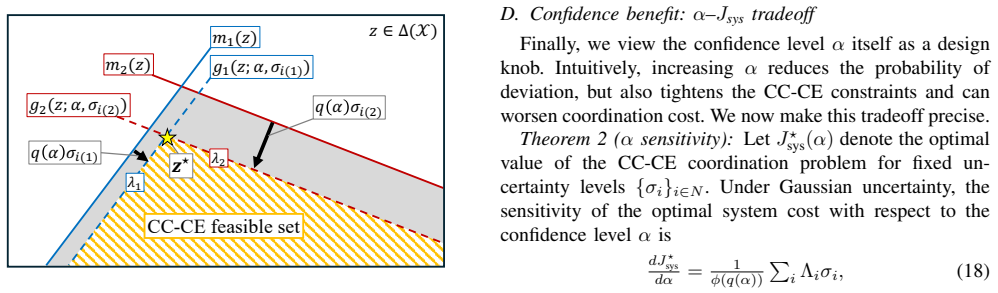
The authors formulate a chance-constrained correlated equilibrium problem that accounts for uncertainty in agents' costs and guarantees incentive compatibility with a prescribed confidence level. They derive sensitivity results that quantify how uncertainty in individual incentive constraints affects the expected coordination outcome by relating the marginal benefit of reducing uncertainty to the dual sensitivities of the incentive constraints. The results reveal that increasing the confidence level is not always beneficial and can introduce a tradeoff between robustness and system efficiency.
What carries the argument
The chance-constrained correlated equilibrium, a version of standard correlated equilibrium in which each incentive-compatibility condition is replaced by a probabilistic requirement that holds except on a small-probability set of cost realizations.
If this is right
- Recommended actions remain incentive-compatible for all but a prescribed small fraction of possible cost realizations.
- Dual sensitivities of the incentive constraints directly measure the expected gain in coordination performance from shrinking uncertainty in each parameter.
- Intermediate confidence levels can produce lower realized coordination costs than either a fully deterministic formulation or a highly conservative one.
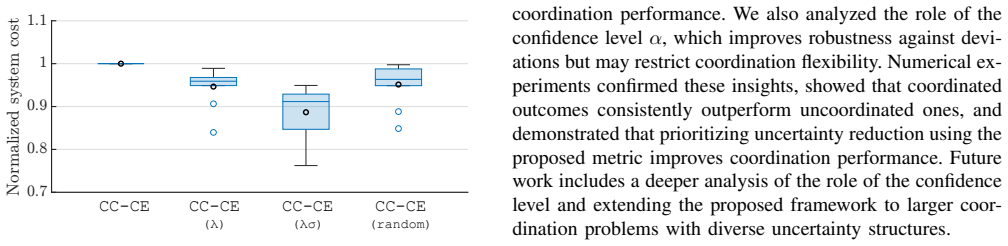
- The information-gain metric derived from the duals identifies which uncertainty sources yield the largest improvement when reduced.
Where Pith is reading between the lines
- The same dual-based ranking of uncertainties could guide sensor placement or model refinement in other multi-agent coordination settings.
- Designers might optimize the target confidence level itself as a decision variable rather than fixing it in advance.
- The approach suggests an iterative loop in which the coordinator periodically re-solves after targeted uncertainty reduction.
Load-bearing premise
The uncertainty affecting agents' costs admits a known probabilistic description that makes the chance constraints well-defined and the resulting optimization problem tractable.
What would settle it
Draw repeated samples of the cost parameters from the assumed distribution, apply the computed recommendations, and check whether the fraction of samples in which any agent has a profitable unilateral deviation exceeds the allowed violation probability.
Figures

read the original abstract
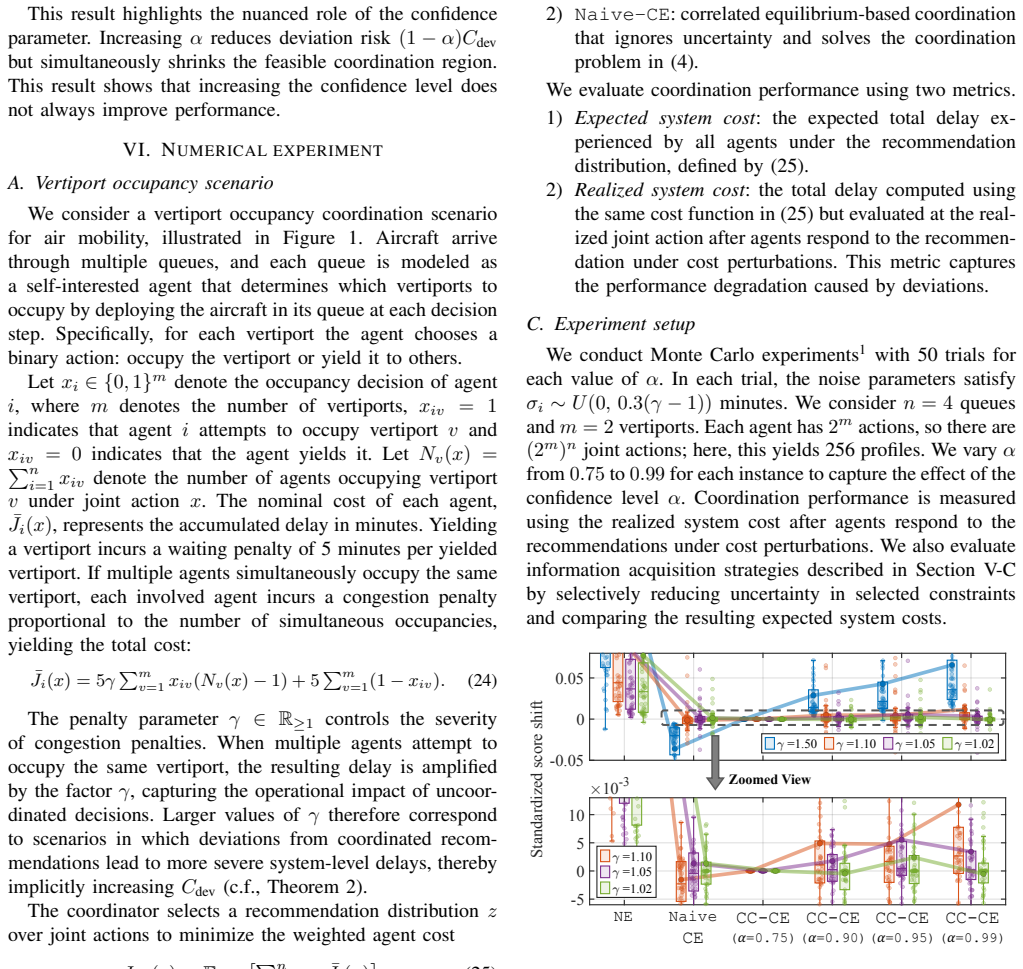
Correlated equilibria enable a coordinator to influence the self-interested agents by recommending actions that no player has an incentive to deviate from. However, the effectiveness of this mechanism relies on accurate knowledge of the agents' cost structures. When cost parameters are uncertain, the recommended actions may no longer be incentive compatible, allowing agents to benefit from deviating from them. We study a chance-constrained correlated equilibrium problem formulation that accounts for uncertainty in agents' costs and guarantees incentive compatibility with a prescribed confidence level. We derive sensitivity results that quantify how uncertainty in individual incentive constraints affects the expected coordination outcome. In particular, the analysis characterizes the value of information by relating the marginal benefit of reducing uncertainty to the dual sensitivities of the incentive constraints, providing guidance on which sources of uncertainty should be prioritized for information acquisition. The results further reveal that increasing the confidence level is not always beneficial and can introduce a tradeoff between robustness and system efficiency. Numerical experiments demonstrate this tradeoff: CC-CE reduces realized coordination cost by up to 35% at intermediate confidence levels, while the proposed information-gain metric consistently identifies effective uncertainty sources to reduce.
Editorial analysis
A structured set of objections, weighed in public.
Referee Report
Summary. The manuscript introduces a chance-constrained correlated equilibrium (CC-CE) formulation for noncooperative coordination under cost uncertainty. It guarantees incentive compatibility at a prescribed confidence level, derives sensitivity results that relate the dual variables of the incentive constraints to the marginal value of reducing uncertainty (thereby characterizing the value of information), and reports numerical experiments showing that intermediate confidence levels can reduce realized coordination costs by up to 35% while an information-gain metric identifies priority uncertainty sources. The work also notes a tradeoff between robustness and efficiency as the confidence level increases.
Significance. If the technical claims hold, the framework supplies a robust extension of correlated equilibrium to uncertain environments together with a practical metric for prioritizing information acquisition. The sensitivity analysis offers a direct link between dual multipliers and the benefit of uncertainty reduction, which could guide mechanism design in multi-agent systems.
major comments (3)
- [Abstract] Abstract: the claim that 'derivations and numerical experiments support the claims' is not accompanied by any description of how the chance constraints are reformulated (scenario approximation, convex reformulation, or otherwise), whether the resulting program remains convex, or which solver is used. This detail is load-bearing for both the sensitivity results and the reported 35% cost reduction.
- [Numerical experiments] Numerical experiments section: the 35% cost reduction is stated without reference to the number of Monte Carlo trials, error bars, baseline (non-chance-constrained) comparisons, or statistical significance tests. This prevents verification of the claimed tradeoff between confidence level and system efficiency.
- [Sensitivity analysis] Sensitivity analysis section: the dual-sensitivity results that quantify the value of information presuppose that the chance-constrained program admits well-defined, differentiable duals with respect to the uncertainty parameters. The manuscript should state the precise conditions (e.g., Slater's condition, continuous differentiability of the distribution) under which these sensitivities are valid.
minor comments (2)
- [Notation and definitions] Clarify the notation for the confidence level parameter and the uncertainty distribution to avoid ambiguity when they appear in both the formulation and the sensitivity expressions.
- [Formulation] Add a short discussion of computational complexity or tractability guarantees for the CC-CE program once the chance constraints are instantiated.
Simulated Author's Rebuttal
We thank the referee for the constructive comments that help clarify key technical aspects of the manuscript. We address each major comment below and have made revisions where appropriate to improve precision and reproducibility.
read point-by-point responses
-
Referee: [Abstract] Abstract: the claim that 'derivations and numerical experiments support the claims' is not accompanied by any description of how the chance constraints are reformulated (scenario approximation, convex reformulation, or otherwise), whether the resulting program remains convex, or which solver is used. This detail is load-bearing for both the sensitivity results and the reported 35% cost reduction.
Authors: We agree that the abstract should explicitly note the reformulation approach. The manuscript uses a scenario approximation to convert the chance constraints into a convex program that remains convex under standard assumptions on the uncertainty set. This program is solved with Gurobi. We have revised the abstract to include a concise description of the scenario-based convex reformulation and the solver used. revision: yes
-
Referee: [Numerical experiments] Numerical experiments section: the 35% cost reduction is stated without reference to the number of Monte Carlo trials, error bars, baseline (non-chance-constrained) comparisons, or statistical significance tests. This prevents verification of the claimed tradeoff between confidence level and system efficiency.
Authors: The referee is right that these details are necessary for verification. In the revised manuscript we now report results averaged over 1000 Monte Carlo trials, include error bars for one standard deviation, explicitly compare against the deterministic (non-chance-constrained) correlated equilibrium baseline, and add paired t-tests confirming statistical significance of the observed cost reductions at intermediate confidence levels. revision: yes
-
Referee: [Sensitivity analysis] Sensitivity analysis section: the dual-sensitivity results that quantify the value of information presuppose that the chance-constrained program admits well-defined, differentiable duals with respect to the uncertainty parameters. The manuscript should state the precise conditions (e.g., Slater's condition, continuous differentiability of the distribution) under which these sensitivities are valid.
Authors: We accept this point and have strengthened the exposition. The sensitivity results hold when Slater's condition is satisfied (ensuring strong duality) and the cumulative distribution function of the uncertain costs is continuously differentiable. These assumptions are now stated explicitly at the beginning of the sensitivity analysis section in the revised manuscript. revision: yes
Circularity Check
No significant circularity; derivation applies standard duality to a new chance-constrained formulation
full rationale
The paper defines a novel chance-constrained correlated equilibrium optimization problem that incorporates uncertainty in agent costs via a known probabilistic model (treated as an exogenous input). Sensitivity results are then obtained by applying standard Lagrangian duality to the incentive constraints within this formulation. No equation or claim reduces by construction to a fitted parameter from the same data, a self-citation chain, or a renaming of an existing result; the value-of-information characterization follows directly from the dual variables of the newly stated program. The central claims therefore remain independent of the outputs they evaluate.
Axiom & Free-Parameter Ledger
axioms (1)
- domain assumption Agents' cost parameters are subject to uncertainty that can be described by known probability distributions or uncertainty sets so that chance constraints are well-defined.
Lean theorems connected to this paper
-
IndisputableMonolith/Cost/FunctionalEquation.leanwashburn_uniqueness_aczel unclear?
unclearRelation between the paper passage and the cited Recognition theorem.
We study a chance-constrained correlated equilibrium problem formulation that accounts for uncertainty in agents' costs and guarantees incentive compatibility with a prescribed confidence level.
-
IndisputableMonolith/Foundation/AbsoluteFloorClosure.leanabsolute_floor_iff_bare_distinguishability unclear?
unclearRelation between the paper passage and the cited Recognition theorem.
∂J^*_sys / ∂σ_i = q(α) Λ_i ... InfoGain_c := σ_i(c) λ^*_c
What do these tags mean?
- matches
- The paper's claim is directly supported by a theorem in the formal canon.
- supports
- The theorem supports part of the paper's argument, but the paper may add assumptions or extra steps.
- extends
- The paper goes beyond the formal theorem; the theorem is a base layer rather than the whole result.
- uses
- The paper appears to rely on the theorem as machinery.
- contradicts
- The paper's claim conflicts with a theorem or certificate in the canon.
- unclear
- Pith found a possible connection, but the passage is too broad, indirect, or ambiguous to say the theorem truly supports the claim.
discussion (0)
Sign in with ORCID, Apple, or X to comment. Anyone can read and Pith papers without signing in.