A parametric signal plus noise inference framework for short duration non-Gaussian noise transients
Pith reviewed 2026-07-01 04:34 UTC · model grok-4.3
The pith
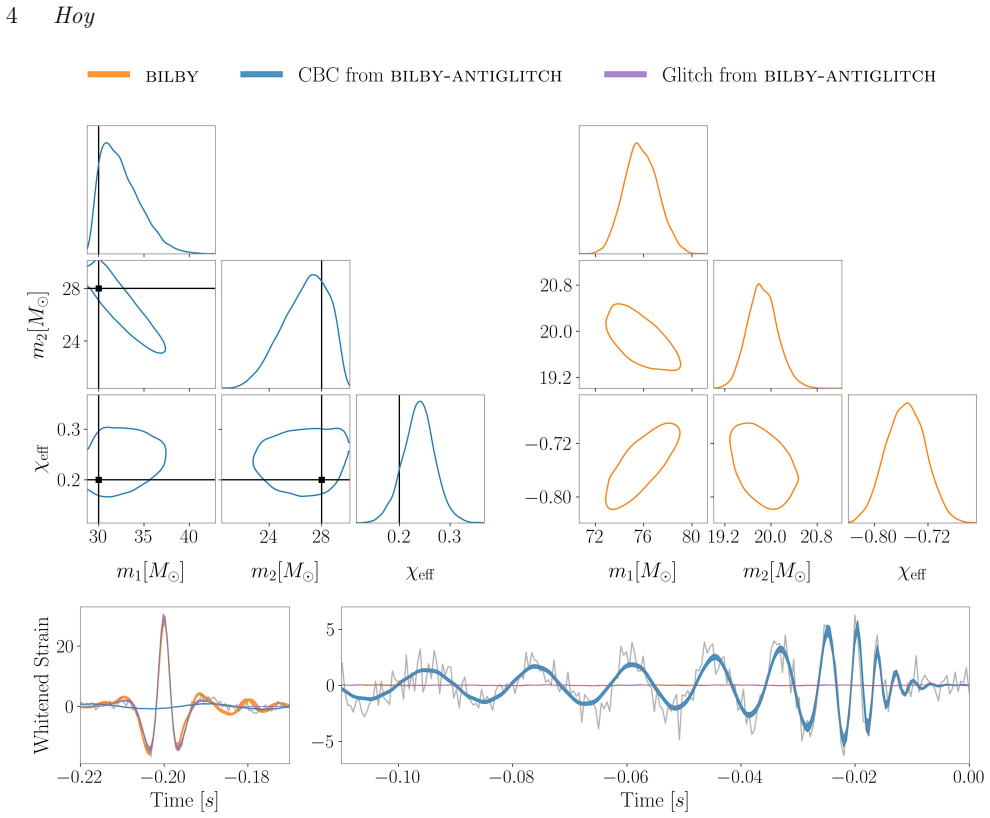
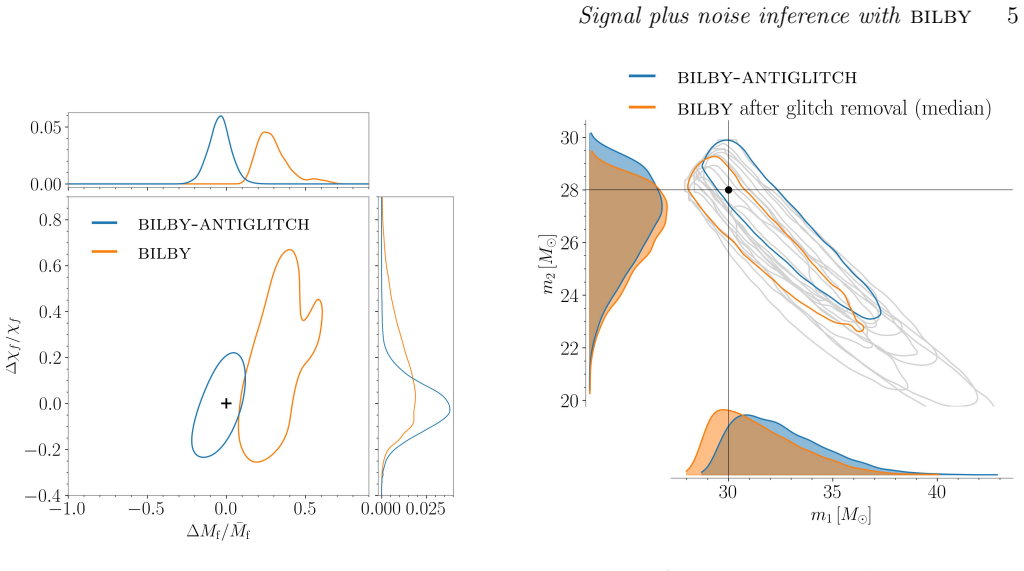
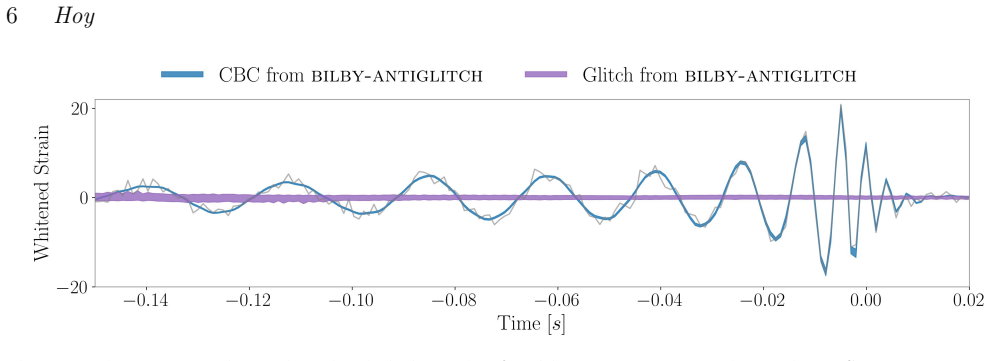
A joint signal-plus-glitch model recovers the true source properties of gravitational waves even when loud noise transients overlap the signal.
A machine-rendered reading of the paper's core claim, the machinery that carries it, and where it could break.
Core claim
By extending the standard Bayesian parameter estimation framework to include a quasi-physical glitch model for short-duration non-Gaussian transients, the analysis infers the true source properties of simulated gravitational wave signals contaminated by loud glitches, whereas conventional techniques that treat the noise as Gaussian produce biased results. The method also prevents false claims of general relativity violations and confirms the exceptional character of the signals in contaminated data.
What carries the argument
The bilby-antiglitch framework, which augments the signal model with a parametric quasi-physical description of short non-Gaussian noise transients that are sampled jointly with the astrophysical parameters.
If this is right
- Source parameters for signals overlapped by loud glitches are recovered without bias.
- False indications that general relativity is violated due to glitch effects are avoided.
- The exceptional nature of genuine gravitational wave signals can be validated even in contaminated data segments.
- Inference remains reliable in realistic detector data that contains short non-Gaussian transients.
Where Pith is reading between the lines
- The same joint modeling approach could be extended to longer-duration or other classes of noise artifacts that currently require separate vetoes.
- Testing on real events where independent evidence confirms the presence of a glitch would show whether the method changes published parameter estimates.
- If the glitch model generalizes across detectors, it could reduce reliance on aggressive data cleaning steps before analysis.
- The framework suggests that explicit noise modeling may become routine rather than an exception in future gravitational wave catalogs.
Load-bearing premise
The chosen quasi-physical glitch model must be flexible enough to describe the actual statistical properties of real noise transients without adding its own systematic biases to the recovered signal parameters.
What would settle it
Apply the method to a set of simulated signals with known true parameters injected into real LIGO data segments that contain verified glitches; if the recovered posterior distributions remain centered on the true values while standard analyses remain biased, the claim holds, otherwise it is falsified.
Figures


read the original abstract
Gravitational waves are now routinely detected with ground-based observatories, and, through a process known as Bayesian inference, their source properties are inferred. However, terrestrial noise artifacts, often referred to as glitches, commonly overlap astrophysical signals. This invalidates a fundamental assumption of gravitational wave analyses: the noise is no longer stationary and Gaussian. As a result, traditional techniques can provide biased inferences in realistic data. One method for mitigating the effect of glitches is to jointly analyse both the signal and noise in a single framework. In this work, we introduce bilby-antiglitch to infer the astrophysical signal properties in non-Gaussian noise. By additionally including a quasi-physical glitch model to describe short duration non-Gaussian noise transients, we show that unlike traditional techniques, we infer the true source properties of simulated signals contaminated with loud glitches. We also show that bilby-antiglitch prevents false violation claims of General Relativity, and validates the exceptional nature of gravitational wave signals in spurious data.
Editorial analysis
A structured set of objections, weighed in public.
Referee Report
Summary. The paper introduces bilby-antiglitch, a Bayesian inference framework extending bilby to jointly model astrophysical gravitational-wave signals and short-duration non-Gaussian noise transients via a quasi-physical parametric glitch model. It claims that, unlike standard analyses assuming stationary Gaussian noise, this approach recovers the true source parameters from simulated signals contaminated by loud glitches and prevents false claims of general-relativity violations.
Significance. If the quasi-physical glitch model generalizes without introducing bias, the framework addresses a recurring practical problem in LIGO/Virgo analyses where glitches overlap signals. The joint signal-plus-noise modeling and software implementation represent a constructive contribution to reproducible data-analysis methods in the field.
major comments (2)
- [Abstract] Abstract: the central claim that true source properties are recovered rests on simulations of signals plus loud glitches, yet supplies no quantitative metrics (bias, credible-interval coverage, or recovery fractions) or error budgets, preventing assessment of whether the improvement over traditional techniques is statistically meaningful.
- [Abstract] Abstract and results sections: the validation uses simulated glitches whose statistical properties are generated from the same quasi-physical parametric family employed in the inference; this leaves open whether recovery would hold for real non-Gaussian transients whose morphology deviates from the model, directly undermining the claim of robustness against realistic data.
minor comments (1)
- Notation for the glitch model parameters is introduced without an explicit equation or table summarizing the functional form and priors; this should be added for reproducibility.
Simulated Author's Rebuttal
We thank the referee for their constructive and detailed report. We address each major comment below and indicate the revisions we will make to the manuscript.
read point-by-point responses
-
Referee: [Abstract] Abstract: the central claim that true source properties are recovered rests on simulations of signals plus loud glitches, yet supplies no quantitative metrics (bias, credible-interval coverage, or recovery fractions) or error budgets, preventing assessment of whether the improvement over traditional techniques is statistically meaningful.
Authors: We agree that the abstract would benefit from explicit quantitative metrics to support the central claim. The manuscript demonstrates parameter recovery primarily through posterior plots and qualitative comparison to standard analyses, but does not report numerical bias values, coverage fractions, or formal error budgets. In the revised version we will add these metrics (e.g., median bias and 68% credible-interval coverage across an ensemble of injections) both in the abstract and in a new results subsection. revision: yes
-
Referee: [Abstract] Abstract and results sections: the validation uses simulated glitches whose statistical properties are generated from the same quasi-physical parametric family employed in the inference; this leaves open whether recovery would hold for real non-Gaussian transients whose morphology deviates from the model, directly undermining the claim of robustness against realistic data.
Authors: This is a substantive limitation of the current validation. The simulations are generated from the same parametric family to establish that the joint inference is unbiased when the glitch model is correctly specified. We will expand the discussion section to explicitly acknowledge the risk of model mismatch for real glitches, include a brief exploration of injected glitches with deliberately altered morphology (e.g., different rise-time or frequency content), and qualify the robustness claims accordingly. Full validation against real LIGO glitches lies beyond the scope of this work and will be noted as future research. revision: partial
Circularity Check
No significant circularity detected
full rationale
The paper presents a new Bayesian inference framework (bilby-antiglitch) that augments standard signal models with an additional quasi-physical glitch model for non-Gaussian transients. All reported results concern recovery of injected signals in simulated data; no derivation chain, fitted parameters, or self-citation is shown that reduces a claimed prediction to an input by construction. The central performance claim is an empirical demonstration on external simulations rather than a self-referential identity, satisfying the default expectation of a non-circular analysis.
Axiom & Free-Parameter Ledger
Reference graph
Works this paper leans on
-
[1]
Accurate modeling and mitigation of overlapping signals and glitches in gravitational-wave data
Hourihane, Sophie and Chatziioannou, Katerina and Wijngaarden, Marcella and Davis, Derek and Littenberg, Tyson and Cornish, Neil. Accurate modeling and mitigation of overlapping signals and glitches in gravitational-wave data. Phys. Rev. D. 2022. doi:10.1103/PhysRevD.106.042006. arXiv:2205.13580
-
[2]
Ashton, Gregory and Thiele, Sarah and Lecoeuche, Yannick and McIver, Jess and Nuttall, Laura K. Parameterised population models of transient non-Gaussian noise in the LIGO gravitational-wave detectors. Class. Quant. Grav. 2022. doi:10.1088/1361-6382/ac8094. arXiv:2110.02689
-
[3]
Gupta, Toral and Cornish, Neil J. Detecting gravitational wave signals using a flexible model for the amplitude and frequency evolution. Phys. Rev. D. 2024. doi:10.1103/PhysRevD.110.064053. arXiv:2404.11719
-
[4]
Cornish, Neil J. and Littenberg, Tyson B. and B \'e csy, Bence and Chatziioannou, Katerina and Clark, James A. and Ghonge, Sudarshan and Millhouse, Margaret. BayesWave analysis pipeline in the era of gravitational wave observations. Phys. Rev. D. 2021. doi:10.1103/PhysRevD.103.044006. arXiv:2011.09494
-
[5]
Enabling high confidence detections of gravitational-wave bursts
Littenberg, Tyson B. and Kanner, Jonah B. and Cornish, Neil J. and Millhouse, Margaret. Enabling high confidence detections of gravitational-wave bursts. Phys. Rev. D. 2016. doi:10.1103/PhysRevD.94.044050. arXiv:1511.08752
work page internal anchor Pith review Pith/arXiv arXiv doi:10.1103/physrevd.94.044050 2016
-
[6]
BayesWave: Bayesian Inference for Gravitational Wave Bursts and Instrument Glitches
Cornish, Neil J. and Littenberg, Tyson B. BayesWave: Bayesian Inference for Gravitational Wave Bursts and Instrument Glitches. Class. Quant. Grav. 2015. doi:10.1088/0264-9381/32/13/135012. arXiv:1410.3835
work page internal anchor Pith review Pith/arXiv arXiv doi:10.1088/0264-9381/32/13/135012 2015
-
[7]
Gaussian processes for glitch-robust gravitational-wave astronomy
Ashton, Gregory. Gaussian processes for glitch-robust gravitational-wave astronomy. Mon. Not. Roy. Astron. Soc. 2023. doi:10.1093/mnras/stad341. arXiv:2209.15547
-
[8]
Remnant of binary black-hole mergers: New simulations and peak luminosity studies
Healy, James and Lousto, Carlos O. Remnant of binary black-hole mergers: New simulations and peak luminosity studies. Phys. Rev. D. 2017. doi:10.1103/PhysRevD.95.024037. arXiv:1610.09713
work page internal anchor Pith review Pith/arXiv arXiv doi:10.1103/physrevd.95.024037 2017
-
[9]
Veitch, J. and others. Parameter estimation for compact binaries with ground-based gravitational-wave observations using the LALInference software library. Phys. Rev. D. 2015. doi:10.1103/PhysRevD.91.042003. arXiv:1409.7215
work page internal anchor Pith review Pith/arXiv arXiv doi:10.1103/physrevd.91.042003 2015
-
[10]
Abbott, B. P. and others. Observation of Gravitational Waves from a Binary Black Hole Merger. Phys. Rev. Lett. 2016. doi:10.1103/PhysRevLett.116.061102. arXiv:1602.03837
work page internal anchor Pith review Pith/arXiv arXiv doi:10.1103/physrevlett.116.061102 2016
-
[11]
Abbott, B. P. and others. Properties of the Binary Black Hole Merger GW150914. Phys. Rev. Lett. 2016. doi:10.1103/PhysRevLett.116.241102. arXiv:1602.03840
work page internal anchor Pith review Pith/arXiv arXiv doi:10.1103/physrevlett.116.241102 2016
-
[12]
Schmidt, Patricia and Ohme, Frank and Hannam, Mark. Towards models of gravitational waveforms from generic binaries II: Modelling precession effects with a single effective precession parameter. Phys. Rev. D. 2015. doi:10.1103/PhysRevD.91.024043. arXiv:1408.1810
work page internal anchor Pith review Pith/arXiv arXiv doi:10.1103/physrevd.91.024043 2015
-
[13]
and Karamanis, Minas and Luo, Yilin and Seljak, Uro s
Williams, Michael J. and Karamanis, Minas and Luo, Yilin and Seljak, Uro s. Validating sequential Monte Carlo for gravitational-wave inference. Mon. Not. Roy. Astron. Soc. 2025. doi:10.1093/mnras/staf1458. arXiv:2506.18977
-
[14]
Ashton, Gregory and Talbot, Colm and Lundgren, Andrew and Malz, Ann-Kristin and Areeda, Joseph. Measuring the rate of glitches in interferometric gravitational wave detectors with a hierarchical Bayesian model. arXiv:2604.16039. 2026. arXiv:2604.16039
work page internal anchor Pith review Pith/arXiv arXiv 2026
-
[15]
Inspiral-merger-ringdown waveforms for black-hole binaries with non-precessing spins
Ajith, P. and others. Inspiral-merger-ringdown waveforms for black-hole binaries with non-precessing spins. Phys. Rev. Lett. 2011. doi:10.1103/PhysRevLett.106.241101. arXiv:0909.2867
work page internal anchor Pith review Pith/arXiv arXiv doi:10.1103/physrevlett.106.241101 2011
-
[16]
Mozzon, S. and Nuttall, L. K. and Lundgren, A. and Dent, T. and Kumar, S. and Nitz, A. H. Dynamic Normalization for Compact Binary Coalescence Searches in Non-Stationary Noise. Class. Quant. Grav. 2020. doi:10.1088/1361-6382/abac6c. arXiv:2002.09407
-
[17]
Journal of the American statistical association , volume=
The monte carlo method , author=. Journal of the American statistical association , volume=. 1949 , publisher=
1949
-
[18]
Abac, A. G. and others. GW250114: Testing Hawking s Area Law and the Kerr Nature of Black Holes. Phys. Rev. Lett. 2025. doi:10.1103/kw5g-d732. arXiv:2509.08054
work page internal anchor Pith review Pith/arXiv arXiv doi:10.1103/kw5g-d732 2025
-
[19]
Abac, A. G. and others. GW241011 and GW241110: Exploring Binary Formation and Fundamental Physics with Asymmetric, High-spin Black Hole Coalescences. Astrophys. J. Lett. 2025. doi:10.3847/2041-8213/ae0d54. arXiv:2510.26931
-
[20]
Incorporation of model accuracy in gravitational wave Bayesian inference
Hoy, Charlie and Akcay, Sarp and Mac Uilliam, Jake and Thompson, Jonathan E. Incorporation of model accuracy in gravitational wave Bayesian inference. Nature Astron. 2025. doi:10.1038/s41550-025-02579-7. arXiv:2409.19404
-
[21]
Prathaban, Metha and Hoy, Charlie and Williams, Michael J. Leveraging rapid parameter estimates for efficient gravitational-wave Bayesian inference via posterior repartitioning. arXiv:2601.21630. 2026. arXiv:2601.21630
-
[22]
Joint inference for gravitational wave signals and glitches using a data-informed glitch model
Malz, Ann-Kristin and Veitch, John. Joint inference for gravitational wave signals and glitches using a data-informed glitch model. Phys. Rev. D. 2025. doi:10.1103/fp4b-mvzx. arXiv:2505.00657
-
[23]
GWTC-5.0: Population Properties of Merging Compact Binaries
The LIGO Scientific, Virgo and KAGRA collaboration. GWTC-5.0: Population Properties of Merging Compact Binaries. arXiv:2605.27226. 2026. arXiv:2605.27226
work page internal anchor Pith review Pith/arXiv arXiv 2026
-
[24]
Gravity Spy: lessons learned and a path forward
Zevin, Michael and others. Gravity Spy: lessons learned and a path forward. Eur. Phys. J. Plus. 2024. doi:10.1140/epjp/s13360-023-04795-4. arXiv:2308.15530
-
[25]
Lecoeuche, Yannick and McIver, Jess and Knee, Alan M. and Udall, Rhiannon and Rink, Katie and Hourihane, Sophie and Miller, Simona J. and Chatziioannou, Katerina and Massinger, TJ and Davis, Derek. Coalescing Compact Binary Parameter Estimation with Gravitational Waves in the Presence of non-Gaussian Transient Noise. arXiv:2604.07668. 2026. arXiv:2604.07668
work page internal anchor Pith review Pith/arXiv arXiv 2026
-
[26]
Inferring the spins of merging black holes in the presence of data-quality issues
Udall, Rhiannon and Bini, Sophie and Chatziioannou, Katerina and Davis, Derek and Hourihane, Sophie and Lecoeuche, Yannick and McIver, Jess and Miller, Simona. Inferring the spins of merging black holes in the presence of data-quality issues. Phys. Rev. D. 2026. doi:10.1103/hyz2-3wxy. arXiv:2510.05029
-
[27]
and Davis, Derek and Dyer, Martin J
Macas, Ronaldas and Pooley, Joshua and Nuttall, Laura K. and Davis, Derek and Dyer, Martin J. and Lecoeuche, Yannick and Lyman, Joseph D. and McIver, Jess and Rink, Katherine. Impact of noise transients on low latency gravitational-wave event localization. Phys. Rev. D. 2022. doi:10.1103/PhysRevD.105.103021. arXiv:2202.00344
-
[28]
Chatziioannou, Katerina and Haster, Carl-Johan and Littenberg, Tyson B. and Farr, Will M. and Ghonge, Sudarshan and Millhouse, Margaret and Clark, James A. and Cornish, Neil. Noise spectral estimation methods and their impact on gravitational wave measurement of compact binary mergers. Phys. Rev. D. 2019. doi:10.1103/PhysRevD.100.104004. arXiv:1907.06540
-
[29]
Transient glitch mitigation in Advanced LIGO data
Merritt, Jonathan and Farr, Ben and Hur, Rachel and Edelman, Bruce and Doctor, Zoheyr. Transient glitch mitigation in Advanced LIGO data. Phys. Rev. D. 2021. doi:10.1103/PhysRevD.104.102004. arXiv:2108.12044
-
[30]
and Mandic, Vuk and Seljak, Uro s and Stergioulas, Nikolaos
Sasli, Argyro and Karamanis, Minas and Karnesis, Nikolaos and Coughlin, Michael W. and Mandic, Vuk and Seljak, Uro s and Stergioulas, Nikolaos. Beyond Gaussian Assumptions: A new robust statistical framework for gravitational-wave data analysis. arXiv:2602.22074. 2026. arXiv:2602.22074
-
[31]
Issues of mismodeling gravitational-wave data for parameter estimation
Edy, Oliver and Lundgren, Andrew and Nuttall, Laura K. Issues of mismodeling gravitational-wave data for parameter estimation. Phys. Rev. D. 2021. doi:10.1103/PhysRevD.103.124061. arXiv:2101.07743
-
[32]
Testing general relativity using golden black-hole binaries
Ghosh, Abhirup and others. Testing general relativity using golden black-hole binaries. Phys. Rev. D. 2016. doi:10.1103/PhysRevD.94.021101. arXiv:1602.02453
work page internal anchor Pith review Pith/arXiv arXiv doi:10.1103/physrevd.94.021101 2016
-
[33]
Abbott, B. P. and others. Tests of general relativity with GW150914. Phys. Rev. Lett. 2016. doi:10.1103/PhysRevLett.116.221101. arXiv:1602.03841
work page internal anchor Pith review Pith/arXiv arXiv doi:10.1103/physrevlett.116.221101 2016
-
[34]
Glanzer, J. and others. Data quality up to the third observing run of advanced LIGO: Gravity Spy glitch classifications. Class. Quant. Grav. 2023. doi:10.1088/1361-6382/acb633. arXiv:2208.12849
-
[35]
Joint inference of gravitational-wave signal and noise glitch
Yin Cheung, Shun and Udall, Rhiannon and Davis, Derek and Lasky, Paul and Thrane, Eric. Joint inference of gravitational-wave signal and noise glitch. In preparation. 2026
2026
-
[36]
and Haster, Carl-Johan and Varma, Vijay and Field, Scott E
Islam, Tousif and Vajpeyi, Avi and Shaik, Feroz H. and Haster, Carl-Johan and Varma, Vijay and Field, Scott E. and Lange, Jacob and O'Shaughnessy, Richard and Smith, Rory. Analysis of GWTC-3 with fully precessing numerical relativity surrogate models. Phys. Rev. D. 2025. doi:10.1103/48ck-2fff. arXiv:2309.14473
-
[37]
Ghosh, Abhirup and Johnson-Mcdaniel, Nathan K. and Ghosh, Archisman and Mishra, Chandra Kant and Ajith, Parameswaran and Del Pozzo, Walter and Berry, Christopher P. L. and Nielsen, Alex B. and London, Lionel. Testing general relativity using gravitational wave signals from the inspiral, merger and ringdown of binary black holes. Class. Quant. Grav. 2018. ...
work page internal anchor Pith review Pith/arXiv arXiv doi:10.1088/1361-6382/aa972e 2018
-
[38]
Rapid and accurate parameter inference for coalescing, precessing compact binaries
Lange, Jacob and O'Shaughnessy, Richard and Rizzo, Monica. Rapid and accurate parameter inference for coalescing, precessing compact binaries. arXiv:1805.10457. 2018. arXiv:1805.10457
work page internal anchor Pith review Pith/arXiv arXiv 2018
-
[39]
Laser Interferometer Space Antenna
Amaro-Seoane, Pau and others. Laser Interferometer Space Antenna. arXiv:1702.00786. 2017. arXiv:1702.00786
work page internal anchor Pith review Pith/arXiv arXiv 2017
-
[40]
and Williams, Natalie and Zimmerman, Aaron
Krishna, Kruthi and Vijaykumar, Aditya and Ganguly, Apratim and Talbot, Colm and Biscoveanu, Sylvia and George, Richard N. and Williams, Natalie and Zimmerman, Aaron. Accelerated parameter estimation in Bilby with relative binning. arXiv:2312.06009. 2023. arXiv:2312.06009
-
[41]
Morisaki, Soichiro. Accelerating parameter estimation of gravitational waves from compact binary coalescence using adaptive frequency resolutions. Phys. Rev. D. 2021. doi:10.1103/PhysRevD.104.044062. arXiv:2104.07813
-
[42]
Heterodyned likelihood for rapid gravitational wave parameter inference
Cornish, Neil J. Heterodyned likelihood for rapid gravitational wave parameter inference. Phys. Rev. D. 2021. doi:10.1103/PhysRevD.104.104054. arXiv:2109.02728
-
[43]
Morisaki, Soichiro and Raymond, Vivien. Rapid Parameter Estimation of Gravitational Waves from Binary Neutron Star Coalescence using Focused Reduced Order Quadrature. Phys. Rev. D. 2020. doi:10.1103/PhysRevD.102.104020. arXiv:2007.09108
-
[44]
Relative Binning and Fast Likelihood Evaluation for Gravitational Wave Parameter Estimation
Zackay, Barak and Dai, Liang and Venumadhav, Tejaswi. Relative Binning and Fast Likelihood Evaluation for Gravitational Wave Parameter Estimation. arXiv:1806.08792. 2018. arXiv:1806.08792
work page internal anchor Pith review Pith/arXiv arXiv 2018
-
[45]
Accelerating gravitational wave parameter estimation with multi-band template interpolation
Vinciguerra, Serena and Veitch, John and Mandel, Ilya. Accelerating gravitational wave parameter estimation with multi-band template interpolation. Class. Quant. Grav. 2017. doi:10.1088/1361-6382/aa6d44. arXiv:1703.02062
work page internal anchor Pith review Pith/arXiv arXiv doi:10.1088/1361-6382/aa6d44 2017
-
[46]
Accelerated gravitational-wave parameter estimation with reduced order modeling
Canizares, Priscilla and Field, Scott E. and Gair, Jonathan and Raymond, Vivien and Smith, Rory and Tiglio, Manuel. Accelerated gravitational-wave parameter estimation with reduced order modeling. Phys. Rev. Lett. 2015. doi:10.1103/PhysRevLett.114.071104. arXiv:1404.6284
work page internal anchor Pith review Pith/arXiv arXiv doi:10.1103/physrevlett.114.071104 2015
-
[47]
Fast Fisher Matrices and Lazy Likelihoods
Cornish, Neil J. Fast Fisher Matrices and Lazy Likelihoods. arXiv:1007.4820. 2010. arXiv:1007.4820
work page internal anchor Pith review Pith/arXiv arXiv 2010
-
[48]
BILBY in space: Bayesian inference for transient gravitational-wave signals observed with LISA
Hoy, Charlie and Nuttall, Laura K. BILBY in space: Bayesian inference for transient gravitational-wave signals observed with LISA. Mon. Not. Roy. Astron. Soc. 2024. doi:10.1093/mnras/stae646. arXiv:2312.13039
-
[49]
Abbott, B. P. and others. Characterization of transient noise in Advanced LIGO relevant to gravitational wave signal GW150914. Class. Quant. Grav. 2016. doi:10.1088/0264-9381/33/13/134001. arXiv:1602.03844
work page internal anchor Pith review Pith/arXiv arXiv doi:10.1088/0264-9381/33/13/134001 2016
-
[50]
Modeling compact binary signals and instrumental glitches in gravitational wave data
Chatziioannou, Katerina and Cornish, Neil and Wijngaarden, Marcella and Littenberg, Tyson B. Modeling compact binary signals and instrumental glitches in gravitational wave data. Phys. Rev. D. 2021. doi:10.1103/PhysRevD.103.044013. arXiv:2101.01200
-
[51]
Ghonge, Sudarshan and Brandt, Joshua and Sullivan, J. M. and Millhouse, Margaret and Chatziioannou, Katerina and Clark, James A. and Littenberg, Tyson and Cornish, Neil and Hourihane, Sophie and Cadonati, Laura. Assessing and mitigating the impact of glitches on gravitational-wave parameter estimation: A model agnostic approach. Phys. Rev. D. 2024. doi:10...
-
[52]
Thorne, K. S. Multipole Expansions of Gravitational Radiation. Rev. Mod. Phys. 1980. doi:10.1103/RevModPhys.52.299
-
[53]
Goldberg, J. N. and MacFarlane, A. J. and Newman, E. T. and Rohrlich, F. and Sudarshan, E. C. G. Spin- s spherical harmonics and. J. Math. Phys. 1967. doi:10.1063/1.1705135
-
[54]
and Cutler, Curt and Sussman, Gerald J
Apostolatos, Theocharis A. and Cutler, Curt and Sussman, Gerald J. and Thorne, Kip S. Spin induced orbital precession and its modulation of the gravitational wave forms from merging binaries. Phys. Rev. D. 1994. doi:10.1103/PhysRevD.49.6274
-
[55]
Improving the Sensitivity of Advanced LIGO Using Noise Subtraction
Davis, D. and Massinger, T. J. and Lundgren, A. P. and Driggers, J. C. and Urban, A. L. and Nuttall, L. K. Improving the Sensitivity of Advanced LIGO Using Noise Subtraction. Class. Quant. Grav. 2019. doi:10.1088/1361-6382/ab01c5. arXiv:1809.05348
work page internal anchor Pith review Pith/arXiv arXiv doi:10.1088/1361-6382/ab01c5 2019
-
[56]
Automatic cross-talk removal from multi-channel data
Allen, Bruce and Hua, Wen-sheng and Ottewill, Adrian C. Automatic cross talk removal from multichannel data. arXiv:gr-qc/9909083. 1999. arXiv:gr-qc/9909083
work page internal anchor Pith review Pith/arXiv arXiv 1999
-
[57]
Mitigation of the instrumental noise transient in gravitational-wave data surrounding GW170817
Pankow, Chris and others. Mitigation of the instrumental noise transient in gravitational-wave data surrounding GW170817. Phys. Rev. D. 2018. doi:10.1103/PhysRevD.98.084016. arXiv:1808.03619
work page internal anchor Pith review Pith/arXiv arXiv doi:10.1103/physrevd.98.084016 2018
-
[58]
Davis, D. and Littenberg, T. B. and Romero-Shaw, I. M. and Millhouse, M. and McIver, J. and Di Renzo, F. and Ashton, G. Subtracting glitches from gravitational-wave detector data during the third LIGO-Virgo observing run. Class. Quant. Grav. 2022. doi:10.1088/1361-6382/aca238. arXiv:2207.03429
-
[59]
Revisiting the evidence for precession in GW200129 with machine learning noise mitigation
Macas, Ronaldas and Lundgren, Andrew and Ashton, Gregory. Revisiting the evidence for precession in GW200129 with machine learning noise mitigation. Phys. Rev. D. 2024. doi:10.1103/PhysRevD.109.062006. arXiv:2311.09921
-
[60]
General-relativistic precession in a black-hole binary
Hannam, Mark and others. General-relativistic precession in a black-hole binary. Nature. 2022. doi:10.1038/s41586-022-05212-z. arXiv:2112.11300
-
[61]
Curious case of GW200129: Interplay between spin-precession inference and data-quality issues
Payne, Ethan and Hourihane, Sophie and Golomb, Jacob and Udall, Rhiannon and Udall, Richard and Davis, Derek and Chatziioannou, Katerina. Curious case of GW200129: Interplay between spin-precession inference and data-quality issues. Phys. Rev. D. 2022. doi:10.1103/PhysRevD.106.104017. arXiv:2206.11932
-
[62]
dynesty: A Dynamic Nested Sampling Package for Estimating Bayesian Posteriors and Evidences
Speagle, Joshua S. dynesty: a dynamic nested sampling package for estimating Bayesian posteriors and evidences. Mon. Not. Roy. Astron. Soc. 2020. doi:10.1093/mnras/staa278. arXiv:1904.02180
work page internal anchor Pith review Pith/arXiv arXiv doi:10.1093/mnras/staa278 2020
-
[63]
Roulet, Javier and Mushkin, Jonathan and Wadekar, Digvijay and Venumadhav, Tejaswi and Zackay, Barak and Zaldarriaga, Matias. Fast marginalization algorithm for optimizing gravitational wave detection, parameter estimation, and sky localization. Phys. Rev. D. 2024. doi:10.1103/PhysRevD.110.044010. arXiv:2404.02435
-
[64]
Sampler-free gravitational wave inference using matrix multiplication
Mushkin, Jonathan and Roulet, Javier and Zackay, Barak and Venumadhav, Tejaswi and Ivashtenko, Oryna and Wadekar, Digvijay and Mehta, Ajit Kumar and Zaldarriaga, Matias. Sampler-free gravitational wave inference using matrix multiplication. Phys. Rev. D. 2025. doi:10.1103/vqj2-7qpz. arXiv:2507.16022
-
[65]
labrador: A domain-optimized machine-learning tool for gravitational wave inference
Roulet, Javier and Crisostomi, Marco and Thomas, Lucy M. and Chatziioannou, Katerina. labrador: A domain-optimized machine-learning tool for gravitational wave inference. arXiv:2604.08897. 2026. arXiv:2604.08897
work page internal anchor Pith review Pith/arXiv arXiv 2026
-
[66]
Biwer, C. M. and Capano, Collin D. and De, Soumi and Cabero, Miriam and Brown, Duncan A. and Nitz, Alexander H. and Raymond, V. PyCBC Inference: A Python-based parameter estimation toolkit for compact binary coalescence signals. Publ. Astron. Soc. Pac. 2019. doi:10.1088/1538-3873/aaef0b. arXiv:1807.10312
work page internal anchor Pith review Pith/arXiv arXiv doi:10.1088/1538-3873/aaef0b 2019
-
[67]
Romero-Shaw, I. M. and others. Bayesian inference for compact binary coalescences with bilby: validation and application to the first LIGO Virgo gravitational-wave transient catalogue. Mon. Not. Roy. Astron. Soc. 2020. doi:10.1093/mnras/staa2850. arXiv:2006.00714
work page internal anchor Pith review Pith/arXiv arXiv doi:10.1093/mnras/staa2850 2020
-
[68]
Bilby: A user-friendly Bayesian inference library for gravitational-wave astronomy
Ashton, Gregory and others. BILBY: A user-friendly Bayesian inference library for gravitational-wave astronomy. Astrophys. J. Suppl. 2019. doi:10.3847/1538-4365/ab06fc. arXiv:1811.02042
work page internal anchor Pith review Pith/arXiv arXiv doi:10.3847/1538-4365/ab06fc 2019
-
[69]
Raymond, Vivien and Al-Shammari, Sama and G. Simulation-based inference for gravitational-waves from intermediate-mass binary black holes in real noise. Mon. Not. Roy. Astron. Soc. 2025. doi:10.1093/mnras/staf1282. arXiv:2406.03935
-
[70]
and Gair, Jonathan and Gupte, Nihar and P
Dax, Maximilian and Green, Stephen R. and Gair, Jonathan and Gupte, Nihar and P. Real-time inference for binary neutron star mergers using machine learning. Nature. 2025. doi:10.1038/s41586-025-08593-z. arXiv:2407.09602
-
[71]
and Gair, Jonathan and Macke, Jakob H
Dax, Maximilian and Green, Stephen R. and Gair, Jonathan and Macke, Jakob H. and Buonanno, Alessandra and Sch. Real-Time Gravitational Wave Science with Neural Posterior Estimation. Phys. Rev. Lett. 2021. doi:10.1103/PhysRevLett.127.241103. arXiv:2106.12594
-
[72]
and Simpson, Christine and Gair, Jonathan
Green, Stephen R. and Simpson, Christine and Gair, Jonathan. Gravitational-wave parameter estimation with autoregressive neural network flows. Phys. Rev. D. 2020. doi:10.1103/PhysRevD.102.104057. arXiv:2002.07656
-
[73]
Green, Stephen R. and Gair, Jonathan. Complete parameter inference for GW150914 using deep learning. Mach. Learn. Sci. Tech. 2021. doi:10.1088/2632-2153/abfaed. arXiv:2008.03312
-
[74]
Gabbard, Hunter and Messenger, Chris and Heng, Ik Siong and Tonolini, Francesco and Murray-Smith, Roderick. Bayesian parameter estimation using conditional variational autoencoders for gravitational-wave astronomy. Nature Phys. 2022. doi:10.1038/s41567-021-01425-7. arXiv:1909.06296
-
[75]
Simple parameter estimation using observable features of gravitational-wave signals
Fairhurst, Stephen and Hoy, Charlie and Green, Rhys and Mills, Cameron and Usman, Samantha A. Simple parameter estimation using observable features of gravitational-wave signals. Phys. Rev. D. 2023. doi:10.1103/PhysRevD.108.082006. arXiv:2304.03731
-
[76]
Pankow, C. and Brady, P. and Ochsner, E. and O'Shaughnessy, R. Novel scheme for rapid parallel parameter estimation of gravitational waves from compact binary coalescences. Phys. Rev. D. 2015. doi:10.1103/PhysRevD.92.023002. arXiv:1502.04370
work page internal anchor Pith review Pith/arXiv arXiv doi:10.1103/physrevd.92.023002 2015
-
[77]
Fast non-Markovian sampler for estimating gravitational-wave posteriors
Tiwari, Vaibhav and Hoy, Charlie and Fairhurst, Stephen and MacLeod, Duncan. Fast non-Markovian sampler for estimating gravitational-wave posteriors. Phys. Rev. D. 2023. doi:10.1103/PhysRevD.108.023001. arXiv:2303.01463
-
[78]
Skilling, John. Nested Sampling. AIP Conf. Proc. 2004. doi:10.1063/1.1835238
-
[79]
Nested sampling for general Bayesian computation
Skilling, John. Nested sampling for general Bayesian computation. Bayesian Analysis. 2006. doi:10.1214/06-BA127
-
[80]
Detection, Measurement and Gravitational Radiation
Finn, Lee S. Detection, measurement and gravitational radiation. Phys. Rev. D. 1992. doi:10.1103/PhysRevD.46.5236. arXiv:gr-qc/9209010
work page internal anchor Pith review Pith/arXiv arXiv doi:10.1103/physrevd.46.5236 1992
discussion (0)
Sign in with ORCID, Apple, or X to comment. Anyone can read and Pith papers without signing in.