FACET: Multi-Agent AI Supporting Teachers in Scaling Differentiated Learning for Diverse Students
Pith reviewed 2026-05-25 07:10 UTC · model grok-4.3
The pith
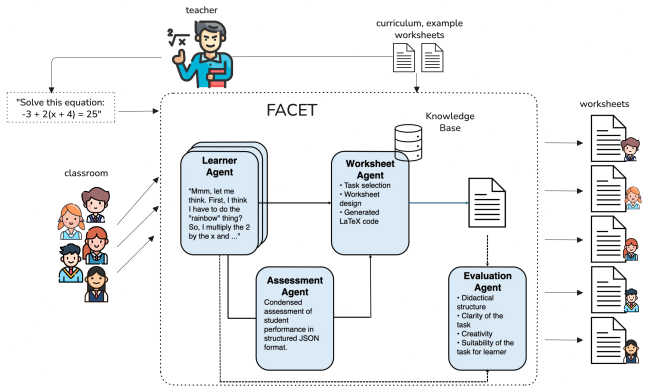
FACET coordinates four AI agents to generate differentiated learning materials that address student motivation, performance, and learning differences while keeping teachers in the decision loop.
A machine-rendered reading of the paper's core claim, the machinery that carries it, and where it could break.
Core claim
The paper claims that a coordinated set of four AI agents—handling learner simulation, diagnostic assessment, material generation, and evaluation—can produce high-quality differentiated learning materials when embedded in a teacher-in-the-loop workflow, as validated by participatory design with principals and quality assessments by teachers.
What carries the argument
The multi-agent framework coordinating learner simulation, diagnostic assessment, material generation, and evaluation agents within a teacher-in-the-loop design.
Load-bearing premise
That positive perceived value from principals and teachers on generated materials will translate into effective differentiation and improved student learning outcomes when deployed in actual classrooms.
What would settle it
A controlled classroom study measuring changes in student achievement or teacher differentiation practices between groups using FACET materials and groups using standard preparation methods.
Figures

read the original abstract
Classrooms are becoming increasingly heterogeneous, comprising learners with diverse performance and motivation levels, language proficiencies, and learning differences such as dyslexia and ADHD. While teachers recognize the need for differentiated instruction, growing workloads create substantial barriers, making differentiated instruction an ideal that is often unrealized in practice. Current AI educational tools, which promise differentiated materials, are predominantly student-facing and performance-centric, ignoring other aspects that shape learning outcomes. We introduce FACET, a teacher-facing multi-agent framework designed to address these gaps by supporting differentiation that accounts for motivation, performance, and learning differences. Developed with educational stakeholders from the outset, the framework coordinates four specialized agents, including learner simulation, diagnostic assessment, material generation, and evaluation within a teacher-in-the-loop design. School principals (N = 30) shaped system requirements through participatory workshops, while in-service K-12 teachers (N = 70) evaluated material quality. Mixed-methods evaluation demonstrates strong perceived value for inclusive differentiation. Practitioners emphasized both the urgent need arising from classroom heterogeneity and the importance of maintaining pedagogical autonomy as a prerequisite for adoption. We discuss implications for future school deployment and outline partnerships for longitudinal classroom implementation.
Editorial analysis
A structured set of objections, weighed in public.
Referee Report
Summary. The manuscript introduces FACET, a teacher-facing multi-agent AI framework to support differentiated instruction in heterogeneous K-12 classrooms. The system coordinates four specialized agents (learner simulation, diagnostic assessment, material generation, and evaluation) in a teacher-in-the-loop design. Requirements were shaped via participatory workshops with 30 school principals, and material quality was evaluated by 70 in-service teachers using mixed methods; the paper concludes that this demonstrates strong perceived value for inclusive differentiation while stressing the need to preserve pedagogical autonomy.
Significance. If the perceptual results translate to classroom practice, the work could contribute to HCI and AIED by modeling how multi-agent systems can incorporate motivation and learning differences beyond performance metrics, with stakeholder co-design as a strength. The current evidence base, however, limits the assessed significance because it stops at perceived material quality without testing downstream effects on instruction or learning.
major comments (1)
- [Abstract and Evaluation] Abstract and Evaluation (mixed-methods results): The central claim that the evaluation 'demonstrates strong perceived value for inclusive differentiation' rests on workshops and quality ratings by principals and teachers. No classroom deployment, student outcome measures, pre/post differentiation metrics, or comparison to baseline teacher practice are reported, which directly bears on whether the system addresses the recognized gap between need and realized practice.
Simulated Author's Rebuttal
We thank the referee for the constructive feedback on the scope of our evaluation. We agree that the current study focuses on perceived value from stakeholder input rather than direct classroom outcomes, and we will revise the manuscript to more explicitly address this distinction while defending the appropriateness of our chosen evaluation approach for this stage of the work.
read point-by-point responses
-
Referee: [Abstract and Evaluation] Abstract and Evaluation (mixed-methods results): The central claim that the evaluation 'demonstrates strong perceived value for inclusive differentiation' rests on workshops and quality ratings by principals and teachers. No classroom deployment, student outcome measures, pre/post differentiation metrics, or comparison to baseline teacher practice are reported, which directly bears on whether the system addresses the recognized gap between need and realized practice.
Authors: The manuscript's central claim is explicitly limited to 'strong perceived value for inclusive differentiation' based on the participatory workshops (N=30 principals) and mixed-methods quality evaluation by 70 in-service teachers; we do not claim to have measured downstream effects on instruction, learning outcomes, or the gap between need and realized practice. This scope aligns with the paper's focus on co-design and initial system validation as a prerequisite for adoption, with explicit discussion of planned longitudinal classroom partnerships. We acknowledge the absence of deployment data or baseline comparisons as a limitation of the current evidence base. We will revise the abstract, evaluation section, and limitations discussion to more clearly separate the demonstrated perceptual results from the need for future studies on actual classroom impact. revision: partial
Circularity Check
No circularity: system description and perception-based evaluation contain no derivations or reductions to inputs.
full rationale
The paper describes a multi-agent framework (FACET) and reports results from participatory workshops (N=30 principals) and material-quality ratings (N=70 teachers). No equations, fitted parameters, predictions, or uniqueness theorems appear. The evaluation claim rests on direct stakeholder input rather than any self-referential chain or renamed prior result. This is a standard non-circular empirical systems paper.
Axiom & Free-Parameter Ledger
axioms (2)
- domain assumption Differentiated instruction is necessary and beneficial in heterogeneous classrooms
- domain assumption Multi-agent coordination can support complex teacher tasks while preserving autonomy
invented entities (4)
-
Learner simulation agent
no independent evidence
-
Diagnostic assessment agent
no independent evidence
-
Material generation agent
no independent evidence
-
Evaluation agent
no independent evidence
Forward citations
Cited by 2 Pith papers
-
LLM-Based Educational Simulation: Evaluating Temporal Student Persona Stability Across ADHD Profiles
LLM-simulated ADHD student personas show stable self-reported traits but behavioral drift in unscripted interactions that explicit task prompts fully eliminate.
-
LLM-Based Educational Simulation: Evaluating Temporal Student Persona Stability Across ADHD Profiles
LLM student personas with ADHD show stable self-reported traits at high intensity but behavioral drift in unscripted interactions that scripted prompts eliminate.
Reference graph
Works this paper leans on
-
[1]
Arriaga, and Adam Tauman Kalai
[Aheret al., 2023 ] Gati Aher, Rosa I. Arriaga, and Adam Tauman Kalai. Using large language models to simulate multiple humans and replicate human subject studies. InProceedings of the 40th International Con- ference on Machine Learning, volume 202 ofICML’23, pages 337–371, Honolulu, Hawaii, USA, July
work page 2023
-
[2]
[Anderson and Krathwohl, 2001] Lorin W
JMLR.org. [Anderson and Krathwohl, 2001] Lorin W. Anderson and David R. Krathwohl.A taxonomy for learning, teaching, and assessing: A revision of Bloom’s taxonomy of edu- cational objectives: complete edition. Addison Wesley Longman, Inc.,
work page 2001
-
[3]
[Bernackiet al., 2021 ] Matthew L. Bernacki, Meghan J. Greene, and Nikki G. Lobczowski. A Systematic Review of Research on Personalized Learning: Personalized by Whom, to What, How, and for What Purpose(s)?Edu- cational Psychology Review, 33(4):1675–1715, December
work page 2021
-
[4]
Carroll, Caroline Holden, Philip Kirby, Paul A
[Carrollet al., 2025 ] Julia M. Carroll, Caroline Holden, Philip Kirby, Paul A. Thompson, Margaret J. Snowling, and the Dyslexia Delphi Panel. Toward a consensus on dyslexia: findings from a Delphi study.Journal of Child Psychology and Psychiatry, 66(7):1065–1076, July
work page 2025
-
[5]
[Danielsonet al., 2024 ] Melissa L. Danielson, Angelika H. Claussen, Rebecca H. Bitsko, Samuel M. Katz, Kimberly Newsome, Stephen J. Blumberg, Michael D. Kogan, and Reem Ghandour. ADHD Prevalence Among U.S. Chil- dren and Adolescents in 2022: Diagnosis, Severity, Co- Occurring Disorders, and Treatment.Journal of Clini- cal Child & Adolescent Psychology, 5...
work page 2024
-
[6]
[Deci and Ryan, 2000] Edward L Deci and Richard M Ryan. The “what” and “why” of goal pursuits: Human needs and the self-determination of behavior.Psychol. Inq., 11(4):227–268, October
work page 2000
-
[7]
A systematic literature review on personalised learning in the higher education context
[Farianiet al., 2022 ] Rida Indah Fariani, Kasiyah Junus, and Harry Budi Santoso. A systematic literature review on personalised learning in the higher education context. Technology, Knowledge and Learning, 28(2):449–476, November
work page 2022
- [8]
-
[9]
arXiv:2506.23774 [cs]. [Gayeet al., 2024 ] Fatou Gaye, Nicole B Groves, Elizabeth S M Chan, Alissa M Cole, Emma M Jaisle, Elia F Soto, and Michael J Kofler. Working memory and math skills in children with and without ADHD.Neuropsychology, 38(1):1–16, January
-
[10]
[Haase and Pokutta, 2025] Jennifer Haase and Sebastian Pokutta. Beyond Static Responses: Multi-Agent LLM Systems as a New Paradigm for Social Science Research, October
work page 2025
-
[11]
Beyond Static Responses: Multi-Agent LLM Systems as a New Paradigm for Social Science Research
arXiv:2506.01839 [cs]. [Habib and Giraud, 2013] Michel Habib and Kimberly Gi- raud. Chapter 23 - dyslexia. In Olivier Dulac, Maryse Lassonde, and Harvey B. Sarnat, editors,Pediatric Neu- rology Part I, volume 111 ofHandbook of Clinical Neu- rology, pages 229–235. Elsevier,
work page internal anchor Pith review Pith/arXiv arXiv 2013
-
[12]
An LLM- Enhanced Multi-agent Architecture for Conversation- Based Assessment
[Houet al., 2025 ] Xinying Hou, Carol Forsyth, Jessica Andrews-Todd, James Rice, Zhiqiang Cai, Yang Jiang, Diego Zapata-Rivera, and Art Graesser. An LLM- Enhanced Multi-agent Architecture for Conversation- Based Assessment. In Alexandra I. Cristea, Erin Walker, Yu Lu, Olga C. Santos, and Seiji Isotani, editors,Artificial Intelligence in Education, volume ...
work page 2025
-
[13]
[Huet al., 2025 ] Bihao Hu, Jiayi Zhu, Yiying Pei, and Xi- aoqing Gu
Series Title: Lecture Notes in Computer Science. [Huet al., 2025 ] Bihao Hu, Jiayi Zhu, Yiying Pei, and Xi- aoqing Gu. Exploring the potential of LLM to enhance teaching plans through teaching simulation.npj Science of Learning, 10(1):7, February
work page 2025
-
[14]
Designing LLM-Agents with Personalities: A Psychometric Approach, October
[Huanget al., 2024 ] Muhua Huang, Xijuan Zhang, Christo- pher Soto, and James Evans. Designing LLM-Agents with Personalities: A Psychometric Approach, October
work page 2024
-
[15]
[Ilkouet al., 2025 ] Eleni Ilkou, Thomai Alexiou, and Olga Viberg
arXiv:2410.19238 [cs]. [Ilkouet al., 2025 ] Eleni Ilkou, Thomai Alexiou, and Olga Viberg. Dyslexia and AI: Do Language Models Align with Dyslexic Style Guide Criteria? InArtificial Intelligence in Education. AIED
-
[16]
[Iseman and Naglieri, 2011] Jackie S Iseman and Jack A Naglieri. A cognitive strategy instruction to improve math calculation for children with ADHD and LD: a random- ized controlled study.J. Learn. Disabil., 44(2):184–195, March
work page 2011
-
[17]
Person- aLLM: Investigating the Ability of Large Language Mod- els to Express Personality Traits
[Jianget al., 2024 ] Hang Jiang, Xiajie Zhang, Xubo Cao, Cynthia Breazeal, Deb Roy, and Jad Kabbara. Person- aLLM: Investigating the Ability of Large Language Mod- els to Express Personality Traits. InFindings of the Associ- ation for Computational Linguistics: NAACL 2024, pages 3605–3627, Mexico City, Mexico,
work page 2024
-
[18]
[Khan Academy, 2025] Khan Academy
Association for Computational Linguistics. [Khan Academy, 2025] Khan Academy. Khan Academy,
work page 2025
-
[19]
Quantifying AI Psychology: A Psychometrics Benchmark for Large Language Models, June
[Liet al., 2024 ] Yuan Li, Yue Huang, Hongyi Wang, Xian- gliang Zhang, James Zou, and Lichao Sun. Quantifying AI Psychology: A Psychometrics Benchmark for Large Language Models, June
work page 2024
-
[20]
arXiv:2406.17675 [cs]. [Liet al., 2025 ] Zhaohui Li, Feiwen Xiao, Jiaju Lin, Xiao- han Zou, Qingxiao Zheng, and Jinjun Xiong. StoryLab: Empowering Personalized Learning for Children Through Teacher-Guided Multimodal Story Generation. InArtifi- cial Intelligence in Education, Cham,
-
[21]
Series Title: Lecture Notes in Computer Science
Springer Na- ture Switzerland. Series Title: Lecture Notes in Computer Science. [Mannekoteet al., 2024 ] Amogh Mannekote, Adam Davies, Jina Kang, and Kristy Elizabeth Boyer. Can LLMs Re- liably Simulate Human Learner Actions? A Simulation Authoring Framework for Open-Ended Learning Environ- ments. InProceedings of Educational Advances in Ar- tificial Inte...
work page 2024
-
[22]
[Montagueet al., 2011 ] Marjorie Montague, Craig Enders, and Samantha Dietz. Effects of cognitive strategy instruc- tion on math problem solving of middle school students with learning disabilities.Learn. Disabil. Q., 34(4):262– 272, November
work page 2011
-
[23]
[Rello and Baeza-Yates, 2013] Luz Rello and Ricardo Baeza-Yates. Good fonts for dyslexia. InProceedings of the 15th International ACM SIGACCESS Conference on Computers and Accessibility, pages 1–8, Bellevue Washington, October
work page 2013
-
[24]
[Schummelet al., 2025 ] Philip Schummel, Malte Teich- mann, and Jana Gonnermann-M¨uller
ACM. [Schummelet al., 2025 ] Philip Schummel, Malte Teich- mann, and Jana Gonnermann-M¨uller. Specifying ten roles of using ChatGPT in secondary education: a teacher’s per- spective. InThirty-Third European Conference on Infor- mation Systems (ECIS 2025), Amman, Jordan,
work page 2025
-
[25]
[Siepmannet al., 2023 ] Philipp Siepmann, Rumlich , Do- minik, Matz , Frauke, , and Ricardo R ¨omhild. At- tention to diversity in German CLIL classrooms: multi- perspective research on students’ and teachers’ percep- tions.International Journal of Bilingual Education and Bilingualism, 26(9):1080–1096, October
work page 2023
-
[26]
eprint: https://doi.org/10.1080/13670050.2021.1981821. [SquirrelAI, 2025] SquirrelAI. Squirrel AI,
-
[27]
[Tomlinson, 2017] Carol Ann Tomlinson. Differentiated In- struction. InFundamentals of Gifted Education. Rout- ledge, 2 edition,
work page 2017
-
[28]
[Wanget al., 2025b ] Yilei Wang, Jiabao Zhao, Deniz S
arXiv:2501.15749 [cs]. [Wanget al., 2025b ] Yilei Wang, Jiabao Zhao, Deniz S. Ones, Liang He, and Xin Xu. Evaluating the ability of large language models to emulate personality.Scientific Reports, 15(1):519, January
-
[29]
International Classification of Diseases (ICD),
[World Health Organisation, 2022] World Health Organisa- tion. International Classification of Diseases (ICD),
work page 2022
-
[30]
[Xuet al., 2020 ] Bing Xu, Nian-Shing Chen, and Guang Chen. Effects of teacher role on student engagement in WeChat-Based online discussion learning.Computers & Education, 157:103956, November
work page 2020
-
[31]
EduAgent: Generative Student Agents in Learning, March
[Xuet al., 2024 ] Songlin Xu, Xinyu Zhang, and Lianhui Qin. EduAgent: Generative Student Agents in Learning, March
work page 2024
-
[32]
arXiv:2404.07963 [cs]. [Xuet al., 2025 ] Songlin Xu, Hao-Ning Wen, Hongyi Pan, Dallas Dominguez, Dongyin Hu, and Xinyu Zhang. Class- room Simulacra: Building Contextual Student Generative Agents in Online Education for Learning Behavioral Sim- ulation. InProceedings of the 2025 CHI Conference on Human Factors in Computing Systems, pages 1–26, April
- [33]
discussion (0)
Sign in with ORCID, Apple, or X to comment. Anyone can read and Pith papers without signing in.