When 2D Tasks Meet 1D Serialization: On Serialization Friction in Structured Tasks
Pith reviewed 2026-05-07 09:08 UTC · model grok-4.3
The pith
Converting 2D structured tasks to 1D text sequences adds a burden that vision pathways avoid.
A machine-rendered reading of the paper's core claim, the machinery that carries it, and where it could break.
Core claim
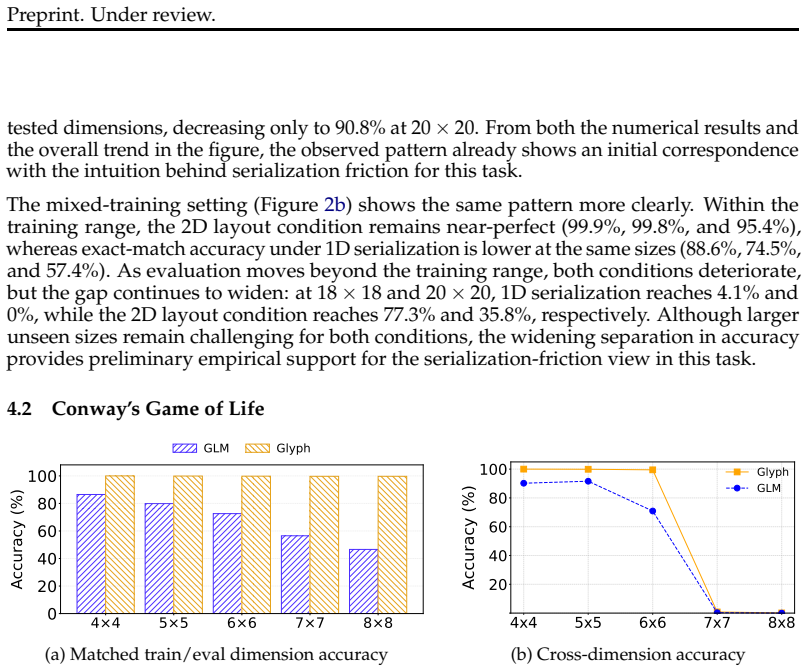
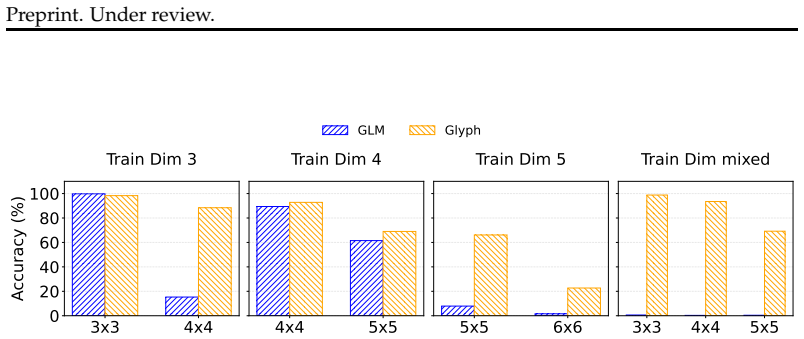
Across matrix transpose, Conway's Game of Life, and LU decomposition, a vision-augmented pathway that receives 2D renderings consistently outperforms a text-only pathway over serialized inputs on the same language backbone. The advantage grows with larger dimensions, and errors under serialization become increasingly spatially structured.
What carries the argument
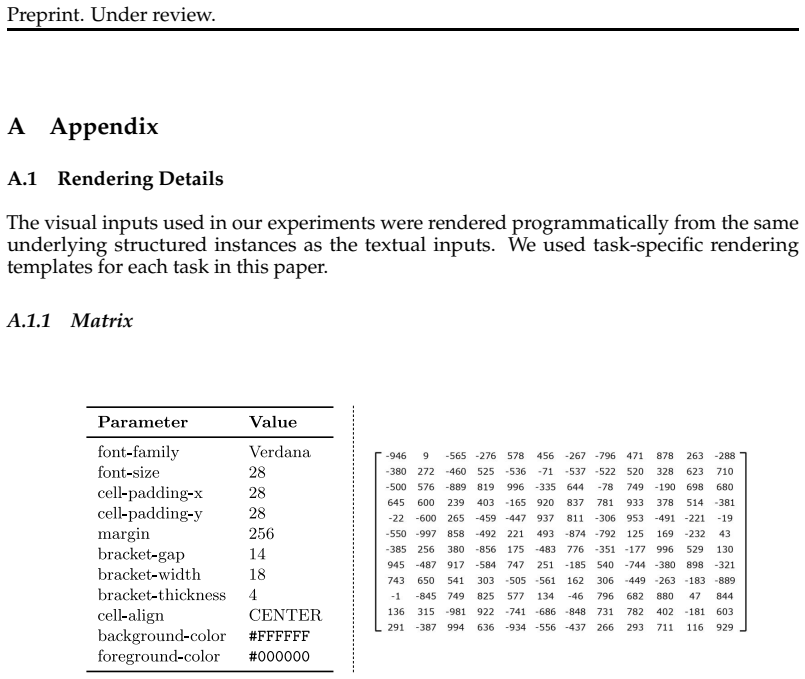
serialization friction, the extra representational load created when 2D row-column alignments and neighborhoods must be inferred from a flattened 1D token sequence instead of being directly visible.
If this is right
- Performance gaps between the two pathways increase as task size grows.
- Textual errors shift toward spatially organized patterns rather than random ones.
- Keeping explicit 2D layout in the input is a promising approach for tasks whose logic depends on spatial structure.
Where Pith is reading between the lines
- Similar friction may appear in other structured domains such as graph algorithms or spreadsheet calculations when forced into linear text.
- Multimodal training that includes 2D renderings could be tested on real-world planning or scientific simulation tasks to measure transfer.
- Future model designs might embed 2D positional encodings directly rather than relying on external vision modules.
Load-bearing premise
That the performance edge of the vision pathway comes mainly from preserving the 2D layout and not from other differences in model architecture or training data.
What would settle it
A controlled experiment in which the text-only pathway matches or surpasses the vision pathway on the same tasks at larger scales, or in which textual errors show no increase in spatial structure.
Figures






read the original abstract
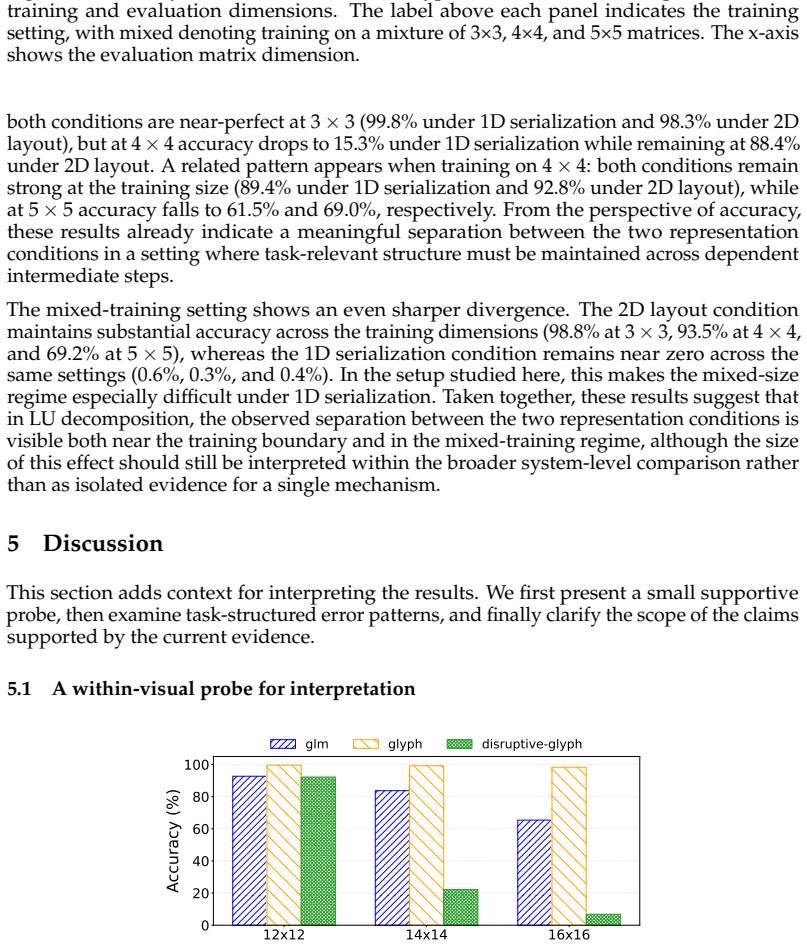
In the LLM era, many symbolic and structured problems are presented to models through 1D text serialization. Yet some such problems are natively two-dimensional: their relevant relations, such as row--column correspondence or spatial adjacency, are defined by position in a 2D layout rather than by sequential order. This raises a representational question: does preserving the same symbolic entries in a 1D sequence also preserve the relational structure needed for computation? We study this issue through the lens of serialization friction: the representational mismatch in which the same underlying task instances and entries are still present, but relations that depend on layout become implicit under 1D serialization. The study uses a controlled synthetic testbed of three tasks: matrix transpose, Conway's Game of Life, and LU decomposition. In each task, the same instances are presented either as 1D text serialization or as their native 2D layout rendered as an image. Across this testbed, 1D serialization degrades more sharply as task size grows, and errors under serialization exhibit spatially structured patterns, suggesting that this presentation choice is consequential within our testbed. To further interpret these results, we add supplementary analyses that include a within-visual probe and an additional comparison of the two input presentations under the mixed-training transpose setting. These findings suggest that, for layout-defined tasks, reducing inputs to 1D serialization is not a neutral choice of representation.
Editorial analysis
A structured set of objections, weighed in public.
Referee Report
Summary. The paper studies 'serialization friction' in LLMs processing structured 2D inputs by comparing a text-only pathway (1D serialized sequences) against a vision-augmented pathway (task-faithful 2D layouts) built on the same language backbone. Using synthetic diagnostic tasks—matrix transpose, Conway's Game of Life, and LU decomposition—it reports that the visual pathway consistently outperforms the textual one, with the gap often widening at larger dimensions and serialization errors becoming increasingly spatially structured.
Significance. If the pathways are shown to be matched in all respects except input representation, the work offers a controlled demonstration that explicit 2D layout preservation can reduce representational burden on spatial tasks. The diagnostic testbed is a strength for isolating effects, and the spatial error analysis provides mechanistic insight. Such findings could guide multimodal architectures for grid-based or matrix reasoning, though the current attribution to layout alone requires stronger controls to be definitive.
major comments (2)
- The abstract states the vision pathway is 'built on the same language backbone' and receives 'task-faithful 2D layout,' but the experimental setup does not specify whether parameter counts, training data, optimization schedules, and integration details (e.g., presence of a separate vision encoder) are identical across pathways. Without these controls, performance differences cannot be isolated to serialization friction versus other factors such as added capacity or inductive biases. This is load-bearing for the central claim of consistent outperformance and widening gaps.
- Results on widening gaps at larger dimensions and spatially structured errors are presented without reported statistical tests, error bars, or ablation on dimension scaling. If these patterns are to support the claim that serialization friction increases with scale, quantitative verification of significance and controls for task-specific difficulty are needed.
minor comments (1)
- The abstract could include a short concrete example of how one task (e.g., a small matrix) is rendered in the 2D pathway versus serialized in the textual pathway to clarify 'task-faithful 2D layout.'
Simulated Author's Rebuttal
We thank the referee for the constructive feedback on our study of serialization friction. The comments highlight important areas for strengthening experimental controls and statistical reporting. We address each major comment below and will incorporate revisions to provide greater clarity and rigor.
read point-by-point responses
-
Referee: The abstract states the vision pathway is 'built on the same language backbone' and receives 'task-faithful 2D layout,' but the experimental setup does not specify whether parameter counts, training data, optimization schedules, and integration details (e.g., presence of a separate vision encoder) are identical across pathways. Without these controls, performance differences cannot be isolated to serialization friction versus other factors such as added capacity or inductive biases. This is load-bearing for the central claim of consistent outperformance and widening gaps.
Authors: We agree that explicit matching of experimental conditions is necessary to isolate the effect of input representation. The manuscript states that the vision-augmented pathway is built on the same language backbone and provides a system-level comparison, but the experimental details section would benefit from additional specification. In the revised manuscript, we will add a table and expanded text detailing parameter counts (noting the lightweight vision encoder addition), identical training data and optimization schedules for the shared backbone, and integration specifics. We will also include capacity-matched text-only baselines to further support attribution to layout preservation rather than capacity differences. revision: yes
-
Referee: Results on widening gaps at larger dimensions and spatially structured errors are presented without reported statistical tests, error bars, or ablation on dimension scaling. If these patterns are to support the claim that serialization friction increases with scale, quantitative verification of significance and controls for task-specific difficulty are needed.
Authors: We acknowledge that the scaling observations and error analyses would be strengthened by statistical verification. The reported trends are based on consistent patterns across dimensions, but we agree single-run results limit robustness. In the revision, we will add error bars from multiple random seeds, report statistical tests (e.g., paired significance tests) for the performance gaps, and include an ablation that scales dimensions while controlling for task difficulty via normalized metrics. This will provide quantitative support for the claim that serialization friction effects intensify with scale. revision: yes
Circularity Check
No circularity in empirical pathway comparison
full rationale
The paper reports experimental results from comparing a text-only language pathway against a vision-augmented pathway on synthetic tasks (matrix transpose, Game of Life, LU decomposition). No mathematical derivation chain, fitted parameters presented as predictions, self-definitional constructs, or load-bearing self-citations appear in the abstract or described methodology. The central finding is a measured performance gap between two input representations, which is self-contained as an empirical observation rather than a result forced by construction or prior author work.
Axiom & Free-Parameter Ledger
axioms (1)
- domain assumption The synthetic tasks (matrix transpose, Conway's Game of Life, LU decomposition) have computations that depend directly on explicit 2D structure such as row-column alignment and local neighborhoods.
discussion (0)
Sign in with ORCID, Apple, or X to comment. Anyone can read and Pith papers without signing in.