A Utility-Driven Bounded-Confidence Model for Opinion Dynamics
Pith reviewed 2026-05-22 02:57 UTC · model grok-4.3
The pith
Opinions with higher utility exert stronger influence, yielding a Gibbs-like distribution for group mean opinion.
A machine-rendered reading of the paper's core claim, the machinery that carries it, and where it could break.
Core claim
We introduce a utility-driven bounded-confidence model of opinion dynamics in which opinions associated with higher utility exert stronger social influence. In the regime where all agents belong to a single opinion cluster, we derive a stochastic differential equation for the mean opinion and show that its stationary distribution is Gibbs-like, with an effective potential determined by the utility landscape and an inverse temperature controlled by the learning rate and the number of agents. For multimodal utility functions, the dynamics exhibit metastability and spontaneous switching between competing opinion states. The reduced stochastic description also captures the evolution and merging.
What carries the argument
The stochastic differential equation for the mean opinion whose stationary distribution is a Gibbs measure with potential given by the utility landscape.
If this is right
- For multimodal utility functions the system shows metastability with spontaneous switches between distinct opinion states.
- The reduced stochastic description reproduces the formation, evolution, and merging of multiple opinion clusters seen in agent-based simulations.
- The inverse temperature of the stationary distribution is set by the learning rate divided by the number of agents.
Where Pith is reading between the lines
- Changing the shape of the utility function could be used to model how external incentives or policies shift the locations and stability of opinion clusters.
- The same reduced equation might be applied to other bounded-confidence settings where influence strength varies with an external field instead of utility.
- Direct comparison with survey data that records both opinions and perceived utilities could test whether real groups exhibit the predicted switching times.
Load-bearing premise
That opinions carrying higher utility exert stronger social influence and that the population remains inside a single cluster long enough for the mean-field derivation to hold.
What would settle it
Run the agent-based model with a known multimodal utility function, collect the long-time histogram of the mean opinion, and check whether it matches the predicted Gibbs distribution within sampling error.
Figures


read the original abstract
We introduce a utility-driven bounded-confidence model of opinion dynamics in which opinions associated with higher utility exert stronger social influence. In the regime where all agents belong to a single opinion cluster, we derive a stochastic differential equation for the mean opinion and show that its stationary distribution is Gibbs-like, with an effective potential determined by the utility landscape and an inverse temperature controlled by the learning rate and the number of agents. For multimodal utility functions, the dynamics exhibit metastability and spontaneous switching between competing opinion states. The reduced stochastic description also captures the evolution and merging of multiple opinion clusters, in agreement with agent-based simulations.
Editorial analysis
A structured set of objections, weighed in public.
Referee Report
Summary. The manuscript introduces a utility-driven bounded-confidence model of opinion dynamics in which opinions with higher utility exert stronger social influence. In the single-cluster regime, the authors derive a stochastic differential equation for the evolution of the mean opinion and establish that its stationary distribution is Gibbs-like, with an effective potential set by the utility landscape and an inverse temperature controlled by the learning rate and agent number. For multimodal utilities the dynamics exhibit metastability and spontaneous switching; the reduced stochastic description is also shown to reproduce the evolution and merging of multiple clusters, in agreement with agent-based simulations.
Significance. If the derivation holds, the work supplies a useful mean-field reduction that connects a utility-modulated bounded-confidence rule to an equilibrium statistical-mechanics description. The explicit Gibbs form and the parameter dependence of the effective temperature provide analytical access to metastability and cluster merging that is otherwise accessible only through large-scale simulation. The reported agreement between the reduced SDE and direct agent-based runs is a concrete strength that supports the practical utility of the approximation for large populations.
major comments (1)
- [Derivation] Derivation section: the transition from the microscopic update rule to the SDE for the mean opinion relies on a mean-field closure that assumes the single-cluster regime persists; an explicit error bound or a quantitative condition on intra-cluster variance relative to the bounded-confidence threshold is needed to delineate the regime of validity of the central claim.
minor comments (2)
- [Model] The precise functional form by which utility rescales the influence weight or the confidence interval should be written as an explicit equation in the model definition to ensure reproducibility.
- [Numerical Results] Simulation figures would benefit from error bars or quantitative discrepancy measures (e.g., Wasserstein distance between cluster histograms) rather than qualitative visual agreement alone.
Simulated Author's Rebuttal
We thank the referee for the careful reading, positive assessment, and recommendation for minor revision. We respond to the major comment below.
read point-by-point responses
-
Referee: Derivation section: the transition from the microscopic update rule to the SDE for the mean opinion relies on a mean-field closure that assumes the single-cluster regime persists; an explicit error bound or a quantitative condition on intra-cluster variance relative to the bounded-confidence threshold is needed to delineate the regime of validity of the central claim.
Authors: We agree that specifying the regime of validity for the mean-field closure is a useful addition. In the revised manuscript we will insert a short paragraph immediately after the SDE derivation that states a practical quantitative condition: the closure holds when the intra-cluster opinion variance satisfies σ ≪ δ, where δ denotes the bounded-confidence threshold. This ensures that the interaction graph within the cluster remains essentially complete. We will also note that this condition is satisfied throughout the single-cluster simulations reported in the paper and can be checked a posteriori in any given run. While a rigorous a-priori error bound would require propagation-of-chaos estimates that lie outside the present scope, the added condition directly addresses the referee’s request for a concrete delineation of validity. revision: yes
Circularity Check
No significant circularity identified
full rationale
The derivation begins from the stated utility-driven bounded-confidence interaction rule and applies standard stochastic approximation methods to obtain an SDE for the mean opinion in the single-cluster regime. The stationary Gibbs-like measure then follows directly from the Fokker-Planck equation associated with that SDE, with the effective potential set by the given utility landscape and temperature parameters controlled by learning rate and agent number. No step reduces by construction to a fitted quantity, self-definition, or load-bearing self-citation; the reduced description is shown to reproduce cluster evolution seen in separate agent-based simulations, confirming the derivation remains independent of its target outputs.
Axiom & Free-Parameter Ledger
axioms (1)
- domain assumption Opinions associated with higher utility exert stronger social influence
Lean theorems connected to this paper
-
IndisputableMonolith/Cost/FunctionalEquation.leanwashburn_uniqueness_aczel echoes?
echoesECHOES: this paper passage has the same mathematical shape or conceptual pattern as the Recognition theorem, but is not a direct formal dependency.
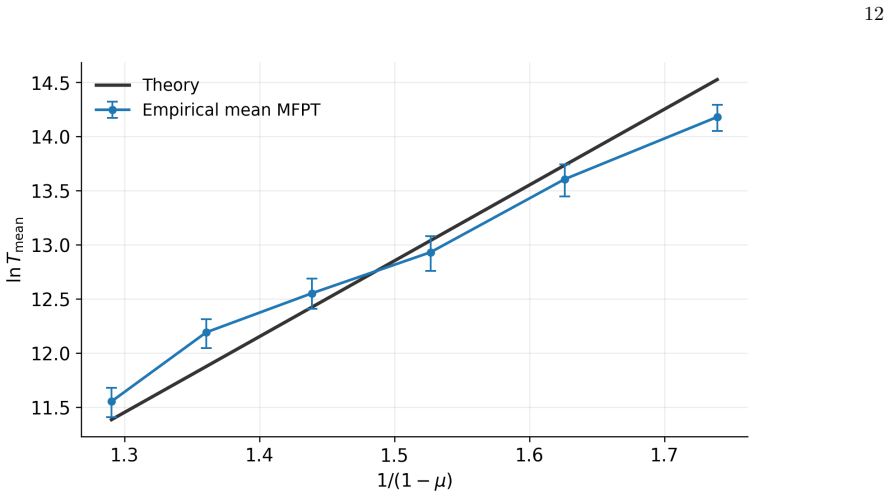
the stationary distribution for the mean opinion is given by p*(x) ∝ U(x)^{N/(1-μ)}, which is a Gibbs distribution for the potential V(x) = -ln(U(x)) with inverse temperature N/(1-μ)
-
IndisputableMonolith/Foundation/AlphaCoordinateFixation.leancostAlphaLog_high_calibrated_iff echoes?
echoesECHOES: this paper passage has the same mathematical shape or conceptual pattern as the Recognition theorem, but is not a direct formal dependency.
drift A(x) ≈ 2μ σ² U'(x)/U(x)
What do these tags mean?
- matches
- The paper's claim is directly supported by a theorem in the formal canon.
- supports
- The theorem supports part of the paper's argument, but the paper may add assumptions or extra steps.
- extends
- The paper goes beyond the formal theorem; the theorem is a base layer rather than the whole result.
- uses
- The paper appears to rely on the theorem as machinery.
- contradicts
- The paper's claim conflicts with a theorem or certificate in the canon.
- unclear
- Pith found a possible connection, but the passage is too broad, indirect, or ambiguous to say the theorem truly supports the claim.
Reference graph
Works this paper leans on
-
[1]
C. A. Bail, L. P. Argyle, T. W. Brown, J. P. Bumpus, H. Chen, M. F. Hunzaker, J. Lee, M. Mann, F. Merhout, and A. Volfovsky, Proceedings of the National Academy of Sciences115, 9216 (2018)
work page 2018
-
[2]
F. Baumann, P. Lorenz-Spreen, I. M. Sokolov, and M. Starnini, Physical Review Letters124, 048301 (2020)
work page 2020
-
[3]
H. Z. Brooks, P. S. Chodrow, and M. A. Porter, SIAM Journal on Applied Dynamical Systems23, 1442 (2024)
work page 2024
-
[4]
S. Bradshaw and P. N. Howard, Journal of International Affairs71, 23 (2018)
work page 2018
-
[5]
J. Lang, W. W. Erickson, and Z. Jing-Schmidt, PloS One 16, e0250817 (2021)
work page 2021
-
[6]
Z. Qiu, B. Espinoza, V. V. Vasconcelos, C. Chen, S. M. Constantino, S. A. Crabtree, L. Yang, A. Vullikanti, J. Chen, J. Weibull,et al., Proceedings of the National Academy of Sciences119, e2123355119 (2022)
work page 2022
- [7]
-
[8]
A. Sˆ ırbu, V. Loreto, V. D. Servedio, and F. Tria, in Participatory sensing, opinions and collective awareness (Springer, 2016) pp. 363–401
work page 2016
-
[9]
A. F. Peralta, J. Kert´ esz, and G. I˜ niguez, inHandbook of Computational Social Science(Edward Elgar Publishing Limited, 2025) pp. 384–406
work page 2025
-
[10]
M. Starnini, F. Baumann, T. Galla, D. Garcia, G. I˜ niguez, M. Karsai, J. Lorenz, and K. Sznajd-Weron, Rev. Mod. Phys. (2026)
work page 2026
-
[11]
Redner, Comptes Rendus Physique20, 275 (2019)
S. Redner, Comptes Rendus Physique20, 275 (2019)
work page 2019
-
[12]
J. R. French Jr, Psychological Review63, 181 (1956)
work page 1956
-
[13]
M. H. DeGroot, Journal of the American Statistical As- sociation69, 118 (1974)
work page 1974
-
[14]
N. E. Friedkin and E. C. Johnsen, Journal of Mathemat- ical Sociology15, 193 (1990)
work page 1990
-
[15]
G. Deffuant, D. Neau, F. Amblard, and G. Weisbuch, Advances in complex systems3, 87 (2000)
work page 2000
-
[16]
R. Hegselmann and U. Krause, Journal of Artificial So- cieties and Social Simulation5(2002)
work page 2002
-
[17]
Lorenz, International Journal of Modern Physics C18, 1819 (2007)
J. Lorenz, International Journal of Modern Physics C18, 1819 (2007)
work page 2007
-
[18]
F. P. Ramsey, inThe Foundations of Mathematics and Other Logical Essays, edited by R. B. Braithwaite (Kegan, Paul, Trench, Tr¨ ubner & Co. and Harcourt, Brace and Company, London and New York, 1931) Chap. VII, pp. 156–198, written in 1926
work page 1931
-
[19]
L. J. Savage,The Foundations of Statistics(John Wiley & Sons, Inc., New York, 1954)
work page 1954
-
[20]
Gardiner,Stochastic methods, Vol
C. Gardiner,Stochastic methods, Vol. 4 (Springer Berlin Heidelberg, 2009). 6 SUPPLEMENTARY MATERIAL Here, we give the derivations for the expressions presented in the main text. We assume that the population remains in a single cluster whose diameter is smaller than the confidence bound, and use the update rule xt+1 i =x t i + 2µ U t j U t i +U t j (xt j ...
work page 2009
discussion (0)
Sign in with ORCID, Apple, or X to comment. Anyone can read and Pith papers without signing in.