Detectability of secondary images from flares near Sgr A* with mock GRAVITY data
Pith reviewed 2026-06-28 00:30 UTC · model grok-4.3
The pith
The signature of secondary images from Sgr A* flares becomes detectable in mock GRAVITY data only when sample sizes grow by an order of magnitude and astrometric errors fall to 40 percent of current levels.
A machine-rendered reading of the paper's core claim, the machinery that carries it, and where it could break.
Core claim
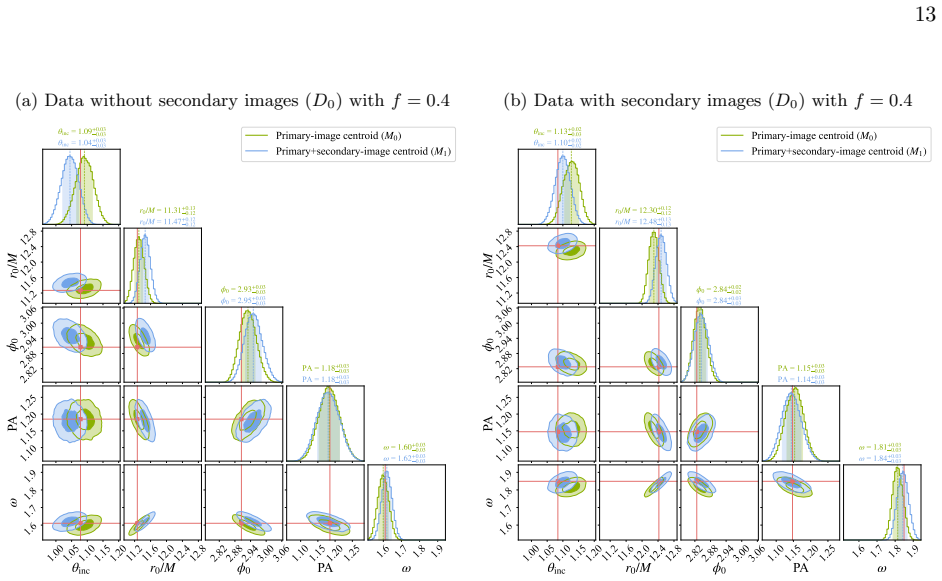
Fitting two centroid models to mock GRAVITY data shows that the model including flux-weighted primary plus secondary images is statistically preferred over the primary-only model with |ΔBIC| > 7.9 only when the number of observations increases by a factor of ten and the astrometric uncertainties shrink to 40 percent of present GRAVITY values.
What carries the argument
Bayesian Information Criterion (BIC) comparison between a primary-image-only centroid model and a flux-weighted primary-plus-secondary-image centroid model applied to mock flare tracks.
If this is right
- Secondary images originate from strong-field gravitational lensing and are less affected by accretion-flow details than primary images.
- Detecting them marks the first step toward observing higher-order images and photon rings around Sgr A*.
- The result supplies an independent probe of the spacetime geometry near the black hole.
- The same modeling approach can be applied once actual future GRAVITY data become available.
Where Pith is reading between the lines
- If secondary images are detected, the same data set could be used to place limits on black-hole spin or deviation from Kerr geometry beyond what primary-image tracks alone allow.
- The required precision gain points to the value of combining GRAVITY with additional VLTI baselines or next-generation interferometers.
- Similar centroid analysis might be tested on flares around other supermassive black holes once comparable astrometric accuracy is reached.
Load-bearing premise
The mock data correctly reproduce the flux-weighted positions of primary and secondary images without dominant unmodeled systematics from the accretion flow or instrument.
What would settle it
Real GRAVITY observations with ten times more points and 40 percent smaller astrometric errors that still yield |ΔBIC| below 7.9 would show the secondary-image signature cannot be distinguished under the paper's modeling assumptions.
Figures

read the original abstract
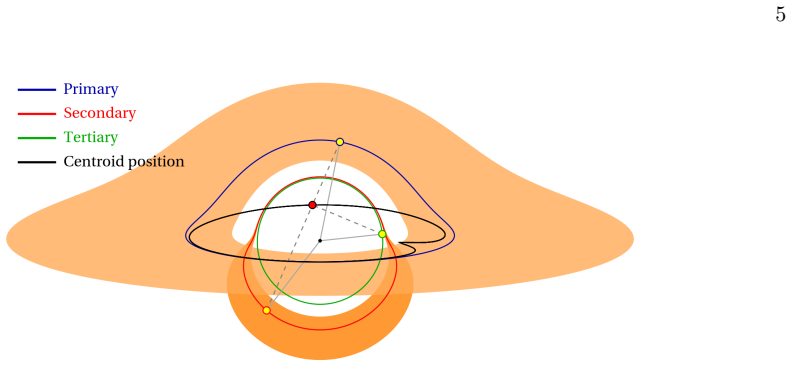
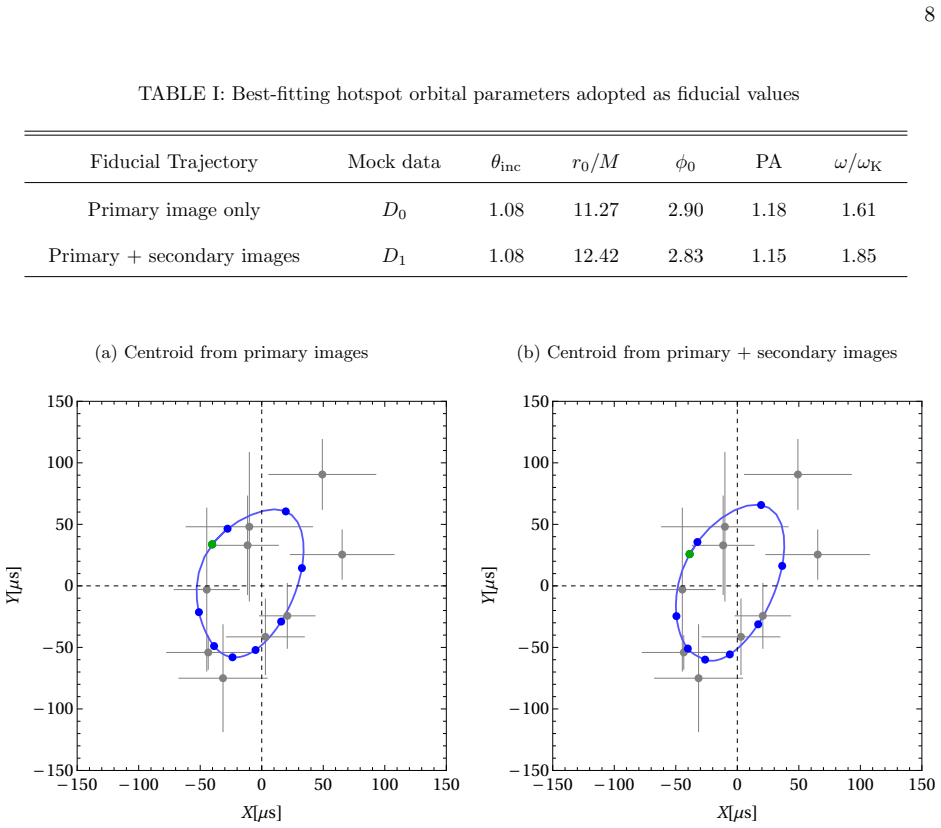
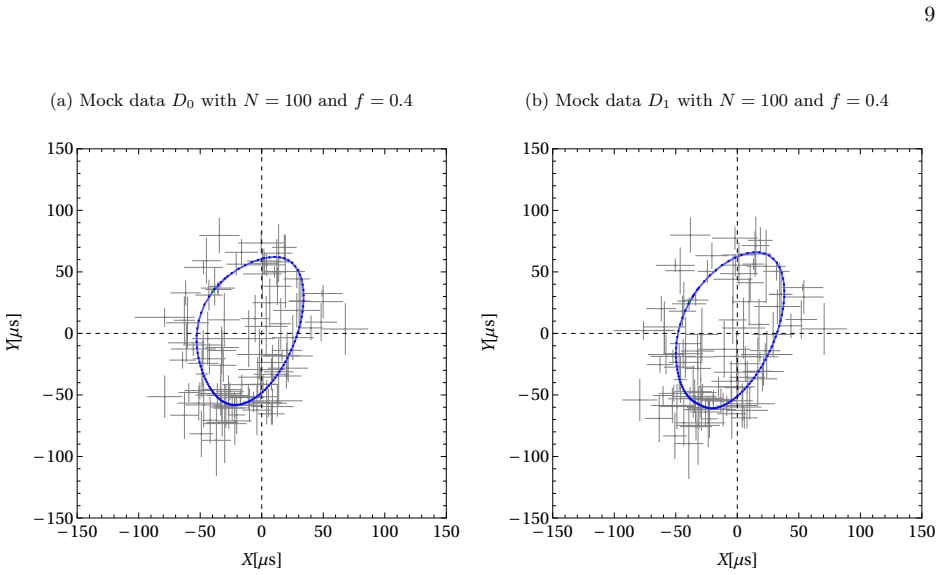
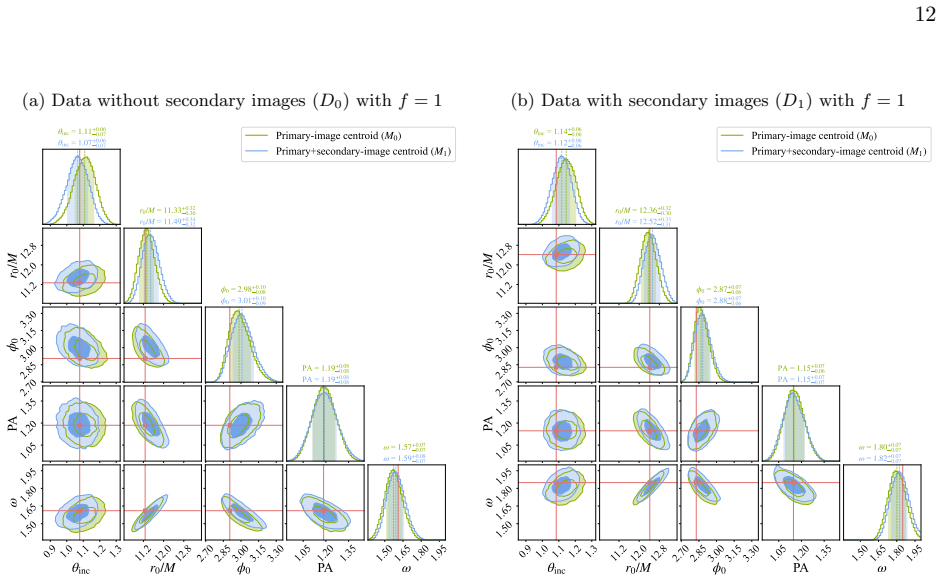
The orbital motion of near-infrared flares reported by the GRAVITY collaboration encodes information about both the dynamics of accretion matter and the underlying spacetime geometry. The centroid track of these flares, which corresponds to the flux-weighted center of light, incorporates contributions from primary, secondary and higher-order images. Thus, it potentially indicates distinctive signatures of the spacetime geometry, even when these individual multiple images remain unresolved. In this study, we explore the detectability of the secondary images from flares orbiting Sgr A* through mock data simulating future GRAVITY observations. Specifically, we compare the model in which the centroid coincides with the track of the primary images with another model in which the centroid incorporates flux-weighted contributions from both the primary and secondary images. Fitting these models to the mock data based on Bayesian framework, we quantify the conditions under which the signature of secondary images can be statistically distinguishable. We demonstrate that increasing the sample size by an order of magnitude alone could not yield strong evidence for distinguishing the secondary image. Robust detectability ($|\Delta\text{BIC}| >7.9$) is achieved when both with the improved sample size and astrometric uncertainties reduced to 40\% of current uncertainties of GRAVITY astrometric data. Unlike the primary image, which is dominated by accretion flow physics, the secondary images originate from gravitational lensing in the strong-field regime. Their detection is an essential first step toward probing higher-order images and the photon rings.
Editorial analysis
A structured set of objections, weighed in public.
Referee Report
Summary. The paper claims that Bayesian model comparison (via BIC) on mock GRAVITY astrometric data for Sgr A* flares can distinguish a primary-image-only centroid model from a primary+secondary flux-weighted model. An order-of-magnitude increase in sample size alone is insufficient for strong evidence, but combining it with astrometric uncertainties reduced to 40% of current GRAVITY values yields robust detectability (|ΔBIC| > 7.9). This is positioned as a first step toward probing strong-field lensing and photon rings.
Significance. If the mock-data assumptions hold, the work supplies a concrete observational requirement (sample size ×10 and 40% precision improvement) for detecting secondary-image signatures in flare centroid tracks, which would be a useful benchmark for planning future GRAVITY campaigns. The Bayesian/BIC framework is a standard and appropriate choice for quantifying model distinguishability in this setting.
major comments (2)
- [Abstract] Abstract: The central claim that |ΔBIC| > 7.9 is achieved only with both increased sample size and 40% uncertainty reduction rests on mock data generated from the secondary-inclusive model. No tests are described for whether adjustments to the primary image's radial emissivity profile or time-dependent brightness distribution allow the primary-only model to partially absorb the secondary contribution, which directly affects whether the reported threshold remains robust.
- [Methods] Methods (mock generation): The flux-weighted centroid calculation assumes a fixed spacetime geometry and flare properties with no unmodeled primary-image variability or higher-order effects. Without explicit sensitivity runs varying these inputs, the distinguishability thresholds cannot be shown to survive realistic systematics that the primary-only fit could exploit.
minor comments (2)
- The abstract states that sample size increase alone is insufficient but does not quote the actual |ΔBIC| values obtained in that case; adding these numbers would make the comparison with the combined-improvement case clearer.
- Notation for the BIC difference and the precise definition of 'robust detectability' (|ΔBIC| > 7.9) should be stated explicitly in the text rather than only in the abstract.
Simulated Author's Rebuttal
We thank the referee for the constructive report and for recognizing the potential utility of the Bayesian framework for planning GRAVITY observations. We address the two major comments below and have revised the manuscript to strengthen the robustness discussion.
read point-by-point responses
-
Referee: [Abstract] Abstract: The central claim that |ΔBIC| > 7.9 is achieved only with both increased sample size and 40% uncertainty reduction rests on mock data generated from the secondary-inclusive model. No tests are described for whether adjustments to the primary image's radial emissivity profile or time-dependent brightness distribution allow the primary-only model to partially absorb the secondary contribution, which directly affects whether the reported threshold remains robust.
Authors: The two models compared in the paper are deliberately defined with identical flare properties and emissivity profiles except for the explicit inclusion (or exclusion) of the secondary-image flux contribution to the centroid. This isolates the lensing signature under the stated assumptions. Allowing the primary-only model to freely vary its radial emissivity or introduce additional time dependence would constitute a different model comparison, one that is outside the scope of the current study. We agree, however, that such degeneracies merit explicit discussion. We have added a paragraph to the Discussion section acknowledging this limitation and noting that the reported thresholds should be viewed as a baseline under fixed emissivity assumptions. No revision to the numerical results or abstract claim is required. revision: partial
-
Referee: [Methods] Methods (mock generation): The flux-weighted centroid calculation assumes a fixed spacetime geometry and flare properties with no unmodeled primary-image variability or higher-order effects. Without explicit sensitivity runs varying these inputs, the distinguishability thresholds cannot be shown to survive realistic systematics that the primary-only fit could exploit.
Authors: The mock-generation procedure follows the fixed geometry and flare parameters described in Section 2 to establish the minimum observational requirements under those conditions. We accept that unmodeled variability could in principle be absorbed by the primary-only fit. To quantify this, we have performed additional sensitivity runs in which the primary-image brightness is allowed modest time-dependent fluctuations (consistent with observed flare variability) and higher-order images are included at low amplitude. These runs, now reported in a new Appendix, confirm that the requirement for both an order-of-magnitude increase in sample size and a 40 % reduction in astrometric uncertainty remains necessary to reach |ΔBIC| > 7.9. The revised manuscript incorporates these tests. revision: yes
Circularity Check
No significant circularity; mock-based distinguishability test is self-contained
full rationale
The paper generates mock GRAVITY data from a full primary+secondary image model and performs BIC model comparison against a primary-only model. This is a standard forward-simulation test of statistical distinguishability under stated assumptions; the reported |ΔBIC| threshold does not reduce to any fitted parameter or self-citation by construction. No load-bearing self-citations, ansatzes smuggled via citation, or self-definitional steps are present. The analysis is externally falsifiable via the mock generation procedure itself.
Axiom & Free-Parameter Ledger
axioms (1)
- domain assumption The centroid track incorporates flux-weighted contributions from primary and secondary images
Reference graph
Works this paper leans on
-
[1]
The Galactic Center Massive Black Hole and Nuclear Star Cluster
R. Genzel, F. Eisenhauer, and S. Gillessen, Rev. Mod. Phys.82, 3121 (2010), arXiv:1006.0064 [astro- ph.GA]
work page internal anchor Pith review Pith/arXiv arXiv 2010
-
[2]
R. Abuteret al.(GRAVITY), Astron. Astrophys.657, L12 (2022), arXiv:2112.07478 [astro-ph.GA]
-
[3]
Genzel, (2021), arXiv:2102.13000 [astro-ph.GA]
R. Genzel, (2021), arXiv:2102.13000 [astro-ph.GA]
-
[4]
A. M. Ghez, S. Salim, S. D. Hornstein, A. Tanner, M. Morris, E. E. Becklin, and G. Duchene, Astrophys. J.620, 744 (2005), arXiv:astro-ph/0306130
work page internal anchor Pith review Pith/arXiv arXiv 2005
-
[5]
K. Akiyamaet al.(Event Horizon Telescope), Astrophys. J. Lett.930, L12 (2022), arXiv:2311.08680 [astro-ph.HE]
work page internal anchor Pith review Pith/arXiv arXiv 2022
-
[6]
Akiyamaet al.(Event Horizon Telescope), Astrophys
K. Akiyamaet al.(Event Horizon Telescope), Astrophys. J. Lett.930, L14 (2022), arXiv:2311.09479 [astro-ph.HE]
-
[7]
V. Perlick and O. Y. Tsupko, Phys. Rept.947, 1 (2022), arXiv:2105.07101 [gr-qc]
-
[8]
S. Vagnozziet al., Class. Quant. Grav.40, 165007 (2023), arXiv:2205.07787 [gr-qc]
work page internal anchor Pith review Pith/arXiv arXiv 2023
- [9]
- [10]
- [11]
- [12]
-
[13]
Z. Chang and Q.-H. Zhu, JCAP09, 003 (2021), arXiv:2104.14221 [gr-qc]
- [14]
-
[15]
He, J.-T
K.-J. He, J.-T. Yao, X. Zhang, and X. Li, Phys. Rev. D109, 064049 (2024)
2024
-
[16]
Bertotti, L
B. Bertotti, L. Iess, and P. Tortora, Nature425, 374 (2003)
2003
-
[17]
C. M. Will, Living Rev. Rel.17, 4 (2014), arXiv:1403.7377 [gr-qc]
work page internal anchor Pith review Pith/arXiv arXiv 2014
-
[18]
General relativistic effects on the orbit of the S2 star with GRAVITY
M. Grould, F. H. Vincent, T. Paumard, and G. Perrin, Astron. Astrophys.608, A60 (2017), arXiv:1709.04492 [astro-ph.HE]
work page internal anchor Pith review Pith/arXiv arXiv 2017
-
[19]
R. Abuteret al.(GRAVITY), Astron. Astrophys.615, L15 (2018), arXiv:1807.09409 [astro-ph.GA]
work page internal anchor Pith review Pith/arXiv arXiv 2018
-
[20]
Doet al., Science365, 664 (2019), arXiv:1907.10731 [astro-ph.GA]
T. Doet al., Science365, 664 (2019), arXiv:1907.10731 [astro-ph.GA]
-
[21]
R. Abuteret al.(GRAVITY), Astron. Astrophys.636, L5 (2020), arXiv:2004.07187 [astro-ph.GA]
-
[22]
Yao and X
J.-T. Yao and X. Li, Phys. Rev. D113, 084003 (2026)
2026
-
[23]
Narayan and E
R. Narayan and E. Quataert, Nature615, 597 (2023)
2023
- [24]
-
[25]
A. Galishnikova, A. Philippov, E. Quataert, F. Bacchini, K. Parfrey, and B. Ripperda, Phys. Rev. Lett.130, 115201 (2023), arXiv:2212.02583 [astro-ph.HE]
-
[26]
Detection of orbital motions near the last stable circular orbit of the massive black hole SgrA*
R. Abuteret al., Astron. Astrophys.618(2018), 10.1051/0004-6361/201834294, arXiv:1810.12641 [astro-ph.GA]
work page internal anchor Pith review Pith/arXiv arXiv doi:10.1051/0004-6361/201834294 2018
-
[27]
R. Abuteret al.(GRAVITY), Astron. Astrophys.677, L10 (2023), arXiv:2307.11821 [astro-ph.GA]
-
[28]
R. Kumar Walia, P. Kocherlakota, D. O. Chang, and K. Salehi, Phys. Rev. D111, 104074 (2025), arXiv:2411.15119 [gr-qc]
-
[29]
C.-Y. Chen, C.-M. Chen, and N. Ohta, Phys. Rev. D113, 044044 (2026), arXiv:2510.00708 [gr-qc]
-
[30]
R. Capobianco, B. Hartmann, N. Vas, J. Kunz, and J. Novo, Phys. Rev. D113, 064053 (2026), arXiv:2510.01937 [gr-qc]
- [31]
-
[32]
Perlick, Living Rev
V. Perlick, Living Rev. Rel.7, 9 (2004)
2004
-
[33]
Gravitational Lensing by Black Holes
V. Bozza, Gen. Rel. Grav.42, 2269 (2010), arXiv:0911.2187 [gr-qc]
work page internal anchor Pith review Pith/arXiv arXiv 2010
-
[34]
S. E. Gralla, D. E. Holz, and R. M. Wald, Phys. Rev. D100, 024018 (2019), arXiv:1906.00873 [astro- ph.HE]
work page internal anchor Pith review Pith/arXiv arXiv 2019
- [35]
- [36]
-
[37]
S. S. Doeleman, J. Barrett, L. Blackburn, K. L. Bouman, A. E. Broderick, R. Chaves, V. L. Fish, G. Fitzpatrick, M. Freeman, A. Fuentes,et al., Galaxies11, 107 (2023)
2023
-
[38]
V. Deliyski, G. Gyulchev, P. Nedkova, and S. Yazadjiev, Phys. Rev. D111, 064068 (2025), 18 arXiv:2401.14092 [gr-qc]
-
[39]
M. D. Johnson, K. Akiyama, R. Baturin, B. Bilyeu, L. Blackburn, D. Boroson, A. C´ ardenas-Avenda˜ no, A. Chael, C.-k. Chan, D. Chang,et al., inSpace Telescopes and Instrumentation 2024: Optical, Infrared, and Millimeter Wave, Vol. 13092 (SPIE, 2024) pp. 821–872
2024
- [40]
- [41]
-
[42]
Shadow of the Scalar Hairy Black Hole with Inverted Higgs Potential
K.-G. Lim and X. Y. Chew, Phys. Rev. D111, 084085 (2025), arXiv:2501.07029 [gr-qc]
work page internal anchor Pith review Pith/arXiv arXiv 2025
-
[43]
K. Kobialko and D. Gal’tsov, Phys. Rev. D113, 104007 (2026), arXiv:2512.24126 [gr-qc]
- [44]
-
[45]
Lupsasca, D
A. Lupsasca, D. R. Mayerson, B. Ripperda, and S. Staelens, inRecent Progress on Gravity Tests: Challenges and Future Perspectives(Springer, 2024) pp. 183–237
2024
-
[46]
H. Yin, S. Chen, and J. Jing, JCAP04, 071 (2026), arXiv:2507.03857 [gr-qc]
work page internal anchor Pith review Pith/arXiv arXiv 2026
-
[47]
F. H. Vincent, Z. Meliani, P. Grandclement, E. Gourgoulhon, and O. Straub, Class. Quant. Grav.33, 105015 (2016), arXiv:1510.04170 [gr-qc]
work page internal anchor Pith review Pith/arXiv arXiv 2016
-
[48]
H. Olivares, Z. Younsi, C. M. Fromm, M. De Laurentis, O. Porth, Y. Mizuno, H. Falcke, M. Kramer, and L. Rezzolla, Mon. Not. Roy. Astron. Soc.497, 521 (2020), arXiv:1809.08682 [gr-qc]
-
[49]
N. Sakai, H. Saida, and T. Tamaki, Phys. Rev. D90, 104013 (2014), arXiv:1408.6929 [gr-qc]
work page internal anchor Pith review Pith/arXiv arXiv 2014
-
[50]
Nakao, C.-M
K.-i. Nakao, C.-M. Yoo, and T. Harada, Phys. Rev. D99, 044027 (2019)
2019
-
[51]
R. Shaikh, Phys. Rev. D98, 024044 (2018), arXiv:1803.11422 [gr-qc]
work page internal anchor Pith review Pith/arXiv arXiv 2018
- [52]
- [53]
- [54]
-
[55]
First M87 Event Horizon Telescope Results. I. The Shadow of the Supermassive Black Hole
K. Akiyamaet al.(Event Horizon Telescope), Astrophys. J. Lett.875, L1 (2019), arXiv:1906.11238 [astro-ph.GA]
work page internal anchor Pith review Pith/arXiv arXiv 2019
- [56]
- [57]
- [58]
- [59]
-
[60]
A. C´ ardenas-Avenda˜ no, C. Gammie, and A. Lupsasca, Phys. Rev. Lett.133, 131402 (2024), arXiv:2406.04176 [astro-ph.HE]. 19
- [61]
- [62]
- [63]
- [64]
-
[65]
Abuter, M
R. Abuter, M. Accardo, A. Amorim,et al., Astron. Astrophys.602, A94 (2017)
2017
- [66]
-
[67]
T. Matsumoto, C.-H. Chan, and T. Piran, Mon. Not. Roy. Astron. Soc.497, 2385 (2020), arXiv:2004.13029 [astro-ph.HE]
-
[68]
E. Antonopoulou and A. Nathanail, Astron. Astrophys.690, A240 (2024), arXiv:2405.10115 [astro- ph.HE]
-
[69]
Baub¨ ocket al.(GRAVITY), Astron
M. Baub¨ ocket al.(GRAVITY), Astron. Astrophys.635, A143 (2020), arXiv:2002.08374 [astro-ph.HE]
- [70]
-
[71]
X. Wang, Z. Zhang, H.-Q. Zhang, M. Guo, and B. Chen, (2026), arXiv:2604.21883 [astro-ph.HE]
work page internal anchor Pith review Pith/arXiv arXiv 2026
- [72]
-
[73]
Bao, Astron
G. Bao, Astron. Astrophys.257, 594 (1992)
1992
-
[74]
G. Bao, P. Hadrava, and E. Ostgaard, Astrophys. J.425, 63 (1994)
1994
-
[75]
I. El Mellah, B. Cerutti, and B. Crinquand, Astron. Astrophys.677, A67 (2023), arXiv:2305.01689 [astro-ph.HE]
- [76]
-
[77]
Distinguishing black holes and wormholes with orbiting hot spots
Z. Li and C. Bambi, Phys. Rev. D90, 024071 (2014), arXiv:1405.1883 [gr-qc]
work page internal anchor Pith review Pith/arXiv arXiv 2014
-
[78]
N. Hamaus, T. Paumard, T. Muller, S. Gillessen, F. Eisenhauer, S. Trippe, and R. Genzel, Astrophys. J.692, 902 (2009), arXiv:0810.4947 [astro-ph]
work page internal anchor Pith review Pith/arXiv arXiv 2009
- [79]
- [80]
discussion (0)
Sign in with ORCID, Apple, or X to comment. Anyone can read and Pith papers without signing in.