Lightweight Complementary-Cue Fusion for Robust Video Face Forgery Detection
Pith reviewed 2026-06-29 12:58 UTC · model grok-4.3
The pith
A lightweight 1x1-convolution fusion of two handcrafted cues raises face-forgery AUC while keeping the model at 21.9 million parameters.
A machine-rendered reading of the paper's core claim, the machinery that carries it, and where it could break.
Core claim
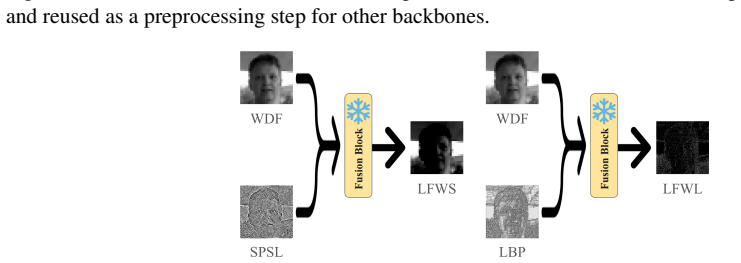
The authors construct two detectors, LFWS and LFWL, by inserting a 1x1 convolution that combines the low-frequency Wavelet-Denoised Feature with either the phase-spectrum channel from Spatial-Phase Shallow Learning or with Local Binary Patterns inside the Xception network. This minimal module raises detection AUC on the reported benchmarks while preserving the original parameter count and outperforming F3Net, SRM, and SPSL across eight evaluation sets.
What carries the argument
The lightweight fusion block: a 1x1 convolution that merges one handcrafted cue channel with the backbone feature maps.
If this is right
- The fused models achieve higher AUC than the Xception baseline and several larger detectors on FaceForensics++ and DFDC-Preview.
- The same architecture outperforms F3Net, SRM, and SPSL on eight public benchmarks without additional data or augmentation.
- Model size remains 21.9 million parameters, smaller than F3Net and less than half the size of SRM.
- The results indicate that carefully paired handcrafted features can deliver competitive robustness at lower computational cost than scale-driven alternatives.
Where Pith is reading between the lines
- The same cue-fusion pattern could be tested on other subtle-artifact detection tasks such as image manipulation or audio deepfake spotting.
- Selecting different handcrafted cues might further improve performance on forgery methods not covered by the current benchmarks.
- If the 1x1 fusion generalizes, it offers a low-cost route to update existing backbones rather than training entirely new large models.
Load-bearing premise
The chosen handcrafted cues carry complementary forgery information that a simple 1x1 convolution can combine effectively across different datasets.
What would settle it
Running the same LFWS and LFWL models on a new forgery dataset where the AUC improvement over the plain Xception baseline falls below 1 percent would falsify the central performance claim.
Figures




read the original abstract
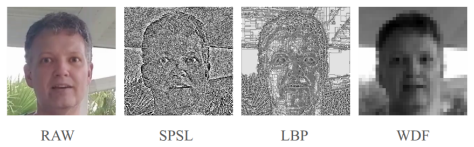
Current face video forgery detectors use wide or dual-stream backbones. We show that a single, lightweight fusion of two handcrafted cues can achieve higher accuracy with a much smaller model. Based on the Xception baseline model (21.9 million parameters), we build two detectors: LFWS, which adds a 1x1 convolution to combine a low-frequency Wavelet-Denoised Feature (WDF) with a phase-spectrum channel derived from Spatial-Phase Shallow Learning (SPSL), and LFWL, which merges WDF with Local Binary Patterns (LBP) in the same way. This extra module adds only 292 parameters, keeping the total at 21.9 million, smaller than F3Net (22.5 million) and less than half the size of SRM (55.3 million). Even with this minimal overhead, the fused models increase the average area under the curve (AUC) from 74.8% to 78.6% on FaceForensics++ and from 70.5% to 74.9% on DFDC-Preview, gains of 3.8% and 4.4% over the Xception baseline. They also consistently outperform F3Net, SRM, and SPSL in eight public benchmarks, without extra data or test-time augmentation. These results show that carefully paired, handcrafted features, combined through the lightweight fusion block, can provide competitive robustness at a significantly lower cost than comparable frequency-based detectors. Our findings suggest a need to reevaluate scale-driven design choices in face video forgery detection.
Editorial analysis
A structured set of objections, weighed in public.
Referee Report
Summary. The paper claims that augmenting the Xception backbone (21.9M parameters) with a 1x1 convolution fusing a low-frequency Wavelet-Denoised Feature (WDF) with either a phase-spectrum channel from SPSL or LBP yields two detectors (LFWS, LFWL) that improve average AUC from 74.8% to 78.6% on FaceForensics++ and from 70.5% to 74.9% on DFDC-Preview (gains of 3.8% and 4.4%), while adding only 292 parameters. The fused models are reported to outperform F3Net, SRM, and SPSL across eight public benchmarks without extra data or test-time augmentation, suggesting that complementary handcrafted cues enable competitive robustness at lower cost than scale-driven alternatives.
Significance. If the empirical results hold under standard controls, the work provides a concrete demonstration that targeted fusion of two handcrafted cues via minimal additional parameters can deliver measurable AUC gains on established forgery benchmarks while remaining smaller than comparable frequency-based detectors. The explicit numerical deltas, parameter counts, and cross-benchmark consistency constitute a falsifiable, low-overhead contribution that directly challenges the trend toward wider or dual-stream architectures in video face forgery detection.
minor comments (3)
- [Abstract] Abstract: the phrase 'average area under the curve' is used for the reported 74.8% to 78.6% and 70.5% to 74.9% figures without stating the precise averaging procedure (e.g., mean over forgery methods, cross-validation folds, or specific dataset splits); this detail belongs in the experimental protocol section for exact replication.
- The fusion module is described as adding exactly 292 parameters via a 1x1 convolution, yet the input channel count to that layer and the precise weight dimensions are not supplied; including this calculation or a small diagram in the methods would strengthen reproducibility.
- The claim of consistent outperformance 'in eight public benchmarks' is central to the contribution, but the manuscript does not list the eight benchmarks or provide a consolidated comparison table; adding such a table would improve clarity without altering the core argument.
Simulated Author's Rebuttal
We thank the referee for the positive summary, significance assessment, and recommendation of minor revision. The provided overview accurately reflects the manuscript's claims regarding the lightweight fusion approach and reported performance gains. No specific major comments were raised in the report.
Circularity Check
No significant circularity; empirical performance reporting only
full rationale
The paper describes an empirical architecture (LFWS/LFWL) that augments an Xception baseline with a 1x1 convolution fusing two handcrafted cues (WDF + SPSL phase or LBP). Performance is measured as AUC deltas on public benchmarks (FaceForensics++, DFDC-Preview) with explicit parameter counts and comparisons to F3Net/SRM/SPSL. No equations, predictions, or derivations are present that reduce the claimed gains to a quantity defined by the result itself; the reported improvements are measured outcomes on fixed external test sets. No self-citation chains, fitted-input renamings, or ansatz smuggling appear in the load-bearing steps. The work is therefore self-contained against external benchmarks.
Axiom & Free-Parameter Ledger
axioms (2)
- domain assumption The Xception architecture is a suitable and representative baseline for video face forgery detection.
- domain assumption Low-frequency wavelet-denoised features and phase-spectrum or LBP maps capture distinct, additive forgery signals.
Reference graph
Works this paper leans on
-
[2]
The Deepfake Detection Challenge (DFDC) Preview Dataset
URL https://arxiv.org/abs/1910.08854. Brian Dolhansky, Russell Howes, Ben Pflaum, Niv Baram, and Cristian Canton Ferrer. The deepfake detection challenge (dfdc) dataset. InProceedings of the IEEE/CVF Conference on Computer Vision and Pattern Recognition (CVPR) Workshops, pages 1608–1617,
work page Pith review arXiv 1910
-
[3]
Contributing data to deepfake detection research
Google AI Blog. Contributing data to deepfake detection research. https://ai.googleblog.com/ 2019/09/contributing-data-to-deepfake-detection.html ,
2019
-
[4]
Kaiming He, Xiangyu Zhang, Shaoqing Ren, and Jian Sun
Accessed: 2025- 09-10. Kaiming He, Xiangyu Zhang, Shaoqing Ren, and Jian Sun. Deep residual learning for image recognition. In Proceedings of the IEEE conference on computer vision and pattern recognition (CVPR), pages 770–778,
2025
-
[5]
Faceshifter: Towards high fidelity and occlusion aware face swapping, 2020a
Lingzhi Li, Jianmin Bao, Hao Yang, Dong Chen, and Fang Wen. Faceshifter: Towards high fidelity and occlusion aware face swapping, 2020a. URLhttps://arxiv.org/abs/1912.13457. Yuezun Li, Ming-Ching Chang, and Siwei Lyu. In Ictu oculi: Exposing ai created fake videos by detecting eye blinking. In2018 IEEE International Workshop on Information Forensics and S...
-
[6]
In: 2018 IEEE International Workshop on Information Forensics and Security (WIFS)
doi: 10.1109/WIFS.2018.8630787. Yuezun Li, Xin Yang, Pu Sun, Honggang Qi, and Siwei Lyu. Celeb-df: A large-scale challenging dataset for deepfake forensics. InProceedings of the IEEE/CVF Conference on Computer Vision and Pattern Recognition (CVPR), pages 3207–3216, 2020b. Jinhua Liang, Tao Zhang, and Guoqing Feng. Channel compression: Rethinking informati...
-
[7]
Zhiyuan Yan, Yong Zhang, Xinhang Yuan, Siwei Lyu, and Baoyuan Wu
arXiv:2106.09369. Zhiyuan Yan, Yong Zhang, Xinhang Yuan, Siwei Lyu, and Baoyuan Wu. Deepfakebench: A comprehensive benchmark of deepfake detection,
-
[8]
Deepfakebench: A comprehensive benchmark of deepfake detection.arXiv preprint arXiv:2307.01426, 2023
URL https://arxiv.org/abs/2307.01426. https: //github.com/SCLBD/DeepfakeBench. 13
discussion (0)
Sign in with ORCID, Apple, or X to comment. Anyone can read and Pith papers without signing in.