REVIEW 3 major objections 4 minor 33 references
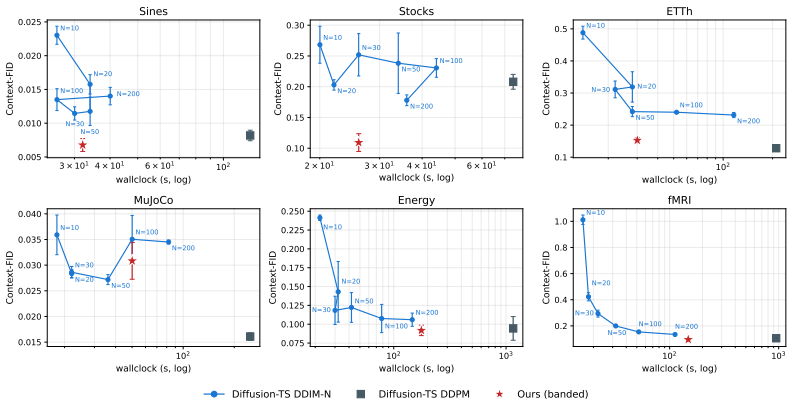
Time-series diffusion models can be sampled through a spectral-activity gate that skips quiet frequency bands, cutting function evaluations from 500/1000 to 14-66 and yielding up to 18.9x wall-clock speedup without retraining.
Reviewed by Pith at T0; open to challenge. T0 means a machine referee read the full paper against a public rubric. the ladder, T0–T4 →
T0 review · deepseek-v4-flash
2026-08-02 06:55 UTC pith:SL7IVJR2
load-bearing objection Genuinely new spectral-adaptive stride sampler for time-series diffusion, but the theory is motivational rather than a proof for the deployed gate, and the abstract overstates quality preservation. the 3 major comments →
StrideDiffusion: Accelerating Diffusion Models for Time-series Generation
The pith
A machine-rendered reading of the paper's core claim, the machinery that carries it, and where it could break.
Core claim
StrideDiffusion is a training-free band-aware scheduler that adapts the denoising step size from the spectrum of the sample being generated. The paper observes a coarse-to-fine progression in reverse diffusion and proves a local stability result: under a deterministic DDIM update, a frequency band whose energy is small in both the current sample and the predicted clean signal changes only to first order in the stride size, so skipping steps in such bands is provably safe. The sampler implements this with a dual gate — a power gate plus a dynamics gate — over relative band energy, log-power drift, and phase velocity, and maps the active set to coarse, mid, or fine strides, with a micro-step o
What carries the argument
The load-bearing identity is the affine decomposition of the deterministic DDIM update in the noise-level parameter ρ (the cumulative signal coefficient): x_{ρ'} = s_{ρ,ρ'} x_ρ + a_{ρ,ρ'} \hat{x}_0(x_ρ, ρ). Projecting onto a Fourier band B, the bandwise change is (s-1)P_B x_ρ + a P_B \hat{x}_0, which is O(Δ) in the stride when both terms are small. Corollary 1 turns this into a stability bound for inactive bands. The practical engine is the dual gate of Eq. (15), which uses observable two-step statistics — relative band energy, log-power drift, and weighted phase velocity — as proxies for that sufficient condition, and the adaptive stride scheduler that translates the active set into a jump
Load-bearing premise
The deployed gate checks energy and dynamics in the sample trajectory only; it never verifies that the predicted-clean residual is also small in the skipped bands, so the proven stability bound does not strictly cover the strides the sampler actually takes.
What would settle it
Compute, during every large jump, the energy of the predicted-clean signal restricted to bands the gate marks inactive; if that residual is non-negligible and output quality still degrades as strides grow, the stability bound is not the reason the sampler works. A simpler check: force the gate to label every band active at every step — if speedup and quality barely change, the spectral signal is not carrying the claimed effect.
If this is right
- Time-series diffusion inference can be made roughly an order of magnitude faster without retraining, which removes a practical barrier to low-latency deployment.
- Band activity is a predictive signal for which denoising steps are redundant, pointing to a general principle for adaptive diffusion sampling rather than a one-off schedule.
- The same band-gating mechanism transfers to conditional tasks — imputation and forecasting — with 5-14x average acceleration and comparable accuracy.
- The spectral statistics generated by the gate could later drive a learned stride policy, which the paper identifies as a natural extension of the heuristic scheduler.
Where Pith is reading between the lines
- If the coarse-to-fine spectral progression observed here is a general property of diffusion reverse processes, similar band-gating could accelerate image and video diffusion samplers that currently rely on fixed schedules; this is an extrapolation beyond the paper's time-series scope.
- Closing the gap between the proven bound and the deployed gate — by adding the predicted-clean residual energy to the gate — would likely let the sampler take even larger safe strides and would turn the acceleration from empirical to provably covered by the theory.
- The near-zero sensitivity to the phase-velocity threshold suggests phase information may be redundant given energy and magnitude drift; a two-signal gate might be equally effective and simpler to tune, a testable simplification the paper does not explore.
Editorial analysis
A structured set of objections, weighed in public.
Referee Report
Summary. StrideDiffusion proposes a training-free, band-aware stride scheduler for time-series diffusion sampling. The paper observes that different frequency bands become active at different stages of the reverse process, and introduces a gating mechanism (Eq. 15) that classifies bands as active or inactive from relative band energy, log-power drift, and phase velocity. The adaptive scheduler then chooses fine, mid, or coarse strides accordingly. The paper provides a bandwise stability analysis (Lemma 1, Corollary 1) for deterministic DDIM updates, extends it to DPM-Solver-2 (Proposition 1), and reports unconditional generation, imputation, and forecasting experiments showing 5-19x wall-clock speedups with quality mostly on par with the full-T DDPM baseline. The manuscript includes pseudocode, an anonymized code link, ablations, and hyperparameter sensitivity analyses.
Significance. If the empirical claims hold, StrideDiffusion is a useful contribution: it offers a simple, training-free way to reduce inference cost for time-series diffusion models, exploiting a domain-specific spectral progression that generic ODE solvers ignore. The paper's strengths include a transparent theoretical derivation (the Taylor expansion in Lemma 1 is direct and appears correct), detailed pseudocode, an anonymized code release, and honest acknowledgment of limitations in Appendix J and Appendix B.5. The spectral observation itself is plausible and supported by Figure 2. However, the connection between the theory and the practical gate is weaker than the word 'principled' in the abstract suggests, and some of the headline quality-preservation claims are not supported by Table 1. With tightening of the claims and additional empirical validation of the gate's assumptions, this could be a solid contribution to efficient time-series generation.
major comments (3)
- [§4.1, Appendix B.5, Eq. (15)] Corollary 1 guarantees stability only when both ||P_B x_rho|| and ||P_B xhat0(x_rho, rho)|| are small. The deployed gate (Eq. 15) thresholds relative energy, log-power drift, and phase velocity from consecutive samples, and Appendix B.5 explicitly states that the xhat0-band energy is not tested. Thus the local O(delta) bound does not apply to the actual leap decisions; large strides could inject unresolved high-frequency structure whenever the predicted-clean residual is non-negligible. This is a load-bearing gap between theory and algorithm. Please either measure ||P_B xhat0|| for bands deemed inactive and show it is small in the regimes where leaps are taken, or explicitly reframe the theory as motivation rather than justification for the deployed rule.
- [Table 1, Abstract] The abstract claims StrideDiffusion achieves the speedups 'while preserving or improving generation quality.' Table 1 shows exceptions: Context-FID is worse than full Diffusion-TS on ETTh (0.147 ± .011 vs 0.136 ± .009) and MuJoCo (0.029 ± .007 vs 0.016 ± .002), and the discriminative score is worse on MuJoCo (0.027 ± .004 vs 0.012 ± .004). The claim as stated requires qualification, e.g., 'on most datasets' or 'with minor degradation on some.'
- [§5.1, Appendix G] The 'Full' configuration is selected per dataset to balance speedup and Context-FID, and the sensitivity analyses in §5.5 and Appendix H are used to justify those defaults. It is not clear whether the reported Table 1 numbers are evaluated on a held-out split after this selection or whether the reported values are the same numbers used during configuration choice. If the per-dataset hyperparameters were chosen after seeing test-set metrics, the unconditional results are partially overfit. Please describe the tuning protocol explicitly (e.g., validation split, number of configurations tried, whether Table 1 numbers come from the configuration selected on a separate split).
minor comments (4)
- [Abstract] 'relativeband energy' is missing a space.
- [§5.3] The text refers to 'Table 5, Appendix 5.3'; this appendix reference appears to be a section label and should be a proper appendix letter (e.g., Appendix F).
- [Table 3 / Appendix G] Dataset names are inconsistently capitalized: 'SINES' appears in tables while the text uses 'Sines'. Please standardize.
- [NeurIPS Checklist, item 3] The checklist says proofs are in 'Appendices B.2, B.3, B.5, C.2, and C.3', but B.5 is a discussion of limitations, not a proof. This is a minor documentation issue.
Circularity Check
No significant circularity: the stability lemma is a direct algebraic consequence of the DDIM update, and the acknowledged gate gap is a soundness limitation, not a definitional or fitted loop.
full rationale
The paper's claimed derivation chain is self-contained. Lemma 1 derives Eqs. (5)-(6) by substituting the noise-predictor identity into the deterministic DDIM update and Taylor-expanding the scalar coefficients; it uses no fitted constants and does not assume the conclusion. Corollary 1 is a direct triangle-inequality/mean-value-theorem consequence with explicit assumptions. The band-gate statistics in Eq. (15) are measured from consecutive samples and are not fitted to the reported Context-FID values or speedups. The acknowledged gap that the gate tests trajectory-level band energy but does not test ||P_B xhat0|| (Appendix B.5) is a coverage/soundness limitation of the theory relative to the deployed rule, not a circular reduction: the theorem is not defined in terms of the gate output, and the gate is not defined in terms of the theorem's conclusion. Per-dataset hyperparameters are tuned for a speed/quality balance, which is disclosed and ablated; this is selection, not a fitted parameter renamed as a prediction. No load-bearing self-citation chain is present; the DDIM and DPM-Solver references are external, standard, and code-reproduced. Therefore the derivation does not reduce to its inputs by construction.
Axiom & Free-Parameter Ledger
free parameters (7)
- per-dataset stride schedule (lcoarse, lmid, lfine) =
not enumerated; per-dataset defaults beyond the SINES sweep
- Kmicro late-stage micro-step window =
default 20 on SINES, per-dataset otherwise
- tau_energy power-gate threshold =
not specified; per-dataset
- tau_mag magnitude-drift threshold =
not specified; per-dataset
- tau_phase phase-velocity threshold =
SINES sweep around 0.1-0.3; per-dataset defaults
- band partition {[0],[1-2],[3-5],[6-12]} for L=24 =
fixed FFT-bin grouping
- soft-projection decay gamma_d =
small positive, not specified
axioms (4)
- domain assumption Coarse-to-fine spectral progression is a stable property of trained time-series diffusion models beyond Sines/ETTh.
- ad hoc to paper The dual gate statistics are a sufficient proxy for the absolute band-inactivity conditions of Corollary 1.
- standard math Deterministic DDIM update is affine in x_rho and xhat0 with the noise-predictor relation of Eq. (22).
- domain assumption Assumption 1: the reverse update map admits a local expansion with Lipschitz f and O(h^2) remainder.
read the original abstract
Diffusion models have become competitive generators for time series, but their practical use is limited by the large number of sequential denoising steps required at inference time. Existing fast samplers typically use fixed or generic timestep schedules, overlooking a distinctive property of time-series diffusion: different spectral bands evolve at different rates during the reverse process. We introduce StrideDiffusion, a training-free spectral-aware sampler that adaptively selects the denoising stride from band-level activity. At each step, StrideDiffusion monitors relative band energy, log-power drift, and phase velocity to identify whether high- frequency dynamics remain active or whether the trajectory is dominated by stable low-frequency structure. It then takes fine steps when rapidly varying bands are active and larger jumps once only coarse components remain. A bandwise stability analysis shows that inactive frequency bands change only linearly with the jump size under deterministic affine reverse updates, providing a local justification for spectral activity as a step-size indicator. Across six unconditional time-series generation benchmarks, StrideDiffusion uses only 14-66 function evaluations instead of 500/1000 denoising steps, achieving up to 18.9x wall-clock speedup while preserving or improving generation quality. On conditional imputation and forecasting, it further delivers 5-14x average acceleration with comparable predictive accuracy. These results show that spectral evolution provides a practical and principled signal for fast time-series diffusion sampling. Our code is available at https://anonymous.4open.science/r/stridediff-ts.
Figures




Reference graph
Works this paper leans on
-
[1]
Junsong Chen, Shuchen Xue, Yuyang Zhao, Jincheng Yu, Sayak Paul, Junyu Chen, Han Cai, Song Han, and Enze Xie. Sana-sprint: One-step diffusion with continuous-time consistency distillation.arXiv preprint arXiv:2503.09641, 2025
arXiv 2025
-
[2]
On the constrained time-series generation problem.Advances in Neural Information Processing Systems, 36:61048–61059, 2023
Andrea Coletta, Sriram Gopalakrishnan, Daniel Borrajo, and Svitlana Vyetrenko. On the constrained time-series generation problem.Advances in Neural Information Processing Systems, 36:61048–61059, 2023
2023
-
[3]
Yefei He, Jing Liu, Weijia Wu, Hong Zhou, and Bohan Zhuang. Efficientdm: Efficient quantization-aware fine-tuning of low-bit diffusion models.arXiv preprint arXiv:2310.03270, 2023
Pith/arXiv arXiv 2023
-
[4]
Denoising diffusion probabilistic models.Advances in neural information processing systems, 33:6840–6851, 2020
Jonathan Ho, Ajay Jain, and Pieter Abbeel. Denoising diffusion probabilistic models.Advances in neural information processing systems, 33:6840–6851, 2020
2020
-
[5]
Elucidating the design space of diffusion-based generative models.Advances in neural information processing systems, 35: 26565–26577, 2022
Tero Karras, Miika Aittala, Timo Aila, and Samuli Laine. Elucidating the design space of diffusion-based generative models.Advances in neural information processing systems, 35: 26565–26577, 2022
2022
-
[6]
Diffwave: A versatile diffusion model for audio synthesis
Zhifeng Kong, Wei Ping, Jiaji Huang, Kexin Zhao, and Bryan Catanzaro. Diffwave: A versatile diffusion model for audio synthesis. InInternational Conference on Learning Representations, 2021
2021
-
[7]
Beta sampling is all you need: Efficient image generation strategy for diffusion models using stepwise spectral analysis
Haeil Lee, Hansang Lee, Seoyeon Gye, and Junmo Kim. Beta sampling is all you need: Efficient image generation strategy for diffusion models using stepwise spectral analysis. In 2025 IEEE/CVF Winter Conference on Applications of Computer Vision (WACV), pages 4215–
2025
-
[8]
Distrifusion: Distributed parallel inference for high-resolution diffusion models
Muyang Li, Tianle Cai, Jiaxin Cao, Qinsheng Zhang, Han Cai, Junjie Bai, Yangqing Jia, Kai Li, and Song Han. Distrifusion: Distributed parallel inference for high-resolution diffusion models. InProceedings of the IEEE/CVF Conference on Computer Vision and Pattern Recognition, pages 7183–7193, 2024
2024
-
[9]
Faster diffusion: Rethinking the role of the encoder for diffusion model inference.Advances in Neural Information Processing Systems, 37: 85203–85240, 2024
Senmao Li, Taihang Hu, Joost van de Weijer, Fahad S Khan, Tao Liu, Linxuan Li, Shiqi Yang, Yaxing Wang, Ming-Ming Cheng, and Jian Yang. Faster diffusion: Rethinking the role of the encoder for diffusion model inference.Advances in Neural Information Processing Systems, 37: 85203–85240, 2024
2024
-
[10]
Q-dm: An efficient low-bit quantized diffusion model.Advances in neural information processing systems, 36: 76680–76691, 2023
Yanjing Li, Sheng Xu, Xianbin Cao, Xiao Sun, and Baochang Zhang. Q-dm: An efficient low-bit quantized diffusion model.Advances in neural information processing systems, 36: 76680–76691, 2023
2023
-
[11]
Timestep embedding tells: It’s time to cache for video diffusion model
Feng Liu, Shiwei Zhang, Xiaofeng Wang, Yujie Wei, Haonan Qiu, Yuzhong Zhao, Yingya Zhang, Qixiang Ye, and Fang Wan. Timestep embedding tells: It’s time to cache for video diffusion model. InProceedings of the Computer Vision and Pattern Recognition Conference, pages 7353–7363, 2025
2025
-
[12]
Retrieval-augmented diffusion models for time series forecasting.Advances in Neural Information Processing Systems, 37:2766–2786, 2024
Jingwei Liu, Ling Yang, Hongyan Li, and Shenda Hong. Retrieval-augmented diffusion models for time series forecasting.Advances in Neural Information Processing Systems, 37:2766–2786, 2024. 10
2024
-
[13]
Dpm-solver: A fast ode solver for diffusion probabilistic model sampling in around 10 steps.Advances in neural information processing systems, 35:5775–5787, 2022
Cheng Lu, Yuhao Zhou, Fan Bao, Jianfei Chen, Chongxuan Li, and Jun Zhu. Dpm-solver: A fast ode solver for diffusion probabilistic model sampling in around 10 steps.Advances in neural information processing systems, 35:5775–5787, 2022
2022
-
[14]
Dpm-solver++: Fast solver for guided sampling of diffusion probabilistic models.Machine Intelligence Re- search, pages 1–22, 2025
Cheng Lu, Yuhao Zhou, Fan Bao, Jianfei Chen, Chongxuan Li, and Jun Zhu. Dpm-solver++: Fast solver for guided sampling of diffusion probabilistic models.Machine Intelligence Re- search, pages 1–22, 2025
2025
-
[15]
Deepcache: Accelerating diffusion models for free
Xinyin Ma, Gongfan Fang, and Xinchao Wang. Deepcache: Accelerating diffusion models for free. InProceedings of the IEEE/CVF conference on computer vision and pattern recognition, pages 15762–15772, 2024
2024
-
[16]
Leapfrog diffusion model for stochastic trajectory prediction
Weibo Mao, Chenxin Xu, Qi Zhu, Siheng Chen, and Yanfeng Wang. Leapfrog diffusion model for stochastic trajectory prediction. InProceedings of the IEEE/CVF conference on computer vision and pattern recognition, pages 5517–5526, 2023
2023
-
[17]
Kashif Rasul, Calvin Seward, Ingmar Schuster, and Roland V ollgraf. Autoregressive denoising diffusion models for multivariate probabilistic time series forecasting, 2021. URL https: //arxiv.org/abs/2101.12072
Pith/arXiv arXiv 2021
-
[18]
Generative modelling with inverse heat dissipation.arXiv preprint arXiv:2206.13397, 2022
Severi Rissanen, Markus Heinonen, and Arno Solin. Generative modelling with inverse heat dissipation.arXiv preprint arXiv:2206.13397, 2022
Pith/arXiv arXiv 2022
-
[19]
Progressive distillation for fast sampling of diffusion models
Tim Salimans and Jonathan Ho. Progressive distillation for fast sampling of diffusion models. InInternational Conference on Learning Representations, 2022
2022
-
[20]
Non-autoregressive conditional diffusion models for time series prediction
Lifeng Shen and James Kwok. Non-autoregressive conditional diffusion models for time series prediction. 2023. URLhttps://arxiv.org/abs/2306.05043
Pith/arXiv arXiv 2023
-
[21]
Temporal dynamic quantization for diffusion models.Advances in neural information processing systems, 36:48686–48698, 2023
Junhyuk So, Jungwon Lee, Daehyun Ahn, Hyungjun Kim, and Eunhyeok Park. Temporal dynamic quantization for diffusion models.Advances in neural information processing systems, 36:48686–48698, 2023
2023
-
[22]
Denoising diffusion implicit models.arXiv preprint arXiv:2010.02502, 2020
Jiaming Song, Chenlin Meng, and Stefano Ermon. Denoising diffusion implicit models.arXiv preprint arXiv:2010.02502, 2020
Pith/arXiv arXiv 2010
-
[23]
Csdi: Conditional score-based diffusion models for probabilistic time series imputation.Advances in neural information processing systems, 34:24804–24816, 2021
Yusuke Tashiro, Jiaming Song, Yang Song, and Stefano Ermon. Csdi: Conditional score-based diffusion models for probabilistic time series imputation.Advances in neural information processing systems, 34:24804–24816, 2021
2021
-
[24]
Videolcm: Video latent consistency model.arXiv preprint arXiv:2312.09109, 2023
Xiang Wang, Shiwei Zhang, Han Zhang, Yu Liu, Yingya Zhang, Changxin Gao, and Nong Sang. Videolcm: Video latent consistency model.arXiv preprint arXiv:2312.09109, 2023
Pith/arXiv arXiv 2023
-
[25]
Cache me if you can: Accelerating diffusion models through block caching
Felix Wimbauer, Bichen Wu, Edgar Schoenfeld, Xiaoliang Dai, Ji Hou, Zijian He, Artsiom Sanakoyeu, Peizhao Zhang, Sam Tsai, Jonas Kohler, et al. Cache me if you can: Accelerating diffusion models through block caching. InProceedings of the IEEE/CVF Conference on Computer Vision and Pattern Recognition, pages 6211–6220, 2024
2024
-
[26]
Diffusion probabilistic model made slim
Xingyi Yang, Daquan Zhou, Jiashi Feng, and Xinchao Wang. Diffusion probabilistic model made slim. InProceedings of the IEEE/CVF Conference on computer vision and pattern recognition, pages 22552–22562, 2023
2023
-
[27]
Weiwei Ye, Zhuopeng Xu, and Ning Gui. Non-stationary diffusion for probabilistic time series forecasting.arXiv preprint arXiv:2505.04278, 2025
Pith/arXiv arXiv 2025
-
[28]
Time-series generative adversarial networks.Advances in neural information processing systems, 32, 2019
Jinsung Yoon, Daniel Jarrett, and Mihaela Van der Schaar. Time-series generative adversarial networks.Advances in neural information processing systems, 32, 2019
2019
-
[29]
Dmfft: improving the generation quality of diffusion models using fast fourier transform.Scientific Reports, 15(1):10200, 2025
Cuihong Yu, Cheng Han, and Chao Zhang. Dmfft: improving the generation quality of diffusion models using fast fourier transform.Scientific Reports, 15(1):10200, 2025
2025
-
[30]
Diffusion-ts: Interpretable diffusion for general time series genera- tion
Xinyu Yuan and Yan Qiao. Diffusion-ts: Interpretable diffusion for general time series genera- tion. InThe Twelfth International Conference on Learning Representations, 2024. 11
2024
-
[31]
Yunlong Yuan, Yuanfan Guo, Chunwei Wang, Wei Zhang, Hang Xu, and Li Zhang. Freqprior: Improving video diffusion models with frequency filtering gaussian noise.arXiv preprint arXiv:2502.03496, 2025
Pith/arXiv arXiv 2025
-
[32]
Haoyi Zhou, Shanghang Zhang, Jieqi Peng, Shuai Zhang, Jianxin Li, Hui Xiong, and Wancai Zhang. Informer: Beyond efficient transformer for long sequence time-series forecasting. In The Thirty-Fifth AAAI Conference on Artificial Intelligence, AAAI 2021, Virtual Conference, volume 35, pages 11106–11115. AAAI Press, 2021. 12 A Extended Related Work A.1 Diffus...
arXiv 2021
-
[33]
Guidelines: • The answer [N/A] means that the paper does not involve crowdsourcing nor research with human subjects
Institutional review board (IRB) approvals or equivalent for research with human subjects Question: Does the paper describe potential risks incurred by study participants, whether such risks were disclosed to the subjects, and whether Institutional Review Board (IRB) approvals (or an equivalent approval/review based on the requirements of your country or ...
discussion (0)
Sign in with ORCID, Apple, or X to comment. Anyone can read and Pith papers without signing in.