Fed-CausalDiff: Decoupled Synchronization for Federated Do-Simulation and Policy Evaluation
Pith reviewed 2026-06-26 10:37 UTC · model grok-4.3
The pith
A federated diffusion model decomposes latent dynamics into shared causal scores and private local confounders to support do-simulation.
A machine-rendered reading of the paper's core claim, the machinery that carries it, and where it could break.
Core claim
The architecture decomposes the evolution of the latent state into a global causal score function and a local confounding score function. This design enables decoupled synchronisation where clients aggregate only the shared causal mechanism while retaining site-specific confounders locally to handle heterogeneity.
What carries the argument
decoupled synchronisation (DSS), which aggregates only the shared causal score function across clients while keeping confounding score functions local
If this is right
- Clients can collaborate on causal estimates without transmitting site-specific confounding information.
- Communication volume drops because only the causal score parameters are synchronized each round.
- Average treatment effect estimates improve relative to methods that share full models or ignore heterogeneity.
- Policy-value estimates become more accurate on heterogeneous decentralized datasets.
Where Pith is reading between the lines
- If the score separation generalizes, the same pattern could be tested in federated settings that use other generative models besides diffusion.
- Datasets with known strong cross-site causal interactions would provide a direct test of whether local terms remain isolated.
- The approach could be extended to settings with continuous or sequential actions if the score functions remain stable under policy changes.
Load-bearing premise
The latent state evolution can be cleanly decomposed into a globally shared causal score function and locally retained confounding score functions that can be learned separately without the local terms contaminating the causal estimates.
What would settle it
If aggregating the causal scores across sites produces ATE estimates that systematically deviate from known ground-truth interventions on a held-out dataset with measured confounding, the separation claim would be falsified.
Figures


read the original abstract
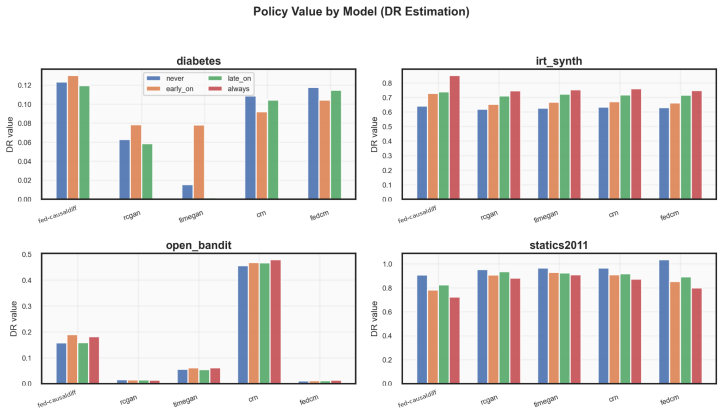
While federated learning enables collaborative modelling on decentralised data, standard methods merely fit historical observations. This purely observational approach is fundamentally insufficient for interventional inference and policy evaluation, as sequential actions dynamically alter future states. We propose \textbf{Fed-CausalDiff}, a federated causal diffusion framework for do-simulation. The architecture decomposes the evolution of the latent state into a global causal score function and a local confounding score function. This design enables \emph{decoupled synchronisation} (DSS), where clients aggregate only the shared causal mechanism while retaining site-specific confounders locally to handle heterogeneity. Experiments on four datasets demonstrate that Fed-CausalDiff achieves better ATE and policy-value estimation accuracy, offering a favorable trade-off between communication cost and inference fidelity.
Editorial analysis
A structured set of objections, weighed in public.
Referee Report
Summary. The manuscript proposes Fed-CausalDiff, a federated causal diffusion framework for do-simulation and policy evaluation. The architecture decomposes latent state evolution into a globally shared causal score function (aggregated via federated learning) and site-specific confounding score functions (retained locally). This enables decoupled synchronization (DSS) to handle data heterogeneity while supporting interventional queries such as ATE and policy-value estimation. Experiments on four datasets are reported to demonstrate improved accuracy and a favorable communication-inference trade-off compared to standard federated approaches.
Significance. If the decomposition into uncontaminated global causal and local confounding scores can be rigorously enforced and the experimental claims hold under proper baselines and statistical controls, the work would address a genuine gap in federated causal inference by enabling do-calculus style queries without full data centralization. The decoupled synchronization idea is conceptually promising for reducing communication while preserving interventional fidelity, but the current presentation supplies no equations, derivations, or experimental details with which to evaluate whether these benefits are realized.
major comments (2)
- [Abstract] Abstract: the claim that Fed-CausalDiff 'achieves better ATE and policy-value estimation accuracy' on four datasets is made without any reported baselines, statistical tests, error bars, or even the numerical values of the improvements. This absence prevents any assessment of whether the central empirical claim is supported.
- [Abstract] Abstract: no parameterization, architectural constraints, or training objective is described for separating the global causal score from the local confounding scores. Without such mechanisms (e.g., explicit regularization or architectural isolation), the skeptic concern that local heterogeneity leaks into the aggregated causal mechanism remains unaddressed, directly undermining the validity of the do-simulation and ATE results.
Simulated Author's Rebuttal
We thank the referee for the careful reading and constructive feedback. We address the two major comments on the abstract below and will revise the manuscript to improve clarity and support for the claims.
read point-by-point responses
-
Referee: [Abstract] Abstract: the claim that Fed-CausalDiff 'achieves better ATE and policy-value estimation accuracy' on four datasets is made without any reported baselines, statistical tests, error bars, or even the numerical values of the improvements. This absence prevents any assessment of whether the central empirical claim is supported.
Authors: We agree that the abstract would be strengthened by including more concrete information on the empirical results. In the revision we will update the abstract to reference the specific baselines, report the magnitude of accuracy improvements, and direct readers to the experimental section for error bars, statistical tests, and full numerical results. This addresses the concern while respecting abstract length limits. revision: yes
-
Referee: [Abstract] Abstract: no parameterization, architectural constraints, or training objective is described for separating the global causal score from the local confounding scores. Without such mechanisms (e.g., explicit regularization or architectural isolation), the skeptic concern that local heterogeneity leaks into the aggregated causal mechanism remains unaddressed, directly undermining the validity of the do-simulation and ATE results.
Authors: The full manuscript details the separation via architectural isolation of the global causal score (aggregated via federated averaging) from site-specific confounding scores (kept local), together with a composite training objective that includes explicit regularization to prevent leakage. We acknowledge that the abstract does not currently mention these mechanisms. We will revise the abstract to briefly note the decoupled synchronization design and local retention of confounders, thereby addressing the concern about potential leakage. revision: yes
Circularity Check
No derivation chain or equations present; claims rest on experimental results rather than self-referential math
full rationale
The provided abstract and text describe a proposed federated diffusion architecture that decomposes latent dynamics into global causal and local confounding scores to enable decoupled synchronization. No equations, parameter-fitting steps, uniqueness theorems, or self-citations are exhibited that would allow any prediction or result to reduce to its inputs by construction. The central claims concern empirical ATE and policy-value accuracy on four datasets; these are external benchmarks rather than internally forced outputs. Absent any load-bearing derivation, the paper is self-contained against external evaluation.
Axiom & Free-Parameter Ledger
Reference graph
Works this paper leans on
-
[1]
Deep learning with logged bandit feedback,
T. Joachims, A. Swaminathan, and M. De Rijke, “Deep learning with logged bandit feedback,” inInternational Conference on Learning Representations, 2018
2018
-
[2]
Principles relating to processing of personal data,
C. De Terwangne, “Principles relating to processing of personal data,” inThe EU general data protection (GDPR): a commentary. Oxford University Press, 2020, pp. 309–320
2020
-
[3]
Advances and open problems in federated learning,
P. Kairouz, H. B. McMahan, B. Avent, A. Bellet, M. Bennis, A. N. Bhagoji, K. Bonawitz, Z. Charles, G. Cormode, R. Cummingset al., “Advances and open problems in federated learning,”Foundations and trends® in machine learning, vol. 14, no. 1–2, pp. 1–210, 2021
2021
-
[4]
Causal inference in recommender systems: A survey and future directions,
C. Gao, Y . Zheng, W. Wang, F. Feng, X. He, and Y . Li, “Causal inference in recommender systems: A survey and future directions,” ACM Transactions on Information Systems, vol. 42, no. 4, pp. 1–32, 2024
2024
-
[5]
Understanding marginal structural models for time-varying exposures: pitfalls and tips,
T. Shinozaki and E. Suzuki, “Understanding marginal structural models for time-varying exposures: pitfalls and tips,”Journal of epidemiology, vol. 30, no. 9, pp. 377–389, 2020
2020
-
[6]
Y . Xie, B. Liu, Q. Liu, Z. Wang, Y . Zhou, and J. Peng, “Off-policy evaluation and learning from logged bandit feedback: Error reduction via surrogate policy,”arXiv preprint arXiv:1808.00232, 2018
Pith/arXiv arXiv 2018
-
[7]
Fedgan: Federated gen- erative adversarial networks for distributed data,
M. Rasouli, T. Sun, and R. Rajagopal, “Fedgan: Federated gen- erative adversarial networks for distributed data,”arXiv preprint arXiv:2006.07228, 2020
arXiv 2006
-
[8]
Time-series generative ad- versarial networks,
J. Yoon, D. Jarrett, and M. Van der Schaar, “Time-series generative ad- versarial networks,”Advances in neural information processing systems, vol. 32, 2019
2019
-
[9]
Doubly robust off-policy value evaluation for rein- forcement learning,
N. Jiang and L. Li, “Doubly robust off-policy value evaluation for rein- forcement learning,” inInternational conference on machine learning. PMLR, 2016, pp. 652–661
2016
-
[10]
Fedcm: Federated learning of deep causal generative models,
M. M. Rahman and M. Kocaoglu, “Fedcm: Federated learning of deep causal generative models,” inThe 41st Conference on Uncertainty in Artificial Intelligence, 2025
2025
-
[11]
Multi- flgans: multi-distributed adversarial networks for non-iid distribution,
A. Amalan, R. Wang, Y . Qiao, E. Panaousis, and K. Liang, “Multi- flgans: multi-distributed adversarial networks for non-iid distribution,” arXiv preprint arXiv:2206.12178, 2022
arXiv 2022
-
[12]
Communication-efficient learning of deep networks from decentralized data,
B. McMahan, E. Moore, D. Ramage, S. Hampson, and B. A. y Arcas, “Communication-efficient learning of deep networks from decentralized data,” inArtificial intelligence and statistics. PMLR, 2017, pp. 1273– 1282
2017
-
[13]
Federated optimization in heterogeneous networks,
T. Li, A. K. Sahu, M. Zaheer, M. Sanjabi, A. Talwalkar, and V . Smith, “Federated optimization in heterogeneous networks,”Proceedings of Machine learning and systems, vol. 2, pp. 429–450, 2020
2020
-
[14]
Tackling the objective inconsistency problem in heterogeneous federated optimiza- tion,
J. Wang, Q. Liu, H. Liang, G. Joshi, and H. V . Poor, “Tackling the objective inconsistency problem in heterogeneous federated optimiza- tion,”Advances in neural information processing systems, vol. 33, pp. 7611–7623, 2020
2020
-
[15]
Federated learning for diffusion models,
Z. Peng, X. Wang, S. Chen, H. Rao, C. Shen, and J. Jiang, “Federated learning for diffusion models,”IEEE Transactions on Cognitive Com- munications and Networking, 2025
2025
-
[16]
Pearl,Causality
J. Pearl,Causality. Cambridge university press, 2009
2009
-
[17]
Causal inference,
M. A. Hern ´an and J. M. Robins, “Causal inference,” 2010
2010
-
[18]
Marginal structural models and causal inference in epidemiology,
J. M. Robins, M. A. Hernan, and B. Brumback, “Marginal structural models and causal inference in epidemiology,” pp. 550–560, 2000
2000
-
[19]
Forecasting treatment responses over time using recurrent marginal structural networks,
B. Lim, “Forecasting treatment responses over time using recurrent marginal structural networks,”Advances in neural information process- ing systems, vol. 31, 2018
2018
-
[20]
I. Bica, A. M. Alaa, J. Jordon, and M. Van Der Schaar, “Estimating counterfactual treatment outcomes over time through adversarially bal- anced representations,”arXiv preprint arXiv:2002.04083, 2020
arXiv 2002
-
[21]
A review of off-policy evaluation in reinforcement learning,
M. Uehara, C. Shi, and N. Kallus, “A review of off-policy evaluation in reinforcement learning,”arXiv preprint arXiv:2212.06355, 2022
arXiv 2022
-
[22]
Federated causal inference in heterogeneous observational data,
R. Xiong, A. Koenecke, M. Powell, Z. Shen, J. T. V ogelstein, and S. Athey, “Federated causal inference in heterogeneous observational data,”Statistics in Medicine, vol. 42, no. 24, pp. 4418–4439, 2023
2023
-
[23]
Federated causal inference from multi-site observational data via propensity score aggregation,
R. Khellaf, A. Bellet, and J. Josse, “Federated causal inference from multi-site observational data via propensity score aggregation,”arXiv preprint arXiv:2505.17961, 2025
arXiv 2025
-
[24]
Federated causal inference: Multi-study ate estimation beyond meta-analysis,
——, “Federated causal inference: Multi-study ate estimation beyond meta-analysis,”arXiv preprint arXiv:2410.16870, 2024
arXiv 2024
-
[25]
Federated causal discovery,
E. Gao, J. Chen, L. Shen, T. Liu, M. Gong, and H. Bondell, “Federated causal discovery,”OpenReview, 2021, iCLR 2022 withdrawn submis- sion
2021
-
[26]
Towards practical federated causal structure learning,
Z. Wang, P. Ma, and S. Wang, “Towards practical federated causal structure learning,” inJoint European Conference on Machine Learning and Knowledge Discovery in Databases. Springer, 2023, pp. 351–367
2023
-
[27]
The causal foundations of structural equation modeling,
J. Pearl, “The causal foundations of structural equation modeling,” Handbook of structural equation modeling, pp. 68–91, 2012
2012
-
[28]
Exploiting shared representations for personalized federated learning,
L. Collins, H. Hassani, A. Mokhtari, and S. Shakkottai, “Exploiting shared representations for personalized federated learning,” inInterna- tional conference on machine learning. PMLR, 2021, pp. 2089–2099
2021
-
[29]
Context-aware attentive knowl- edge tracing,
A. Ghosh, N. Heffernan, and A. S. Lan, “Context-aware attentive knowl- edge tracing,” inProceedings of the 26th ACM SIGKDD international conference on knowledge discovery & data mining, 2020, pp. 2330– 2339
2020
-
[30]
Impact of hba1c measurement on hospital readmission rates: analysis of 70,000 clinical database patient records,
B. Strack, J. P. DeShazo, C. Gennings, J. L. Olmo, S. Ventura, K. J. Cios, and J. N. Clore, “Impact of hba1c measurement on hospital readmission rates: analysis of 70,000 clinical database patient records,”BioMed research international, vol. 2014, no. 1, p. 781670, 2014
2014
-
[31]
Open bandit dataset and pipeline: Towards realistic and reproducible off-policy evaluation,
Y . Saito, S. Aihara, M. Matsutani, and Y . Narita, “Open bandit dataset and pipeline: Towards realistic and reproducible off-policy evaluation,” arXiv preprint arXiv:2008.07146, 2020
arXiv 2008
-
[32]
Real-valued (medical) time series generation with recurrent conditional gans,
C. Esteban, S. L. Hyland, and G. R ¨atsch, “Real-valued (medical) time series generation with recurrent conditional gans,”arXiv preprint arXiv:1706.02633, 2017
Pith/arXiv arXiv 2017
-
[33]
Deep knowledge tracing,
C. Piech, J. Bassen, J. Huang, S. Ganguli, M. Sahami, L. J. Guibas, and J. Sohl-Dickstein, “Deep knowledge tracing,”Advances in neural information processing systems, vol. 28, 2015
2015
-
[34]
Estimating individual treatment effect: generalization bounds and algorithms,
U. Shalit, F. D. Johansson, and D. Sontag, “Estimating individual treatment effect: generalization bounds and algorithms,” inInternational conference on machine learning. PMLR, 2017, pp. 3076–3085
2017
discussion (0)
Sign in with ORCID, Apple, or X to comment. Anyone can read and Pith papers without signing in.