Zee models with a non-invertible Z_M symmetry
Pith reviewed 2026-05-25 04:30 UTC · model grok-4.3
The pith
Non-invertible Z_M symmetry restricts Yukawa structures in Zee models and selects viable neutrino mass patterns.
A machine-rendered reading of the paper's core claim, the machinery that carries it, and where it could break.
Core claim
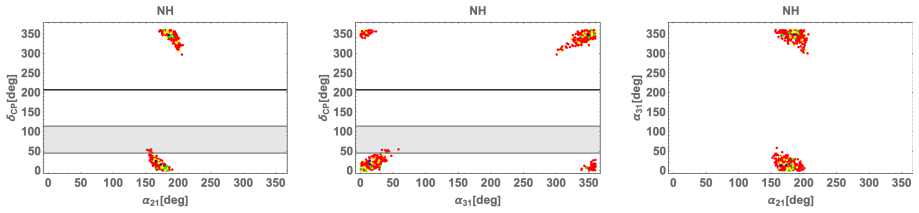
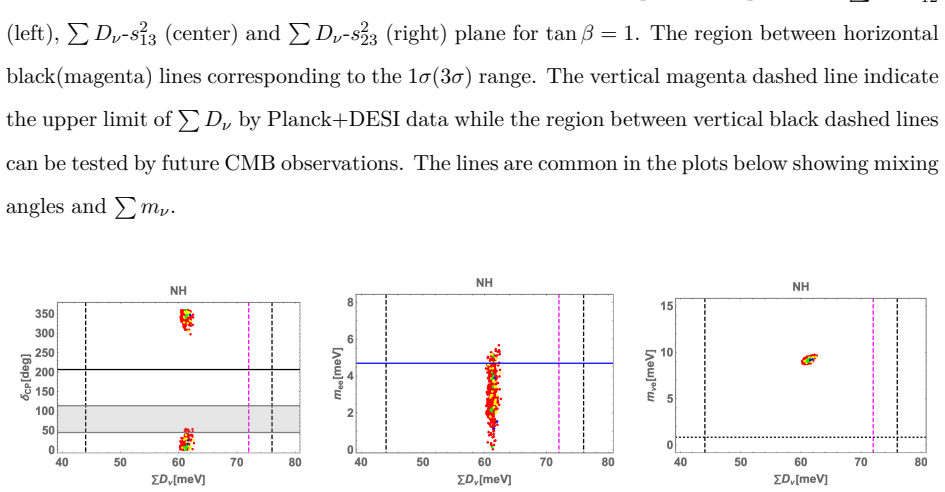
Assigning the fields of the Zee model to appropriate representations of a non-invertible Z_M symmetry restricts the Yukawa Lagrangian to specific terms. The resulting one-loop neutrino mass matrix then takes a definite texture whose parameters must reproduce the observed neutrino spectrum. Systematic enumeration of consistent assignments identifies the viable models, and a benchmark with M equal to 7 supplies numerical predictions for both neutrino observables and charged lepton flavor violating processes inside the experimentally allowed parameter space.
What carries the argument
non-invertible Z_M symmetry acting on the scalar and fermion fields to select allowed interaction terms
If this is right
- Viable models are those whose predicted neutrino mass matrix textures fit current oscillation data.
- The Z_7 benchmark yields specific correlations between neutrino mixing angles and CP phases.
- Charged lepton flavor violating rates such as mu to e gamma are constrained to narrow intervals.
- The classification applies uniformly across different values of M.
Where Pith is reading between the lines
- The same symmetry technique could be used to generate similar textures in other loop-induced mass models.
- Precision measurements at future neutrino experiments might distinguish between different M values.
- If no LFV is seen at the predicted levels, the models would require additional suppression mechanisms.
Load-bearing premise
The non-invertible symmetry is implemented exactly in the Lagrangian without additional breaking terms or operators that would allow forbidden Yukawa couplings.
What would settle it
Observation of neutrino oscillation parameters or LFV branching ratios that cannot be accommodated by any of the symmetry-allowed mass matrix structures.
Figures





read the original abstract
We investigate Zee models by incorporating a non-invertible $Z_M$ symmetry. The models are systematically classified based on their symmetry assignments, which dictate structures for the Yukawa couplings and the neutrino mass matrix. By evaluating the consistency of these mass structures with current experimental data, we identify the viable model candidates. Focusing on a representative benchmark model based on the non-invertible $Z_7$ symmetry, we perform a detailed numerical analysis. Our results yield characteristic predictions for neutrino observables and charged lepton flavor violating processes within the allowed parameter space.
Editorial analysis
A structured set of objections, weighed in public.
Referee Report
Summary. The paper investigates Zee models augmented with non-invertible Z_M symmetries. Models are classified according to symmetry assignments that fix the allowed Yukawa couplings and resulting neutrino mass matrix structures. Viable candidates are selected by consistency with current experimental data. A detailed numerical analysis is then performed on a representative Z_7 benchmark, producing predictions for neutrino observables and charged-lepton flavor-violating rates inside the allowed parameter space.
Significance. If the non-invertible symmetry is realized such that the Yukawa structures are exactly those selected by the fusion rules, the classification supplies a systematic way to constrain Zee-model parameter space and the Z_7 benchmark yields falsifiable predictions for neutrino mixing angles, mass-squared differences, and CLFV branching ratios. The explicit numerical scan within experimentally allowed regions is a concrete strength.
major comments (2)
- [§2] §2 (Classification): The central claim that the non-invertible Z_M symmetry produces precisely the listed Yukawa textures (and no others) rests on the unverified assumption that the symmetry can be embedded in the Zee Lagrangian without additional operators, defects, or higher-dimensional terms entering at the same order. This assumption is load-bearing for the subsequent identification of viable models and the mass-matrix patterns used in the data comparison.
- [§4] §4 (Numerical analysis of Z_7 benchmark): The reported predictions for neutrino observables and CLFV processes are obtained after imposing experimental constraints, yet the manuscript does not specify the exact scan ranges, priors, or exclusion criteria applied to the free parameters. Without these details it is impossible to determine whether the quoted characteristic predictions are robust outputs or artifacts of post-hoc parameter choices.
minor comments (2)
- [Abstract] The abstract states that 'viable model candidates' are identified but does not indicate how many survive the data cuts; a short table or sentence summarizing the number of surviving assignments would improve clarity.
- [§2] Notation for the non-invertible symmetry generators and fusion rules is introduced without a compact summary table; adding one would help readers track which assignments are allowed.
Simulated Author's Rebuttal
We thank the referee for the careful reading and constructive comments. We address each major point below and will incorporate clarifications in a revised manuscript.
read point-by-point responses
-
Referee: [§2] §2 (Classification): The central claim that the non-invertible Z_M symmetry produces precisely the listed Yukawa textures (and no others) rests on the unverified assumption that the symmetry can be embedded in the Zee Lagrangian without additional operators, defects, or higher-dimensional terms entering at the same order. This assumption is load-bearing for the subsequent identification of viable models and the mass-matrix patterns used in the data comparison.
Authors: The classification proceeds by assigning fields to representations of the non-invertible Z_M symmetry and retaining only those Yukawa operators allowed by the fusion rules at the renormalizable level. This is the standard procedure when imposing a discrete symmetry on an effective Lagrangian. We do not provide an explicit UV embedding or prove the absence of all higher-dimensional operators; such terms are assumed to be suppressed by a cutoff scale, as is conventional. To address the concern we will revise §2 to state the assumption explicitly and note that the listed textures follow directly from the field charges under the symmetry. revision: yes
-
Referee: [§4] §4 (Numerical analysis of Z_7 benchmark): The reported predictions for neutrino observables and CLFV processes are obtained after imposing experimental constraints, yet the manuscript does not specify the exact scan ranges, priors, or exclusion criteria applied to the free parameters. Without these details it is impossible to determine whether the quoted characteristic predictions are robust outputs or artifacts of post-hoc parameter choices.
Authors: The manuscript indeed omits the precise numerical scan protocol. The free parameters (Yukawa couplings, scalar masses, and mixing angles) were scanned over ranges ensuring perturbative couplings (|Y| < 4π) and consistency with existing CLFV upper limits, using logarithmic priors for dimensionful parameters and uniform priors for angles. Points were retained only if they reproduced neutrino oscillation data within 3σ and satisfied all CLFV bounds. We will add an explicit description of the scan ranges, priors, and selection criteria to §4 (or a new appendix) in the revised version. revision: yes
Circularity Check
No significant circularity; derivation remains self-contained
full rationale
The paper classifies models via symmetry assignments on the Zee Lagrangian, derives resulting Yukawa and mass-matrix structures, confronts those structures with external neutrino oscillation data for viability, and then scans the surviving parameter space of a Z_7 benchmark to obtain predictions for CLFV rates. No quoted equation or step reduces a claimed prediction to a fitted input by construction, no self-citation is invoked as a uniqueness theorem that forces the central result, and the symmetry-to-mass-matrix mapping is presented as an independent input rather than a renaming of known patterns. The numerical outputs for observables outside the fitting data therefore constitute genuine forward predictions rather than tautological restatements.
Axiom & Free-Parameter Ledger
Reference graph
Works this paper leans on
-
[1]
We also note that CLFV associated with electron is highly suppressed due to the structure of the Yukawa couplings
The mixing matrix VL(R) is calculated by numerically diagonalizing the mass matrix in the anal- ysis below. We also note that CLFV associated with electron is highly suppressed due to the structure of the Yukawa couplings. 10 The neutrino mass is given by Eq. (24) and its structure is mν : 0 BBB@ 0 × × × × × × × × 1 CCCA , m ν|tβ →∞ : 0 BBB@ 0 0 × 0 × × ×...
-
[2]
+ (z + y)m2 3 + xm2 4 , (A8) I2(m1, m2, m3, m4) = Z [dX] xz −x(1 − x)m2 1 + xz(m2 1 − m2
-
[3]
+ (z + y)m2 3 + xm2 4 , (A9) I3(m1, m2, m3, m4) = Z [dX] 1 − x −x(1 − x)m2 1 + xz(m2 1 − m2
-
[4]
+ (z + y)m2 3 + xm2 4 , (A10) I4(m1, m2, m3) = Z [dX] xy −x(1 − x)m2 1 + xz(m2 1 − m2
-
[5]
+ (z + y)m2 3 , (A11) I5(m1, m2, m3) = Z [dX] xz −x(1 − x)m2 1 + xz(m2 1 − m2
-
[6]
Appendix B: List of viable models In this appendix, we list viable models which can in principle fit neutrino data
+ (z + y)m2 3 , (A12) where R [dX] ≡ R 1 0 dxdydzδ (1 − x − y − z). Appendix B: List of viable models In this appendix, we list viable models which can in principle fit neutrino data. The viable models under Z N I 4 , Z N I 5 , Z N I 6 and Z N I 7 are summarized in Table III, Table IV, Table V, and Tables VI-VIII, respectively
-
[7]
Y. Cai, J. Herrero-García, M. A. Schmidt, A. Vicente, and R. R. Volkas, Front. in Phys. 5, 63 (2017), 1706.08524. 21 ZN I 4 Models {kℓ1, kℓ2, kℓ3} kS kΦ f yΦ Mℓ mν mν|tβ →∞ (1) {0, 1, 2} 1 1 0 BBBB@ 0 × 0 × 0 × 0 × 0 1 CCCCA 0 BBBB@ 0 × 0 × 0 × 0 × 0 1 CCCCA 0 BBBB@ × × 0 × × × 0 × × 1 CCCCA 0 BBBB@ × × × × × × × × × 1 CCCCA 0 BBBB@ × 0 × 0 × 0 × 0 × 1 CC...
work page internal anchor Pith review Pith/arXiv arXiv 2017
-
[8]
Zee, Phys
A. Zee, Phys. Lett. 93B, 389 (1980), [Erratum: Phys. Lett.95B,461(1980)]
1980
-
[9]
Full parameter scan of the Zee model: exploring Higgs lepton flavor violation
J. Herrero-García, T. Ohlsson, S. Riad, and J. Wirén, JHEP 04, 130 (2017), 1701.05345
work page internal anchor Pith review Pith/arXiv arXiv 2017
-
[10]
Can the Zee Model Explain the Observed Neutrino Data?
Y. Koide, Phys. Rev. D 64, 077301 (2001), hep-ph/0104226
work page internal anchor Pith review Pith/arXiv arXiv 2001
-
[11]
P. H. Frampton, M. C. Oh, and T. Yoshikawa, Phys. Rev. D 65, 073014 (2002), hep- 22 ZN I 6 Models {kℓ1, kℓ2, kℓ3} kS kΦ f yΦ Mℓ mν mν|tβ →∞ (1) {0, 1, 2} 1 1 0 BBBB@ 0 × 0 × 0 × 0 × 0 1 CCCCA 0 BBBB@ 0 × 0 × 0 × 0 × 0 1 CCCCA 0 BBBB@ × × 0 × × × 0 × × 1 CCCCA 0 BBBB@ × × × × × × × × × 1 CCCCA 0 BBBB@ × 0 × 0 × 0 × 0 × 1 CCCCA (2) {0, 1, 2} 1 3 0 BBBB@ 0 ×...
-
[12]
X.-G. He, Eur. Phys. J. C 34, 371 (2004), hep-ph/0307172
work page internal anchor Pith review Pith/arXiv arXiv 2004
-
[13]
Phenomenology in the Zee Model with the A_4 Symmetry
T. Fukuyama, H. Sugiyama, and K. Tsumura, Phys. Rev. D 83, 056016 (2011), 1012.4886. 23
work page internal anchor Pith review Pith/arXiv arXiv 2011
-
[14]
R-Parity Conserving Supersymmetric Extension of the Zee Model
S. Kanemura, T. Shindou, and H. Sugiyama, Phys. Rev. D 92, 115001 (2015), 1508.05616
work page internal anchor Pith review Pith/arXiv arXiv 2015
- [15]
- [16]
-
[17]
Are neutrino masses modular forms?
F. Feruglio, Are neutrino masses modular forms? (2019), pp. 227–266, 1706.08749
work page internal anchor Pith review Pith/arXiv arXiv 2019
- [18]
-
[19]
T. Nomura and H. Okada, Phys. Lett. B 867, 139618 (2025), 2412.18095
- [20]
-
[21]
ICTP Lectures on (Non-)Invertible Generalized Symmetries
S. Schafer-Nameki, Phys. Rept. 1063, 1 (2024), 2305.18296
work page internal anchor Pith review Pith/arXiv arXiv 2024
-
[22]
Lectures on Generalized Symmetries
L. Bhardwaj, L. E. Bottini, L. Fraser-Taliente, L. Gladden, D. S. W. Gould, A. Platschorre, and H. Tillim, Phys. Rept. 1051, 1 (2024), 2307.07547
work page internal anchor Pith review Pith/arXiv arXiv 2024
-
[23]
What's Done Cannot Be Undone: TASI Lectures on Non-Invertible Symmetries
S.-H. Shao (2023), 2308.00747
work page internal anchor Pith review Pith/arXiv arXiv 2023
- [24]
-
[25]
T. Kobayashi, H. Otsuka, and M. Tanimoto, JHEP 12, 117 (2024), 2409.05270
- [26]
-
[27]
S. Funakoshi, T. Kobayashi, and H. Otsuka, JHEP 04, 183 (2025), 2412.12524
-
[28]
T. Kobayashi, Y. Nishioka, H. Otsuka, and M. Tanimoto, JHEP 05, 177 (2025), 2503.09966
-
[29]
Q. Liang and T. T. Yanagida, Phys. Lett. B 868, 139706 (2025), 2505.05142
-
[30]
T. Kobayashi, H. Otsuka, M. Tanimoto, and H. Uchida (2025), 2505.07262
- [31]
-
[32]
T. Kobayashi, H. Mita, H. Otsuka, and R. Sakuma (2025), 2506.10241
- [33]
- [34]
- [35]
-
[36]
C. Cordova, S. Hong, S. Koren, and K. Ohmori, Phys. Rev. X 14, 031033 (2024), 2211.07639
- [37]
-
[38]
J. Chen, C.-Q. Geng, H. Okada, and J.-J. Wu, Nucl. Phys. B 1025, 117391 (2026), 2507.11951
- [39]
-
[40]
T. Kobayashi, H. Otsuka, and T. T. Yanagida, Phys. Rev. D 113, 055016 (2026), 2508.12287
-
[41]
Spurion Analysis for Non-Invertible Selection Rules from Near-Group Fusions
M. Suzuki, L.-X. Xu, and H. Y. Zhang (2025), 2508.14970
work page internal anchor Pith review Pith/arXiv arXiv 2025
- [42]
- [43]
- [44]
- [45]
- [46]
- [47]
- [48]
- [49]
- [50]
- [51]
-
[52]
Dynamical CP Violation from Non-Invertible Selection Rules
H. Okada and H. Otsuka (2026), 2604.04423
work page internal anchor Pith review Pith/arXiv arXiv 2026
-
[53]
A General Prescription for Spurion Analysis of Non-Invertible Selection Rules
L.-X. Xu (2026), 2604.09345
work page internal anchor Pith review Pith/arXiv arXiv 2026
-
[54]
Dirac one-loop seesaw in a non-invertible fusion rule
H. Okada and L. Singh (2026), 2604.11308
work page internal anchor Pith review Pith/arXiv arXiv 2026
-
[55]
A theoretical account of tiny multi-Higgs vacuum expectation values from non-invertible symmetry
T. Nomura and H. Okada (2026), 2604.27612
work page internal anchor Pith review Pith/arXiv arXiv 2026
- [56]
- [57]
-
[58]
Muon Decay and Physics Beyond the Standard Model
Y. Kuno and Y. Okada, Rev. Mod. Phys. 73, 151 (2001), hep-ph/9909265
work page internal anchor Pith review Pith/arXiv arXiv 2001
-
[59]
Detailed calculation of lepton flavor violating muon-electron conversion rate for various nuclei
R. Kitano, M. Koike, and Y. Okada, Phys. Rev. D 66, 096002 (2002), [Erratum: Phys.Rev.D 76, 059902 (2007)], hep-ph/0203110
work page internal anchor Pith review Pith/arXiv arXiv 2002
-
[60]
Selecting mu -> e Conversion Targets to distinguish Lepton Flavour-Changing Operators
S. Davidson, Y. Kuno, and M. Yamanaka, Phys. Lett. B 790, 380 (2019), 1810.01884
work page internal anchor Pith review Pith/arXiv arXiv 2019
-
[61]
Y. G. Cui et al. (COMET) (2009)
2009
-
[62]
K. Afanaciev et al. (MEG II), Eur. Phys. J. C 85, 1177 (2025), [Erratum: Eur.Phys.J.C 85, 1317 (2025)], 2504.15711
-
[63]
K. Afanaciev et al. (MEG II), Eur. Phys. J. C 84, 216 (2024), [Erratum: Eur.Phys.J.C 84, 1042 (2024)], 2310.12614
-
[64]
Searches for Lepton Flavor Violation in the Decays tau -> e gamma and tau -> mu gamma
B. Aubert et al. (BaBar), Phys. Rev. Lett. 104, 021802 (2010), 0908.2381
work page internal anchor Pith review Pith/arXiv arXiv 2010
- [65]
-
[66]
Bellgardt et al
U. Bellgardt et al. (SINDRUM), Nucl. Phys. B 299, 1 (1988)
1988
-
[67]
K. Hayasaka et al., Phys. Lett. B 687, 139 (2010), 1001.3221
work page internal anchor Pith review Pith/arXiv arXiv 2010
-
[68]
H. Okada and M. Tanimoto, Eur. Phys. J. C 81, 52 (2021), 1905.13421
- [69]
-
[70]
N. Abgrall et al. (LEGEND) (2021), 2107.11462. 25
-
[71]
G. Adhikari et al. (nEXO), J. Phys. G 49, 015104 (2022), 2106.16243
- [72]
-
[73]
Planck 2018 results. VI. Cosmological parameters
N. Aghanim et al. (Planck), Astron. Astrophys. 641, A6 (2020), [Erratum: Astron.Astrophys. 652, C4 (2021)], 1807.06209
work page internal anchor Pith review Pith/arXiv arXiv 2020
-
[74]
A. G. Adame et al. (DESI), JCAP 02, 021 (2025), 2404.03002
work page internal anchor Pith review Pith/arXiv arXiv 2025
-
[75]
NuFit-6.0: Updated global analysis of three-flavor neutrino oscillations
I. Esteban, M. C. Gonzalez-Garcia, M. Maltoni, I. Martinez-Soler, J. P. Pinheiro, and T. Schwetz, JHEP 12, 216 (2024), 2410.05380
work page internal anchor Pith review Pith/arXiv arXiv 2024
-
[76]
CMB-S4 Science Case, Reference Design, and Project Plan
K. Abazajian et al. (2019), 1907.04473
work page internal anchor Pith review Pith/arXiv arXiv 2019
-
[77]
T. Matsumura et al., J. Low Temp. Phys. 176, 733 (2014), 1311.2847
work page internal anchor Pith review Pith/arXiv arXiv 2014
-
[78]
M. Sajjad Athar et al., Prog. Part. Nucl. Phys. 124, 103947 (2022), 2111.07586
-
[79]
Abada et al
A. Abada et al. (FCC), Eur. Phys. J. C 79, 474 (2019)
2019
-
[80]
Future Circular Collider Feasibility Study Report: Volume 1, Physics, Experiments, Detectors
M. Benedikt et al. (FCC), Eur. Phys. J. C 85, 1468 (2025), 2505.00272
work page internal anchor Pith review Pith/arXiv arXiv 2025
discussion (0)
Sign in with ORCID, Apple, or X to comment. Anyone can read and Pith papers without signing in.