Binge, Bot, Repeat: Unpacking the Ecosystem of Video Piracy on Telegram
Pith reviewed 2026-05-21 09:26 UTC · model grok-4.3
The pith
Telegram video piracy relies on chains of intermediary channels and bots to stay resilient against takedowns while distributing thousands of copyrighted titles.
A machine-rendered reading of the paper's core claim, the machinery that carries it, and where it could break.
Core claim
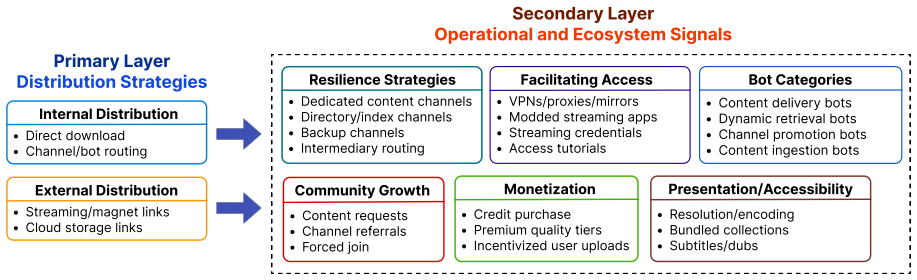
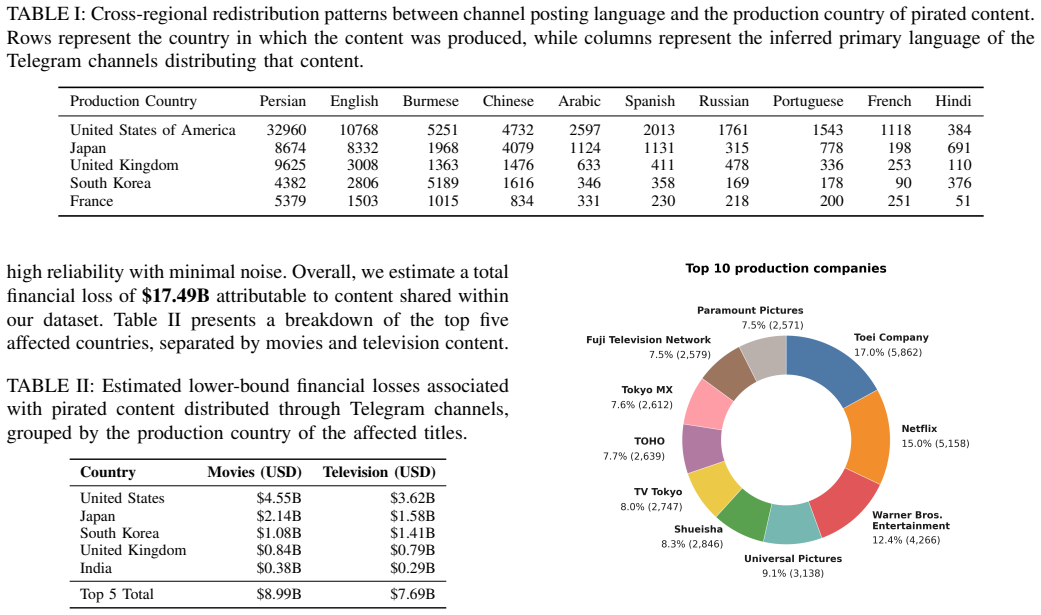
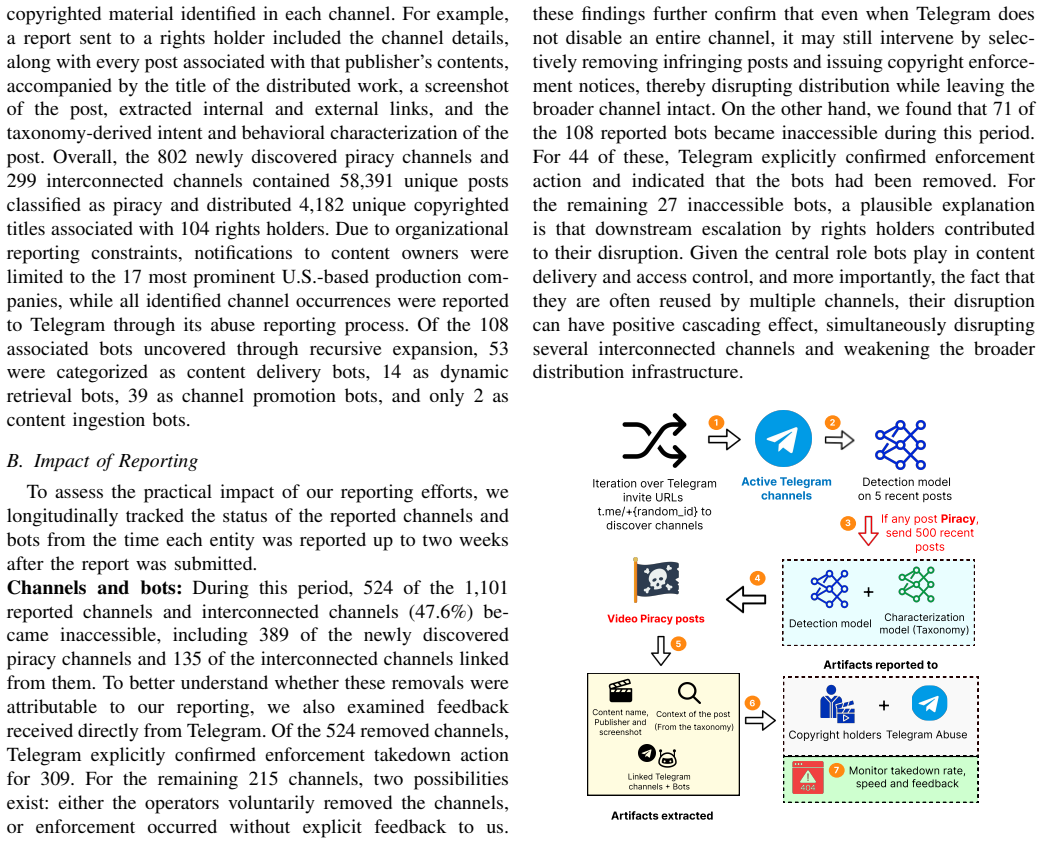
The video piracy ecosystem on Telegram is deliberately engineered to be resilient against takedown efforts, frequently redirecting users through chains of intermediary channels and automated bots that collectively handle hosting, access control, monetization, and channel discovery. The channels collectively distributed 19,033 unique copyrighted titles originating from 175 countries, accumulating over 4.85B unique views and resulting in a lower-bound estimated financial loss of $17.49B for content rights holders. The Anti-RIP framework, which applies a fine-grained taxonomy of per-post activity, facilitated the takedown of 524 previously unknown piracy channels and 71 bots over a 61-day real
What carries the argument
The fine-grained taxonomy that classifies per-post activity and intent in piracy channels, which powers detection of new operations and supports the Anti-RIP framework for generating actionable insights on channel networks and bots.
If this is right
- Individual channel takedowns have limited effect because users are redirected through remaining intermediary channels and bots.
- The quantified distribution of 19,033 titles across 175 countries and 4.85 billion views establishes a measurable economic impact on rights holders.
- Taxonomy-based detection improves the ability to identify and act on new piracy communities in real time.
- Releasing the dataset and framework allows others to replicate the analysis or build on the classification approach for similar platforms.
Where Pith is reading between the lines
- The same layered bot and channel structure could appear in piracy on other messaging services, pointing to a need for comparable studies across apps.
- Rights holders might adapt the post-classification approach to monitor specific titles proactively rather than waiting for reports.
- Efforts to reduce piracy would gain from focusing on the monetization and discovery layers rather than only removing final distribution points.
- Combining the detection method with platform-level data on user redirects could reveal how quickly new chains form after disruptions.
Load-bearing premise
The 1,057 sampled channels and the posts collected between December 2023 and January 2026 are representative of the broader ongoing video piracy activity on Telegram, and the taxonomy accurately captures per-post activity and intent without substantial misclassification or selection bias.
What would settle it
A follow-up measurement that finds the volume of unique copyrighted titles and total views on Telegram piracy channels remains at comparable levels after repeated targeted removals of identified bot chains and intermediary networks.
Figures





read the original abstract
Telegram has emerged as a major platform for large-scale video piracy, where copyrighted content is rapidly distributed among users. Despite its prominence, the structural and operational dynamics of this ecosystem remain insufficiently understood. To address this gap, we present the first large-scale study of video piracy on Telegram through a mixed-method analysis of 1,057 channels that shared 209k unique posts between December 2023 and January 2026 - systematically characterizing their content, distribution strategies, and how the ecosystem is sustained at scale. Central to our approach is the development of a fine-grained taxonomy that enables a structured understanding of the activity and intent of these channels on a per-post level. The channels collectively distributed 19,033 unique copyrighted titles originating from 175 countries, accumulating over 4.85B unique views and resulting in a lower-bound estimated financial loss of $17.49B for content rights holders. We also find that this ecosystem is deliberately engineered to be resilient against takedown efforts, frequently redirecting users through chains of intermediary channels and automated bots that collectively handle hosting, access control, monetization, and channel discovery. The scale and persistence of this ecosystem motivated the development of Anti-RIP, a real-time framework for detecting emerging video piracy communities on Telegram. Anti-RIP utilizes our taxonomy to generate contextual, interpretable insights that stakeholders confirmed improve the triaging action against reported posts and channels. Over a 61-day period, the framework facilitated the takedown of 524 previously unknown piracy channels and 71 bots. To support reproducibility and future research, we open-source both the dataset and the Anti-RIP framework.
Editorial analysis
A structured set of objections, weighed in public.
Referee Report
Summary. The paper conducts the first large-scale mixed-methods study of video piracy on Telegram by analyzing 1,057 channels that posted 209k unique items between December 2023 and January 2026. It introduces a fine-grained per-post taxonomy to classify activities such as hosting, redirection, monetization, and discovery; reports that these channels distributed 19,033 copyrighted titles from 175 countries, generating 4.85 billion views and an estimated $17.49 billion in lower-bound losses; characterizes the ecosystem as deliberately resilient through chains of intermediary channels and bots; and presents the Anti-RIP detection framework, which stakeholders used to achieve 524 channel and 71 bot takedowns over 61 days. The dataset and framework are released for reproducibility.
Significance. If the sampling and taxonomy claims hold, the work supplies concrete, large-scale evidence on the operational structure of piracy on messaging platforms, quantifies its economic impact, and demonstrates a deployable, taxonomy-driven tool that produced verified real-world takedowns. The open-sourcing of both the 209k-post dataset and the Anti-RIP implementation is a notable strength that enables follow-on measurement and mitigation research in cybersecurity and digital rights.
major comments (3)
- [§3 (Data Collection)] §3 (Data Collection): The sampling procedure that produced the 1,057 channels is not described (e.g., keyword search, snowball sampling from known seeds, or random crawl). This directly affects the internal validity of the scale claims (4.85 B views, $17.49 B loss) and the resilience characterization, because any bias toward high-visibility or easily discoverable channels would inflate both the reported volume and the apparent density of redirection chains.
- [§4 (Taxonomy and Classification)] §4 (Taxonomy and Classification): No validation of the fine-grained taxonomy is reported (inter-annotator agreement, ground-truth labeling, or error analysis on categories such as “intermediary” vs. “final” channel). Systematic mislabeling of redirection or access-control posts would undermine the central claim that the ecosystem is “deliberately engineered to be resilient” through intermediary chains.
- [§5 (Financial Impact)] §5 (Financial Impact): The conversion parameters used to translate views into the $17.49 B loss figure are listed as free parameters but are not justified or sensitivity-tested. Because this number is used to motivate both the scale of the problem and the value of Anti-RIP, the lack of transparent derivation weakens the quantitative claims.
minor comments (2)
- [Abstract and §2] The abstract and §2 would benefit from a brief statement of the exact time window (December 2023–January 2026) and the total number of unique posts (209k) to allow readers to assess temporal coverage without consulting later sections.
- [Results figures] Figure captions for the redirection-chain diagrams should explicitly state the number of channels and bots in each illustrated example so that the visual evidence can be directly compared to the aggregate statistics.
Simulated Author's Rebuttal
We thank the referee for their constructive and detailed feedback, which has identified important areas for improving the transparency and rigor of our manuscript. We address each major comment point by point below, outlining the specific revisions we will make.
read point-by-point responses
-
Referee: [§3 (Data Collection)] The sampling procedure that produced the 1,057 channels is not described (e.g., keyword search, snowball sampling from known seeds, or random crawl). This directly affects the internal validity of the scale claims (4.85 B views, $17.49 B loss) and the resilience characterization, because any bias toward high-visibility or easily discoverable channels would inflate both the reported volume and the apparent density of redirection chains.
Authors: We agree that the sampling procedure requires explicit description to allow proper evaluation of internal validity. The 1,057 channels were identified via an initial set of keyword searches on Telegram for terms associated with video piracy, followed by snowball sampling that traced redirection links and channel recommendations from the seed set, with additional filtering against public lists of known piracy communities. In the revised manuscript we will add a dedicated subsection in §3 that fully documents this multi-stage process, discusses its limitations including potential over-representation of high-visibility channels, and explains how these factors should inform interpretation of the reported scale and resilience findings. revision: yes
-
Referee: [§4 (Taxonomy and Classification)] No validation of the fine-grained taxonomy is reported (inter-annotator agreement, ground-truth labeling, or error analysis on categories such as “intermediary” vs. “final” channel). Systematic mislabeling of redirection or access-control posts would undermine the central claim that the ecosystem is “deliberately engineered to be resilient” through intermediary chains.
Authors: We acknowledge that the absence of reported validation metrics leaves the taxonomy's reliability open to question and could weaken the resilience characterization. The taxonomy was developed iteratively through team discussions informed by observed post patterns and consultation with domain experts; however, formal inter-annotator agreement and error analysis were not included in the original submission. In the revision we will add these elements to §4, reporting agreement statistics on a labeled sample and a focused error analysis of the intermediary versus final channel distinction, thereby providing stronger support for the claim that the ecosystem is deliberately engineered for resilience. revision: yes
-
Referee: [§5 (Financial Impact)] The conversion parameters used to translate views into the $17.49 B loss figure are listed as free parameters but are not justified or sensitivity-tested. Because this number is used to motivate both the scale of the problem and the value of Anti-RIP, the lack of transparent derivation weakens the quantitative claims.
Authors: We thank the referee for noting the need for greater transparency in the financial estimates. The parameters were drawn from industry reports on per-view revenue and piracy loss multipliers, but these sources and any sensitivity considerations were not detailed. In the revised §5 we will provide explicit citations and justifications for each parameter and include a sensitivity analysis that varies the key conversion factors across plausible ranges, demonstrating that the lower-bound loss estimate remains substantial even under conservative assumptions. This will strengthen the motivation for both the scale of the problem and the utility of Anti-RIP. revision: yes
Circularity Check
No circularity: purely empirical observational study
full rationale
The paper reports an empirical mixed-methods study grounded in direct collection of 1,057 channels and 209k posts, followed by manual taxonomy development and application to characterize distribution patterns and build the Anti-RIP detector. No equations, first-principles derivations, fitted parameters, or predictions appear; the resilience claim and takedown counts are presented as observed outcomes from the sampled data and framework deployment rather than quantities that reduce to the authors' own definitions or inputs by construction. The work is self-contained against external benchmarks of collected posts and reported platform actions.
Axiom & Free-Parameter Ledger
free parameters (1)
- Financial loss conversion parameters
axioms (1)
- domain assumption The 1,057 channels collected are representative of Telegram video piracy activity during the study window.
Lean theorems connected to this paper
-
IndisputableMonolith/Foundation/AbsoluteFloorClosure.leanreality_from_one_distinction unclear?
unclearRelation between the paper passage and the cited Recognition theorem.
Central to our approach is the development of a fine-grained taxonomy that enables a structured understanding of the activity and intent of these channels on a per-post level... The scale and persistence of this ecosystem motivated the development of Anti-RIP, a real-time framework for detecting emerging video piracy communities on Telegram.
-
IndisputableMonolith/Cost/FunctionalEquation.leanwashburn_uniqueness_aczel unclear?
unclearRelation between the paper passage and the cited Recognition theorem.
We also find that this ecosystem is deliberately engineered to be resilient against takedown efforts, frequently redirecting users through chains of intermediary channels and automated bots...
What do these tags mean?
- matches
- The paper's claim is directly supported by a theorem in the formal canon.
- supports
- The theorem supports part of the paper's argument, but the paper may add assumptions or extra steps.
- extends
- The paper goes beyond the formal theorem; the theorem is a base layer rather than the whole result.
- uses
- The paper appears to rely on the theorem as machinery.
- contradicts
- The paper's claim conflicts with a theorem or certificate in the canon.
- unclear
- Pith found a possible connection, but the passage is too broad, indirect, or ambiguous to say the theorem truly supports the claim.
Reference graph
Works this paper leans on
- [1]
-
[2]
Piracy in the entertainment industry & legal penalties. Justia. Accessed 2026-05-06. [Online]. Available: https://www.justia.com/ entertainment-law/piracy-in-the-entertainment-industry/
work page 2026
-
[3]
Sharing large files has never been easier,
“Sharing large files has never been easier,” https://terashare.net/en/. 15
-
[4]
Peer-to-peer file sharing: The case of the music recording industry,
P. Alexander, “Peer-to-peer file sharing: The case of the music recording industry,”Review of Industrial Organization, vol. 20, no. 2, pp. 151–161, 2002
work page 2002
-
[5]
Apple Inc., “iCloud+ plans and pricing,” https://support.apple.com/ en-us/108047, 2026, apple Support; accessed 2026-05-06
work page 2026
-
[6]
M. Bal, “Audio-visual piracy on Telegram: a perspective on monetization models, pirate strategies and industrial pathways,”Contemporary South Asia, vol. 31, pp. 1–15, 05 2023
work page 2023
-
[7]
Behind the scenes of online copyright enforcement: Empirical evidence on notice & takedown,
S. Bar-Ziv and N. Elkin-Koren, “Behind the scenes of online copyright enforcement: Empirical evidence on notice & takedown,”Connecticut Law Review, vol. 50, no. 2, pp. 339–386, 2018
work page 2018
-
[8]
The Pushshift Telegram dataset,
J. Baumgartner, S. Zannettou, J. Blackburn, and E. D. Cristofaro, “The Pushshift Telegram dataset,” 2020, a large-scale dataset of public Telegram messages for research purposes
work page 2020
- [9]
-
[10]
Scam pandemic: How attackers exploit public fear through phishing,
M. Bitaab, H. Cho, A. Oest, P. Zhang, Z. Sun, R. Pourmohamad, D. Kim, T. Bao, R. Wang, Y . Shoshitaishviliet al., “Scam pandemic: How attackers exploit public fear through phishing,” in2020 APWG Symposium on Electronic Crime Research (eCrime). IEEE, 2020, pp. 1–10
work page 2020
-
[11]
Why Telegram is the go-to platform for pirates
Block X. Why Telegram is the go-to platform for pirates. Block X. Published on LinkedIn Pulse; accessed 2026-05-06. [Online]. Available: https://www.linkedin.com/pulse/ why-telegram-go-to-platform-pirates-blockxtechs-tpovc/
work page 2026
-
[12]
The piracy problem streaming plat- forms can’t solve,
T. Boulifi, “The piracy problem streaming plat- forms can’t solve,” https://www.wired.com/story/ the-piracy-problem-streaming-platforms-cant-solve/, Mar. 2026, wIRED; accessed 2026-05-06
work page 2026
-
[13]
Z. Carpou, “Robots, pirates, and the rise of the automated takedown regime: Using the DMCA to fight piracy and protect end-users,” Columbia Journal of Law & the Arts, vol. 39, no. 4, pp. 551–590, 2016
work page 2016
-
[14]
The looming shadow of illicit trade on the internet,
P. E. Chaudhry, “The looming shadow of illicit trade on the internet,” Business Horizons, vol. 60, no. 1, pp. 77–89, 2017. [Online]. Available: https://www.sciencedirect.com/science/article/pii/S0007681316300908
work page 2017
-
[15]
The effect of piracy website blocking on consumer behavior,
B. Danaher, J. S. Hersh, M. D. Smith, and R. Telang, “The effect of piracy website blocking on consumer behavior,” Aug. 2019, available at SSRN: https://ssrn.com/abstract=2612063
work page 2019
-
[16]
Gone in 60 seconds: The impact of the Megaupload shutdown on movie sales,
B. Danaher and M. D. Smith, “Gone in 60 seconds: The impact of the Megaupload shutdown on movie sales,”International Journal of Industrial Organization, vol. 33, pp. 1–8, 2014
work page 2014
-
[17]
N. Desk. Feds seize domain names of movie piracy websites. [Online]. Available: https://www.courthousenews.com/ feds-seize-domain-names-of-movie-piracy-websites/
-
[18]
G. Dhanwate, A. Jadhav, I. Lavate, S. Bawage, R. Aghavane, and D. Patil, “Empowering digital rights: Real-time detection of piracy channels on Telegram using machine learning and network analysis,” in2025 IEEE International Conference on Blockchain and Distributed Systems Security (ICBDS), 2025, pp. 1–6
work page 2025
-
[19]
How to use Telegram DMCA for copyright infringement
DMCA Force. How to use Telegram DMCA for copyright infringement. DMCA Force. Accessed 2026-05-06. [Online]. Available: https:// dmcaforce.com/how-to-use-telegram-dmca-for-copyright-infringement/
work page 2026
-
[20]
European Union Intellectual Property Office (EUIPO), “Social media—discussion paper: New and existing trends in using social media for ip infringement activities and good practices to address them,” European Observatory on Infringements of Intellectual Property Rights, Tech. Rep., Jun. 2021, accessed: 2026-05-03. [Online]. Available: https://euipo.europa....
work page 2021
-
[21]
Federal Bureau of Investigation Internet Crime Complaint Center (IC3), “2023 internet crime report,” https://www.ic3.gov/annualreport/reports/ 2023 ic3report.pdf, 2024, accessed 2026-05-06
work page 2023
-
[22]
The bandwagon effect on participation in and use of a social networking site,
W. W. Fu, J. Teo, and S. Seng, “The bandwagon effect on participation in and use of a social networking site,”First Monday, vol. 17, no. 5, May 2012. [Online]. Available: https: //firstmonday.org/ojs/index.php/fm/article/view/3971
work page 2012
-
[23]
Why pay if it’s free? Streaming, downloading, and digital music consumption in the ‘iTunes era’,
T. Giletti, “Why pay if it’s free? Streaming, downloading, and digital music consumption in the ‘iTunes era’,” Master’s thesis, London School of Economics and Political Science, 2012
work page 2012
-
[24]
GoFile—cloud storage made simple,
GoFile, “GoFile—cloud storage made simple,” https://gofile.io/
-
[25]
How your Google storage works,
Google, “How your Google storage works,” https://support.google.com/ googleone/answer/9312312, google One Help; accessed 2026-05-06
-
[26]
“How Google Fights Piracy,” 2016. [Online]. Available: https://storage.googleapis.com/gweb-uniblog-publish-prod/ documents/GO806 Google FightsPiracy eReader final.pdf
work page 2016
-
[27]
D. P. Harris. (2015) Time to reboot? Rethinking the Digital Millennium Copyright Act. Temple University Beasley School of Law. Faculty article in temple’s busi- ness law zine). [Online]. Available: https://law.temple.edu/10q/ time-to-reboot-rethinking-the-digital-millennium-copyright-act/
work page 2015
-
[28]
Equal prices, unequal earnings: Netflix affordability still skewed against Nigerians,
R. Ibeh, “Equal prices, unequal earnings: Netflix affordability still skewed against Nigerians,” https://tinyurl.com/4ptjd7tk, Oct. 2025, busi- nessDay Nigeria; accessed 2026-05-06
work page 2025
-
[29]
Movie Pirates of the Caribbean: Exploring Illegal Streaming Cyberlockers
D. Ibosiola, B. A. Steer, ´A. Garc ´ıa-Recuero, G. Stringhini, S. Uhlig, and G. Tyson, “Movie Pirates of the Caribbean: Exploring illegal streaming cyberlockers,”CoRR, vol. abs/1804.02679, 2018. [Online]. Available: http://arxiv.org/abs/1804.02679
work page internal anchor Pith review Pith/arXiv arXiv 2018
-
[30]
The eco- nomic impacts of counterfeiting and piracy
International Chamber of Commerce (ICC). The eco- nomic impacts of counterfeiting and piracy. International Chamber of Commerce (ICC). Accessed 2026-05-06. [On- line]. Available: https://iccwbo.org/news-publications/policies-reports/ economic-impacts-counterfeiting-piracy-report-prepared-bascap-inta/
work page 2026
-
[31]
A. Karthik, “Telegram increases file size limit to 2GB, adds support for multiple accounts on desktop, profile videos on mobile,” https://shorturl. at/V1Av1, Jul. 2020, gHacks Technology News; accessed 2026-05-06
work page 2020
-
[32]
Network effects and personal influences: The diffusion of an online social network,
Z. Katona, P. P. Zubcsek, and M. Sarvary, “Network effects and personal influences: The diffusion of an online social network,”Journal of Marketing Research, vol. 48, no. 3, 2011. [Online]. Available: https://journals.sagepub.com/doi/full/10.1509/jmkr.48.3.425
-
[33]
Copyright gossip: Exploring copyright opinions, theories, and strategies on YouTube,
D. B. V . Kaye and J. E. Gray, “Copyright gossip: Exploring copyright opinions, theories, and strategies on YouTube,”Social Media+ Society, vol. 7, no. 3, p. 20563051211036940, 2021
work page 2021
-
[34]
An analysis of Facebook’s graph search,
Z. C. Khan and T. Mashiane, “An analysis of Facebook’s graph search,” in2014 Information Security for South Africa, 2014, pp. 1–8
work page 2014
-
[35]
Another one of the most popular file- sharing sites is getting shut down,
K. Knibbs, “Another one of the most popular file- sharing sites is getting shut down,” https://gizmodo.com/ another-one-of-the-most-popular-file-sharing-sites-is-g-1684967540, Feb. 2015, accessed 2026-05-06
work page 2015
-
[36]
iPhone vs Android users market share (new stats 2026),
N. Kumar, “iPhone vs Android users market share (new stats 2026),” https://www.demandsage.com/iphone-vs-android-users/, Mar. 2026, de- mandSage; accessed 2026-05-06
work page 2026
-
[37]
Uncovering the dark side of Telegram: Fakes, clones, scams, and conspiracy movements,
M. La Morgia, A. Mei, A. M. Mongardini, and J. Wu, “Uncovering the dark side of Telegram: Fakes, clones, scams, and conspiracy movements,”arXiv preprint arXiv:2111.13530, 2021. [Online]. Available: https://arxiv.org/abs/2111.13530
-
[38]
Clickonomics: Determining the effect of anti-piracy measures for one-click hosting
T. Lauinger, M. Szydlowski, K. Onarlioglu, G. Wondracek, E. Kirda, and C. Kruegel, “Clickonomics: Determining the effect of anti-piracy measures for one-click hosting.” inNDSS, 2013
work page 2013
-
[39]
S. Leasca. Japan introduces strict anti-piracy laws. GlobalPost. Published by The World (PRX). [Online]. Available: https://theworld. org/stories/2016/07/31/japan-introduces-strict-anti-piracy-laws
work page 2016
-
[40]
Timely crawling of high-quality ephemeral new content,
D. Lefortier, L. Ostroumova, E. Samosvat, and P. Serdyukov, “Timely crawling of high-quality ephemeral new content,” inProceedings of the 22nd ACM international conference on Information & Knowledge Management, 2013, pp. 745–750
work page 2013
-
[41]
When bots get smarter: Static fraud tools, no match for AI,
N. Lewkowicz, “When bots get smarter: Static fraud tools, no match for AI,” https://www.darwinium.com/resources/the-evolution-blog/ when-bots-get-smarter, Nov. 2025, darwinium Evolution Blog; accessed 2026-05-06
work page 2025
-
[42]
Z. Li, S. Zhang, J. Yin, M. Du, Z. Zhang, and Q. Liu, “Fighting against piracy: An approach to detect pirated video websites enhanced by third-party services,” in2022 IEEE Symposium on Computers and Communications (ISCC). IEEE, 2022, pp. 1–7
work page 2022
-
[43]
The effect of over-the-top media services on piracy search: Evidence from a natural experiment,
S. Lu, K. Rajavi, and I. Dinner, “The effect of over-the-top media services on piracy search: Evidence from a natural experiment,” Marketing Science, vol. 40, no. 3, pp. 548–568, 2021. [Online]. Available: https://pubsonline.informs.org/doi/10.1287/mksc.2020.1256
-
[44]
V . Lymishchenko, E. Kamar, E. Botchkovar, and D. Maimon, “Com- parative analysis of cyber fraud ecosystems: Telegram and dark web platforms in digital criminal landscapes,” 01 2025
work page 2025
-
[45]
The ultimate list of geo-restricted streaming services,
G. Lynch, “The ultimate list of geo-restricted streaming services,” https: //secureblitz.com/list-of-geo-restricted-streaming-services/, Apr. 2026, secureBlitz; accessed 2026-05-06
work page 2026
-
[46]
Copyright restrictions in social media markets: A 16 legal enforcement challenge,
S. F. Maddusila, Fithrah, D. Hendrawan, Adiman, A. I. Purnamasari, and Supriyadi, “Copyright restrictions in social media markets: A 16 legal enforcement challenge,”International Journal of Criminal Justice Sciences, vol. 19, no. 2, 2024, july-December 2024
work page 2024
-
[47]
M. M ¨akitalo, “Tracking the stolen video product on the internet: focus on illicit streaming of copyrighted content,” Ph.D. dissertation, H¨ame University of Applied Sciences, 2024, uRN: URN:NBN:fi:amk- 2024052113744; accessed 2026-05-06. [Online]. Available: https: //urn.fi/URN:NBN:fi:amk-2024052113744
work page 2024
-
[48]
Stayin’ alive: How global stolen data markets thrive on Telegram,
T. Marjanov, T. Tsuchiya, K. Ioannidis, J. Hughes, N. Christin, and A. Hutchings, “Stayin’ alive: How global stolen data markets thrive on Telegram,” inUSENIX Security Symposium (USENIX Security ’26), 2026, accessed 2026-05-06. [Online]. Available: https://www.usenix.org/ system/files/conference/usenixsecurity26/sec26 prepub marjanov.pdf
work page 2026
-
[49]
Storage wars: Clouds, cyberlockers, and media piracy in the digital economy,
N. Marx, “Storage wars: Clouds, cyberlockers, and media piracy in the digital economy,”The Journal of e-Media Studies, vol. 3, no. 1,
-
[50]
Available: https://digitalcommons.dartmouth.edu/joems/ vol3/iss1/4
[Online]. Available: https://digitalcommons.dartmouth.edu/joems/ vol3/iss1/4
-
[51]
J. McKenzie, “Digital piracy,” inHandbook of Cultural Economics, Third Edition. Edward Elgar Publishing, Mar. 2020, pp. 228–234
work page 2020
-
[52]
I. Mehta, “Telegram founder Pavel Durov says app now has 1b users, calls WhatsApp a ‘cheap, watered down imitation’,”TechCrunch, Mar
- [53]
-
[54]
Tackling online abuse: A survey of automated abuse detection methods,
P. Mishra, H. Yannakoudakis, and E. Shutova, “Tackling online abuse: A survey of automated abuse detection methods,” 2020. [Online]. Available: https://arxiv.org/abs/1908.06024
-
[55]
Napster and its effects on the music industry: An empirical analysis,
P. Mooney, S. Samanta, and A. H. M. Zadeh, “Napster and its effects on the music industry: An empirical analysis,”Journal of Social Sciences, vol. 6, no. 3, pp. 303–309, 2010
work page 2010
-
[56]
How dig- ital piracy is harming America’s economy
NCTA—The Internet & Television Association. How dig- ital piracy is harming America’s economy. NCTA. Ac- cessed 2026-05-06. [Online]. Available: https://www.ncta.com/news/ how-digital-piracy-is-harming-americas-economy
work page 2026
-
[57]
A. Oest, Y . Safaei, A. Doup ´e, G.-J. Ahn, B. Wardman, and K. Tyers, “Phishfarm: A scalable framework for measuring the effectiveness of evasion techniques against browser phishing blacklists,” in2019 IEEE Symposium on Security and Privacy (SP). IEEE, 2019, pp. 1344–1361
work page 2019
-
[58]
A. Oest, P. Zhang, B. Wardman, E. Nunes, J. Burgis, A. Zand, K. Thomas, A. Doup ´e, and G.-J. Ahn, “Sunrise to sunset: Analyzing the end-to-end life cycle and effectiveness of phishing attacks at scale,” in29th{USENIX}Security Symposium ({USENIX}Security 20), 2020
work page 2020
-
[59]
Office of Public Affairs. U.S. law enforcement assists Bulgarian law enforcement in taking down three of the largest piracy sites in the European Union. [Online]. Available: https://shorturl.at/rpqjG
-
[60]
2025 review of notorious markets for counterfeiting and piracy,
Office of the United States Trade Representative, “2025 review of notorious markets for counterfeiting and piracy,”
work page 2025
-
[61]
[Online]. Available: https://ustr.gov/sites/default/files/files/Press/ Releases/2026/2025%20Notorious%20Markets%20List%20(final).pdf
work page 2026
-
[62]
2025 review of notorious markets for counterfeiting and piracy,
Office of the United States Trade Representative (USTR), “2025 review of notorious markets for counterfeiting and piracy,” Office of the United States Trade Representative, Tech. Rep., Mar. 2026, accessed: 2026-05-03. [Online]. Avail- able: https://ustr.gov/sites/default/files/files/Press/Releases/2026/2025% 20Notorious%20Markets%20List%20%28final%29.pdf
work page 2025
-
[63]
C. O’Hagan, “Indie authors’ battle against piracy on digital publishing platforms: An endless game of whac-a-mole,”Michigan State Law Review, vol. 2024.2, p. 501, 2024
work page 2024
-
[64]
Accountability in algorithmic copyright enforcement,
M. Perel and N. Elkin-Koren, “Accountability in algorithmic copyright enforcement,”Stanford Technology Law Review, vol. 19, no. 3, pp. 473– 532, 2016
work page 2016
-
[65]
High-definition content and file sharing networks,
P. H. Potgieter, “High-definition content and file sharing networks,” International Telecommunications Society (ITS), 19th ITS Biennial Conference, Bangkok 2012: Moving Forward with Future Technologies - Opening a Platform for All 72518, 2012. [Online]. Available: https://ideas.repec.org/p/zbw/itsb12/72518.html
work page 2012
-
[66]
Can’t pay, won’t pay: impoverished streaming services are driving viewers back to piracy,
G. V . Rindborg, “Can’t pay, won’t pay: impoverished streaming services are driving viewers back to piracy,” https://shorturl.at/fVRg3, Aug. 2025, the Guardian; accessed 2026-05-06
work page 2025
-
[67]
{DarkGram}: A{Large-Scale}analysis of cybercriminal activity channels on telegram,
S. S. Roy, E. P. Vafa, K. Khanmohamaddi, and S. Nilizadeh, “{DarkGram}: A{Large-Scale}analysis of cybercriminal activity channels on telegram,” in34th USENIX Security Symposium (USENIX Security 25), 2025, pp. 4839–4858
work page 2025
- [68]
-
[69]
K. Stout, J. Morris, and S. Ramakrishnan. (2025) Site blocking and incentive-compatible solutions to illicit online activity. International Center for Law & Economics. Law & Economics Center resource. [Online]. Available: https://laweconcenter.org/resources/ site-blocking-and-incentive-compatible-solutions-to-illicit-online-activity/
work page 2025
-
[70]
Pirate Bay down after Stockholm area data center raid,
Y . Sverdlik, “Pirate Bay down after Stockholm area data center raid,”Data Center Knowledge. [On- line]. Available: https://www.datacenterknowledge.com/business/ pirate-bay-down-after-stockholm-area-data-center-raid
-
[71]
Telegram users statistics: Growth, demographics, and insights,
R. Tayal, “Telegram users statistics: Growth, demographics, and insights,” https://www.digitalwebsolutions.com/blog/ telegram-users-statistics/, May 2025, accessed 2026-05-06
work page 2025
- [72]
-
[73]
Telemetr.io, “Telemetr.io global catalog,” https://telemetr.io, 2024, ac- cessed: 2024-07-10
work page 2024
-
[74]
The Movie Database (TMDB), “Getting started,” 2026, accessed: 2026-05-07. [Online]. Available: https://developer.themoviedb.org/docs/ getting-started
work page 2026
-
[75]
Notice and takedown in everyday practice,
J. M. Urban, J. Karaganis, and B. Schofield, “Notice and takedown in everyday practice,”UC Berkeley Public Law Research Paper, no. 2755628, 2017
work page 2017
-
[76]
Section 512 of title 17: A report of the register of copyrights,
U.S. Copyright Office, “Section 512 of title 17: A report of the register of copyrights,” U.S. Copyright Office, Tech. Rep., May 2020, published May 21, 2020; accessed 2026-05-03. [Online]. Available: https: //www.copyright.gov/policy/section512/section-512-full-report.pdf
work page 2020
-
[77]
United States leads dismantlement of one of the world’s largest hacker forums,
U.S. Department of Justice, Office of Public Affairs, “United States leads dismantlement of one of the world’s largest hacker forums,” Mar. 2026, press release, Criminal Division / FBI Cyber- crime operation. [Online]. Available: https://www.justice.gov/opa/pr/ united-states-leads-dismantlement-one-worlds-largest-hacker-forums
work page 2026
-
[78]
Streaming site 123movies has been shut down
Waqas. Streaming site 123movies has been shut down. HackRead. [Online]. Available: https://hackread.com/ streaming-site-123movies-shut-down-and-its-alterntives/
-
[79]
Node-imbalance learning on heterogeneous graph for pirated video website detection,
S. Zhang, J. Yin, Z. Li, R. Yang, M. Du, and R. Li, “Node-imbalance learning on heterogeneous graph for pirated video website detection,” in2022 IEEE 25th international conference on computer supported cooperative work in design (CSCWD). IEEE, 2022, pp. 834–840. 17
work page 2022
discussion (0)
Sign in with ORCID, Apple, or X to comment. Anyone can read and Pith papers without signing in.