REVIEW 3 major objections 5 minor 83 references
Synergizing LLMs and Knowledge Graphs: A Novel Approach to Software Repository-Related Question Answering
T0 review · 3 major / 5 minor · reviewed 2026-08-11 · deepseek-v4-flash
Pith's one-line read A knowledge-graph-grounded LLM with chain-of-thought prompting answered repository questions correctly 84% of the time in this study's evaluation.
desk verdict Useful pipeline and error taxonomy, but the 84% headline is not trustworthy as reported because the same 20 questions were used for model selection, prompt tuning, and the final evaluation. read the letter →
The pith
A machine-rendered reading of the paper's core claim, the machinery that carries it, and where it could break.
The reading
What carries the argument
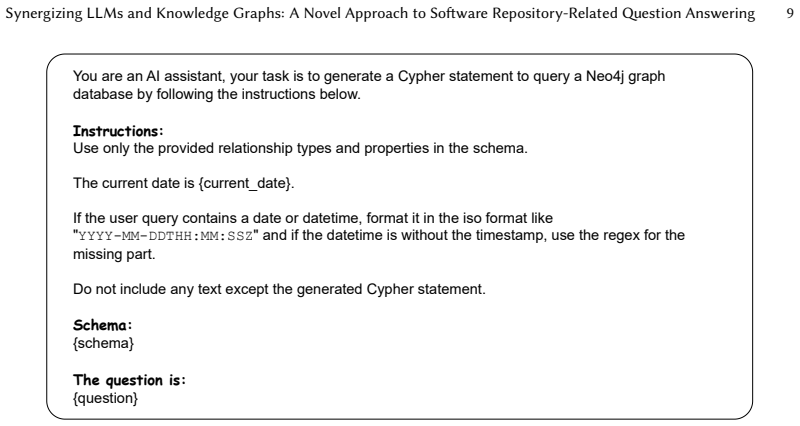
The load-bearing object is a repository knowledge graph whose schema has four node types—User, Commit, Issue, and File—connected by relationships such as author, fixed, introduced, impacted, and changed, with evolving file attributes stored on edges. The LLM-based query generator receives this schema plus the question and must emit Cypher, a declarative query language for property graphs, with randomness reduced to zero; a regular-expression extractor isolates the Cypher from stray text, the query runs against a graph database, and the response generator, another LLM call, produces the answer from the query results. The decisive mechanism is the few-shot chain-of-thought prompt, which embeds two worked examples that model how to list possible interpretations, choose the most probable one, identify relevant nodes and relationships, and assemble the query step by step; this is what lifts accuracy from 65% to 84%.
What would settle it
Have an independent team write ground-truth graph queries for the same 20 questions without seeing the LLM outputs, then re-run the five-per-project evaluation; the claim is confirmed only if the few-shot chain-of-thought pipeline again beats the 65% no-CoT baseline and the intent-based baseline.
Extended reading notes
Core claim
The central claim is that the bottleneck in LLM-based repository question answering is not retrieving facts but reasoning over the graph structure, and that few-shot chain-of-thought prompting directly addresses that bottleneck. The paper reports that overall accuracy rises from 65% to 84% when two worked reasoning examples are added to the query-generation prompt; for level-3 questions requiring two or more graph relationships, accuracy rises from 50% to 90%. Against baselines on the full 150-question set, the approach scored 82% versus 70% for an intent-based chatbot and 19% for an LLM with web search. In a user study with 20 participants, 84% of tasks were completed correctly with the chatbot versus 36% manually, and median time per session fell from about 20.7 minutes to 10.3 minutes. The paper also documents that 75% of failures trace to incorrect relationship modeling, supporting the reasoning-centric diagnosis.
Load-bearing premise
The headline accuracy depends on the authors' hand-written graph queries being the uniquely correct interpretation of each question, and on the authors' manual judgment of which answers count as correct.
Editorial extensions
If this is right
- A query generator with few-shot chain-of-thought can answer questions requiring two or more relationships at 90% accuracy, up from 50% without it, so the hardest part of repository Q&A is reasoning rather than retrieval.
- The approach beats an intent-based chatbot (70%) and an LLM with web search (19%) on the same 150 questions, suggesting structured grounding outperforms both fixed intents and unstructured retrieval for repository metadata questions.
- Non-specialists can get correct answers to repository questions without command-line skill: in the user study, 84% of chatbot-aided answers were correct versus 36% manually, in about half the median time.
- Because the schema is identical across projects, the 80–90% per-project accuracy range suggests the method transfers across repositories once the graph is built.
- The documented failure modes—incorrect relationship modeling, faulty arithmetic, misapplied filters and dates, and hallucination—provide a concrete checklist for improving LLM-to-graph query generation.
Reading between the lines
- If ambiguous questions were scored as correct whenever the LLM's interpretation is defensible, the paper's own re-analysis puts accuracy near 94%; a benchmark that pre-registers interpretation rules would make the headline number less dependent on the authors' judgment.
- The same schema-plus-few-shot-reasoning recipe is a natural template for other structured domains—enterprise data, scientific metadata, or CI/CD logs—where a graph schema and a query language already exist and the open question is how reliably an LLM can translate natural language into queries.
- The paper's error taxonomy suggests a testable extension: adding a verification pass that executes a generated query, checks the result for empty or anomalous output, and re-prompts the LLM could recover a share of the remaining 16% errors without changing the schema.
- Because the user study compared chatbot use against whatever methods participants chose, part of the time saving may reflect tool familiarity; a controlled comparison against a chatbot without knowledge-graph grounding would isolate the contribution of the graph itself.
Editorial analysis
A structured set of objections, weighed in public.
Referee Report
Summary. This paper proposes a repository question-answering pipeline that combines a knowledge graph of Git metadata (users, commits, issues, files) with an LLM that translates natural-language questions into Cypher queries, executes them against a Neo4j graph, and generates natural-language answers. The authors evaluate on five GitHub projects using 20 question templates derived from the MSRBot dataset, report a baseline accuracy of 65%, identify LLM reasoning errors through manual analysis, add few-shot chain-of-thought prompting and report 84% accuracy, compare against MSRBot (70%) and GPT-4o-search-preview (19%), and supplement this with a 20-participant task-based user study. The paper also provides a failure taxonomy, an ad-hoc example outside the test set, and a replication package.
Significance. If the accuracy claims held, this would be a useful empirical contribution: it is among the first studies to apply a knowledge-graph-plus-LLM architecture to repository-metadata question answering, it provides a detailed error taxonomy, it includes a user study, and it releases a replication package. However, the central quantitative claims are not currently supported by the evaluation design. The same 20 question templates were used for LLM selection, for prompt development, and for the reported RQ1/RQ3 results; the relationship between the 20-question evaluation and the 150-question set referenced in the abstract and in Table 15 is unclear; and correctness is judged against author-written Cypher queries whose interpretation changes the headline result from 84% to 94%. These are load-bearing issues, so the paper needs a major revision with a held-out evaluation and a transparent, reproducible correctness protocol.
major comments (3)
- [§5.1 and §4.2] The evaluation is contaminated by test-set leakage: RQ0 selects GPT-4o by execution accuracy on the same 20 templates (Table 4) that are later used to report the 65% and 84% results (Tables 5–6 and 13–14), and the few-shot chain-of-thought prompt was designed after inspecting failures on those same questions. Because no held-out split exists, the headline accuracy and the comparison with MSRBot are estimates of in-sample fit, not of generalization. Please re-run the evaluation on a disjoint held-out set, or otherwise account for the model-selection and prompt-development steps in the reported numbers.
- [§5.4, Table 15, and §4.2] The manuscript is internally inconsistent about the evaluation size. Section 4.2 defines the evaluation set as 20 templates (100 question-project pairs), and RQ1/RQ3 report results over 100 executed question-project pairs. Section 5.4 and Table 15 then report 750 questions (150 per project) for the comparison with MSRBot and GPT-4o-search-preview, and the abstract attributes the 84% figure to 150 questions. Please clarify which set produced each number; if the full 150-question set was used for the chain-of-thought evaluation, report its per-project and per-difficulty results separately. As written, the abstract's '150 questions' claim does not match the main RQ3 evaluation, and the baseline comparison is not directly comparable if the two methods were evaluated on different sets.
- [§4.2 and §6] The correctness measure is subjective in a way that directly affects the headline result. The ground truth consists of Cypher queries written by the first author and reviewed by the co-authors, and Section 6 reports that accepting alternative reasonable interpretations of ambiguous questions raises accuracy from 84% to 94%. The 84% figure is therefore not a stable property of the system but a function of the authors' query semantics. Please pre-specify the intended semantics for each question template, use multiple independent annotators to judge whether a generated answer matches the ground truth, report inter-annotator agreement, and present both the strict and the lenient scores.
minor comments (5)
- [Abstract and §8] The abstract and conclusion say the approach was evaluated on '150 questions,' while RQ1 and RQ3 report results on 20 question templates; align the abstract with the actual evaluation described in Sections 4.2 and 5.2–5.4.
- [§5.3 and §8] The RQ2 summary and the conclusion state that faulty reasoning accounts for 80.5% of errors, but Table 7 reports 75.0% for incorrect relationship modeling and lists other reasoning-related categories separately; please explain how the 80.5% figure is computed.
- [§6] The discussion claims that if the LLM generated the same Cypher query for each question, accuracy would be constant across repositories; this ignores differences in repository data and in which questions are answered, so please qualify the claim.
- [Figure 6] Figure 6 would be easier to interpret if the cumulative number of questions and the majority-vote threshold (3/5) were marked directly on the plot.
- [§4.4] Section 4.4 explains that a RAG baseline was excluded because it performed poorly, and GPT-4o-search-preview is introduced as a replacement; please add one sentence explaining how web search is expected to serve the same evaluation purpose as RAG.
Circularity Check
Headline 84% is measured on the same 20 questions used to select the model and develop the CoT prompt, and correctness is scored against the authors' own hand-written oracle; the claim is partly circular, though the 150-question baseline comparison retains independent content.
-
fitted input called prediction
[Section 5.1 (RQ0, model selection) and Section 5.4 (RQ3, few-shot CoT evaluation); Tables 4 and 13]
"We evaluate the models on the 20 questions described in Section 4.2 using the prompt template shown in Figure 3 to generate the Cypher query. [...] The selection of the GPT-4o model is based on its performance in our exploratory question (discussed in Section 5.1). [...] To evaluate the gains, we use the same set of 20 questions described in Section 4 and used in RQ1, executing the experiments five times for each question to account for the stochastic nature of the LLM's generation."
GPT-4o is chosen because it scored highest (EX 0.65) on the same 20-question set that later defines the RQ1/RQ3 accuracy, and the few-shot chain-of-thought configuration was introduced after failure analysis on those same questions. The reported 84% is therefore the score of a configuration selected and refined on the very test set from which it is reported, so the headline accuracy is not an unbiased estimate for unseen questions. Table 15's full 150-question run reports 0.82 (not 0.84), confirming that the abstract's 84% is the leaked-set number rather than a stable system property.
-
self definitional
[Section 4.2 (ground-truth construction) and Section 6 (ambiguity discussion); Appendix E]
"To establish the ground truth for our evaluation, the first author manually wrote Cypher queries corresponding to all 20 questions for each of the selected repositories. To ensure the correctness of these queries and eliminate potential bias, the authors collaboratively reviewed and discussed the logic employed in each query. [...] In the evaluation in our RQ3, we considered these scenarios as incorrectly answered questions. However, if we had considered such scenarios in our evaluation as correct, the accuracy in RQ3 increased from an average of 84% to 94%."
The oracle answers are authored by the first author and reviewed by the same team, so 'correct' is defined by the authors' interpretation of each question rather than by an independent standard. The paper itself quantifies the consequence: reclassifying 'reasonable interpretations' of ambiguous questions as correct moves the headline from 84% to 94%. The measured accuracy is thus a function of the scoring convention adopted by the authors, and the 84% figure cannot be treated as an intrinsic, interpretation-independent property of the approach.
full rationale
The paper makes no first-principles derivation; it is an empirical system evaluation, so circularity arises only in how the headline number is produced and scored. Two intertwined issues make the headline 84% partially circular. First, RQ0 selects GPT-4o on the same 20-question set used for RQ1/RQ3, and the CoT prompting decision was made after inspecting failures on that same set, so the 84% is measured on the set used to make the design choices (test-set leakage). Second, the oracle answers are hand-written and author-reviewed, and Section 6 shows that accepting alternative reasonable interpretations raises the same result to 94%, so the 'correctness' label is an author-defined convention rather than an objective ground truth. These issues do not void the paper: Table 15 reports a full 150-question-per-project comparison (0.82 vs MSRBot's 0.70 and GPT-4o-search's 0.19), and the user study is a separate, externally anchored evaluation; those parts retain independent content. The paper also contains a reporting inconsistency: Section 4.2 defines the evaluation set as 20 templates, while Section 5.4/Table 15 and Section 7.3 refer to 150 questions per project, and the abstract conflates the two by attributing 84% to the 150-question evaluation. The self-citation to Abedu et al. [4] for RAG's failure justifies omitting a RAG baseline but is not load-bearing for the central comparison against MSRBot and GPT-4o-search, so it does not raise the score further. Overall: partial circularity in the headline accuracy, but the approach has independent empirical content beyond the leaked set.
Assumptions & free parameters
free parameters (3)
- LLM choice =
GPT-4o
- Few-shot CoT examples =
2 hand-crafted examples
- Majority-vote threshold =
3 out of 5
assumptions (4)
- domain assumption R-SZZ correctly identifies bug-introducing commits
- domain assumption The 150 questions from Abdellatif et al. cover the space of repository-related questions
- domain assumption Git commit logs reference issue IDs for fixing commits
- ad hoc to paper Manual judgment of LLM responses is a valid correctness measure
Cite this review
Pith. "Pith review of Synergizing LLMs and Knowledge Graphs: A Novel Approach to Software Repository-Related Question Answering." pith.science (2026). https://pith.science/paper/TGZP5MLO
@misc{pith2026241203815,
  author       = {Pith},
  title        = {Pith review of: Synergizing LLMs and Knowledge Graphs: A Novel Approach to Software Repository-Related Question Answering},
  year         = {2026},
  howpublished = {\url{https://pith.science/paper/TGZP5MLO}},
  note         = {Machine review of arXiv:2412.03815}
}
read the original abstract
Software repositories contain valuable information for understanding the development process. However, extracting insights from repository data is time-consuming and requires technical expertise. While software engineering chatbots support natural language interactions with repositories, chatbots struggle to understand questions beyond their trained intents and to accurately retrieve the relevant data. This study aims to improve the accuracy of LLM-based chatbots in answering repository-related questions by augmenting them with knowledge graphs. We use a two-step approach: constructing a knowledge graph from repository data, and synergizing the knowledge graph with an LLM to handle natural language questions and answers. We curated 150 questions of varying complexity and evaluated the approach on five popular open-source projects. Our initial results revealed the limitations of the approach, with most errors due to the reasoning ability of the LLM. We therefore applied few-shot chain-of-thought prompting, which improved accuracy to 84%. We also compared against baselines (MSRBot and GPT-4o-search-preview), and our approach performed significantly better. In a task-based user study with 20 participants, users completed more tasks correctly and in less time with our approach, and they reported that it was useful. Our findings demonstrate that LLMs and knowledge graphs are a viable solution for making repository data accessible.
Figures


Figures from the paper (5 more)


Reference graph
Works this paper leans on
-
[1]
Ahmad Abdellatif, Khaled Badran, Diego Elias Costa, and Emad Shihab. 2022. A Comparison of Natural Language Understanding Platforms for Chatbots in Software Engineering.IEEE Transactions on Software Engineering48, 8 (Aug. 2022), 3087–3102. https://doi.org/10.1109/TSE.2021.3078384
arXiv 2022
-
[2]
Ahmad Abdellatif, Khaled Badran, and Emad Shihab. 2020. MSRBot: Using Bots to Answer Questions from Software Repositories.Empirical Software Engineering25, 3 (May 2020), 1834–1863. https://doi.org/10.1007/s10664-019-09788-5
-
[3]
Ahmad Abdellatif, Diego Costa, Khaled Badran, Rabe Abdalkareem, and Emad Shihab. 2020. Challenges in Chatbot Development: A Study of Stack Overflow Posts. InProceedings of the 17th International Conference on Mining Software Repositories (MSR ’20). Association for Computing Machinery, New York, NY, USA, 174–185. https://doi.org/10.1145/ 3379597.3387472
arXiv 2020
-
[4]
Samuel Abedu, Ahmad Abdellatif, and Emad Shihab. 2024. LLM-Based Chatbots for Mining Software Repositories: Challenges and Opportunities. InProceedings of the 28th International Conference on Evaluation and Assessment in Software Engineering (EASE ’24). Association for Computing Machinery, New York, NY, USA, 201–210. https: //doi.org/10.1145/3661167.3661218
arXiv 2024
-
[5]
Samuel Abedu, SayedHassan Khatoonabadi, and Emad Shihab. 2024. Sabedu/Knowledge_graph_llm_synergy: Replica- tion Package Release. Zenodo. https://doi.org/10.5281/zenodo.14271490
-
[6]
Hasan Abu-Rasheed, Christian Weber, and Madjid Fathi. 2024. Knowledge Graphs as Context Sources for LLM-Based Explanations of Learning Recommendations. https://doi.org/10.48550/arXiv.2403.03008 arXiv:2403.03008
-
[7]
Eleni Adamopoulou and Lefteris Moussiades. 2020. An Overview of Chatbot Technology. InArtificial Intelligence Applications and Innovations, Ilias Maglogiannis, Lazaros Iliadis, and Elias Pimenidis (Eds.). Springer International Publishing, Cham, 373–383. https://doi.org/10.1007/978-3-030-49186-4_31
-
[8]
Anthropic. 2024. Introducing Claude 3.5 Sonnet \ Anthropic. https://www.anthropic.com/news/claude-3-5-sonnet
2024
Show all 83 references
-
[9]
Sean Banerjee and Bojan Cukic. 2015. On the Cost of Mining Very Large Open Source Repositories. In2015 IEEE/ACM 1st International Workshop on Big Data Software Engineering. IEEE Press, 37–43. https://doi.org/10.1109/BIGDSE.2015.16
2015 doi
-
[10]
Andrew Begel and Thomas Zimmermann. 2014. Analyze This! 145 Questions for Data Scientists in Software Engineering. InProceedings of the 36th International Conference on Software Engineering (ICSE 2014). Association for Computing Machinery, New York, NY, USA, 12–23. https://doi...
2014
-
[11]
Hudson Borges and Marco Tulio Valente. 2018. What’s in a GitHub Star? Understanding Repository Starring Practices in a Social Coding Platform.Journal of Systems and Software146 (Dec. 2018), 112–129. https://doi.org/10.1016/j.jss. 2018.09.016
2018 doi
-
[12]
Bradley, Thomas Fritz, and Reid Holmes
Nick C. Bradley, Thomas Fritz, and Reid Holmes. 2018. Context-Aware Conversational Developer Assistants. InPro- ceedings of the 40th International Conference on Software Engineering (ICSE ’18). Association for Computing Machinery, New York, NY, USA, 993–1003. https://doi.org/1...
2018
-
[13]
Gleison Brito, Thais Mombach, and Marco Tulio Valente. 2019. Migrating to GraphQL: A Practical Assessment. In2019 IEEE 26th International Conference on Software Analysis, Evolution and Reengineering (SANER). IEEE Computer Society, 140–150. https://doi.org/10.1109/SANER.2019.8667986
2019
-
[14]
Meiqi Chen, Yubo Ma, Kaitao Song, Yixin Cao, Yan Zhang, and Dongsheng Li. 2024. Improving Large Language Models in Event Relation Logical Prediction. InProceedings of the 62nd Annual Meeting of the Association for Computa- tional Linguistics (Volume 1: Long Papers), Lun-Wei Ku...
2024 doi
-
[15]
Xiaojun Chen, Shengbin Jia, and Yang Xiang. 2020. A Review: Knowledge Reasoning over Knowledge Graph.Expert Systems with Applications141 (March 2020), 112948. https://doi.org/10.1016/j.eswa.2019.112948
2020
-
[16]
Lan Cheng, Emerson Murphy-Hill, Mark Canning, Ciera Jaspan, Collin Green, Andrea Knight, Nan Zhang, and Elizabeth Kammer. 2022. What Improves Developer Productivity at Google? Code Quality. InProceedings of the 30th ACM Joint European Software Engineering Conference and Sympos...
2022
-
[17]
Daniel Alencar da Costa, Shane McIntosh, Weiyi Shang, Uirá Kulesza, Roberta Coelho, and Ahmed E. Hassan. 2017. A Framework for Evaluating the Results of the SZZ Approach for Identifying Bug-Introducing Changes.IEEE Transactions on Software Engineering43, 7 (July 2017), 641–657...
2017
-
[18]
Steven Davies, Marc Roper, and Murray Wood. 2014. Comparing Text-Based and Dependence-Based Approaches for Determining the Origins of Bugs.Journal of Software: Evolution and Process26, 1 (2014), 107–139. https: //doi.org/10.1002/smr.1619 , Vol. 1, No. 1, Article . Publication ...
2014 doi
-
[19]
Malinda Dilhara, Ameya Ketkar, and Danny Dig. 2021. Understanding Software-2.0: A Study of Machine Learning Library Usage and Evolution.ACM Transactions on Software Engineering and Methodology30, 4 (July 2021), 1–42. https://doi.org/10.1145/3453478
2021 doi
-
[20]
James Dominic, Jada Houser, Igor Steinmacher, Charles Ritter, and Paige Rodeghero. 2020. Conversational Bot for Newcomers Onboarding to Open Source Projects. InProceedings of the IEEE/ACM 42nd International Conference on Software Engineering Workshops (ICSEW’20). Association f...
2020
-
[21]
EbookFoundation. 2024. EbookFoundation/Free-Programming-Books. Free Ebook Foundation
2024
-
[22]
Darren Edge, Ha Trinh, Newman Cheng, Joshua Bradley, Alex Chao, Apurva Mody, Steven Truitt, and Jonathan Larson
-
[23]
Nadime Francis, Alastair Green, Paolo Guagliardo, Leonid Libkin, Tobias Lindaaker, Victor Marsault, Stefan Plantikow, Mats Rydberg, Petra Selmer, and Andrés Taylor. 2018. Cypher: An Evolving Query Language for Property Graphs. In Proceedings of the 2018 International Conferenc...
2018
-
[24]
Mingyang Geng, Shangwen Wang, Dezun Dong, Haotian Wang, Ge Li, Zhi Jin, Xiaoguang Mao, and Xiangke Liao
-
[25]
GitHub. 2024. GitHub GraphQL API Documentation. https://docs.github.com/en/graphql
2024
-
[26]
InProceedings of the IEEE/ACM 46th International Conference on Software Engineering(New York, NY, USA, 2024-02-06) (ICSE ’24)
Large Language Models are Few-Shot Summarizers: Multi-Intent Comment Generation via In-Context Learning. InProceedings of the IEEE/ACM 46th International Conference on Software Engineering(New York, NY, USA, 2024-02-06) (ICSE ’24). Association for Computing Machinery, 1–13. ht...
2024
-
[27]
GitHub. 2024. Public Schema. https://docs.github.com/en/graphql/overview/public-schema
2024
-
[28]
GitHub. 2024. GitHub REST API Documentation. https://docs.github.com/en/rest
2024
-
[29]
Hideaki Hata, Nicole Novielli, Sebastian Baltes, Raula Gaikovina Kula, and Christoph Treude. 2021. GitHub Discussions: An Exploratory Study of Early Adoption.Empirical Software Engineering27, 1 (Oct. 2021), 3. https://doi.org/10.1007/ s10664-021-10058-6
2021
-
[30]
Ahmed E. Hassan. 2008. The Road Ahead for Mining Software Repositories. In2008 Frontiers of Software Maintenance. IEEE, 48–57. https://doi.org/10.1109/FOSM.2008.4659248
2008
-
[31]
Rashid, Anisa Rula, Lukas Schmelzeisen, Juan Sequeda, Steffen Staab, and Antoine Zimmermann
Aidan Hogan, Eva Blomqvist, Michael Cochez, Claudia D’amato, Gerard De Melo, Claudio Gutierrez, Sabrina Kirrane, José Emilio Labra Gayo, Roberto Navigli, Sebastian Neumaier, Axel-Cyrille Ngonga Ngomo, Axel Polleres, Sabbir M. Rashid, Anisa Rula, Lukas Schmelzeisen, Juan Sequed...
2021 doi
- [32]
-
[33]
Xinyi Hou, Yanjie Zhao, Yue Liu, Zhou Yang, Kailong Wang, Li Li, Xiapu Luo, David Lo, John Grundy, and Haoyu Wang
- [34]
-
[35]
Shaoxiong Ji, Shirui Pan, Erik Cambria, Pekka Marttinen, and Philip S. Yu. 2022. A Survey on Knowledge Graphs: Representation, Acquisition, and Applications.IEEE Transactions on Neural Networks and Learning Systems33, 2 (Feb. 2022), 494–514. https://doi.org/10.1109/TNNLS.2021.3070843
2022
-
[36]
33, 8 (2024), 220:1–220:79
Large Language Models for Software Engineering: A Systematic Literature Review. 33, 8 (2024), 220:1–220:79. https://doi.org/10.1145/3695988
2024 doi
-
[37]
izkeros. 2022. How Can I Calculate the Number of Lines Changed since Last Commit in Git?
2022
-
[38]
Ranim Khojah, Mazen Mohamad, Philipp Leitner, and Francisco Gomes de Oliveira Neto. 2024. Beyond Code Generation: An Observational Study of ChatGPT Usage in Software Engineering Practice. 1 (2024), 81:1819–81:1840. Issue FSE. https://doi.org/10.1145/3660788
2024 doi
- [39]
-
[40]
SayedHassan Khatoonabadi, Ahmad Abdellatif, Diego Elias Costa, and Emad Shihab. 2024. Predicting the First Response Latency of Maintainers and Contributors in Pull Requests.IEEE Transactions on Software Engineering50, 10 (Oct. 2024), 2529–2543. https://doi.org/10.1109/TSE.2024.3443741
2024
-
[41]
Jasmine Latendresse, Samuel Abedu, Ahmad Abdellatif, and Emad Shihab. 2024. An Exploratory Study on Machine Learning Model Management.ACM Trans. Softw. Eng. Methodol.(Aug. 2024). https://doi.org/10.1145/3688841
2024 doi
-
[42]
Ko, Robert DeLine, and Gina Venolia
Amy J. Ko, Robert DeLine, and Gina Venolia. 2007. Information Needs in Collocated Software Development Teams. In 29th International Conference on Software Engineering (ICSE’07)(2007-05). 344–353. https://doi.org/10.1109/ICSE.2007.45 ISSN: 1558-1225. , Vol. 1, No. 1, Article . ...
2007 doi
-
[43]
Takeshi Kojima, Shixiang (Shane) Gu, Machel Reid, Yutaka Matsuo, and Yusuke Iwasawa. 2022. Large Language Models Are Zero-Shot Reasoners.Advances in Neural Information Processing Systems35 (Dec. 2022), 22199–22213
2022
- [44]
-
[45]
Ernests Lavrinovics, Russa Biswas, Johannes Bjerva, and Katja Hose. 2025. Knowledge Graphs, Large Language Models, and Hallucinations: An NLP Perspective. 85 (2025), 100844. https://doi.org/10.1016/j.websem.2024.100844
2025
-
[46]
Jinyang Li, Binyuan Hui, Ge Qu, Jiaxi Yang, Binhua Li, Bowen Li, Bailin Wang, Bowen Qin, Ruiying Geng, Nan Huo, Xuanhe Zhou, Ma Chenhao, Guoliang Li, Kevin Chang, Fei Huang, Reynold Cheng, and Yongbin Li. 2023. Can LLM Already Serve as A Database Interface? A BIg Bench for Lar...
2023
-
[47]
Akshat Malik, Bram Adams, and Ahmed Hassan. 2024. Towards Graph-Anonymization of Software Analytics Data: Empirical Study on JIT Defect Prediction.Empirical Software Engineering29, 4 (June 2024), 76. https://doi.org/10.1007/ s10664-024-10464-6
2024
- [48]
-
[49]
Yacine Majdoub and Eya Ben Charrada. 2024. Debugging with Open-Source Large Language Models: An Evaluation. In Proceedings of the 18th ACM/IEEE International Symposium on Empirical Software Engineering and Measurement (ESEM ’24). Association for Computing Machinery, New York, ...
2024
-
[50]
Dušan Okanović, Samuel Beck, Lasse Merz, Christoph Zorn, Leonel Merino, André van Hoorn, and Fabian Beck
-
[51]
Maxwell, L
K.D. Maxwell, L. Van Wassenhove, and S. Dutta. 1996. Software Development Productivity of European Space, Military, and Industrial Applications.IEEE Transactions on Software Engineering22, 10 (Oct. 1996), 706–718. https: //doi.org/10.1109/32.544349
1996 doi
-
[52]
Meta. 2024. Meta-Llama/Meta-Llama-3-8B·Hugging Face. https://huggingface.co/meta-llama/Meta-Llama-3-8B
2024
-
[53]
Shirui Pan, Linhao Luo, Yufei Wang, Chen Chen, Jiapu Wang, and Xindong Wu. 2024. Unifying Large Language Models and Knowledge Graphs: A Roadmap.IEEE Transactions on Knowledge and Data Engineering36, 7 (July 2024), 3580–3599. https://doi.org/10.1109/TKDE.2024.3352100
2024
- [54]
-
[55]
OpenAI. 2024. Best Practices for Prompt Engineering with the OpenAI API. https://help.openai.com/en/articles/6654000- best-practices-for-prompt-engineering-with-the-openai-api
2024
-
[56]
OpenAI. 2024. Hello GPT-4o. https://openai.com/index/hello-gpt-4o/
2024
-
[57]
Juan Sequeda, Dean Allemang, and Bryon Jacob. 2025. Knowledge Graphs as a source of trust for LLM-powered enterprise question answering. (2025), 100858. https://doi.org/10.1016/j.websem.2024.100858
2025
- [58]
-
[59]
Chandrasekaran
Kiran Ramesh, Surya Ravishankaran, Abhishek Joshi, and K. Chandrasekaran. 2017. A Survey of Design Techniques for Conversational Agents. InInformation, Communication and Computing Technology, Saroj Kaushik, Daya Gupta, Latika Kharb, and Deepak Chahal (Eds.). Springer, Singapor...
2017 doi
-
[60]
Iflaah Salman, Ayse Tosun Misirli, and Natalia Juristo. 2015. Are Students Representatives of Professionals in Software Engineering Experiments?. In2015 IEEE/ACM 37th IEEE International Conference on Software Engineering, Vol. 1. 666–676. https://doi.org/10.1109/ICSE.2015.82 I...
2015 doi
-
[61]
Amit Singhal. 2012. Introducing the Knowledge Graph: Things, Not Strings. https://blog.google/products/search/introducing-knowledge-graph-things-not/. , Vol. 1, No. 1, Article . Publication date: October 2025. 34 Abedu et al
2012
-
[62]
Jacek Śliwerski, Thomas Zimmermann, and Andreas Zeller. 2005. When Do Changes Induce Fixes?ACM SIGSOFT Software Engineering Notes30, 4 (May 2005), 1–5. https://doi.org/10.1145/1082983.1083147
2005
-
[63]
Vibhu Saujanya Sharma, Rohit Mehra, and Vikrant Kaulgud. 2017. What Do Developers Want? An Advisor Approach for Developer Priorities. In2017 IEEE/ACM 10th International Workshop on Cooperative and Human Aspects of Software Engineering (CHASE). IEEE Press, 78–81. https://doi.or...
2017 doi
-
[64]
Jiho Shin, Clark Tang, Tahmineh Mohati, Maleknaz Nayebi, Song Wang, and Hadi Hemmati. 2025. Prompt Engineering or Fine-Tuning: An Empirical Assessment of LLMs for Code. In2025 IEEE/ACM 22nd International Conference on Mining Software Repositories (MSR)(2025-04). 490–502. https...
2025
-
[65]
M. Vidoni. 2022. A Systematic Process for Mining Software Repositories: Results from a Systematic Literature Review. Information and Software Technology144 (April 2022), 106791. https://doi.org/10.1016/j.infsof.2021.106791
2022
-
[66]
Peiyi Wang, Lei Li, Liang Chen, Zefan Cai, Dawei Zhu, Binghuai Lin, Yunbo Cao, Qi Liu, Tianyu Liu, and Zhifang Sui
-
[67]
2024.AI | 2024 Stack Overflow Developer Survey
Stackoverflow. 2024.AI | 2024 Stack Overflow Developer Survey. https://survey.stackoverflow.co/2024/ai
2024
-
[68]
Linus Torvalds. 2024. Torvalds/Linux
2024
-
[69]
Le, and Denny Zhou
Jason Wei, Xuezhi Wang, Dale Schuurmans, Maarten Bosma, Brian Ichter, Fei Xia, Ed Chi, Quoc V. Le, and Denny Zhou
-
[70]
Yi Wu, Nan Jiang, Hung Viet Pham, Thibaud Lutellier, Jordan Davis, Lin Tan, Petr Babkin, and Sameena Shah. 2023. How Effective Are Neural Networks for Fixing Security Vulnerabilities. InProceedings of the 32nd ACM SIGSOFT International Symposium on Software Testing and Analysi...
2023
-
[71]
Ruobing Xie, Zhiyuan Liu, Jia Jia, Huanbo Luan, and Maosong Sun. 2016. Representation Learning of Knowledge Graphs with Entity Descriptions.Proceedings of the AAAI Conference on Artificial Intelligence30, 1 (March 2016). https://doi.org/10.1609/aaai.v30i1.10329
2016 doi
- [72]
- [73]
- [74]
-
[75]
Yanjie Zhao, Haoyu Wang, Lei Ma, Yuxin Liu, Li Li, and John Grundy. 2019. Knowledge Graphing Git Repositories: A Preliminary Study. In2019 IEEE 26th International Conference on Software Analysis, Evolution and Reengineering (SANER). IEEE, 599–603. https://doi.org/10.1109/SANER...
2019
- [76]
- [77]
- [78]
-
[79]
Junjielong Xu, Ziang Cui, Yuan Zhao, Xu Zhang, Shilin He, Pinjia He, Liqun Li, Yu Kang, Qingwei Lin, Yingnong Dang, Saravan Rajmohan, and Dongmei Zhang. 2024. UniLog: Automatic Logging via LLM and In-Context Learning. In Proceedings of the IEEE/ACM 46th International Conferenc...
2024
-
[2020]
InProceedings of the ACM/SPEC International Conference on Performance Engineering (ICPE ’20)
Can a Chatbot Support Software Engineers with Load Testing? Approach and Experiences. InProceedings of the ACM/SPEC International Conference on Performance Engineering (ICPE ’20). Association for Computing Machinery, New York, NY, USA, 120–129. https://doi.org/10.1145/3358960.3375792
-
[2022]
2022), 24824–24837
Chain-of-Thought Prompting Elicits Reasoning in Large Language Models.Advances in Neural Information Processing Systems35 (Dec. 2022), 24824–24837
2022
- [2023]
- [2024]
Reviewed August 11, 2026 · model on record in the stance chip above.
Discussion (0). Continue with ORCID to comment.