REVIEW 3 major objections 5 minor 20 references
Closed-Loop Control with Rule-Aligned Small Language Models and Multi-Agent Self-Correction
T0 review · 3 major / 5 minor · reviewed 2026-07-14 · grok-4.5
Pith's one-line read A 1.5B language model aligned for thermal control and wrapped in a validator–reprompt loop reaches 91.5% action accuracy at edge-friendly latency.
desk verdict Solid systems demo that a GRPO-tuned 1.5B SLM plus oracle validator can imitate discrete thermal rules at usable latency, but the headline accuracy is largely circular and the reconfiguration claim is untested. read the letter →
The pith
A machine-rendered reading of the paper's core claim, the machinery that carries it, and where it could break.
The reading
What carries the argument
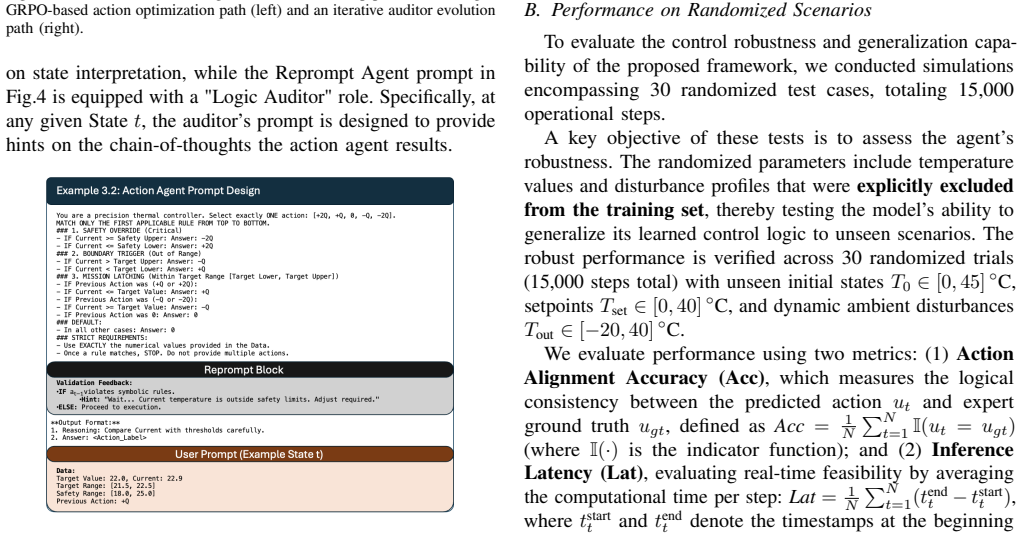
The multi-agent validator-guided correction loop—Action Agent (GRPO-aligned 1.5B SLM), symbolic Validation layer that accepts only actions matching ExpertRules, and Reprompt Agent that issues corrective hints—turns imperfect token-level proposals into plant-safe actions by iterative zero-shot self-correction without training the action agent on those hints.
What would settle it
Run the same multi-agent loop on a hardware-in-the-loop thermal plant with sensor noise and actuator lag, using only the learned SLM and validator; if temperature stays inside the safety band for ~95% of multi-hour steps even when action accuracy against the original rule table collapses, or if the plant leaves the band when the rule table is deliberately corrupted, the central claim is settled either way.
Extended reading notes
Core claim
A Qwen2.5-1.5B model aligned via Group Relative Policy Optimization, placed inside a three-agent loop of action proposal, symbolic validation against expert rules, and zero-shot reprompt correction, achieves 91.5% average action-alignment accuracy (86.3%–100% across 30 randomized 500-step thermal experiments) at 3.84 s mean latency, and under symbolic re-mapping of the power label still maintains a 95% in-range rate, supporting SLM-plus-validator architectures as a practical path to reconfigurable edge control.
Load-bearing premise
The system treats agreement with a fixed expert-rule table—used both to reward training and to validate every action—as a sufficient stand-in for successful plant control; if those rules are wrong, incomplete, or unavailable on a real plant, both the accuracy claims and the safety argument fail.
Editorial extensions
If this is right
- Compact SLMs can be specialized for closed-loop industrial control without relying on cloud inference.
- Physical regulation can remain strong even when token-level agreement with expert labels drops under interface changes.
- Reconfigurable control policies become reachable from high-level intent once a plant-aware validator gates every execution step.
- Edge deployment of language-model controllers becomes latency- and data-sovereignty-feasible relative to large cloud models.
- Emergent corrective ability can appear without ever training the action agent on reprompt dialogues.
Reading between the lines
- The same GRPO-plus-validator pattern could transfer to other discrete-action process loops (multi-zone HVAC, simple batch chemistry) wherever expert rule tables or twins already exist.
- Replacing the perfect symbolic ExpertRules oracle with an imperfect predictive digital twin is the natural next stress test of whether the architecture still stabilizes.
- Mean 3.84 s latency currently suits slow thermal processes more than fast mechanical or power-electronics loops unless model size or edge hardware is further optimized.
- Because both training reward and runtime safety rest on the same fixed rule table, true natural-language policy reconfiguration still requires a trustworthy validator layer to remain safe.
Editorial analysis
A structured set of objections, weighed in public.
Referee Report
Summary. The paper proposes a closed-loop thermal controller built from a GRPO-aligned Qwen2.5-1.5B Action Agent, a symbolic ExpertRules validation layer, and a Reprompt Agent that supplies corrective hints. In 30 randomized 500-step simulations the system reports 91.5% average action-alignment accuracy (Acc) at 3.84 s mean latency; under symbolic re-mapping of the power label it retains a 95% in-range rate (IRR). The authors argue that SLM+validator architectures are a practical path to edge-deployable, reconfigurable autonomous control from natural-language specifications.
Significance. If the result holds under an independent plant-aware validator and under genuine natural-language requirement changes, the work would be a useful demonstration that a 1.5B model can internalize discrete thermal heuristics and participate in a verify-then-execute loop at edge-relevant latency. Strengths that should be retained include: (i) the symbolic re-mapping stress test, which cleanly separates token agreement from physical regulation (74.1% Acc vs 95% IRR); (ii) explicit multi-agent separation of proposal, validation, and correction (Algorithm 1); (iii) trajectory-level comparison against an HRBC expert baseline and against GPT-4o/DeepSeek-V3 on a fixed 1,500-sample benchmark; and (iv) an honest limitations section that already flags HIL testing and digital-twin validators as next steps. These elements make the manuscript a credible engineering contribution once the metric and claim scope are tightened.
major comments (3)
- [§IV.B, Algorithm 1, Table I–II] §IV.B defines Acc as exact match to ugt = ExpertRules(st). Algorithm 1 (lines 7–10) and Table II use the identical ExpertRules hierarchy both as the GRPO reward target and as the runtime Validation Agent that accepts or triggers reprompting. Consequently the primary reported success metric largely measures imitation of a fixed discrete oracle that is also the safety gate; it does not independently establish closed-loop competence against plant dynamics (Eq. 1). The remapping experiment already shows Acc and physical success can diverge (74.1% vs 95% IRR). Please either (a) elevate IRR / tracking-error / constraint-violation metrics as primary, with Acc demoted to a secondary imitation score, or (b) introduce a validator that is independent of the ExpertRules table used for training (e.g., a predictive digital twin or a held-out rule set) and re-report Acc under that validator.
- [Abstract, §I, §IV.C] The abstract and §I frame the contribution as creating and reconfiguring control policies from natural-language requirement specifications with minimal manual redesign. All reported experiments, however, use a fixed symbolic rule hierarchy (Table I) and never vary natural-language objectives, safety envelopes, or set-point policies at inference time. The remapping test changes only the action token label (Q→F), not the requirement text. Either provide at least one experiment in which the natural-language specification is altered and the same SLM+loop is re-run without re-training, or narrow the claim language to “rule-aligned SLM control with validator-guided self-correction” and move NL reconfiguration to future work.
- [§III.A–B, Algorithm 1, Fig. 1] The safety argument rests on the Validation Agent returning ugt when retries are exhausted (Algorithm 1, final return). That fallback is only safe if ExpertRules is complete and correct for the plant. The paper markets the layer as “symbolic/digital-twin-style” (§III.A, Fig. 1) but implements pure rule matching, not a plant model. Given that future work already proposes replacing the rule layer with a predictive digital twin, the current manuscript should (i) state explicitly that the validator is an expert-rule oracle, not a twin, and (ii) quantify how often the fallback is invoked and what the closed-loop cost of that fallback is under the reported disturbance ranges.
minor comments (5)
- [Figs. 7–8 vs Table IV / §IV.B] Figure captions for Figs. 7–8 report “average latency of 5.28 s” while the main text and Table IV report 3.84 s. Reconcile or explain the two numbers (different hardware, different reprompt budgets, or different protocols).
- [§IV.B.3] In-text figure references are incomplete (“As shown in 5”, “In 6”). Use consistent “Fig. X” notation.
- [Throughout] Typographical issues: “V alidation” (space in “Validation”), “repromtping”, and occasional missing spaces around units. A careful copy-edit pass is needed.
- [Table III] Table III reports Acc on 15,000 steps for the fine-tuned model but only 2,000 for the base model; state whether the base-model evaluation used the same 30 randomized scenarios or a different subset so that the 39.5%→91.5% jump is fully comparable.
- [§III.C.3, Eq. (1)] Eq. (1) uses a_t for the control action while the rest of the paper uses u_t / at; unify notation.
Circularity Check
Primary Acc metric, GRPO reward, and runtime validator all reduce to exact match against the identical ExpertRules oracle, so reported alignment is largely an imitation score against the training target.
-
self definitional
[Algorithm 1 (lines 7–10, 17) + §IV.B Acc definition + Table II]
"u_gt ← ExpertRules(s_t) if u_t = u_gt then return u_t else … return u_gt … Acc = 1/N ∑ I(ut = ugt) … Correct execution a∗ â=a∗ 1.0"
The sole ground-truth action used for GRPO rewards (Table II), for the runtime Validation Agent that accepts or triggers reprompting, and for the primary reported accuracy metric is identical: ExpertRules(st). Consequently Acc simply counts how often the (reprompted) Action Agent reproduces the same oracle that defined its training objective and that the loop will fall back to. The number is therefore an imitation rate against the paper’s own symbolic definition of correctness, not an independent prediction of plant behavior.
-
fitted input called prediction
[§IV.C Symbolic Re-mapping + Abstract claim of 95% IRR]
"While the exact action alignment accuracy decreased to 74.1%, the system achieved an In-Range Rate (IRR) of 95% … even when the agent fails to select the “expert-identical” token, its decisions remain functionally effective"
Under the Algorithm 1 fallback the executed action is forced to the (remapped) ExpertRules whenever the agent mismatches, so physical IRR is largely guaranteed by the validator rather than by the SLM’s free decisions. Presenting the 95% IRR as evidence that “decisions remain functionally effective despite reduced token-level agreement” therefore re-uses the same oracle-enforced safety that was already built into the loop; the physical success is not a fully independent prediction of the learned policy alone.
full rationale
The paper is an empirical systems/ML evaluation, not a first-principles derivation of a physical or mathematical quantity. High Acc is a non-trivial outcome of GRPO (base Qwen2.5-1.5B scores only 39.5% under the same loop) measured on held-out randomized thermal trajectories, and the remapping experiment supplies an independent physical metric (95% IRR at 74.1% Acc). Latency comparisons to GPT-4o/DeepSeek-V3 and trajectory plots vs HRBC are also external to the oracle. Nevertheless, a partial circularity exists by construction of the evaluation stack: the same discrete rule table (Table I) supplies (i) the GRPO reward target a*, (ii) the Validation Agent’s acceptance test, and (iii) the Acc definition. Algorithm 1 further returns u_gt on exhaustion of retries, guaranteeing that executed actions (and therefore plant trajectories under the perfect validator) match the oracle whenever the SLM fails. This makes the headline 91.5% Acc and the “closed-loop success” claim partly definitional rather than an independent demonstration of regulation competence against plant dynamics alone. Self-citations to prior Vyas/Mercangöz agentic frameworks are background only and not load-bearing for the quantitative results. Score 4 reflects the shared-oracle reduction without elevating it to full tautology, because training still has to produce the match and physical IRR under symbol remapping remains partially independent.
Assumptions & free parameters
free parameters (7)
- Thermal capacity C =
20.0
- Heat-transfer coefficient UA =
0.5
- Base power unit Q =
5.0
- GRPO group size G =
8
- Distillation trajectory count =
5000
- Reward penalty magnitudes =
{-1.0,-0.75,-0.5,1.0}
- Safety margin offset (±2 on T_safe) =
2
assumptions (5)
- domain assumption First-order energy-balance plant C dT/dt = UA(T_out - T) + a_t + ε adequately represents the closed-loop thermal task for evaluating controllers.
- domain assumption The symbolic rule hierarchy in Table I (safety override, boundary trigger, mission latching) is the correct expert ground truth for both training rewards and validation.
- domain assumption Discrete action set a ∈ {-2Q,-Q,0,Q,2Q} is sufficient for the control task.
- domain assumption GRPO with group-relative advantages stabilizes policy updates without a learned value function for this control-reasoning task.
- ad hoc to paper Brief distillation from DeepSeek-R1-671B for format/CoT does not amount to task memorization and leaves zero-shot corrective behavior emergent.
invented entities (1)
-
Reprompt Agent as zero-shot Logic Auditor with 'Wait...' Aha-moment prefix
Cite this review
Pith. "Pith review of Closed-Loop Control with Rule-Aligned Small Language Models and Multi-Agent Self-Correction." pith.science (2026). https://pith.science/paper/U5AEKMQX
@misc{pith2026260709713,
  author       = {Pith},
  title        = {Pith review of: Closed-Loop Control with Rule-Aligned Small Language Models and Multi-Agent Self-Correction},
  year         = {2026},
  howpublished = {\url{https://pith.science/paper/U5AEKMQX}},
  note         = {Machine review of arXiv:2607.09713}
}
read the original abstract
A key step toward autonomous industrial operation is the ability to create and reconfigure control policies from natural-language requirement specifications, with minimal or no manual redesign. In this setting, policy generation by AI agents can be a credible path when paired with a plant-aware validator (e.g., a digital twin) that can check generated candidate actions before execution. However, practical deployment is constrained by inference latency and compute footprint: large cloud-based models are often too slow, opaque, or data-sensitive for edge closed-loop use. This work investigates whether a compact Small Language Model (SLM) can be retrained for control reasoning and embedded in a validator-guided correction loop. We use a Qwen2.5-1.5B model aligned via Group Relative Policy Optimization (GRPO), combined with (i) an action agent, (ii) a symbolic/digital-twin-style validation layer, and (iii) a reprompting agent that iteratively steers outputs toward valid actions. In randomized thermal-control simulations (30 experiments with 500 steps each), the framework achieves 91.5% average action-alignment accuracy (86.3%--100% across cases) at 3.84\,s mean inference latency. Under symbolic re-mapping, it maintains a 95% in-range rate, indicating robust physical regulation despite reduced token-level agreement. These results support SLM+validator architectures as a practical path toward reconfigurable autonomous control at the edge.
Figures


Figures from the paper (4 more)


Reference graph
Works this paper leans on
-
[1]
Leveraging llm agents and digital twins for fault handling in process plants,
M. S. Gill, J. Vyas, A. Markaj, F. Gehlhoff, and M. Mercangöz, “Leveraging llm agents and digital twins for fault handling in process plants,” in2025 IEEE 30th International Conference on Emerging Technologies and Factory Automation (ETFA), 2025, pp. 1–8
2025
-
[2]
V oyager: An open-ended embodied agent with large language models,
G. Wang, Y . Xie, Y . Jiang, A. Mandlekar, C. Xiao, Y . Zhu, L. Fan, and A. Anandkumar, “V oyager: An open-ended embodied agent with large language models,”arXiv preprint arXiv:2305.16291, 2023
arXiv 2023
-
[3]
Chain-of-thought prompting elicits reasoning in large language models,
J. Wei, X. Wang, D. Schuurmans, M. Bosma, F. Xia, E. Chi, Q. V . Le, D. Zhouet al., “Chain-of-thought prompting elicits reasoning in large language models,”Advances in neural information processing systems, vol. 35, pp. 24 824–24 837, 2022
2022
-
[4]
Edge computing: Vision and challenges,
W. Shi, J. Cao, Q. Zhang, Y . Li, and L. Xu, “Edge computing: Vision and challenges,”IEEE internet of things journal, vol. 3, no. 5, pp. 637–646, 2016
2016
-
[5]
A review of attacks, vulnerabilities, and defenses in industry 4.0 with new challenges on data sovereignty ahead,
V . Pedreira, D. Barros, and P. Pinto, “A review of attacks, vulnerabilities, and defenses in industry 4.0 with new challenges on data sovereignty ahead,”Sensors, vol. 21, no. 15, p. 5189, 2021
2021
-
[6]
Qwen2. 5-coder technical report,
B. Hui, J. Yang, Z. Cui, J. Yang, D. Liu, L. Zhang, T. Liu, J. Zhang, B. Yu, K. Luet al., “Qwen2. 5-coder technical report,”arXiv preprint arXiv:2409.12186, 2024
arXiv 2024
-
[7]
Deepseek-r1: Incentivizing reasoning capability in llms via reinforcement learning,
D. Guo, D. Yang, H. Zhang, J. Song, R. Zhang, R. Xu, Q. Zhu, S. Ma, P. Wang, X. Biet al., “Deepseek-r1: Incentivizing reasoning capability in llms via reinforcement learning,”arXiv preprint arXiv:2501.12948, 2025
arXiv 2025
-
[8]
From automated to autonomous process operations,
M. Baldea, A. T. Georgiou, B. Gopaluni, M. Mercangöz, C. C. Pan- telides, K. Sheth, V . M. Zavala, and C. Georgakis, “From automated to autonomous process operations,”Computers & Chemical Engineering, vol. 196, p. 109064, 2025
2025
Show all 20 references
-
[9]
A comparative review of large language models in engineering with emphasis on chemical engineering applications,
T. L. Khoo, T. S. Lee, S.-T. Bee, C. Ma, and Y .-Y . Zhang, “A comparative review of large language models in engineering with emphasis on chemical engineering applications,”Processes, vol. 13, no. 9, 2025. [Online]. Available: https://www.mdpi.com/2227-9717/13/ 9/2680
2025
-
[10]
Eureka: Human-level reward design via coding large language models,
Y . J. Ma, W. Liang, G. Wang, D.-A. Huang, O. Bastani, D. Jayara- man, Y . Zhu, L. Fan, and A. Anandkumar, “Eureka: Human-level reward design via coding large language models,”arXiv preprint arXiv:2310.12931, 2023
2023 arXiv
-
[11]
Deepseekmath: Pushing the limits of mathematical reasoning in open language models,
Z. Shao, P. Wang, Q. Zhu, R. Xu, J. Song, X. Bi, H. Zhang, M. Zhang, Y . Li, Y . Wuet al., “Deepseekmath: Pushing the limits of mathematical reasoning in open language models,”arXiv preprint arXiv:2402.03300, 2024
2024 arXiv
-
[12]
Controlagent: Automating control system design via novel integration of llm agents and domain expertise,
X. Guo, D. Keivan, U. Syed, L. Qin, H. Zhang, G. Dullerud, P. Seiler, and B. Hu, “Controlagent: Automating control system design via novel integration of llm agents and domain expertise,”arXiv preprint arXiv:2410.19811, 2024
2024 arXiv
-
[13]
Autonomous industrial control using an agentic framework with large language models,
J. Vyas and M. Mercangöz, “Autonomous industrial control using an agentic framework with large language models,”IFAC- PapersOnLine, vol. 59, no. 6, pp. 349–354, 2025, 14th IFAC Symposium on Dynamics and Control of Process Systems, including Biosystems DYCOPS 2025. [Online]. Av...
2025
-
[14]
Autonomous control leveraging llms: An agentic framework for next-generation industrial automation,
J. Vyas and M. Mercangoz, “Autonomous control leveraging llms: An agentic framework for next-generation industrial automation,”arXiv preprint arXiv:2507.07115, 2025
2025 arXiv
-
[15]
Star: Bootstrapping reasoning with reasoning,
E. Zelikman, Y . Wu, J. Mu, and N. Goodman, “Star: Bootstrapping reasoning with reasoning,”Advances in Neural Information Processing Systems, vol. 35, pp. 15 476–15 488, 2022
2022
-
[16]
Agentic ai for intent-based industrial automation,
M. L. Romero and R. Suyama, “Agentic ai for intent-based industrial automation,”arXiv preprint arXiv:2506.04980, 2025
2025
-
[17]
Autocontrol: An end-to-end fully automated workflow for control design of building energy systems,
Z. Hu, M. Li, H. Tang, and Z. Wang, “Autocontrol: An end-to-end fully automated workflow for control design of building energy systems,” Energy, p. 138329, 2025
2025
-
[18]
Small language models are the future of agentic ai,
P. Belcak, G. Heinrich, S. Diao, Y . Fu, X. Dong, S. Muralidharan, Y . C. Lin, and P. Molchanov, “Small language models are the future of agentic ai,”arXiv preprint arXiv:2506.02153, 2025
2025 arXiv
-
[19]
Deepseek-v3 technical report,
A. Liu, B. Feng, B. Xue, B. Wang, B. Wu, C. Lu, C. Zhao, C. Deng, C. Zhang, C. Ruanet al., “Deepseek-v3 technical report,”arXiv preprint arXiv:2412.19437, 2024
2024 arXiv
-
[20]
Distilling step-by-step! outperforming larger language models with less training data and smaller model sizes,
C.-Y . Hsieh, C.-L. Li, C.-K. Yeh, H. Nakhost, Y . Fujii, A. Ratner, R. Kr- ishna, C.-Y . Lee, and T. Pfister, “Distilling step-by-step! outperforming larger language models with less training data and smaller model sizes,” inFindings of the Association for Computational Lingu...
2023
Reviewed July 14, 2026 · model on record in the stance chip above.
Discussion (0). Continue with ORCID to comment.