Night-Window Batching versus Carbon-Aware Scheduling for Clinical AI GPU Workloads
Pith reviewed 2026-06-28 12:56 UTC · model grok-4.3
The pith
Night-window batching closes 78% of the carbon gap to a mixed urgency-carbon scheduler while missing fewer urgent deadlines.
A machine-rendered reading of the paper's core claim, the machinery that carries it, and where it could break.
Core claim
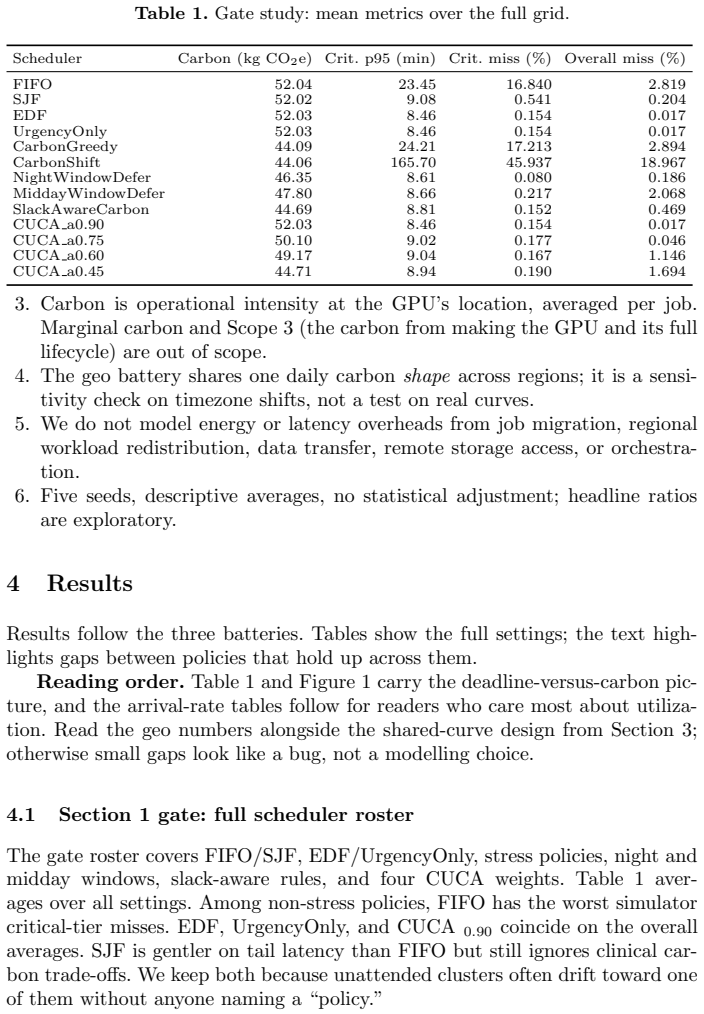
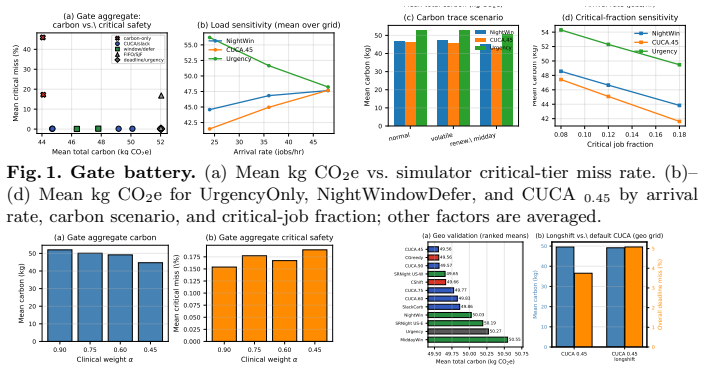
On an eight-GPU baseline, the overnight rule closes about 78% of the carbon gap between urgency-only and CUCA0.45 while missing fewer urgent deadlines than either. At 48 jobs per hour the carbon footprints nearly tie, yet the overnight rule still misses fewer urgent deadlines. CarbonShift lets about 46% of the most urgent jobs miss their deadline. A geography test where regions share one daily carbon shape with only timezone shifts trims under one percentage point of average carbon. A twelve-hour routine window saves a little carbon for CUCA0.45 but raises overall missed deadlines.
What carries the argument
Night-window batching, the rule that defers non-urgent jobs to overnight periods of lower grid carbon intensity and compares its performance to CUCA0.45 and urgency-only policies.
If this is right
- Carbon-only rules such as CarbonShift cause about 46% of the most urgent jobs to miss deadlines.
- At 48 jobs per hour the carbon footprints of the overnight rule and CUCA0.45 nearly tie while the overnight rule misses fewer urgent deadlines.
- A geography test with shared daily carbon shapes but timezone shifts changes average carbon by under one percentage point.
- A twelve-hour routine window improves carbon for CUCA0.45 but increases overall missed deadlines.
Where Pith is reading between the lines
- Hospitals could achieve most modeled carbon reductions with a fixed overnight window without needing real-time carbon data feeds.
- The same fixed-window approach may apply to other 24/7 computing environments where loads can shift to low-emission periods.
- The wide run-to-run spread in the simulator suggests that real job-arrival variance could require adjustable window thresholds.
Load-bearing premise
The synthetic patient-style jobs, urgency tiers, time-of-day carbon traces, and mixed GPU hardware in the simulator accurately represent real clinical AI GPU workloads and their scheduling constraints.
What would settle it
Running the overnight batching rule, urgency-only policy, and CUCA0.45 side-by-side on actual hospital GPU job logs paired with real-time grid carbon intensity data would show whether the 78% gap closure and deadline improvements hold.
Figures
read the original abstract
Hospitals run more machine learning on GPUs while the carbon footprint of grid electricity rises and falls through the day. Using a computer simulation, we compare $13$ scheduling rules on mixed GPU hardware, with synthetic patient-style jobs, urgency tiers, and time-of-day carbon traces. We do not study patient outcomes; every percentage we report is a simulator queue number, not a clinical finding. We ask whether running non-urgent jobs overnight is almost as good as a richer rule that mixes urgency and carbon (CUCA at weight 0.45, written CUCA$_{0.45}$). The comparison keeps carbon reduction secondary to clinical priority and deadline compliance, so each policy is judged on both average kg CO$_2$e and missed-deadline behavior. CarbonGreedy and CarbonShift are carbon-first stress tests that demonstrate how poorly wrong vendor presets can disrupt clinical priorities, and are not meant for production. Numbers are averages over many test settings, with wide run-to-run spread and no statistical adjustment, so headline ratios are exploratory. On an eight-GPU baseline, the overnight rule closes about $78\%$ of the carbon gap between urgency-only and CUCA$_{0.45}$ while missing fewer urgent deadlines than either. CarbonShift lets about $46\%$ of the most urgent jobs miss their deadline; this is simulated queueing, not bedside harm. At $48$ jobs per hour, the carbon footprints almost tie, yet the overnight rule still misses fewer urgent deadlines. A geography test, where regions share one daily carbon shape with only timezone shifts, trims under one percentage point of average carbon; a twelve-hour routine window saves a little carbon for CUCA$_{0.45}$ but raises overall missed deadlines. Overnight batching stays competitive on average modelled carbon; carbon-only rules belong only in stress tests.
Editorial analysis
A structured set of objections, weighed in public.
Referee Report
Summary. The paper uses discrete-event simulation to compare 13 scheduling policies (including urgency-only, CUCA0.45, overnight batching, and carbon-first stress tests) for synthetic clinical AI GPU jobs on mixed hardware with time-of-day carbon traces. It reports that, on an 8-GPU baseline at 48 jobs/h, overnight batching closes ~78% of the carbon gap between urgency-only and CUCA0.45 while missing fewer urgent deadlines than either; results are framed as exploratory simulator queue statistics with wide run-to-run variance and no statistical adjustment.
Significance. If the synthetic workload assumptions hold, the comparison demonstrates that a simple overnight window can capture most modeled carbon savings of a richer urgency-carbon policy while preserving better deadline compliance for urgent jobs; the explicit stress tests for carbon-first rules and the geography/routine-window variants add useful boundary cases. The work's direct policy comparison and acknowledgment that all percentages are simulator outputs (not clinical findings) are strengths.
major comments (2)
- [Results] Results section (headline 78% gap-closure claim): the quantitative ranking of overnight batching versus CUCA0.45 is produced entirely inside the simulator; the synthetic patient-style job generator, urgency tiers, deadline model, carbon-intensity traces, and mixed-GPU hardware are not calibrated against hospital logs or subjected to sensitivity sweeps on job-size or arrival distributions, which is load-bearing for the central comparative claim.
- [Methods] Simulation setup (Methods): the abstract notes wide run-to-run spread and absence of statistical adjustment, yet the headline ratios are still presented as the primary finding; without confidence intervals or robustness checks on the free parameters (CUCA weight 0.45, 48 jobs/h arrival rate), the reported 78% figure and deadline-miss ordering remain sensitive to untested modeling choices.
minor comments (1)
- [Abstract] Abstract: the notation CUCA$_{0.45}$ is introduced without an earlier inline definition of the weighting scheme, which could be clarified on first use.
Simulated Author's Rebuttal
We thank the referee for the detailed review. We agree the work is exploratory simulation under synthetic assumptions and will revise to further emphasize limitations, add sensitivity analysis where feasible, and clarify that headline figures are not robust statistical claims.
read point-by-point responses
-
Referee: [Results] Results section (headline 78% gap-closure claim): the quantitative ranking of overnight batching versus CUCA0.45 is produced entirely inside the simulator; the synthetic patient-style job generator, urgency tiers, deadline model, carbon-intensity traces, and mixed-GPU hardware are not calibrated against hospital logs or subjected to sensitivity sweeps on job-size or arrival distributions, which is load-bearing for the central comparative claim.
Authors: We concur that the 78% figure and policy ranking rest entirely on uncalibrated synthetic parameters and are not validated against hospital logs. The manuscript already states that all reported percentages are simulator queue statistics, not clinical findings, and frames the study as exploratory. We will add an expanded limitations subsection explicitly noting the absence of real-data calibration and the load-bearing role of the synthetic generator. We will also run and report additional sensitivity sweeps on arrival rate and job-size distributions in the revision. revision: partial
-
Referee: [Methods] Simulation setup (Methods): the abstract notes wide run-to-run spread and absence of statistical adjustment, yet the headline ratios are still presented as the primary finding; without confidence intervals or robustness checks on the free parameters (CUCA weight 0.45, 48 jobs/h arrival rate), the reported 78% figure and deadline-miss ordering remain sensitive to untested modeling choices.
Authors: The abstract and main text already flag the wide run-to-run variance and lack of statistical adjustment, describing the ratios as exploratory. We will revise the results and methods sections to include explicit discussion of sensitivity to the listed free parameters (CUCA weight and arrival rate) and report ranges across additional runs. Full confidence intervals or formal robustness testing would require extending the simulation framework beyond the current scope; we can partially address this by documenting parameter sensitivity in the revision. revision: partial
Circularity Check
No significant circularity: direct simulation comparison with no fitted predictions or self-referential derivations
full rationale
The paper performs a simulation study comparing 13 scheduling rules on synthetic workloads. All reported metrics (carbon footprints, missed deadlines, gap closures) are direct outputs from the simulator runs, with no mathematical derivations, parameter fitting, or predictions that reduce to inputs by construction. No self-citations, uniqueness theorems, or ansatzes are invoked as load-bearing steps. The work explicitly labels results as exploratory simulator queue numbers rather than derived claims. This matches the default case of a self-contained empirical comparison without circular reduction.
Axiom & Free-Parameter Ledger
free parameters (2)
- CUCA weight 0.45
- job arrival rate (48 per hour)
axioms (1)
- domain assumption Synthetic jobs and time-of-day carbon traces sufficiently represent real hospital GPU workloads
Reference graph
Works this paper leans on
-
[1]
Future Healthcare Journal , volume=
The Potential for Artificial Intelligence in Healthcare , author=. Future Healthcare Journal , volume=. 2019 , publisher=
2019
-
[2]
A Governance Model for the Application of
Reddy, Sandeep and Allan, Sonia and Coghlan, Simon and Cooper, Paul , journal=. A Governance Model for the Application of. 2020 , publisher=
2020
-
[3]
Proceedings of the 57th Annual Meeting of the Association for Computational Linguistics , pages=
Energy and Policy Considerations for Deep Learning in NLP , author=. Proceedings of the 57th Annual Meeting of the Association for Computational Linguistics , pages=
-
[4]
Communications of the ACM , volume=
Green AI , author=. Communications of the ACM , volume=. 2020 , publisher=
2020
-
[5]
Carbon Emissions and Large Neural Network Training
Carbon Emissions and Large Neural Network Training , author=. arXiv preprint arXiv:2104.10350 , year=
work page internal anchor Pith review Pith/arXiv arXiv
-
[6]
Proceedings of the 2022 ACM Conference on Fairness, Accountability, and Transparency , pages=
Measuring the Carbon Intensity of AI in Cloud Instances , author=. Proceedings of the 2022 ACM Conference on Fairness, Accountability, and Transparency , pages=. 2022 , publisher=
2022
-
[7]
Journal of the ACM , volume=
Scheduling Algorithms for Multiprogramming in a Hard-Real-Time Environment , author=. Journal of the ACM , volume=. 1973 , publisher=
1973
-
[8]
2011 , publisher=
Hard Real-Time Computing Systems: Predictable Scheduling Algorithms and Applications , author=. 2011 , publisher=
2011
-
[9]
Communications of the ACM , volume=
The Tail at Scale , author=. Communications of the ACM , volume=. 2013 , publisher=
2013
-
[10]
JAMA , volume=
Development and Validation of a Deep Learning Algorithm for Detection of Diabetic Retinopathy in Retinal Fundus Photographs , author=. JAMA , volume=
-
[11]
2020 7th International Conference on Signal Processing and Integrated Networks (SPIN) , pages=
Diabetic Retinopathy Classification Using Downscaling Algorithms and Deep Learning , author=. 2020 7th International Conference on Signal Processing and Integrated Networks (SPIN) , pages=. 2020 , address=
2020
-
[12]
CheXNet: Radiologist-Level Pneumonia Detection on Chest X-Rays with Deep Learning
CheXNet: Radiologist-Level Pneumonia Detection on Chest X-Rays with Deep Learning , author=. arXiv preprint arXiv:1711.05225 , year=
work page internal anchor Pith review Pith/arXiv arXiv
-
[13]
Proceedings of the 22nd International Middleware Conference , pages=
Let's Wait Awhile: How Temporal Workload Shifting Can Reduce Carbon Emissions in the Cloud , author=. Proceedings of the 22nd International Middleware Conference , pages=. 2021 , publisher=
2021
-
[14]
Proceedings of the 1st Workshop on Sustainable Computer Systems Design and Implementation (HotCarbon) , year=
Treehouse: A Case For Carbon-Aware Datacenter Software , author=. Proceedings of the 1st Workshop on Sustainable Computer Systems Design and Implementation (HotCarbon) , year=
-
[15]
Proceedings of the 28th ACM International Conference on Architectural Support for Programming Languages and Operating Systems (ASPLOS) , year=
Carbon Explorer: A Holistic Framework for Designing Carbon Aware Datacenters , author=. Proceedings of the 28th ACM International Conference on Architectural Support for Programming Languages and Operating Systems (ASPLOS) , year=
-
[16]
Proceedings of the 28th ACM International Conference on Architectural Support for Programming Languages and Operating Systems (ASPLOS) , year=
Ecovisor: A Virtual Energy System for Carbon-Efficient Applications , author=. Proceedings of the 28th ACM International Conference on Architectural Support for Programming Languages and Operating Systems (ASPLOS) , year=
-
[17]
Computer , volume=
The Carbon Footprint of Machine Learning Training Will Plateau, Then Shrink , author=. Computer , volume=. 2022 , publisher=
2022
-
[18]
Proceedings of the 2024 ACM Conference on Fairness, Accountability, and Transparency (FAccT) , pages=
Power Hungry Processing: Watts Driving the Cost of AI Deployment? , author=. Proceedings of the 2024 ACM Conference on Fairness, Accountability, and Transparency (FAccT) , pages=
2024
-
[19]
Computer , volume=
Implications of Classical Scheduling Results for Real-Time Systems , author=. Computer , volume=. 1995 , publisher=
1995
-
[20]
Health Care System and Effects on Public Health , author=
Environmental Impacts of the U.S. Health Care System and Effects on Public Health , author=. PLOS ONE , volume=
-
[21]
The Lancet Planetary Health , volume=
The Environmental Footprint of Health Care: A Global Assessment , author=. The Lancet Planetary Health , volume=
-
[22]
and Smith, Andrew Z
Tennison, Imogen and Roschnik, Sonia and Ashby, Ben and Boyd, Robin and Hamilton, Ian and Oreszczyn, Tadj and Owen, Anne and Romanello, Marina and Ruyssevelt, Paul and Sherman, Jodi D. and Smith, Andrew Z. P. and Steele, Kristian and Watts, Nick and Eckelman, Matthew J. , journal=. Health Care's Response to Climate Change: A Carbon Footprint Assessment of the
-
[23]
2022 , howpublished=
Delivering a Net Zero National Health Service , author=. 2022 , howpublished=
2022
-
[24]
Nature Medicine , volume=
High-Performance Medical Intelligence: Deep Learning Applications in Medicine , author=. Nature Medicine , volume=
-
[25]
Nature Machine Intelligence , volume=
Secure, Privacy-Preserving and Federated Machine Learning in Medical Imaging , author=. Nature Machine Intelligence , volume=
discussion (0)
Sign in with ORCID, Apple, or X to comment. Anyone can read and Pith papers without signing in.